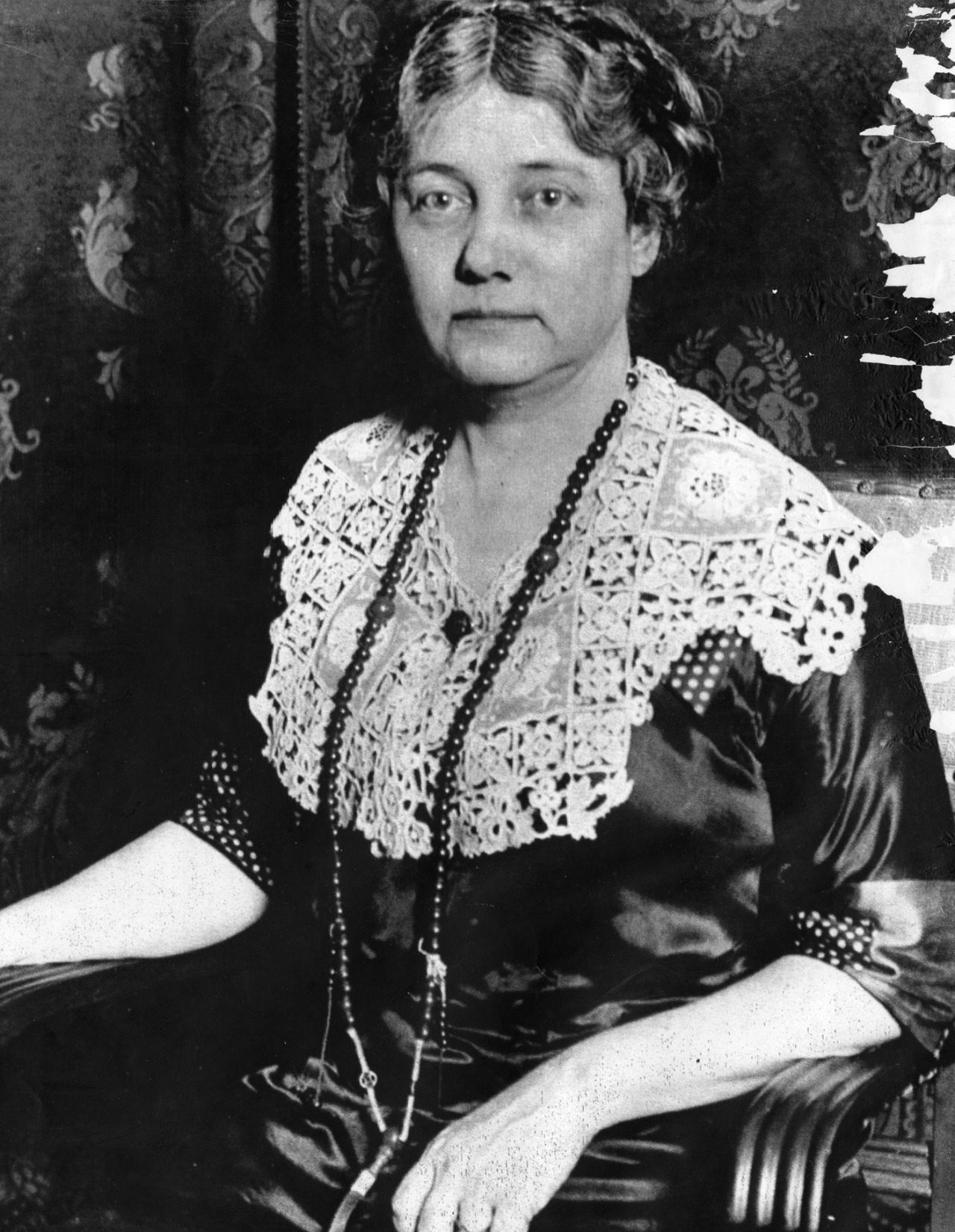
January 25, 1890: Nellie Bly makes an honest man out of Jules Verne, and beats Phileas Fogg.
She was born Elizabeth Ann Cochran outside Pittsburgh in 1864. In 1885, she saw an article in the Pittsburgh Dispatch titled "What Girls Are Good For." The male author limited the subject to 2 things: Having babies and keeping house. Elizabeth wrote a letter of objection, and the paper's editor was so impressed by it, he hired her. To protect her identity, he gave her the nom de plume "Nellie Bly," after a Stephen Foster song. (The editor slightly goofed: The song was "Nelly Bly.")
She went to Mexico, to report on what life was like there. It was miserable, largely thanks to dictator Porfirio Díaz. She wrote so, and had to flee the country. But her writing got the attention of Joseph Pulitzer, and in 1887, he hired her for his newspaper, The New York World. She wrote Ten Days in a Mad-House, about how she feigned insanity to get into the Women's Lunatic Asylum on Blackwell's Island. (It was renamed Welfare Island in 1921, and Roosevelt Island for FDR in 1973.)
She became the first of the "stunt girls," women who would use sensational acts to get sensational news stories, and, in her case, not only made her famous -- but, with the inability of newspapers to really reproduce photographs, allowed her to go mostly unrecognized wherever she went -- but made the World the biggest-selling newspaper in the Western Hemisphere, at least until William Randolph Hearst bought the New York Journal, and started challenging Pulitzer, wild story for wild story.
In 1873, French author Jules Verne, already known for his tales of fantasy and science fiction, published the novel Around the World in Eighty Days. In it, he suggested that the recent building of new railroads across the United States and India, and of the Suez Canal connecting the Mediterranean Sea with the Red Sea, made it possible for a man to leave wherever he was in the world, go all the way around it, and return to his point of origin -- in the novel's case, a "gentlemen's club" in London -- in 80 days.
(In Victorian England, a gentlemen's club was a private social club for rich men, exclusive enough that you had to get recommended by a member to become a member. In 21st Century America, strip joints have taken to calling themselves "gentlemen's clubs." Who is kidding who?)
Going all the way around the world had first been proposed by Ferdinand Magellan, who was killed in mid-voyage, but his men completed the journey in 1522, in just under 3 years. In 1865, James Iredell Waddell did it in 13 months, or 394 days. But that was before the completion of the railroads and the canal in question.
The inspiration for the book came from an American railroad and shipping magnate, aptly named George Francis Train. In 1871, he decided to travel around the world. His actual travel time turned out to be 80 days, but was interrupted when he was arrested in Paris, for supporting the Paris Commune.
In the book, Phileas Fogg, an inventor, bets the other members of his club that he can do it. The amount: £20,000, which he estimates to be about half his fortune. It's about £2.52 million in 2022, or $3.4 million. Spoiler Alert for a story a century and a half old: He wins the bet.
In real life, by 1889, no one was known to have attempted it. So Nellie talked Pulitzer into letting her attempt it. Word got out, and Cosmopolitan magazine sent a rival reporter, Elizabeth Bisland, to beat Nellie. But while Nellie was going to go eastward, as Fogg did, Bisland headed west.
Both left on the same day: November 14, 1889. At 9:40 AM, Nellie boarded a ferry at Hoboken Terminal in New Jersey, crossing the Hudson River to Manhattan, where she boarded the German cruise liner SS Augusta Victoria. It docked in England's main westward port, Southampton. It left for France, where she boarded a train to Amiens, and met Jules Verne.
She crossed France and Italy by rail, reaching the Italian port of Brindisi. From there, she boarded a steamer that went through the Suez Canal. She boarded ships that took her to Colombo, in the British colony of Ceylon (now the independent nation of Sri Lanka), Penang (in what's now Malaysia), Singapore (where she bought a monkey), and Hong Kong.
The World organized a "Nellie Bly Guessing Match" in which readers were asked to estimate her arrival time, to the second, with the Grand Prize consisting of a trip to Europe, and spending money for the trip. There was even a "Round the World with Nellie Bly" board game.
It wasn't under December 24, Christmas Eve, when she was in Hong Kong, that Nellie found out about Bisland. "I would not race," Nellie said. "If someone else wants to do the trip in less time, that is their concern."
Nellie got to Japan, and on January 7, 1890, she boarded the British ship RMS Oceanic in Yokohama. But the Pacific weather was rough, and it took her until January 21 to get to San Francisco. Fortunately, word received Pulitzer in New York by telegram, and he chartered a private train to pick her up in Oakland once she crossed San Francisco Bay by ferry.
The Miss Nellie Bly Special roared across the continent, stopping in Chicago, and arriving back at Hoboken Terminal on January 25, 1890, at 3:51 PM. A big crowd cheered as she disembarked. It was the biggest thing that had ever happened in Hoboken. (The alleged first baseball game played there in 1846 had hardly any spectators.)
She had done it: Nellie Bly went around the world in 72 days, 6 hours and 6 minutes. Bisland missed a connection, had to take a slower ship, and was still on the Atlantic Ocean when Nellie completed her journey. She reached New York on January 30, after 77 days. She beat Phileas Fogg, but she didn't beat Nellie Bly.
Nellie was now the 2nd-most famous woman in the world, behind Britain's Queen Victoria. Her record didn't last long: George Francis Train was inspired to try again, and, before the year was out, had gone around the world in 67 days. In 1892, he cut the record to 60 days.
In 1931, Wiley Post became the 1st person to try it in an airplane, and he lowered the record to 8 days and 16 hours. In 1933, he tried again, and cut it to 7 days and 20 hours. In 1938, Howard Hughes tried it, taking 3 days and 19 hours. The current record is 31 hours, 27 minutes and 49 seconds, by Michael Dupont and Claude Hetru, flying an Air France Concorde with 98 passengers on August 15 and 16, 1995. That's 2 hours faster than it took Charles Lindbergh just to fly from New York to Paris in 1927.
Nellie Bly was 25 years old at the time of her achievement. The rest of her life couldn't help but be an anticlimax, but it was hardly wasted. She kept reporting for the World, and wrote novels. In 1895, she married for the 1st and only time, to a millionaire named Robert Seaman. She was 31, he was 73. Neither of them ever had children, together or with anyone else.
His health was already failing, and she took over his business, the Iron Clad Manufacturing Company, which made steel containers, such as milk cans and boilers. He died in 1904. Shortly thereafter, the company began making the model for the 55-gallon oil drum still in use in America today. Although the U.S. Patent Office registered Henry Wehrhahn as the inventor, it may have been Nellie herself. She did receive patents for inventing a new version of the milk can and a stacking garbage can. She was perhaps the most successful female industrialist in America.
Until she wasn't. Her husband's illness had left the company's financial affairs in disarray, and, even with her inventions, she was unable to fix it. The company went bankrupt, and she went back to reporting -- not for the New York World, whose owner Pulitzer had died in 1911, but for its rival, Hearst's New York Journal.
In 1913, she covered the Woman Suffrage Procession, titling her article "Suffragists Are Men's Superiors." She predicted that women would get the right to vote in America in 1920. She did not specify a date, but she got the year right. She also reported from the front lines in World War I.
Elizabeth Cochrane Seaman, a.k.a. Nellie Bly, died on January 27, 1922, of pneumonia in New York. She was 57 years old. Her tombstone in Woodlawn Cemetery in The Bronx bears both names, and the legend "In Honor of a Famous News Reporter."
She has been played by Anne Helm in a 1960 episode of the NBC Western Tales of Wells Fargo, Linda Purl in the 1981 NBC movie The Adventures of Nellie Bly, and Caroline Barry in the 2015 film 10 Days in a Madhouse.
She was also played by Julia Duffy on a 1983 episode of the NBC time-travel series Voyagers! The lead character, Phineas Bogg (played by Jon-Erik Hexum), was obviously named after Phileas Fogg, and he and his young companion, Jeffrey Jones (Meeno Peluce), arrive in 1889 London, and find Nellie early in her trip, wearing a deerstalker hat, which we now associate with Sherlock Holmes. They also meet Holmes' creator, Dr. Arthur Conan Doyle, who's got writer's block.
Not buying Bogg's name, thinking it too close to Fogg's, she decides that Bogg is Jack the Ripper. And Jeffrey convinces Conan Doyle to use Holmes' methods to prove otherwise. They don't actually catch the Ripper, but they do catch a renegade time traveler who had attacked Nellie to mess with history. (The idea of a renegade time traveler pretending to be the Ripper would later be used in the short-lived TV version of Timecop. And, of course, the film Time After Time had already done it the other way: The Ripper is never caught because he becomes a renegade time traveler.)
*
January 25, 1890 was a Saturday. Baseball and football were out of season. Hockey was still all-amateur. And basketball wouldn't be invented for nearly another 2 years. So there were no scores on this historic day.