
The USS Maine, before
February 15, 1898: The battleship USS Maine sinks in Havana Harbor, Cuba, killing 261 sailors.
The Maine, launched on November 18, 1889, was there to protect U.S. interests in Cuba, then controlled by Spain. In the 1890s, the people of Cuba rebelled against their colonial overlords. Many Americans wanted to go to war to free Cuba. Most of those, however, were business lords who wanted to exploit Cuba's natural resources, without Spain keeping them out. They had tried to make deals with Spain, and failed. So they needed to get Spain out of Cuba. All they needed was an excuse.
On February 15, 1898, they got their excuse. An official U.S. Navy investigation ruled that an external mine caused the explosion. Witnesses among the American survivors denied this, and a much more likely cause for the explosion was a coal fire in the boiler.
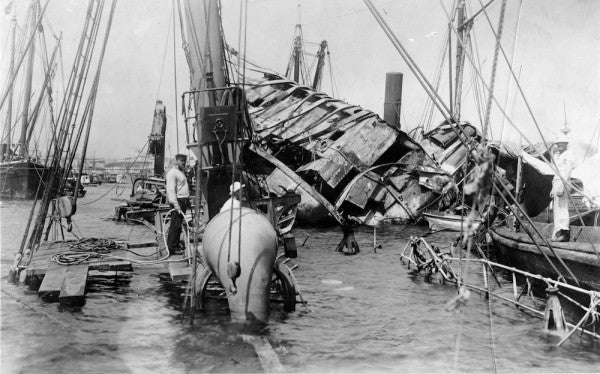
The USS Maine, after
Amidst cries of "Remember the Maine!" American newspapers did whatever they could to outdo each other for headlines. Joseph Pulitzer of The New York World had practically invented what became known as "yellow journalism." But he found he could not top the rich kid from San Francisco, William Randolph Hearst. ("Kid"? Hearst was 34 years old. Pulitzer was 50.)
Hearst had sent artist Frederic Remington to Cuba to draw pictures of Spanish atrocities that Hearst could use for his national chain of papers, starting with the San Francisco Examiner and now including the New York Journal. Remington sent a telegram to New York, saying there was nothing he could find that would lead to war. Hearst wired back, "Please remain. You furnish the pictures and I'll furnish the war."
And he did: On April 25, the U.S. Congress declared war on Spain. President William McKinley had wanted to avoid it, but he no longer could.
This was America's 1st war with a European power since facing Britain in the War of 1812, which ended in 1815, 83 years earlier. And it was a mismatch: Spain was a nation of a crumbling bureaucracy, and the war only lasted until August 13, 1898. There were 2 signature battles, 1 naval, 1 land. The naval battle was in Manila Bay, helping America to take the Philippines on May 1, led by Commodore George Dewey. The other was San Juan Hill, on July 1, led by Colonel Theodore Roosevelt.
"The Splendid Little War" -- in which 385 Americans died of combat wounds, and another 2,061 died from disease -- ended when Spain surrendered on August 13, 6 months after the sinking of the Maine. America took Cuba, Puerto Rico and the Philippines. Each of these would cause problems in the years to come.
The last surviving veteran of the Spanish-American War was Jones Morgan, a man of color, who lived until August 29, 1993, at the age of 110.
A new battleship USS Maine was launched on July 27, 1901, and was part of the U.S. fleet during World War I. But it didn't last much longer than its predecessor did: It was decommissioned on May 15, 1920, and scrapped 2 years later.
*
February 15, 1898 was a Tuesday. It was the off-season for baseball, there was no pro hockey, pro football was in its infancy, and basketball had barely been invented. So there were no scores on that historic day.


No comments:
Post a Comment