Showing posts with label david niven. Show all posts

Sunday, December 18, 2022

December 18, 1963: “The Pink Panther” Premieres

December 18, 1963: The film The Pink Panther premieres, directed by Blake Edwards. The cartoon character of the same name debuted in the film's opening sequence, with the classic theme song composed and conducted by Henry Mancini. You know the joke: What did the Pink Panther say when he stepped on an ant? "Dead ant, dead ant... "

But, within the film, the Pink Panther is not a character. Rather, it is the thing everyone is chasing, what film director Alfred Hitchcock called a "MacGuffin": A large pink diamond with a "flaw" in the shape of a leaping panther. It is owned by Princess Dala (played by the Tunisian-born Italian actress Claudia Cardinale, with her voice dubbed by Canadian singer Gale Garnett), an exiled royal whose country's new dictatorship wants it back, and the United Nations' World Court has sided with them, and they've offered a big reward for it.

And Inspector Jacques Clouseau (played by Peter Sellers), the incompetent, clumsy, accident-prone Paris police official who was, clearly, named for oceanographer Jacques Cousteau, isn't the hero of the movie. The hero is actually a criminal, a "gentleman thief" named Sir Charles Lytton, a.k.a. The Phantom (David Niven).
Cardinale, Niven and the Panther

To make matters worse, Clouseau's wife, Simone (the French actress Germaine Hélène Irène Lefebvre, a.k.a. Capucine) is having an affair with The Phantom. He shouldn't be the hero, but he has been treated as such, because, while he often played less-than-moral characters, the handsome, incredibly charming Niven was beloved, as if he were an earlier, English version of Paul Newman. Even my mother, a senior in high school when the film came out, adored Niven. She also liked Robert Wagner, who played Lytton's American-based and even less-moral nephew, George.

The film was successful enough to lead to a series, with A Shot in the Dark premiering the following June, and Inspector Clouseau in 1968. The film also inspired the TV show Get Smart: NBC told the producers to combine Inspector Clouseau and James Bond, because they were the two biggest cultural phenomena in the world at the time. I guess they forgot about the Beatles.

The series resumed a few years later: The Return of the Pink Panther was released in 1975, The Pink Panther Strikes Again in 1976, and The Revenge of the Pink Panther in 1978. Sellers died in 1980. By that point, Niven was suffering from ALS, known in America as Lou Gehrig's disease. That didn't stop Blake Edwards: In 1982, he made The Trail of the Pink Panther, using a brief cameo from Niven and previously unused footage of Sellers, with Clouseau spending most of the film in a body-cast. And in 1983, all kinds of tricks, including the briefest of cameos from a dying Niven, were used for Curse of the Pink Panther.

In a way, in 1983, things came full circle: The cartoon Inspector Gadget premiered, with Don Adams, star of Get Smart, voicing the title role, a well-meaning but incompetent robot cop who dressed much like Inspector Clouseau, with a tan trenchcoat and a trilby hat, the kind also favored by another famous fictional cop, Telly Savalas on Kojak.

In 1993, Edwards tried again, with Son of the Pink Panther, with Italian actor Roberto Benigni as the title character, Gendarme Jacques Gambrelli. As it turns out, he is half of the result of a one-night stand between Clouseau and a different character played by Cardinale, the other being his twin sister, Jacqueline Gambrelli (Nicoletta Braschi).

The one constant through all these films was Czech-British actor Herbert Lom as the original Clouseau's beleaguered boss, Chief Inspector Charles Dreyfus.

Capucine died in 1990, Edwards in 2010, Lom in 2012. As of December 18, 2022, Cardinale and Wagner are still alive. (UPDATE: Cardinale died in 2025.)

In 2006, Steve Martin starred in a reboot, with The Pink Panther 2 released in 2009.

*

December 18, 1963 was a Wednesday. Basketball star Charles Oakley and actor Brad Pitt were born.

Baseball was out of season. Football was in midweek. There were 4 games in the NBA:

* The New York Knicks lost to the Boston Celtics, 133-111 at the Boston Garden.

* The Baltimore Bullets beat the Detroit Pistons, 124-107 at Cobo Hall (now Huntington Place) in Detroit. For the Bullets, Gus Johnson scored 38 points, and Walt Bellamy scored 36. 

* The Los Angeles Lakers beat the Philadelphia 76ers, 116-96 at the Los Angeles Sports Arena. Jerry West scored 30 points and grabbed 14 rebounds.

* And the San Francisco Warriors beat the St. Louis Hawks, 104-96 at, sort of, a neutral site: The gymnasium at Sacramento High School, 88 miles northeast of downtown San Francisco. It was just another day at the office for Wilt Chamberlain: He scored 27 points, grabbed 27 rebounds, and had 11 assists. For the Hawks, Bob Pettit scored 29 points. Pettit was the NBA's all-time leading scorer.

And the NHL's entire "Original Six" were in action:

* The New York Rangers and the Detroit Red Wings played to a tie, 1-1 at the old Madison Square Garden.

* The Montreal Canadiens beat the Toronto Maple Leafs, 7-1 at the Montreal Forum.

* And the Boston Bruins beat the Chicago Black Hawks, 2-1 at the Chicago Stadium.

Wednesday, April 13, 2022

April 13, 1939: The Film "Wuthering Heights" Premieres

Laurence Olivier and Merle Oberon

April 13, 1939: A film version of Emily Bronte's novel Wuthering Heights premieres, directed by William Wyler.

Wuthering Heights was met with rather mixed reviews when it was first published in London on November 24, 1847, with the author's name given as "Ellis Bell." Some were scathing, horrified by its "brutal cruelty" and its portrayal of a "semi-savage love." Others acknowledged the book's "power and cleverness," its "delineation forcible and truthful." Many said it was simply "strange."

Despite the popularity of gothic fiction at the time, it is perhaps unsurprising that the book shocked readers in the 19th Century, a time of strict moral scrutiny. "People did not know what to do with this book, because it has no clear moral angle," said Clare O'Callaghan, senior professor of Victorian literature at Loughborough University in England, and the author of Emily Brontë Reappraised.

Thomas Newby was the book's publisher. On the same day, he also published Agnes Grey, by "Acton Bell." The previous month, on October 19, 1847, he published Jane Eyre, by "Currer Bell."

In 1850, Charlotte Brontë revealed that the Bell brothers were, in fact, sisters: She had written Jane Eyre, Anne Brontë had written Agnes Grey, and Emily Brontë had written Wuthering Heights. Charlotte argued that critics had failed to do Emily's work justice: "The immature but very real powers revealed in Wuthering Heights were scarcely recognised; its import and nature were misunderstood."

Charlotte was born on April 21, 1816; Emily on July 30, 1818; and Anne on January 17, 1820; all in Thornton, now a part of the city of Bradford, in Yorkshire, about 15 miles west of Leeds and 220 miles northwest of London.

Tuberculosis struck the family. Brother Branwell, whose career as a poet stalled due to his drinking, died on September 24, 1848, at the age of 31. Emily died on December 19, at 30. Anne died on May 28, 1849, at 29. Charlotte was the only one to marry, to the Rev. Arthur Bell Nicholls, and even she only made it to 38, dying along with her unborn child on March 31, 1855.

*

The 1939 film version is the best-known adaptation of Wuthering Heights. The titular estate is owned by Heathcliff, played by Laurence Olivier, considered the finest British stage actor of the 20th Century. As a boy in Liverpool, Heathcliff had been taken in by the Earnshaw family, whose daughter, Cathy, grows up to become his great love, played by Merle Oberon. Eventually, she rejects him, and marries another man, Edgar Linton, played by David Niven.

Heathcliff leaves, and returns years later a rich man. He buys Wuthering Heights, and takes his revenge on Cathy by dating and then marrying Edgar's sister, Isabella, played by Geraldine Fitzgerald. Shortly after the wedding, Cathy falls ill, and calls for Heathcliff. She tells him he's the only man she's ever truly loved. They forgive each other, and as she dies, she accepts his request to haunt him until he dies. One night, he hears her on the moors outside the estate, goes out into the snow to see her, and freezes to death.

Contrary to legend, Olivier, then married to actress Vivien Leigh, and Oberon, then married to film director Alexander Korda, did not have an affair. In fact, they didn't even get along. Oberon died in 1979, Wyler in 1981, Niven in 1983, Olivier in 1989, and Fitzgerald in 2005.

Robert Fuest's 1970 film version, starring Timothy Dalton and Anna Calder-Marshall, and Andrea Arnold's 2011 film, starring James Howson and Kaya Scodelario, both end with Cathy's death. But that only happens halfway through the novel, which contains about 18 more years' worth of story.

So those film versions overlook how dark the novel gets, as Heathcliff makes Isabella miserable. A 1967 miniseries version for the BBC starred Ian McShane and Angela Scoular, and inspired British singer Kate Bush to write "Wuthering Heights," her 1st hit song, in 1978. That same year, another BBC miniseries starred Ken Hutchinson and Kay Adshead, and is regarded as the version most faithful to the text.

A 1992 feature film starred Ralph Fiennes and Juliette Binoche, and notably included the story of the children that the main characters had (not with each other). The 2009 ITV version starred Tom Hardy and his girlfriend, now wife, Charlotte Riley. It, too, told the whole story.

*

April 13, 1939 was a Wednesday. Irish poet and academic Seamus Heaney was born.

Baseball season started 4 days later. Football was out of season. The NBA hadn't been founded yet. Game 4 of the Stanley Cup Finals was played at Maple Leaf Gardens in Toronto. The Boston Bruins beat the Toronto Maple Leafs, 2-0. The Bruins won the Cup in Game 5 on April 16.

Saturday, April 2, 2022

April 2, 1974: Streaking the Oscars

April 2, 1974: The fad of "streaking" -- taking off your clothes and running naked through a public place -- reaches its peak, at the Academy Awards.

By this point, the Awards, nicknamed the Oscars, were firmly established as the day the American film industry, inherently conservative in spite of the occasional innovation, celebrated itself. When things didn't go according to plan, the studio heads didn't like it.

It was bad enough in 1971, when George C. Scott declined his Best Actor award for playing the titular World War II U.S. Army General in Patton. It got worse in 1973, when Marlon Brando won Best Actor for playing organized crime boss Vito Corleone in The Godfather, and, to accept his award, sent Sacheen Littlefeather, a Native American activist, to plead her people's case, which Brando supported.

In June 1973, the press reported on a "streaking" trend at Michigan State University. The following December 1973, Time magazine called streaking "a growing Los Angeles-area fad" that was "catching on among college students and other groups."

In response to this Time article, a graduate of Carleton College in Northfield, Minnesota wrote to the magazine that the term "streaking" was coined because the nude students ran across the campus primarily during the Winter months of January and February, and "unless one appeared as a streak against the landscape, the Minnesota winter was triumphant and streaker became a statue." The school's newspaper, The Carletonian, used the term "streaking" as early as 1967, but initially in negative terms: "Examples of [Carleton's social problems] are the large number of departing female students, the rise of class spirit, low grades, streaking, destruction, drinking, and the popularity of rock dances."

By February 1974, it had become an epidemic. On NBC's The Tonight Show, Johnny Carson began making jokes about it in his monologue. On CBS' Match Game, the fad began appearing in questions. On March 23, a middle-aged man named John Taylor ran onto the field at a soccer game between Arsenal and Manchester City at the Arsenal Stadium, a.k.a. Highbury, in North London. He was caught, forced into a pair of pants, removed from the stadium, and fined £10. (About £120, or $150, in 2022 money. Arsenal won the game, 2-0.)

On April 2, the Oscars were held at the Dorothy Chandler Pavilion in Los Angeles. The hosting duties were divided by 4: Singer Diana Ross, director John Huston, and actors Burt Reynolds (to attract younger viewers, especially women) and David Niven (to attract older viewers, especially women).

There were several notable moments, above and beyond what the night would become most known for:

* Future Star Wars boss George Lucas was nominated for the 1st time, for Best Director for American Graffiti. Setting an apparent record for quickest attempt at nostalgia (1962 to 1973), it was also nominated for Best Picture.

* Tatum O'Neal won Best Supporting Actress for her role in Paper Moon. She was only 10 years old, and remains the youngest Oscar winner ever.
* John Houseman won Best Supporting Actor for his role in The Paper Chase. He was 71, and although he wasn't the oldest Oscar winner ever, the 61-year gap between winners Houseman and O'Neal remains the biggest at a single ceremony.

* The Exorcist became the 1st horror film nominated for Best Picture. It was nominated for 10 awards, but won only 2: Best Adapted Screenplay and Best Sound.

* The Sting, a story about con artists during the Great Depression, won Best Picture. Since that award goes to a film's producer(s), that made Julia Phillips the 1st female producer to win one. George Roy Hill directed it, and won Best Director. Robert Redford was nominated for Best Actor, but co-star Paul Newman was not.

* Groucho Marx was presented with an Honorary Academy Award for his contributions to film.

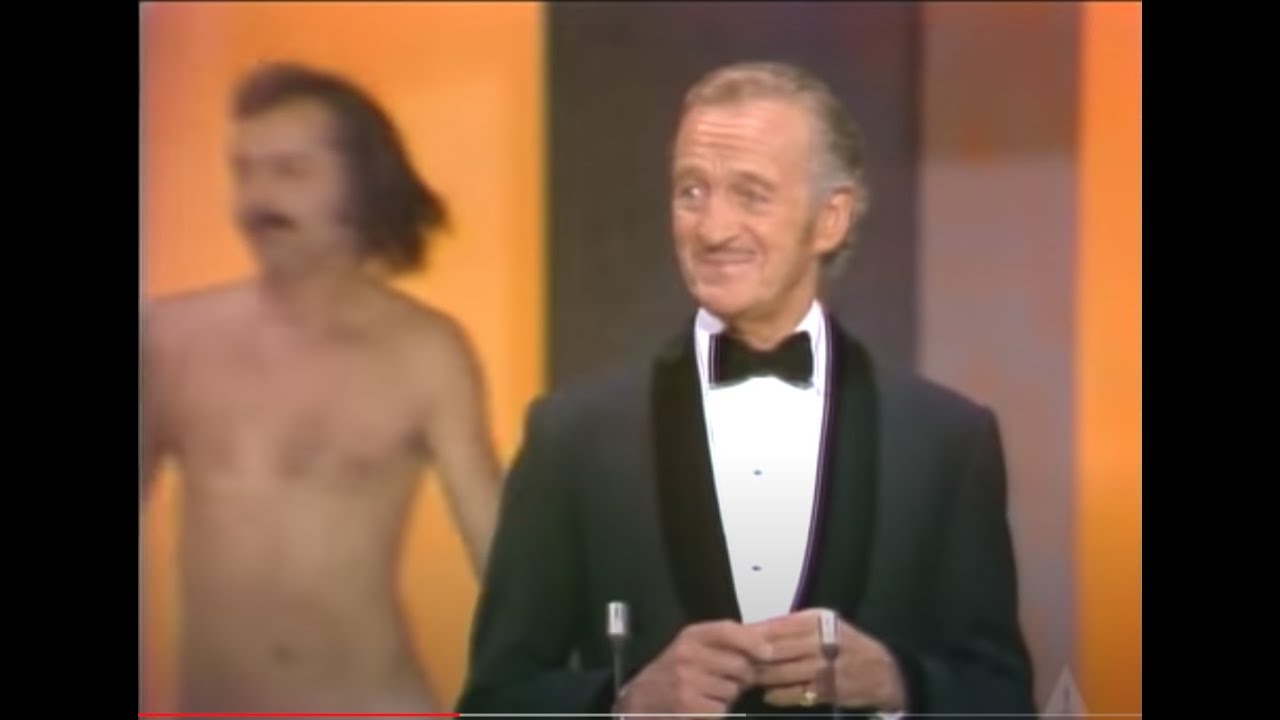
At the time, Robert Opel, a 34-year-old Pittsburgh native, was an English teacher in Los Angeles, who had once been a speechwriter for actor-turned-Governor Ronald Reagan of California. But on this night, he posed as a journalist to gain entry to the stage at the Pavilion. He waited for Niven to begin a speech introducing actress Elizabeth Taylor. Opel took his clothes off, and ran naked past Niven, flashing not just himself, but also a peace sign.

After breaking into laughter momentarily, Niven regained his composure, turned to the audience and quipped, "Well, ladies and gentlemen, that was almost bound to happen. But isn't it fascinating to think that probably the only laugh that man will ever get in his life is by stripping off and showing his shortcomings?"

On May 18, country singer Ray Stevens, known for his novelty songs, hit Number 1 with his single "The Streak." It held the top spot for 3 weeks. ("Don't look, Ethel!" But it was too late.) By the end of the year, the fad had run its course, or so to speak.

Opel lost his job over the incident, and became an artist, a photographer, and a gay rights activist. On July 7, 1979, he was murdered during a robbery attempt at his studio in San Francisco. He was 39. Both robbers were imprisoned.

*

April 2, 1974 was a Tuesday. The Major League Baseball season opened 2 days later. Football was out of season. The American Basketball Association scheduled no games for this date. The NBA scheduled 3:

* The New York Knicks lost to the Capital Bullets, 88-79 at Madison Square Garden. Known as the Baltimore Bullets from 1963 to 1973, this was the team's only season under the "Capital Bullets" name. For 1974-75, they became the Washington Bullets. For 1997-98, they became the Washington Wizards.

* The Buffalo Braves beat the Boston Celtics, 115-105 at the Buffalo Memorial Auditorium.

* And the Los Angeles Lakers beat the Milwaukee Bucks, 98-96 at The Forum outside Los Angeles in Inglewood, California.

There were 3 games scheduled in the NHL:

* The New York Islanders beat the Pittsburgh Penguins, 3-2 at the Nassau Coliseum.

* The Philadelphia Flyers beat the Minnesota North Stars, 6-3.

* And the St. Louis Blues beat the California Golden Seals, 5-3 at the St. Louis Arena.

And there were 2 games in the World Hockey Association. The Jersey Knights lost to the Chicago Cougars, 7-3 at the International Amphitheatre in Chicago. And the Toronto Toros beat the Edmonton Oilers, 3-2 at Maple Leaf Gardens in Toronto.

Saturday, January 29, 2022

January 30, 1873: Jules Verne Publishes "Around the World In Eighty Days"

January 30, 1873: Jules Verne publishes his novel Around the World In Eighty Days, one of the greatest adventure stories ever written.

Verne was born on February 8, 1828 in Nantes, France. At age 6, he was sent to a boarding school in that city. The teacher was the wife of a naval captain who had disappeared at sea about 30 years before. She told the students that he was not dead, but that he was a shipwrecked castaway, and, like Daniel Defoe's character Robinson Crusoe, would one day make it off his desert island and back to civilization. If he ever did, he never returned to her. But the idea of such adventure, and similar adventures, was put in young Jules' mind.

While attending law school in Paris, he met a woman who returned his affections, but her family didn't like him, and married her off to another man. This was to become another recurring theme in Verne's work: Women married against their will, including Aouda in Around the World In Eighty Days.

In 1849, he met Alexandre Dumas, already the author of The Count of Monte Cristo and The Three Musketeers, and became a close friend of his son, Alexandre Dumas fils, already the author of The Lady of the Camellias, which would be adapted into the opera La Traviata and the Greta Garbo film Camille. Verne helped Dumas fils write a play, The Broken Straws, which played to some success in 1850.

Verne abandoned his legal career for a literary one, spending the 1850s writing short stories and comic operas. In 1857, he married Honorine Morel, a widow with 2 small children. His only natural child, Michel Verne, was born in 1861.

The term "science fiction" was coined in 1926 by Hugo Gernsback. In the 1st issue of his magazine, Amazing Stories, he wrote, "By 'scientifiction' I mean the Jules Verne, H.G. Wells and Edgar Allan Poe type of story -- a charming romance intermingled with scientific fact and prophetic vision."

Verne himself used the terms "Roman de la Science" (novel of science) and "Voyages extraordinaires" (extraordinary voyages). These began with Five Weeks in a Balloon in 1863, and would also include Journey to the Center of the Earth in 1864, and From the Earth to the Moon in 1865.

Not only did From the Earth to the Moon inspire the 1st science fiction film, A Trip to the Moon in 1902, but it correctly predicted both that America would be the 1st nation to put people on the Moon, and it came very close to predicting the time the trip would take: He said 97 hours and 20 minutes, a little over 4 full days; from liftoff to Neil Armstrong's message of, "Houston, Tranquility Base here. The Eagle has landed," Apollo 11 took 102 hours and 45 minutes. Telling his tale 104 years before it could become reality, Verne under-estimated the time by only 5 hours and 25 minutes.

In 1870, Verne published Twenty Thousand Leagues Under the Sea, creating the character of Captain Nemo, and predicting the production of submarines. In 1871, he published A Floating City. And he was just getting warmed up.

In 1869, the Suez Canal was built across the Isthmus of Suez in Egypt, connecting the Mediterranean Sea with the Red Sea, and thus with the Indian Ocean. No longer would ships from Europe have to travel all the way around Africa to reach the Middle East, India, the Far East, and Australia. That same year, the transcontinental railroad opened in America. No longer would travelers have to board ships steaming all the way around South America to get from America's Atlantic Coast to its Pacific Coast. In 1870, a rail line connected the Indian cities of Bombay and Calcutta (now known as Mumbai and Kolkata, the names officially changed in 1995 and 2001, respectively).

A magazine article suggested that, with these 3 advances, it would now be possible to go around the world in 80 days -- less than 3 months, also less than 12 weeks. The existing record was much longer: 394 days, by James Iredell Waddell, from October 8, 1864 to November 6, 1865. It was the end of the Age of Exploration, and the beginning of an era when, given enough money and enough time, anyone could travel pretty much anywhere they wanted.

Verne imagined Phileas Fogg, a Londoner of some means (how he made his money is never told in the original novel), who mentions the 80-day possibility to his fellow members of the Reform Club. They bet him that he can't do it. The wager is £20,000 -- in today's money, about £2.5 million; or, with the current exchange rate, a little over $3 million.

Fogg was very well off, but £20,000 was half his fortune, and he withdrew the other half from the bank to cover his expenses: If he lost the wager, he would be "ruined." But, as a "gentleman," having been challenged by his fellow "gentlemen," if he refused the challenge, he would be considered a "coward." And worse than the ruin of his finances would be the ruin of his reputation: Were he to be bankrupt, his friends would still consider him a man of honor, and help him out. But he could not refuse, in spite of the many dangers abroad.

He leaves the Reform Club at 8:45 PM on October 2, 1872, with a deadline of the same time of night on December 21. He is accompanied by his French valet, Jean Passepartout, who, as originally written, is a virtual copy of Conseil, the Flemish (Belgian) servant of Professor Pierre Aronnax, the natural scientist who narrated Twenty Thousand Leagues Under the Sea.

Fogg's original itinerary:

* Days 1 to 7: London to Dover by rail; ferry across the English Channel to Calais, France; rail to Brindisi, Italy; steamer across the Mediterranean to Suez.

* Days 8 to 20: Steamer across the Red Sea and the Indian Ocean to Bombay.

* Days 21 to 23: Rail to Calcutta.

* Days 24 to 36: Steamer to Hong Kong.

* Days 37 to 42: Steamer to Yokohama, Japan. 

* Days 43 to 64: Steamer to San Francisco.

* Days 65 to 71: Rail to Jersey City, New Jersey, and ferry to New York.

* Days 72 to 80: Steamer to Liverpool, and then rail to London.

Spoiler alert for a novel almost a century and a half old, which has been adapted in movie form several times, most notably in a 1956 film, winning the Academy Award for Best Picture, starring David Niven as Fogg: There is another traveler, a London detective named Fix, who believes Fogg matches the physical description of an unidentified bank robber, and pursues him. He's got to get Fogg, either in Egypt, India or Hong Kong, each then under British rule. If he can't do that, then he's got to get on the same conveyances (ship to Yokohama, ship across the Pacific, train across America, ship across the Atlantic), before they are both, once again, on British soil in Liverpool.

Fix promises the captain of the Egypt-to-India steamer a reward if he can reach Bombay early. He does, by 2 days. But Fogg and Passepartout get away. Good for them. Bad for them is that there is still a part of the railway unfinished. They hire an elephant driver, and, along the way, save a widow named Aouda from the ritual suicide designed, against her will, from joining her husband. All the time they have gained has been lost, but Fogg doesn't care, as he and Aouda fall in love.

Fogg and Passepartout become separated in Hong Kong, and each (Fogg with Aouda) makes his separate way to Yokohama, where they meet up, and, as does Fix, get on the ship to San Francisco. The train ride across America is interrupted by a herd of bison crossing the tracks and a Native American attack.

Upon disembarking in Liverpool, on Day 80, Fix tells Fogg, "I arrest you in the Queen's name!" (Queen Victoria.) But when he telegraphs London to tell Scotland Yard, he receives a wire back, telling him the real robber had been arrested in Edinburgh 3 days earlier. Like Lieutenant Philip Gerard with Dr. Richard Kimble on the TV show The Fugitive, 95 years hence, he now knows that the man he has been long chasing is innocent. He has to let Fogg go. Fogg comes out of St. Pancras Station in London, and discovers it is 5 minutes past his deadline.

Fogg tells Aouda that he wants to marry her, but is willing to let her go if she doesn't want to live in poverty. She agrees to marry him anyway. He sends Passepartout to find a minister who will marry them tomorrow. He returns and says the minister can't marry them tomorrow, because tomorrow is Sunday. Fogg tells him that tomorrow is Monday. Passepartout explains that they had crossed the International Date Line on the Pacific Ocean, so they gained a day: To the members of the Reform Club, today is December 21, Day 80.

Fogg rushes to the Club, and, 5 seconds before 8:45 PM, he says, "Here I am, gentlemen." He collects his winnings, and splits them with Passepartout and Fix, who had helped him (for his own reason), and marries Aouda.

The novel was a smashing success. In 1889, American journalist Nellie Bly told her editor, Joseph Pulitzer of the New York World, that she could beat the fictional record. Pulitzer forwarded her the money necessary to try. In Amiens, France, she met Verne, who doubted she could do it, but wished her luck. She did it in 72 days and 6 hours, her launching point and destination being Hoboken Terminal in New Jersey.

Verne continued to write his scientific novels, including The Mysterious Island in 1875, The Green Ray (predicting lasers) in 1882, Robur the Conqueror (with his armed airship) in 1886, The Purchase of the North Pole in 1889 (20 years before Robert Peary claimed to be the 1st person to reach the real thing), An Antarctic Mystery in 1897 (14 years before Roald Amundsen became the 1st person to reach the South Pole), The Village in the Treetops in 1901, and the Robur sequel Master of the World in 1904.

He died in 1905, in Amiens, at age 77. His son Michel, also a writer, lived until 1925. At least one great-great-grandson of Jules Verne is believed to still be alive.

In 1928, Palle Huld, a 15-year-old boy scout from Denmark, sponsored by a Danish newspaper, tried to set a new around-the-world record in commemoration of the 100th Anniversary of Verne's birth. Instead of going by India, he crossed the Soviet Union on the Trans-Siberian Railway, which had been completed in 1904. It took him 44 days, and he published an account titled A Boy Scout Around the World. Once done, he made another trip, to Amiens, where he laid flowers at Verne's grave. Believed to be the inspiration for the character Tintin by Hergé (Georges Prosper Remi), he lived until 2010, age 98.

In 1988, attempting to follow Fogg's route and modes as closely as possible, including starting and ending at the real-life Reform Club in London, Michael Palin of the Monty Python comedy troupe did it in 79 days and 7 hours, recording his journey for the documentary Around the World in 80 Days with Michael Palin. The following year, another Python member, Eric Idle, played Passepartout to Pierce Brosnan's Fogg in a film version of the novel, airing on CBS. It ends with Fogg walking into the Club and nonchalantly saying, "Gentlemen, it is precisely nine o'clock. Anyone for a game of whist?" (An early form of the card game bridge.)

The current record, perhaps appropriately, is held by a pair of Frenchmen: Michel Dupont and Claude Hetru, who piloted an Air France Concorde on August 15 and 16, 1995, doing it in 31 hours, 27 minutes and 49 seconds. That's 2 hours faster than it took Charles Lindbergh to fly only across the Atlantic in 1927.

*

January 30, 1873 was a Thursday. Baseball was in the off-season. Basketball didn't yet exist. Nor did organized hockey, and American football was still basically soccer. Even England's FA Cup, in only its 2nd season, was between rounds. So there were no scores on this historic day.

However, on the date that Fogg fictionally completed his trip, December 21, 1872, there was an FA Cup match. Maidenhead F.C., of Berkshire, a team now named Maidenhead United, defeated nearby Windsor Home Park (now Windsor F.C.), 1-0 in Windsor.

Wednesday, January 5, 2022

January 5, 1905: "The Scarlet Pimpernel" Premieres

Baroness Orczy

January 5, 1905: The Scarlet Pimpernel premieres at the New Theatre in London's West End. Emma Magdalena Rozália Mária Jozefa Borbála Orczy de Orci, a 39-year-old Hungarian known as Baroness Orczy, had written it. Fred Terry stars in the title role.

She created the character of Sir Percy Blakeney, an English aristocrat living in Paris, seeing his friends being executed during the French Revolution's Reign of Terror in 1792. He leads a double life: Pretending to be a wealthy but mid-mannered fop, while courageously saving his friends' lives with expert swordsmanship. The name "Scarlet Pimpernel" comes from the red flower he draws on the messages he leaves, bragging of his exploits to his friends' would-be executioners.
He is assisted by a group of fellow gentlemen, and they are the only ones who know of his, as would be said later, secret identity, until his wife, the French actress Marguerite St. Just, finds out. She had left him after seeing the change in his attitude, while admiring the Pimpernel. Finding out that his change was a cover for his efforts, she returned to him.

British audiences loved the play, and the subsequent novel made the character and Baroness Orczy known throughout the world. Eventually, there would be 14 novels featuring Sir Percy, published between 1905 and 1940, plus 2 prequels featuring Blakeney ancestors, and one written in 1924, set in the present day, with a Blakeney descendant. Fred Terry lived until 1933, the Baroness until 1947.

There would be 3 silent films, starting in 1917, with Dustin Farnum in the role. The 1st sound version was in 1928, The Triumph of the Scarlet Pimpernel, starring Matheson Lang. The character would be played by Leslie Howard in 1934, Barry K. Barnes in 1937, and David Niven in 1950.
Merle Oberon as Marguerite, and Leslie Howard as Sir Percy

On TV, the BBC had productions starring James Carney in 1950 and 1951, and Tony Britton in 1955. ITV had a series based on the character in the 1955-56 season, starring Marius Goring. American TV debuted the Pimpernel in 1960, on CBS, with Michael Rennie. The BBC had a 1969 series with Anton Rodgers. CBS aired a TV-movie in 1982, with Anthony Andrews. BBC One aired a series in 1999 and 2000, with Richard E. Grant.

Someone once joked that the Scarlet Pimpernel had the lamest superhero name ever, despite having "Pimp" in it. But his mild-mannered civilian persona, combined with his courageous costumed heroism, made him an inspiration for such superheroes as Superman and Spider-Man; while his wealthy aristocrat secret identity as a cover for his heroism inspired Zorro, who, with his other attributes, inspired Batman, Green Arrow, Iron Man, and others.

*

January 5, 1905 was a Thursday. Baseball and football were out of season. Basketball and hockey were still mostly amateur. So there were no scores on this historic day.

December 31, 1999 & January 1, 2000: The Millennium

December 31, 1999:  The Millennium arrives. The people of planet Earth survived. At a terrible cost. But we hadn't destroyed ourselves. ...