August 27, 1964: The Democratic National Convention concludes at Convention Hall in Atlantic City, New Jersey. It is part of an extraordinary week at the Jersey Shore.
President John F. Kennedy was supposed to be nominated for a second term. Instead, a memorial film was shown on the last night. Then his brother, Robert F. Kennedy, no longer Attorney General but running for U.S. Senator from New York, was introduced. The delegates and spectators give him a standing ovation that lasted 22 minutes. I don't know if that's a record, but it's longer than any that Ronald Reagan ever got at a Republican Convention.
The emotional highlight came 3 nights earlier, when a film was shown, a tribute to the President they had originally hoped to renominate there, John F. Kennedy. His brother, Attorney General Robert F. Kennedy – who would resign that office the next week, to run for the U.S. Senate from New York – received a 22-minute standing ovation before allowing him to speak.
He tried to get them to sit down. Finally, they did.
Speaking about his brother's vision for the country, RFK quoted from William Shakespeare's play Romeo and Juliet: "When he shall die, take him and cut him out into the stars, and he shall make the face of heaven so fine that all the world will be in love with night and pay no worship to the garish sun."
The new President, Lyndon B. Johnson, who had first dismissed JFK and then come to admire him and fight for his legacy -- LBJ's slogan "LET US CONTINUE" was placed in a banner above the stage -- had feuded with RFK. Lyndon thought Bobby was a nasty little upstart who hadn't paid his dues. (JFK was 6-foot-1, RFK was 5 feet 9¾, and LBJ was 6 feet 3½.) Bobby thought Lyndon was a rural vulgarian. Both thought the other should never have been President. And at the 1960 Convention, Bobby tried to get Jack to retract his offer of the Vice Presidency to Lyndon, but Jack knew it was the right thing to do. Lyndon found out, and hated Bobby even more.
The stage, with photos of Franklin D. Roosevelt and Harry S Truman
flanking that of John F. Kennedy.
The photo of Johnson on the right was replaced
by one of Humphrey on the final night.
LBJ knew that he would have to not only battle the Republican nominee, who turned out to be Senator Barry Goldwater of Arizona, to be President in 1965, '66, '67 and '68; but also battle RFK to be seen as JFK's heir. One thing LBJ was absolutely determined to do was prevent any groundswell for RFK be named Vice President at the Convention. So he made a pre-emptive announcement that no member of the Cabinet would be considered for the office. Nobody in the White House press corps thought he was thinking of Secretary of State Dean Rusk, or Secretary of the Treasury C. Douglas Dillon, when he ruled out all Cabinet members.
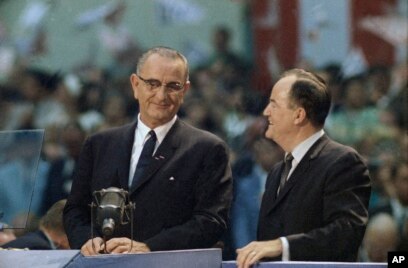
Johnson chose Senator Hubert H. Humphrey of Minnesota, the Senate Majority Whip, who had played a key role in getting the Civil Rights Act of 1964 through the Senate. He was considered the leader of the Senate's liberals, to the point where, in his satirical song "Love Me, I'm a Liberal," folksinger Phil Ochs sang, "Oh, I cheered when Humphrey was chosen, my faith in the system restored." That nomination was approved on the last night of the Convention, before RFK's speech, thus preventing any last chance he had at the nomination. It did not defuse the feud between him and LBJ, though.
Johnson (left) and Humphrey
The Convention was disrupted by the Mississippi Freedom Democrats demanding to be seated, led by Fannie Lou Hamer, who had organized the voter-registration campaign known as Mississippi Freedom Summer. A "compromise" was reached, in which two of the Freedom Democrats would be seated. They didn't like it, but they accepted it as better than nothing. The segregationists treated even this crumb as a personal insult, and walked out, and the Freedom Democrats were awarded their seats.
The final night of the Convention was Johnson's 56th birthday. In his acceptance speech, he paid tribute to JFK (but not RFK), Humphrey, and former President Harry S Truman. He cited the Democratic Party's record over the last 3½ years, and his plans for the next 4½:
We are in the midst of the largest and the longest period of peacetime prosperity in our history. And almost every American listening to us tonight has seen the results in his own life.
But prosperity for most has not brought prosperity to all. And those who have received the bounty of this land, who sit tonight secure in affluence and safe in power, must not now turn from the needs of their neighbors.
Our Party and our nation will continue to extend the hand of compassion and the hand of affection and love to the old and the sick and the hungry. For who among us dares to betray the command: "Thou shalt open thine hand, unto thy brother, to thy poor, and to thy needy, in thy land." (Deuteronomy 15:11)
The needs that we seek to fill, the hopes that we seek to realize, are not our needs, our hopes alone. They are the needs and hopes of most of the people.
Most Americans want medical care for older citizens. And so do I.
Most Americans want fair and stable prices and decent incomes for our farmers. And so do I.
Most Americans want a decent home in a decent neighborhood for all. And so do I.
Most Americans want an education for every child to the limit of his ability. And so do I.
Most Americans want a job for every man who wants to work. And so do I.
Most Americans want victory in our war against poverty. And so do I.
Most Americans want continually expanding and growing prosperity. And so do I.
He did not mention either the Republican Party or Senator Goldwater, not even once. But he did say something that seemed to contradict Goldwater's bellicose rhetoric:
There is no place in today's world for weakness. But there is also no place in today's world for recklessness. We cannot act rashly with the nuclear weapons that could destroy us all. The only course is to press with all our mind and all our will to make sure, doubly sure, that these weapons are never really used at all...
Let no one tell you that he can hold back progress and at the same time keep the peace. This is a false and empty promise. To stand in the way of orderly progress is to encourage violence.
And I say tonight to those who wish us well, and to those who wish us ill, the growing forces in this country are the forces of common human decency, and not the forces of bigotry and fear and smear.
Our problems are many and are great. But our opportunities are even greater...
The Founding Fathers dreamed America before it was. The pioneers dreamed of great cities on the wilderness that they crossed.
Our tomorrow is on its way. It can be a shape of darkness or it can be a thing of beauty. The choice is ours, it is yours, for it will be the dream that we dare to dream.
I know what kind of a dream Franklin Delano Roosevelt and Harry S. Truman and John F. Kennedy would dream if they were here tonight! And I think that I know what kind of a dream you want to dream.
Tonight we of the Democratic Party confidently go before the people offering answers, not retreat; offering unity, not division; offering hope, not fear or smear.
We do offer the people a choice, a choice of continuing on the courageous and the compassionate course that has made this Nation the strongest and the freest and the most prosperous and the most peaceful nation in the history of mankind.
To those who have sought to divide us, they have only helped to unite us. To those who would provoke us, we have turned the other cheek.
So as we conclude our labors, let us tomorrow turn to our new task. Let us be on our way!
Three days later, on Sunday, August 30, 1964, The Beatles played at Convention Hall. Needless to say, it attracted a very different crowd.
The Convention was held in Atlantic City as part of New Jersey's Trecentenary, as it became an English-speaking place in 1664. There are still a few 1664-1964 historical markers around the State.
The Convention was also intended to boost Atlantic City's image as a premier travel destination. Instead, the DNC and the Beatles concert exposed the decline of the city. It faced criticism for poor quality hotels, and the streets and buildings were revealed as dirty.
In addition to the reportedly rude service visitors faced from hospitality service workers, the city's hotel facilities were baring visible signs of age and upkeep that was reflective of the decline in tourism that the city was experiencing. This left visitors with a less than stellar impression of the city. With no contested ballot to preoccupy their coverage, members of the news media spent time expressing their grievances about what they considered to be poor hospitality in Atlantic City.
The decrepitude of Atlantic City was particularly present in comparison to San Francisco, which had hosted the Republican Convention the month before. New Jersey made moves to try to improve the city's image, and this culminated with the 1976 ballot initiative that legalized casino gambling there. On May 26, 1978, Resorts International opened as the 1st hotel in America, outside the State of Nevada, with a legal gambling casino.
Did it work? Well, yes, and no. Tourism in Atlantic City, and residually elsewhere on the Jersey Shore -- people staying in other Shore towns for a weekend, or for an entire Summer, would make day-trips to A.C. -- soared. But the city itself remains run-down, long after the Convention, the Beatles, and the casino legalization. As the comedian Alan King said, "They spent $9 million on the hotel, and 11 bucks on the city!"
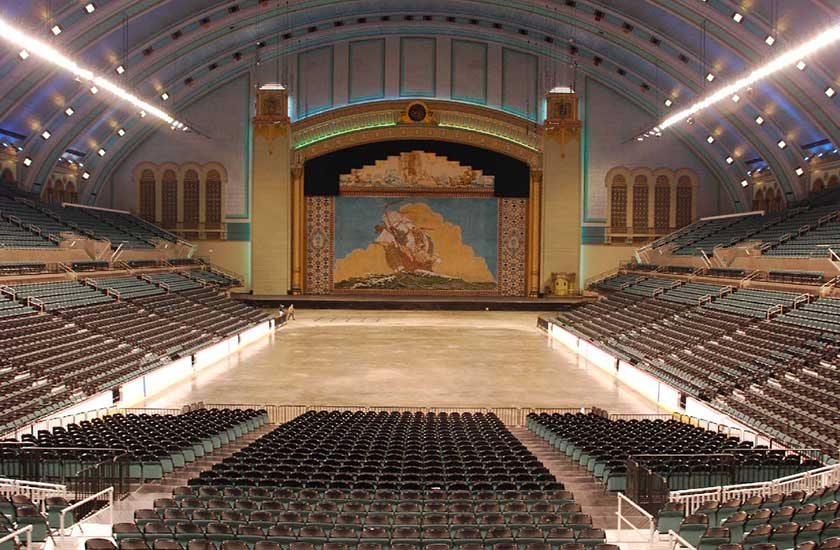
Built in 1929, Convention Hall was renamed Boardwalk Hall in 2001, following a renovation. It is next to Caesars Atlantic City at the intersection of Boardwalk and, ironically given the tumult earlier in the Convention, Mississippi Avenue. Across the Boardwalk is a memorial to JFK.
Like the now-demolished Convention Hall of the Philadelphia Civic Center, and the still-standing CFG Bank Arena (formerly the Baltimore Civic Center), it has a horseshoe of seats, 14,770 of them, with a stage at the open end. On the stage's curtain is a mural of an old sailing ship.
When it was new, the building hosted 3 neutral-site NHL games, and has hosted minor-league hockey and basketball, arena football, and college basketball tournaments, including the 2008 Atlantic 10 Conference Tournament Final, which I attended, and saw Temple beat fellow Philadelphia school St. Joseph's.
It even hosted college football bowl games on a shortened field, although only the 1964 Liberty Bowl, after moving out of Philadelphia and before moving to Memphis, was a major-college bowl game. From 1961 to 1973, it hosted the Boardwalk Bowl. From 1961 to 1967, it was between the U.S. Merchant Marine Academy at Kings Point, Long Island, New York and the Pennsylvania Military College, which became Widener University in 1972. In 1970, '71 and '72, the Hall hosted the Knute Rockne Bowl, the Eastern Semifinal in the NCAA Division II Playoffs.
*
August 27, 1964 was a Thursday. This was also the day the film Mary Poppins premiered. I have a separate entry for that event.
These 4 baseball games were played:
* The Detroit Tigers beat the Boston Red Sox, 5-4 at Fenway Park in Boston. Al Kaline went 0-for-2 with 2 walks. Carl Yastrzemski went 1-for-4 with an RBI.
* The Minnesota Twins beat the Chicago White Sox, 6-2 at Comiskey Park in Chicago. Harmon Killebrew went 0-for-4.
* The Milwaukee Braves beat the San Francisco Giants, 13-0 at Candlestick Park in San Francisco. Rico Carty and Lee Maye hit home runs. Hank Aaron did not hit a home run, but went 3-for-4 with 2 RBIs. And 2nd baseman Woody Woodward, later to become one of baseball's top executives, went 2-for-4 with 4 RBIs.
Hank Fischer went the distance on the shutout, allowing 3 hits. Willie Mays didn't get any of them. Nor did Willie McCovey. Nor did Orlando Cepeda. Hal Lanier got 2, and Jesús Alou got the other. In contrast, Giants starter Bobby Bolin didn't get out of the 1st inning.
* And the Los Angeles Angels beat the Kansas City Athletics, 7-1 at Kansas City Municipal Stadium.