Showing posts with label east end. Show all posts

Tuesday, November 8, 2022

November 9, 1888: Jack the Ripper's Last Murder

Who the bloody hell was he?

November 9, 1888: Jack the Ripper strikes again. This time, it is the most brutal of his murders.

In the last few years of the reign of Queen Victoria, London was the biggest and most advanced city in the world. But it was also one of economic extremes: Great wealth, and dire poverty. Dreamers came from all over the British Isles, and from all over the world, in the hopes of making their living, or even their fortune, in the seat of the British Empire, which stretched all over the world, and thus, it was said, the Sun never set on it.

As with other cities -- in America from that time onward, the leading example has been New York, and would be joined by Los Angeles -- in London, that hope soon vanished in a morass of deprivation. Unless a woman had a man to work alongside, the only living most women could make was through prostitution.

And while there was always a market for it, that didn't mean that one would meet that market every night. Paying rent on even the meagerest of lodgings was hard. And as for keeping yourself well-fed, clean and healthy, and thus attractive enough for your potential customers, that was unlikely. Not that some men cared: They would take whatever they could afford.

Being a prostitute was a good way for a woman to get killed. Every year, a few "ladies of the evening" were murdered in London. But it didn't happen often enough for the police to notice a pattern. In 1887, there was a murder in the East End that some later tried to tie to the Ripper killings, but most people who've studied the case don't see enough similarities to think it was one.

The murders of Emma Elizabeth Smith on April 3, 1888 and Martha Tabram on August 7 of that year, both in the Whitechapel district of the East End, bear some resemblance to the Ripper killings, but the differences were noticeable enough for them to be ruled not the work of the Ripper. Generally, there are 5 murders said to be his work, known as "the Canonical Five." I'll spare you the most gruesome, and the most intimate, details.

1. August 31, 1888. Mary Ann Nichols, 43 years old, from Soho, West London. She was discovered on Buck's Row, now Durward Street, in Whitechapel -- current London postcode, E1 5BA. Found at about 3:40 AM by her roommate, Emily Holland. It was a vicious knife attack, by anyone's standards. Still, the area had seen killings like this before.

2. September 8, 1888. Annie Chapman, not quite 48, from Paddington, West London. Found at about 6:00 AM at 29 Hanbury Street, Spitalfields, E1 6QS, about a mile west of the Nichols murder. A witness had seen her half an hour earlier, "in the company of a dark-haired man wearing a brown deer-stalker hat and dark overcoat."

This was just 8 days after the Nichols murder, and the details were very similar. Now, people in the neighborhood were getting scared. Already, guesses were being made, based on the wounds. The killer was lefthanded. Or not. The killer was used to using knives. Maybe he was a surgeon. Or a barber. Or a butcher. Or a shoemaker. (Hence the 1st nickname the London press gave him: "Leather Apron.") Maybe he was of one of the immigrant groups in the East End. An Irishman. A Russian. A Pole. A Hungarian. A Jew. Take your pick of bigotries: It was available.

On September 27, the Central News Agency received a letter postmarked that same day, dated September 25. On September 29, they gave it to the London police, collectively called Scotland Yard after their headquarters' address. It read (grammar, spelling and underlining are shown here exactly as written):
Dear Boss,
I keep on hearing the police have caught me but they wont fix me just yet. I have laughed when they look so clever and talk about being on the right track. That joke about Leather Apron gave me real fits. I am down on whores and I shant quit ripping them till I do get buckled. Grand work the last job was. I gave the lady no time to squeal. How can they catch me now. I love my work and want to start again. You will soon hear of me with my funny little games. I saved some of the proper red stuff in a ginger beer bottle over the last job to write with but it went thick like glue and I cant use it. Red ink is fit enough I hope ha. ha. The next job I do I shall clip the ladys ears off and send to the police officers just for jolly wouldn't you. Keep this letter back till I do a bit more work, then give it out straight. My knife's so nice and sharp I want to get to work right away if I get a chance. Good Luck. Yours truly
Jack the Ripper
Dont mind me giving the trade name

PS Wasnt good enough to post this before I got all the red ink off my hands curse it. No luck yet. They say I'm a doctor now. ha ha


Was this letter actually from the killer? Or was it someone having a little fun with the police? The police weren't sure if they should take it seriously. And then...

3. September 30, 1888: Elizabeth Stride, 44, a Swedish immigrant born Elizabeth Gustafsdotter, and known as Long Liz for her unusual height. She was found at around 1:00 AM in Dutfield's Yard, off Berner Street (now 71 Henriques Street), E1 1LZ. The places where Nichols and Chapman were found were both less than a mile away.

Witnesses said they had seen Stride talking to a man on the street a few hours earlier, but their descriptions did not agree, split on both his complexion and his clothes. This murder was also different in that there was only one incision, across her neck. This had been done to Nichols and Chapman, but they'd had more done.

This led to 2 competing theories: Either the Ripper was disturbed in mid-murder, and left so he wouldn't be caught, and thus felt he had to kill another prostitute, in order to fulfill his compulsion; or Stride was killed by someone other than the Ripper, possibly what would now be called a "copycat killer," and it happened to have occurred right before an actual Ripper murder. But the next one is almost universally agreed to be the Ripper's work:

4. September 30, 1888: Catherine Eddowes, 46, from Wolverhampton in the West Midlands, near Birmingham. Found in Mitre Square, not in the East End but in "The City of London," EC3A 5DE. Still, this was within a one-mile walk of the other murders.

She was found at around 1:45 AM -- only about 45 minutes after Stride was found. Certainly, an able-bodied man would have been able to walk less than one mile within 45 minutes. And part of her ear was missing, just as "the Dear Boss Letter" had suggested would happen -- something the police would have known, but the general public would not have, meaning that, almost certainly, this killer was no copycat.

At 2:55 AM, a bloody apron was found in front of a tenement on Goulston Street, about 6 blocks away from Mitre Square. It was recognized as belonging to Eddowes. Above it, someone had written in chalk, "The Juwes are The men That Will not be Blamed for Nothing." (Again, I have not changed the text.) Was this graffito already there? Or was it a suggestion that Jack was Jewish? Police Commissioner Charles Warren thought it might spark an anti-Semitic riot, and ordered it washed away before dawn -- thus removing potential evidence.

Two murders in 45 minutes? It became known as "The Double Event." Now, the whole city was in terror, and the newspapers and magazines of the time didn't help, publishing sensational stories of the murders, with wild theories.

On October 1, 1888, the day after the Double Event, the Central News Agency received a postcard, postmarked that day. It read:

I was not codding dear old Boss when I gave you the tip, you'll hear about Saucy Jacky's work tomorrow double event this time number one squealed a bit couldn't finish straight off. Had not time to get ears off for police thanks for keeping last letter back till I got to work again.
Jack the Ripper

In 1931, 43 years later, a reporter claimed that he'd written all the correspondence attributed to the Ripper to "keep the business alive." In 2018, a handwriting expert concluded that, at the very least, "The Dear Boss Letter" and "The Saucy Jacky Postcard" were definitely written by the same person. Which didn't mean that said person was the actual killer, or somebody riding his attention.

By October 16, there had not been another murder resembling those of Nichols, Chapman, Stride and Eddowes. Things had not calmed down, however. The Whitechapel Vigilance Committee had been formed, a group of local volunteers who patrolled the streets at night, looking for the Ripper. Their chairman was George Lusk, a 49-year-old builder.

On October 16, Lusk received a letter, postmarked the day before. Again, I have not changed the text, leaving the misspellings and grammar intact:

From hell.
Mr Lusk,
Sor
I send you half the Kidne I took from one women prasarved it for you tother piece I fried and ate it was very nise. I may send you the bloody knif that took it out if you only wate a whil longer
signed
Catch me when you can Mishter Lusk

To me, someone who grew up outside New York City and remembers 1977, the Dear Boss Letter looks reminiscent of the letters that David Berkowitz, the Son of Sam, sent to the police and the New York Daily News. But "The From Hell Letter" sounds more like Hannibal Lecter, the villain of Thomas Harris' novels including The Silence of the Lambs. (In 2014, the Internet series Epic Rap Battles of History had the Ripper, played by English online celebrity Dan Bull, face Lecter, played by "Epic" Lloyd Ahlquist.)

It was noted that the handwriting on the From Hell Letter was different from the Dear Boss Letter and the Saucy Jacky Postcard. Nor did it mention, let alone taunt, the police. Nor did it include a prediction of a murder to come. Nor did it include the name "Jack the Ripper" or any derivation thereof. But it did come with a box containing half a human kidney. If the journalist who claimed in 1931 to have written the 2 earlier notes was telling the truth, then the From Hell Letter may be the only real thing.

And then came a killing that truly seemed to come from Hell itself:

5. November 9, 1888: Mary Jane Kelly. Less is known about her than the other victims. She was apparently 25 years old, or around that age, making her young enough to be the daughter of the 1st 4. She claimed to have come from Limerick, Ireland, and grown up in Wales.

This murder was different, and not just because of the victim's age or origin. For one thing, her body was found indoors, at 13 Miller's Court, off Dorset Street, Spitalfields. The street names have changed since: It's at the corner of Brushfield Street and Commercial Street, E1 6AG. One big similarity: Each of the other 4 murder sites was within a one-mile walk, and Chapman's was right around the corner.

Because she wasn't murdered on the street, where she could be easily found by a passerby, it took until 10:45 AM to find her. There were morgue photos taken of the 1st 4, so we have facial photos of them, if not living ones. That was impossible with Kelly: Her face was "hacked beyond all recognition," and it was, by far, the bloodiest and goriest of the Canonical Five crime scenes.

Five prostitutes murdered, all in the same neighborhood, all within 70 days. And then... the killings stopped.

Or... did they? After 1888, pretty much anytime a woman, especially a prostitute, anywhere in the world, was stabbed to death, people blamed Jack the Ripper. There were "Rippers" all over the world. Later murders of prostitutes in Whitechapel were attributed to the Ripper, including those of Alice McKenzie, known as "Clay Pipe Alice," on July 17, 1889; and Frances Coles, known as "Carrotty Nell" for her carrot-orange hair, on February 13, 1891. But the differences in the details of the killings dismissed the unknown killer as theirs.

But the killer was never officially identified, and this is what keeps the Ripper case active in public memory. Who was he? There were several immigrants who were questioned, but the evidence against them wasn't strong enough to bring a case: Doctors like Irish-American Francis Tumblety and Russian Michael Ostrog, and shoemakers like Pole Aaron Kosminsky.

A popular theory is that it was Dr. William Gull, a physician working for the royal family, who killed prostitutes known to have been visited by Prince Albert Victor, Duke of Clarence and Avondale, eldest son of the Prince of Wales, grandson of Queen Victoria, and thus would have been King of England had he lived. Gull -- possibly acting on the Queen's orders -- had to silence these women. There's even a theory that the Duke himself, a.k.a. "Prince Eddy," was the Ripper, leading to the title of a book: Frank Spiering's 1981 Prince Jack.

It wasn't Prince Eddy: Records show that he was at Windsor Castle, 25 miles away, at the time of every one of the Ripper's "canonical five murders." Given the transportation available at the time, there was no way he could have gotten to the murder sites and back without blowing his cover. It wasn't Gull, either: He was 71 years old, and had suffered a stroke, and was unlikely to have been able to overpower the women enough to kill them. If he ever killed anybody, it was through medical mistake, not willful murder.

Another theory, proposed by the initial investigator, Inspector Frederick Abberline, is that Jack was actually a Jill: A midwife would have carried blades, would be able to move around a poor neighborhood at night without raising suspicion, would have known how to render a patient/victim unconscious, could have bloodstained clothing explainable by her work, and would have known how to perform the particulars of some of the mutilations of the Ripper victims. And, since everyone was looking for a man, "Jill the Ripper" was far less likely to become a suspect. Two female murderers contemporary to the Ripper case have been identified as suspects, but circumstances make either seem unlikely.

A theory with some merit is that the last murder, that of Mary Jane Kelly, shocked even the Ripper himself, so deeply that whatever sanity he had left snapped, and that he was found mad on the street, and committed, and no one ever found out that the Ripper had, in fact, been caught -- because he was not identified as the Ripper.

A similar theory is that he was so guilt-stricken by what he'd done to Kelly that he killed himself, possibly by drowning himself in the River Thames. His body would have been found, and, even if identified, no one would ever have known he was the Ripper. Either way, it would explain why Kelly was the last "canonical victim."

Then there are those who notice that the 3rd and 5th killings, those of Stride and Kelly, don't really match the others, and suggest that, while Nicholas, Chapman and Eddowes were killed by the same man, Stride and Kelly were murders separate from them, and separate from each other. Some take this theory to the next logical step: All 5 killings were done by different people, and the name "Jack the Ripper" was totally made up. In other words, There was no Jack the Ripper. Given the nature of crime at the time, there is some logic to this theory.

DNA evidence is useless: The artifacts of the case that survive have been handled by so many people, a positive identification is impossible. In 2014, a shawl belonging to Eddowes was discovered to have DNA from both her and Aaron Kosminsky. But all that proves is that they had sex. She was, after all, a prostitute, and he did live in the same neighborhood. It could have been a one-time thing, or he could have been a regular customer. It doesn't even prove that they were together on the night of her murder, let alone that he was the Ripper.

Most cultural depictions of the Ripper make up fictional characters with which to identify him, including the 1979 film Time After Time: Malcolm McDowell, better known for playing bad guys, is cast not as the Ripper, but as H.G. Wells, author of The Time Machine. In this film, Wells himself invents a time machine, and discovers a friend of his, Dr. John Stevenson, played by David Warner, is the Ripper. Stevenson escapes to the present day, and Wells has to follow him. Stevenson decides to stay, believing that the late 20th Century is much better suited to his sadistic, homicidal ways.

The 1989 DC Comics story Gotham By Gaslight, which puts Batman in the Victorian era, and has his civilian identity, Bruce Wayne, convicted of Ripper-like slayings in Gotham City, before he breaks out of jail and discovers that the Ripper and the man who killed his parents were, in this story, one and the same: Jacob Packer, a man who was in love with Martha Wayne, and kills her and Thomas out of jealousy. This graphic novel launched DC's Elseworlds line, out-of-canon stories involving their characters in "worlds that don't, couldn't, or shouldn't exist."

Other authors have tried to link the Ripper killings to such Victorian-based characters as Wells' The Invisible Man and Robert Louis Stevenson's Strange Case of Dr Jekyll and Mr Hyde; to have Arthur Conan Doyle's Sherlock Holmes, a contemporary of the Ripper, solve the case; and, in one novel, Michael Dibdin's 1978 The Last Sherlock Holmes Story, combine all three: Holmes tries to find a cure for his cocaine addiction, which leads him to become a Hyde-like character, and commit the Ripper murders.

Barring the invention of an actual time machine, we will never know.

In a 2014 episode of the YouTube series Epic Rap Battles of History, British comedian Dan Bull played the Ripper, against "Epic" Lloyd Ahlquist as Hannibal Lecter from Silence of the Lambs.

*

November 9, 1888 was a Friday. The baseball season was over. Hockey was still all-amateur. Basketball wouldn't be invented for another 3 years. And no college football games were played. So there were no scores on this historic day.

It was the birthdate of Jean Monnet, a French civil servant and diplomat, who is considered one of the founding fathers of the European Union.

Tuesday, October 4, 2022

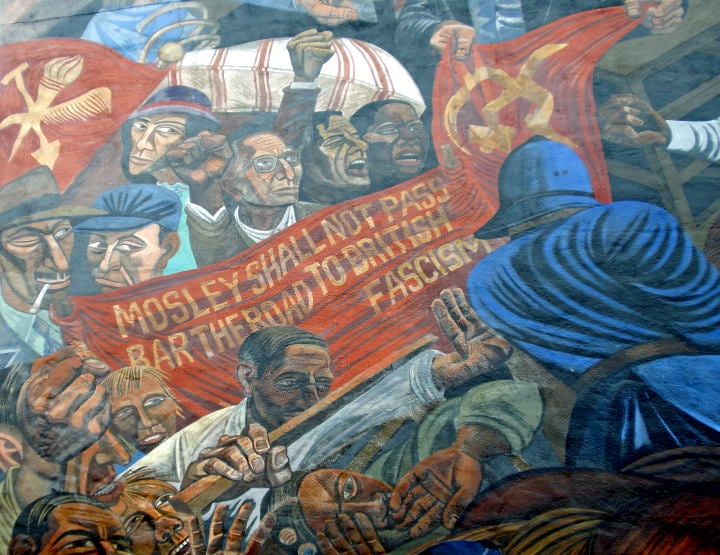
October 4, 1936: The Battle of Cable Street

October 4, 1936: London's police and anti-fascist demonstrators clash with members of the British Union of Fascists in the East End. It was known as the Battle of Cable Street, and it was Britain's 1st message that it would not put up with far-right tyranny. Sadly, in 1938, its government did. Thankfully, in 1939, that stopped.

As Mike Cole, of the East End, wrote for the website Historic UK:

The 1930s was a period of seismic political change throughout Europe. Fascist dictators took power in Germany, Italy and Romania and left wing and communist movements rebelled against expanding fascism in countries like Spain. In Britain, this tension culminated in a violent event in the East London area of Stepney, on Cable Street.

The murderous pogroms in Russia and elsewhere in Europe had lead to many Jewish refugees arriving in the East End of London by the late 19th Century. The backlash against this contributed to the suspicion that serial killer Jack the Ripper might have been an immigrant, Jewish or otherwise. By the early 1900s, Stepney was one of the poorest and most densely populated suburbs of London. By the 1930s, that part of the East End had a distinct Jewish population and culture.

Sir Oswald Mosley was the leader of the British Union of Fascists (BUF) in 1931, when America's Time magazine put him on their cover, calling him "America's Hitler." At 35, he had already been knighted for his government service. He met Italian dictator Benito Mussolini in early 1932, and very much admired and modelled himself on the man known as "Il Duce." Mosley even created a new, sinister organization, the Blackshirts, a quasi-military group of around 15,000 thugs, modelled on Mussolini's Squadrismo.

As the number of fascists was growing, so too was the opposition against them. Trade unionists and Communists, as well as the Jewish community, were becoming increasingly mobilized. When Mosley announced a march into the heart of the Jewish community in the East End of London, planned for Sunday, the 4th of October, 1936, the community was in disbelief and it was a clear provocation.

The Jewish People’s Council presented a petition of 100,000 names to urge the Home Secretary to ban the march. But, the BUF had the support of the press and police, and with the Daily Mail running headlines in the 1930s such as “Hurrah for the Blackshirts” the government failed to ban the march and the people of the East End set about organizing to defend themselves. (After World War II, the Daily Mail continued to be far enough to the right that it was nicknamed the Daily Heil.)

The Communist newspaper, The Daily Worker, called people to the streets on the day of the march, to block Mosley’s way. There were many who were worried about violence, and the Jewish Chronicle warned its readers to stay home on the day. Many other groups such as the Communists and Irish Dockers encouraged the defense of the diverse community from Fascist intimidation. The Communist Party even cancelled a planned demonstration in Trafalgar Square and redirected its supporters to the East End.

On October 4, thousands of antifascists began to gather at Gardeners Corner in Aldgate. The battle lines were set as Mosley gathered his men at the Royal Mint by The Tower of London. The police amassed 6,000 officers to clear a path for them into Whitechapel. The police used mounted officers at Aldgate to beat back the crowds onto the pavements but thousands more were streaming into the area. Four sympathetic tram drivers strategically abandoned their vehicles to help block the road to the fascists.

“Down with the fascists!” chants were heard across East London as the police clashed with the community blocking their way. Communists, Jews, Irish Dockers, Trade Unionists all united under the chant “They Shall Not Pass!” -- a line used by French Field Marshal Henri Petain against the Germans in World War I, and recently taken up by the Spanish Republic in their eventually failed effort to prevent a Fascist takeover.

As the police could not get through the crowds towards Whitechapel, Mosley decided to change the route, and head down narrow Cable Street, that ran parallel to his original route. The Blackshirts were headed up and flanked by the Metropolitan Police as they headed into Cable Street.

Everything from rotten fruit to boiling water rained down on them from windows on all sides. The Met reached the first barrier, but brawls broke out, and the police withdrew and demanded that Mosley turn around.

Celebrations broke out across the East End that afternoon. 79 antifascists were arrested, many of whom were beaten by the police, some even sentenced to hard labor. Only 6 fascists were arrested.
Mural honoring the Battle, on Cable Street

Within 2 years, the British government was appeasing Nazi Germany. Within another year, Britain and Germany were at war.

Two days after the Battle of Cable Street, and 3 years after the death of his 1st wife, Mosley, who had cheated on her endlessly, married his longtime mistress, Diana Guinness -- in Germany, in a ceremony held at the home of propaganda minister Joseph Goebbels, and attended by Chancellor Adolf Hitler.

On May 23, 1940, after Winston Churchill became Prime Minister, Mosley was arrested under Defence Regulation 18B. Diana was interned a month later, the gap due to the fact that she was pregnant with their son, Max. Most other BUF members were interned, and Fascism was eliminated as a threat in the country. Diana was released in November 1943, but Oswald was kept under house arrest for the duration of The War.

Afterward, he became an advocate for a united Europe, and a leader of Holocaust denial. After the Notting Hill Riots of 1958, he ran for Parliament on an anti-immigrant platform, and lost badly. He ran again in 1966, from a district in East London, but his evil there was not forgotten, and, again, he was clobbered at the polls. He moved to France, and never returned to Britain except for brief visits.

By 1977, he was suffering from Parkinson's disease, but dissension in Britain led to a turn back to the right, and a partial restoration of his reputation. Rock singer Elvis Costello mentioned this in his hit song "Less Than Zero." He lived to see the election of the Conservative Party government led by Prime Minister Margaret Thatcher, the most right-wing government Britain had ever had. He died on December 3, 1980.

Between his 2 marriages, he had 5 children, including the novelist Nicholas Mosley, 3rd Baron Ravensdale, a title from his mother's family; and Max Mosley, who served 16 years as President of the International Automobile Federation. Through 2022, none of Mosley's descendants have run for public office in any country.

*

October 4, 1936 was a Sunday. Game 4 of the World Series. Carl Hubbell was in the middle of a 24-game regular season winning streak, and Time magazine called this Series "a personal struggle between Hubbell and Gehrig."

Well, Hubbell had won Game 1, but Lou Gehrig homers off him in this Game 4, and the Yankees win, 5-2. Monte Pearson is the winning pitcher, and now the Yankees are 1 win away from taking the Series. I have a separate entry for this event.

And there were 4 games played in the NFL:

* The New York Giants beat the Boston Redskins, 7-0 at Fenway Park in Boston. The following year, the Redskins moved to Washington.

* The Brooklyn Dodgers beat the Philadelphia Eagles, 18-0 at Ebbets Field. The football version of the Dodgers went out of business after the 1948 season.

* The Chicago Bears beat the Pittsburgh Pirates, 27-9 at Forbes Field in Pittsburgh.

* And the Green Bay Packers beat the Chicago Cardinals, 24-0 at the Dairy Bowl in the Milwaukee suburb of West Allis, Wisconsin. The Dairy Bowl was a football stadium built in the infield of a speedway, now known as the Milwaukee Mile, at the Wisconsin State Fair Park.

Friday, May 6, 2022

May 6, 1967: The Modern Age of Football Hooliganism Begins

May 6, 1967: The modern age of "football hooliganism" begins. And it's in celebration of one of the best soccer teams in English history.

Matt Busby managed Manchester United to the Football League Division One title in 1956 and 1957. After the Munich Air Disaster of 1958, he had to rebuild his team almost from scratch. But they managed to finish 2nd in 1959. It was an outlier: The next 4 seasons, they finished 7th, 7th, 15th and 19th, barely avoiding relegation to Division Two in 1963, although they did manage to win the FA Cup.

By that point, the players known as "The Trinity" were in place: English forward Bobby Charlton, Scottish forward Denis Law, and Northern Irish winger George Best. In 1964, they finished 2nd. In 1965, they won the League again. In 1966, they finished 4th. In all 3 seasons, they reached the Semifinals of the FA Cup. In 1966, as his ill-fated "Busby Babes" did in 1957 and 1958, they reached the Semifinal of the European Cup. And in 1967, they went into the final game of the season, on May 6, needing a win or a loss by Nottingham Forest to clinch the title.

All this success, both before and after the Air Disaster, made them a popular team beyond the Manchester area: Television coverage made them nationally popular, especially with Charlton having helped England win the 1966 World Cup; and Best's long hair, skill and personality making him the most popular player in the country.

This success did not necessarily transfer to their national teams: Although Charlton and midfielder Norbert "Nobby" Stiles were members of England's 1966 World Cup winners, Law's Scotland and Best's Northern Ireland did not qualify for that tournament. Scotland, with Law, did famously beat England, with Charlton and Stiles, 3-2 at Wembley Stadium in London on April 15, 1967, but the Scots' claim of being "Unofficial World Champions" was not taken seriously.

By 1967, Man United were probably the most popular team in England. They were also, arguably, the 4th-most popular team within London's M25 motorway (their equivalent of a road "beltway"), behind North London's Tottenham Hotspur (League and FA Cup "Double" winners in 1961, Cup winners again in 1962 and 1967, European Cup Winners' Cup winners in 1963), West London's Chelsea (not very successful, but popular among denizens of the city's nearby theatre district), and East London's West Ham United (1964 FA Cup winners, 1965 Cup Winners' Cup winners, and the darlings of the working class).

By this point, North London team Arsenal, which hadn't won the League since 1953 or the Cup since 1950, and were nearly relegated in 1966, were considered just about irrelevant. Little did anyone know that their rebuilding effort would result in a Double in 1971.

Best certainly enjoyed taking the train down from Manchester to London to enjoy the capital's delights, its "wine, women and song," which would ultimately ruin his health and lead to his death in 2005, not quite 60 years old. His shenanigans are also the best way to deny later United manager Alex Ferguson's statement that, had Paul Gascoigne left Newcastle for him, instead of for Tottenham, he could have kept him on the straight and narrow, in Manchester and out of London. Carousers will always find a way.

There had always been "firms" of "hooligans" following English soccer teams. In the East End, West Ham had already developed one of the most fearsome, which would become the Inter-City Firm (ICF). Manchester United had the Red Army. But their London following was big enough that they had a separate firm of Londoners, "The Cockney Reds."

This infuriated West Ham fans: While pretty much everybody from outside the M25 thinks of everybody from inside it was a "Cockney," the word has a specific definition: A person born "within the sound of Bow Bells," meaning the bells of the Church of St Mary-le-Bow, on the street known as Cheapside, a mile and a half from Central London -- but only a 5-minute walk from the much larger St. Paul's Cathedral. Both churches were rebuilt after the Great Fire of London in 1666, and both were designed by the greatest architect of the age, Sir Christopher Wren.

On May 6, the next-to-last weekend of the League season, Man United needed to win 1 of their last 2 games to clinch the title. The suspense ended early: Charlton scored in the 2nd minute, Pat Crerand in the 7th, and Bill Foulkes in the 10th. Best scored in the 25th, and Law in the 63rd (on a penalty) and the 79th. The Irons' only goal came from John Charles, who, 4 years earlier, became their 1st black player. (He should not be confused with the John Charles who starred for Leeds United, Juventus, Cardiff City, and the Wales national team.)

But after the game, the Cockney Reds began throwing bottles, rocks, and whatever else they could get their hands on, at anything damageable: Windows, cars, people. According to local newspapers, 20 people were hospitalized, and 12 were arrested.

As one member of West Ham's ICF put it in a book about their doings, in particular their relationship with Man United: "Attitudes changed toward them. They had some respect after the Munich air crash, and many an old boy round our way admired the way they had rebuilt after that. After 1967, any respect they had went out the door, and it hasn't changed to this day."

Over the late 1960s, the 1970s, and the early 1980s, things would continually get worse and worse. By the mid-1970s, "perimeter fencing" was put around the fields at many stadiums, to prevent "pitch invasions." The idea was, if the fans were going to act like animals, the authorities were going to put them in cages. But that didn't prevent fighting in the stands, and it certainly didn't prevent it outside the stadiums.

*

May 6, 1967 was a Saturday. It was the day my parents got married in their hometown of Newark, New Jersey. It rained that day, which was said to be a good omen for a marriage. Theirs lasted 47 years. My parents couldn't have cared less about soccer, even though America's 1st top-flight soccer league had just begun play. Their old neighborhood didn't care, despite being mostly Italian-American: People there didn't care much about what was going on in "the old country." The neighborhood sure cares about it now, as it's populated mostly by Central and South Americans.

Elsewhere in English football that day: Arsenal beat Staffordshire team Stoke City, 3-1 at Highbury in North London; Liverpool and the other North London team, Tottenham Hotspur, who would go on to win the FA Cup 2 weeks later, played to a 0-0 draw at Anfield in Liverpool; Everton, also of Liverpool and the defending League Champions, beat Aston Villa, 4-2 at Villa Park in Birmingham; Manchester City and Yorkshire team Sheffield United played to a draw, 1-1 at Maine Road in Manchester; and Midlands team Leicester City beat North-East team Newcastle United, 4-2 at Filbert Street in Leicester.

On the same day, Scotland's league finished its season. The Glasgow derby, "the Old Firm," between Rangers and Celtic, was played to a 2-2 draw. They had a "ruck" (or an "off"), too: Among the fans, 50 were injured, and 39 were arrested. Celtic won the League, and went on to win the Scottish Cup, and the League Cup, and became the 1st British team to win the European Cup: A still-unique "Quadruple": No other team in European soccer has managed that.

American football was out of season. The NHL season had ended 2 days earlier, with the Toronto Maple Leafs beating the Montreal Canadiens for the Stanley Cup. The NBA season had ended on April 24, with the Philadelphia 76ers beating the San Francisco Warriors. Both of those Finals went to 6 games.

These games were played in Major League Baseball:

* The Cincinnati Reds beat the Atlanta Braves, 4-3 at Atlanta Stadium (later Atlanta-Fulton County Stadium). Pete Rose went 3-for-4 with a solo home run. Hank Aaron went 1-for-4 with 2 RBIs. Joe Torre went 1-for-3 with a walk.

* The Pittsburgh Pirates beat the San Francisco Giants, 6-5 at Forbes Field in Pittsburgh. George Spriggs singled home the winning run in the bottom of the 10th inning. Roberto Clemente went 1-for-4. Bill Mazeroski went 3-for-5. Willie Stargell did not play. For the Giants, Willie Mays went 0-for-4 with a walk. Jack Hiatt, starting at 1st base in place of Willie McCovey, went 2-for-4 with a home run and 4 RBIs. McCovey later pinch-hit, and went 0-for-2.

* The Chicago White Sox beat the Cleveland Indians, 2-0 at Cleveland Municipal Stadium. Joe Horlen pitched 7 innings of 3-hit shutout ball, and Bob Locker pitched 2 perfect innings to finish it.

* The Detroit Tigers beat the Baltimore Orioles, 4-1 at Tiger Stadium in Detroit. Al Kaline hit a home run. Frank Robinson went 1-for-3 with a walk. Brooks Robinson went 0-for-4.

* The St. Louis Cardinals beat their arch-rivals, the Chicago Cubs, 5-3 at Wrigley Field in Chicago. Lou Brock went 1-for-5 with a stolen base. Orlando Cepeda hit 2 home runs. Ernie Banks went 2-for-4 with 2 RBIs.

* The Minnesota Twins beat the Boston Red Sox, 4-2 at Metropolitan Stadium in the Minneapolis suburb of Bloomington, Minnesota. Harmon Killebrew went 0-for-4. Rookie of the Year Rod Carew went 2-for-4. Carl Yastrzemski went 1-for-4.

* The Washington Senators beat the California Angels, 2-0 at Anaheim Stadium (now Angel Stadium of Anaheim). Barry Moore had pitched 3 innings of 3-hit shutout ball, but had also walked 4 batters, and was moved in favor of Darold Knowles. He allowed just 2 hits over the last 6 innings, and completed the shutout.

* As I said, it rained in the New York Tri-State Area, so the New York Mets and the Houston Astros were rained out at Shea Stadium. The game was made up on July 20, and the Astros won, 7-0. Don Wilson pitched a 2-hit shutout, allowing only singles by Larry Stahl and Ed Charles, and walks to Stahl and Ed Kranepool.

* The rain that hit the Northeast on May 6 also rained out the Philadelphia Phillies and the Los Angeles Dodgers at Connie Mack Stadium in Philadelphia. The game was made up as part of a doubleheader on July 18. The Phils won the opener, 5-0. Rick Wise pitched a 4-hit shutout. The Dodgers won the nightcap, 2-1.

* And while the New York Yankees were on the road, they, too, got rained out, against the Kansas City Athletics at Kansas City Municipal Stadium. The game was made up as part of a doubleheader on June 27. The A's won the 1st game, 10-2. Future Yankee Jim "Catfish" Hunter outpitched Al Downing. The Yanks won the 2nd game, 2-1. Joe Verbanic outpitched Chuck Dobson. Mickey Mantle went 1-for-3 with a walk in the 1st game, and drew a walk as a pinch-hitter in the 2nd game.

Monday, May 2, 2022

May 2, 1964: Bubbles at Wembley

Bobby Moore with the FA Cup

May 2, 1964: The FA Cup Final is held at Wembley Stadium in West London.

West Ham United Football Club, despite its name, is located in the East End of London. Since 1895, when they were founded as Thames Ironworks FC, "the Hammers," a.k.a. "the Irons," have represented that part of town with grit and courage, if not with much success.

Through the 1962-63 season, the closest they had come to a major trophy were the London Combination in 1917, the Football League War Cup in 1940 (and both of those were won under unusual wartime conditions), and the championship of the Football League Division Two in 1958. In 1923, when Wembley Stadium opened, and hosted its 1st FA Cup Final, West Ham reached it, but lost to Manchester-area team Bolton Wanderers. It would take until 1964 for them to get that far again.

At this point, they weren't even known for having the most fearsome "hooligan firm" in the British Isles, the Inter-City Firm. That would come later. They were best known as the country's ultimate working-class team, and for their song, "I'm Forever Blowing Bubbles."

The song was written in 1918. The music was written by John Kellette. The lyrics were written the next year, by 3 men: James Kendis, James Brockman and Nat Vincent. The song debuted in a Broadway musical, The Passing Show of 1918, where it was first sung by Helen Carrington.

The song was the World War I-era equivalent of a hit -- the dawn of radio broadcasting was soon to arrive, so it was sales of sheet music that determined that sort of thing, not airplay and record sales -- and became popular in British music halls.

West Ham player Billy Murray had a resemblance to the boy in the painting "Bubbles" by Sir John Millais, which was used in a print ad for Pears soap. So his nickname became "Bubbles," and West Ham fans began to sing the song to honor him. Just as "You'll Never Walk Alone" survived as a "club song" for Liverpool F.C. after the hit version of the song by Gerry & the Pacemakers dropped off the charts in 1963, so, too, did Hammers fans continue to sing "I'm Forever Blowing Bubbles" after Murray left the team.

And so, those fans sang it all through their team's FA Cup run: Beating South London team Charlton Athletic in the 3rd Round, East London team Leyton Orient in the 4th Round (with a replay), Wiltshire team Swindon Town in the 5th Round, Lancashire team Burnley in the Quarterfinal, and Cup holders Manchester United in the Semifinal.

They would play Preston North End, then in the Football League Division Two. Preston were, and are, best known as the team that, in the 1st season of the Football League, 1888-89, won both the title, by going undefeated, and the Cup, the 1st "Double." Preston had famously won the Cup in 1938, with a fairly-awarded penalty in the last minute of extra time.

Doug Holden opened the scoring, putting Preston ahead 1-0 in the 10th minute. But right after that, John Sissons equalized for the Irons. At the age of 18, he was then the youngest scorer in Final history. Alex Dawson scored in the 40th, and Preston took a 2-1 lead into the break.

But Geoff Hurst scored in the 52nd, and the game was tied again. Extra time loomed, but in the 90th and last minute of normal play, Ronnie Boyce scored on a header, and West Ham won, 3-2. Bobby Moore, centreback, Captain of West Ham and Captain of the England national team, received the FA Cup from George Lascelles, the 7th Earl of Harewood, a 1st cousin of Queen Elizabeth II, representing the Football Association. (Two years later, when England won the World Cup at Wembley, Moore would receive that trophy from the Queen herself.)

Playing left halfback for Preston was Howard Kendall, a few days short of his 18th birthday, even younger than Sissons. This made him the youngest player to play in an FA Cup Final since the game moved to Wembley. That record would be broken by a West Ham player, Paul Allen in 1980. But this would not be what Kendall would be best known for: He won the League playing for Liverpool team Everton in 1970, and managed that team to the League title in 1985 and 1987, the FA Cup in 1984, and the European Cup Winners' Cup in 1985.

West Ham have never won the League, or even finished 2nd. Even when they won the FA Cup in 1964 and the European Cup Winners' Cup in 1965, they only finished 14th and 9th, respectively. And their 1980 win remains the last time the FA Cup has been won by a team from outside Division One, although they won Division Two in 1980-81 to get promoted back into Division One for 1981-82.

Harry Redknapp, later to manage several English teams, including West Ham, played for them from 1965 to 1972, and was later a teammate of Moore's on the North American Soccer League's Seattle Sounders. He once remarked, "We had Bobby Moore, Geoff Hurst, Martin Peters, John Bond, Ronnie Boyce and John Sissons. And we finished 14th. That should tell you how bad the rest of us were."

But winning the FA Cup meant that the Hammers had qualified for the European Cup Winners' Cup, their 1st European competition. (That tournament was last held in 1999, and the teams that would have qualified for it thereafter were, instead, placed in the UEFA Cup, known since 2010 as the UEFA Europa League.)

They did improve to 9th in the League. But it would take until 1986 for West Ham to finish higher than 6th in the top flight. That season, they finished 3rd. They quickly fell to 15th the next season. They finished 5th in 1999. Those 1986 and 1999 finishes remain their 2 best League seasons ever.

As for Preston, they have never seriously challenged for another major trophy, and have not played in England's top flight since 1961.

*

May 2, 1964, like most FA Cup Final days, was a Saturday. The NBA season had ended 6 days earlier, with the Boston Celtics beating the San Francisco Warriors for their 6th straight Championship. The NHL season had ended the day before that, with the Toronto Maple Leafs beating the Detroit Red Wings for their 3rd straight Stanley Cup. And American football was out of season.

But these baseball games were played, and some of them had weird occurrences:

* The New York Yankees lost to the Washington Senators, 5-4 at Yankee Stadium. The Yankees were beaten in the top of the 10th inning, on a single by former Yankee Bill "Moose" Skowron. Tom Tresh hit a home run. Mickey Mantle only appeared as a pinch-hitter, and did not reach base.

* The New York Mets beat the Cincinnati Reds, 3-0 at Crosley Field in Cincinnati. Al Jackson pitched a 2-hit shutout, allowing only a single by Deron Johnson and, oddly, one by the opposing pitcher, Jim Maloney. But Maloney balanced that out by throwing a wild pitch that allowed a run while Jackson was at bat. Frank Robinson did not play. Pete Rose went 0-for-4. 

* The Detroit Tigers beat the Boston Red Sox, 4-0 at Fenway Park in Boston. Dave Wickersham pitched a 6-hit shutout. Al Kaline went 1-for-3 with 2 walks.

* The Cleveland Indians beat the Baltimore Orioles, 6-4 at Memorial Stadium in Baltimore. Much as he did in 1959, after pitching 12 perfect innings for Pittsburgh against Milwaukee, Harvey Haddix fell apart in the top of the 13th inning for Baltimore in this game. Brooks Robinson went 1-for-5 with a walk. An escalator accident injured 46 people, killing a 14-year-old girl. I have a separate entry for that event.

* The Chicago White Sox beat the Los Angeles Angels, 3-1 at Comiskey Park in Chicago.

* The Milwaukee Braves beat the Philadelphia Phillies, 11-2 at Milwaukee County Stadium. Hank Aaron went 3-for-4 with a walk and an RBI. He did not hit a home run, but Eddie Mathews did. So did their former Brave teammate, Wes Covington, for the Phils, as did Johnny Callison.

* The Pittsburgh Pirates beat the St. Louis Cardinals, 5-4 at Busch Stadium (formerly Sportsman's Park) in St. Louis. The Cards led 4-3 in the top of the 9th, but Gene Freese singled home 2 runs to win it. Roberto Clemente went 1-for-4 with a walk. Willie Stargell did not play.

So the 3 teams that finished the regular season within 1 game of each other at the top of the National League standings -- Cincinnati, Philadelphia and St. Louis -- all lost on this day.

* The Minnesota Twins beat the Kansas City Athletics, 7-3 at Kansas City Municipal Stadium. The game was 2-2 after 8 innings. In the top of the 9th, Harmon Killebrew hit a home run for the Twins. In the bottom of the 9th, Rocky Colavito singled home Ed Charles for the A's, and the game went to extra innings.

In the top of the 11th, with Dan Pfister pitching for the A's, the Twins did something that has only happened 11 times in major league history, and this was only the 3rd time: They hit 4 straight home runs. They were hit by Tony Oliva, Bob Allison, Jimmie Hall and Killebrew.

* The Chicago Cubs beat the Houston Colt .45s, 9-0 at Colt Stadium in Houston. The Colts became the Astros the next season. Bob Buhl pitched a 3-hit shutout. Ernie Banks went 3-for-5 with 2 RBIs. Lou Brock went 3-for-4 with a walk and a stolen base. The Cubs, desperate for pitching, traded him a few weeks later anyway, to St. Louis, for Ernie Broglio. It didn't work out well for them. It worked out great for the Cardinals.

* And the San Francisco Giants beat their arch-rivals, the Los Angeles Dodgers, 5-4 at Dodger Stadium in Los Angeles. Chuck Hiller singled home the winning run in the top of the 12th inning. Duke Snider hit a home run -- for the Giants, against the Dodgers. It was the 404th home run of his career, which, at the time, ranked 6th all-time. He would hit only 3 more. Willie Mays went 1-for-6.

December 31, 1999 & January 1, 2000: The Millennium

December 31, 1999:  The Millennium arrives. The people of planet Earth survived. At a terrible cost. But we hadn't destroyed ourselves. ...