Showing posts with label marlon brando. Show all posts

Thursday, November 24, 2022

November 24, 1950: "Guys and Dolls" Premieres On Broadway

November 24, 1950: The musical Guys and Dolls premieres on Broadway. Along with West Side Story because of its macho characters, and My Fair Lady because of its male chauvinism, it is 1 of 3 Broadway musicals that men can like, and not have their heterosexuality questioned.

No, not Damn Yankees. Yes, it involves baseball, and the film version had Gwen Verdon wearing the 1950s equivalent of skimpy outfits. But it also had a locker room scene with men walking around wearing nothing but towels, and even doing a chorus-line kick. Anyway...

The musical was written by Frank Loesser, with a "book" by Jo Swerling and Abe Burrows (father of Cheers co-creator and director James Burrows), based on the writings of Damon Runyon. His stories, written in the 1920s and 1930s, concerned gangsters, gamblers, and other characters of the New York underworld.

Runyon was known for the unusual comic dialect he employed in his stories; mixing highly formal language, without contractions, and colorful slang. For example, in the show, Joey Biltmore, owner of the Biltmore Garage, will not accept a "marker" (an I.O.U.) from "Good Old Reliable" Nathan Detroit. Upon hearing this, Nathan's friend, Nicely-Nicely Johnson, says, "Dis, I do not believe!"

("Nicely" is so nicknamed because, when you ask him how he's doing, he says, "Nicely, nicely, thank you." It may be a coincidence that there was a later real-life New York gangster named John Campopiano, nicknamed Johnny Echoes, because he said everything twice. He was depicted in the film Goodfellas as Jimmy Two Times, played by Anthony Powers: "I'm gonna go get the papers, get the papers.")

The show begins with a song titled "Fugue for Tinhorns," in which gamblers Nicely, Benny Southstreet and Rusty Charlie talk about racehorses that are running tomorrow, named Paul Revere, Valentine and Epitaph. Nicely enters a phrase into the American lexicon: "I got the horse right here, his name is Paul Revere... "

Nathan runs a "floating crap game": A dice-shooting contest whose location goes from place to place, to avoid the police. But NYPD Lieutenant Brannigan is "breathing down everyone's neck," and the only guy willing to host the game is Biltmore, and even he wants a security deposit of $1,000: "A grand." (About $12,000 in 2022 money, so we're not exactly talking pocket change.) Nathan admits, "The one thousand bucks, I ain't got." But there are so many high rollers coming into New York that his greed kicks in, and he can't simply cancel the game.

Among the high rollers is Sky Masterson, dressed like a million bucks, known for having extraordinary luck, and, when asked how he's doing, says, "Healthy at the moment." Nathan knows that Sky will bet on anything, so he sets up a sure thing. Sky is no dope: He sees through this immediately, and does not take the bet.

But Nathan knows that Sky is a womanizer, so he proposes a new bet: Sky must take a woman of Nathan's choice to dinner in Havana, Cuba -- in those pre-Castro days, the gambling capital of the Caribbean. Sky agrees, and Nathan chooses Sarah Brown, a Sergeant in a Salvation Army-type group. Sky knows he's been had, but he also knows that, in the circles in which he and Nathan travel, a guy can never "welsh" on a bet: He can neither call it off nor refuse to pay if he loses, or he loses all credibility, and nobody will ever deal with him again.

At the mission, Sky attempts to make a deal with Sarah, offering her "one dozen genuine sinners" in exchange for the date in Havana. In spite of her General telling her that her branch of the mission will be closed unless attendance rises, Sarah refuses, and they argue over whom they will fall in love with, with a duet titled "I'll Know."

Nathan has his own romantic problem: For 14 years, he has been engaged to nightclub singer "Miss Adelaide" (her last name is never mentioned), and she's not getting any younger, and she wants to be married. But he doesn't have enough money to support a wife. He would, if this weekend's crap game goes the way he thinks it will. But first, he needs the grand.

Nathan and Sarah are both forced by circumstances into doing what they don't want to do: Brannigan's presence forces Nathan's pals to say they're gathered together for his bachelor party, meaning he now has to marry Adelaide soon; and Sarah promises her General "one dozen genuine sinners."

Nathan sees the band, but Sarah's not in it. He's sure he's lost the bet. But he realizes that the mission will be empty, and he holds the crap game in there. Sure enough, Sky has flown Sarah to Cuba, where they have dinner. They arrive back at the mission in New York at 4:00 in the morning, having not done anything naughty, but admitting that they've fallen in love with each other. (It's Broadway: It requires a little suspension of disbelief.) They hear a police siren, and the cops break the game up. Nathan gets away, but Sarah sees it, and breaks up with Nathan.

The game has moved to the sewers. To protect Sarah's reputation, Sky gives Nathan $1,000, implying that he was unable to take her to dinner. (He might as well, since he won the terms of the bet, but lost the girl.) Sky offers a bet to every one of the gamblers, including Big Julie, a nasty but illiterate gangster from Chicago. (We know he's illiterate because he writes an X on a piece of paper, and says, "That's my marker!") If Sky loses his turn at the dice, he'll give every one of them $1,000 -- which he doesn't want to lose, as a matter of pride, but he does have, so it's not that bad. But if he wins, he gets their souls. No, he's not the Devil: They will have to follow him to Sarah's mission. Preparing to throw, he sings "Luck Be a Lady." He wins.

Among the gamblers following Sky to the mission is Nathan himself. He sees Adelaide, and tries to win her back, singing "Sue Me." The General is impressed by the turnout, Sarah is impressed that Sky kept his word, and Nicely is moved to genuinely repent, and the others join him in singing "Sit Down, You're Rocking the Boat."

So everything gets resolved: Brannigan shows up to arrest everybody, but Sarah says they weren't there last night, and the General backs her lie up, so Brannigan leaves. Nathan tells Sarah everything, and tells her that it must mean Sky truly loves her. The show ends with Sky using his gambling winnings to marry Sarah, and Nathan using his to marry Adelaide. They have both gone straight: Sky runs the mission band, and Nathan runs a newsstand, and none of the four ever has to worry about love or money again.

The original production, directed by George S. Kaufman, debuted on November 24, 1950, at the 46th Street Theatre. It is still in operation, as the Richard Rodgers Theatre, at 226 West 46th Street. Robert Alda, father of actor Alan Alda, played Sky. Sam Levene played Nathan. Isabel Bigley played Sarah, Vivian Blaine played Adelaide, and Stubby Kaye played Nicely. It won 5 Tony Awards, including Best Musical.

The film version premiered on November 3, 1955. It stars Marlon Brando as Sky, Frank Sinatra as Nathan, and Jean Simmons as Sarah. Blaine and Kaye reprised their roles. Joseph L. Mankiewicz directed. It was nominated for 4 Academy Awards, but won none.

The newsstand seen during "Fugue for Tinhorns" includes copies of the June 6, 1955 issues of Time and Life magazines, respectively showing Yugoslavia's Marshal Josip Broz Tito and Henry Fonda in Navy uniform as the title character in the film Mister Roberts, a non-musical Broadway play turned 1955 film; and Look magazine from June 14, 1955, showing Jackie Gleason and Art Carney, about to spin The Honeymooners off from a sketch of The Jackie Gleason Show into its own half-hour sitcom.

For those of you who are confused by the film:

* Frank Sinatra rather enjoyed playing losers, and Nathan Detroit, for all his popularity among his kind of guys, is very much a loser for much of the film.

* Yes, Marlon Brando was young and handsome once. Yes, Brando sings in this movie, and he's... not terrible. In fact, it was an inversion of the original stage production: Sam Levene, the original Nathan, couldn't sing; but in the movie, Nathan is played by Sinatra, the top singer of the era, while Brando, known for a speech impediment and dramatics, plays the comic but not-really-musical Sky. In the musical, Sam as Nathan only sings "Sue Me," while Frank as Nathan is in a couple of other numbers.

* No, this Jean Simmons is not related to Kiss singer Gene Simmons. For one thing, she used her real name. For another, she had loads of class, while he has none. If I'd been around then, Jean would have preceded Marina Sirtis, Catherine Zeta-Jones, Kate Beckinsale and Hayley Atwell as British brunettes that I could not resist.

The 1st Broadway revival was in 1976, with an all-black cast: Robert Guillaume as Nathan, Norma Donaldson as Adelaide, Jimmy Randolph as Sky, and Ernestine Jackson as Sarah. The 1992 revival was highly regarded. Actor Joseph Lane had renamed himself Nathan Lane after Nathan Detroit, and now played the role. Peter Gallagher played Sky, Josie de Guzman played Sarah, and Faith Prince played Adelaide. It won 4 Tonys, including Best Revival. A 2009 revival had Oliver Platt as Nathan, Lauren Graham as Adelaide, Craig Bierko as Sky and Kate Jennings Grant as Sarah.

Damon Runyon had already died in 1946. His last words were recorded as, "You can keep the things of bronze and stone, and give me one man to remember me just once a year." George S. Kaufman followed in 1961, Jo Swerling in 1964, Frank Loesser in 1969, Sam Levene in 1980, Abe Burrows in 1985, Robert Alda in 1986, Vivian Blaine in 1995, Stubby Kaye in 1997, Frank Sinatra in 1998, Marlon Brando in 2004, Isabel Bigley in 2006, and Jean Simmons in 2010.

*

November 24, 1950 was a Friday, the day after Thanksgiving. My Three Sons actor Stanley Livingston and original Lynyrd Skynyrd drummer Bob Burns were born.

Baseball was out of season. No games were scheduled for the NFL, the NBA or the NHL. There were 5 college football games played:

* Number 14 Miami beat Iowa, 14-6 at Burdine Stadium in Miami. The stadium was later renamed for the game annually held there, on or around New Year's Day: The Orange Bowl.

* Louisiana State University (LSU) beat Villanova, 13-7 at Tiger Stadium in Baton Rouge, Louisiana.

* The University of Houston beat Midwestern Texas State University, 40-18 at Public School Stadium (later renamed Jeppesen Stadium and Robertson Stadium) in Houston. MTSU, in Wichita Falls, Texas, became Midwestern State University. They now compete in NCAA Division II.

* San Jose State beat Montana, 32-7 at Honolulu Stadium in Hawaii

* And the College of the Pacific beat Boston University, 55-7 at Pacific Memorial Stadium in Stockton, California. The home team's school was renamed the University of the Pacific in 1961, and they dropped their football program after the 1995 season. BU dropped theirs after the 1997 season.

Monday, September 19, 2022

September 19, 1951: "A Streetcar Named Desire" Premieres

September 19, 1951: A film version of A Streetcar Named Desire premieres. Directed by Elia Kazan, it makes a star out of Marlon Brando.

Brando reprised his role of Stanley Kowalski from the play by Thomas "Tennessee" Williams, which premiered on Broadway at the Ethel Barrymore Theatre on December 3, 1947. He had gotten rave reviews, but starring on Broadway could only get a performer so far: In order to become nationally famous, that performer had to star in the film version of a play, or sing on the original soundtrack album. And Streetcar was not a musical. And, as Brando later proved in the film version of Guys and Dolls, he wasn't much of a singer.

Stanley is a factory parts salesman in New Orleans. He is married to Stella, played by Kim Hunter in both original play and film, receiving an Academy Award for the film. Stella is the younger sister of Blanche DuBois, once the pride of a wealthy Mississippi family, but now dependent upon Stanley and Stella, because her divorce, all her husband's fault, left her with nothing; and her subsequent affairs led her family to cut her off, before their squandering of the family fortune meant that they had nothing to leave her when they died.

Jessica Tandy played Blanche on Broadway, receiving a Tony Award. In the film, Blanche was played by Vivien Leigh, in her best-known role other than that of another damaged Southern belle, Scarlett O'Hara in Gone with the Wind. She won Oscars for both of those roles. The role, including the famed final line, "I have always depended upon the kindness of strangers," was based on Williams' own mother, although the name came from a friend, theater critic and former actress Blanche Marvin.

Stella is pregnant, not that this bothers the unfaithful Stanley. Blanche is prejudiced against the Polish Stanley (never mind that he's a fellow Catholic), and he doesn't much like her, either. Blanche soon starts dating one of Stanley's co-workers, Harold "Mitch" Mitchell, played in both the original production and the film by Karl Malden.

In the middle of the play and movie, there's a poker game involving Stanley, Mitch and some co-workers. A drunken Stanley gets angry at Stella, and hits her. She leaves, staying with their upstairs neighbors. Stanley runs out into the rain, yelling up to the neighbor's apartment. Brando's cry of "Stella!" while getting soaked in the rain became iconic, as did his T-shirt revealing his physique.

Copying the yell became the definitive way to do an impression of Brando for 20 years, until he started mumbling as Vito Corleone in The Godfather. As Brando got old and fat, a series of Baby Boomer jokes included: "1950s: Want to look like Marlon Brando. 1990s: Don't want to look like Marlon Brando."

Stella returns, but the tension between Stanley and Blanche mounts. Stanley starts asking around, and learns about Blanche's past, including her marriage. Her husband's infidelity is changed for the movie, due to the Hays Code: In the play, the husband was discovered to be gay, like author Williams. (The gay subtext of Williams' 1955 play Cat on a Hot Tin Roof was also excised when it became a film, in 1958.)

Stanley tells Mitch all, and he breaks up with Blanche. At the same time, Stella goes into labor. It takes a long time, and Stanley goes home to get some sleep. He finds Blanche packing, though it's not clear where she's going. Stanley grabs her, but, again due to the Hays Code, the screen goes dark, implying rather than showing that he rapes her.

The final scene takes place weeks later, after the baby has been born. Blanche is being taken away to a mental hospital. In the original play, Stella stays with Stanley, and doesn't believe Blanche after she told him what he did to her. But for the movie, again because of the Hays Code, which says that evil must be punished, she finally takes Blanche's word for it as Blanche is being taken away, and leaves Stanley, taking the baby with her. That scene was filmed after an ending reflecting the play was filmed, and that version is sometimes shown on television.

Leigh died in 1967, Williams in 1983, Tandy in 1994, Hunter in 2002, Kazan in 2003, Brando in 2004, and Malden in 2009.

The film was remade for ABC television in 1984. Treat Williams played Stanley, Beverly D'Angelo played Stella, Ann-Margret played Blanche, and Randy Quaid played Mitch. CBS aired a version in 1995, with Alec Baldwin, Diane Lane, Jessica Lange and John Goodman. Baldwin and Lange had recently appeared in a Broadway revival.

As for the title: The Desire Line ran from 1920 to 1948, at the height of streetcar use in New Orleans. The route ran down Royal Street, through the French Quarter, to Desire Street in the Bywater District, and back up to Canal Street. Blanche's route in the play -- "They told me to take a streetcar named Desire, transfer to one called Cemeteries, and ride six blocks and get off at... Elysian Fields!" is allegorical, taking advantage of New Orleans's colorful street names: The Desire line itself crossed Elysian Fields Avenue on its way to Canal Street. There, one could transfer to the Cemeteries line, which ran along Canal, blocks away from Elysian Fields.

*

September 19, 1951 was a Wednesday. These baseball games were played that day:

* The New York Yankees beat the Chicago White Sox, 5-3 at Yankee Stadium. Yankee starter Tom Morgan had to leave the game after 2 innings, but Bob Kuzava went the rest of the way, and got the win. Rookies Mickey Mantle and Gil McDougald hit home runs. Mantle had a rough rookie season, but McDougald was named American League Rookie of the Year. Joe DiMaggio, in his last season, went 0-for-3 with a walk. Yogi Berra went 0-for-4.

* The Brooklyn Dodgers beat the St. Louis Cardinals, 3-0 at Sportsman's Park in St. Louis. Jackie Robinson went 2-for-5. Preacher Roe pitched a 5-hit shutout.

* The Cleveland Indians beat the Boston Red Sox, 15-2 at Fenway Park in Boston. Ray Boone (Bob's father, and Bret and Aaron's grandfather), Luke Easter and Bobby Avila hit home runs for the Tribe. Sam Chapman went 2-for-4 with 4 RBIs. Larry Doby went 0-for-0... with 5 walks, and scored 4 runs. All this was in support of Early Wynn. Billy Goodman went 3-for-4, but the rest of the Red Sox got only 4 hits, including Ted Williams going 0-for-4.

* The Philadelphia Athletics beat the Detroit Tigers, 8-1 at Shibe Park in Philadelphia.

* The Washington Senators beat the St. Louis Browns, 4-3 at Griffith Stadium in Washington.

* The Pittsburgh Pirates beat the Boston Braves, 7-3 at Forbes Field in Pittsburgh. Ralph Kiner went 1-for-2 with 2 walks and an RBI.

* The Philadelphia Phillies beat the Chicago Cubs, 5-1 at Wrigley Field in Chicago.

* And the New York Giants and the Cincinnati Reds were rained out at Crosley Field in Cincinnati. The game was made up the next day. The Reds won, 3-1. Rookie Willie Mays went 2-for-4.

Thursday, July 28, 2022

July 28, 1954: "On the Waterfront" Premieres

Eva Marie Saint (left) and Marlon Brando

July 28, 1954: On the Waterfront premieres, directed by Elia Kazan. It is regarded as one of the greatest movies ever made.

The film is widely considered to be Kazan's answer to those who criticized him for identifying 8 Communists in the film industry before the House Committee on Un-American Activities (HUAC) in 1952. Budd Schulberg, who had previously written about boxers (and would again), wrote the script, after Kazan's friend, playwright Arthur Miller, backed out. Leonard Bernstein composed the musical score.

Terry Malloy (Marlon Brando) was a former boxer, who never made it, because his brother Charley (Rod Steiger), desperate for cash, made a deal with a corrupt union leader, Johnny Friendly (Lee J. Cobb), who strong-armed Terry into throwing a fight. In a famous scene in the back of a taxicab, Terry tells Charley, "You don't understand! I coulda had class! I coulda been a contender! I coulda been somebody! Instead of a bum, which is what I am. Let's face it."

(When people do impressions of Brando, they have multiple choices. It's often this scene. But they also do Stanley Kowalski yelling, "Stella!" from A Streetcar Named Desire; Colonel Kurtz's last words, "The horror... " from Apocalypse Now; and and various quotes from Don Vito Corleone in The Godfather.)

In saying this, Terry, now a poor longshoreman on the docks of Hoboken, New Jersey, across the Hudson River from Manhattan, tells Charley that he's going to testify against Friendly before the Waterfront Crime Commission. This is in revenge for Friendly having coerced him into luring Joey Doyle, a fellow dockworker, onto a rooftop, where Friendly's thugs pushed him to his death for testifying.

Terry had been dating Joey's sister Edie (Eva Marie Saint, in her 1st film role). She talks a local priest, Father Barry (Karl Malden), into rallying the dockworkers against Friendly. But they are more afraid of Friendly than than they are of God, and refuse. That fear grows the next day, when another boxer-turned-dockworker "owned" by Friendly, Timothy "Kayo" Dugan, testifies behind closed doors, in an attempt to keep his identity hidden, but it gets out, and he is killed.

Terry is subpoenaed, and Friendly sends Charley to tell him not to testify, leading to the conversation in the cab. Having failed in his mission, Charley is killed by Friendly, and left on a hook for Terry to see, as one final warning not to testify, meaning, if he does, he will be the next to go.

My mother told me her parents took her to see this movie, because they wanted to see it and they couldn't get a babysitter. She was 7 years old, and she said the sight of Charley on the hook traumatized her. I was 17 when I first saw it, and I can understand why.

The murder has the opposite effect on Terry: He is more determined than ever, and he does testify. The next day, He appears at the dock for the daily ritual where workers are chosen from the assembled longshoremen. Everyone is called to work except Terry, who taunts Friendly outside the nearby shack, shouting that he is proud of testifying. They get into a shouting match, and start fighting. Terry is winning until Friendly's thugs beat the hell out of him, leaving him all but dead.

Finally, the other dockworkers get it: They tell Friendly that they're on strike until Terry goes back to work. In his condition, he can't. Father Barry tells him that he lost the battle, but has a chance to win the war if he can walk into the warehouse. Father Barry and Edie get him on his feet, and he stumbles up the gangway to stand before the warehouse, where the boss nods to Terry, letting him in, and tells them to get to work. The men follow Terry inside, ignoring Friendly. Friendly threatens them all, but it's over: Even his thugs are no longer afraid of him, so his power is gone, and he is completely ignored.

Tony Galento, Tami Mauriello and Abe Simon, all of whom had fought Joe Louis for the Heavyweight Championship of the World, played dockworkers in this film. Fred Gwynne, later to star on The Munsters, played dockworker Mladen "Slim" Sekulovich. Mladen Sekulovich was Karl Malden's real name.

(Malden would also play the warden in The Birdman of Alcatraz, and "Sekulovich" was one of the names he rattled off in solitary confinement along with Burt Lancaster's Robert Stroud, the titular birdkeeper.)

The film was nominated for 12 Academy Awards. It won 8, including Best Picture, Best Actor for Brando, Best Supporting Actress for Saint, and Best Director for Kazan. Saint did not attend the award ceremony: She was pregnant, and her son Darrell Hayden was born 2 days later. Eva and director Jeffrey Hayden had one of the longest marriages in Hollywood history, marrying in 1951, and were still married when he died in 2016. In addition to Darrell, they later had a daughter, Laurette.

In 1999, Malden played a priest on an episode of The West Wing. Onto their Oval Office set, he brought the same Bible he'd used in On the Waterfront.

Cobb died in 1976, Bernstein in 1990, Steiger in 2002, Kazan in 2003, Brando in 2004, Malden and Schulberg in 2009. As of July 28, 2022, Saint is still alive, the last surviving actor from the film.

*

July 28, 1954 was a Wednesday. Hugo Chávez, dictatorial President of Venezuela from 1999 until his death in 2013, was born on this day.

And these baseball games were played:

* The New York Yankees beat the Chicago White Sox, 7-5 at Comiskey Park in Chicago. Mickey Mantle went 3-for-5 with a home run and 3 RBIs. Yogi Berra went 4-for-5 with an RBI. Still, Eddie Lopat only lasted 1 inning, and the Yankees trailed 5-1 after 7 innings, before coming from behind, scoring 3 runs in the 8th and 3 more in the 9th. Bob Grim was the winning pitcher in relief.

* The New York Giants beat the St. Louis Cardinals, 10-0 at the Polo Grounds. Johnny Antonelli allowed 10 hits, but only 1 walk, and kept the shutout. Dusty Rhodes hit 3 home runs. Willie Mays added 1.

* The Brooklyn Dodgers beat the Chicago Cubs, 3-1 at Ebbets Field. Roy Campanella hit a home run. Jackie Robinson went 0-for-3, but drove in a run with a bases-loaded walk. The only Cub run came on a home run by Ralph Kiner. Rookie Ernie Banks went 0-for-4.

* The Philadelphia Phillies beat the Cincinnati Redlegs, 3-2 at Connie Mack Stadium. (That ballpark had been Shibe Park until the year before. The Reds called themselves the Redlegs from 1953 to 1958, because of the Red Scare.)

* The Baltimore Orioles beat the Washington Senators, 2-1 at Memorial Stadium in Baltimore.

* The Milwaukee Braves beat the Pittsburgh Pirates, 6-4 at Forbes Field in Pittsburgh. Rookie Hank Aaron went 3-for-5 with 3 RBIs, although he did not hit a home run.

* The Cleveland Indians beat the Boston Red Sox, 2-1 at Cleveland Municipal Stadium. Early Wynn was the winning pithcer. Ted Williams went 2-for-4 with an RBI.

* The Detroit Tigers beat the Philadelphia Athletics, 10-2 at Briggs Stadium (renamed Tiger Stadium in 1961) in Detroit. Bud Souchock hit 2 home runs, and Al Kaline went 1-for-4.

Friday, June 3, 2022

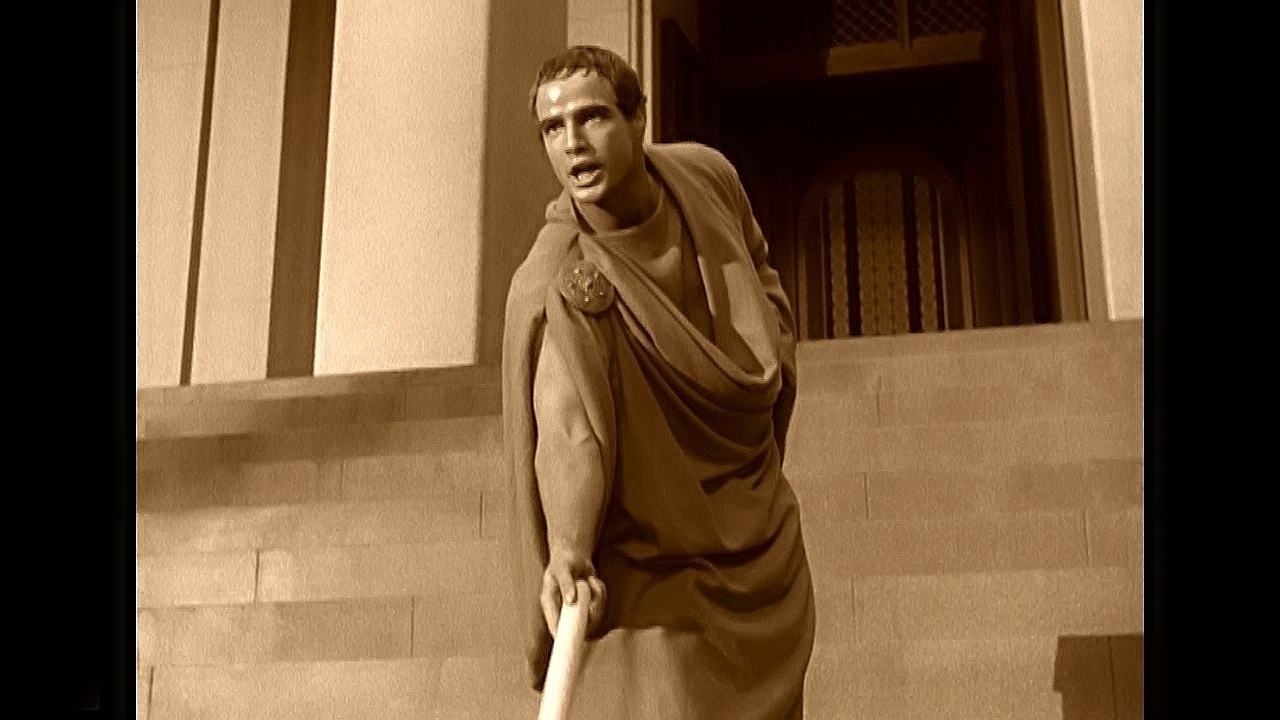
June 3, 1953: Marlon Brando Stars In "William Shakespeare's Julius Caesar"

If you've seen the 1989 film Dead Poets Society, you've seen Robin Williams, as 1959 New Hampshire prep-school English teacher John Keating, imitating Marlon Brando and John Wayne doing Shakespeare.

The John Wayne as Macbeth part was a joke, perhaps to suggest it as the conclusion to the slippery slope of Brando reciting Marc Antony's funeral oration for the title character in William Shakespeare's 1599 play Julius Caesar. But Keating wasn't joking about Brando doing that: It happened:

June 3, 1953: The film William Shakespeare's Julius Caesar premieres. As with Shakespeare's other historical plays, it is titled after who was ruling the country at the time. But Caesar, played in this film by Louis Calhern, dies right in the middle of the story, right after telling the Senate, "I am constant as the Northern Star!"

The film is mostly faithful to the play, if not to actual history. It begins with Caesar in his victory parade after defeating his former ally Pompey the Great, being warned to "Beware the Ides of March," and ignoring it. Cassius (Gaius Cassius Longinus, played by John Gielgud) realizes that Caesar has grown too powerful, and entices Marcus Junius Brutus (James Mason) to join him in a conspiracy to assassinate Caesar, which is done on the Senate floor on the Ides of March: On the calendar used today, March 15, 44 BC.

Cassius recruited Brutus because he was believed by many, including Caesar himself, to be Caesar's most loyal ally. So he is the last to plunge the knife in. At least he did it while facing Caesar, as the others all stabbed him from behind or to the side, the source of the expression. "stab in the back."

Before Brutus does it, a shocked Caesar says, "Et tu, Brute?" Latin for, "You, too, Brutus?" The historian Suetonius had suggested that Caesar had said this, but another, Plutarch, wrote that Caesar said nothing. They are often mistaken for Caesar's last words. In the play, in which Caesar, like many rulers, refers to himself in the third person, he follows being stabbed by Brutus with, "Then, fall, Caesar." And he does.

At Caesar's funeral, Brutus delivers an oration defending his actions, and for the moment, the crowd is on his side. But Antony, Caesar's ally, speaks next. At first, he seems to agree, but he uses sarcasm and innuendo to turn the crowd:

Friends, Romans, countrymen, lend me your ears;
I come to bury Caesar, not to praise him.
The evil that men do lives after them;
The good is oft interred with their bones;
So let it be with Caesar. The noble Brutus
Hath told you Caesar was ambitious:
If it were so, it was a grievous fault,
And grievously hath Caesar answer’d it.
Here, under leave of Brutus and the rest–
For Brutus is an honourable man;
So are they all, all honourable men–
Come I to speak in Caesar’s funeral.
He was my friend, faithful and just to me:
But Brutus says he was ambitious;
And Brutus is an honourable man.
He hath brought many captives home to Rome
Whose ransoms did the general coffers fill:
Did this in Caesar seem ambitious?
When that the poor have cried, Caesar hath wept:
Ambition should be made of sterner stuff:
Yet Brutus says he was ambitious;
And Brutus is an honourable man.
You all did see that on the Lupercal
I thrice presented him a kingly crown,
Which he did thrice refuse: was this ambition?
Yet Brutus says he was ambitious;
And, sure, he is an honourable man.
I speak not to disprove what Brutus spoke,
But here I am to speak what I do know.
You all did love him once, not without cause:
What cause withholds you then, to mourn for him?
O judgment! thou art fled to brutish beasts,
And men have lost their reason. Bear with me;
My heart is in the coffin there with Caesar,
And I must pause till it come back to me.

It works: The common people drive the conspirators out of Rome, weakening their forces. In the resulting civil war, Antony's forces triumph. Following defeat at the Battle of Philippi, in what is now northeastern Greece, on October 23, 42 BC, Cassius has an aide stab him, while Brutus commits suicide the classic Roman way, "Falling on his sword." Antony takes no joy in this, calling Brutus "the noblest Roman of all."

Also of note in the film: Greer Garson as Calpurnia, Caesar's wife; Deborah Kerr as Portia, Brutus' wife; Alan Napier, eventually the butler Alfred on the 1966-68 Batman series, as noted Roman Senator Cicero; John Hoyt as Decius Brutus (an misspelling of Decimus Brutus), a Roman general and a cousin of Marcus Junius Brutus; Ian Wolfe, who specialized in Roman roles, including Septimus in the Star Trek episode "Bread and Circuses," as Ligarius, one of the conspiring Senators; Michael Ansara as Pindarus, another conspirator; and Douglas Watson as Octavius Caesar, a.k.a. Octavian, who initially helps Antony, but later turns against him, and becomes Caesar Augustus, the 1st Emperor of Rome.

The film won just 1 Academy Award, for Best Art Direction. For the 3rd of 4 straight years, Brando was nominated for Best Actor, although he wouldn't win this one, as he did in 1951 for A Streetcar Named Desire and in 1954 for On the Waterfront.

That 1953 Best Actor race was as good as it gets: William Holden won for the World War II film Stalag 17. He defeated Brando; Richard Burton, for another film set in Ancient Rome, The Robe; and Burt Lancaster and Montgomery Clift, each nominated for their roles in From Here to Eternity.

Julius Caesar is a masculine-heavy play, and none of the actresses in this film version was nominated for Best Actress, although Kerr was nominated for her role in From Here to Eternity, losing to Audrey Hepburn of Roman Holiday -- which took place in present-day Rome. From Here to Eternity won Best Picture, defeating William Shakespeare's Julius Caesar, The Robe, Roman Holiday, and the Western Shane.

In 1321, in his Divine Comedy, Dante Aligheri imagined a man being taken through Hell, Purgatory and Heaven. At the bottom of Hell, in its 9th circle, are traitors, as Dante considered betrayal to be the worst sin of all. At the bottom of that, the Devil is eternally chewing on the forms Judas Iscariot, the betrayer of Jesus; and Brutus and Cassius, the betrayers of Caesar.

The Booth brothers, the leading American stage actors of the 19th Century, made their only appearance onstage together in a benefit performance of Julius Caesar on November 25, 1864, at the Winter Garden Theater in New York. Junius Brutus Booth Jr. (1821-1883, named for his father, himself named for an even earlier Brutus in Rome), played Cassius. Edwin Thomas Booth (1833-1893, considered the greatest Hamlet of his time) played Brutus. John Wilkes Booth (1838-1865) played Mark Antony. Ironically, it would be John who became a famous assassin.

On May 29, 1916, commemorating the 300th Anniversary of Shakespeare's death, a production was shown in a natural bowl in Beachwood Canyon in Los Angeles, not far from where the Hollywood Bowl would be built. A crowd of 40,000 people saw Tyrone Power Sr. play Brutus, and Douglas Fairbanks Sr. play Mark Antony. Each man had a namesake son who became a legendary actor as well, and Power Sr. would be surpassed in fame by his son.

In 1937, the Mercury Theatre staged the play on Broadway. Orson Welles directed, and played Brutus. Joseph Holland played Caesar, Greek-English actor George Coulouris played Antony, Joseph Cotten played Publius, Martin Gabel (later better known as the husband of actress Arlene Francis) played Cassius; and Norman Lloyd played Cinna the poet, whose murder scene, rather than Caesar's murder scene or Coulouris' recitation of Antony's eulogy for Caesar, was considered the play's show-stopper. Ironically, Holland outlived most of his castmates, though Lloyd lived to be 106 years old. In 1938, Welles trimmed the play for a one-hour radio broadcast on CBS, with the same cast.

Welles intended the play to be an analogy to the current leader of Italy, the Fascist Il Duce, Benito Mussolini, who was the subject of, among other biographies, one written in 1935 by a friend he had betrayed, the American journalist George Seldes, who titled his book Sawdust Caesar. Likewise, in 1978, historian William Manchester titled his biography of Douglas MacArthur, also a general whose genius was exceeded by his ego, American Caesar.

In 1954, on See It Now, CBS journalist Edward R. Murrow would close his televised exposé of Senator Joseph McCarthy by quoting Cassius' line to Brutus, about how the people of Rome had already let Caesar go too far: "The fault, dear Brutus, is not in our stars, but in ourselves." In 2012, John Green would write a novel for young adult audiences, titled The Fault In Our Stars. It was filmed in 2014.

The 1960 film An Honourable Murder is a reworking of the play, set in present-day London in the world of business, with John Longden (not the American horse-racing jockey) as corporate titan Julian Caesar. The 1963 film Cleopatra fictionalizes the romance between the titular Queen of Egypt (Elizabeth Taylor) and Caesar (Rex Harrison), and the later one between Cleopatra and Mark Antony (Richard Button, whom Taylor soon married). In the film, Cleopatra has a nightmare about Caesar's assassination, and is then told that it has happened. However, she is not mentioned in Shakespeare's play Julius Caesar.

Ted Sorensen, one of President John F. Kennedy's speechwriters, recalled a conversation with JFK's brother and Attorney General, Robert F. Kennedy, after JFK's assassination. Bobby was worried that Jack would be forgotten by history, since he had been President less than 3 full years. Sorensen reminded RFK that Julius Caesar had ruled Rome for only 3 years, and was still remembered. RFK reminded Sorensen that Caesar had Shakespeare writing about him. This led Sorensen to write a biography of JFK, and it won the Pulitzer Prize.

Of course, the real Caesar had an earlier writer to tell his story: Himself. His own writings, about his escapades in war, have survived. They reveal his genius, but also his massive ego.

The Star Trek franchise is loaded with Shakespearean references, and the 1966 original series episode "The Conscience of the King" is about a traveling company of actors, specializing in Shakespeare's works, led by a man who hides his identity as a politician who, many years earlier, had committed a massacre. His daughter tries to protect him, and, threatening Captain Kirk, says, "Caesar, beware the Ides of March!" But her father, tired of it all, steps in between Kirk and her phaser beam, driving her into the last part of madness.

The 1991 film Star Trek VI: The Undiscovered Country takes its title from a line from Hamlet, and the Klingon General Chang is played by Christopher Plummer, who got his start in Shakespearean roles in Montreal, alongside his fellow native of that city, Kirk portrayer William Shatner. Chang quotes Shakespeare throughout, including Caesar's line, "I am constant as the Northern Star," and Antony's line, "Cry havoc! And let slip the dogs of war!"

In a 1970 film version of Julius Caesar, Gielgud played Caesar, with Charlton Heston as Antony and Jason Robards as Brutus. In 1977, Gielgud played Caesar at the Royal National Theatre in London, in what turned out to be his last Shakespearean stage appearance.

In a 1972 episode of The Odd Couple, "A Night to Dismember," Oscar Madison (Jack Klugman) is hypnotized, with a post-hypnotic suggestion: When he hears, "The fault lies not in our stars, but in ourselves," he is to stop being messy as usual, and become as neat as he thinks Felix is -- but it goes too far. In 1973, the BBC aired the TV-play Heil Caesar, set in a present-day Britain that is teetering on the verge of a dictatorship. The BBC did the play straight in 1978, and again in 2012, with an all-black cast led by Paterson Joseph as Brutus and Ray Fearon as Antony. A 1984 Charles Bronson film was titled The Evil That Men Do.

"The Dogs of War" would be used as the titles of a 1974 novel by Frederick Forsyth, a 2017 novel by Adrian Tchaikovsky, a 1999 episode of Star Trek: Deep Space Nine, and a 2003 episode of The West Wing.

The expression "It's Greek to me," to mean a lack of understanding of something, dates back to the play, as Casca tells Cassius of a speech that Cicero made. "Et tu?" has been used by many people, including in popular culture, to suggest that someone has been let down by the last person they expected to do so.

The name "Caesar" was applied to the Emperors of Rome, some of whom adopted it as part of their legal names. The German title for Emperor, "Kaiser," and the Russian title, "Czar" or "Tsar," both come from "Caesar."

I once saw a T-shirt (sadly, I could find no picture of it online) showing a Roman soldier cutting a steak with his sword, saying, "Caesar did not have a salad." But the Caesar salad has nothing to do with the historic Roman. It was created in 1924 by Caesar Cardini, who ran Caesar's restaurant in Tijuana, Mexico. He also created the salad dressing that goes with it, which eventually led to this meme. Note that the bottle has been stabbed in the back:
In a 2012 episode of the YouTube series Epic Rap Battles of History, Angela Trimbur played Cleopatra, against Kimmy Gatewood playing Marilyn Monroe. A 2015 episode featured "Nice" Peter Shukoff as Julius Caesar, against early 19th Century South African Chief Shaka Zulu, played by DeStorm Power. The Cleopatra episode mentioned Caesar, and vice versa.

*

June 3, 1953 was a Wednesday. These baseball games were played:

* The New York Yankees beat the Chicago White Sox, 18-2 at Comiskey Park in Chicago. This was the 6th straight win for the Yankees, in a winning streak that would eventually reach 18. Whitey Ford was the winning pitcher for the Bronx Bombers, while Bob Keegan didn't get out of the 2nd inning for the South Siders.

The Yankees got 19 hits, but only 1 was a home run, by Irv Noren. Mickey Mantle went 1-for-4, but had 4 RBIs: On a single, a groundout, and 2 bases-loaded walks. Joe Collins went 4-for-5 with a walk and an RBI. Gene Woodling went 2-for-5 with a walk and 3 RBIs. Charlie Silvera, filling in at catcher for the injured Yogi Berra, went 3-for-6 with 2 RBIs.

* The New York Giants beat the Cincinnati Reds, 11-3 at the Polo Grounds. Larry Jansen went the distance for the win. Daryl Spencer hit 2 home runs and had 5 RBIs. Davey Williams went 2-for-4 with a home run, a walk, and 3 RBIs. Willie Mays was unavailable for the Giants, as he was serving in the Korean War.

The next day, the Giants won by the exact same score as they scored 7 runs in the bottom of the 8th to come from behind and win. 

* The Brooklyn Dodgers lost to the Milwaukee Braves, 14-9 at Ebbets Field. Vern Bickford didn't get out of the 3rd inning for the Braves, but Carl Erskine didn't get out of the 5th for Dem Bums. Eddie Mathews, Jim Pendleton, and former Dodger Andy Pafko hit home runs for the Braves. Jackie Robinson only appeared as a pinch-hitter, and drew a walk.

* A doubleheader was split at the former Shibe Park, newly renamed Connie Mack Stadium, in Philadelphia. The St. Louis Cardinals won the opener, 5-3. The Philadelphia Phillies won the nightcap, 6-5. Over the 2 games, Stan Musial went 1-for-6 with 2 walks and 2 RBIs. The next day, the Phils again beat the Cards, 6-5.

* The Pittsburgh Pirates beat the Chicago Cubs, 1-0 at Forbes Field in Pittsburgh. Paul LePalme pitched a 7-hit shutout, outpitching Warren Hacker. The only run came in the bottom of the 4th, when Pete Castiglione singled Ralph Kiner home.

The very next day, in a blockbuster deal with the Cubs, Pirate general manager Branch Rickey traded Kiner, Joe Garagiola, George "Catfish" Metkovich and Howie Pollet, for Bob Addis, Toby Atwell, George Freese, Gene Hermanski, Bob Schultz, Preston Ward, and $150,000. Rickey was so cheap (How cheap was he?),  it was once said of him, "He has players and he has money, and he does not like to see the two of them mix." So he valued the cash he was getting from Cubs owner and chewing gum magnate Philip K. Wrigley more than the 6 players he was getting, or the 4 players he was giving up.

One of those players, Kiner, was on his way to the Hall of Fame. But he was also making $75,000, a cut from $90,000 the season before. The Pirates were coming off an atrocious season in which they went 42-112, despite Kiner leading the National League in home runs for a record 7th season in a row. Rickey told Kiner, "We finished 8th with you, and we can finish 8th without you" -- meaning, "...and keep a lot of the money we're paying you."

* The Boston Red Sox beat the Cleveland Indians, 4-3 at Cleveland Municipal Stadium. The Red Sox scored 3 runs off Early Wynn in the top of the 9th inning to come from behind, to make Ellis Kinder a winning pitcher in relief of Sid Hudson. Ted Williams was unavailable for the Red Sox, as he was serving in the Korean War.

* The Philadelphia Athletics beat the Detroit Tigers, 10-7 at Briggs Stadium (later renamed Tiger Stadium) in Detroit. Gus Zernial had 2 home runs and 5 RBIs.

* And the Washington Senators beat the St. Louis Browns, 3-2 at what had been the last ballpark in St. Louis known as Sportsman's Park, but had just been renamed as the first Busch Stadium. Wayne Terwilliger singled Eddie Yost home with the winning run in the top of the 10th inning.

Tuesday, May 10, 2022

May 10, 1979: "Apocalypse Now" Premieres

May 10, 1979: Apocalypse Now premieres, Francis Ford Coppola’s film that moved Joseph Conrad’s novella Heart of Darkness from colonial Africa to the Vietnam War. This is a long movie: 2 hours and 33 minutes. Even the trailer is 4 minutes long.

The filming was long, too: Coppola started in the Philippines in July 1976 -- just over a year after the fall of Saigon -- and ending in May 1977. Things were complicated by Coppola's re-editing, by Marlon Brando being way overweight and more eccentric than ever, and Martin Sheen suffering a heart attack at the age of 36.

The film stars Sheen as a U.S. Army Captain -- named Ben Willard, combining the names of the 1971 horror-film rat and the misfit boy who takes care of him -- assigned to find rogue Colonel Walter E. Kurtz, played by Brando, and "terminate, with extreme prejudice."

This film made Sheen a bigger star, but it almost killed him. It gave Robert Duvall, after 2 Godfather movies, his own catchphrase. And it made it impossible to ever again view Brando as a dashing matinee idol. The joke was that, in the 1950s, men wanted to look like Brando; but, from the 1980s onward, men wanted to not look like Brando.

Also, next time you watch Back to the Future II, set in 2015, check out a poster at the travel agency: "Surf Vietnam." It is an inside joke, a reference to Duvall's line in this film: "Charlie don't surf!" I don't know if surfing is good on the Vietnam coast, but the country does now welcome American tourists. It's their former colonial masters, the French, that they really hate.

Later in 1979, Star Trek: The Motion Picture was released. It, too, was a lot longer than it should have been, earning it the nicknames "Star Trek: The Motionless Picture" and, in a nod to this movie, "A Spockalypse Now." (With the antagonist V'Ger resembling the that of the series' episode "The Changeling," it was also nicknamed "Where Nomad Has Gone Before."

*

May 10, 1979 was a Thursday. This was also the day the Boston Bruins committed the most famous penalty in hockey history, leading to them losing Game 7 of the Stanley Cup Semifinals to the Montreal Canadiens, 5-4 in overtime at the Montreal Forum. I have a separate entry for that event.

The World Hockey Association's last Finals, as it turned out, began the next day. The Winnipeg Jets beat the Edmonton Oilers in 6 games.

Football was out of season. The NBA's Conference Finals were in progress, but no games were scheduled for this day. These games were played in Major League Baseball:

* The New York Yankees beat the Seattle Mariners, 8-1 at Yankee Stadium. Tommy John went the distance for the win. Mickey Rivers hit a home run. Reggie Jackson went 3-for-4 with a walk and an RBI.

* The New York Mets lost to the Los Angeles Dodgers, 14-1 at Dodger Stadium in Los Angeles. Andy Messersmith was the winning pitcher, but injury ended his career after 4 more starts. This was the 130th and last win of his career, only 33 years old. His place in baseball history was secure, however, not because he a 4-time All-Star and a 20-game winner for a Pennant winner (the 1974 Dodgers), but because he was the free agent whose arbitration broke the reserve clause after the 1975 season.

Ron Cey, Bill Russell and Steve Yeager hit home runs for the Dodgers. Lee Mazzilli hit one for the Mets.

* The California Angels beat the Boston Red Sox, 5-3 at Fenway Park in Boston. Don Aase outpitched Dennis Eckersley. Rod Carew went 2-for-5. Brian Downing hit a home run for the Angels, Jim Rice for the Red Sox.

* The Baltimore Orioles beat the Oakland Athletics, 3-1 at Memorial Stadium in Baltimore. Gary Roenicke hit a home run. Eddie Murray went 0-for-4.

* Unusually, both Chicago teams were at home on the same day. The Chicago White Sox beat the Kansas City Royals, 5-2 at Comiskey Park. Claudell Washington hit a home run. George Brett went 0-for-4.

* And the Chicago Cubs played the Cincinnati Reds at Wrigley Field. The game went to extra innings, and, because Wrigley did not have lights, it was called due to darkness in the top of the 10th, with the score 7-7. It was resumed on July 23.

Each team scored a run in the 11th. Ken Henderson led off to the bottom of the 18th inning with a single, and was bunted over to 2nd base by relief pitcher Lynn McGlothen. Dave Kingman was intentionally walked to set up the double play. It didn't work, as Steve Ontiveros singled Henderson home, and the Cubs won, 9-8. So, while both Chicago teams were at home on the same day, and both won, they did not both win at home on the same day.

Kingman hit a home run, surprising few people. Barry Foote and Ted Sizemore also hit home runs, surprising nearly everybody. Johnny Bench went 2-for-8 with 3 RBIs, but Dave Concepción hit the only Cincy homer.

* The Cleveland Indians beat the Milwaukee Brewers, 8-1 at Milwaukee County Stadium. Robin Yount went 1-for-3 with a walk. Paul Molitor went 1-for-5.

* The St. Louis Cardinals beat the Houston Astros, 3-1 at the Astrodome in Houston.

* The Philadelphia Phillies beat the San Diego Padres, 3-2 at San Diego Stadium (later Jack Murphy Stadium and Qualcomm Stadium.) Pete Rose went 1-for-4 with an RBI. Mike Schmidt went 0-for-4. Dave Winfield went 1-for-3 with a walk.

Nino Espinosa outpitched Gaylord Perry. Perry did, however, hit a home run, the 5th of 6 he would hit during his career. Legend has it that, early in his career, Giants manager Alvin Dark saw Perry take a pathetic batting practice, and said that a man would be on the Moon before he hit a home run. Was Dark right? Sort of: Perry did indeed hit his 1st major league home run on July 20, 1969, apparently just a few minutes after Apollo 11 landed on the Moon, but a few hours before Armstrong stepped onto its surface. 

* The Montreal Expos beat the San Francisco Giants, 3-0 at Candlestick Park in San Francisco. Steve Rogers (not the fictional superhero of the same name, a.k.a. Captain America) pitched a 3-hit shutout.

* And the Detroit Tigers, the Minnesota Twins, the Texas Rangers, the Toronto Blue Jays, the Atlanta Braves and the Pittsburgh Pirates were not scheduled. 

Monday, March 14, 2022

March 14, 1972: "The Godfather" Premieres

Al Pacino (left) and Marlon Brando

March 14, 1972: The film The Godfather premieres at Loew's State Theatre in New York, based on the 1969 novel by Mario Puzo, directed by Francis Ford Coppola. It follows the Corleone family and its organized crime business in New York City from 1945 to 1955.

Marlon Brando was already a legend, but his legend grew by leaps and bounds with his portrayal of Vito Corleone, a crime boss but a dedicated family man. James Caan had become a star the year before, by playing dying football player Brian Piccolo in Brian's Song. But his role as Vito's son, Santino, a.k.a. Sonny, lifted him into the stratosphere. Robert Duvall had played Major Frank Burns in the film version of M*A*S*H, but became a star by playing Tom Hagen, consigliere (counselor) to the Corleone family.

Launched to stardom were Al Pacino as Vito's son and successor Michael Corleone; Talia Shire (Coppola's sister) as the Don's daughter Connie, whose wedding begins the film; Diane Keaton as Michael's girlfriend and eventual wife Kay Adams; Richard Castellano and Abe Vigoda as longtime Corleone caporegimes Peter Clemenza and Salvatore Tessio, respectively; and Alex Rocco as Las Vegas casino boss Moe Greene, whose status within the film as the man who made Las Vegas made him a thinly-veiled version of real-life Los Angeles gangster Bugsy Siegel.

The film was nominated for 9 Academy Awards. It won 3: For Best Picture, Best Actor (Brando), and Best Adapted Screenplay. It is regarded by many as the greatest film of all time, or one of the greatest. Of course, it's a very masculine film, with the women little more than plot points. I often joke that men have The Godfather, while women have The Way We Were.

The performances were iconic, the scenes legendary, the music (scored by Nino Rota) unforgettable. It's also one of the most-quoted movies ever:

* Vito: "Someday, and that day may never come, I will call upon you to do a service for me."
** "I'm gonna make him an offer he can't refuse."
** "Revenge is a dish best served cold." (This was already an old saying.)
** "Women and children can be careless, but not men."
** "Look how they massacred my boy."
** "I refused to be a fool, dancing on the strings held by all of those big shots."
* Clemenza: "He wants to go to the mattresses already."
** "It's a Sicilian message: It means 'Luca Brasi sleeps with the fishes.'"
** "Leave the gun. Take the cannoli." (The 2nd half was an ad-lib by Castellano.)
** "Oh, Paulie? You won't see him no more."
* Jack Woltz (a film studio boss, played by John Marley): "A man in my position can't afford to look ridiculous."
* Calò (Michael's bodyguard in Sicily, played by Franco Citti): "In Sicily, women are more dangerous than guns."
* Tessio: "Tom, can you get me off the hook, for old times' sake?"
* Michael: "It's not personal, Sonny. It's strictly business."
** "Fredo, you're my older brother, and I love you. But don't ever take sides against the family again."
** "Don't ever ask me about my business, Kay."

And while Michael was a U.S. Marine Corps officer in World War II, he'd only killed men from far away, never up close like a "made man." It was Sonny, the originally-intended heir to the Don, who told him that, in order to kill a man their way, you had to get up close and fire. The sound effect he used also entered the American lexicon: "Ba-da-bing!"

It's also worth noting that, while the film is about organized crime in New York's Italian community, the words "Mafia," "mob" and "Cosa Nostra" are never spoken. In the Spring of 1971, as preparations for filming were underway, one of the producers, Albert Ruddy, met with Joseph Colombo, boss of the New York crime family that bears his name and (in 1964) the 1st American-born boss of a crime family. Colombo agreed to drop all opposition to the film, and to allow the labor unions that New York's real "Five Families" controlled to work on the film, if those words were not used in the film. Ruddy took the deal to Coppola, who agreed. The words did not appear in the film -- although they were used in the sequels.

(In real life, the Five Families are named, in alphabetical order -- that's the only way to show proper respect -- Bonanno, Colombo, Gambino, Genovese and Lucchese. In the film, in order of most mentions, they are Corleone, Barzini, Tattaglia, Cuneo and Stracchi.)

Sequels weren't really a thing at the time. But there was enough material in the original novel that they could make The Godfather Part II in 1974, going back and forth between Vito's youth from 1901 to 1925, showing how he went from a boy targeted by a Sicilian boss to an American boss who could go back home and get his revenge; and 1958 to 1960, as Michael struggled to find a way to "go straight," but, unlike his father, lost his family in the process.

John Cazale played the middle Corleone son, Fredo, whose physical and mental shortcomings led to his overreach in the 2nd film. Cazale made 5 films over 7 years, before dying of cancer in 1978: The Godfather, The Conversation, The Godfather Part II, Dog Day Afternoon (also with Pacino), and The Deer Hunter (with Robert De Niro, who played the younger Vito in The Godfather Part II). All 5 were nominated for Best Picture. The Godfather and The Deer Hunter won it.

Since the 1st 2 Godfather films, Pacino has become a self-caricature: He has had many iconic performances, usually showing him yelling and out of control: Dog Day Afternoon, ...And Justice for All, Scarface, Scent of a Woman, The Devil's Advocate, Any Given Sunday. He's also become one of the easy choices for impressionists. The genius of his portrayal of Michael is that, once he becomes the new Don, he is calm, cool, collected, and totally in control. On those occasions where events fall out of his control, he quickly figures out how to regain it.

Part II is considered one of the few sequels to a great film that is as good as, or perhaps even better than, the original. That would not be the case with The Godfather Part III, released in 1990. Set in 1979 and 1980, it brings Michael's story to a shocking close, but it's long, it drags, and the acting isn't as sharp as in the 2 previous films. Duvall did not reprise his role as Tom Hagen, saying he didn't mind making half as much money as Pacino, but didn't want to make only a fraction of it. And a criticism I have of the 3rd film is that, aging and sick, Michael does lose control, bit by bit, both of his power and his emotions, until the shocking close.

And, after Winona Ryder had to back out of the role, Coppola cast his own daughter Sofia as Michael's now-grown daughter Mary, and her acting was horribly ripped by the critics, and by original Godfather fans. She has since become a director herself, and gotten considerably better reviews. Maybe she followed the advice Michael quoted from his father in Part II: "Keep your friends close, and your enemies closer." Or maybe she proved what Fredo was unable to prove in Part II: "I can handle things! I'm smart! Not like everybody says, like dumb! I'm smart, and I want respect!" She now has it.

The 1st film was 2 hours, 57 minutes long; the 2nd, 3 hours, 20 minutes; the 3rd, 2 hours, 42 minutes. All tolled, just under 9 hours. At that rate, they could have made 5 separate films, averaging 1 hour and 48 minutes each:

* 1901-25: The rise of Vito.
* 1945-48: Vito's decline, Sonny's murder, and Michael's exile.
* 1948-55: Michael's return, Vito's death, and "The Baptism of Fire" that puts Michael firmly on top.
* 1958-60: Michael's death struggle with Hyman Roth, and his life struggles with Kay and Fredo.
* 1979-80: Michael's coda.

Would that have worked better? Someday, and that day may never come, we may get an answer -- if not in this life, then in the next. Until then, accept this post, on the 50th Anniversary of the original film's release.

As I said, John Cazale died in 1978. Richard Conte (opposing boss Emilio Barzini) and Al Lettieri (opposing boss Virgil "The Turk" Sollozo) both died in 1975, Lee Strasberg (Hyman Roth in Part II) in 1982, John Marley in 1984, Sterling Hayden (Captain Mark McCluskey) in 1986, Richard Castellano in 1988, Lenny Montana (Luca Brasi) in 1992, Michael Gazzo (Frank Pentangeli in Part II) in 1995, Marlon Brando in 2004, Richard Bright (Al Neri) in 2006, Al Martino (singer Johnny Fontane) in 2009, Alex Rocco in 2015, Abe Vigoda in 2016, and Morgana King (Carmela Corleone, too young to be the mother of the Corleone children) in 2018.

As of March 14, 2022, Francis Ford Coppola, Al Pacino, Robert Duvall, James Caan, Talia Shire, Diane Keaton, Gianni Russo (Connie's husband Carlo Rizzi), John Martino (Paulie Gatto) and Simonetta Stefanelli (Apollonia Vitelli, Michael's ill-fated 1st wife in Sicily) are still alive.

UPDATE: James Caan died later in 2022. Diane Keaton died in 2025. Robert Duvall died in 2026.

*

March 14, 1972 was a Tuesday. Baseball was in Spring Training. Football was out of season. There were 7 games played in the NBA that night:

* The New York Knicks beat the Atlanta Hawks, 115-107 at Madison Square Garden.

* The Boston Celtics beat the Golden State Warriors, 124-110 at the Boston Garden. John Havlicek scored 38 points.

* The Cleveland Cavaliers beat the Baltimore Bullets, 127-118 in overtime at the Baltimore Civic Center (which is now named the CFG Bank Arena).

* The Buffalo Braves beat the Philadelphia 76ers, 108-105 at the Buffalo Memorial Auditorium. Elmore Smith had 33 points and 24 rebounds for the Braves.

* The Los Angeles Lakers beat the Detroit Pistons, 129-116 at Cobo Hall (which is now named Huntington Place) in Detroit. Bob Lanier scored 35 for the Pistons, but Jim McMillian had 30, Wilt Chamberlain had 28, Jerry West had 23 and Gail Goodrich had 21.

* The Seattle SuperSonics beat the Chicago Bulls, 115-111 at the Chicago Stadium. Lee Winfield scored 38 for the Sonics.

* And the Milwaukee Bucks beat the Portland Trail Blazers, 109-98 at the Veterans Memorial Coliseum in Portland. Kareem Abdul-Jabbar had 36 points and 17 rebounds.

There were 3 games in the American Basketball Association:

* The Virginia Squires beat the Pittsburgh Condors, 156-133 at the Civic Arena in Pittsburgh. No, there was no overtime. Julius "Dr. J" Erving scored 33 for the Squires. 

* The Dallas Chaparrals beat the Carolina Cougars, 113-105 at the Moody Coliseum in Dallas.

* And the Denver Rockets beat the Indiana Pacers, 123-106 at the Auditorium Arena in Denver. The Rockets became the Denver Nuggets in 1974.

There were 2 games played in the NHL that day. The Buffalo Sabres beat the Minnesota North Stars, 4-3 at the Metropolitan Sports Center in the Minneapolis suburb of Bloomington, Minnesota. And the Pittsburgh Penguins beat the Vancouver Canucks, 7-4 at the Pacific Coliseum in Vancouver.

December 31, 1999 & January 1, 2000: The Millennium

December 31, 1999:  The Millennium arrives. The people of planet Earth survived. At a terrible cost. But we hadn't destroyed ourselves. ...