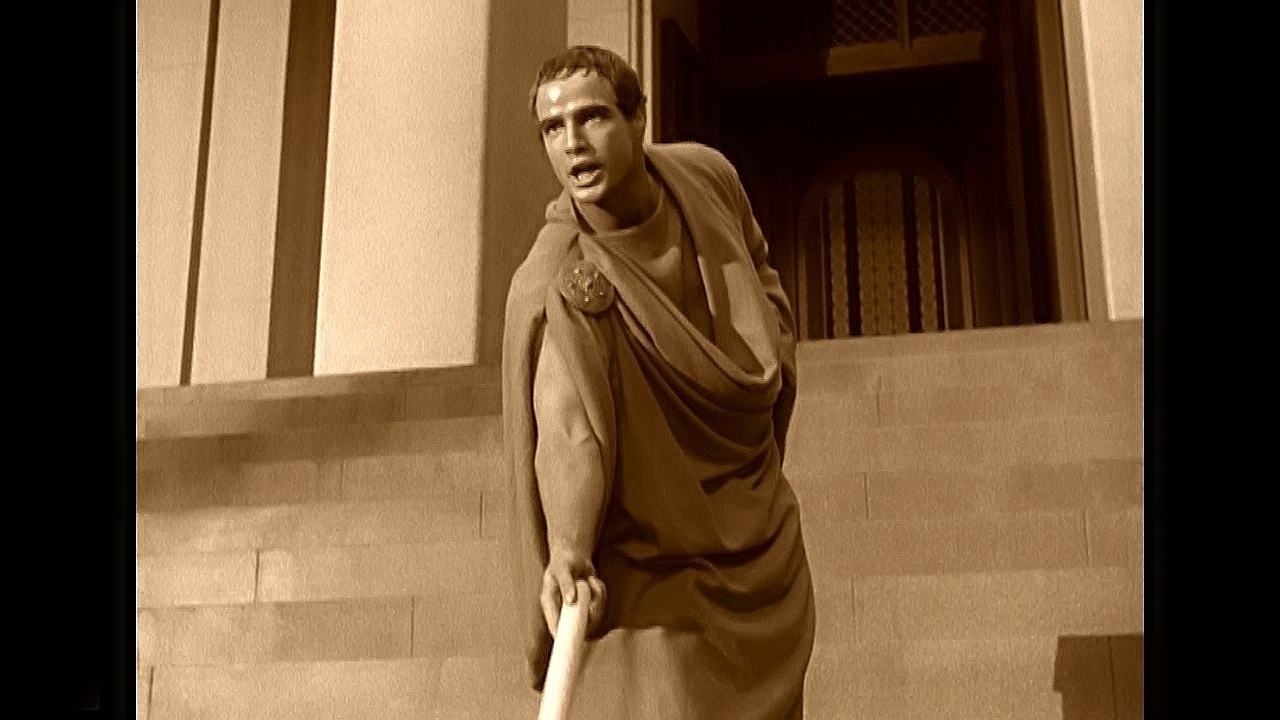
If you've seen the 1989 film Dead Poets Society, you've seen Robin Williams, as 1959 New Hampshire prep-school English teacher John Keating, imitating Marlon Brando and John Wayne doing Shakespeare.
The John Wayne as Macbeth part was a joke, perhaps to suggest it as the conclusion to the slippery slope of Brando reciting Marc Antony's funeral oration for the title character in William Shakespeare's 1599 play Julius Caesar. But Keating wasn't joking about Brando doing that: It happened:
June 3, 1953: The film William Shakespeare's Julius Caesar premieres. As with Shakespeare's other historical plays, it is titled after who was ruling the country at the time. But Caesar, played in this film by Louis Calhern, dies right in the middle of the story, right after telling the Senate, "I am constant as the Northern Star!"
The film is mostly faithful to the play, if not to actual history. It begins with Caesar in his victory parade after defeating his former ally Pompey the Great, being warned to "Beware the Ides of March," and ignoring it. Cassius (Gaius Cassius Longinus, played by John Gielgud) realizes that Caesar has grown too powerful, and entices Marcus Junius Brutus (James Mason) to join him in a conspiracy to assassinate Caesar, which is done on the Senate floor on the Ides of March: On the calendar used today, March 15, 44 BC.
Cassius recruited Brutus because he was believed by many, including Caesar himself, to be Caesar's most loyal ally. So he is the last to plunge the knife in. At least he did it while facing Caesar, as the others all stabbed him from behind or to the side, the source of the expression. "stab in the back."
Before Brutus does it, a shocked Caesar says, "Et tu, Brute?" Latin for, "You, too, Brutus?" The historian Suetonius had suggested that Caesar had said this, but another, Plutarch, wrote that Caesar said nothing. They are often mistaken for Caesar's last words. In the play, in which Caesar, like many rulers, refers to himself in the third person, he follows being stabbed by Brutus with, "Then, fall, Caesar." And he does.
At Caesar's funeral, Brutus delivers an oration defending his actions, and for the moment, the crowd is on his side. But Antony, Caesar's ally, speaks next. At first, he seems to agree, but he uses sarcasm and innuendo to turn the crowd:
Friends, Romans, countrymen, lend me your ears;
I come to bury Caesar, not to praise him.
The evil that men do lives after them;
The good is oft interred with their bones;
So let it be with Caesar. The noble Brutus
Hath told you Caesar was ambitious:
If it were so, it was a grievous fault,
And grievously hath Caesar answer’d it.
Here, under leave of Brutus and the rest–
For Brutus is an honourable man;
So are they all, all honourable men–
Come I to speak in Caesar’s funeral.
He was my friend, faithful and just to me:
But Brutus says he was ambitious;
And Brutus is an honourable man.
He hath brought many captives home to Rome
Whose ransoms did the general coffers fill:
Did this in Caesar seem ambitious?
When that the poor have cried, Caesar hath wept:
Ambition should be made of sterner stuff:
Yet Brutus says he was ambitious;
And Brutus is an honourable man.
You all did see that on the Lupercal
I thrice presented him a kingly crown,
Which he did thrice refuse: was this ambition?
Yet Brutus says he was ambitious;
And, sure, he is an honourable man.
I speak not to disprove what Brutus spoke,
But here I am to speak what I do know.
You all did love him once, not without cause:
What cause withholds you then, to mourn for him?
O judgment! thou art fled to brutish beasts,
And men have lost their reason. Bear with me;
My heart is in the coffin there with Caesar,
And I must pause till it come back to me.
I come to bury Caesar, not to praise him.
The evil that men do lives after them;
The good is oft interred with their bones;
So let it be with Caesar. The noble Brutus
Hath told you Caesar was ambitious:
If it were so, it was a grievous fault,
And grievously hath Caesar answer’d it.
Here, under leave of Brutus and the rest–
For Brutus is an honourable man;
So are they all, all honourable men–
Come I to speak in Caesar’s funeral.
He was my friend, faithful and just to me:
But Brutus says he was ambitious;
And Brutus is an honourable man.
He hath brought many captives home to Rome
Whose ransoms did the general coffers fill:
Did this in Caesar seem ambitious?
When that the poor have cried, Caesar hath wept:
Ambition should be made of sterner stuff:
Yet Brutus says he was ambitious;
And Brutus is an honourable man.
You all did see that on the Lupercal
I thrice presented him a kingly crown,
Which he did thrice refuse: was this ambition?
Yet Brutus says he was ambitious;
And, sure, he is an honourable man.
I speak not to disprove what Brutus spoke,
But here I am to speak what I do know.
You all did love him once, not without cause:
What cause withholds you then, to mourn for him?
O judgment! thou art fled to brutish beasts,
And men have lost their reason. Bear with me;
My heart is in the coffin there with Caesar,
And I must pause till it come back to me.
It works: The common people drive the conspirators out of Rome, weakening their forces. In the resulting civil war, Antony's forces triumph. Following defeat at the Battle of Philippi, in what is now northeastern Greece, on October 23, 42 BC, Cassius has an aide stab him, while Brutus commits suicide the classic Roman way, "Falling on his sword." Antony takes no joy in this, calling Brutus "the noblest Roman of all."
Also of note in the film: Greer Garson as Calpurnia, Caesar's wife; Deborah Kerr as Portia, Brutus' wife; Alan Napier, eventually the butler Alfred on the 1966-68 Batman series, as noted Roman Senator Cicero; John Hoyt as Decius Brutus (an misspelling of Decimus Brutus), a Roman general and a cousin of Marcus Junius Brutus; Ian Wolfe, who specialized in Roman roles, including Septimus in the Star Trek episode "Bread and Circuses," as Ligarius, one of the conspiring Senators; Michael Ansara as Pindarus, another conspirator; and Douglas Watson as Octavius Caesar, a.k.a. Octavian, who initially helps Antony, but later turns against him, and becomes Caesar Augustus, the 1st Emperor of Rome.
The film won just 1 Academy Award, for Best Art Direction. For the 3rd of 4 straight years, Brando was nominated for Best Actor, although he wouldn't win this one, as he did in 1951 for A Streetcar Named Desire and in 1954 for On the Waterfront.
That 1953 Best Actor race was as good as it gets: William Holden won for the World War II film Stalag 17. He defeated Brando; Richard Burton, for another film set in Ancient Rome, The Robe; and Burt Lancaster and Montgomery Clift, each nominated for their roles in From Here to Eternity.
Julius Caesar is a masculine-heavy play, and none of the actresses in this film version was nominated for Best Actress, although Kerr was nominated for her role in From Here to Eternity, losing to Audrey Hepburn of Roman Holiday -- which took place in present-day Rome. From Here to Eternity won Best Picture, defeating William Shakespeare's Julius Caesar, The Robe, Roman Holiday, and the Western Shane.
In 1321, in his Divine Comedy, Dante Aligheri imagined a man being taken through Hell, Purgatory and Heaven. At the bottom of Hell, in its 9th circle, are traitors, as Dante considered betrayal to be the worst sin of all. At the bottom of that, the Devil is eternally chewing on the forms Judas Iscariot, the betrayer of Jesus; and Brutus and Cassius, the betrayers of Caesar.
The Booth brothers, the leading American stage actors of the 19th Century, made their only appearance onstage together in a benefit performance of Julius Caesar on November 25, 1864, at the Winter Garden Theater in New York. Junius Brutus Booth Jr. (1821-1883, named for his father, himself named for an even earlier Brutus in Rome), played Cassius. Edwin Thomas Booth (1833-1893, considered the greatest Hamlet of his time) played Brutus. John Wilkes Booth (1838-1865) played Mark Antony. Ironically, it would be John who became a famous assassin.
On May 29, 1916, commemorating the 300th Anniversary of Shakespeare's death, a production was shown in a natural bowl in Beachwood Canyon in Los Angeles, not far from where the Hollywood Bowl would be built. A crowd of 40,000 people saw Tyrone Power Sr. play Brutus, and Douglas Fairbanks Sr. play Mark Antony. Each man had a namesake son who became a legendary actor as well, and Power Sr. would be surpassed in fame by his son.
In 1937, the Mercury Theatre staged the play on Broadway. Orson Welles directed, and played Brutus. Joseph Holland played Caesar, Greek-English actor George Coulouris played Antony, Joseph Cotten played Publius, Martin Gabel (later better known as the husband of actress Arlene Francis) played Cassius; and Norman Lloyd played Cinna the poet, whose murder scene, rather than Caesar's murder scene or Coulouris' recitation of Antony's eulogy for Caesar, was considered the play's show-stopper. Ironically, Holland outlived most of his castmates, though Lloyd lived to be 106 years old. In 1938, Welles trimmed the play for a one-hour radio broadcast on CBS, with the same cast.
Welles intended the play to be an analogy to the current leader of Italy, the Fascist Il Duce, Benito Mussolini, who was the subject of, among other biographies, one written in 1935 by a friend he had betrayed, the American journalist George Seldes, who titled his book Sawdust Caesar. Likewise, in 1978, historian William Manchester titled his biography of Douglas MacArthur, also a general whose genius was exceeded by his ego, American Caesar.
In 1954, on See It Now, CBS journalist Edward R. Murrow would close his televised exposé of Senator Joseph McCarthy by quoting Cassius' line to Brutus, about how the people of Rome had already let Caesar go too far: "The fault, dear Brutus, is not in our stars, but in ourselves." In 2012, John Green would write a novel for young adult audiences, titled The Fault In Our Stars. It was filmed in 2014.
The 1960 film An Honourable Murder is a reworking of the play, set in present-day London in the world of business, with John Longden (not the American horse-racing jockey) as corporate titan Julian Caesar. The 1963 film Cleopatra fictionalizes the romance between the titular Queen of Egypt (Elizabeth Taylor) and Caesar (Rex Harrison), and the later one between Cleopatra and Mark Antony (Richard Button, whom Taylor soon married). In the film, Cleopatra has a nightmare about Caesar's assassination, and is then told that it has happened. However, she is not mentioned in Shakespeare's play Julius Caesar.
Ted Sorensen, one of President John F. Kennedy's speechwriters, recalled a conversation with JFK's brother and Attorney General, Robert F. Kennedy, after JFK's assassination. Bobby was worried that Jack would be forgotten by history, since he had been President less than 3 full years. Sorensen reminded RFK that Julius Caesar had ruled Rome for only 3 years, and was still remembered. RFK reminded Sorensen that Caesar had Shakespeare writing about him. This led Sorensen to write a biography of JFK, and it won the Pulitzer Prize.
Of course, the real Caesar had an earlier writer to tell his story: Himself. His own writings, about his escapades in war, have survived. They reveal his genius, but also his massive ego.
The Star Trek franchise is loaded with Shakespearean references, and the 1966 original series episode "The Conscience of the King" is about a traveling company of actors, specializing in Shakespeare's works, led by a man who hides his identity as a politician who, many years earlier, had committed a massacre. His daughter tries to protect him, and, threatening Captain Kirk, says, "Caesar, beware the Ides of March!" But her father, tired of it all, steps in between Kirk and her phaser beam, driving her into the last part of madness.
The 1991 film Star Trek VI: The Undiscovered Country takes its title from a line from Hamlet, and the Klingon General Chang is played by Christopher Plummer, who got his start in Shakespearean roles in Montreal, alongside his fellow native of that city, Kirk portrayer William Shatner. Chang quotes Shakespeare throughout, including Caesar's line, "I am constant as the Northern Star," and Antony's line, "Cry havoc! And let slip the dogs of war!"
In a 1970 film version of Julius Caesar, Gielgud played Caesar, with Charlton Heston as Antony and Jason Robards as Brutus. In 1977, Gielgud played Caesar at the Royal National Theatre in London, in what turned out to be his last Shakespearean stage appearance.
In a 1972 episode of The Odd Couple, "A Night to Dismember," Oscar Madison (Jack Klugman) is hypnotized, with a post-hypnotic suggestion: When he hears, "The fault lies not in our stars, but in ourselves," he is to stop being messy as usual, and become as neat as he thinks Felix is -- but it goes too far. In 1973, the BBC aired the TV-play Heil Caesar, set in a present-day Britain that is teetering on the verge of a dictatorship. The BBC did the play straight in 1978, and again in 2012, with an all-black cast led by Paterson Joseph as Brutus and Ray Fearon as Antony. A 1984 Charles Bronson film was titled The Evil That Men Do.
"The Dogs of War" would be used as the titles of a 1974 novel by Frederick Forsyth, a 2017 novel by Adrian Tchaikovsky, a 1999 episode of Star Trek: Deep Space Nine, and a 2003 episode of The West Wing.
The expression "It's Greek to me," to mean a lack of understanding of something, dates back to the play, as Casca tells Cassius of a speech that Cicero made. "Et tu?" has been used by many people, including in popular culture, to suggest that someone has been let down by the last person they expected to do so.
The name "Caesar" was applied to the Emperors of Rome, some of whom adopted it as part of their legal names. The German title for Emperor, "Kaiser," and the Russian title, "Czar" or "Tsar," both come from "Caesar."
I once saw a T-shirt (sadly, I could find no picture of it online) showing a Roman soldier cutting a steak with his sword, saying, "Caesar did not have a salad." But the Caesar salad has nothing to do with the historic Roman. It was created in 1924 by Caesar Cardini, who ran Caesar's restaurant in Tijuana, Mexico. He also created the salad dressing that goes with it, which eventually led to this meme. Note that the bottle has been stabbed in the back:

In a 2012 episode of the YouTube series Epic Rap Battles of History, Angela Trimbur played Cleopatra, against Kimmy Gatewood playing Marilyn Monroe. A 2015 episode featured "Nice" Peter Shukoff as Julius Caesar, against early 19th Century South African Chief Shaka Zulu, played by DeStorm Power. The Cleopatra episode mentioned Caesar, and vice versa.
*
June 3, 1953 was a Wednesday. These baseball games were played:
* The New York Yankees beat the Chicago White Sox, 18-2 at Comiskey Park in Chicago. This was the 6th straight win for the Yankees, in a winning streak that would eventually reach 18. Whitey Ford was the winning pitcher for the Bronx Bombers, while Bob Keegan didn't get out of the 2nd inning for the South Siders.
The Yankees got 19 hits, but only 1 was a home run, by Irv Noren. Mickey Mantle went 1-for-4, but had 4 RBIs: On a single, a groundout, and 2 bases-loaded walks. Joe Collins went 4-for-5 with a walk and an RBI. Gene Woodling went 2-for-5 with a walk and 3 RBIs. Charlie Silvera, filling in at catcher for the injured Yogi Berra, went 3-for-6 with 2 RBIs.
* The New York Giants beat the Cincinnati Reds, 11-3 at the Polo Grounds. Larry Jansen went the distance for the win. Daryl Spencer hit 2 home runs and had 5 RBIs. Davey Williams went 2-for-4 with a home run, a walk, and 3 RBIs. Willie Mays was unavailable for the Giants, as he was serving in the Korean War.
The next day, the Giants won by the exact same score as they scored 7 runs in the bottom of the 8th to come from behind and win.
* The Brooklyn Dodgers lost to the Milwaukee Braves, 14-9 at Ebbets Field. Vern Bickford didn't get out of the 3rd inning for the Braves, but Carl Erskine didn't get out of the 5th for Dem Bums. Eddie Mathews, Jim Pendleton, and former Dodger Andy Pafko hit home runs for the Braves. Jackie Robinson only appeared as a pinch-hitter, and drew a walk.
* A doubleheader was split at the former Shibe Park, newly renamed Connie Mack Stadium, in Philadelphia. The St. Louis Cardinals won the opener, 5-3. The Philadelphia Phillies won the nightcap, 6-5. Over the 2 games, Stan Musial went 1-for-6 with 2 walks and 2 RBIs. The next day, the Phils again beat the Cards, 6-5.
* The Pittsburgh Pirates beat the Chicago Cubs, 1-0 at Forbes Field in Pittsburgh. Paul LePalme pitched a 7-hit shutout, outpitching Warren Hacker. The only run came in the bottom of the 4th, when Pete Castiglione singled Ralph Kiner home.
The very next day, in a blockbuster deal with the Cubs, Pirate general manager Branch Rickey traded Kiner, Joe Garagiola, George "Catfish" Metkovich and Howie Pollet, for Bob Addis, Toby Atwell, George Freese, Gene Hermanski, Bob Schultz, Preston Ward, and $150,000. Rickey was so cheap (How cheap was he?), it was once said of him, "He has players and he has money, and he does not like to see the two of them mix." So he valued the cash he was getting from Cubs owner and chewing gum magnate Philip K. Wrigley more than the 6 players he was getting, or the 4 players he was giving up.
One of those players, Kiner, was on his way to the Hall of Fame. But he was also making $75,000, a cut from $90,000 the season before. The Pirates were coming off an atrocious season in which they went 42-112, despite Kiner leading the National League in home runs for a record 7th season in a row. Rickey told Kiner, "We finished 8th with you, and we can finish 8th without you" -- meaning, "...and keep a lot of the money we're paying you."
* The Boston Red Sox beat the Cleveland Indians, 4-3 at Cleveland Municipal Stadium. The Red Sox scored 3 runs off Early Wynn in the top of the 9th inning to come from behind, to make Ellis Kinder a winning pitcher in relief of Sid Hudson. Ted Williams was unavailable for the Red Sox, as he was serving in the Korean War.
* The Philadelphia Athletics beat the Detroit Tigers, 10-7 at Briggs Stadium (later renamed Tiger Stadium) in Detroit. Gus Zernial had 2 home runs and 5 RBIs.
* And the Washington Senators beat the St. Louis Browns, 3-2 at what had been the last ballpark in St. Louis known as Sportsman's Park, but had just been renamed as the first Busch Stadium. Wayne Terwilliger singled Eddie Yost home with the winning run in the top of the 10th inning.


No comments:
Post a Comment