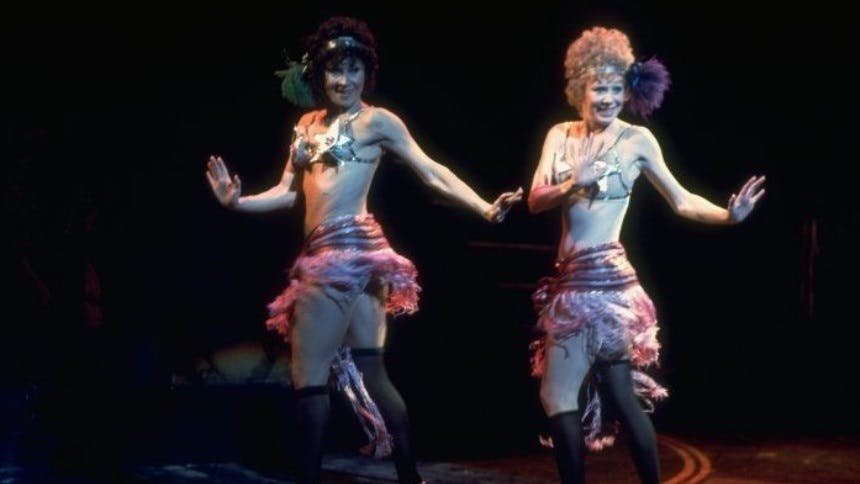
Chita Rivera (left) and Gwen Verdon
June 3, 1975: The musical Chicago opens at the 46th Street Theatre in Midtown Manhattan.
The background: In 1924, Beulah Annan, cheating on her husband, shot her boyfriend -- she claimed, in self-defense. She was acquitted, but died of tuberculosis in 1928. Also in 1924, Belva Gaertner shot and killed her boyfriend. Each of them was married to someone else. She was also acquitted, and lived on until 1965.
Both crimes, and both trials, occurred in Chicago, and Maurine Dallas Watkins covered both trials for the Chicago Tribune. The novelty of a female reporter covering the murder trials of women caught the public's attention. In 1926, Watkins wrote a play, titled Chicago, with Belva being renamed Velma Kelly and depicted as a successful showgirl, and Beulah being renamed Roxie Hart and depicted as wanting to be one. Watkins lived until 1969.
The play was successful. In 1927, Cecil B. DeMille produced a silent film version, starring Phyllis Haver as Roxie. That was successful, too. Even more successful was the 1942 film Roxie Hart, starring Ginger Rogers. It was successful because the Great Depression, and the start of World War II, had made stories set in the Roaring Twenties, not that long ago, charming period pieces.
This film is, so far, the only version of the story in which Roxie is actually innocent, mainly because of the Hays Code, as she had to be seen as a wronged heroine, not as villainess, however justified. But, for the plot, her innocence didn't matter. In 1924, the joke was that all-male juries would never convict a woman of murder, because that would mean the death penalty. But in the play, a woman who is actually innocent -- an immigrant, of course -- is convicted and hanged, making Roxie's case desperate.
In the 1960s, actress Gwen Verdon read the play, and asked her husband, actor-dancer-choreographer Bob Fosse, to turn it into a Broadway musical. Fosse approached Watkins to buy the rights, but she wouldn't sell. She died in 1969. Once her estate was settled, the rights were sold to the Fosses and producer Richard Fryer. John Kander and Fred Ebb wrote the songs.
On June 3, 1975, over half a century after the original case -- hence, the reference to "fifty years" in the song "Nowadays" -- it finally opened, with Verdon as Roxie and Chita Rivera as Velma. At 50 and 42, respectively, each was already way too old for the part. But, in spite of their ages, both were still so sexy that it didn't matter: The play was a hit.
Notable early in the show is "The Cell Block Tango," clearly a ripoff of the title song sequence of the Elvis Presley film Jailhouse Rock. Six women on "Murderesses' Row" tell their tales:
* Liz had a husband named Bernie. She hated the sound made when her husband would pop his bubble gum: "I took a shotgun from the wall and fired two warning shots -- into his head."
* Annie moved in with Ezekiel, who claimed to be single. "Single, my ass!" she says, after finding out he was a Mormon with 6 wives. So, she fixed him a drink: "You know, some guys just can't hold their arsenic."
* June was making dinner when she was accused by her husband Wilbur of screwing the milkman. Was she? She neither admits it nor denies it. She says, "And then, he ran into my knife. He ran into my knife ten times!"
* Katalin Helinszki, a Hungarian ballet dancer, known as "The Hunyak." (This, along with its variant "Hunyock," was a term for unskilled laborers from Eastern Europe, and is a slur that should not have been allowed by the time the musical was finally filmed in 2002.) She's actually innocent, but, because she's an immigrant who can't speak English -- limited to, when Roxie asks her, "Yeah, but did you do it?" the words, "Uh-uh: Not guilty!" -- she ends up convicted and hanged.
* Velma claims that she caught her husband having sex with her sister, who was also her stage partner. Unlike the other four guilty women, who confess to the audience if not to the court, she flat-out lies, and claims she doesn't remember doing it, that she blacked out: "I can't remember a thing. It was only later, when I was washing the blood off my hands, that I even knew they were dead."
* Mona married Alvin because he was "a sensitive guy, a painter." He said he wanted to "find himself." He ended up finding himself in lovers of both sexes. She says, "I guess you could say we broke up because of creative differences: He saw himself as alive, and I saw him dead!"
Both Velma and Roxie are defended by Billy Flynn, played by Jerry Orbach in the original musical. He plays them off each other, and they use each other for their own purposes as well. Spoiler Alert for an old story: Velma ends up cutting a deal with the State's Attorney, testifying against Roxie in exchange for a plea bargain and an early parole; and Billy finds out about it, and uses it to question the S.A.'s character, and Roxie is acquitted.
But right after she is let go, another murder is committed, spectacularly right outside the courthouse, with all the reporters and photographers a few feet away. And Roxie is no longer the star. It's just her, alone... and Amos. She'd rather be alone than be with him. He wouldn't. He's the real victim.
Time goes by, the stock market crashes, the Roaring Twenties become the Dirty Thirties, the Coolidge Prosperity becomes the Hoover Great Depression, and Velma and Roxie can't find work -- until they team up. Roxie hears Velma suggest this, and says, "There's just one problem: We hate each other!" Velma says, "There's one business where that's not a problem," meaning show business. After all, one murderess is a-dime-a-dozen, but two of them together is a hit!
As was the 1975 musical. It was nominated for 11 Tony Awards, including Best Musical, Fosse for directing and choreography; and Verdon, Rivera and Orbach, all for acting. Strangely, it won none of those 11 nominations: A Chorus Line had opened 2 months earlier, and took most of the big awards.
Chicago was revived in 1996. Ann Reinking, the dancer-actress that Fosse left Verdon for well before the '75 premiere, had succeeded Verdon as Roxie in that show, and not only reprised the role in '96, but choreographed it as well. She won the Tony for choreography, but not for acting. Bebe Neuwirth, best known for playing Dr Lilith Sternin-Crane on Cheers, played Velma; and James Naughton played Billy. Again, the female leads were too old for the parts -- Reinking was 44 and Neuwirth was 36 -- but it didn't seem to matter, as the show was a hit all over again. Still running as of June 3, 2002, it became the longest-running revival in Broadway history.
The play won the Tonys for Best Revival of a Musical, Walter Bobbie for Best Director, and Broadway legend Joel Grey won Best Actor for playing Roxie's beleaguered husband, Amos Hart. In the original, Amos was played by Barney Martin, by this point best known for playing Morty, Jerry's father, on Seinfeld.
Fosse had wanted to film Chicago, but his health failed, and he died in 1987. The Broadway revival also revived interest in a film version, but it seemed tricky, due to the vaudeville style of the musical seeming like it wouldn't translate well to the big screen. The word "unfilmable" began to be used.
Director Rob Marshall -- a choreographer like his sister, Kathleen Marshall, but no relation to directors and siblings Garry and Penny Marshall -- came up with the idea of filming the show scenes in bright lights, making them figments of Roxie's imagination; while filming the "real life" segments with a darker lens, letting both the character and the viewer know that this was real, and deadly serious.
It worked: Unlike most recent film musicals -- even A Chorus Line had bombed as a movie -- Chicago was a hit, and was nominated for 13 Academy Awards. At the 2003 "Oscar" ceremony, it won 6, including Best Picture, and Catherine Zeta-Jones won Best Supporting Actress for playing Velma. Zeta-Jones now had an Oscar, to go with the 2 her husband, Michael Douglas, had won, for Best Picture for producing One Flew Over the Cuckoo's Nest in 1976, and for Best Actor for Wall Street in 1998. At the time of the ceremony, she was 8 months pregnant with their daughter, Carys. They already had a son, Dylan.
Renée Zellweger was nominated for Best Actress for playing Roxie, Marshall for Best Director, and John C. Reilly for Best Supporting Actor as Amos. Queen Latifah, the rapper who starred in the 1990s Fox sitcom Living Single, was nominated for Best Supporting Actress, for playing Mama Morton, the prison matron, a role expanded for the film version. None of them won. Richard Gere played Billy Flynn, but was not nominated. Chita Rivera, the original musical's Velma, had a cameo. (At least this time, the leads were closer to the right age: Both Zeta-Jones and Zellweger were 33 during filming.)
As I said, Maurine Dallas Watkins died in 1969, and Bob Fosse in 1987. Gwen Verdon died in 2000, Fred Ebb and Jerry Orbach in 2004, Barney Martin in 2005, and Ann Reinking in 2020. As of June 3, 2002, John Kander, Chita Rivera, Joel Grey, Bebe Neuwirth, Rob Marshall, Renée Zellweger, Catherine Zeta-Jones, Queen Latifah, Richard Gere and John C. Reilly are still alive. (UPDATE: Chita Rivera died in 2024.)
The 46th Street Theatre, now the Richard Rodgers Theatre, still stands, at 226 West 46th Street.
*
June 3, 1975 was a Tuesday. These Major League Baseball games were played:
* The New York Yankees beat the Minnesota Twins, 5-4 at Metropolitan Stadium in the Minneapolis suburb of Bloomington, Minnesota. Pat Dobson outpitched Dave Goltz. Bobby Bonds, in his only season with the Yankees, hit a home run for them. He and Chris Chambliss each had 2 hits. Rod Carew went 3-for-3 with a solo home run and 2 walks.
* The New York Mets beat the Houston Astros, 4-3 at Shea Stadium. Tom Hall outpitched Ken Forsch. Dave Kingman hit a home run. Joe Torre went 1-for-3 with a walk.
* The Los Angeles Dodgers beat the Montreal Expos, 6-5 at Jarry Park in Montreal.
* The Boston Red Sox beat the Chicago White Sox, 4-0 at Fenway Park in Boston. Dick Pole -- I swear, that was his real name -- pitched a 3-hit shutout. Carl Yastrzemski went 0-for-3 with 2 walks. Rookie Jim Rice went 2-for-4 with a home run and 3 RBIs.
* The Philadelphia Phillies beat the San Diego Padres, 12-1 at Veterans Stadium in Philadelphia. Mike Schmidt hit 2 home runs and had 5 RBIs.
* The Baltimore Orioles beat the Texas Rangers, 6-3 at Memorial Stadium in Baltimore. Brooks Robinson went 1-for-4 with an RBI.
* The Cincinnati Reds beat the Pittsburgh Pirates, 8-4 at Three Rivers Stadium in Pittsburgh. Pete Rose went 1-for-4 with an RBI. Joe Morgan went 3-for-5 with 3 RBIs. Johnny Bench went 0-for-4 with a walk. Willie Stargell went 0-for-4.
* The Kansas City Royals beat the Cleveland Indians, 5-2 at Cleveland Municipal Stadium. Harmon Killebrew, the Minnesota Twins legend running out the string, went 1-for-3 with a walk. George Brett went 0-for-3 with a walk. Frank Robinson, now player-manager for the Indians, did not put himself in the game.
* The Chicago Cubs beat the San Francisco Giants, 6-5 at Wrigley Field in Chicago. Bill Madlock doubled Don Kessinger home with the winning run in the bottom of the 10th inning.
* The St. Louis Cardinals beat the Atlanta Braves, 4-2 at Busch Memorial Stadium in St. Louis. Lou Brock went 1-for-4 with 2 stolen bases.
* The Detroit Tigers beat the California Angels, 8-5 at Anaheim Stadium (now Angel Stadium of Anaheim). The Tigers scored 5 runs in the top of the 9th to win it. It was a rarity for them: They lost 102 games, their worst season between 1952 and 1996.
* And the Milwaukee Brewers beat the Oakland Athletics, 5-4 at the Oakland Coliseum. Hank Aaron went 1-for-3. George "Boomer" Scott hit a home run. Robin Yount went 0-for-5. Reggie Jackson, then wearing Number 9 for the A's, but would later honor Aaron by wearing Number 44 with the Yankees and the Angels, hit a home run.


No comments:
Post a Comment