Showing posts with label sarah bernhardt. Show all posts

Wednesday, April 13, 2022

April 14, 1900: The Exposition Universelle Opens in Paris

April 14, 1900: The Exposition Universelle opens in Paris. It was the 17th World's Fair in Paris, and the 5th known as the Universal Exposition, but it became the best-known of them, the dawn of a new century.

The Fair was held to celebrate the achievements of the past century, and to accelerate development into the next. It was held at the esplanade of Les Invalides, the Champ de Mars, the Trocadéro, and at the banks of the River Seine between them, with an additional section in the Bois de Vincennes. It was visited by more than 50 million people.

Many technological innovations were displayed at the Fair, including a ferris wheel (an idea that had debuted at a previous World's Fair, the World's Columbian Exposition in Chicago in 1893; a moving sidewalk, the 1st regular passenger trolleybus line, escalators, diesel engines, electric cars, dry cell batteries, electric fire engines, talking films, a magnetic audio recorder, and matryoshka (Russian nesting) dolls.

One film that did not "talk" was the 1st version of William Shakespeare's Hamlet ever filmed, a brief recreation of the sword duel between Hamlet and Laertes. Hamlet was played by a woman. Not just any woman, but the woman then considered the world's greatest living actress: Sarah Bernhardt. Hamlet is usually depicted as a young man, around college age. "The Divine Sarah," as much the pride of France as any of its citizens then living, was 55 years old.

It also brought international attention to the Art Nouveau style. Additionally, it showcased France as a major colonial power, through numerous pavilions built on the hill of the Trocadéro Palace. The Palace, an auditorium and museum, was demolished in 1937, to make way for the Palais de Chaillot.

The Métropolitain, or Métro, Paris' subway system, opened on July 19, and was able to service the Exposition.

Many international congresses and other events were held within the framework of the exposition, including the 1900 Summer Olympics. Those Games were awarded to Paris as a tribute to the founder of the modern Olympic Games, Baron Pierre de Coubertin. But they were easily the lamest Olympics ever, with only 26 countries participating. There weren't even Opening or Closing Ceremonies. It did, however, mark the debut of women competing.

The fair closed on November 12. Paris would also host World's Fairs in 1925, 1931, 1937 and 1947.

*

April 14, 1900 was a Saturday. Baseball season was 5 days away, and no other sport was then in progress in North America. In English soccer, Woolwich Arsenal, the South-East London team that would later become the North London team Arsenal, and later still a team I began to support, went to Cleethorpes in Lincolnshire, and lost to Grimsby Town, 1-0 at Blundell Park.

Wednesday, March 30, 2022

March 31, 1889: The Eiffel Tower Opens

March 31, 1889: The Eiffel Tower opens, on the Left Bank on the River Seine, in the 7th Arrondissement of Paris. It was the centerpiece of the Exposition Universelle, a World's Fair celebrating the 100th Anniversary of the French Revolution.

Parisian high society hated it. I guess they didn't get the memo: The fair was celebrating the overthrow of the high society of the previous century. Everybody else liked it. Visitors during the Exposition included the great French stage actress Sarah Bernhardt, the Prince of Wales (later King Edward VII of Britain, who was having an affair with Bernhardt), inventor Thomas Edison, and Buffalo Bill Cody, whose Wild West Show was an attraction at the fair.

Gustave Eiffel was 56 years old at the time it opened, and was previously best known for designing railroad bridges, which explains the black iron structure of his tower. It was meant to be torn down after the fair, but it was kept up. This proved to be invaluable in World War I, since its height made it a good point from which to transmit radio signals from the capital to the front, something of which Eiffel heartily approved. He died in 1923.
From 1925 to 1934, it was the world's tallest advertisement, carrying a sign advertising Citroën cars on its sides. When the Nazis took over in 1940, Adolf Hitler wanted it dismantled and taken to Berlin. When the Allies advanced on Paris in 1944, Hitler wanted the city burned and the Tower blown up. Neither happened.

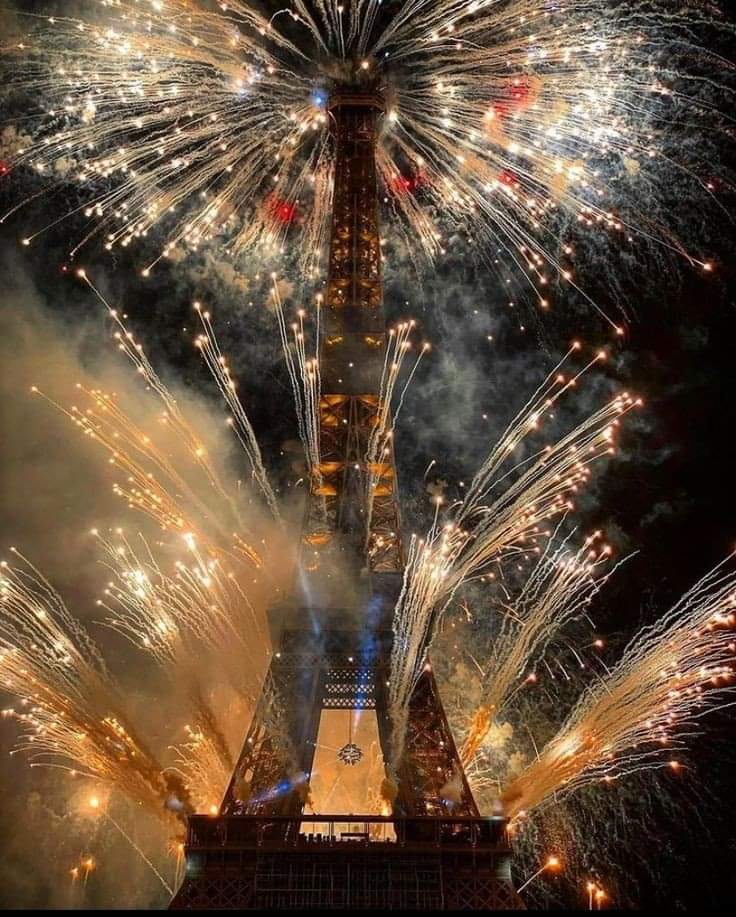
Its original height was 984 feet, making it the tallest freestanding structure in the world, until surpassed by the Chrysler Building in 1930. In 1957, a broadcast antenna was added, making it 1,052 feet tall. The antenna has periodically been replaced, and a new one in 2022, for digital radio, made it 1,083 feet. Like the Empire State Building in New York, it gets lit up in special colors for special occasions (including France winning the World Cup in 1998 and 2018), and it gets fireworks shot out of it every New Year's Eve.
At Midnight on New Year's Eve

It remains, easily, the tallest building in France, and still serves as a stand-in for the city, the entire country, sometimes even for Europe as a whole. Of course, it has still has its critics: A common joke is that it has the best view in Paris, because, from there, you can't see the Eiffel Tower.

Many copies or replicas, at least in intent, have been built, including the Blackpool Tower in England, the Tokyo Tower in Japan, one at the France Pavilion at Epcot at Walt Disney World in Florida, and one at the Paris Las Vegas Casino Hotel.

It's been shown in many films, including Funny Face in 1957, The Great Race in 1965, Superman II in 1981, A View to a Kill with Roger Moore as James Bond in 1985, National Treasure: Book of Secrets in 2007, and the recent animated films Ratatouille in 2007 and Hugo in 2011. It's also one of those landmarks that tends to get destroyed in disaster movies, including Armageddon in 1998 and G.I. Joe: The Rise of Cobra in 2009.

*

March 31, 1889 was a Sunday. Baseball was in the preseason, football was out of season, basketball didn't exist yet, and hockey barely did. So there were no scores on this historic day.

Sunday, March 20, 2022

March 21, 1901: Bernhardt, Duse & D'Annunzio

March 21, 1901: La Città Morta (The Dead City) premieres at Teatro della Canobbiana, in Milan, Italy. Set in the ruins of Mycenae, in ancient Greece, it explores themes of love, jealousy, obsession, and the clash between past and present. The plot follows characters entangled in a web of passion and despair as they confront their inner demons and the ghosts of history.

The play was written by Gabriele D'Annunzio. It's been said that there is a fine line between genius and madness. D'Annunzio pissed on that line.
Gabriele D'Annunzio

Born in 1863 in Pescara, Italy, he was a poet, a playwright, an orator, a journalist, an aristocrat, and an officer in the Royal Italian Army during World War I. He was considered one of the greatest novelists of his time, but he was also one of the intellectual fathers of Fascism, as he was an early supporter of dictator Benito Mussolini.

In 1894, he began an affair with actress Eleonora Duse. Born in 1858 outside Pavia, she was considered the greatest Italian actress of her era. She achieved a unique power of conviction and verity on the stage through intense absorption in the character, "eliminating the self" as she put it, and letting the qualities emerge from within, not imposed through artifice.
Eleonora Duse

But there was an even greater actress at the time, from France: "The Divine Sarah." Sarah Bernhardt was born in 1844 in Paris, and by the 1870s was already touring everywhere that she was beloved, which was basically any country that had a stage.

No less than Edmond Rostand, author of the 1897 play Cyrano de Bergeraccalled her "the queen of the pose and the princess of the gesture." Victor Hugo, author of The Hunchback of Notre-Dame and Les Misérables, wrote a play based on the Spanish legend Ruy Blas, and demanded that she be cast in it, citing her "golden voice."
Sarah Bernhardt

d'Annunzio wrote 4 plays for Duse to star in. But when he cast Bernhardt in La Città Morta, she was furious, and ended the affair. Not to be outdone, he wrote a novel, Il Fuoco (The Flame). Finishing it, he gave her a copy. It contained intimate details about their affair. Very intimate details, including details about her body that only a bed-partner could know. She got furious all over again, and demanded that he burn his original manuscript.

He said he had to publish it, because he was broke. He said he would burn it if she would give him the same amount of money that he said he was getting as an advance. She went on tour, including in America, to great success, made the money, and gave it to him. He told her he burned the original manuscript. He lied: It was published, anyway.

This led George Seldes, the American journalist who covered Mussolini in his early days as Italy's dictator -- and got chased out and nearly killed for his criticisms, to call D'Annunzio one of "the three SOBs" he had covered in a career that lasted through every decade of the 20th Century. (Seldes survived Il Duce's attempt to have him killed, and lived to be 104.) Seldes wrote, "Treason is treason, to a person as well as to an idea. Many a man has betrayed a person or country for a cause he felt just. This man merely doubled his money." (Seldes' other two "SOBs" were actor Errol Flynn and broadcaster Fulton Lewis Jr. -- also for their frauds.)

Bernhardt died in 1923, Duse in 1924, both still beloved. Which was greater? The Irish playwright George Bernard Shaw, who saw both actresses in London within the span of a few days, in the same play, gave his nod to Duse. English actress Ellen Terry, a contemporary who knew them both, observed, "How futile it is to make comparisons! Better far to thank heaven for both these women."

d'Annunzio lived to see Italy's rise under Mussolini, but not its fall under him, dying in 1938, and has mostly been forgotten outside his home country. Which may be what he deserves.

*

March 21, 1901 was a Thursday. The only major professional sport in North America at the time was baseball, and it was then in Spring Training. Hockey's Stanley Cup had been awarded the previous month, to the Winnipeg Victorias. But there were no scores that counted on this day.

December 31, 1999 & January 1, 2000: The Millennium

December 31, 1999:  The Millennium arrives. The people of planet Earth survived. At a terrible cost. But we hadn't destroyed ourselves. ...