Showing posts with label lou gehrig. Show all posts

Wednesday, November 2, 2022

November 2, 1934: The Yankees vs. the Yankees of Japan

Eiji Swamura

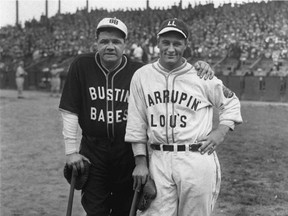
November 2, 1934: Babe Ruth, Lou Gehrig, and several other baseball players, led by manager Connie Mack, step off the cruiseliner Empress of Japan at the port city of Yokohama, and begin a tour of Japan. This was the 1st time that American major leaguers faced Japanese professionals.

The American "besuboru" players were adored by the Japanese fans, especially "Babu Rusu." But as much as they loved their own players, the natives were under no illusions: No one was surprised when the Americans won 17 out of 18 games.

The big surprise occurred when 17-year-old Eiji Sawamura of the Tokyo Baseball Club struck Ruth, Gehrig, Jimmie Foxx and Charlie Gehringer out in succession in a game in Shizuoka. But Gehrig also hit a home run off him, and the Americans won 1-0.

The Tokyo BC was founded that season, and in 1947, they became known as the Yomiuri Giants. Unlike in North American sports, where sports teams merely sell the naming rights to their venues to corporations, in Asian sports leagues, corporations buy teams, and name them after themselves. (This has also been done by Red Bull of Austria, buying the New York Red Bulls and the former soccer teams of Salzubrg and Leipzig.) Yomiuri Shumbun started as a newspaper, and has grown to a massive media conglomerate.

The Giants have won 47 Pennants (38 of them in the Central League, including in 2021) and 22 Japan Series (the last in 2012). Because of this, despite bearing the name and colors of the New York (now San Francisco) Giants of the National League, they are known as "The Yankees of Japan."

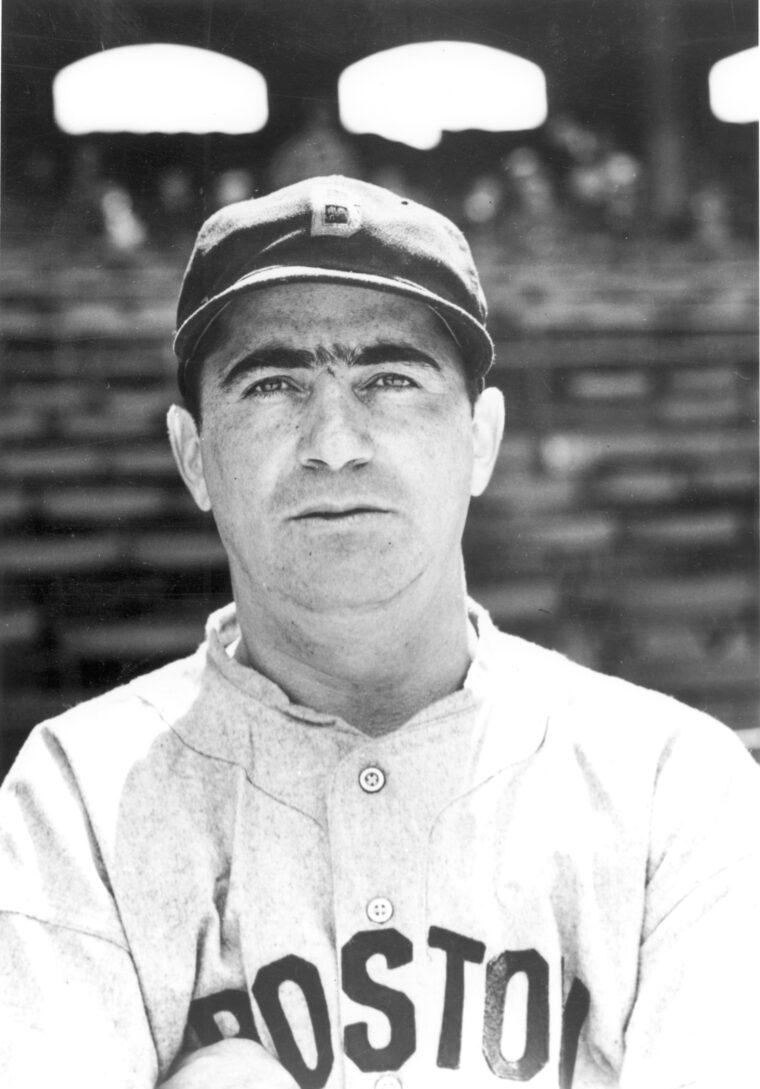
Among the American players on that tour was Moe Berg, a good catcher, and an intellectual from Newark. Dave Harris, a teammate on the Washington Senators, was told that Berg spoke 7 languages, responded, "Yeah, and he can't hit in any of them." He was right: Berg's lifetime batting average was .243.
Moe Berg

But his skill with languages, and with a camera, led the U.S. Department of State to include him on the roster. With the countries not yet at war, but with tensions between them rising, Berg was able, without suspicion, to go onto the rooftops of major buildings in Japan's various cities, and take pictures and home movies. These images aided the U.S. Department of War (which became the Department of Defense in 1947) to pick bombing targets once Japan's attack on Pearl Harbor in 1941 forced America into World War II.

That war cut Sawamura's career short: He ended up being killed in 1944, when his ship was sunk by an American ship. The Japanese leagues now give the Eiji Sawamura Award to their best pitcher, their equivalent of the Cy Young Award.

Berg last played in the major leagues in 1939, served with the Office of Strategic Services (OSS, forerunner of the CIA), and lived on until 1972.

*

November 2, 1934 was a Friday. Baseball season was over. Football was in midweek. The NBA hadn't been founded yet. And the NHL season wouldn't start until November 8. So there were no scores on this historic day. But Australian tennis legend Ken Rosewall was born on this day.

Friday, October 14, 2022

October 14, 1928: Ruth & Gehrig In Montreal

October 14, 1928: Fresh off their 3rd straight World Series appearance and 2nd straight win, Babe Ruth and Lou Gehrig of the New York Yankees bring their "barnstorming" tour to Delorimier Stadium, the new 20,000-seat home of the International League's Montreal Royals.
They would play for Ahuntsic, a semi-pro team from the north side of the city (Montréal-Nord), against the Chappies, a team of black American players led by George "Chappie" Johnson, the top catcher in black baseball in the 1900s and 1910s.
Bad weather held the crowd to 16,000, but they were thrilled when Ruth hit 5 balls over the fence in batting practice. The actual game was tight, and the Babe came in to pitch. In the top of the 9th, Gehrig hit a home run to give Ahuntsic the lead, and the fans rushed the field, making the bottom of the 9th unplayable.

People who favor the modern game of baseball -- and people who simply hate the Yankees -- love to point out that Ruth and Gehrig never played against black players, since black players weren't allowed in the major leagues until 1947. But tours like this render the argument a half-truth. They did face black players, albeit not in regular-season competition or in the World Series. But, on some occasions, it was on a black team's home field, in front of mostly-black crowds, in conditions that favored the all-black teams. And their pitchers couldn't stop the Sultan of Swat and the Iron Horse any more than the white pitchers could.

This ballpark, also known as Delorimier Downs, Montreal Stadium and Hector Racine Stadium, would be home to the Royals from 1928 until their dissolution after the 1960 season; and the Canadian Football League's Montreal Alouettes from 1946 to 1953. A survey was done to determine if it could be used as the home of the expansion Montreal Expos in 1969, but it was determined that the stadium was already in such bad shape, they might as well build a new one elsewhere. That became Jarry Park. The old one was torn down in 1971, and a high school was built on the site.

After Montreal, Ruth and Gehrig went on to Hull, Quebec, across the Ottawa River from the national capital of Ottawa, and, on October 15 at Dupuis Park, beat a team that included brothers Frank Boucher of the New York Rangers and Georges "Buck" Boucher of the Ottawa Senators, both members of the Hockey Hall of Fame.

Then they headed back to the U.S., touring the Midwest and the West, before their planned finale in Denver on Halloween was rained out. MLB rules said that barnstorming tours must be completed by October 31. This was before Bud Selig was born, allowing baseball games after that date.

*

October 14, 1928 was a Sunday. Héctor Rial was born that day. The Argentine forward helped Nacional win Uruguay's league in 1952, before being purchased by Real Madrid. With them, he won 5 La Liga titles, and the 1st 5 European Cups, 1956 to 1960.

And these games were played in the NFL:

* The football version of the New York Yankees (like the Giants, containing no players from the baseball team for whom they were named) lost to the Detroit Wolverines, 35-12 at Yankee Stadium.

* The New York Giants lost to the Chicago Bears, 13-0 at Wrigley Field in Chicago.

* The Providence Steam Roller beat the Dayton Triangles, 28-0 at the Providence Cycledrome in Rhode Island. Always without the S on the end ("Roller," not "Rollers"), Providence would win the NFL Championship that season. It would take another 73 years for another NFL team based in New England to take the title.

* And the Green Bay Packers beat the Chicago Cardinals, 20-0 at City Stadium in Green Bay, Wisconsin.

Saturday, October 8, 2022

October 8, 1927: The Yankees' Murderer's Row, "The Greatest Team Ever"

The 1927 New York Yankees. In the top row,
Lou Gehrig is furthest to the left.
and Babe Ruth is 5th from the left.

October 8, 1927: The 1927 Yankees, considered one of the best teams in baseball history, live up to their reputation as they beat the Pittsburgh Pirates, 4-3, to sweep the World Series in 4 straight.

But this Game 4 concludes in an unusual fashion: In the bottom of the 9th, with the score tied, Pirate pitcher Johnny Miljus loads the bases with no out. He begins to work out of it, striking out Lou Gehrig swinging and Bob Meusel looking. Facing Tony Lazzeri with 2 outs and an 0-and-1 count, Miljus uncorks a wild pitch, and Earle Combs races home with the winning run, to give the Bronx Bombers the sweep and their 2nd World Championship.

This is the only time the winning run of a World Series has scored on a wild pitch. Flip the last 2 digits, and in 1972 the Pirates became the 1st (and still only) team to lose a League Championship Series on a wild pitch, by Bob Moose against the Cincinnati Reds.

The team was known as "Murderer's Row" as early as 1926, when they won the 1st of 3 straight Pennants, but lost the World Series before winning it in 1927 and 1928. Right fielder Babe Ruth was the greatest player in the history of the game. Gehrig was the greatest 1st baseman ever. 2nd baseman Lazzeri, center fielder Combs, and pitchers Waite Hoyt and Herb Pennock joined Ruth and Gehrig in the Baseball Hall of Fame, as did manager Miller Huggins, general manager Ed Barrow, and owner Jacob Ruppert. Left fielder Meusel was a heavy hitter, and shortstop Mark Koenig and 3rd baseman Joe Dugan were decent players.

Dugan was circumspect about his role on the team: "It's always the same: Combs walks. Koenig singles. Ruth hits one out of the park. Gehrig doubles. Meusel singles. Lazzeri triples. Then Dugan goes in the dirt on his can." In other words, pitchers were tired of pitching to these guys, so they threw Dugan a brushback pitch.

Oddly, the team was the weakest at the most important position: They never settled on a starting catcher, with Pat Collins playing 92 games, Mike Gazella 54, and Benny Bengough 31.

Gehrig was the last active member of the Yankees' 1927 and 1928 World Champions, playing unti 1939. Koenig was the last living member, living until 1993.

In 1949, Ogden Nash, my grandmother's favorite poet, wrote "Line-Up for Yesterday" for Sport magazine, an alphabetical list of star players. For the letter G, he wrote:

G is for Gehrig,
The Pride of the Stadium;
His record pure gold,
His courage, pure radium.

But even in this poem, the Bambino took precedence, if not alphabetical order:

R is for Ruth.
To tell you the truth,
There's just no more to be said,
Just R is for Ruth.

On a 1998 episode of the ABC sitcom Sports Night, Casey McCall, the anchor of the eponymous show-within-the-show (played by Peter Krause), was asked to compare the Yankee team that had just gone 125-50 and swept the World Series with the 1927 edition. He remarked that the 1998 Yankees would win, because the 1927 Yankees would have been too confused by the airplanes flying overhead to focus on beating the 1998 version. Series creator and writer Aaron Sorkin must have forgotten that there were airplanes in 1927. Or maybe he thought the '98 Yanks played home games at Shea Stadium.

UPDATE: Among the Yankees' many traditions is Monument Park at Yankee Stadium. From the 1920s Dynasty, they have honored manager Miller Huggins, right fielder George "Babe" Ruth, and 1st baseman Lou Gehrig with Monuments. Huggins never wore a number, but the team retired Number 3 for Ruth a 4 for Gehrig, although they didn't start wearing the numbers until the 1929 season. They have also honored team owner Jacob Ruppert and general manager Ed Barrow with Plaques.

Despite having been elected to the Baseball Hall of Fame, pitchers Waite Hoyt and Herb Pennock have never been honored in Monument Park.

*

October 8, 1927 was a Saturday. There were no other baseball games. The NHL season wouldn't start for another month. The NBA hadn't been founded yet. There was an NFL game played, but it wasn't worth watching: The Frankford Yellow Jackets and the Dayton Triangles played to a 0-0 tie at Frankford Stadium in Northeast Philadelphia.

However, there were college football games, including these:

* Illinois beat Butler, 58-0 at Memorial Stadium in Champaign, Illinois. The Illini went on to win the Big Ten Conference title, and were retroactively awarded the National Championship.

* The University of Pittsburgh beat West Virginia, eventually their arch-rivals, 40-0 at Pitt Stadium in Pittsburgh.

* Notre Dame beat the University of Detroit, 20-0 at Titan Stadium in Detroit. Now known as the University of Detroit Mercy, the Catholic school dropped their football program after the 1964 season. In their 1st season with the "Fighting Irish" name being official -- they had previously been the "Ramblers" -- Notre Dame went 7-2-1.

* Mississippi College, the team that went on to win the Southeastern Intercollegiate Athletic Association, forerunner of the Southeastern Conference were idle. Not to be confused with "Ole Miss" or Mississippi State, Mississippi College now play in NCAA Division II.

* Missouri beat Nebraska, 7-6 at Memorial Stadium (now Faurot Field) in Columbia, Missouri. The Tigers went on to win the Missouri Valley Conference, a precursor to the Big 8/Big 12.

* Texas A&M beat Sewanee, 18-0 at Fair Park Stadium in Dallas. The Aggies went on to win the Southwest Conference title, finishing undefeated at 8-0-1.

* Stanford beat Nevada, 20-2 at the old, but then-new, Stanford Stadium in the San Francisco suburb of Palo Alto, California. Stanford, then known as the Indians but later as the Cardinal, won the Pacific Coast Conference title, and beat Pittsburgh in the Rose Bowl.

* Army beat Marquette, 21-12 at Michie Stadium in West Point, New York.

* Navy beat Drake University, 27-0 at Thompson Stadium in Annapolis, Maryland.

* Among New York City teams, Columbia beat Wesleyan University, 28-0 at Baker Field in Manhattan. New York University beat Alfred College, 65-0 at Ohio Field in The Bronx. City College of New York and St. Lawrence University played to a tie, 14-14 at Weeks Field in Canton, New York. Fordham were idle. Columbia and Fordham now compete in NCAA Division I FCS (formerly Division I-AA); while NYU, Wesleyan and St. Lawrence compete in NCAA Division III; and CCNY no longer play football.

* Among New Jersey teams, Rutgers lost to Lafayette, 56-0 at Fisher Field in Easton, Pennsylvania. And Princeton beat Lehigh, 42-0 at Palmer Stadium in Princeton. Rutgers and Princeton used to be arch-rivals, while Lafayette and Lehigh still are. Princeton, Lafayette and Lehigh now compete in NCAA Division I FCS.

And in English soccer, North London's Arsenal beat Portsmouth, 3-2 at Fratton Park in Portsmouth, Hampshire.

Tuesday, October 4, 2022

October 4, 1936: King Carl's Interregnum

Carl Hubbell

October 4, 1936: Game 4 of the World Series is played at Yankee Stadium. The New York Yankees were led by slugging 1st baseman Lou Gehrig, catcher Bill Dickey, and rookie center fielder Joe DiMaggio. The New York Giants, with manager Bill Terry in his last year as a player, were led by powerful right fielder Mel Ott and lefthanded pitcher Carl Hubbell

Known as "King Carl" or "The Meal Ticket," Hubbell was the 1st pitcher since an earlier Giant, Christy Mathewson, to master the screwball. He finished 26-6 on the season, having won his last 16 regular-season decisions. That streak would continue deep into the 1937 season: From July 17, 1936 to May 27, 1937, Hubbell won 24 straight games, plus 2 saves, and a no-decision in a game the Giants won. In other words, they won 29 straight games in which he appeared.

Time magazine called this Series "a personal struggle between Hubbell and Gehrig." Hubbell did win Game 1, but Gehrig hit a home run off him in the 3rd inning of this Game 4. Hubbell was also undermined by his fielding, which allowed a Yankee run to score in the 2nd. The Yankees won, 5-2. Monte Pearson was the winning pitcher, and now the Yankees were 1 win away from taking the Series.
Lou Gehrig

Hubbell went 105-50 from 1933 to 1937, and 253-154 over his career, with a 2.98 ERA, and a dazzling 1.166 WHIP. He would be elected to the Hall of Fame, and the Giants would retire his Number 11. He died in 1988.

*

October 4, 1936 was a Sunday. Also on this day, London's police and anti-fascist demonstrators clash with members of the British Union of Fascists in the East End. It was known as the Battle of Cable Street, and I have a separate entry for that event. This was Britain's 1st message that it would not put up with far-right tyranny. Sadly, in 1938, its government did. Thankfully, in 1939, that stopped.

And there were 4 games played in the NFL:

* The New York Giants beat the Boston Redskins, 7-0 at Fenway Park in Boston. The following year, the Redskins moved to Washington.

* The Brooklyn Dodgers beat the Philadelphia Eagles, 18-0 at Ebbets Field. The football version of the Dodgers went out of business after the 1948 season.

* The Chicago Bears beat the Pittsburgh Pirates, 27-9 at Forbes Field in Pittsburgh.

* And the Green Bay Packers beat the Chicago Cardinals, 24-0 at the Dairy Bowl in the Milwaukee suburb of West Allis, Wisconsin. The Dairy Bowl was a football stadium built in the infield of a speedway, now known as the Milwaukee Mile, at the Wisconsin State Fair Park.

Thursday, September 8, 2022

September 9, 1928: The Death of Urban Shocker

September 9, 1928: Urban Shocker dies of heart failure. He was only 37 years old and, technically, still an active pitcher in baseball.

Today, a man with a name like "Urban Shocker" would be welcomed with open arms in New York sports. And every rapper would ask himself why he didn't think of that for a stage name. (New Orleans-based rapper Vyshonn King Miller named himself "Silkk the Shocker" -- instead of going with, oh, I don't know, "King Miller.")

He was of French-Canadian descent, born Urbain Jacques Shockcor in Cleveland, on September 22, 1890. He threw a breaking ball and a spitball with great success, and ended up as 1 of the 17 active pitchers who was allowed to continue throwing the spitball after the 1920 season.

In 1914, pitching for the Ottawa Senators of the Canadian League, he went 20-8; in 1915, 19-10. That led the New York Yankees to sign him, but he appeared in only 12 games, going 4-3, before going back to Canada, loaned to the Toronto Maple Leafs of the International League. (Both the Senators and the Maple Leafs would have their names borrowed by hockey teams that survived them.) There, he went 15-3 with a 1.31 ERA.

He went 8-5 for the Yankees in 1917, but the new manager, Miller Huggins, had little faith in him. On January 22, 1918, the Yankees traded Shocker, Fritz Maisel, Les Nunamaker, Nick Cullop, Joe Gedeon and $15,000 to the St. Louis Browns for Eddie Plank and Del Pratt.

From 1918 to 1924, Shocker went 126-80 for the Browns -- an average of 18-11. He won 27 games in 1921, leading the major leagues, and 24 in 1922, with 149 strikeouts, which doesn't sound like much today, but it was good enough to lead both Leagues that season.

Shocker's absence nearly cost the Yankees the Pennant in '22, may have cost them the Pennant in '20 (20-10) and '24 (16-13), and may have been a reason why they lost the World Series in '21 and '22. Never mind the other players the Yankees gave up: Getting rid of Shocker was a mistake.

What about what they got in return? Plank was a genuine Hall-of-Fame pitcher, with a career record of 326-194 before the trade. But he was 42, and never threw another professional pitch, retiring because the stress of the game had given him stomach problems. (The stress must have gotten worse: He died of a stroke in 1926, just 8 years after the trade.)

Pratt was a good 2nd baseman, and led the AL in RBIs in 1916. In 1920, he attained career highs while with the Yankees in batting .314 with 108 RBIs. But the Yankees traded him, anyway -- to the Red Sox for pitcher Waite Hoyt and catcher Wally Schang. That was a great trade.

In his 1979 book This Date In New York Yankees History, Nathan Salant called trading Shocker away the worst trade in Yankee history to that point. But there are 2 reasons why it isn't that bad: The fact that it was, essentially, Shocker for Hoyt (a Hall-of-Famer) and Schang (an All-Star-caliber player, had there been an All-Star Game back then); and the fact that the Yankees did get Shocker back from the Browns, on December 17, 1924, sending them another star pitcher, Bullet Joe Bush, and 2 other guys.

He was only 12-12 in 1925, as the Yankees were in transition: The hitting stars of their Pennant streak of 1921-23 had stopped hitting. They were replaced with new stars, like Lou Gehrig, Earle Combs and Tony Lazzeri, joining Babe Ruth. In 1926, Shocker went 19-11, and the Yankees won the Pennant. In 1927, the year the Yankees became known as "Murderers' Row" and "The Greatest Team Ever," Shocker went 18-6.

But he had a swollen heart, causing him constant pain. Supposedly, his condition was so severe, he had to sleep either sitting or standing up. He was too ill to appear in the 1927 World Series, and appeared in only 1 game in 1928, on May 30, pitching 2 innings in a mop-up role, as the Yankees lost to the Washington Senators, 5-0.

Like many people before him with either a bad heart or bad lungs, he went to Denver, Colorado, thinking that the thin mountain air would be good for him. He asked the Yankees for his release, and they gave it to him. On August 6, 1928, Shocker appeared in an exhibition tournament in Denver, and pitched in a game against a team from Cheyenne, Wyoming, but fared poorly. Shortly thereafter, he contracted pneumonia, and was hospitalized shortly thereafter.

The Yankees began September 9, 1928 half a game behind the Philadelphia Athletics. The Yankees had 19 games left in the regular season; The A's, 18. And they were about to face each other in a 4-game series at Yankee Stadium, starting with a Sunday doubleheader that brought 85,265 fans to the big ballyard in The Bronx. With the Stadium's triple-decked stands not curled around the right-field foul pole until 1936, newspaper accounts estimated that another 5,000 people were able to watch the games from rooftops on River Avenue.

The Yankees won the opener, 5-0. George Pipgras allowed 9 hits, but kept a shutout. Then the Yankees won the nightcap, 7-3, coming back from 3-0 down at the 7th inning stretch to score 2 runs in the 7th, and a grand slam by Bob Meusel meant 4 in the 8th. Hoyt beat Eddie Rommel, a knuckleballer about to turn 41.

Over the 2 games, Babe Ruth went 1-for-6 with 2 walks, and Lou Gehrig went 3-for-6 with a walk and an RBI. For the A's, Jimmie Foxx went 1-for-8, and Mickey Cochrane went 1-for-7 with a walk. With the A's at the end of long and glorious careers, Eddie Collins got a hit as a pinch-hitter in the 1st game, while Ty Cobb and Tris Speaker, both available, did not get into either game. Cobb played in the last game of the series, on September 11, a 5-3 Yankee win, popping up to shortstop as a pinch-hitter for Max Bishop. It was his last major-league appearance. Speaker had made his last on August 30. Collins played 16 more games over the 1928, '29 and '30 seasons, and retired.

The Yankees ended the day a game and a half ahead of the A's. They roared into their clubhouse, and were ready to celebrate, when they saw Mark Roth, the team's traveling secretary, standing by a telephone, and looking sad. He told them he had just heard that Shocker was dead. The players knew Shocker was sick, but they had no idea how sick. They ended the season 2 1/2 games ahead of the A's, and won the World Series again.

Urban Shocker compiled a record of 187-117 with an ERA of 3.17, and an ERA+ of 124. He's not in the Hall of Fame, but he should be.

*

September 9, 1928 was a Sunday. These other baseball games were played that day:

* The Brooklyn Dodgers beat the New York Giants, 3-2 at Ebbets Field. The Dodgers were actually called the Brooklyn Robins from 1914 to 1931, while Wilbert Robinson was their manager. In this game, Jake Flowers singled Babe Herman home with the winning run in the bottom of the 9th. Dazzy Vance, the best pitcher the Dodger franchise ever had until Sandy Koufax found his control, went the distance for the win.

* A doubleheader was split at Griffith Stadium in Washington. The Boston Red Sox won the 1st game, 3-2. The Washington Senators won the 2nd game, 5-3.

* The Chicago White Sox beat the Cleveland Indians, 10-1 at League Park in Cleveland.

* The St. Louis Browns beat the Detroit Tigers, 8-6 at Navin Field (later renamed Briggs Stadium and Tiger Stadium).

* The Chicago Cubs beat the Cincinnati Reds, 2-0 at Wrigley Field in Chicago. Guy Bush, later to become famous as the pitcher who gave up Babe Ruth's 714th and last career home run, pitched a 2-hit shutout.

* The Pittsburgh Pirates beat the St. Louis Cardinals, 8-7 at Sportsman's Park in St. Louis. The Cards scored 5 runs in the bottom of the 7th, but the Bucs scored 5 in the top of the 8th.

* And the Boston Braves and the Philadelphia Phillies took the day off. They didn't have a choice: The 2 previous days, they'd played at Baker Bowl in Philadelphia, but, until 1933, playing a professional sporting event on a Sunday was illegal in Pennsylvania. Come to think of it, 1928 was also the year Sunday ball was legalized in Massachusetts, so they couldn't move a game they wanted to play on this day to Braves Field in Boston, either.

Tuesday, September 6, 2022

September 6, 1995: Cal Ripken Becomes Baseball's All-Time "Iron Man"

September 6, 1995: The Baltimore Orioles beat the California Angels, 4-2 at Oriole Park at Camden Yards. Cal Ripken Jr. batted 5th and played shortstop. As the game's 5th inning concluded, making the game official, the game was interrupted for a ceremony honoring Ripken, because it was his 2,131st consecutive game with the Orioles.

This broke the record of 2,130, set by Lou Gehrig with the New York Yankees, from June 1, 1925 to April 30, 1939.

Ripken's streak began on May 30, 1982, at the Orioles' previous home park, Memorial Stadium. Then 20 years old, and the son of Oriole 3rd base coach Cal Ripken Sr., he played shortstop, and batted 8th, going 0-for-2, but did draw a walk. The Toronto Blue Jays beat the Orioles, 6-0, getting a 1-hit shutout from Jim Gott (6 innings) and Roy Lee Jackson (3). The only Oriole hit was a single by Rick Dempsey in the 5th inning.

Although he had been featured on the Orioles' "Future Stars" card in the 1982 Topps baseball card set -- along with shortstop Bob Bonner and pitcher Jeff Schneider -- he had, to this point, appeared in a grand total of 65 major league games. And the Orioles' most recent one hadn't been one of them.

He must have impressed manager Earl Weaver, because Earl put Cal in the next game as well. And the next. And so on. In 1982, he was named the American League's Rookie of the Year. In 1983, defying the "sophomore jinx" that had hit many Rookies of the Year, he became the only one, in either League, to win his League's Most Valuable Player award the following season. The Orioles won the World Series, beating the Philadelphia Phillies in 5 games, with Ripken catching a line drive from Garry Maddox for the last out.

Ripken became a perennial All-Star, and in 1991 was named AL MVP again, and also the MVP of the All-Star Game. He surpassed the various men ahead of him on the list of most consecutive games played: Stan Musial with 895, Billy Williams with 1,117, Steve Garvey with the National League record of 1,207, and Everett Scott with the pre-Gehrig record of 1,307.

When the Strike of '94 hit on August 12, 1994, with Ripken having played in 2,009 straight games, there was some question as to whether the next Orioles game, should he play in it, would count as part of the streak. Major League Baseball ruled that it would.

The Strike was ended, and Ripken and the Orioles resumed. On September 5, the Orioles beat the Angels, 8-0, having hit 7 home runs, 2 by Brady Anderson, 1 by Ripken as he tied Gehrig's record at 2,130.

On Gehrig's Monument in Monument Park at Yankee Stadium, the inscription includes the words, "A man, a gentleman and a great ball player whose amazing record of 2130 consecutive games should stand for all time." Whether it should have stood for all time was a separate debate. But it took 56 years after Gehrig's retirement, forced by a fatal illness, to fall.

With the Washington Senators having moved to the Dallas area after the 1971 season, becoming the Texas Rangers, the Orioles became the closest MLB team to the nation's capital, and many Washington insiders made the 45-mile trip up the Baltimore-Washington Parkway, took up the Orioles as their second team, and entertained prominent guests, first at Memorial Stadium, then, starting in 1992, at Camden Yards.

And because Ripken was the biggest star on the capital, he became a national figure, celebrated not for being spectacular, but for simply showing up and doing his job every day -- even though he had just come off the longest work stoppage in his industry's history. (Of course, the players were right and the team owners were wrong. But it does make the celebration of Ripken showing up every day a bit hypocritical.)

So when it was calculated, after the Strike's end, that September 6 would (barring a postponement) be Game Number 2,131, everybody who was anybody wanted to be there. This included President Bill Clinton and First Lady Hillary Clinton, who watched the game with MLB Acting Commissioner Bud Selig. ESPN broadcast the game nationally.

The teams traded home runs in the 1st inning: Tim Salmon for the Angels, and Rafael Palmeiro for the Orioles. Bobby Bonilla led off the bottom of the 4th with a home run. Up next was Ripken, who was a few days past his 35th birthday, and he made it back-to-back home runs, causing Oriole broadcaster Jon Miller to shout, "Oh my goodness, he's done it again!" That made it 3-1 Orioles.

After the 5th inning, as the game began official, people turned to the warehouse beyond the right field wall, where 4 banners hung, reading 2, 1, 3 and 0. A 1 banner was unfurled over the 0 banner, making it 2,131. A standing ovation began, and would not stop. For the moment, he was not just a national treasure, a man widely seen as having restored baseball's popularity after the Strike: He was one of their own, a native of Aberdeen, Maryland, 34 miles to the northeast.

He took what English soccer fans would call a "lap of honour," shaking hands around the field. The ovation lasted 22 minutes, and ESPN did not break for commercial.

Palmeiro hit a home run in the 7th, and the Orioles won, 4-2. Future Hall-of-Famer Mike Mussina was the winning pitcher.

In recognition of his achievement, Sports Illustrated named Ripken their Sportsman of the Year for 1995.

Ripken had once been an excellent defensive shortstop, but, in 1996, was moved to 3rd base, where he remained for the rest of his career. In 1996 and '97, he helped the Orioles reach the Playoffs, but their 1983 remained his only Pennant win. It had been suggested that he was hurting the team by not taking the occasional day off, but he kept going until September 20, 1998, at home against the Yankees, Gehrig's team. His streak ended at 2,632 in a row. He had surpassed Gehrig's record by 23 percent.

In taking the occasional day off, he 1999, he batted .340, the highest average of his career -- but also equal to Gehrig's career batting average. After the season, he was voted by fans onto the MLB All-Century Team. Early the next season, he collected his 3,000th career hit. He retired after the 2001 season, the Orioles retired his Number 8, and he was elected to the Baseball Hall of Fame in 2007.

Given what's now called "load management," the possibility of seriously approaching the streaks of Musial, Williams, Garvey, Scott and Gehrig, never mind Ripken's, is incredibly remote.

*

September 6, 1995 was a Wednesday. These other games were played in Major League Baseball that day:

* The New York Yankees beat the Seattle Mariners, 4-3 at Yankee Stadium. Jack McDowell went the distance for the win. Don Mattingly, in his last month as an active player, went 1-for-4. Ken Griffey Jr. went 1-for-3 with a walk. Tino Martinez hit a home run -- for the Mariners. The next season, he would be hitting them for the Yankees.

* The New York Mets lost to the San Diego Padres, 6-5 at Jack Murphy Stadium in San Diego. Todd Hundley hit a home run for the Mets, Ken Caminiti and Marc Newfield for the Padres. Tony Gwynn went 3-for-3 with a walk. Fernando Valenzuela started for the Padres, but only lasted 3 innings. Three straight singles in the bottom of the 9th, by Steve Finley, Scott Livingstone and Bip Roberts, won it for the Padres.

* The Boston Red Sox beat the Oakland Athletics, 8-2 at Fenway Park in Boston. Rickey Henderson went 1-for-2.

* The Atlanta Braves beat the St. Louis Cardinals, 6-1 at Atlanta-Fulton County Stadium.

* The Florida Marlins beat the Pittsburgh Pirates, 2-1 at Joe Robbie Stadium (now Hard Rock Stadium) in Miami Gardens, Florida.

* The Colorado Rockies beat the Chicago Cubs, 10-4 at Wrigley Field in Chicago.

* The Cleveland Indians beat the Milwaukee Brewers, 12-2 at Milwaukee County Stadium.

* The Minnesota Twins beat the Detroit Tigers, 9-1 at the Metrodome in Minneapolis.

* The Toronto Blue Jays beat the Kansas City Royals, 6-2 at Kauffman Stadium in Kansas City.

* The Chicago White Sox beat the Texas Rangers, 7-5 at The Ballpark (now Choctaw Stadium) in the Dallas suburb of Arlington, Texas.

* The Cincinnati Reds beat the Houston Astros, 7-3 at the Astrodome in Houston.

* The Philadelphia Phillies beat the Los Angeles Dodgers, 1-0 at Dodger Stadium in Los Angeles. Mike Grace (no relation to Mark Grace) pitched 7 innings of 2-hit shutout ball, and 2 relievers completed the 3-hit shutout.

* And the Montreal Expos beat the San Francisco Giants, 8-2 at Candlestick Park (then named 3Com Park at Candlestick Point) in San Francisco. Barry Bonds went 0-for-2 with 2 walks.

Thursday, July 14, 2022

July 14, 1942: "The Pride of the Yankees" Premieres

July 14, 1942: The Pride of the Yankees premieres at the Astor Theatre, at 1537 Broadway in Manhattan. It was distributed by RKO Radio Pictures, and directed by Sam Wood, previously known for directing the Marx Brothers films A Night at the Opera and A Day at the Races.

It stars Gary Cooper as New York Yankees star Lou Gehrig, who had died a year earlier, and Teresa Wright as his wife Eleanor, who lived on until 1984.

At this point, Cooper was best known for Sergeant York, about Alvin C. York, the Tennessee farmer and pacifist, turned World War I Congressional Medal of Honor winner. "Coop" was considered an All-American hero himself.

But the worst-kept secret in Hollywood was that he slept with all his female leads -- not including Wright. But they did include Clara Bow, Lupe Vélez, Marlene Dietrich, Carole Lombard, Ingrid Bergman, Patricia Neal and Grace Kelly. (Granted, some of these women also got around, especially Bow, Dietrich and Kelly.) In contrast, if the real Gehrig ever slept with any woman other than Eleanor, I would be surprised.

But there was a problem other than Cooper's extramarital activities: He had never played baseball before. And he just couldn't swing a bat lefthanded, as Gehrig did. So they made a reverse Yankee uniform, had him run to 3rd base, and flipped the film.

File footage of the original Yankee Stadium was used, and the film has some of the best footage available of the 8 American League ballparks then in use. But, due to proximity to the Hollywood studios, the actual baseball scenes were filmed at Wrigley Field, home of the Pacific Coast League's Los Angeles Angels, then a Chicago Cubs farm team, and thus built to look like Wrigley Field in Chicago.

Walter Brennan had also been in Sergeant York. Through his role in Western films, the 1960s Western TV series The Real McCoys, and the spoken-word records he made like "Old Rivers," he is remembered as a grizzled old ranch hand. In this film, much younger, and dressed in what were then present-day clothes, he was almost unrecognizable as he played fictional sportswriter Sam Blake.

Four Yankee greats play themselves: Babe Ruth, Bob Meusel, Mark Koenig and Bill Dickey (still active at the time, and the closest thing the Yankees had to a Captain after Gehrig's retirement). The scene where Dickey punches out a teammate who questions the dedication of an impaired Gehrig was a dramatization, but he would have done it: Gehrig was his best friend on the team.

Gehrig's farewell address on July 4, 1939 is depicted, although the key line, about being "the luckiest man on the face of the Earth," is spoken at the end, instead of the beginning as it actually happened. The film ends with Cooper walking down the tunnel to the locker room -- the baseball equivalent of a Western hero walking off into the sunset.

It is regarded as the best baseball-themed movie yet made, and would remain so into the 1980s. But it really isn't a "baseball movie." It's an old-fashioned romance, the story of Lou and Eleanor, and Lou just happens to be a baseball player.

In 1977, Eleanor's memoir was turned into an ABC TV-movie A Love Affair: The Eleanor and Lou Gehrig Story. Blythe Danner (Gwyneth Paltrow's mother) played Eleanor, Edward Herrmann played Lou, and, in a weird twist, Gehrig's domineering German immigrant mother was played by one of Cooper's exes, Patricia Neal. Unlike The Pride of the Yankees, this film showed the final effects of amyotrophic lateral sclerosis (ALS), the disease that claimed Lou's life and has since borne his name.

The Astor Theatre was on Broadway between 45th and 46th Streets, facing Times Square. It was torn down in 1982, and the Marriott Marquis Hotel was built on the site. I stood across from it as I watched the Yankees' 2009 World Series win on the big board in Times Square.

*

July 14, 1942 was a Tuesday. These baseball games were played that day:

* The New York Yankees beat the Detroit Tigers, 3-0 at Yankee Stadium. Hank Borowy pitched a 2-hit shutout. Tommy Henrich, soon to be drafted, hits a home run. Joe DiMaggio went 2-for-3 with a walk, and would also be in World War II before the next Opening Day.

* The New York Giants lost to the Chicago Cubs, 3-0 at Wrigley Field in Chicago. Vern Olssen allowed 11 hits, but kept the shutout, and helped his own cause with a sacrifice fly. Mel Ott went 0-for-4.

* The Brooklyn Dodgers beat the Pittsburgh Pirates, 4-1 at Forbes Field in Pittsburgh. Whitlow Wyatt went the distance for the win, and Pete Reiser got 3 hits.

* The St. Louis Browns beat the Boston Red Sox, 3-2 at Fenway Park in Boston. Ted Williams went 0-for-4, but still went on to win the Triple Crown that season -- and go into The War the next.

* The Philadelphia Phillies beat the Cincinnati Reds, 2-1 at Crosley Field in Cincinnati.

* The St. Louis Cardinals beat the Boston Braves, 7-5 at Sportsman's Park in St. Louis. A rookie named Stan Musial won the game with a home run in the bottom of the 11th inning.

* The Chicago White Sox were supposed to play the Philadelphia Athletics at Shibe Park in Philadelphia, but got rained out. On August 31, an off day for both teams, 2 games that had been rained out were played. The ChiSox swept, 3-1 and 5-0. Edgar Smith allowed 9 hits in the nightcap, but still pitched a shutout.

* And, in a notation for which Baseball-Reference.com (without which I could not possibly write this feature to my satisfaction) provides no explanation, a game scheduled for this day, between the Washington Senators and the Cleveland Indians for Griffith Stadium in Washington, was moved back to the preceding Sunday, July 12, as part of a doubleheader. The Indians swept, 9-7 and 5-0. Jeff Heath won the 1st game with a triple in the top of the 10th inning. Jim Bagby Jr. allowed 8 hits in the 2nd game, but kept the shutout.

Sunday, July 10, 2022

July 10, 1934: The Crowning of King Carl Hubbell

July 10, 1934: The 2nd baseball All-Star Game is held at the Polo Grounds, home of the New York Giants. Among the host players in the game for the National League are starting pitcher Carl Hubbell, starting 1st baseman Bill Terry, starting shortstop Travis Jackson, reserve outfielders Mel Ott and Jo-Jo Moore. Terry is also the NL team's manager, because he's the manager of the defending League (and, in this case, World) Champions.

But the American League's starting lineup is loaded:

2B Charlie Gehringer, Detroit Tigers, also their manager
CF Henry "Heinie" Manush, Washington Senators
RF Babe Ruth, New York Yankees
1B Lou Gehrig, Yankees
3B Jimmie Foxx, Philadelphia Athletics
LF Al Simmons, Athletics
SS Joe Cronin, Senators, also their manager and the AL team's
C Bill Dickey, Yankees
P Vernon "Lefty" Gomez, Yankees

Okay, Gomez wasn't a good hitter. Even by the standards of pitchers, he was lousy. Great pitcher, and a bit of a quipster, even as an old man, but a lousy hitter: "I never broke a bat until I was 73 years old, and that was by backing the car out of the garage." Still, all 9 are in the Baseball Hall of Fame.

Of course, the NL starting lineup wasn't exactly a bunch of Punch-and-Judy hitters:

2B Frankie Frisch, St. Louis Cardinals, also their manager
3B Harold "Pie" Traynor, Pittsburgh Pirates
LF Joe Medwick, Cardinals
CF Hazen "Kiki" Cuyler, Chicago Cubs
RF Wally Berger, Boston Braves
1B Bill Terry, New York Giants
SS Travis Jackson, Giants
C Charles "Gabby" Hartnett, Cubs
P Carl Hubbell, Giants

All of these are in the Hall of Fame, except Berger, and he was still a .300 lifetime hitter who peaked at 38 home runs in a season, despite playing in a pitcher's park for most of his career.

Gehringer started the game with a single to center, and advanced to 2nd base on an error by Cuyler. Manush followed by drawing a walk. And the Great Bambino was coming up, with the Polo Grounds' right-field pole only 257 feet away. It was not looking good for Hubbell.

Except Hubbell, a lefthander who was one of the earliest pitchers to throw an effective screwball, struck Ruth out on 3 pitches.

Gehringer and Manush executed a double steal, giving the lefthanded Gehrig a good chance at 2 RBIs, as if he didn't already have a good chance at 3 with that close pole. But Hubbell struck him out, too.

Next up was Foxx, Ruth's fellow Marylander, and the closest thing that righthanded hitting had to a Ruth: His 58 home runs in 1932 were then the most by any player other than Ruth. They even looked a lot alike. Gomez once said, "Even his hair has muscles." And, "He wasn't scouted, he was trapped." And the left-field pole wasn't a whole lot further out than the one in right: 279 feet. But Hubbell struck him out, stranding the runners.

Frisch led off for the NL with a home run off Gomez, giving Hubbell a 1-0 lead to work with. The next batter he faced was Simmons, a dangerous hitter who once batted .392, and would fall just 73 hits short of 3,000 for his career. Hubbell struck him out. Next up was Cronin, a lifetime .301 hitter on his way to his 5th straight season of at least 100 RBIs. Hubbell struck him out, too.

Hubbell had struck out 5 men who were already legends of the game. No one could believe it.

The next batter was Dickey, a dangerous hitter, and he singled. But next up was Gomez, and, as stated, he was no hitter. Hubbell had no problem striking him out.

Six strikeouts, all of them future Hall-of-Famers, including 5 in a row. Hubbell, a World Series winner with the Giants the season before, was known as "King Carl" from then on. In the 1936 and '37 seasons, he won 24 straight regular-season decisions, helping the Giants win the Pennant each time, and earning him a new nickname: "The Meal Ticket." Of course, that's in the regular season. In the 1936 World Series, a Gehrig homer helped to make him a losing pitcher, and the Yankees won both Series.

Hubbell finished his career in 1944, with a record of 253-154. The Giants made his Number 11 the 1st uniform number retired in the National League. He was elected to the Hall of Fame in 1947 (a player only needed to be retired for 1 full year at that time), and died in 1988. In 1999, he was ranked 45th on The Sporting News' list of the 100 Greatest Baseball Players.

Here's the thing, though: Hubbell wouldn't be the 1934 All-Star Game's winning pitcher. Not even after Medwick hit a 3-run homer in the bottom of the 3rd inning. The AL closed to within 3-2 in the top of the 4th.

And then, well, you know what walks can do, especially the leadoff variety. Lon Warneke of the Cubs was brought in to relieve Hubbell, and he started the top of the 5th by walking Ruth and Gehrig -- neither, intentionally.

Terry replaced Warneke with Van Lingle Mungo of the Brooklyn Dodgers, and he had nothing, allowing an RBI single to Foxx, an RBI single to Simmons, a popup by Cronin, a walk to Dickey, and a 2-RBI double to Earl Averill of the Cleveland Indians, who had pinch-hit for Gomez. He then intentionally walked Gehringer. The next batter was the new AL pitcher, Charles "Red" Ruffing of the Yankees. He was a good hitter for a pitcher, and singled home 2 more runs. It was 8-4 AL.

The NL closed to within 8-7 in the bottom of the 5th, including a steal of home plate by Traynor. But an RBI double by Cronin in the 6th gave the AL a 9-7 lead, and that's the way it ended. The winning pitcher was the Indians' Mel Harder.

In 1949, Ogden Nash, my grandmother's favorite poet, wrote "Line-Up for Yesterday" for Sport magazine, an alphabetical list of star players. For the letter U, not having a great player with a name starting with that letter, he cheated a little, and, being a Giants fan, wrote of his favorite pitcher:

U would be 'Ubell
if Carl were a cockney;
We say Hubbell and Baseball
Like Football and Rockne.

*

July 10, 1934 was a Tuesday. Since baseball was the only team sport then playing in the Summer, and the All-Star Break, a new tradition, was on, there were no other scores on this historic day.

Jerry Nelson, the puppeteer who operated The Count on the kids' TV series Sesame Street, was born on this day.

Monday, July 4, 2022

July 4, 1939: Lou Gehrig Day

July 4, 1939: The New York Yankees host Lou Gehrig Appreciation Day (usually just shortened in the retelling to "Lou Gehrig Day") at the original Yankee Stadium. Gehrig didn't want a special day for himself, so the Yankees decided to hold it between games of a holiday doubleheader, when a big crowd would be expected anyway.

For 14 years, from June 1, 1925 to April 30, 1939, Gehrig, the greatest 1st baseman the game of baseball has ever known, played every day, and superbly. But he had slown down a bit in 1938, and at the start of the 1939 season, not yet 36 years old, it was clear that he could no longer play. He retired with a .340 lifetime batting average, 493 home runs (then, 2nd all-time behind Babe Ruth), and 1,995 RBIs.

He had helped the Yankees win 7 American League Pennants and 6 World Series, won the AL's Most Valuable Player award in 1927 (despite Ruth hitting 60 home runs) and 1936, and became the 1st Yankee to win the Triple Crown in 1934 (leading the League in batting average, home runs and RBIs in the same season, something only 1 Yankee has done since, Mickey Mantle in 1956).

No one could tell him what was wrong with him, so he went to the prestigious Mayo Clinic in Rochester, Minnesota. They diagnosed him with amyotrophic lateral sclerosis, which breaks down the connections between nerves and muscles, until the patient becomes paralyzed. When it paralyzes the lungs, the patient dies. The name is usually shorted to "ALS," but it became widely known as "Lou Gehrig's disease."

So the Yankees wanted to honor him while they still could. It wasn't the first "day" the Yankees gave a player, nor even the first they gave to Lou (he'd previously gotten one in 1937). He didn't even want this one: He didn't want the Yankees to use his name and illness to artificially boost the crowd. So the ceremony was held between games of a 4th of July doubleheader, against the Washington Senators.

On one sideline, the current Yankees lined up. On the other, all the members (all then still alive) of his 1st World Series-winning team, the 1927 Yankees. (He was a member of 6 World Championship teams -- although he played in 1923 and 1939, he wasn't on the Series roster either time, so "only" 1927, '28, '32, '36, '37 and '38 are counted.) Although there would not be another gathering of former Yankees like this until 1947, the Yankees organization would come to recognize Lou Gehrig Day as their 1st Old-Timers Day.

Lou and the Babe had been feuding for a few years, and for the tail end of their status as teammates, they hadn't spoken off the field. Knowing that this could well be it, the Babe embraced Lou, and whatever the cause (I've heard conflicting stories), all was forgiven.

The '27 World Championship flag was raised (temporarily taking the place of the '38). George Pipgras, one of his teammates and now an AL umpire, was assigned to the games. (In the interest of fairness, today, such an ump would have been permitted to attend the game, but not call it.) Walter Johnson, then a Senator coach and perhaps the greatest pitcher who ever lived, was also on hand.

Lou was given all kinds of gifts, including one from the New York Giants, whom the Yankees had knocked off the perch of "greatest franchise in baseball" in the early 1920s, and (with Lou) had beaten in the 1936 and '37 Series.

The Mayor at the time, Fiorello LaGuardia (a Yankee Fan who once represented a part of The Bronx in Congress), spoke, and presented a proclamation from the City. His Number 4 was retired, the 1st uniform number retired in baseball, making him the only Yankee to ever wear it. (The team had begun wearing numbers in 1929.)

At first, Lou, very self-conscious of how he'd been slowed and weakened by the disease, didn't want to come forward and speak. But the fans in the crowd of 61,808 (about 5,000 short of a sellout, although there may have been complimentary tickets not counted) chanted, "We want Lou! We want Lou! We want Lou!" So he stepped to the microphone.

The newsreel cameras did not capture the entire speech. Stops and restarts can clearly be seen. Based on what's seen on film, and what was reported in newspapers that night (this was the era of evening as well as morning newspapers) and the next day, this, totally made up on the spot, is probably what he said, known due to both its eloquence and its brevity as "Baseball's Gettysburg Address":

For the past two weeks, you've been reading about a bad break.

Today, I consider myself the luckiest man on the face of the Earth.

I have been in ballparks for 17 years, and have never received anything but kindness and encouragement from you fans.

When you look around, wouldn't you consider it a privilege to associate yourself with such fine-looking men as are standing in uniform in this ballpark today? Look at these grand men. Which of you wouldn't consider it the highlight of his career just to associate with them for even one day?

Sure, I'm lucky. Who wouldn't consider it an honor to have known Jacob Ruppert? Also, the builder of baseball's greatest empire, Ed Barrow? To have spent 6 years with that wonderful little fellow, Miller Huggins? Then to have spent the next 9 years with that outstanding leader, that smart student of psychology, the best manager in baseball today, Joe McCarthy? Who wouldn't feel honored to room with such a grand guy as Bill Dickey?

Sure, I'm lucky. When the New York Giants, a team you would give your right arm to beat, and vice versa, sends you a gift, that's something. When everybody down to the groundskeepers and those boys in white coats remember you with trophies, that's something.

When you have a wonderful mother-in-law, who takes sides with you in squabbles with her own daughter, that's something. When you have a father and a mother, who work all their lives so you can have an education and build your body, it's a blessing. When you have a wife, who has been a tower of strength, and shown more courage than you dreamed existed, that's the finest I know.

So I close in saying that I may have been given a bad break, but I've got an awful lot to live for. Thank you.

It's been disputed as to how well it was known that the disease he had was fatal. Some people had no idea. But when Lou finished, the people in the stands were roaring through their tears.

A little over 2 years later, on June 2, 1941, he was dead, not quite 38 years old. The Yankees dedicated a monument to him, to be placed in center field next to the flagpole and the monument to Huggins. It, too, was set to be dedicated on the 4th of July, between games of a doubleheader. But it rained, so the dedication was done 2 days later, between games of a Sunday doubleheader, yet the plaque on the monument reads "JULY THE FOURTH 1941."

The last living player from either game in the doubleheader on Lou Gehrig Day was Buddy Lewis, who played 3rd base for the Senators in the 2nd game, and went 1-for-4. He lived until 2011. The last surviving Yankee was Tommy Henrich, who lived until 2009.

*

And, yes, there were games that day, a Tuesday. In fact, there were 15 games played in Major League Baseball that day. Today, with 30 teams, that would be expected. Then, with just 16 teams, well, the 4th of July was a day off for most people, making them available to attend baseball games, so teams usually scheduled doubleheaders for that day -- and also for Memorial Day, Labor Day, and as many Sundays as they could. Indeed, of the 8 pairings of games that day, only 1 wasn't a doubleheader.

* In the opener at Yankee Stadium, the Yankees lost to the Senators, 3-2. That score can be seen on the scoreboard in the newsreel footage of Lou Gehrig Day. Despite a home run by George Selkirk, Monte Pearson was outpitched by Dutch Leonard.

But in the 2nd game, the Yankees broke out, putting on a performance worthy of Gehrig and Ruth, beating the Senators 11-1. Selkirk homered in this game, too. (I can't find a definitive list of Yankees who homered in both halves of a twinbill.) Selkirk and Joe DiMaggio each had 3 hits, and Babe Dahlgren, Gehrig's replacement at 1st base, had 2. Joe Gordon had 4 RBIs. Steve Sundra went the distance for the win.

* The New York Giants got swept by the Boston Bees at Braves Field in Boston. The hosts won the 1st game 3-1, and the 2nd game 10-2. (The Braves had a horrible season in 1935, and new ownership changed the team's name to the Bees for 1936. They did not change the ballpark's name, although it was nicknamed "The Bee Hive." The Bees name didn't catch on, and it was changed back to Braves in 1941.)

* In terms of results, the Brooklyn Dodgers were the most successful team in New York on this holiday. At Ebbets Field, they swept the Philadelphia Phillies, 6-3 and 8-6.

* The Boston Red Sox pounded the Philadelphia Athletics at Shibe Park in Philadelphia. Boston won the opener 17-7, and the nightcap 18-12. Think about that: The A's scored 19 runs on the day, and didn't come close to coming away with a single win. Rookie left fielder Ted Williams hit a double and a home run in the 1st game, and a single in the 2nd game, totaling 3-for-8 with 4 RBIs.

* The Pittsburgh Pirates split a doubleheader with the Cincinnati Reds at Forbes Field in Pittsburgh. The Reds won the 1st game 7-4, and the Bucs won the 2nd game 4-3.

* In the day's only single game, the Detroit Tigers beat the Cleveland Indians, 4-0 at Briggs Stadium in Detroit. (It was renamed Tiger Stadium in 1961.) Bobo Newsom pitched a 3-hit shutout. So the Tigers scored 4 runs on the day and came away with a win, while the A's scored 19 and didn't. As Joe Garagiola would later say, "Baseball is a funny game."

* Arch-rivals split a doubleheader at Wrigley Field in Chicago. In the opener, the St. Louis Cardinals beat the Chicago Cubs 6-4. In the nightcap, the Cubs won 3-2, on Gus Mancuso's RBI single in the bottom of the 10th inning. It was the only one of the day's 15 games to go to extra innings.

* And the Chicago White Sox swept the St. Louis Browns at Sportsman's Park in St. Louis. The Pale Hose won the 1st game 7-3, and the 2nd game 7-4. 

Friday, June 3, 2022

June 3, 1932: John McGraw Steals Lou Gehrig's Thunder

June 3, 1932: Lou Gehrig becomes the 3rd player, and the 1st in the American League, to hit 4 home runs in a game. The New York Yankees beat the Philadelphia Athletics, 20-13 at Shibe Park in Philadelphia. Yes, that's a baseball score, not football, although Gehrig did play football at Columbia University in the 1922 and '23 seasons.

In the 1st inning, Gehrig hit a 2-run homer off George Earnshaw. Hall of Fame catcher Mickey Cochrane came back with a 2-run shot of his own. Gehrig led off the 4th with a home run. The A's scored 6 runs in the bottom of the 4th, taking an 8-6 lead. But in the top of the 5th, Earnshaw gave up home runs to Earle Combs, Babe Ruth, and Gehrig, Hall-of-Famers all.

Gehrig led off the 7th with his 4th homer of the game, off Roy Mahaffey. In the top of the 9th, he just missed a 5th homer, with what may have been his longest drive of the game, to straightaway center field, which was then 447 feet. Years later, with the ballpark renamed Connie Mack Stadium for the A's owner-manager, it was reduced to 410. It's still a sacrifice fly that brings a run in.

Hall-of-Famer Tony Lazzeri homers in the inning. Another Hall-of-Famer, Jimmie Foxx, hits one in the bottom of the 9th, but it's far from enough.

Gehrig finishes 4-for-6, with 6 RBIs. To this day, no other Yankee, not even Ruth, has hit 4 home runs in a game. Yankees who've done 3: Ruth, 1926 in the World Series, 1928 in the World Series, and 1930; Lazzeri, 1927 and 1936; Gehrig, 1927, 1930, and 1932 with 4; Ben Chapman, 1932; Joe DiMaggio, 1937, 1948 and 1950; Bill Dickey, 1939; Charlie Keller, 1940; Johnny Mize, 1950; Mickey Mantle, 1955; Tom Tresh, 1965; Bobby Murcer, 1970 and 1973; Cliff Johnson, 1977; Reggie Jackson, 1977 in the World Series; Mike Stanley, 1995; Paul O'Neill, 1995; Darryl Strawberry, 1996; Tino Martinez, 1997; Tony Clark, 2004; Alex Rodriguez, 2005, 2010 and 2015; Mark Teixeira, 2010; Curtis Granderson, 2012; Aaron Hicks, 2018; Gary Sánchez, 2019; Kyle Higashioka, 2020; and Anthony Rizzo, 2022.

The Yankees went on to dethrone the 3-time defending Champion A's as Pennant winners, and win the World Series.

But for baseball fans, Gehrig's big day is not the biggest story of the day: John McGraw retired as manager of the New York Giants, after 30 years, including 10 Pennants and 3 World Series wins. He was tired (59 years old), and also sick: He died less than 2 years later. He and Mack became the 1st 2 managers elected to the Hall of Fame.
At this point, the Pennant total was Giants 12, Yankees 6; the World Series total, Giants 3, Yankees 3. Maybe Ruth was bigger than McGraw by now, to the disgust of McGraw, the king of "scientific baseball"; but Gehrig was not bigger than McGraw, and wouldn't be until July 4, 1939 -- at which point, he, too, would be dying.

*

June 3, 1932 was a Friday. These other games were played that day:

* The Brooklyn Dodgers beat the Boston Braves, 6-5 at Ebbets Field.

* The Pittsburgh Pirates beat the Chicago Cubs, 6-5 at Forbes Field in Pittsburgh. Tony Piet won it with an inside-the-park home run, leading off the bottom of the 11th inning.

* The Cleveland Indians swept a doubleheader from the Detroit Tigers at Navin Field in Detroit, 3-1 and 10-7. The ballpark would be renamed Briggs Stadium in 1938, and Tiger Stadium in 1961.

* The St. Louis Browns beat the Chicago White Sox, 2-1 at Comiskey Park in Chicago. Goose Goslin led off the top of the 10th with a home run.

* The Cincinnati Reds were supposed to play the St. Louis Cardinals at Sportsman's Park in St. Louis, but it was rained out. It was made up on September 20, and the Cardinals won, 3-1.

* The Boston Red Sox were supposed to play the Washington Senators at Fenway Park in Boston, but it was rained out. It was made up as part of a doubleheader on September 21. The Senators swept, 1-0 and 3-2.

* McGraw's New York Giants and the Philadelphia Phillies were scheduled to play at the Polo Grounds, but were rained out. Since both teams ended up well out of the race, the game was never made up.

December 31, 1999 & January 1, 2000: The Millennium

December 31, 1999:  The Millennium arrives. The people of planet Earth survived. At a terrible cost. But we hadn't destroyed ourselves. ...