Showing posts with label 1898. Show all posts

Thursday, December 29, 2022

December 30, 1898: Bill Stearns, Baseball's 1st Casualty of War

December 30, 1898: For the 1st time, a man who had played professional baseball dies as a result of serving his country.

William Stearns (no middle name) was born on March 20, 1853 in Washington, D.C. Although he was only 12 years old when the American Civil War ended, he was a member of the Grand Army of the Republic, a veterans' organization that grew out of that war, which indicates he served in some capacity during the war, perhaps as a drummer, a bugler, or a messenger.

In 1871, the 1st season of the National Association, baseball's 1st professional league, he pitched 2 games for the Washington Olympics, completing and winning both. He was just 18 years old, and it seemed like he had a good career in front of him.

If you're a believer in foreshadowing, you may have guessed that he was killed at the Battle of the Little Bighorn just 5 years later. But the date at the start of this post rules that out.

The Olympics had begun play in 1867, and it was their defeat of a team from Cincinnati that inspired businessmen from that city to form the sport's 1st openly professional team, the Red Stockings, in 1869. But the Washington Nationals were an even older team, going back to 1860. Stearns pitched for them in 1872, but went 0-11. I guess the NA batters had figured him out. He went 7-25 for them in 1873 and, bowing to the fact that their move to the professional ranks had exposed them as inadequate, the Nationals dropped out of the NA. 

Stearns went 3-14, albeit with a decent 2.95 ERA, for a a terrible Hartford Dark Blues team in 1874. A new Washington Nationals team was even worse in 1875, and Stearns went 1-14 for them. In 1874, he became an outfielder as well as a pitcher, but didn't hit well: He batted .159 with 11 RBIs in 33 games in 1874, and .256 with 7 RBIs in 21 games in 1875.

After the 1875 season, the NA collapsed, and, rather than join the new National League for 1876, the Nationals disbanded. There would be more professional teams in Washington, but the "Washington Nationals" name remained dormant until 1973, when it was rumored (incorrectly, as it turned out) that the San Diego Padres were going to move to D.C. for the 1974 season; and then again until 2004, when the Montreal Expos moved to the capital.

Stearns became an umpire, and remained in baseball that way. In 1898, with the outbreak of the Spanish-American War, Stearns volunteered for military service. Despite being 45 years old, he was accepted. He was a Private with the First District of Columbia Volunteers, and deployed to Puerto Rico in July. While there, he contracted malaria. He returned to his hometown in September, but he never recovered, and died there on December 30.

No Washington team -- not the "Old Senators" of 1901 to 1960, who became the Minnesota Twins; the "New Senators" of 1961 to 1971, who became the Texas Rangers; or the Nationals -- has ever made any mention of hometown hero Bill Stearns at their ballpark. He may not have died in combat, but he did die in service to his country, and he should be remembered.

*

December 30, 1898 was a Friday. Baseball was out of season. Football season had ended. Basketball barely existed. And hockey was all-amateur. So there were no scores on this historic day.

Sunday, December 25, 2022

December 26, 1898: Madame Curie Discovers Radium

December 26, 1898: Madame Curie discovers radium, advancing the study of radioactivity by leaps and bounds.

Maria Salomea Skłodowska was born on November 7, 1867 in Warsaw, in what was then "Congress Poland," in the Russian Empire. In 1891, she and her sister, eventually known as Bronisława Dłuska, fled to Paris, and became renowned scientists.

Maria married French scientist Pierre Curie, and became known in France as Marie Curie or, more popularly, "Madame Curie." Together, the Curies conducted pioneering research into radioactivity. She was the 1st woman to win a Nobel Prize, the 1st person and still the only woman to win 2 Nobels, and remains the only person to win Nobels in 2 different scientific fields: Chemistry and Physics.

She discovered the elements polonium (atomic number 84, named after her homeland) and radium (atomic number 86). Once synthesized, curium (atomic number 96) was named for her. She died in 1934, at the age of 66, probably from the effects of long-term exposure to radioactivity.

Pierre had died in 1906. Their daughter Irène Joliot-Curie (1897-1956) and her husband Frédéric Joliot-Curie (1900-1958) shared a Nobel Prize in 1935, but they also died young due to exposure to radioactivity. In contrast, their daughter Hélène Langevin-Joliot became a scientist and still teaches at the University of Paris at the age of 95, and their son Pierre Joliot is still working at 90. Between them, the Joliot-Curie grandchildren have 3 children of their own, all scientists.

Marie Curie has been played by Greer Garson in the 1943 film Madame Curie, Isabelle Huppert in the 1997 film The Palms of Madame Schutz, fellow Pole Karolina Gruszka in the 2016 film Marie Curie: The Courage of Knowledge, and Rosamund Pike in the 2019 film Radioactive.

*

December 26, 1898 was a Monday. Baseball and football were out of season. Basketball barely existed. Hockey was still all-amateur. However, being the day after Christmas, English soccer held its already-traditional Boxing Day fixtures. Among these was Manchester City's 4-0 win over Newton Heath at the Hyde Road ground in Manchester. This was what would now be called a Manchester Derby: In 1902, Newton Heath changed its name to Manchester United.

Wednesday, November 30, 2022

December 1, 1898: The 1st Professional Basketball League

The 1900 Trenton Nationals

December 1, 1898: The 1st professional basketball league debuts. It is called the National Basketball League. The 1st game is played at Textile Hall, in the Kensington section of Philadelphia. The Trenton Nationals beat the Hancock Athletic Association, 21-19. Attendance was estimated at 900.

The 1898–99 season saw 6 teams in the league. Three were in Philadelphia: The aforementioned Hancock A.A., the Clover Wheelmen, and the Germantown Nationals. Three were in New Jersey: The aforementioned Nationals, the Camden Electrics, and the Millville Glass Blowers. Two of the Philly teams folded within days, but the other 4 teams finished the season.
Trenton went 18-2-1, to win the title. Their starting five averaged 5-foot-10, 161 pounds. Needless to say, there was no dunking. No one even took a jump shot or, God forbid, a skyhook. They hadn't been invented yet.
The following season was more stable for the new league. The season was divided into 2 halves. Teams in the first half were the Nationals, the Electrics, the New York Wanderers, the Pennsylvania Bicycle Club, the Bristol Pile Drivers, and the Chester Basketball Club of Chester, Pennsylvania. Chester dropped out, and were immediately replaced by the Millville Glass Blowers, who had originally elected not to participate that season. Trenton and Millville provided the best teams in the loop, with Trenton gaining a disputed championship, in which the team won both halves of the season.
The Masonic Temple, in downtown Trenton, converted its 3rd-floor banquet hall into a home court. The court was ringed by a 12-foot, chain-link "cage" separating players from fans. "The Trentons had conceived the idea that a cage would make the game faster by stopping all out-of-bounds delays," wrote Marvin Riley, the referee at that historic game. "That cage was an object of both interest and sarcasm for a long time. It was called 'Trenton's monkey cage.'"

By the 1920s, the cage had been phased out of the game. Still, headline writers fell in love with the word as a synonym for basketball, and players are sometimes still called "cagers."

When introduced, the cage made pro basketball a rough sport, as players engaged in hockey-style body checks against the wire. Frenzied fans would stick hatpins and lit cigars through the cage and into opposing players' flesh.
The NBL began the 1900–01 season with 7 teams and an expanded schedule of 32 games. The Nationals, the Glass Blowers, the Pile Drivers, the Wanderers and the Penn B.C. stayed. So did the Electrics, although they changed their name to the Camden Skeeters. Only the newest team, from Burlington, New Jersey, failed to complete the season. With the split season dropped, no playoffs were necessary, and the New York Wanderers captured the League title by 3 games.
The 1901–02 season may have been the most successful year of the NBL in terms of stability, with six strong franchises, namely the Bristol, New York, Trenton, Camden, Millville, and Philadelphia teams from the previous year. The schedule expanded once again, to 40 games. Every game save one was played as scheduled, no teams dropped out, and there was only one really weak team in the league. Camden finally became more than a .500 team, and lost the league crown to the Pile Drivers by only 3 games.
In 1902-03, the NBL went back to a split-season format. There were 8 1st-half teams: The Camden Electrics (back to the old name), the New York Wanderers, the Bristol Pile Drivers, the Philadelphia Phillies (named for the baseball team), the Trenton Potters (replacing the Nationals), Conshohocken, and the Burlington Shoe Pegs. The 2nd half of the season saw only 6 teams: Camden, Burlington, Trenton, New York, Conshohocken, and the Delaware-based Wilmington Peaches.
Burlington did so poorly that its owner-coach, Frank Reber, fired his entire team, purchased the Bristol franchise, and used Bristol's players to represent Burlington. Phillies manager and future member of the Basketball Hall of Fame, Frank Morgenweck, disbanded his Phillies team to purchase the Wilmington team. Camden, coached by Billy Morgenweck (Frank's brother), cruised to 36 wins against only 9 defeats, a winning percentage of .800.
Things did not go very well during the offseason in 1903. Only 5 teams elected to play that year. More importantly, New York, Burlington, and Wilmington, all with experienced owners and coaches, failed to return. The league began the season with only the Camden Electrics, the Trenton Potters, Conshohocken, the Millville Glass Blowers, and St. Bridget's Biddies.
Trenton dropped out on December 26, 1903, and Camden left on December 31. The National Basketball League was disbanded on January 4, 1904, not without controversy, and at least one lawsuit followed its demise. Billy Morgenweck was subsequently sued by investors in the Camden Electrics.
*

December 1, 1898 was a Thursday. If any games were played in the NBL other than the Trenton-Hancock lid-lifter, I can find no record of them. Baseball was out of season. Football was in midweek. And hockey was still all-amateur. So, as far as I can tell, Trenton 21, Hancock 19 was the only score on this historic day.

Wednesday, November 9, 2022

November 10, 1898: The Wilmington Insurrection

November 10, 1898: The Wilmington Insurrection of 1898 is carried out in Wilmington, North Carolina. The white press in Wilmington originally described the event as a race riot, caused by black people. Since the late 20th Century and further study, the event has been characterized as a violent overthrow of a duly elected government by a group of white supremacists.

The coup was the result of a group of the State's white Southern Democrats conspiring and leading a mob of 2,000 white men to overthrow the legitimately elected local Fusionist biracial government in Wilmington. They expelled opposition black and white political leaders from the city, destroyed the property and businesses of black citizens built up since the American Civil War, including the only black-owned newspaper in the city, and killed an estimated 60 to more than 300 people.

The Wilmington Insurrection is considered a turning point in Southern politics. It was part of an era of more severe racial segregation and effective disenfranchisement of African-Americans in the region, which had been underway since the passage of a new State Constitution in Mississippi in 1890, which raised barriers to the registration of black voters. Other States soon passed similar laws.

Historian Laura Edwards writes, "What happened in Wilmington became an affirmation of white supremacy not just in that one city, but in the South and in the nation as a whole," as it affirmed that invoking "whiteness" eclipsed the legal citizenship, individual rights, and equal protection under the law that black Americans were guaranteed under the 14th Amendment.

In other words, a State could nullify not just a federal law, but a human being’s federally-guaranteed rights. It has been just 33 years since there had literally been a war over it, and their side lost the war in 1865. But they “won the peace,” and it would take until 1965 for the right thing to be done.

*

November 10, 1898 was a Thursday. Baseball was out of season. Football was in midweek. Professional basketball and hockey did not exist. So there were no scores on this historic day.

Thursday, June 30, 2022

July 1, 1898: The Battle of San Juan Hill

July 1, 1898: The Battle of San Juan Hill is fought near Santiago, Cuba, as part of the Spanish-American War.

This battle has become part of the myth of American greatness, military and civilian. The truth is a bit more complicated.

In the 1890s, the people of Cuba rebelled against their colonial overlords from Spain. Many Americans wanted to go to war to free Cuba. Most of those, however, were business lords who wanted to exploit Cuba's natural resources, without Spain keeping them out. They had tried to make deals with Spain, and failed. So they needed to get Spain out of Cuba. All they needed was an excuse.

On February 15, 1898, they got their excuse. The battleship USS Maine was berthed in Havana Harbor, when there was an explosion, killing 261 sailors. An official U.S. Navy investigation ruled that an external mine caused the explosion. Witnesses among the American survivors denied this, and a much more likely cause for the explosion was a coal fire in the boiler.

No matter: Amid cries of "Remember the Maine!", on April 25, America declared war on Spain. President William McKinley had wanted to avoid it, but he no longer could.

This was America's 1st war with a European power since facing Britain in the War of 1812, which ended in 1815, 83 years earlier. Perhaps "power" was too strong a word for Spain, because the war was a mismatch: Spain was a nation of a crumbling bureaucracy, and the war only lasted until August 13, 1898. There were 2 signature battles, 1 on land, 1 on the sea. The naval battle was in Manila Bay, helping America to take the Philippines on May 1. The other was San Juan Hill.

One of the leading advocates for war with Spain was the Assistant Secretary of the Navy, Theodore Roosevelt. He had written books on military power, so he knew his stuff -- at least, from afar. But his father, Theodore Roosevelt Sr., a wealthy New York importer, had bought a substitute for himself in the American Civil War -- which, under the law of the time, was legal, if not moral -- and the son felt that the man he most admired in the world had damaged the family honor.

So when the Spanish-American War came, Theodore Jr. resigned his post, and enlisted in the U.S. Army. He was commissioned a Lieutenant Colonel, and after Colonel Leonard Wood (later to be one of the leading American Generals of World War I) was reassigned, TR (he didn't mind the use of his initials, but he hated being called "Teddy") was given command of the 1st United States Volunteer Cavalry. (Hence, the "U.S.V." pin on his collar.) 
The hat became iconic. Even after he became President,
editorial cartoonists drew him wearing it.

They were nicknamed the Rough Riders, after a term used in Buffalo Bill Cody's Wild West Show. Originally a group of men living up to the "rough" part of their name, TR used his contacts to bring in intelligent men of all kinds of expertise: Athletes, lawmen, actual cowboys he had known while running a ranch in South Dakota (men with "horse sense" if not formal education), and so on.

He wasn't the only one: A veteran of Buffalo Bill's show, the trick-shot artist Annie Oakley, wrote to McKinley, saying she could bring 50 female sharpshooters, who would bring their own weapons and ammunition, thus saving the government money on training and supplies. Although women had assumed masculine identities to serve in every American war effort from 1775 onward, this was the 1st time there was an official public effort by women to volunteer as anything other than a nurse, a cook, or, um, a provider of physical comfort. McKinley declined the offer.

When the Battle of San Juan Hill came, Roosevelt's men charged, with Gatling guns behind them, and the Spanish Army, which hadn't fought a major army since the Peninsular Campaign of the Napoleonic Wars 84 years earlier, didn't have a chance. The Americans lost more men -- 144 to 114 -- but they vastly outnumbered the Spanish, so they only lost 8 percent of their force, as opposed to Spain's 22 percent.

Spain surrendered Cuba a few days later. The Treaty of Paris was signed on October 18, 1898, allowing America to officially take possession of Puerto Rico and Cuba from Spain. This was before Britain was able to spread soccer to Spain and its Western Hemisphere possessions. This is why Puerto Rico and Cuba, and also the Dominican Republic, love baseball, when most of the former Spanish colonies in the New World prefer soccer, and the former British colonies in the New World prefer cricket.

The victory made Roosevelt the most famous man in America, ahead of McKinley, ahead of Buffalo Bill, ahead of any actor, ahead of any athlete. That November, he was elected Governor of New York. In 1900, tired of his reform efforts, his own party, the Republican Party of the State of New York, talked the national Party into nominating him for Vice President, getting him out of their hair. The Vice Presidency was vacant due to the death of Garret Hobart the year before.

On September 6, 1901, President McKinley was assassinated. He died 8 days later, and his campaign manager and right-hand man, Ohio Republican boss Mark Hanna, said, "That damned cowboy is in the White House!" Hanna knew TR would be an activist President, and planned to oppose him for the Republican nomination in 1904. But Hanna died early that year, and TR won a term of his own easily -- becoming the 1st "accidental President" to do so.

He was that popular. Even Democrats who opposed him politically liked him personally. To this day, over 100 years after his death, he remains one of the most popular Presidents in American history, and a symbol of America's can-do optimism and toughness. 

*

July 1, 1898 was a Friday. There was a full slate of 6 games in the National League, the only major league at the time:

* The New York Giants beat the Chicago Orphans, 8-4 at West Side Park in Chicago. Huh? "Orphans"? The year before, Adrian Constantine Anson, their 1st baseman since 1876 and their manager since 1879, retired as a player and left as their manager -- and was now managing the Giants. That only lasted one season. Anyway, he had long been known as "Cap," for "Captain." As he got older, people started calling him "Pop."

The team was founded in 1870 as the Chicago White Stockings. In 1890, because they had so many young players, they became the Chicago Colts. But after Anson left, a sportswriter called them the Orphans, because they "missed their Pop." Another youth movement, in 1903, led to them adopting the name everyone knows them by: The Chicago Cubs.

* The Brooklyn Bridegrooms beat the Pittsburgh Pirates, 8-7 at Exposition Park in Pittsburgh. There was an off-season in which 4 players from the team then known as the Brooklyn Grays got married, so, "Bridegrooms." In 1899, Ned Hanlon became their manager, somebody remembered a circus troupe named Hanlon's Superbas, and they became the Brooklyn Superbas. They became the Dodgers, short for Trolly Dodgers, in 1911, were known as the Robins while Wilbert Robinson managed them from 1914 to 1931, and became the Dodgers again.

* The Cleveland Spiders beat the Boston Beaneaters, 12-6 at League Park in Cleveland. The Spiders lasted just 1 more season. In 1901, the team that would eventually become the Cleveland Indians began play at League Park. A new ballpark with that name was built on the same site in 1910. The Beaneaters became the Braves in 1912.

* The Cincinnati Reds beat the Philadelphia Phillies, 14-2 at League Park in Cincinnati. What would eventually be named Crosley Field would be built on the site in 1912.

* The Baltimore Orioles beat the Louisville Colonels, 2-0 at Eclipse Park in Louisville.

* And the St. Louis Browns beat the Washington Senators, 4-2 at Sportsman's Park in St. Louis. These Browns would become the Cardinals. A new Browns would be started in the American League in 1902, and play at Sportsman's Park. A new ballpark with that name was built on the site in 1909.

The American League was possible because, after the 1899 season, the Spiders, the Orioles, the Colonels and the Senators would be contracted. However, the AL would take up several former NL names: The Baltimore Orioles, the Boston Red Sox, the Chicago White Sox, the St. Louis Browns, and the Washington Senators.

Sunday, May 1, 2022

May 1, 1898: The Battle of Manila Bay

The USS Olympia

May 1, 1898: The Battle of Manila Bay is fought. It is the decisive naval battle of the Spanish-American War. Commodore George Dewey led the U.S. Asiatic Squadron, 9 ships, to victory over a 13-ship Spanish flotilla commanded by Contraalmirante Patricio Montojo. (His rank was equivalent in the U.S. to a Real Admiral, 2 stars.)

Dewey, a 60-year-old native of Vermont, was a graduate of the U.S. Naval Academy, and participated in the Union's capture of New Orleans during the American Civil War. He commanded the fleet from the cruiser USS Olympia. At 5:41 AM, local time, he told the Olympia's commanding officer, Captain Charles V. Gridley, "You may fire when ready, Gridley."

It was a wipeout. Six of the Spanish ships were sunk, and all the American ships survived. Only one American sailor died, and that was from dysentery, not from a battle wound or injury. The battle led to Spain ceding the Philippines to the U.S. in the peace treaty. With the additional losses of Puerto Rico, Cuba, and other possessions in the Caribbean, Spain's time as a colonial power was over.

Charles Gridley did not survive the Spanish-American War. He already had liver cancer, and died on June 5, aboard the Olympia, docked at Kobe, Japan. He was 53 years old. Dewey was promoted to Admiral of the Navy, 5 stars, equivalent to a General of the Army. He died in 1917, at 79. Dewey Square, outside South Station in Boston, is named for him. Montojo, who was court-martialed for his defeat, outlived Dewey by 8 months.

The Olympia was decommissioned after the Spanish-American War, but returned to service in World War I. It is now part of the Independence Seaport Museum in Philadelphia, and is the oldest steel American warship still afloat. It sits across the Delaware River from the World War II-era battleship USS New Jersey, in Camden.

*

May 1, 1898 was a Sunday. At the time, there was only one professional sports league in America, baseball's National League. And playing on Sunday was still illegal in many places. And so, only 2 games were played:

* The Pittsburgh Pirates beat the Cincinnati Reds, 11-5 at League Park in Cincinnati. Crosley Field would be built on the site in 1912. The Reds played home games at that location from 1884 to 1970.

* And the Louisville Colonels beat the Chicago Orphans, 4-3 at West Side Park in Chicago. This was the 1st season for the Chicago team of the NL, formerly known as the White Stockings and the Colts, without Adrian Constantine Anson on their roster since 1875, when they were still in the National Association. He became the team's 1st baseman, their captain, and eventually their manager, nicknamed "Captain," shortened to "Cap." As he got older, they called him "Pop." After he retired, someone started calling the team the Orphans, "because they missed their Pop." In 1903, they were renamed the Cubs.

Friday, April 15, 2022

April 16, 1898: The East Midlands Derby In the Cup Final

Nottingham Forest pose with the trophy

April 16, 1898: An FA Cup Final between local rivals is rare these days. On this day, it was an "East Midlands Derby," between aptly named Derby County of Derby, in Derbyshire, and their ach-rivals, Nottingham Forest of Nottingham.

And, in each case, the English pronounce it "DAR-bee," not "DUR-bee," like we do in America.

While the City Ground, home to Forest, and Meadow Lane, home to Notts County, are merely on opposite sides of the River Trent in Nottingham, Notts County have always been a smaller club. So Forest fans have looked to the next-biggest team in the East Midlands, Derby County, 20 miles to the west. Forest had won the Football League in 1892. Derby finished 3rd in the League in 1894 and 2nd in 1896.

In 1898, Forest finished in 8th place, 11 points behind winners Sheffield United. Derby finished 10th, 14 points off the pace. But they both reached the FA Cup Final, held at the Crystal Palace stadium in Southeast London. This should not be confused with Selhurst Park, built in 1924 as the home of Crystal Palace F.C.
Derby got there by beating the leading English team of the 1890s, Birmingham club Aston Villa; then Wolverhampton Wanderers, and then the 2 main clubs on Merseyside, first Liverpool (needing a replay but winning it an Anfield), then Everton. Forest's path was a bit easier, beating Lincolnshire teams Grimsby Town and Gainsborough Trinity, Birmingham-area team West Bromwich Albion, and Hampshire team Southampton, needing a replay.

Derby, as familiar to fans today, wore white shirts with black shorts. Forest wore red shirts with blue shorts. Arthur Capes, Forest's inside left, opened the scoring in the 19th minute. Steve Bloomer, Derby's sensational inside right, equalized in the 31st. Capes scored again in the 42nd. Centre half John McPherson made it 3-1 Forest in the 86th minute.

It remained 3-1 Forest, and their Captain, Frank Forman, accepted the Cup from Albert Edward, the Prince of Wales, later to be King Edward VII, representing his mother, Queen Victoria, who, unlike her son, didn't care about sports other than horse racing.

Steve Bloomer was the biggest star in English "football" at the time -- such as stardom was, as there was no "mass media" as we understand that term today. Even printing photographs in newspapers and magazines was a new phenomenon. Motion pictures were new, and hadn't yet developed "newsreels." Radio broadcasting was, as yet, impossible. And television was barely an idea. If you wanted to watch Steve Bloomer, and to see what he was watching, you had to go to the ground and buy a ticket.

He never won a major trophy for Derby, who would also lose the Cup Final in 1899 to Sheffield United, and in 1903 to Bury (a game Bloomer missed due to injury); and finish 3rd in the League in 1897, a height they would not reach again until 1930. But he was the English Football League's all-time leading goalscorer until surpassed by Jimmy Greaves in 1969. He still ranks 2nd, over a century past his last game.
Actually, he did win 3 major trophies for Derby County, league titles – in baseball. Derbyshire was one of the few places in England where, if only briefly, the sport caught on. Indeed, from 1895 to 1997, long after new construction prevented it from looking like a ballpark anymore, Derby's home stadium was known as The Baseball Ground.

Steve's playing career ended in 1914, with the start of World War I. At the time, he was in, of all places, the German capital, having signed a contract to manage a club named Britannia Berlin 92, now known as Berliner SV 1892. To this day, their colors are the same as Derby's, black and white. Steve's contract was canceled, he was arrested, and he became a prisoner of war. He was held in a camp of about 5,000 Allied prisoners, who, by all accounts, were treated well. They included many once-and-future footballers, and, despite being past his 40th birthday, Bloomer captained a team.

He was released in March 1918, after a farewell match in his honor, a rather bizarre way of holding what English football fans would call a testimonial match. Twice in the early 1920s, he was caretaker manager of Derby. In 1924, he managed Real Unión to the Copa del Rey (King's Cup), Spain's version of the FA Cup. He returned to Derby as groundsman, and died in 1938.

Derby's theme song, "Steve Bloomer's Watching," is played before every home game at Pride Park, which replaced the Baseball Ground in 1997. To keep this honest, a bust of him was dedicated, overlooking the pitch, in 2009.

Arthur Capes lived on until 1945. Alf Spouncer, Forest's left wing, was the last surviving player from this game, making it until 1962.

It became a bit of a joke that Derby couldn't win the Cup, and they've only won it once, in 1946. Forest would win it again, but not until 1959, and not since. Like Derby, Forest have spent most of their history in the 2nd tier of English football. Both teams -- first Derby in the late 1960s, then Forest in the mid-1970s -- would be revived by the one man beloved by both fanbases, Brian Clough. He would win just about every trophy there is to win -- except, oddly, the FA Cup, never as a player and never as a manager.

*

April 16, 1898 was a Saturday. There was only 1 professional sports league operating in America at the time, baseball's National League, and its season had just started the day before. These games were played on this day:

* The New York Giants lost to the Boston Beaneaters, 4-2 at the Polo Grounds. The Beaneaters went through some name changes until becoming the Braves in 1912.

* The Brooklyn Bridegrooms beat the Philadelphia Phillies, 7-6 at National League Park (later renamed Baker Bowl) in Philadelphia. There was an off-season in which 4 players from the team then known as the Brooklyn Grays got married, so, "Bridegrooms." In 1899, Ned Hanlon became their manager, somebody remembered a circus troupe named Hanlon's Superbas, and they became the Brooklyn Superbas. They became the Dodgers, short for Trolly Dodgers, in 1911, were known as the Robins while Wilbert Robinson managed them from 1914 to 1931, and became the Dodgers again.

* The Baltimore Orioles beat the Washington Senators, 8-3 at Oriole Park in Baltimore.

* The Cleveland Spiders beat the Cincinnati Reds, 3-1 at League Park in Cincinnati -- not to be confused with the Spiders' home, also named League Park.

* The Pittsburgh Pirates beat the Louisville Colonels, 3-1 at Eclipse Park in Louisville.

* And a fire at Sportsman's Park in St. Louis postponed the game that day between the Chicago Orphans and the St. Louis Browns. They were able to play again the next day. But the makeup was moved to the West Side Grounds in Chicago, on May 18. The Browns beat the Orphans, 11-4.

Huh? "Orphans"? The year before, Adrian Constantine Anson, their 1st baseman since 1876 and their manager since 1879, retired as a player and left as their manager -- and was now managing the Giants. That only lasted one season. Anyway, he had long been known as "Cap," for "Captain." As he got older, people started calling him "Pop."

The team was founded in 1870 as the Chicago White Stockings. In 1890, because they had so many young players, they became the Chicago Colts. But after Anson left, a sportswriter called them the Orphans, because they "missed their Pop." Another youth movement, in 1903, led to them adopting the name everyone knows them by: The Chicago Cubs. Their arch-rivals, the Browns, became the St. Louis Cardinals in 1900.

Monday, February 14, 2022

February 15, 1898: The Sinking of the USS Maine

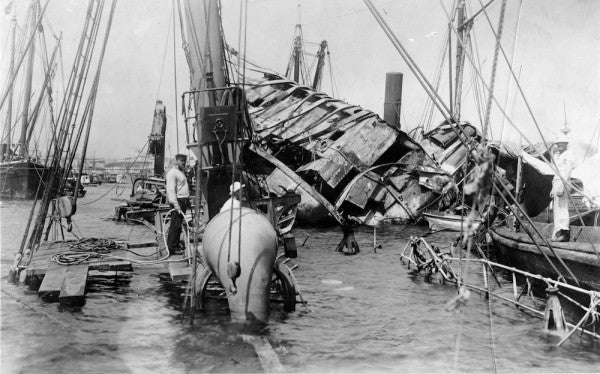
The USS Maine, before

February 15, 1898: The battleship USS Maine sinks in Havana Harbor, Cuba, killing 261 sailors.

The Maine, launched on November 18, 1889, was there to protect U.S. interests in Cuba, then controlled by Spain. In the 1890s, the people of Cuba rebelled against their colonial overlords. Many Americans wanted to go to war to free Cuba. Most of those, however, were business lords who wanted to exploit Cuba's natural resources, without Spain keeping them out. They had tried to make deals with Spain, and failed. So they needed to get Spain out of Cuba. All they needed was an excuse.

On February 15, 1898, they got their excuse. An official U.S. Navy investigation ruled that an external mine caused the explosion. Witnesses among the American survivors denied this, and a much more likely cause for the explosion was a coal fire in the boiler.
The USS Maine, after

Amidst cries of "Remember the Maine!" American newspapers did whatever they could to outdo each other for headlines. Joseph Pulitzer of The New York World had practically invented what became known as "yellow journalism." But he found he could not top the rich kid from San Francisco, William Randolph Hearst. ("Kid"? Hearst was 34 years old. Pulitzer was 50.)

Hearst had sent artist Frederic Remington to Cuba to draw pictures of Spanish atrocities that Hearst could use for his national chain of papers, starting with the San Francisco Examiner and now including the New York Journal. Remington sent a telegram to New York, saying there was nothing he could find that would lead to war. Hearst wired back, "Please remain. You furnish the pictures and I'll furnish the war."

And he did: On April 25, the U.S. Congress declared war on Spain. President William McKinley had wanted to avoid it, but he no longer could.

This was America's 1st war with a European power since facing Britain in the War of 1812, which ended in 1815, 83 years earlier. And it was a mismatch: Spain was a nation of a crumbling bureaucracy, and the war only lasted until August 13, 1898. There were 2 signature battles, 1 naval, 1 land. The naval battle was in Manila Bay, helping America to take the Philippines on May 1, led by Commodore George Dewey. The other was San Juan Hill, on July 1, led by Colonel Theodore Roosevelt.

"The Splendid Little War" -- in which 385 Americans died of combat wounds, and another 2,061 died from disease -- ended when Spain surrendered on August 13, 6 months after the sinking of the Maine. America took Cuba, Puerto Rico and the Philippines. Each of these would cause problems in the years to come.

The last surviving veteran of the Spanish-American War was Jones Morgan, a man of color, who lived until August 29, 1993, at the age of 110. 

A new battleship USS Maine was launched on July 27, 1901, and was part of the U.S. fleet during World War I. But it didn't last much longer than its predecessor did: It was decommissioned on May 15, 1920, and scrapped 2 years later.

*

February 15, 1898 was a Tuesday. It was the off-season for baseball, there was no pro hockey, pro football was in its infancy, and basketball had barely been invented. So there were no scores on that historic day.

Thursday, January 13, 2022

January 13, 1898: Émile Zola Accuses

January 13, 1898: Émile Zola, perhaps France's foremost living writer, writes an open letter to the newspaper L'Aurore, in which he accuses President Félix Faure and his government of anti-Semitism in regard to the Dreyfus Affair.

In 1870, Germany humiliated France by occupying Paris, winning the Franco-Prussian War, and claiming the provinces of Alsace and Lorraine as spoils. In 1894, just 24 years later, Captain Alfred Dreyfus was an artillery officer, both Jewish and Alsatian, although he was too young to have served in that war. He was accused of having recently communicated French military secrets to the German Embassy in Paris. He was convicted, and sentenced to the notorious prison on Devil's Island, in the South African colony of French Guiana.
Alfred Dreyfus

In 1896, new evidence came to light, showing that the guilty party was, instead, Major Ferdinand Esterhazy. Not wanting to look foolish after having already "gotten their man," a military court acquitted Esterhazy in a trial that lasted only 2 days.

The Dreyfus Affair had polarized France, its alleged ideals of "Liberté, égalité, fraternité  (liberty, equality, brotherhood) dragged through the mud of elitism (many of the officers involved in framing Dreyfus were monarchists, still loyal to the idea of the fallen Emperor Napoleon III and other royal pretenders) and bigotry (France, by this point, had no official religion, but was still largely Catholic).

On January 13, 1898, L'Aurore (The Dawn), a national newspaper with a liberal stance, published an open letter from Émile Zola to the President of France, Félix Faure. Having already written extensively about how French society fell apart due to the Franco-Prussian War, Zola seemed to have credibility with both sides. He had already received France's highest civilian honor, "Officer of the Legion of Honor."

So his letter in L'Aurore caught everyone's attention. How could it not? In a big, bold headline, the paper blasted: "J'Accuse! Lettre au Président de La République par Émile Zola." (I accuse! Letter to the President of the Republic from Émile Zola.)
Félix Faure

Zola wrote, "The conviction of Alfred Dreyfus was based on false accusations of espionage and was a misrepresentation of justice." He accused Major Armand du Paty de Clam of framing Dreyfus. He pointed out that the evidence clearly showed that the incriminating document came from an infantry officer, not an artillery officer. 

Zola accused many influential men in his letter, including Major Esterhazy. And he wrote, "The evidence of Drefyus's character, his affluence, the lack of motive and his continued affirmation of innocence combine to show that he is the victim of the lurid imagination of Major du Paty de Clam, the religious circles surrounding him, and the 'dirty Jew' obsession that is the scourge of our time."

As with the Marquess of Queensberry's accusation 3 years earlier, that Oscar Wilde was having a (then-illegal) gay affair with the Marquess' son, Zola's purpose was to get sued for libel, so that the truth would come out, and those he accused would be exposed and ruined. Unlike the Marquess, however, Zola's move didn't work. He was brought to trial for libel, and was convicted, sentenced to jail, and removed from the Legion of Honor.

When the Marquess first accused Wilde, and again after Wilde was convicted, Wilde's friends told him to flee to France. He refused. To avoid jail time, Zola fled to England.

In 1899, the pressure on the French government could no longer be ignored. Faure died in office that year -- from a stroke while receiving, ahem, assistance from his mistress -- and Émile Loubet became President. He ordered Dreyfus returned to France for another trial. The Dreyfusards now included writers Anatole France and Charles Péguy, mathematician Henri Poincaré, and actress Sarah Bernhardt. An Anti-Dreyfusard hit Loubet over the head with his cane.

Dreyfus got his new trial, but he was convicted again, and sentenced to 10 years in prison. Loubet pardoned him, and he was released. That freed him, but it did not restore his honor.

Zola returned to France. On September 29, 1902, he died in his house in Paris, from carbon monoxide poisoning, caused by an improperly ventilated chimney. Accusations of murder were launched, but no suspect was arrested. His funeral was attended by thousands, including, having gotten permission from Zola's widow, Alexandrine.

In 1906, Dreyfus was officially exonerated, and his rank of Major and his previous decorations were restored. He served through the entirety of World War I, and retired with the rank of Lieutenant Colonel. He died in 1935.

L'Aurore continued to be published until 1916, when the continuation of World War I made its own continuation impossible. By that point, the man who was publisher of the paper in 1898 was the Prime Minister of France, Georges Clemenceau. That same year, Armand du Paty de Clam died from wounds received 2 years earlier at the First Battle of the Marne. Ferdinand Esterhazy, who committed the crime of which Dreyfus was accused, fled to England in 1899, and died there in 1923.

In 1937, the film The Life of Emile Zola was released. It won the Academy Award for Best Picture. Paul Muni played Zola, and was nominated for Best Actor. He didn't win, but Joseph Schildkraut won Best Supporting Actor for playing Dreyfus.

In 1953, the newspaper Libération published the deathbed confession of Henri Buronfosse, a chimney-sweep: "Zola was asphyxiated voluntarily. I'm the one who blocked the chimney in his apartment."

*

January 13, 1898 was a Thursday. Baseball and football were out of season. Hockey was still all-amateur. And basketball barely existed. Therefore, there were no scores on this historic day.

December 31, 1999 & January 1, 2000: The Millennium

December 31, 1999:  The Millennium arrives. The people of planet Earth survived. At a terrible cost. But we hadn't destroyed ourselves. ...