Showing posts with label harvard crimson. Show all posts

Wednesday, November 23, 2022

November 23, 1968: "Harvard Beats Yale, 29-29"

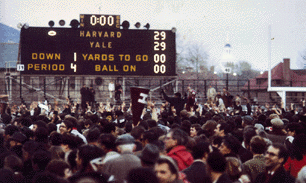
November 23, 1968: The most famous game in Ivy League history is played. The winners were... everybody who was involved, because it gets talked about more than most games that were glorious wins for one team or the other.

Harvard University was America's 1st college, founded in 1636 in Cambridge, Massachusetts, across the Charles River from Boston. Yale University was the 3rd, founded in 1701 and re-established a few years later in New Haven, Connecticut. (The 2nd was The College of William and Mary, in Williamsburg, Virginia.)

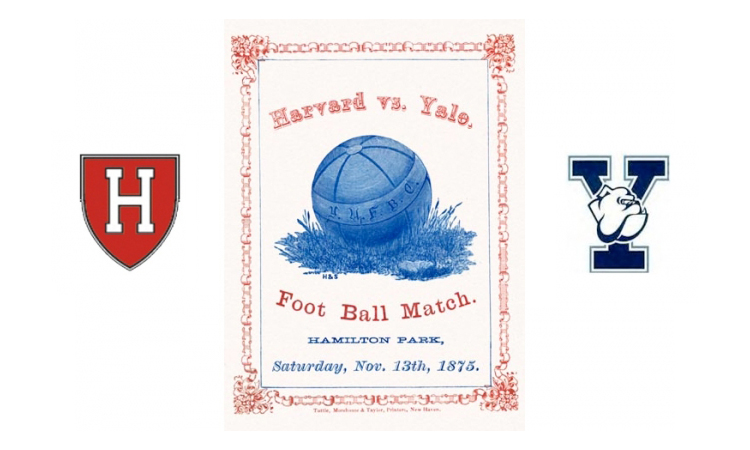
They first played each other in football on November 13, 1875, with the sport still in its infancy, on the Yale campus. Harvard won, 4-0 under the scoring rules of the time. But Yale took over the rivalry, going 9-0-2 through 1889. Eventually, their contest became each school's season finale, known as simply "The Game."

In 1968, both teams looked like they were among the best teams in the country, a rarity for Ivy League teams after World War I. Each went into their finale 8-0, the 1st time since 1909 that both of them were undefeated going into The Game.

Yale had Brian Dowling, an All-American quarterback from Cleveland. He had led them to 16 straight wins, and hadn't lost a game since the 6th grade. Yale student Garry Trudeau would start a comic strip titled Bull Tales, which in 1970 would become the nationally-syndicated Doonesbury. Dowling would be parodied as "B.D.," although the character and the real Dowling would turn out to be very different people. Yale also had running back Calvin Hill, who would star in the NFL, and whose son, Grant Hill, would become a Basketball Hall-of-Famer.

Harvard had a strong defense, nicknamed the Boston Stranglers after a recent serial killer. Their captain and top offensive player was running back Vic Gatto. One of their guards, good enough to make the All-Ivy League Team, was then listed as "Tom Jones." He became an actor under the name Tommy Lee Jones. His roommate was a prelaw student named Al Gore. (Bill Clinton and Hillary Rodham were still 3 years away from starting Yale Law School, and George W. Bush had just graduated from Yale.)

The game was played at Harvard Stadium, but that didn't matter to the oddsmakers, who made Yale, then ranked in the national Top 20, heavy favorites. The stadium's seating capacity was then listed as 57,750, and there wasn't a seat to be had, despite the weather being cold, with the wind blasting off the Charles. Scalpers were demanding $100 for tickets -- about $831 in today's money. God only knows what would have been charged if Internet ticket brokers were possible at the time.

At first, Yale justified their classification as favorites: Dowling ran for a touchdown, then passed to Hill for another, then threw another. In the 2nd quarter, the Bulldogs led 22-0. No team had scored that many off the Crimson in an entire game since Yale themselves did it in a 24-20 win in New Haven the year before.

Harvard managed a touchdown before the half, but missed the extra point. It was 22-6. Early in the 2nd half, Yale fumbled a punt, and Harvard recovered in the end zone. This time, the extra point was converted, and Harvard was within 22-13. But early in the 4th quarter, Dowling took over again, drove the Elis down the Allston pitch, and scored himself to put his team up 29-13.

With 2 minutes left, Yale still led 29-13. And, due to injuries, Harvard was left with their backup quarterback, Frank Champi. But he was undeterred, and got the Crimson over the goal line with 42 seconds left on the clock. A 2-point conversion failed, but Yale was called for pass interference. Gus Crim took the ball in on their 2nd chance, so it was Yale 29, Harvard 21.

The most obvious onside kick in the history of football was coming. But Harvard managed to recover it. Time was running out. Champi got the Crimson to the Bulldogs' 8-yard line with 3 seconds left. On the last play of regulation, he was flushed out of the pocket, but still managed to get a pass off. Gatto caught it, and took it in. Yale 29, Harvard 27.

Fans poured onto the field. But there was still a 2-point conversion to be attempted. The fans were cleared off. Champi found Pete Varney. He would appear in 69 games as a catcher for the Chicago White Sox and the Atlanta Braves from 1973 to 1976, serve as head baseball coach at Brandeis University in nearby Waltham, Massachusetts, and coach for years in the Cape Cod Baseball League. Nothing he did matched the pass he caught from Frank Champi with no time on the clock.
It was a tie. Along with Notre Dame's games with Army in 1946 and Michigan State in 1966 -- both known as "The Game of the Century" -- this is the most famous tie in football history. Why not? It remains the game of the century as far as the Ivy League is concerned.

The next day, the Harvard Crimson newspaper printed a headline: "HARVARD BEATS YALE, 29-29." In 2008, on the game's 40th Anniversary, a documentary film would use that headline as its title.
Did Harvard "win"? Yale coach Carm Cozza later admitted, "That tie was the worst loss of my career."

I mentioned Army in 1946. After their tie against Notre Dame, they had a similar season-closing rivalry game, with Navy in Philadelphia. They led 21-0. Navy came back, and was down 21-18, and was on Army's 3-yard line with time for one more play. Navy coach Tom Hamilton tried to run it in, and failed. When asked why he didn't go for the tying field goal, he spoke words that have entered the American lexicon: "A tie is like kissing your sister."

For Harvard, this tie was more like kissing your sister's really hot best friend. For Yale, this tie was like kissing your sister's other best friend. You know: The only with the "great personality."

Look at it this way: Since the league's official establishment for the 1956 season, Yale have won its title outright in 1956, 1960, 1967, 1977, 1979, 1980 and 2017; and won at least a share of it in 1968, 1969, 1974, 1976, 1981, 1989, 1999, 2006 and 2019. But do any of those teams get talked about, even as a "great team," other than among Yalies? No.

The 1968 Yale Bulldogs, and the 1968 Harvard Crimson, both get talked about, as great teams that played a great game.

*

November 23, 1968 was a Saturday. There were other big college football rivalry games played that day:

* Number 1 USC beat UCLA, 28-16 at the Los Angeles Memorial Coliseum. But the next week, a tie with Notre Dame cost them the Number 1 ranking. They ended up losing the Rose Bowl, and thus the National Championship, to Ohio State.

* Number 2 Ohio State beat Number 4 Michigan, 50-14 at Ohio Stadium in Columbus. It was said that Buckeye coach Woody Hayes purposely ran up the score. The Wolverines did not forget, and the next year's game between the rivals was an epic win for Michigan.

* Number 3 Penn State beat the University of Pittsburgh, 65-9 at Pitt Stadium.

* Number 5 Georgia were idle, between wins over rivals Auburn and Georgia Tech.

* Number 6 Arkansas beat Texas Tech, 42-7 at Jones Stadium in Lubbock, Texas. Okay, that's not a rivalry game.

* Number 7 Kansas beat Number 13 Missouri, 21-19 at Memorial Stadium (now Faurot Field) in Columbia, Missouri, to clinch the Big Eight Conference title.

* Number 8 Tennessee beat Kentucky, 24-7 at Neyland Stadium in Knoxville, Tennessee.

* Number 9 Louisiana State beat Tulane, 34-10 at Tulane Stadium in New Orleans.

* Number 10 Texas were idle, between wins over Texas Christian and Texas A&M.

* Number 11 Notre Dame were idle, between a win over Georgia Tech and a tie against USC.

* Number 12 Purdue beat Indiana, 38-35 at Ross-Ade Stadium in West Lafayette, Indiana.

* Number 14 Oklahoma beat Nebraska, 47-0 at Owen Field in Norman, Oklahoma.

* Number 15 Alabama were idle, between wins over Miami and arch-rival Auburn.

* Number 16 Oregon State beat Oregon, 41-19 at Parker Stadium (now Reser Stadium) in Corvallis, Oregon.

* Number 17 Auburn were idle, between losses to rivals Georgia and Alabama.

* Number 18 California was upset by Stanford, 20-0 at Memorial Stadium in Berkeley, California.

* Virginia beat Maryland, 28-23 at Scott Stadium in Charlottesville, Virginia.

* North Carolina beat Duke, 23-14 at Kenan Stadium in Chapel Hill, North Carolina. If Yale felt bad, think of how Duke felt: That was the only Atlantic Coast Conference game Carolina won all season, and it was against their greatest rival.

* South Carolina beat Clemson, 7-3 at Memorial Stadium in Clemson, South Carolina.

* Minnesota beat Wisconsin, 23-15 at Camp Randall Stadium in Madison, Wisconsin.

* Washington State beat Washington, 24-0 at Joe Albi Stadium in Spokane, Washington. "Wazzu" used Albi Stadium for games too big for their 23,500-seat Rogers Stadium, before building Martin Stadium in 1972.

* Army were idle, between wins over Pittsburgh and Navy.

* Navy were idle, between losses to Syracuse and Army.

* In New York City, Columbia beat Brown, 46-20 at Baker Field.

* In New Jersey, Princeton beat Cornell, 41-13 at Palmer Stadium in Princeton.

* And Rutgers beat Colgate, 55-34 at Rutgers Stadium in Piscataway.

In high school football, my alma mater, East Brunswick, beat Sayreville, 41-0 at War Memorial Stadium in Sayreville, clinching a Conference Championship.

There were 6 games played in the NBA that day:

* The New York Knicks beat the Boston Celtics, 111-100 at the new Madison Square Garden.

* The Baltimore Bullets beat the Detroit Pistons, 128-127 at the Baltimore Civic Center (now the CFG Bank Arena). Dave Bing scored 39 in a losing effort for the Pistons.

* The Philadelphia 76ers beat the Cincinnati Royals, 120-105 at the Cincinnati Gardens.

* The Atlanta Hawks beat the Chicago Bulls, 114-96 at the Chicago Stadium.

* The Milwaukee Bucks beat the Phoenix Suns, 115-112 at the Milwaukee Arena. In 1974, it was renamed the Milwaukee Exposition, Convention Center and Arena, or "The MECCA." Since 2014, it has been named the UW-Panther Arena.

* And the San Francisco Warriors beat the Seattle SuperSonics, 132-119 at the Cow Palace outside San Francisco in Daly City, California.

There were 2 games played in the American Basketball Association:

* The New York Nets beat the Minnesota Muskies, 110-105 at the Metropolitan Sports Center in the Minneapolis suburb of Bloomington, Minnesota.

* And the Miami Floridians beat the Indiana Pacers, 126-107 at the Miami Beach Convention Center.

And the entire NHL was in action that day:

* The New York Rangers lost to the team that would then have been considered their arch-rivals, the Boston Bruins, 5-1 at the Boston Garden.

* The Montreal Canadiens beat the Minnesota North Stars, 4-3 at the Montreal Forum.

* The Oakland Seals beat the Philadelphia Flyers, 2-1 at The Spectrum in Philadelphia.

* The Pittsburgh Penguins and the Los Angeles Kings played to a tie, 2-2 at the Civic Arena in Pittsburgh.

* The Detroit Red Wings beat the Toronto Maple Leafs, 5-2 at Maple Leaf Gardens in Toronto.

* The St. Louis Blues beat their arch-rivals, the Chicago Black Hawks, 1-0 at the St. Louis Arena.

Also, Arsenal lost to Chelsea, 1-0 at Highbury in North London.

Monday, November 21, 2022

November 21, 1914: The Yale Bowl Opens

November 21, 1914: The Yale Bowl opens, a mile and a half west of the main campus of Yale University in New Haven, Connecticut. Arch-rival Harvard spoil the party, as the Crimson beat the Bulldogs, 36-0. Yale were a good team that season, going 6-2. But Harvard might have been the best team in the country, going 7-0-2.

Prior to the Yale Bowl, Yale had played since 1884 at Yale Field, across Derby Avenue, where they built the current baseball version of Yale Field in 1928. It seated 33,000 fans, while the Yale Bowl seated 70,896. After decades of deterioration, a much-needed renovation was completed in 2006, with a more modern facility, and wider seats, reducing seating capacity to 61,446.

While Yale claim 27 retroactively-awarded National Championships, only one of these, in 1927, has been won since the Yale Bowl opened. The Ivy League was founded in 1954, and in 2022, Yale won its 17th Ivy League title. (UPDATE: In 2023, they won their 18th.)
With the combined Harvard-Yale logo at midfield

When the New York Giants needed a temporary home between the October 1973 closing of the original Yankee Stadium and the October 1976 opening of Giants Stadium, they considered several facilities in the New York Tri-State Area. Being 76 miles northeast of Midtown Manhattan, the Yale Bowl was at the very edge of that area.

Indeed, New Haven is the terminus of one of the lines of what's now the Metro-North Commuter railroad. And, with ties to both New York and New England, the city often serves as something of a "neutral zone" between New York and Boston sports fandoms.

Nevertheless, the Giants played 5 home games at the ale Bowl in 1973, and 7 in 1974, before being allowed to use Shea Stadium in Queens for the 1975 season. The commute, the traffic and the parking situation were terrible, and as the Giants got worse and worse, attendance dropped from a peak of 70,168 to a trough of 21,170. The Giants went 1-11 at the Yale Bowl, including a 1974 overtime loss to the Jets -- and that doesn't include the 1st game ever played between the Giants and the Jets, a 1969 preseason game at the Yale Bowl, which the Jets also won.

In the 1976 and 1977 seasons, the Connecticut Bicentennials of the North American Soccer League played at the Yale Bowl. But, except for the 17,302 they got for a 1977 game against the PelĂ©-led New York Cosmos, they never got more than 7,000 fans.

*

November 21, 1914 was a Saturday. These other notable college football games were played that day:

* Army beat Springfield College, 13-6 on The Plain in West Point, New York. Army went 9-0 that season.

* Navy beat Ursinus, 33-2 at Worden Field in Annapolis, Maryland.

* Illinois beat Wisconsin, 24-9 at Randall Field in Madison, Wisconsin. Illinois went 7-0, and won the title of the Western Conference, which later became the Big Ten.

* Nebraska beat Iowa, 16-7 at Iowa Field in Iowa City. Nebraska finished 7-0-1 and won the Missouri Valley Conference title.

* Tennessee did not play that week. They went 9-0, and won the Southern Intercollegiate Athletic Association title.

* Texas also did not play that week. They went 8-0, and won the 1st-ever Southwest Conference title.

* Rivalry: Lehigh beat Lafayette, 17-7 at March Field in Easton, Pennsylvania.

* Rivalry: Purdue beat Indiana, 23-13 at Stuart Field in West Lafayette, Indiana.

* Rivalry: Minnesota beat the University of Chicago, 13-7 at Stagg Field in Chicago.

* Rivalry: Missouri beat Kansas, 10-7 at McCook Field in Lawrence, Kansas.

* Among New York City teams, New York University lost to Wesleyan, 29-13 at Ohio Field in The Bronx; Fordham beat Boston College, 14-3 at Fordham Field in The Bronx; and Columbia had suspended its program for the season.

* And for the New Jersey schools, Rutgers beat the Stevens Institute of Technology, 83-0 at Castle Field in Hoboken; while Princeton had concluded its season the week before, losing to Yale.

Baseball was out of season. Professional basketball barely existed. And, in that era, it was a little early for hockey season to start.

In English soccer, North London team Arsenal went to Yorkshire, and lost to Huddersfield Town, 3-0 at Leeds Road.

Sunday, November 13, 2022

November 14, 1903: Harvard Stadium Opens

November 14, 1903: Harvard Stadium opens, changing the history of college football, and of sports venues in general.

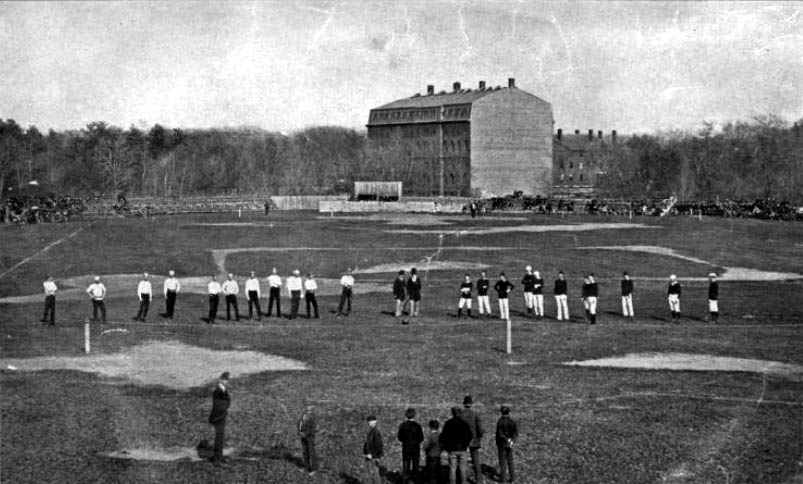
Harvard University, America's 1st college and one of its earliest practitioners of intercollegiate sports, began playing football in 1873, at Jarvis Field. In 1898, their baseball and football teams moved to Soldier's Field, dedicated as a memorial to Harvard men who had sacrificed their lives in the American Civil War. Their baseball team still plays there today, although since 1997 it has been named Joseph J. O'Donnell Field, after a former Harvard baseball player whose donations allowed them to upgrade it.

But college football was becoming a business, and Harvard perennially had one of the best teams in the sport. In 1903, Harvard Stadium was built, the 1st vertical structure to employ reinforced structural concrete.

This would inspire not just football stadiums, but baseball stadiums: In 1909, Shibe Park in Philadelphia would be the first concrete-and-steel ballpark, followed later that year by Sportsman's Park in St. Louis and Forbes Field in Pittsburgh; in 1910, League Park in Cleveland and Comiskey Park in Chicago; in 1911, the Polo Grounds in New York and Griffith Stadium in Washington; in 1912, Crosley Field in Cincinnati, Tiger Stadium in Detroit and Fenway Park in Boston; in 1913, Ebbets Field in Brooklyn; in 1914, Wrigley Field in Chicago; and in 1915, Braves Field in Boston.

After playing their 1st 8 games of the 1903 season at Soldier's Field, the Crimson opened Harvard Stadium on November 14. Dartmouth College spoiled the party, winning, 11-0. However, when Harvard's arch-rivals, Yale University, opened the Yale Bowl in 1914, Harvard would win the first game there.

In 1905, a newspaper with a photograph of a bloody football player, Swarthmore College guard Robert "Tiny" Maxwell," made its way to President Theodore Roosevelt. A former athlete himself -- he had been on the Harvard boxing team in 1880, and played tennis even while President -- he requested figures, and found out that 18 young men had died playing college football in 1904.

So the Rough Rider hauled the presidents of Harvard, Yale and Princeton -- then the nation's leading football-playing universities -- into the White House, and told them point-blank: Either you do something to make football safer, or I will take action. Given his reputation as a man who got things done and didn't let anything stand in his way, just the possibility that he would be taking over their sport, taking their power away, was enough to spur them into action. The safety measures they took over the next year are now considered the founding of the National Collegiate Athletic Association (NCAA).

One move that was made in the interest of safety was the invention of hashmarks, putting the ball at the yard-line where the last play ended, but closer to the middle of the field, instead of putting the ball exactly where the play ended every time.

Another suggestion was widening the field. But Harvard shot this idea down, since they had only opened Harvard Stadium in 1903, and they didn't have room to widen their field, and they weren't going to tear down half of their new stadium just to accommodate everyone else. In those days, what Harvard wanted, Harvard got. So an alternative was thought up: The legalization of the forward pass. It would take a few years, but football became considerably more exciting because of it.

The addition of stands in the northeast end zone of Harvard Stadium's horseshoe raised the seating capacity to 57,166. But as the Ivy League decreased in importance and influence, so did crowds, and this bleachers were replaced by a smaller structure in 1952, dropping capacity to 40,280. This would be the attendance for the stadium's, and the Ivy League's, most famous game, the title decider that decided nothing, as unbeaten Harvard came from 16 points down in the last minute to hold unbeaten Yale to a tie -- or, as the Harvard Crimson newspaper headline put it, "HARVARD BEATS YALE, 29-29."

In the 1970 season, and only in that season, Harvard Stadium was the home of the NFL's Boston Patriots. In 1971, they moved to suburban Foxborough, Massachusetts. In 1998, the steel bleachers in the open end were torn down, and replaced by the Murr Center. This reduced the seating capacity to the current 30,323.

The oldest active stadium in college football, and still in good shape due to the donations of rich alumni, Harvard Stadium maintained a natural grass surface until the 2006 season, when it was replaced by FieldTurf. That same year, it got its first permanent lights. Its 1st night game was played on September 22, 2007, a 24-17 win over Brown University.

*

November 14, 1903 was a Saturday. These other noteworthy college football games were played:

* Elsewhere in what would became known as the Ivy League, Princeton beat Yale, 11-6 at Yale Field in New Haven, Connecticut; Columbia beat Cornell, 17-12 at Percy Field in Ithaca, New York; the University of Pennsylvania lost to the Carlisle Indian School, 16-6 at Franklin Field in Philadelphia, perhaps the 1st notable upset by a school that would produce many over the next few years; and Brown beat Syracuse, 12-5 at the Old Oval in Syracuse, New York.

* Among the service academies, Army beat the University of Chicago, 10-6 on The Plain in West Point, New York; and Navy lost to Bucknell, 23-5 at Worden Field in Annapolis, Maryland.

* Alabama, not yet a big football school, lost to Cumberland College, 44-0 on The Quad in Tuscaloosa, Alabama.

* Georgia, already a big football school, were upset by the Savannah Athletic Club, 6-0 in Savannah, Georgia.

* Michigan beat Wisconsin, 16-0 at Regents Field in Ann Arbor, Michigan.

* Minnesota beat Illinois, 32-0 at Illinois Field in Champaign, Illinois.

* Notre Dame, not yet a big football school, played Northwestern to a 0-0 tie at South Side Park, then the home of the Chicago White Sox.

* The Pennsylvania State College, not yet a university, let alone a big football school -- unlike a lot of schools then using only colors as a team name, before developing mascots, they were simply "the Penn State football team" -- lost to Dickinson College, 6-0 at Williamsport, Pennsylvania.

* In an intracity rivalry, Georgetown University beat George Washington University, 33-0 at Georgetown Field in Washington, D.C.

* In what would become one of the biggest rivalries in the sport was played the day before: Texas beat Oklahoma, 11-5 at Colcord Park in Oklahoma City. Oklahoma was still a Territory, and wouldn't gain Statehood until 1907.

* And in another growing Western rivalry, Colorado A&M beat Wyoming, 17-0 at Durkee Field in Fort Collins, Colorado. A&M was renamed Colorado State in 1957.

Saturday, November 12, 2022

November 13, 1875: The 1st Harvard-Yale Game

November 13, 1875: Harvard University and Yale University, America's oldest and 3rd-oldest colleges, and both pioneers of college football, play each other in the sport for the 1st time. The game is played at Hamilton Park, a horse-racing track in New Haven, Connecticut, and, with one touchdown, under the scoring system of the time, Harvard won, 4-0.

The first American intercollegiate sporting event took place on August 3, 1852, after Yale invited Harvard to a race of crews. Harvard won "The Boat Race" on that 1st occasion. The first intercollegiate contests in ice hockey, soccer, and 5-on-5 basketball featured teams from Harvard and Yale.

Many now century-old, or older, aspects of American football were introduced by Harvard or Yale students or athletes. Yale introduced cheerleading at athletic events in 1890, and tailgate parties in 1905. Harvard introduced spring practice to collegiate football March 14, 1889.

Yalies sang "Hold the Fort" during the 1892 Harvard game, considered the first public performance of a collegiate "fight song." It predated "Boola Boola," in 1900, and what became their official fight song, "Bull Dog," written by Cole Porter when he was a senior at Yale in 1913.

In 1883, Harvard and Yale played each other at the Polo Grounds in New York, with Yale winning, 23-2. From 1891 to 1894, they played each other at Hampden Park in Springfield, Massachusetts. There was fan violence at the 1894 game, won by Yale, 12-4, leading to the schools taking the next 2 seasons off. They resumed in 1897, and have alternated between Boston and New Haven ever since.

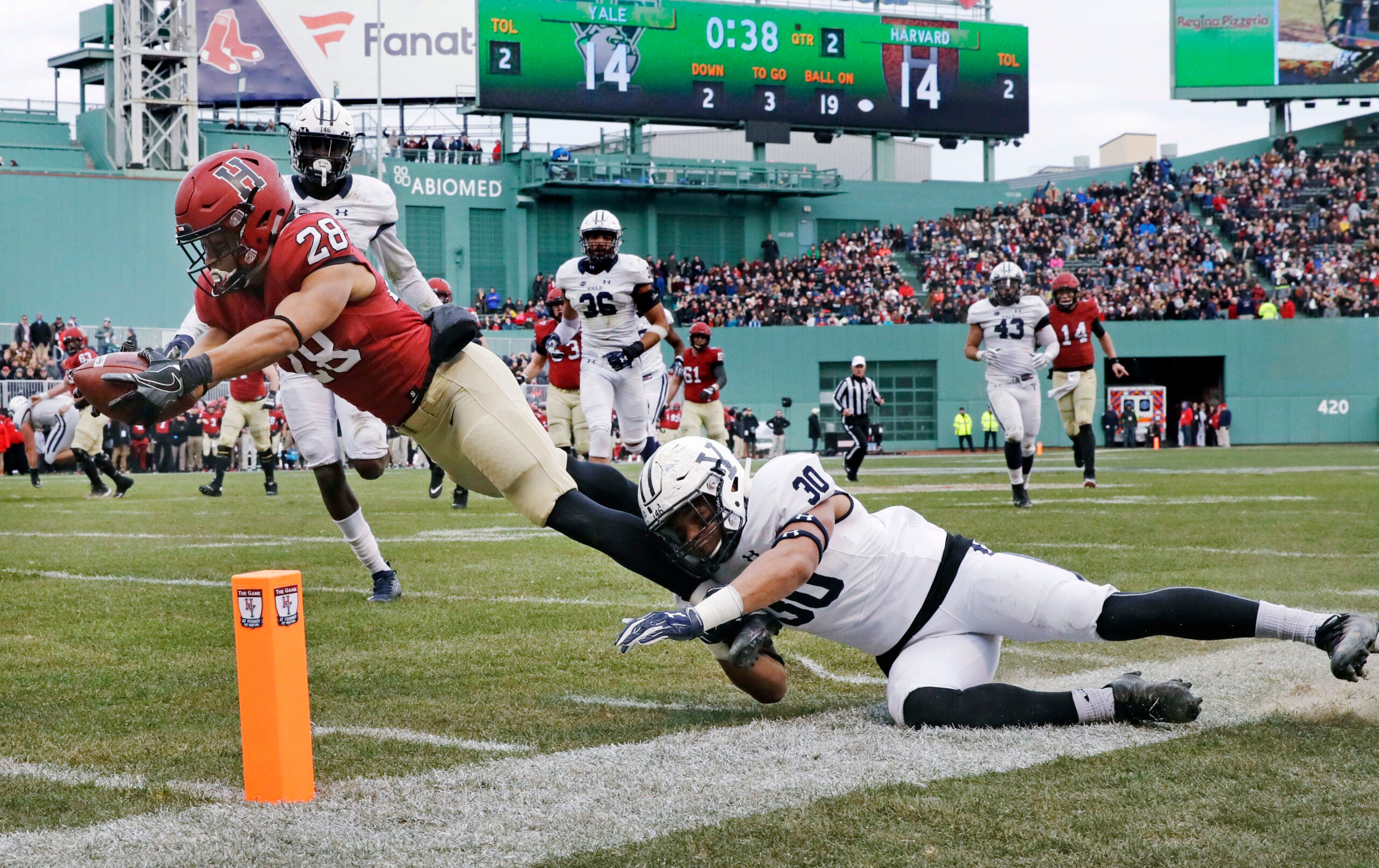
They took 1917 and 1918 off due to World War I; 1943, 1944 and 1945 due to World War II; and 2020, due to COVID. But, since WWII, they have played at Harvard Stadium (built in 1903) in even-numbered years, and the Yale Bowl (built in 1914) in odd-numbered years. An exception was made in 2018, when Harvard, having the choice of home field, talked Yale into playing at Fenway Park in Boston. Harvard won that one, 45-27, making it the highest-scoring contest in the history of "The Game."
November 17, 2018

Both teams went into the 1900 game undefeated, and Yale won, 28-0. The 1908 game saw both teams undefeated as well, and Harvard won, 4-0. In 1914, Harvard spoiled the opening of the Yale Bowl, winning 36-0.
The Yale Bowl, with the field marked for "The Game"

Before the opening kickoff of the 1923 game, Yale coach Dwight Jones told his undefeated Bulldogs, "Gentlemen, you are about to play Harvard. You will never do anything else so important for the rest of your lives."

They certainly wouldn't have done so under worse conditions: According to the era's greatest sportswriter, Grantland Rice, the field at Harvard Stadium was "a gridiron of seventeen lakes, five quagmires and a water hazard." Perhaps it was fitting that the key play, a return of a fumble 67 yards for a touchdown, was made by a man named Raymond Pond, known as Ducky. Yale won, 13-0. Pond later served as Yale's head coach, from 1934 to 1940.

In 1947, the only way for a Harvard football player to win his varsity letter was to play in the Yale game. Legend has it that, knowing this, Robert F. Kennedy played in the Harvard-Yale game on a broken leg. In 1955, his brother, Ted Kennedy, caught a touchdown pass against Yale. What the Kennedy legend doesn't say is that Bobby really played on "only" a sprained ankle, and that Yale won both of these games. (Ted was good enough to receive interest from the Green Bay Packers, but his father told him to go to law school instead.)
Harvard Stadium

Both teams were undefeated going into the 1968 game at Harvard Stadium, making it the 1st Ivy League title decider between them. Yale led 29-13 with 42 seconds to go, but Harvard scored 2 touchdowns and 2 2-point conversions to tie the game, and split the honors. The Harvard Crimson newspaper had the headline: "HARVARD BEATS YALE, 29-29."
November 23, 1968

In 1982, students at the Massachusetts Institute of Technology, Harvard's Cambridge neighbors, pulled one of the great college football pranks, pushing a balloon with the letters "MIT" on it through the turf at Harvard Stadium. (Harvard won, 45-7.) Not to be outdone, a little over a year later, during the 1984 Rose Bowl, students at California Institute of Technology in Pasadena hacked into the Rose Bowl scoreboard, so that what should have read "UCLA 38" and "ILLINOIS 9" read "CALTECH 38" and "MIT 9." (UCLA ended up winning, 45-9.)
November 20, 1982

Going into the 2022 game, Yale leads the all-time series, with 69 wins to Harvard's 60, while there have been 8 ties. (UPDATE: Through the 2024 game, Yale leads, 71-61.)

*

November 13, 1875 was a Saturday. This was still early in the history of football, college or otherwise. Only 1 other game was played that day: Princeton (then still known as the College of New Jersey) beat Columbia, 6-2 at University Field in Princeton, New Jersey.

Friday, October 28, 2022

October 29, 1921: The Impossible Formula

October 29, 1921: The Harvard University football team loses to Centre College of Danville, Kentucky, 6-0 at Harvard Stadium in Boston, ending a 25-game winning streak. This is considered one of the biggest upsets in the history of college football, as the "Praying Colonels" (no, I'm not making that mascot name up), from a school of just 300 students at the time, were the 1st team from outside the old Northeast (Jim Thorpe's Pennsylvania-based Carlisle counts) to beat one of the old "Big Three" of Harvard, Yale and Princeton.
All over Danville, graffiti appeared with the score: "C6H0." This could be read as a scientific formula: Six parts carbon, zero parts hydrogen. Since that can't be done, it become known as "The Impossible Formula."
Today, Harvard, like all the Ivy League teams, is in the FCS, the Football Championship Subdivision, what used to be known as Division I-AA. Since the official founding of the Ivy League as a sports conference in 1955, Harvard has won its football championship 15 times, most recently in 2015.
Centre would prove that their 1921 win over Harvard was no fluke. They finished their regular season undefeated, 10-0, having also beaten Clemson, Virginia Tech, Kentucky, Auburn, Tulane and Arizona. They were invited to play Texas A&M in the Dixie Classic, a precursor game to the Cotton Bowl. A&M won, 22-14, in a game that became known for the origin story of their "12th Man" tradition. Their biggest star of 1921, Bo McMillin, was a rough Texan who was one of the 1st good NFL quarterbacks, and would coach Indiana to its 1st football title in the Big Ten in 1945.
In 1922, Centre beat Clemson away, Mississippi, Virginia Tech away, Louisville, Kentucky away and South Carolina. However, they lost a rematch away to Harvard on October 21, 24-10. They also lost to Auburn at Rickwood Field, the Birmingham ballpark.
In 1923, they went 7-1-1, their conquests including Clemson, Kentucky, and Auburn at Rickwood again. They tied Georgia, and their only loss was the Penn at the original Franklin Field in Philadelphia. On 4 consecutive Saturdays in 1924, the Colonels defeated Kentucky, Tennessee, Alabama, and Georgia. 
Today, however, Centre are in Division III, but have won their league 15 times, including 6 times from 1980 to 1990. Their last title was in 2014. Their current enrollment: 1,430, to Harvard's 27,000.
Nor would Harvard's loss be a fluke: A week later, they went down to Princeton, and lost again.
In 1950, the Associated Press named C6H0 the greatest upset of the 1st half of the 20th Century, in any sport. In 2005, The New York Times called it "arguably the upset of the century in college football." (They did not use capital letters.) In 2006, ESPN named it the 3rd-biggest upset in college football history.
In anticipation of the game's 75th Anniversary, in 1996, Centre challenged Harvard to a rematch. Harvard declined. Harvard went 4-6 that season. I can't find a record of how Centre did that year, but they won their league the year before. Who knows, maybe history could have repeated itself.
This year? Harvard won its 1st 5 games before losing to Princeton last week. They host Dartmouth tomorrow. Centre take a 5-2 record into tomorrow's game, home to Rhodes College of Memphis.
*
October 29, 1921 was a Saturday. Football was the only sport in season. These other notable college games were played:
* Notre Dame beat Indiana, 28-7 at Washington Park, a baseball park in Indianapolis.
* Iowa beat Purdue, 13-6 at Stuart Field in West Lafayette, Indiana. Iowa went on to win the Big Ten and go undefeated.
* Nebraska beat Oklahoma, 44-0 at Nebraska Field in Lincoln. Nebraska went on to win the Missouri Valley Conference, the league that eventually evolved into the Big Twelve.
* California beat Washington State, 14-0 at Multnomah Stadium in Portland, Oregon. What is now named Providence Park was built on the site in 1926. Cal went undefeated until the Rose Bowl, which ended in a 0-0 between them and Washington & Jefferson.
* Penn State beat Georgia Tech, 28-7 in a game that, for some reason, was played in New York, at the Polo Grounds, and attracted 30,000 fans. Penn State finished undefeated, 8-0-2.
* New York University finished in a tie with Colgate, 7-7 at Johnson Field in Johnson City, New York.
* Fordham played Boston College to a tie, 0-0 at Fordham Field in The Bronx.
* Columbia lost to Williams, 20-0 at South Field in Manhattan.
* Princeton beat Virginia, 34-0 at Palmer Stadium in Princeton, New Jersey.
* And Rutgers lost to Lafayette, 35-0 at March Field in Easton, Pennsylvania.

Friday, October 7, 2022

October 7, 1923: The Horween Brothers

Arnold Horween (left) and Ralph Horween

October 7, 1923: The Chicago Cardinals beat the Rochester Jeffersons, 60-0 at Normal Park on the South Side of Chicago. Fullback Ralph Horween scores a touchdown, and halfback Arnold Horween kicks 2 extra points. This makes them the 1st brother combination to score for the same team in an NFL game. On December 2, they will do it again. But it hasn't happened since.

The family name was actually Horwitz, as was that of two of the Three Stooges, Moe and Jerry "Curly" Howard. Ralph was born on August 3, 1896, and Arnold was born on July 7, 1898, both in Chicago. Each was an All-American offensive and defensive back at Harvard University, helping them win the 1920 Rose Bowl. Arnold became Harvard football's 1st Jewish captain.

Ralph played for the Cardinals from 1921 to 1923, and Arnold did so from 1921 to 1924. However, at the time, professional football was still looked down upon. So they used the name "McMahon," to fool people into thinking they were Irish. When that didn't work, they used "Horween," which sounded Jewish, and at least gave them the same initials.

Both men went back to Harvard. Arnold was their head coach from 1925 to 1930, going 21-17-3. More importantly, he went 3-2-1 against Yale. He later became a trustee of the Chicago Symphony Orchestra. Both he and his brother helped run the family leather tannery business. Arnold lived until August 5, 1985.

Ralph went back to Harvard, graduated from their Law School, became a patent attorney, a federal government official, and raised cattle. He died on May 26, 1997, making him the 1st former NFL player to live to be 100 years old. He was also the last surviving player from the early days of the NFL.

The Horweens were the last pair of Jewish brothers to play in the NFL until 2012, when Geoff Schwartz was a guard for the Minnesota Vikings, and Mitchell Schwartz was an offensive tackle for the Cleveland Browns.

*

October 7, 1923 was a Sunday. These other NFL games were played that day:

* The Buffalo All-Americans beat the Akron Pros, 9-0 at Olympic Park in Buffalo, New York.

* The Canton Bulldogs beat the Louisville Brecks, 37-0 at Lakeside Park in Canton, Ohio, outside Cleveland. The fact that this was the only other game of the weekend that was not close shows how good the Bulldogs were: From 1922 to 1924, they won the NFL Championship all 3 times, with a record of 28-1-4.

* The Toledo Maroons beat the Oorang Indians, 7-0 at Swayne Field in Toledo, Ohio. Swayne Field was also home to the Toledo Mud Hens of the International League from 1909 to 1955, the team best known as the hometown team of M*A*S*H character Max Klinger, played by Toledo native Jamie Farr.

The Indians were a team of native Americans organized by Jim Thorpe, based in LaRue, Ohio, outside Marion, hometown of the recently deceased President Warren Harding, but essentially a "traveling team" that played all away games. They were named for Oorang Kennels, their sponsor, and so a dog was their symbol. Thorpe had been the best football player, and the best track & field athlete, of the 1910s, but by this point, he was 36 years old, much slower as a player, and he was no coach or administrator. The team lasted only 2 seasons, this being the 2nd, going 3-6 and 1-10.

* The Hammond Pros beat the Dayton Triangles, 7-0 at League Park in Hammond, Indiana, outside Chicago.

* The Rock Island Independents and the football version of the Cleveland Indians played to a tie, 0-0 at Douglas Park in Rock Island, Illinois.

* The Chicago Bears beat the Racine Legion, 3-0 at Horlick Park in Racine, Wisconsin. Although Racine is in Wisconsin, it is closer in distance to Chicago than to Milwaukee.

* The Milwaukee Badgers and the Columbus Tigers played to a tie, 0-0 at Athletic Park (later Borchert Field) in Milwaukee.

* The Green Bay Packers and the St. Louis All-Stars played to a tie, 0-0 at Bellevue Park in Green Bay, Wisconsin.

* The Duluth Kelleys beat their in-State rivals, the Minneapolis Marines, 10-0 at Nicollet Park in Minneapolis.

And these baseball games were played:

* The New York Yankees lost to the Philadelphia Athletics, 9-7 at Yankee Stadium. The Yankees had already clinched the American League Pennant. Babe Ruth hit a home run, and Harvey Hendrick hit a grand slam, but it wasn't enough.

* The Brooklyn Robins (as the Dodgers were known under the managing of Wilbert Robinson, from 1914 to 1931) beat their arch-rivals, the New York Giants, 6-1 at Ebbets Field. The Giants had already clinched the National League Pennant, and the Yankees went on to beat them, winning their 1st World Series.

* The Washington Senators beat the Boston Red Sox, 5-2 at Griffith Stadium in Washington.

* The Cleveland Indians beat the Chicago White Sox, 9-6 at League Park in Cleveland. Indians center fielder and manager Tris Speaker went 1-for-3 with 2 walks and an RBI.

* The Pittsburgh Pirates beat the Cincinnati Reds, 7-5 at Redland Field (later Crosley Field) in Cincinnati.

* The Detroit Tigers beat the St. Louis Browns, 7-6 at Navin Field (later Briggs Stadium and Tiger Stadium) in Detroit. Tigers center fielder and manager Ty Cobb went 2-for-5 with an RBI. George Sisler, the Browns' greatest player ever, was at the height of his powers, but did not play in this game.

* A doubleheader between arch-rivals was split at Sportsman's Park in St. Louis. The Chicago Cubs won the opener, 10-3. The St. Louis Cardinals won the nightcap, 6-3.

* And the Boston Braves and the Philadelphia Phillies, the 2 worst teams in the league, losing 100 and 104 games, respectively, ended their season against each other the day before.

Saturday, May 14, 2022

May 15, 1874: Harvard and McGill Invent American Football

 
May 15, 1874: American football is invented.

What's that? You thought that happened on November 6, 1869, between Rutgers and Princeton? Well, that was the 1st football game played in America. But that was essentially a soccer game, 25-a-side. In 1870, these 2 schools in New Jersey were joined by Columbia University, of New York City.

In 1872 came another New Jersey school, the Hoboken-based Stevens Institute of Technology; and Yale University, of New Haven, Connecticut. In 1873 came Harvard University, of Cambridge, Massachusetts, across the Charles River from Boston; and the 1st game in the South, between Washington & Lee University and the Virginia Military Institute (VMI), which are practically next-door to each other in Lexington, Virginia.

So what happened on May 15, 1874?

Essentially, McGill University, in Montreal, Quebec, is Canada's answer to Harvard, right down to the use of Crimson red as the school color. Both Harvard's men and McGill's men believed themselves to be sporting gentlemen, in the tradition of the Victorian Era that was pretty much at its peak in the 1870s.

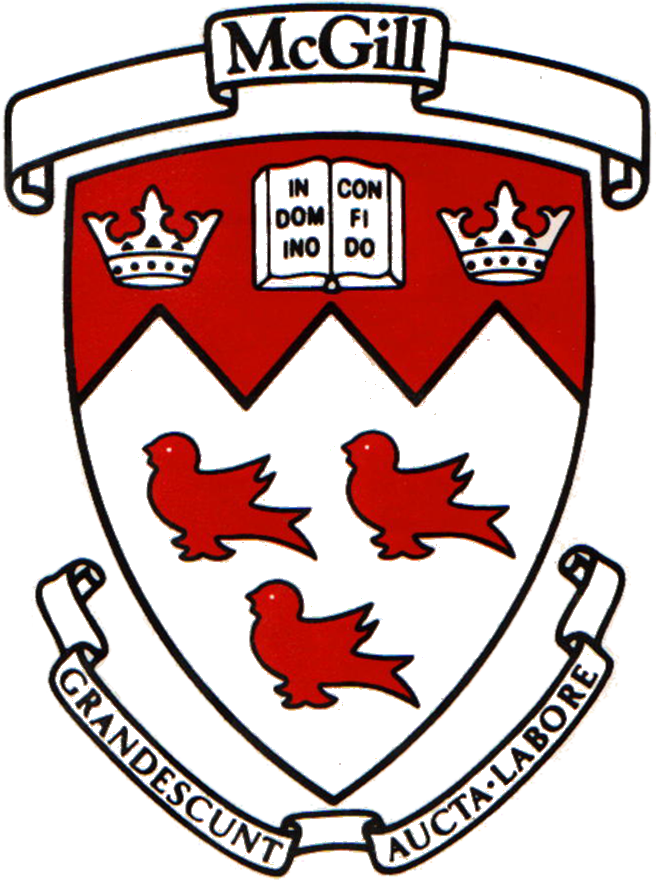
As citizens of the British Empire, McGill's men believed themselves to be honest, brave, and examples for the youth of the world to follow. The University's motto is Grandescunt Aucta Labore, Latin for "By work, all things increase and grow."

As citizens of the United States of America, Harvard's men believed the same things of themselves, with the added touch of being the inheritors of the American Revolution. The University's motto is simply Veritas, Latin for "Truth."

Having heard that Harvard had one the best football teams in America, McGill started its football program in 1874, and challenged Harvard to a game of "football." It would be the 1st-ever "football" game between American and Canadian teams. Wishing to maintain their appearance as honorable sportsmen, Harvard happily accepted.

But when the McGill men got to Harvard's Jarvis Field on May 14, they discovered that the game Harvard thought they'd been invited to play was soccer -- which got shortened to "assoc." and eventually to "soccer." The McGill men expected that they would be playing rugby (which has frequently been called "rugger").

Being "sportsmen" and "gentlemen," the team captains met to discuss the discrepancy with civility. There may have been tea involved, or perhaps a stronger beverage.

They came up with a compromise: They would play a game under Harvard's "Boston game" rules, and another game under the "code" of "rugby union," the version of football most familiar to Canada at the time. (Indeed, the predecessor to the CFL, the Canadian Football League, was the CRU, the Canadian Rugby Union.)

At least, that's the story I'd been led to believe. But, as Richard Hershberger, a historian who specializes in the post-Civil War period, points out, an article in The Boston Globe of May 11 suggests that the teams already knew ahead of time about the discrepancy, and that the compromise was worked out, by either mail or telegram. (The telephone was invented 2 years later, also in Boston. Note that, just as baseball was often spelled as 2 words at the time, or hyphenated, "base ball" or "base-ball," so, too, is "foot-ball" hyphenated here.)
On May 14, Harvard won the soccer game 3-0. The following day, they met for the rugby match, which ended 0-0. As Hershberger puts it:

This is the most important game in the history of American sport. I write this with no exaggeration. This is the game that converted Harvard to the rugby rules. Harvard then went forth and explained to the other schools that Harvard is Harvard and you other schools are not, so that is that. Next year, rugby will be adopted as for intercollegiate matches. From there they will immediately begin fiddling with the rules, and by 1880 will have distinctive features of American football. Most schools in 1874 favored a kicking game. Were it not for today's game, college football would be soccer, or something very close to it.

The Harvard men liked the rugby version, including the "try." Later in the year, their officials met with officials from the other football-playing schools, and the rules were combined with those of the soccer generally considered "football" in America, and carrying the ball was officially allowed, and the "try" became the "touchdown."
So if you want to know why America plays the gridiron game instead of the sport that most of the rest of the world calls "football" or some variant, blame Harvard and McGill.


Like St. John's University in New York City's Queens, McGill used to call their team the Redmen. Despite the Indigenous heritage of Canada, it had nothing to do with the people then usually called "Indians": University founder James McGill, like many Scotsmen, had red hair. The name was used from 1927 to 2020, when it was changed to Redbirds.
"Redbirds" was chosen as a match for the name for their women's teams, the Martlets. Their women's sports department was founded in 1976, and their women's teams were named for the birds shown on the McGill family crest.

*

May 15, 1874 was a Friday. There was another notable sporting event that day, a game played in the 1st professional baseball league, the National Association. The Boston Red Stockings beat the Brooklyn Atlantics, 8-2 at the Union Grounds in the Williamsburg section of Brooklyn.

Brooklyn remained a separate city from New York until 1898. By that point, the Atlantics had folded, and the Borough of Brooklyn was home to the team known today at the Los Angeles Dodgers. When the National League was founded in 1876, the Boston Red Stockings were admitted, and are known today as the Atlanta Braves.

December 31, 1999 & January 1, 2000: The Millennium

December 31, 1999:  The Millennium arrives. The people of planet Earth survived. At a terrible cost. But we hadn't destroyed ourselves. ...