Showing posts with label yale university. Show all posts

Sunday, December 25, 2022

December 25, 1894: The 1st Intersectional College Football Game

Walter Camp

December 25, 1894: In a manner of speaking, the 1st holiday-season college bowl game is played on this day. Certainly, it was the 1st college football game, ever, between teams from 2 different parts of the country. And it was the 2 men most responsible for the development of American football who set it up and opposed each other in it.

Walter Camp had been one of the 1st great college football players, at Yale University in the late 1870s. In 1888, he became Yale's head coach, and one of his players on that great team was Amos Alonzo Stagg. Between them, they invented pretty much every feature that turned American football from a game resembling soccer and rugby to the game that became so popular in the 20th Century.
Amos Alonzo Stagg

Both men went West to start college football programs, Stagg at the University of Chicago, Camp at the newly-founded Stanford University in the San Francisco Bay Area. They played at the Haight Street Grounds in San Francisco. Chicago beat Stanford 24-4.
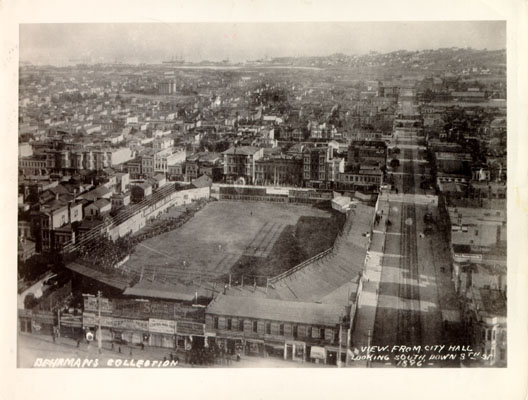
The Haight Street Grounds stood from 1887 to 1895. It was actually not at Haight Street, but at the southeastern corner of Stanyan and Waller Streets, in the Haight-Ashbury district that would become the seat of the Hippie movement in the 1960s, at the southeastern corner of Golden Gate Park, about a block from where Kezar Stadium would later be built.

*

December 25, 1894 was a Tuesday. Baseball was out of season, hockey was all-amateur, basketball was a recent invention, and this was before college football was playing bowl games, let alone on Christmas Day.

But in England, soccer, or "football" as they call it, had a tradition: To keep traveling to a minimum, and thus families together, 2 nearby teams would play at one's home ground on Christmas Day, and at the other's on the next day, December 26, Boxing Day. This tradition began to die out in the 1950s, but Boxing Day games are still played.

On December 25, 1894, the London-based team which I would eventually support, then known as Woolwich Arsenal, played, but not against a nearby team: They hosted Burslem Port Vale, at the Manor Ground in Plumstead, Kent, later to be a part of Southeast London, and won, 7-0. Patrick O'Brien scored 3 goals -- not yet known as a "hat trick" in either ice hockey or association football.

Monday, December 5, 2022

December 6, 1873: Eton vs. Yale

December 6, 1873: Eton vs. Yale, in football? Or in "foot ball," written as two words? Given the existence of the scorecard in this photo, apparently, it happened, if not officially, as the NCAA would say today.

Yale University, in New Haven, Connecticut, is America's 3rd-oldest college, following Harvard, and William & Mary. They are traditionally elitist and stuck-up, and that's two of the many things that they like about themselves.

But Eton College, in Eton, Berkshire, England, makes the Yalies look like nouveau riche. Founded in 1440 by King Henry VI, intended as a sister institution to King's College, Cambridge, Eton (pronounced "EE-ton") is known for its history, wealth, and notable alumni, known as Old Etonians. It is 1 of 3 public schools (what the English call private schools), along with Harrow and Radley, to have retained the boys-only-boarding-only tradition, which means that its boys live at the school, 7 days a week, with no girls. It's been called "the nurse of England's statesmen."

I quote Richard Hershberger, a historian who tends to specialize in baseball during this period:

A group of rich former students of Eton (this is more or less redundant) are tourists in America. While in Connecticut, they get up a game with some students at Yale. This is in no sense the Eton football team. I have my doubts about this being the Yale football team, or if that even had meaning in 1873. The most interesting aspect of this game is that it shows Yale playing more or less under the Football Association rules, i.e. soccer, and doing it well enough to beat a pickup team of Eton "old boys." The dominance of rugby in American college football is still a bit in the future.

The Earl of Rosebery is an interesting figure. This is Archibald Primrose, 5th Earl of Rosebery. He is 26 years old at this point.
"This point" being in 1873. This photo was taken years later.

After matriculating from Eton in 1866, he went to Oxford, but was kicked out two years later. He had bought a race horse, which was prohibited to undergraduates. When the school found out, they gave him the choice of selling the horse or of leaving school. He left. You have to respect that.

His lack of a degree did not hold him back. He became UK Prime Minister in 1894. Honestly, I could not have named a Victorian prime minister not named Disraeli, Gladstone, or Palmerston, but apparently there were some. In this case, it was brief and not terribly successful, but still...

What has this to do with football? Just as Yale's performance tells us something about how football was played in America in 1873, Archie's presence tells us something about the social status of football in Britain.

The game was played at Hamilton Park in New Haven. According to a newspaper, the Brooklyn Union, "After a closely contested match, played according to the English rules, with one or two American variations mutually agreed upon, it was won by Yale." No score is mentioned, nor a citation of the goalscorers. The Hartford Courant cited Yale as having won, 2-1, with Sherman being the scorer. Neither newspaper listed Sherman's first name.

Earlier in the season, both also at Hamilton Park, on October 25, Yale beat Rutgers, 3-1; and, on November 15, Yale lost to Princeton, 3-0. So Yale were 2-1 on the "season." A few months later, Harvard played McGill University of Montreal in 2 different "codes" of football, and it led to the game that would become known outside the United States as "American football."

Hamilton Park was the first home field for Yale's football team, from 1870 until the land for Yale Field was acquired in 1884. The park hosted horse races, and was home to the New Haven Elm Citys baseball team of the National Association during the 1875 season. The Hartford Dark Blues of the National League hosted a game there in 1877.

*

December 6, 1873 was a Saturday. It was the only college football game played that day. No other sporting events were played: Baseball was out of season, ice hockey barely existed, and basketball wouldn't be invented for another 18 years.

Sunday, November 27, 2022

November 28, 1889: College Football's Game of the Century -- the 19th Century

The 1889 Princeton Tigers

November 28, 1889: Perhaps, for the 1st time, a college football game was hyped up to be considered "The Game of the Century." Except, this was the 19th Century.

The 1889 season was a bit of a step forward for a sport that still resembled the English game of rugby more than the game the world outside the United States calls "American football." A field goal was worth 5 points, making it worth more than a touchdown, which was 4 points, and a kicked point after touchdown (PAT) was 2 points. Scoring a safety, then as now, was 2 points. Not until 1909 would a field goal become the 3 points it has remained ever since, and a PAT 1 point. It would be 1912 before a touchdown became 6 points.

The field itself was different. There was no end zone until 1912, which was also when the field was shortened from 110 to 100 yards. That was also the year a team was given 4 downs to make a 1st down, instead of 3. And 1889 was also the year that a "touchdown" no longer had to be literally true: Until then, a player had to cross the goal line and touch the ball to the ground. From this year onward, just crossing the goal line would be enough.

The game was still mostly played in the Northeast, and was dominated by the schools that would later be collectively called, and would ultimately found, "The Ivy League": Harvard, Yale, Princeton, the University of Pennsylvania (or "Penn"), Columbia, Dartmouth, Brown and Cornell.

But  there were some schools playing in the Midwest. And the South was beginning to catch on, and the 1st college football game in the State of South Carolina was played on December 14: Wofford defeated Furman, 5-1 on Furman's campus in Greenville. Wofford is in Spartanburg. Both schools now play in the NCAA's Football Championship Subdivision, formerly known as Division I-AA.

On October 26, the University of Delaware played its 1st game, losing 74-0 away to the Delaware Field Club in Wilmington. On November 16, the University of Iowa played its 1st game, losing 24-0 away to Iowa College in Grinnell. On November 23, Syracuse University (which had been founded in 1870, thus making it younger than the sport) played its 1st game, losing 36-0 away to the University of Rochester. And, in the Pacific Northwest, the University of Washington played its 1st game on November 28, Thanksgiving Day. I'll get to that shortly.

One major change for the 1889 season was the legalization of low tackling. This led to a sharp decrease in open-field running, and an increase in heavy, concentrated line formations like the "Princeton V," where teams engaged in brutal momentum plays to drive the ball forward. Also known as the "flying wedge," Princeton (officially, still "The College of New Jersey" until 1896, but everybody called them "Princeton") had used it against Rutgers in the 1st 2 college football games ever played, in 1869, with each team winning a game.
Harvard players demonstrating the flying wedge, 1892

The flying wedge would prove to be dangerous, resulting in several injuries, and even some deaths. It would be eliminated as part of safety measures created by the newly-established National Collegiate Athletic Association (NCAA) in 1906. But, for now, Princeton, already known as the Tigers due to their black and orange striped socks, were able to use it with brutal effectiveness.

How brutal? Their 1st 8 games went as follows: A 16-0 win over Lehigh, at University Field on the Princeton campus in Princeton, Mercer County, New Jersey; a 16-4 win in a rematch against Lehigh in Bethlehem, Pennsylvania; a 49-0 home win over Stevens Institute of Technology; a 72-4 win over Penn at the University Athletic Grounds in Philadelphia; a 98-0 win over Wesleyan University at the Berkeley Oval in The Bronx; a 71-0 win over Columbia at the Berkeley Oval just 3 days later, meaning they played 2 games in 4 days at the same location, and won by a combined total of 169-0; a 41-15 win over Harvard at Jarvis Field in Cambridge, Massachusetts; and a 54-6 home win over the Orange Athletic Club of Orange, New Jersey, outside Newark. So Princeton played 8 games, won all 8, and outscored its opponents 417-29, or an average of 52-4.

Big deal, you say? Weak schedule, full of "weak sisters," "paper tigers," "cupcakes," "gimmes"? Going into their game with Princeton on November 15, Harvard were 9-0, and had outscored their opponents 404-6, and Princeton beat them, 41-15. After their season-opening "doubleheader" with Princeton, Lehigh played 11 games, and went 8-1-2, so, clearly, they weren't a bad team. And, while the Orange A.C. mainly played other amateur sides that were not affiliated with colleges, they went 6-3 that season.

And then there was Yale University of New Haven, Connecticut. If there was any doubt, going into November 15, that the best team in the country was not either Princeton or Harvard, it was Yale.  Walter Camp's Bulldogs were dogged, indeed: They beat Wesleyan at home, 38-0, then away, 63-5; Williams college at home, 36-0; Cornell at home, 56-6; Amherst College at home, 42-0; Trinity College away in Hartford, 64-0; Columbia away, 62-0; Penn away, 20-10; Stevens at Berkeley Oval, 30-0; the Crescent Athletic Club, one of the Orange A.C.'s other opponents, 18-0 at Washington Park in Brooklyn, then home of the baseball team that would become the Dodgers; Cornell away, 70-0; Amherst on their campus in Amherst, Massachusetts, 32-0; Williams on their campus in Williamstown, Massachusetts, 70-0 the very next day; and Wesleyan at Hampden Park in Springfield, Massachusetts, 52-0.

And then, on November 23, in what was already the biggest rivalry in college football, on Saturday afternoon, November 23, also at Hampden Park, named for the famed "football ground" in Glasgow, Scotland, in front of 15,000 paying customers, an enormous total for the time, Yale beat Harvard, 6-0.

That's 15-0, outscoring their opponents, 699-21, or an average of 47-1. And that's after outscoring their opponents 698-0 in 13 games the year before. I don't care what era you're playing in, or what your schedule is: That is mind-boggling.

So a showdown between Yale and Princeton was set up, at the Berkeley Oval, for November 28, Thanksgiving Day, which, thanks to high school football in the Northeastern U.S., was already a traditional day for big rivalry football games. A crowd of 25,000, probably a record for a college football game anywhere in the country at that point, saw the teams kick off at 2:30 PM.

Yale attempted a field goal, but it hit an upright, and bounced back onto the field. Under the rules of the time, a player from the defending team could retrieve the ball and try to advance it. A Princeton player picked up the loose ball, and punted it back upfield, getting the Tigers out of danger.

Later, Princeton missed a field goal attempt, and the ball skidding past the goal line. Still considered live, a Yale player picked it up, but before he could decide whether to run with it or kick it, he fumbled it, and it rolled into the stands. This allowed a Princeton player to go into the stands and claim a touchdown. Another Yale fumble, deep in their own territory, led to a 2nd Princeton touchdown.

Princeton erased all doubt as to who was the better team, defeating Yale, 10-0. To put that in perspective: The last time Yale was held scoreless was in the 1886 season finale, a 0-0 tie with Princeton. The last time they lost was on November 21, 1885 -- to Princeton. They were undefeated in their last 48 games: 47-0-1. They did not lose again until the next season's Harvard game.

Let me put this another way. Yale began playing football in 1872. Through the 1895 season, their combined record against Princeton and Harvard was 23-7-8. Against all other teams, their record was 163-1-3. That is not a typographical error: One hundred sixty-three wins, one loss, three ties. Yale were not the New York Yankees of college football, or the Boston Celtics, or the Montreal Canadiens: They were all three combined.

Yale were considered National Champions for 1872, 1874, 1876, 1877, 1879, 1880, 1881, 1882, 1883, 1884, 1886, 1887, 1888, 1891, 1892, 1893, 1894, 1895, 1897, 1900, 1901, 1902, 1905, 1906, 1907, 1909 and 1927 -- 27 times.

Princeton closed its season on December 7, defeating an all-star team from Washington, D.C., 57-0 at Capitol Park, the District's baseball park. They finished 10-0, outscoring their opponents 482-29, for an average of 48-3. They were the undisputed National Champions.

Princeton were considered National Champions for 1869, 1870, 1873, 1875, 1878, 1885, 1889, 1893, 1896, 1898, 1899, 1903, 1911, 1920, 1922, 1933, 1935 and 1950 -- 18 times. Harvard were considered National Champions for 1890, 1910, 1912, 1913 and 1919 -- "only" 5 times.

After the 1889 season, Caspar Whitney, a magazine editor who later served as President of the U.S. Olympic Committee, created one of American sports' earliest all-star teams, naming it the All-America Team. It became a postseason tradition. These were the initial selections:

* Ends: Amos Alonzo Stagg of Yale, Arthur Cumnock of Harvard. Between them, Stagg and Yale mentor Walter Camp did more to shape the sport of football in America than any other people.

* Tackles: Hector Cowan of Princeton, Charles Gill of Yale.

* Guards: Walter "Pudge" Heffelfinger of Yale, John Cranston of Harvard. In 1892, a Pittsburgh athletic club made Heffelfinger the 1st man to be openly paid to play American football.
Pudge Heffelfinger

* Center: William George of Princeton.

* Quarterback: Edgar Allan Poe of Princeton, also their team Captain, making him, effectively, also their head coach. He went on to be elected to the office of Attorney General of the State of Maryland, as had his father, John Prentiss Poe. The writer Edgar Allan Poe had married his first cousin, Virginia Clemm, which made him both the great uncle and the second cousin twice removed of the Princeton Edgar Allan Poe.
Edgar Allan Poe. That's a football he's holding,
not a tell-tale heart or a cask of Amontillado.

* Halfbacks: Roscoe Channing of Princeton and James P. Lee of Harvard.

* Fullback: Knowlton Ames of Princeton. It sure sounds like the name of an Ivy League football player, and like the name of a successful financier, and he was both. He also served as head football coach at Purdue University, and as the 1st head coach at Northwestern University.
Knowlton Ames

So the 1st All-American team consisted of 5 players from Princeton, 3 from Yale, and 3 from Harvard.

The Berkeley Oval was at West 179th Street and University Avenue. New York University built it there as part of its University Heights Campus. NYU built Ohio Field in 1901, and the Oval began to decline in use, and apartment buildings went up on the site in 1923.

But NYU would end up scheduling bigger games at the Polo Grounds and Yankee Stadium. In 1973, having long since scaled back their athletic program (they now play in NCAA Division III), NYU left the campus, and the City University of New York (CUNY) system -- ironically, the successor to NYU's former rivals, City College (CCNY), took over the campus, as Bronx Community College.

Although football is no longer played there, BCC maintains Ohio Field as an athletic facility. But the Berkeley Oval, 2 blocks to the south, was arguably the more important sports site, and yet there's no historical marker, or any other indication of that importance.

*

November 28, 1889 was a Thursday -- being, as I said, Thanksgiving Day. There were 6 other college football games played that day:

* Dartmouth beat the Stevens Institute of Technology, 18-5 at the St. George Cricket Grounds in Hoboken, Hudson County, New Jersey, which is where Stevens was, and still is, now playing as an NCAA Division III school. Stevens was founded by engineer Edwin Augustus Stevens, who owned the land on which the St. George Grounds were built.

Previously, the only St. George Cricket Grounds I knew of was on Staten Island, adjacent to the St. George Ferry Terminal, roughly where the Staten Island University Hospital Community Park is now, home of minor-league baseball's Staten Island FerryHawks, and formerly the Staten Island Yankees.

In 1889, the New York Giants baseball team used that St. George Cricket Grounds as a temporary home, because the City of New York decided to extend 111th Street through the original version of the Polo Grounds, between 5th and 6th Avenues, and so a new ballpark with that name was built at 155th Street and 8th Avenue in Upper Manhattan, but the Giants needed a temporary home. Despite this, they won the National League Pennant. 

* Cornell beat Lafayette, 24-0 at Syracuse, New York, making it more or less a home game for Ithaca-based Cornell.

* Wesleyan University beat the University of Pennsylvania, 10-2 at the Berkeley Oval in The Bronx, roughly halfway between the schools. Wesleyan, now a Division III school, is in Middletown, Connecticut; and Penn is in Philadelphia.

* Franklin & Marshall University beat Dickinson College, 22-0 at McGrann's Park in Lancaster, Pennsylvania. Both schools now play in NCAA Division III.

* Lehigh University beat the Naval Academy, 26-6 at the Academy's parade ground in Annapolis, Maryland.

* And, in the very first game in what would become a proud history, the University of Washington got off to a bad start, losing to a team of alumni of Eastern colleges who happened to be living in Seattle, 20-0, at the Jackson Street Baseball Park.

Wednesday, November 23, 2022

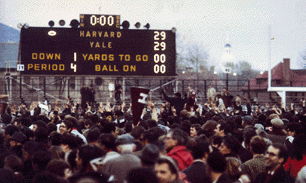
November 23, 1968: "Harvard Beats Yale, 29-29"

November 23, 1968: The most famous game in Ivy League history is played. The winners were... everybody who was involved, because it gets talked about more than most games that were glorious wins for one team or the other.

Harvard University was America's 1st college, founded in 1636 in Cambridge, Massachusetts, across the Charles River from Boston. Yale University was the 3rd, founded in 1701 and re-established a few years later in New Haven, Connecticut. (The 2nd was The College of William and Mary, in Williamsburg, Virginia.)

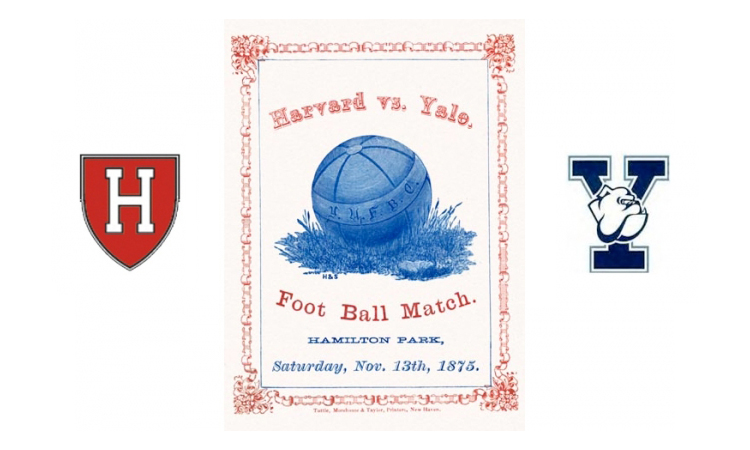
They first played each other in football on November 13, 1875, with the sport still in its infancy, on the Yale campus. Harvard won, 4-0 under the scoring rules of the time. But Yale took over the rivalry, going 9-0-2 through 1889. Eventually, their contest became each school's season finale, known as simply "The Game."

In 1968, both teams looked like they were among the best teams in the country, a rarity for Ivy League teams after World War I. Each went into their finale 8-0, the 1st time since 1909 that both of them were undefeated going into The Game.

Yale had Brian Dowling, an All-American quarterback from Cleveland. He had led them to 16 straight wins, and hadn't lost a game since the 6th grade. Yale student Garry Trudeau would start a comic strip titled Bull Tales, which in 1970 would become the nationally-syndicated Doonesbury. Dowling would be parodied as "B.D.," although the character and the real Dowling would turn out to be very different people. Yale also had running back Calvin Hill, who would star in the NFL, and whose son, Grant Hill, would become a Basketball Hall-of-Famer.

Harvard had a strong defense, nicknamed the Boston Stranglers after a recent serial killer. Their captain and top offensive player was running back Vic Gatto. One of their guards, good enough to make the All-Ivy League Team, was then listed as "Tom Jones." He became an actor under the name Tommy Lee Jones. His roommate was a prelaw student named Al Gore. (Bill Clinton and Hillary Rodham were still 3 years away from starting Yale Law School, and George W. Bush had just graduated from Yale.)

The game was played at Harvard Stadium, but that didn't matter to the oddsmakers, who made Yale, then ranked in the national Top 20, heavy favorites. The stadium's seating capacity was then listed as 57,750, and there wasn't a seat to be had, despite the weather being cold, with the wind blasting off the Charles. Scalpers were demanding $100 for tickets -- about $831 in today's money. God only knows what would have been charged if Internet ticket brokers were possible at the time.

At first, Yale justified their classification as favorites: Dowling ran for a touchdown, then passed to Hill for another, then threw another. In the 2nd quarter, the Bulldogs led 22-0. No team had scored that many off the Crimson in an entire game since Yale themselves did it in a 24-20 win in New Haven the year before.

Harvard managed a touchdown before the half, but missed the extra point. It was 22-6. Early in the 2nd half, Yale fumbled a punt, and Harvard recovered in the end zone. This time, the extra point was converted, and Harvard was within 22-13. But early in the 4th quarter, Dowling took over again, drove the Elis down the Allston pitch, and scored himself to put his team up 29-13.

With 2 minutes left, Yale still led 29-13. And, due to injuries, Harvard was left with their backup quarterback, Frank Champi. But he was undeterred, and got the Crimson over the goal line with 42 seconds left on the clock. A 2-point conversion failed, but Yale was called for pass interference. Gus Crim took the ball in on their 2nd chance, so it was Yale 29, Harvard 21.

The most obvious onside kick in the history of football was coming. But Harvard managed to recover it. Time was running out. Champi got the Crimson to the Bulldogs' 8-yard line with 3 seconds left. On the last play of regulation, he was flushed out of the pocket, but still managed to get a pass off. Gatto caught it, and took it in. Yale 29, Harvard 27.

Fans poured onto the field. But there was still a 2-point conversion to be attempted. The fans were cleared off. Champi found Pete Varney. He would appear in 69 games as a catcher for the Chicago White Sox and the Atlanta Braves from 1973 to 1976, serve as head baseball coach at Brandeis University in nearby Waltham, Massachusetts, and coach for years in the Cape Cod Baseball League. Nothing he did matched the pass he caught from Frank Champi with no time on the clock.
It was a tie. Along with Notre Dame's games with Army in 1946 and Michigan State in 1966 -- both known as "The Game of the Century" -- this is the most famous tie in football history. Why not? It remains the game of the century as far as the Ivy League is concerned.

The next day, the Harvard Crimson newspaper printed a headline: "HARVARD BEATS YALE, 29-29." In 2008, on the game's 40th Anniversary, a documentary film would use that headline as its title.
Did Harvard "win"? Yale coach Carm Cozza later admitted, "That tie was the worst loss of my career."

I mentioned Army in 1946. After their tie against Notre Dame, they had a similar season-closing rivalry game, with Navy in Philadelphia. They led 21-0. Navy came back, and was down 21-18, and was on Army's 3-yard line with time for one more play. Navy coach Tom Hamilton tried to run it in, and failed. When asked why he didn't go for the tying field goal, he spoke words that have entered the American lexicon: "A tie is like kissing your sister."

For Harvard, this tie was more like kissing your sister's really hot best friend. For Yale, this tie was like kissing your sister's other best friend. You know: The only with the "great personality."

Look at it this way: Since the league's official establishment for the 1956 season, Yale have won its title outright in 1956, 1960, 1967, 1977, 1979, 1980 and 2017; and won at least a share of it in 1968, 1969, 1974, 1976, 1981, 1989, 1999, 2006 and 2019. But do any of those teams get talked about, even as a "great team," other than among Yalies? No.

The 1968 Yale Bulldogs, and the 1968 Harvard Crimson, both get talked about, as great teams that played a great game.

*

November 23, 1968 was a Saturday. There were other big college football rivalry games played that day:

* Number 1 USC beat UCLA, 28-16 at the Los Angeles Memorial Coliseum. But the next week, a tie with Notre Dame cost them the Number 1 ranking. They ended up losing the Rose Bowl, and thus the National Championship, to Ohio State.

* Number 2 Ohio State beat Number 4 Michigan, 50-14 at Ohio Stadium in Columbus. It was said that Buckeye coach Woody Hayes purposely ran up the score. The Wolverines did not forget, and the next year's game between the rivals was an epic win for Michigan.

* Number 3 Penn State beat the University of Pittsburgh, 65-9 at Pitt Stadium.

* Number 5 Georgia were idle, between wins over rivals Auburn and Georgia Tech.

* Number 6 Arkansas beat Texas Tech, 42-7 at Jones Stadium in Lubbock, Texas. Okay, that's not a rivalry game.

* Number 7 Kansas beat Number 13 Missouri, 21-19 at Memorial Stadium (now Faurot Field) in Columbia, Missouri, to clinch the Big Eight Conference title.

* Number 8 Tennessee beat Kentucky, 24-7 at Neyland Stadium in Knoxville, Tennessee.

* Number 9 Louisiana State beat Tulane, 34-10 at Tulane Stadium in New Orleans.

* Number 10 Texas were idle, between wins over Texas Christian and Texas A&M.

* Number 11 Notre Dame were idle, between a win over Georgia Tech and a tie against USC.

* Number 12 Purdue beat Indiana, 38-35 at Ross-Ade Stadium in West Lafayette, Indiana.

* Number 14 Oklahoma beat Nebraska, 47-0 at Owen Field in Norman, Oklahoma.

* Number 15 Alabama were idle, between wins over Miami and arch-rival Auburn.

* Number 16 Oregon State beat Oregon, 41-19 at Parker Stadium (now Reser Stadium) in Corvallis, Oregon.

* Number 17 Auburn were idle, between losses to rivals Georgia and Alabama.

* Number 18 California was upset by Stanford, 20-0 at Memorial Stadium in Berkeley, California.

* Virginia beat Maryland, 28-23 at Scott Stadium in Charlottesville, Virginia.

* North Carolina beat Duke, 23-14 at Kenan Stadium in Chapel Hill, North Carolina. If Yale felt bad, think of how Duke felt: That was the only Atlantic Coast Conference game Carolina won all season, and it was against their greatest rival.

* South Carolina beat Clemson, 7-3 at Memorial Stadium in Clemson, South Carolina.

* Minnesota beat Wisconsin, 23-15 at Camp Randall Stadium in Madison, Wisconsin.

* Washington State beat Washington, 24-0 at Joe Albi Stadium in Spokane, Washington. "Wazzu" used Albi Stadium for games too big for their 23,500-seat Rogers Stadium, before building Martin Stadium in 1972.

* Army were idle, between wins over Pittsburgh and Navy.

* Navy were idle, between losses to Syracuse and Army.

* In New York City, Columbia beat Brown, 46-20 at Baker Field.

* In New Jersey, Princeton beat Cornell, 41-13 at Palmer Stadium in Princeton.

* And Rutgers beat Colgate, 55-34 at Rutgers Stadium in Piscataway.

In high school football, my alma mater, East Brunswick, beat Sayreville, 41-0 at War Memorial Stadium in Sayreville, clinching a Conference Championship.

There were 6 games played in the NBA that day:

* The New York Knicks beat the Boston Celtics, 111-100 at the new Madison Square Garden.

* The Baltimore Bullets beat the Detroit Pistons, 128-127 at the Baltimore Civic Center (now the CFG Bank Arena). Dave Bing scored 39 in a losing effort for the Pistons.

* The Philadelphia 76ers beat the Cincinnati Royals, 120-105 at the Cincinnati Gardens.

* The Atlanta Hawks beat the Chicago Bulls, 114-96 at the Chicago Stadium.

* The Milwaukee Bucks beat the Phoenix Suns, 115-112 at the Milwaukee Arena. In 1974, it was renamed the Milwaukee Exposition, Convention Center and Arena, or "The MECCA." Since 2014, it has been named the UW-Panther Arena.

* And the San Francisco Warriors beat the Seattle SuperSonics, 132-119 at the Cow Palace outside San Francisco in Daly City, California.

There were 2 games played in the American Basketball Association:

* The New York Nets beat the Minnesota Muskies, 110-105 at the Metropolitan Sports Center in the Minneapolis suburb of Bloomington, Minnesota.

* And the Miami Floridians beat the Indiana Pacers, 126-107 at the Miami Beach Convention Center.

And the entire NHL was in action that day:

* The New York Rangers lost to the team that would then have been considered their arch-rivals, the Boston Bruins, 5-1 at the Boston Garden.

* The Montreal Canadiens beat the Minnesota North Stars, 4-3 at the Montreal Forum.

* The Oakland Seals beat the Philadelphia Flyers, 2-1 at The Spectrum in Philadelphia.

* The Pittsburgh Penguins and the Los Angeles Kings played to a tie, 2-2 at the Civic Arena in Pittsburgh.

* The Detroit Red Wings beat the Toronto Maple Leafs, 5-2 at Maple Leaf Gardens in Toronto.

* The St. Louis Blues beat their arch-rivals, the Chicago Black Hawks, 1-0 at the St. Louis Arena.

Also, Arsenal lost to Chelsea, 1-0 at Highbury in North London.

Monday, November 21, 2022

November 21, 1934: "Anything Goes" Premieres

November 21, 1934: The musical Anything Goes premieres at the Alvin Theatre in New York. Along with Kiss Me, Kate, Cole Porter called it "one of my two perfect musicals."

Cole Albert Porter was born on June 8, 1891 in Peru, Indiana, to a wealthy family. His mother, the daughter of a coal and lumber speculator who was believed to be the richest man in Indiana at the time, indulged his love of music. Together, they wrote his first operetta when he was only 10 years old.

He was valedictorian of his Massachusetts prep school, and his grandfather rewarded him with a trip to Europe and admission to Yale University, which made him a worldly young man. He joined the famed Whiffenpoofs a cappella singing group, and wrote "Bulldog," which is still Yale's fight song to this day.

His frequent trips to Manhattan on the New York, New Haven & Hartford Railroad (now the New Haven Line of Metro-North Commuter Railroad) indulged his love of musicals, but also indulged his love of nightlife, including gay liaisons.

To indulge his grandfather, he moved on to Harvard Law School, but the school's dean knew where his talent lay, and helped him switch to Harvard Music School. His mother was told, and supported it; his grandfather was not told. He staged musicals at Harvard, and by 1915, was staging them on Broadway.

He worked with the Duryea Relief organization during World War I, and hosted debauched parties in Paris. In 1918, he met Linda Lee Thomas, and their marriage gave both what they needed: She got security, and a man who adored her for her personality, if not lusting for her; he got the cover of a marriage to deflect public suspicion of what he really wanted in bed. The marriage lasted until her death in 1954.

His musicals were good enough to help him get by, if not to become famous, until 1928, when Paris became his 1st big hit show. His 1929 show Fifty Million Frenchmen included the song "You Do Something to Me," which truly launched him: Along with Irving Berlin, George & Ira Gershwin, Richard Rodgers & Lorenz Hart, and Johnny Mercer and his various collaborators, Cole Porter became one of the leaders of what became known as "The Great American Songbook." More than that, it kept him afloat during the Great Depression, when many writers, producers and theater owners went under.

In 1932, he staged a musical titled The Gay Divorce -- "gay" in its original sense of "happy," not as in "homosexual," no matter what the tendencies of Broadway in general and Porter in particular. It starred Fred Astaire, and it was his last show before he went to Hollywood, including the 1934 film version, The Gay Divorcee. It included "Night and Day," which remains Porter's best-known song.

In 1934, producer Vinton Freedley came up with a new approach to producing musicals. Instead of commissioning book, music and lyrics, and then casting the show, Freedley sought to create an ideal musical with stars and writers all engaged from the outset.

The stars he wanted were Ethel Merman, William Gaxton and comedian Victor Moore. He planned a story about a shipwreck and a desert island, and for the book he turned to P. G. Wodehouse and Guy Bolton. For the songs, he decided on Porter. By telling each of these that he had already signed the others -- in other words, lying to them -- Freedley gathered his ideal team together.

A drastic last-minute rewrite was necessitated by the Morro Castle fire off the coast of New Jersey in September, which dominated the news and made Bolton and Wodehouse's book seem tasteless. Nevertheless, the show, Anything Goes, was an immediate hit.

Its songs include the title number, "I Get a Kick Out of You," "All Through the Night" and, along with "Night and Day," probably the best-known Porter song, "You're the Top." (Often mis-listed and mis-sung as "You're the Tops.") It name-checks several current big names in the world: Mickey Mouse, Mahatma Gandhi (pronounced "GAN-dee," to rhyme with "Napoleon brandy"), Greta Garbo, Fred Astaire, Eugene O'Neill, Jimmy Durante, Irving Berlin, and "Mrs. Astor," although not specifying which one.

Anything Goes was filmed in 1936, with Merman, Bing Crosby and Ida Lupino. There was a remake in 1956, but with a seriously rewritten story, this time with Crosby and Mitzi Gaynor. Merman and Frank Sinatra starred in a made-for-TV version in 1954, for NBC's The Colgate Comedy Hour. A performance of a 2021 London revival, with Broadway (and TV show Younger) star Sutton Foster and British musical legend Robert Lindsay, was broadcast on PBS' Great Performances in 2022.

Anything Goes was the 1st of 5 Porter shows featuring Merman. He loved her loud, brassy voice, and wrote many numbers that displayed her strengths. Jubilee, written with Moss Hart in 1935, was not a major hit, but included the songs "Begin the Beguine" and "Just One of Those Things." He also wrote for movies, including "I've Got You Under My Skin" for Born to Dance in 1936, and "In the Still of the Night" for Rosalie in 1937. (This is not the doo-wop hit of The Five Satins in 1956, although Dion & the Belmonts had a hit with it in 1960.) He wrote "Don't Fence Me In" for a 1934 film musical that was never made, but it became a hit when Roy Rogers sang it in the 1944 film Hollywood Canteen.

On October 24, 1937, only 46 years old, Porter was riding a horse at Piping Rock Club in Locust Valley, Long Island, New York, when his horse rolled on him and crushed his legs, leaving him substantially crippled and in constant pain for the rest of his life. Though doctors told Porter's wife and mother that his right leg would have to be amputated, and possibly the left one as well, he refused to have the procedure. He remained in the hospital for seven months before being allowed to go home to his apartment at the Waldorf Towers.

He resumed work as soon as he could, finding it took his mind off his perpetual pain. In 1938, he staged Leave It to Me!, with Mary Martin singing "My Heart Belongs to Daddy." His 1939 show DuBarry Was a Lady starred Merman and Bert Lahr, but it was too risqué for the censors, and some lines and songs had to be cut. "Friendship," one of Merman's best-known songs, was kept.

In 1940, Porter wrote Panama Hattie. Most of its songs have been forgotten, but it was his longest-running hit yet. It also led to one of the best jokes on The Muppet Show: In 1977, Merman guested, and, after she sang a medley of her hits, the camera panned to the box where the old hecklers Statler and Waldorf, both named for famous New York hotels, sat. Waldorf said, "I remember Ethel Merman in the opening of Panama Hattie!" Statler, apparently believing himself to be the younger of the two, told him, "You remember Teddy Roosevelt in the opening of the Panama Canal!" (In fact, while Roosevelt got the Canal built, it didn't open until 1914, when Woodrow Wilson was President.)

Composer biographies were common in 1940s films, even for still-living writers like Porter. In 1946, Cary Grant played Porter in Night and Day. Porter himself was at a commercial low point, but in 1948, he staged Kiss Me, Kate, a modernization of William Shakespeare's The Taming of the Shrew, which led to a rebound in his career. The following year, the Tony Awards debuted, and Kiss Me, Kate won the 1st-ever Tony for Best Musical.

After Porter resisted it for 20 years after the horseback accident, ulcers on his right leg finally forced its amputation in 1958. Broadway writer Noël Coward, a close friend, visited him, and saw how he was no longer in pain, and predicted that his musical output would get back to normal levels, and he would be a hit all over again.

Sadly, that turned out to be wishful thinking: He never wrote another song, and lived in seclusion until kidney failure ended his life on October 15, 1964 outside Los Angeles in Santa Monica, California. He was 73. Both the music industry, through rock and roll, and Broadway, with more sophisticated musicals like My Fair Lady and Fiddler On the Roof, had passed him by.

But not completely. The roster of singers who've recorded compilation albums of his songs is staggering: Ella Fitzgerald, Frank Sinatra, Rosemary Clooney, Anita O'Day, Julie London, Dionne Warwick, and, as recently as 2021, in his last album before being overtaken by Alzheimer's disease, Tony Bennett recorded Love for Sale, a series of Porter duets with Lady Gaga, born 22 years after Porter died.

In 1966, Frankie Valli & The Four Seasons had a Top 10 hit with "I've Got You Under My Skin." In a 1974 episode of M*A*S*H, set in 1951, "Trapper" John McIntire (played by Wayne Rogers) sang it during a surgery session. In a 1982 episode of the show, set in 1953, Hawkeye Pierce (played by Alan Alda), having lost a bet to Trapper's replacement, B.J. Hunnicutt (played by Mike Farrell), had to climb on top of a table in the mess tent, drop his pants (but not his underwear), and "sing 'You're the Tops' without your bottoms." Not long before her death in 1984, Merman recorded a new version of "Friendship" for Friendship brand margarine.

In 1989, interviewed for the CBS News show 48 Hours while on tour for his album Flowers In the Dirt, Paul McCartney, 47 years old and 19 years into his post-Beatles solo career, made no bones about his love for rock and roll, but also made the point that he didn't start out that way: He said, "I was out to be another Cole Porter. Still am, babe."

In 1990, noting that Porter was gay and that AIDS had devastated the gay community, including the gay overlap with the Broadway sub-community, the fundraising album Red Hot + Blue was recorded. It included David Byrne of Talking Heads on "Don't Fence Me In," Neneh Cherry on "I've Got You Under My Skin," and Sinéad O'Connor on "You Do Something to Me."

The Alvin Theatre, where Anything Goes premiered, was at 250 West 52nd Street in Midtown Manhattan. In 1983, it was renamed the Neil Simon Theatre. It is still in operation. Oddly, no Broadway Theatre has yet been named for Cole Porter.

*

November 21, 1934 was a Wednesday. This was also the day that American newspapers broke the story of the "Business Plot," a proposed military coup that would be backed by some of America's richest men to depose President Franklin D. Roosevelt and install a fascist government, a plan torpedoed when their intended commander, Marine General Smedley Butler, blew the whistle on it in a Congressional committee hearing. I have a separate entry for that event.

This was also the day that the Yankees purchased the contract of Joe DiMaggio from the San Francisco Seals of the Pacific Coast League. I have a separate entry for that event.

Baseball was out of season. Football was in midweek. The NBA hadn't been founded yet. And while the NHL season began on November 8, there were no games scheduled for this day. So there were no scores.

November 21, 1914: The Yale Bowl Opens

November 21, 1914: The Yale Bowl opens, a mile and a half west of the main campus of Yale University in New Haven, Connecticut. Arch-rival Harvard spoil the party, as the Crimson beat the Bulldogs, 36-0. Yale were a good team that season, going 6-2. But Harvard might have been the best team in the country, going 7-0-2.

Prior to the Yale Bowl, Yale had played since 1884 at Yale Field, across Derby Avenue, where they built the current baseball version of Yale Field in 1928. It seated 33,000 fans, while the Yale Bowl seated 70,896. After decades of deterioration, a much-needed renovation was completed in 2006, with a more modern facility, and wider seats, reducing seating capacity to 61,446.

While Yale claim 27 retroactively-awarded National Championships, only one of these, in 1927, has been won since the Yale Bowl opened. The Ivy League was founded in 1954, and in 2022, Yale won its 17th Ivy League title. (UPDATE: In 2023, they won their 18th.)
With the combined Harvard-Yale logo at midfield

When the New York Giants needed a temporary home between the October 1973 closing of the original Yankee Stadium and the October 1976 opening of Giants Stadium, they considered several facilities in the New York Tri-State Area. Being 76 miles northeast of Midtown Manhattan, the Yale Bowl was at the very edge of that area.

Indeed, New Haven is the terminus of one of the lines of what's now the Metro-North Commuter railroad. And, with ties to both New York and New England, the city often serves as something of a "neutral zone" between New York and Boston sports fandoms.

Nevertheless, the Giants played 5 home games at the ale Bowl in 1973, and 7 in 1974, before being allowed to use Shea Stadium in Queens for the 1975 season. The commute, the traffic and the parking situation were terrible, and as the Giants got worse and worse, attendance dropped from a peak of 70,168 to a trough of 21,170. The Giants went 1-11 at the Yale Bowl, including a 1974 overtime loss to the Jets -- and that doesn't include the 1st game ever played between the Giants and the Jets, a 1969 preseason game at the Yale Bowl, which the Jets also won.

In the 1976 and 1977 seasons, the Connecticut Bicentennials of the North American Soccer League played at the Yale Bowl. But, except for the 17,302 they got for a 1977 game against the Pelé-led New York Cosmos, they never got more than 7,000 fans.

*

November 21, 1914 was a Saturday. These other notable college football games were played that day:

* Army beat Springfield College, 13-6 on The Plain in West Point, New York. Army went 9-0 that season.

* Navy beat Ursinus, 33-2 at Worden Field in Annapolis, Maryland.

* Illinois beat Wisconsin, 24-9 at Randall Field in Madison, Wisconsin. Illinois went 7-0, and won the title of the Western Conference, which later became the Big Ten.

* Nebraska beat Iowa, 16-7 at Iowa Field in Iowa City. Nebraska finished 7-0-1 and won the Missouri Valley Conference title.

* Tennessee did not play that week. They went 9-0, and won the Southern Intercollegiate Athletic Association title.

* Texas also did not play that week. They went 8-0, and won the 1st-ever Southwest Conference title.

* Rivalry: Lehigh beat Lafayette, 17-7 at March Field in Easton, Pennsylvania.

* Rivalry: Purdue beat Indiana, 23-13 at Stuart Field in West Lafayette, Indiana.

* Rivalry: Minnesota beat the University of Chicago, 13-7 at Stagg Field in Chicago.

* Rivalry: Missouri beat Kansas, 10-7 at McCook Field in Lawrence, Kansas.

* Among New York City teams, New York University lost to Wesleyan, 29-13 at Ohio Field in The Bronx; Fordham beat Boston College, 14-3 at Fordham Field in The Bronx; and Columbia had suspended its program for the season.

* And for the New Jersey schools, Rutgers beat the Stevens Institute of Technology, 83-0 at Castle Field in Hoboken; while Princeton had concluded its season the week before, losing to Yale.

Baseball was out of season. Professional basketball barely existed. And, in that era, it was a little early for hockey season to start.

In English soccer, North London team Arsenal went to Yorkshire, and lost to Huddersfield Town, 3-0 at Leeds Road.

Sunday, November 20, 2022

November 21, 1877: Thomas Edison Invents the Phonograph

November 21, 1877: Thomas Edison invents the phonograph at his laboratory in the Menlo Park section of Raritan Township, Middlesex County, New Jersey. It is the 1st device capable of recording sound.

It recorded on tinfoil around a grooved cylinder. Into its speaker -- partly because it was the only way it could be done, and partly because he was hard of hearing -- Edison shouted into it, an old nursery rhyme:

Mary had a little lamb!
Its fleece was white as snow!
And everywhere that Mary went
the lamb was sure to go!

Although that recording does not survive, Edison recorded it again for a demonstration years later, and that one does survive.

Edison already had many patents to his name, making him wealthy. But the phonograph was the one that first got him national attention. Over the next few years, other scientists, including telephone inventor Alexander Graham Bell, made improvements that made the recording industry possible.

Edison died in 1931. In 1954, to differentiate itself from the other towns in New Jersey named Raritan, the town that included the neighborhood of Menlo Park changed its name to the Township of Edison. It later erected a monument on the site of Edison's laboratory, a "Light Tower" that referenced his invention of the incandescent lamp, the 1st practical light bulb, in 1879.

*

November 21, 1877 was a Wednesday. Traditionally, this is not a day on which football games are played. But one was: On what was then its home field, Hamilton Park in New Haven, Connecticut, Yale University beat Trinity College of Hartford, 7-0.

Saturday, November 12, 2022

November 13, 1875: The 1st Harvard-Yale Game

November 13, 1875: Harvard University and Yale University, America's oldest and 3rd-oldest colleges, and both pioneers of college football, play each other in the sport for the 1st time. The game is played at Hamilton Park, a horse-racing track in New Haven, Connecticut, and, with one touchdown, under the scoring system of the time, Harvard won, 4-0.

The first American intercollegiate sporting event took place on August 3, 1852, after Yale invited Harvard to a race of crews. Harvard won "The Boat Race" on that 1st occasion. The first intercollegiate contests in ice hockey, soccer, and 5-on-5 basketball featured teams from Harvard and Yale.

Many now century-old, or older, aspects of American football were introduced by Harvard or Yale students or athletes. Yale introduced cheerleading at athletic events in 1890, and tailgate parties in 1905. Harvard introduced spring practice to collegiate football March 14, 1889.

Yalies sang "Hold the Fort" during the 1892 Harvard game, considered the first public performance of a collegiate "fight song." It predated "Boola Boola," in 1900, and what became their official fight song, "Bull Dog," written by Cole Porter when he was a senior at Yale in 1913.

In 1883, Harvard and Yale played each other at the Polo Grounds in New York, with Yale winning, 23-2. From 1891 to 1894, they played each other at Hampden Park in Springfield, Massachusetts. There was fan violence at the 1894 game, won by Yale, 12-4, leading to the schools taking the next 2 seasons off. They resumed in 1897, and have alternated between Boston and New Haven ever since.

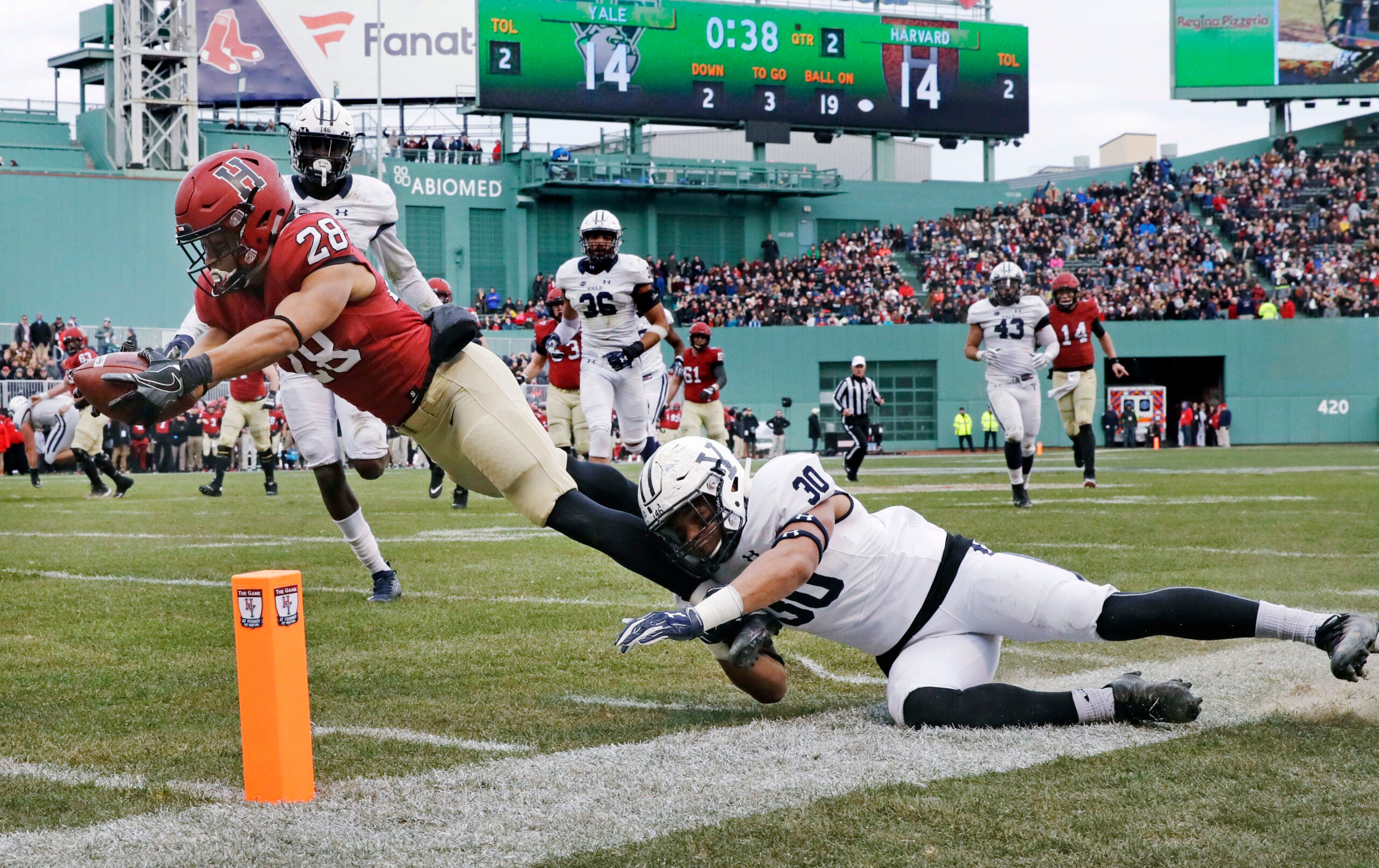
They took 1917 and 1918 off due to World War I; 1943, 1944 and 1945 due to World War II; and 2020, due to COVID. But, since WWII, they have played at Harvard Stadium (built in 1903) in even-numbered years, and the Yale Bowl (built in 1914) in odd-numbered years. An exception was made in 2018, when Harvard, having the choice of home field, talked Yale into playing at Fenway Park in Boston. Harvard won that one, 45-27, making it the highest-scoring contest in the history of "The Game."
November 17, 2018

Both teams went into the 1900 game undefeated, and Yale won, 28-0. The 1908 game saw both teams undefeated as well, and Harvard won, 4-0. In 1914, Harvard spoiled the opening of the Yale Bowl, winning 36-0.
The Yale Bowl, with the field marked for "The Game"

Before the opening kickoff of the 1923 game, Yale coach Dwight Jones told his undefeated Bulldogs, "Gentlemen, you are about to play Harvard. You will never do anything else so important for the rest of your lives."

They certainly wouldn't have done so under worse conditions: According to the era's greatest sportswriter, Grantland Rice, the field at Harvard Stadium was "a gridiron of seventeen lakes, five quagmires and a water hazard." Perhaps it was fitting that the key play, a return of a fumble 67 yards for a touchdown, was made by a man named Raymond Pond, known as Ducky. Yale won, 13-0. Pond later served as Yale's head coach, from 1934 to 1940.

In 1947, the only way for a Harvard football player to win his varsity letter was to play in the Yale game. Legend has it that, knowing this, Robert F. Kennedy played in the Harvard-Yale game on a broken leg. In 1955, his brother, Ted Kennedy, caught a touchdown pass against Yale. What the Kennedy legend doesn't say is that Bobby really played on "only" a sprained ankle, and that Yale won both of these games. (Ted was good enough to receive interest from the Green Bay Packers, but his father told him to go to law school instead.)
Harvard Stadium

Both teams were undefeated going into the 1968 game at Harvard Stadium, making it the 1st Ivy League title decider between them. Yale led 29-13 with 42 seconds to go, but Harvard scored 2 touchdowns and 2 2-point conversions to tie the game, and split the honors. The Harvard Crimson newspaper had the headline: "HARVARD BEATS YALE, 29-29."
November 23, 1968

In 1982, students at the Massachusetts Institute of Technology, Harvard's Cambridge neighbors, pulled one of the great college football pranks, pushing a balloon with the letters "MIT" on it through the turf at Harvard Stadium. (Harvard won, 45-7.) Not to be outdone, a little over a year later, during the 1984 Rose Bowl, students at California Institute of Technology in Pasadena hacked into the Rose Bowl scoreboard, so that what should have read "UCLA 38" and "ILLINOIS 9" read "CALTECH 38" and "MIT 9." (UCLA ended up winning, 45-9.)
November 20, 1982

Going into the 2022 game, Yale leads the all-time series, with 69 wins to Harvard's 60, while there have been 8 ties. (UPDATE: Through the 2024 game, Yale leads, 71-61.)

*

November 13, 1875 was a Saturday. This was still early in the history of football, college or otherwise. Only 1 other game was played that day: Princeton (then still known as the College of New Jersey) beat Columbia, 6-2 at University Field in Princeton, New Jersey.

Friday, November 11, 2022

November 12, 1892: The 1st Pro Football Player

November 12, 1892: For the 1st time -- as far as is known today -- a is paid to play the sport of American football.

William Walter Heffelfinger was born on December 20, 1867 in Minneapolis. "Pudge" played baseball and football at Central High School in Minneapolis before making his way to Yale University in New Haven, Connecticut. Playing on both the offensive and defensive lines, Heffelfinger was named to Yale head coach Walter Camp's All-American Team 3 times.

Yale was a major football power during that time, and Heffelfinger helped lead the team to undefeated seasons in 1888 and 1891, accompanying one-loss seasons in 1889 and 1890. The 1888 team amazingly outscored their opponents 698-0 that season. Their biggest win was a 105-0 demolition of Wesleyan University of Middletown, Connecticut; their narrowest, a 28-0 win over the Crescent Athletic Club at Washington Park in Brooklyn, then the home of the baseball team that would become known as the Brooklyn Dodgers. Oddly, that season, Yale did not play the school already considered their arch-rivals, Harvard University.

At 6-foot-3 and 200 pounds. Heffelfinger was considered especially big for his time, and towered over his opponents. His size allowed him to wreak havoc on opposing lines, where it was said he would typically take out two to three players at a time. He also is credited with introducing the "pulling guard" play. In the 1920s, the great sportswriter Grantland Rice referred to Heffelfinger as the greatest guard of all time. "Pudge" also lettered in baseball, rowing, and track.

For many years, it was believed that the 1st game in which someone was paid to play American-style football occurred on September 3, 1895, in Latrobe, Pennsylvania, about 40 miles east of Pittsburgh. The Latrobe Athletic Association defeated the Jeannette Athletic Club, 12-0 (a touchdown was then worth 4 points, so this was three touchdowns to none), despite Jeannette having paid Joh Brallier $10 (about $355 in 2022 money) to play as their quarterback.

Latrobe were, however, so impressed with Brallier that they hired him as a player-coach, and he remained with them through 1907, his coaching record an amazing 36-3-4. He died in 1960, and was the earliest man to have admitted to being paid to play football.

But in the 1960s, Pittsburgh Steelers owner Art Rooney was presented with documents that proved an earlier man was paid to play the game. Pudge Heffelfinger was paid $500 (about $16,400 in 2022 money) to play one game for the Pittsburgh-based Allegheny Athletic Association on November 12, 1892, at Exposition Park, then the home of baseball's Pittsburgh Pirates. He helped Allegheny defeat its archrival, the Pittsburgh Athletic Club, 4-0, the one touchdown scored when Heffelfinger picked up a fumble and ran it in.

Heffelfinger soon began a career in coaching, where he made stops at the University of California, Lehigh University, and the University of Minnesota. He also frequently returned to Yale to help the football team prepare for contests against rivals Harvard and Princeton.

In the 1930s, he founded Heffelfinger Publications, which produced sales booklets for football and baseball equipment. He also spent time working for his father's shoe business, and later in real estate. He also went on to find success in politics. He was a Minnesota delegate to the Republican National Conventions in 1904 and 1908. He served as Hennepin County Commissioner (the County that includes Minneapolis) from 1924 to 1948, and ran unsuccessfully for Congress in 1930. (That was a bad year for Republicans, as it was the 1st Congressional election of the Great Depression.)

Despite his nickname, suggesting that he was overweight, "Pudge" maintained his playing shape throughout his life. Even in his 40s, it was common for him to return to Yale, where the coach would give him a jersey and let him play with the second team during practice. In the early 1920s, he played in a pro game against the Columbus Panhandles which featured the famous Nesser brothers. He continued as a regular in pro charity games up until his mid-60s. He played his last organized football game in a charity event in Minneapolis in 1933, at the age of 65.
He was inducted into the College Football Hall of Fame in 1951, and died on April 2, 1954 at the age of 86. He had never publicly discussed his role as a professional football pioneer, unlike Brallier. (As far as I can determine, the two men never met.) He was buried at the small Hawley Cemetery outside Blessing, Texas, where he was living at the time, near Houston.

*

November 12, 1892 was a Saturday. The only sport in action that day was college football, with these 9 games being played:

* Harvard beat the Boston Athletic Club, 16-12 in Boston.

* Cornell beat the Massachusetts Institute of Technology, 44-12 on MIT's campus in Cambridge, Massachusetts, outside Boston.

* Lafayette and Mount Hermon played to a tie, 12-12 on Mount Hermon's campus in Gill, Massachusetts.

* Amherst beat Trinity, 21-8 on Trinity's campus in Hartford, Connecticut.

* Bowdoin beat Brown, 8-0 on Brown's campus in Providence, Rhode Island.

* Yale beat the University of Pennsylvania, 28-0 at Manhattan Field, next-door to the Polo Grounds in Upper Manhattan.

* Lafayette beat the Orange Athletic Club, 30-0 in Orange, New Jersey, outside Newark.

* Michigan beat the University of Chicago, 18-10 at Olympic Park in Toledo, Ohio.

* And Northwestern Beat Lake Forest, 18-0 in Lake Forest, Illinois, outside Chicago.

December 31, 1999 & January 1, 2000: The Millennium

December 31, 1999:  The Millennium arrives. The people of planet Earth survived. At a terrible cost. But we hadn't destroyed ourselves. ...