
November 12, 1892: For the 1st time -- as far as is known today -- a is paid to play the sport of American football.
William Walter Heffelfinger was born on December 20, 1867 in Minneapolis. "Pudge" played baseball and football at Central High School in Minneapolis before making his way to Yale University in New Haven, Connecticut. Playing on both the offensive and defensive lines, Heffelfinger was named to Yale head coach Walter Camp's All-American Team 3 times.
Yale was a major football power during that time, and Heffelfinger helped lead the team to undefeated seasons in 1888 and 1891, accompanying one-loss seasons in 1889 and 1890. The 1888 team amazingly outscored their opponents 698-0 that season. Their biggest win was a 105-0 demolition of Wesleyan University of Middletown, Connecticut; their narrowest, a 28-0 win over the Crescent Athletic Club at Washington Park in Brooklyn, then the home of the baseball team that would become known as the Brooklyn Dodgers. Oddly, that season, Yale did not play the school already considered their arch-rivals, Harvard University.
At 6-foot-3 and 200 pounds. Heffelfinger was considered especially big for his time, and towered over his opponents. His size allowed him to wreak havoc on opposing lines, where it was said he would typically take out two to three players at a time. He also is credited with introducing the "pulling guard" play. In the 1920s, the great sportswriter Grantland Rice referred to Heffelfinger as the greatest guard of all time. "Pudge" also lettered in baseball, rowing, and track.
For many years, it was believed that the 1st game in which someone was paid to play American-style football occurred on September 3, 1895, in Latrobe, Pennsylvania, about 40 miles east of Pittsburgh. The Latrobe Athletic Association defeated the Jeannette Athletic Club, 12-0 (a touchdown was then worth 4 points, so this was three touchdowns to none), despite Jeannette having paid Joh Brallier $10 (about $355 in 2022 money) to play as their quarterback.
Latrobe were, however, so impressed with Brallier that they hired him as a player-coach, and he remained with them through 1907, his coaching record an amazing 36-3-4. He died in 1960, and was the earliest man to have admitted to being paid to play football.
But in the 1960s, Pittsburgh Steelers owner Art Rooney was presented with documents that proved an earlier man was paid to play the game. Pudge Heffelfinger was paid $500 (about $16,400 in 2022 money) to play one game for the Pittsburgh-based Allegheny Athletic Association on November 12, 1892, at Exposition Park, then the home of baseball's Pittsburgh Pirates. He helped Allegheny defeat its archrival, the Pittsburgh Athletic Club, 4-0, the one touchdown scored when Heffelfinger picked up a fumble and ran it in.
Heffelfinger soon began a career in coaching, where he made stops at the University of California, Lehigh University, and the University of Minnesota. He also frequently returned to Yale to help the football team prepare for contests against rivals Harvard and Princeton.
In the 1930s, he founded Heffelfinger Publications, which produced sales booklets for football and baseball equipment. He also spent time working for his father's shoe business, and later in real estate. He also went on to find success in politics. He was a Minnesota delegate to the Republican National Conventions in 1904 and 1908. He served as Hennepin County Commissioner (the County that includes Minneapolis) from 1924 to 1948, and ran unsuccessfully for Congress in 1930. (That was a bad year for Republicans, as it was the 1st Congressional election of the Great Depression.)
Despite his nickname, suggesting that he was overweight, "Pudge" maintained his playing shape throughout his life. Even in his 40s, it was common for him to return to Yale, where the coach would give him a jersey and let him play with the second team during practice. In the early 1920s, he played in a pro game against the Columbus Panhandles which featured the famous Nesser brothers. He continued as a regular in pro charity games up until his mid-60s. He played his last organized football game in a charity event in Minneapolis in 1933, at the age of 65.
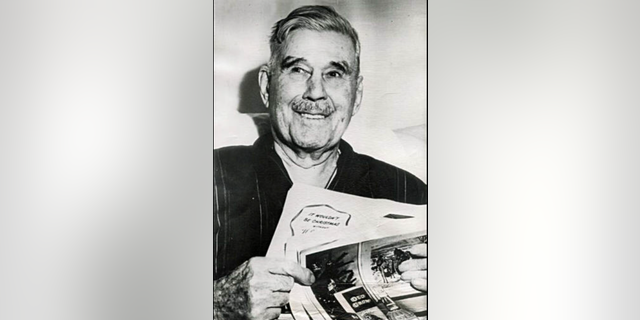
He was inducted into the College Football Hall of Fame in 1951, and died on April 2, 1954 at the age of 86. He had never publicly discussed his role as a professional football pioneer, unlike Brallier. (As far as I can determine, the two men never met.) He was buried at the small Hawley Cemetery outside Blessing, Texas, where he was living at the time, near Houston.
*
November 12, 1892 was a Saturday. The only sport in action that day was college football, with these 9 games being played:
* Harvard beat the Boston Athletic Club, 16-12 in Boston.
* Cornell beat the Massachusetts Institute of Technology, 44-12 on MIT's campus in Cambridge, Massachusetts, outside Boston.
* Lafayette and Mount Hermon played to a tie, 12-12 on Mount Hermon's campus in Gill, Massachusetts.
* Amherst beat Trinity, 21-8 on Trinity's campus in Hartford, Connecticut.
* Bowdoin beat Brown, 8-0 on Brown's campus in Providence, Rhode Island.
* Yale beat the University of Pennsylvania, 28-0 at Manhattan Field, next-door to the Polo Grounds in Upper Manhattan.
* Lafayette beat the Orange Athletic Club, 30-0 in Orange, New Jersey, outside Newark.
* Michigan beat the University of Chicago, 18-10 at Olympic Park in Toledo, Ohio.
* And Northwestern Beat Lake Forest, 18-0 in Lake Forest, Illinois, outside Chicago.


No comments:
Post a Comment