Showing posts with label ted koppel. Show all posts

Friday, November 4, 2022

November 4, 1979: The Iran Hostage Crisis Begins

November 4, 1979: The Iran Hostage Crisis begins. Islamic militants, inspired by the Islamic Revolution 9 months earlier, led by the Ayatollah Ruhollah Khomeini, a fundamentalist Shia Muslim cleric, take over the U.S. Embassy in Iran, and take 80 hostages, a number that will drop to 52. At first, the nation rallies around President Jimmy Carter, as the nation tends to rally around the President when a crisis occurs.

By April 25, 1980, when the failed "Desert One" rescue attempt occurred, Carter had the Democratic nomination for a 2nd term sewed up, and people (including some Republicans crossing over) started voting for Senator Edward M. "Ted" Kennedy as a protest vote, knowing he could no longer win the nomination, but the Primaries he might win could, and did, damage Carter.

As the Crisis dragged on and on, with ABC News starting its late-night broadcast Nightline, hosted by Ted Koppel, and that show and Walter Cronkite on The CBS Evening News both counting the days up and up and up -- Day 50, Day 100, Day 200, Day 365, and so on -- and as the economy continued to struggle as it had begun to do in 1979, people got more and more fed up with Carter.

The 1980 election was held exactly one year to the date after the Crisis began, and Carter lost very badly to Ronald Reagan.

As the great politically-themed comedian Mort Sahl put it: "Reagan won because he ran against Jimmy Carter. Had he run unopposed, he would have lost."

The hostages:

* From the U.S. Army: Colonels Leland Holland and Charles W. Scott, military attachés; Chief Warrant Officer 3rd Class Joseph M. Hall, USA, military attaché; Master Sergeant Regis Ragan, defense attaché’s office; Staff Sergeant Joseph Subic, military police; Specialist 1st Class Donald Hohman, medic.

From the U.S. Navy: Commander Donald Sharer and Lieutenant Commander Robert Engelmann, military attachés; IS1 Duane Gillette, communications and intelligence specialist.

From the U.S. Air Force: Colonel Thomas Schaefer, Air Force attaché; Lieutenant Colonel David Roeder, deputy Air Force attaché; Captain Neal Robinson, military intelligence officer; Captain Paul Needham, logistics staff officer; Master Sergeant Joseph Vincent and Sergeant James Hughes, administrative managers.

From the U.S. Marine Corps: Staff Sergeant Michael Moeller, head of the Marine Corps guard unit, as every U.S. Embassy is guarded by Marines; Sergeants William Gallegos, Kevin Hermening, Paul Lewis, James Lopez, Ladell Maples, John McKeel, Gregory Persinger, William Quarles, Rodney Sickmann, David Walker and Westley Williams, and Corporal Steven Kirtley, embassy guards.

From the CIA (their roles since declassified): William J. Daugherty, secretary of the U.S. mission; Jerry Miele and Phillip Ward, communications officers.

Civilians: Richard Morefield, consul general; Thomas Ahern, narcotics control officer; Clair Cortland Barnes, communications specialist; William Belk, records officer; Robert Blucker, economics officer; Donald Cooke and Richard Queen, vice consuls; Bruce German, budget officer; Alan Golacinski, chief of embassy security; John Graves, public affairs officer; Michael Howland, assistant regional security officer; Charles A. Jones Jr., teletype operator; Malcolm Kalp and Moorhead Kennedy, commercial officers; Kathryn Koob, cultural officer; Frederick Kupke, electronics specialist; Bruce Laingen, chargé d'affaires; Gary Lee, administrative officer; John Limbert and Michael Metrinko, political officers; Bert Moore, administration counselor; Robert Ode, retired foreign service officer on temporary duty in Tehran; Jerry Plotkin, civilian businessman visiting Tehran; Lloyd Rollins, administrative officer; Barry Rosen, press attaché; William Royer, assistant director of the Iran-American Society; Elizabeth Ann Swift, deputy head of political section; Victor Tomseth, counselor for political affairs; Kathy Gross, Lillian Johnson, Elizabeth Montagne, Terri Tedford and Joan Walsh, secretaries.

Kathy Gross, Ladell Maples and William Quarles were released on November 19, 1979. James Hughes, Lillian Johnson, Elizabeth Montagne, Lloyd Rollins, Neal Robinson, Terri Tedford, Joseph Vincent, David Walker, Joan Walsh and Westley Williams were released on November 20. Richard Queen, for health reasons, was released on July 11, 1980. The remaining 52 had to wait until the end, January 20, 1981, 444 days.

Joan Walsh and Michael Howland married each other in 1982. William Keough died in 1985, Leland Holland in 1990, John McKeel in 1991, Robert Ode in 1995, Jerry Plotkin in 1996, Bert Moore in 2000, Michael Kalp and Richard Queen in 2002, Elizabeth Cronin (formerly Elizabeth Swift) in 2004; Bruce German, Richard Morefield and Gary Lee in 2010, Phillip Ward in 2012, Thomas Schaefer in 2016, Neal Robinson in 2017, Bruce Laingen in 2019, Westley Williams in 2020, Donald Sharer and Donald Hohman in 2021, and Duane Gillette in 2022. As of November 4, 2022, the others are still alive.

UPDATE: Moorhead Kennedy died in 2024.

*

November 4, 1979 was a Sunday. The baseball season was over. But the NFL held games:

* The New York Giants lost to the Dallas Cowboys, 16-14 at Giants Stadium in the Meadowlands.

* The New York Jets beat the Green Bay Packers, 27-22 at Lambeau Field in Green Bay.

* The Cleveland Browns beat the Philadelphia Eagles, 24-19 at Veterans Stadium in Philadelphia.

* The New England Patriots beat the Buffalo Bills, 26-6 at Rich Stadium (later Ralph Wilson Stadium) in the Buffalo suburb of Orchard Park, New York.

* The Pittsburgh Steelers beat the Washington Redskins, 38-7 at Three Rivers Stadium in Pittsburgh.

* The Baltimore Colts beat the Cincinnati Bengals, 38-28 at Riverfront Stadium in Cincinnati.

* The Atlanta Falcons beat the Tampa Bay Buccaneers, 17-14 at Atlanta-Fulton County Stadium.

* The Chicago Bears beat the Detroit Lions, 35-7 at the old Soldier Field in Chicago.

* The football version of the St. Louis Cardinals beat the Minnesota Vikings, 37-7 at Busch Memorial Stadium in St. Louis.

* The San Diego Chargers beat the Kansas City Chiefs, 20-14 at Arrowhead Stadium in Kansas City.

* The Denver Broncos beat the New Orleans Saints, 10-3 at Mile High Stadium in Denver.

* The Oakland Raiders beat the San Francisco 49ers, 23-10 at the Oakland Coliseum.

* And the Los Angeles Rams beat the Seattle Seahawks, 24-0 at the Kingdome in Seattle.

* The next, on ABC Monday Night Football, the Houston Oilers beat the Miami Dolphins, 9-6 at the Orange Bowl in Miami.

There were 3 games played in the NBA that night:

* The New Jersey Nets beat the Kansas City Kings, 101-98 at the Rutgers Athletic Center in Piscataway, New Jersey. (It's now named the Jersey Mike's Arena)

* The Seattle SuperSonics beat the Milwaukee Bucks, 114-101 at the Milwaukee Exposition, Convention Center and Arena, or "The MECCA." Since 2014, it has been named the UW-Panther Arena.

* And the Portland Trail Blazers beat the San Antonio Spurs, 127-124 in overtime at the Portland Memorial Coliseum. George Gervin led all scorers on the night, with 32 points.

And there were 6 games played in the NHL:

* The New York Rangers beat the Vancouver Canucks, 4-2 at the Pacific Coliseum in Vancouver. The Rangers trailed 2-1 with 4:16 left in regulation, but they got an equalizer on the power play from Anders Hedberg at that point, a go-ahead goal from Phil Esposito with 3:07 to go, and an empty-netter at the end from Don Maloney.

* The New York Islanders played the Winnipeg Jets to a tie, 4-4 at the Winnipeg Arena.

* The Philadelphia Flyers beat the Buffalo Sabres, 3-1 at The Spectrum in Philadelphia.

* The Quebec Nordiques beat the Detroit Red Wings, 5-1 at the Colisée de Québec.

* The Los Angeles Kings beat the Chicago Black Hawks, 5-3 at the Chicago Stadium.

* And the Boston Bruins beat the Edmonton Oilers, 2-1 at the Northlands Coliseum in Edmonton.

Wednesday, April 6, 2022

April 6, 1987: Al Campanis' Racist Interview

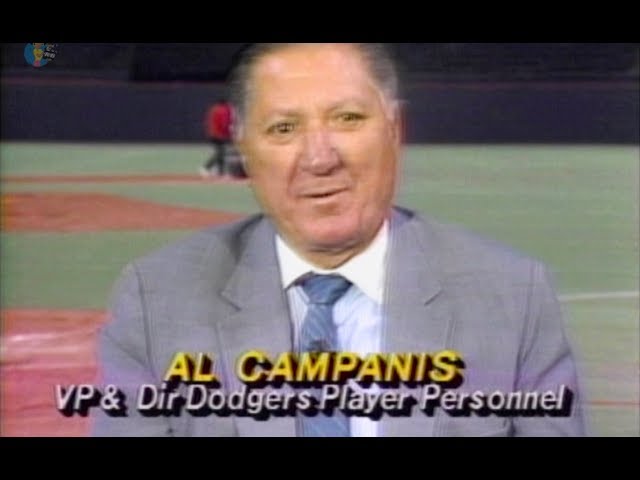
April 6, 1987: It is Opening Day of the Major League Baseball season. Late that night, ABC's news program Nightline dedicated its show to the 40th Anniversary of Jackie Robinson and the Brooklyn Dodgers desegregating MLB. (The anniversary was on the 15th).

Host Ted Koppel had videotaped interviews, ready for broadcast, of Jackie's widow, Rachel Robinson, and former Dodger broadcaster Red Barber. The original intention was to have a live conversation with Jackie's former Dodger teammate and fellow former Negro Leagues player, pitcher Don Newcombe; sportswriter Roger Kahn, a Brooklyn native who covered the Dodgers for the New York Herald Tribune in 1952 and 1953, and knew Jackie well for the rest of his life; and Al Campanis, a former minor-league teammate of Jackie's, later an executive who had been with the Dodgers during their 1957-58 move to Los Angeles, and had been their general manager since 1968.

Newcombe turned out to be unable to participate, due to travel issues. And that turned out to be the least of the broadcast's issues. The taped interview with Mrs. Robinson closed with her saying, "It's not coincidental that baseball in the 40-year period has not been able to integrate at any other level other than the players' level. We have a long way to go."

At this point, there had been 3 black field managers in MLB: Frank Robinson, with the Cleveland Indians, and then with the San Francisco Giants; Larry Doby, with the Chicago White Sox; and Maury Wills, with the Seattle Mariners. Only Robinson (no relation to Jackie) had lasted a full season. Plenty of teams had black coaches, but only 4 out of the 26 teams then in MLB had had a black manager.

Officially, there had never been a black general manager in MLB. Bill Lucas had the duties of a GM, but not the title, with the Atlanta Braves, starting in 1976, but died unexpectedly less than 3 years later, and there had not yet been another.

Next up was Campanis' segment. He was sitting in the press box at the Astrodome in Houston, where the Dodgers had just opened the season by losing to the Houston Astros, 4-3. Mike Scott outpitched Orel Hershiser. Sitting at his usual desk at ABC's Washington office, Koppel asked Campanis why there were, at the moment, no black managers or GMs.

Campanis' answer: "Well, Mr. Koppel, there have been some black managers, but I really can't answer that question directly. The only thing I can say is that you have to pay your dues when you become a manager. Generally, you have to go to the minor leagues. There's not very much pay involved, and some of the better-known black players have been able to get into other fields, and make a pretty good living in that way."

They hadn't paid their dues? To his credit, Koppel gave Campanis a chance to clarify his remarks, and perhaps recover from what could have been a career-ruining moment: "Yeah, but you know, in your heart of hearts, you know that that's a lot of baloney. I mean, there are a lot of black players, there are a lot of great black baseball men who would dearly love to be in managerial positions, and I guess what I'm really asking you is to, you know, peel it away a little bit. Just tell me, why you think it is. Is there still that much prejudice in baseball today?"

Instead of coming up with a better answer, Campanis doubled down: "No, I don't believe it’s prejudice. I truly believe that they may not have some of the necessities to be, let's say, a field manager, or perhaps a general manager."

"Necessities"? What would those be? Interviewed years later, Kahn, sitting in the ABC studio in New York, said, "When he said that blacks lacked the necessities, my legs almost fell off my body."

Koppel asked Campanis, "Do you really believe that?" And he said, "Well, I don't say that all of them, but they certainly are short. How many quarterbacks do you have? How many pitchers do you have that are black?" (This was 10 months before Doug Williams became the 1st black quarterback to start in, and the 1st to win, a Super Bowl.)

Koppel was Jewish. He knew what discrimination was. Campanis was the 1st person born in Greece ever to play in the major leagues, growing up in America at a time when Catholics -- especially Eastern Orthodox ones, as he was -- were treated by the establishment as less than fully American. He knew what discrimination was. Campanis should have known better, and Koppel knew that he should have known better.

Koppel went to a commercial, and when he came back, challenged Campanis again: "Yeah, but I mean, I gotta tell you, that sounds like the same kind of garbage we were hearing 40 years ago about players, when they were saying, 'Ah, not really, not really cut out.' Remember the days, you know, 'Hit a black football player in the knees,' and you know, no. That really sounds like garbage, if you'll forgive me."

Campanis still didn't realize he was in a hole, and kept digging: "No, it's not, it's not garbage, Mr. Koppel, because I played on a college team, and the center fielder was black, and the backfield at NYU, with a fullback who was black, never knew the difference, whether he was black or white, we were teammates. So, it might just be... Why are black men, or black people, not good swimmers? Because they don’t have the buoyancy."

"Buoyancy"? Where was he getting this stuff? Kahn, Jewish, and a victim of professional discrimination as a young man, had had enough. He said, "Oh, I get it, Al. Blacks have the ability to work in the cotton fields, but not to manage a baseball team."

Koppel responded to the swimming remark by saying, "Oh, I don't... It may just be that they don't have access to all the country clubs and the pools."

Koppel tried one more time to get Campanis to take the high road: "From everything I understand, you're a very decent man and a highly respected man in baseball. I confess to you, before we began this program, baseball is not one of my areas of expertise. I'd like to give you another chance to dig yourself out, because I think you need it."

Instead of taking this lifeline, Campanis took the offensive. He had a point, but he was the wrong man to make it: "Well, let me just say this, Mr. Koppel. How many executives do you have on a higher level or higher echelon in your business, in TV, I mean, or anchormen? How many black anchormen do you have?"

Koppel: "You're absolutely right, but I... "

Campanis: "Let's just, let's just turn around."

Koppel: "Yeah, fortunately, there are a few black anchormen. But if you want me to tell you why there aren't many black executives, I'm not going to tell you it's because the blacks aren't intelligent enough. I'm going to tell you it's because it is that whites have been running the establishment of broadcasting, just as they've been running the establishment of baseball for too long, and seem to be reluctant to give up power. I mean, that's what it finally boils down to, isn't it?"

Campanis: "Well, we have scouts in our organization who are black, and they're very capable people. I have never said that blacks are not intelligent. I think many of them are highly intelligent, but they may not have the desire to be in the front office. I know that they have wanted to manage and some of them have managed, but they're outstanding athletes, very God-gifted, and they're very wonderful people, and that's all I can tell you about them."

The Dodgers fired Campanis than 48 hours later. He never held another job in baseball.

In 1989, National League President Bart Giamatti was named Commissioner of Baseball. Hired to take his place as NL President was Bill White, then a broadcaster for the New York Yankees, and previously one of the game's top 1st basemen. He was black. He served in the office until 1994. That year, Leonard Coleman was named the 1st black President of the American League.

Most MLB teams have since had a black manager. The Yankees are not one of them. They have, however, had a black GM, Bob Watson.

*

April 6, 1987 was a Monday. This was also the night of the fight between Sugar Ray Leonard and Marvelous Marvin Hagler. I have a separate entry for that event.

These games were played on MLB's Opening Day, in addition to the Dodger-Astro game:

* The New York Yankees beat the Detroit Tigers, 2-1 at Tiger Stadium in Detroit. Rickey Henderson doubled Claudell Washington home with the winning run in the top of the 10th inning, making Dave Righetti a winning pitcher in relief of Dennis Rasmussen. Dave Winfield went 1-for-4. Don Mattingly went 0-for-5.

* The Baltimore Orioles beat the Texas Rangers, 2-1 at Memorial Stadium in Baltimore. Larry Sheets drove in the winning run, Rene Gonzales, with a sacrifice fly in the bottom of the 9th. Eddie Murray went 1-for-4, and Cal Ripken went 0-for-4.

* The Toronto Blue Jays beat the Cleveland Indians, 7-3 at Exhibition Stadium in Toronto.

* The Cincinnati Reds beat the Montreal Expos, 11-5 at Riverfront Stadium in Cincinnati.

* The Milwaukee Brewers beat the Boston Red Sox, 5-1 at Milwaukee County Stadium. Paul Molitor went 2-for-4 with an RBI. Robin Yount went 2-for-4 with 2 RBIs.

* The Chicago White Sox beat the Kansas City Royals, 5-4 at Royals Stadium (now Kauffman Stadium) in Kansas City. George Brett hit a home run.

* The San Francisco Giants beat the San Diego Padres, 4-3 at Candlestick Park in San Francisco. Chili Davis singled Jeffrey Leonard home with the winning run in the bottom of the 12th inning. Tony Gwynn went 1-for-4.

* And the New York Mets, the Atlanta Braves, the Chicago Cubs, the Philadelphia Phillies, the Pittsburgh Pirates, the St. Louis Cardinals, the California Angels, the Minnesota Twins, the Oakland Athletics and the Seattle Mariners each opened their seasons the next day.

Football was out of season. The NHL was between its regular season and the Stanley Cup Playoffs. There were 6 games played in the NBA:

* The New York Knicks beat the Philadelphia 76ers, 108-101 at Madison Square Garden.

* The Atlanta Hawks beat the Cleveland Cavaliers, 110-105 at The Omni in Atlanta. Dominique Wilkins scored 41 points.

* The Phoenix Suns beat the Dallas Mavericks, 118-110 at the Arizona Veterans Memorial Coliseum in Phoenix.

* The Sacramento Kings beat the Utah Jazz, 110-104 at the Salt Palace in Salt Lake City, Utah.

* The Los Angeles Lakers beat the Los Angeles Clippers, 135-112 at The Forum outside Los Angeles in Inglewood, California.

* And the Houston Rockets beat the Portland Trail Blazers, 114-108 at the Portland Memorial Coliseum. 

Saturday, March 12, 2022

March 12, 1983: Buckwheat Is Assassinated on "Saturday Night Live"

March 12, 1983: Buckwheat is assassinated on Saturday Night Live. This was a big deal at the time.

Eddie Murphy had been playing a grownup version of Buckwheat, the black kid with the speech impediment and the upswept hair in the Our Gang serials from 1938 to 1944, on the show. His use of "O-tay!" instead of "Okay!" briefly became a popular catchphrase.

The actor who played Buckwheat, William Thomas Jr., billed as "Billie Thomas," later served in the U.S. Army, was decorated for his service, and returned to the film industry as an editor. On July 31, 1980, he was one of several former Our Gang (rebranded as The Little Rascals for later broadcasts on television) members honored at a convention in Los Angeles. But just a few weeks later, on October 10, he died of a heart attack. He was only 49 years old.

It was only after Thomas' death that Murphy began playing the character. What Thomas would have thought can only be speculated. His son, also named William Thomas Jr., became the executor of his father's estate and image, and raised no objection. But former co-star George "Spanky" McFarland hated it. Murphy got tired of it, too, and decided to "kill the character off." SNL executive producer Dick Ebersol agreed.

Despite being at night, instead of in daylight, the scene was staged to resemble the attempted assassination of President Ronald Reagan by John Hinckley 2 years earlier: Murphy, in character as Buckwheat, walks out of 30 Rockefeller Plaza, which includes NBC headquarters and the studio where SNL is taped, and waves to a crowd, saying "I wub noo!" (Meaning, "I love you!")

Then, as Buckwheat approaches his limousine, just as Hinckley shouted out, "Mr. President!" a voice is heard yelling, "Hey, Mr. Wheat!" Buckwheat turns, with his hands still up, and says, "Yes?" And he is shot. A bodyguard shoves him into the limo, which speeds off toward a hospital, while several people jump on the shooter.

SNL shot two versions, one with "blood squibs" and one without. They decided to go with the one without the squibs, because the one with the squibs looked too real, and they didn't want to actually scare anyone.

Castmember Joe Piscopo, known for his impersonation of Frank Sinatra, played ABC News Nightline host Ted Koppel, reporting on the story, and playing it absolutely straight, as if this was a real story happening in real time. He showed the shooting over and over, including in slow motion, as had been done with Reagan's shooting. Finally, he made the tragic announcement: "We have just received word: Buckwheat is dead!" Again and again, in slow motion, the shooting was repeated, and the audience got the joke.

As the character was taken in for emergency surgery, Mary Gross came on to play Alfalfa, another of the Our Gang characters. "His" reaction was, "I'm alarmed, and confused, and I don't know what to say." Ironically, the actual actor who played Alfalfa, Carl Switzer, was murdered, at his home in Los Angeles, on January 21, 1959. He was only 31.

Later, during the show's regular Saturday Night News segment -- it had originally been, and would again, be Weekend Update -- anchor Brad Hall (now better known for being the husband of Julia Louis-Dreyfus, also then an SNL castmember -- did the show as if it was a complete story, and posted reactions from famous people, who were obviously talking about someone else:

* Actor Charlton Heston, by then also known for his gun advocacy: "Well, he was one of the best we had, maybe the best America had had in this century." (He may have been talking about actor Henry Fonda, who died 7 months earlier.)

* Former Secretary of State Henry Kissinger: "He was tough. He had a good sense of humor." (He may have been talking about Soviet dictator Leonid Brezhnev, who died 4 months earlier; or Egyptian President Anwar Sadat, assassinated in late 1981.)

* President Reagan: "Nancy and I feel that we have lost a close and dear friend." (He could also have been talking about Fonda, or Sadat. In spite of their respective positions, he never met Brezhnev.)

* Pope John Paul II (graphics on the screen suggesting a translation from the original Italian -- yes, I know he was Polish, but he was speaking to Italians): "The entire world mourns the loss of this great humanitarian. Buckwheat was a man of peace. We all know how he died. But, perhaps some of you haven't seen the videotape. Let's take a look." (That made the live audience at 30 Rockefeller Plaza crack up.)

And every minute or so, they squeezed in a "commercial": "Buckwheat shot. America stunned. Brought to you by Texxon. Life goes on, and Texxon is there." "Emergency surgery. The world waits. Brought to you by Texxon. Life goes on, and Texxon is there." "Buckwheat dead. America mourns. Brought to you by Texxon. Life goes on, and Texxon is there." Finally, they closed the sketch with, "Buckwheat dead. America mourns. Brought to you by Texxon. Life goes on, and Texxon is there. Because Buckwheat would have wanted it that way."

The following week, Buckwheat's funeral was shown, again with Piscopo as Koppel covering it. It parodied Brezhnev's funeral, with soldiers doing a slow goose-step. But it also showed American soldiers firing a cannon in salute, probably taken from Reagan's Inauguration in 1981.

Among the simulated guests were First Lady Nancy Reagan, but not the President; and Diana, Princess of Wales, but not her husband, Prince Charles, or his mother, Queen Elizabeth II. Also, in footage clearly taken from Sadat's funeral: Former Presidents Richard Nixon, Gerald Ford and Jimmy Carter; plus Kissinger, and Prime Minister Menachem Begin of Israel.

They also showed footage of the candlelight vigil held in Central Park for former Beatle John Lennon after his assassination, in 1980, saying that this was for Buckwheat. (The entire Our Gang cast combined didn't have the impact that Lennon had.)

Piscopo/Koppel then announced that the police had identified the assassin. Like John Wilkes Booth, Lee Harvey Oswald, and Lennon's killer Mark David Chapman, he was always identified with all three names: John David Stutts. Murphy did double duty as victim and assassin.

As police led Stutts into court for his arraignment, a reporter asked him why he did it. Parodying David Berkowitz, the 1976-77 serial killer known as the Son of Sam, "Well, I had to kill him, because my dog told me he was the Antichrist."

Koppel introduced a clinical psychologist, asking him why people kill famous people. The psychologist said it was to become famous themselves, "and, unfortunately, certain irresponsible people in the media are only too eager to turn these assassins into instant celebrities." Koppel then introduced a profile of Stutts.

Everybody interviewed on the subject, including his former pastor, said Stutts was "Quiet, kind of a loner," which is what people always tend to say about famous killers, whether their victims are famous or not. But Koppel asked them all, "Do you think he killed Buckwheat?" They all said, "Oh, yes!" showing they were not surprised about his apparent guilt. His high school yearbook showed him to be President of the Future Assassins of America, and his class voted him "Most Likely to Kill Buckwheat."

Then, they parodied the shooting of Oswald in 1963, just 2 days after the assassination of President John F. Kennedy. Stutts was even dressed like Oswald, wearing a sweater, and the shooter was wearing a hat like the one Jack Ruby wore while shooting Oswald. Stutts' killer was not identified on the air.

There was also a new "commercial": "Brought to you by Mutual Life: Because you could die tomorrow." The last time, the announcer added, "Just like John David Stutts."

In spite of the "death," and having tired of the character, Murphy has brought Buckwheat back a few times.

*

March 12, 1983 was a Saturday. Baseball was in Spring Training. Football was out of season. There were 6 games played in the NBA that day:

* The New York Knicks beat the Portland Trail Blazers, 97-95 at Madison Square Garden.

* The Philadelphia 76ers beat the Washington Bullets, 95-86 at the Capital Centre in the Washington suburb of Landover, Maryland.

* The Atlanta Hawks beat the Detroit Pistons, 120-119 at the Silverdome in the Detroit suburb of Pontiac, Michigan. Isiah Thomas scored 39 points, to no avail.

* The Phoenix Suns beat the Houston Rockets, 105-94 at The Summit (now the Lakewood Church Central Campus) in Houston.

* The San Antonio Spurs beat the Golden State Warriors, 131-120 at the HemisFair Arena in Dallas. Joe Barry Carroll scored 36 points in defeat. Clearly, this was one time when he did not live up to his unflattering nickname, "Joe Barely Cares."

* And the Los Angeles Lakers beat the Chicago Bulls, 123-116 at The Forum outside Los Angeles in Inglewood, California.

There were 9 games played in the NHL:

* The New York Rangers beat the Calgary Flames, 4-1 at the Saddledome in Calgary.

* The New York Islanders beat the Washington Capitals, 6-2 at the Nassau Coliseum.

* The New Jersey Devils beat the Montreal Canadiens, 7-3 at the Montreal Forum.

* The Quebec Nordiques beat the Minnesota North Stars, 6-3 at the Colisée de Québec in Quebec City.

* The Boston Bruins beat the Philadelphia Flyers, 5-2 at the Boston Garden.

* The Pittsburgh Penguins beat the Hartford Whalers, 7-2 at the Hartford Civic Center (now the PeoplesBank Arena).

* In an "Original Six" matchup, the Toronto Maple Leafs beat the Chicago Black Hawks, 4-2 at Maple Leaf Gardens in Toronto.

* The St. Louis Blues beat the Detroit Red Wings, 2-1 at the St. Louis Arena, then known as the Checkerdome.

* The Vancouver Canucks beat the Buffalo Sabres, 8-3 at the Pacific Coliseum in Vancouver.

* And the Los Angeles Kings, the Winnipeg Jets and the Edmonton Oilers were not scheduled.

And in English soccer, Arsenal defeated Birmingham team Aston Villa, 2-0 in an FA Cup Quarterfinal at Highbury in North London.

December 31, 1999 & January 1, 2000: The Millennium

December 31, 1999:  The Millennium arrives. The people of planet Earth survived. At a terrible cost. But we hadn't destroyed ourselves. ...