Showing posts with label walter cronkite. Show all posts

Friday, November 4, 2022

November 4, 1979: The Iran Hostage Crisis Begins

November 4, 1979: The Iran Hostage Crisis begins. Islamic militants, inspired by the Islamic Revolution 9 months earlier, led by the Ayatollah Ruhollah Khomeini, a fundamentalist Shia Muslim cleric, take over the U.S. Embassy in Iran, and take 80 hostages, a number that will drop to 52. At first, the nation rallies around President Jimmy Carter, as the nation tends to rally around the President when a crisis occurs.

By April 25, 1980, when the failed "Desert One" rescue attempt occurred, Carter had the Democratic nomination for a 2nd term sewed up, and people (including some Republicans crossing over) started voting for Senator Edward M. "Ted" Kennedy as a protest vote, knowing he could no longer win the nomination, but the Primaries he might win could, and did, damage Carter.

As the Crisis dragged on and on, with ABC News starting its late-night broadcast Nightline, hosted by Ted Koppel, and that show and Walter Cronkite on The CBS Evening News both counting the days up and up and up -- Day 50, Day 100, Day 200, Day 365, and so on -- and as the economy continued to struggle as it had begun to do in 1979, people got more and more fed up with Carter.

The 1980 election was held exactly one year to the date after the Crisis began, and Carter lost very badly to Ronald Reagan.

As the great politically-themed comedian Mort Sahl put it: "Reagan won because he ran against Jimmy Carter. Had he run unopposed, he would have lost."

The hostages:

* From the U.S. Army: Colonels Leland Holland and Charles W. Scott, military attachés; Chief Warrant Officer 3rd Class Joseph M. Hall, USA, military attaché; Master Sergeant Regis Ragan, defense attaché’s office; Staff Sergeant Joseph Subic, military police; Specialist 1st Class Donald Hohman, medic.

From the U.S. Navy: Commander Donald Sharer and Lieutenant Commander Robert Engelmann, military attachés; IS1 Duane Gillette, communications and intelligence specialist.

From the U.S. Air Force: Colonel Thomas Schaefer, Air Force attaché; Lieutenant Colonel David Roeder, deputy Air Force attaché; Captain Neal Robinson, military intelligence officer; Captain Paul Needham, logistics staff officer; Master Sergeant Joseph Vincent and Sergeant James Hughes, administrative managers.

From the U.S. Marine Corps: Staff Sergeant Michael Moeller, head of the Marine Corps guard unit, as every U.S. Embassy is guarded by Marines; Sergeants William Gallegos, Kevin Hermening, Paul Lewis, James Lopez, Ladell Maples, John McKeel, Gregory Persinger, William Quarles, Rodney Sickmann, David Walker and Westley Williams, and Corporal Steven Kirtley, embassy guards.

From the CIA (their roles since declassified): William J. Daugherty, secretary of the U.S. mission; Jerry Miele and Phillip Ward, communications officers.

Civilians: Richard Morefield, consul general; Thomas Ahern, narcotics control officer; Clair Cortland Barnes, communications specialist; William Belk, records officer; Robert Blucker, economics officer; Donald Cooke and Richard Queen, vice consuls; Bruce German, budget officer; Alan Golacinski, chief of embassy security; John Graves, public affairs officer; Michael Howland, assistant regional security officer; Charles A. Jones Jr., teletype operator; Malcolm Kalp and Moorhead Kennedy, commercial officers; Kathryn Koob, cultural officer; Frederick Kupke, electronics specialist; Bruce Laingen, chargé d'affaires; Gary Lee, administrative officer; John Limbert and Michael Metrinko, political officers; Bert Moore, administration counselor; Robert Ode, retired foreign service officer on temporary duty in Tehran; Jerry Plotkin, civilian businessman visiting Tehran; Lloyd Rollins, administrative officer; Barry Rosen, press attaché; William Royer, assistant director of the Iran-American Society; Elizabeth Ann Swift, deputy head of political section; Victor Tomseth, counselor for political affairs; Kathy Gross, Lillian Johnson, Elizabeth Montagne, Terri Tedford and Joan Walsh, secretaries.

Kathy Gross, Ladell Maples and William Quarles were released on November 19, 1979. James Hughes, Lillian Johnson, Elizabeth Montagne, Lloyd Rollins, Neal Robinson, Terri Tedford, Joseph Vincent, David Walker, Joan Walsh and Westley Williams were released on November 20. Richard Queen, for health reasons, was released on July 11, 1980. The remaining 52 had to wait until the end, January 20, 1981, 444 days.

Joan Walsh and Michael Howland married each other in 1982. William Keough died in 1985, Leland Holland in 1990, John McKeel in 1991, Robert Ode in 1995, Jerry Plotkin in 1996, Bert Moore in 2000, Michael Kalp and Richard Queen in 2002, Elizabeth Cronin (formerly Elizabeth Swift) in 2004; Bruce German, Richard Morefield and Gary Lee in 2010, Phillip Ward in 2012, Thomas Schaefer in 2016, Neal Robinson in 2017, Bruce Laingen in 2019, Westley Williams in 2020, Donald Sharer and Donald Hohman in 2021, and Duane Gillette in 2022. As of November 4, 2022, the others are still alive.

UPDATE: Moorhead Kennedy died in 2024.

*

November 4, 1979 was a Sunday. The baseball season was over. But the NFL held games:

* The New York Giants lost to the Dallas Cowboys, 16-14 at Giants Stadium in the Meadowlands.

* The New York Jets beat the Green Bay Packers, 27-22 at Lambeau Field in Green Bay.

* The Cleveland Browns beat the Philadelphia Eagles, 24-19 at Veterans Stadium in Philadelphia.

* The New England Patriots beat the Buffalo Bills, 26-6 at Rich Stadium (later Ralph Wilson Stadium) in the Buffalo suburb of Orchard Park, New York.

* The Pittsburgh Steelers beat the Washington Redskins, 38-7 at Three Rivers Stadium in Pittsburgh.

* The Baltimore Colts beat the Cincinnati Bengals, 38-28 at Riverfront Stadium in Cincinnati.

* The Atlanta Falcons beat the Tampa Bay Buccaneers, 17-14 at Atlanta-Fulton County Stadium.

* The Chicago Bears beat the Detroit Lions, 35-7 at the old Soldier Field in Chicago.

* The football version of the St. Louis Cardinals beat the Minnesota Vikings, 37-7 at Busch Memorial Stadium in St. Louis.

* The San Diego Chargers beat the Kansas City Chiefs, 20-14 at Arrowhead Stadium in Kansas City.

* The Denver Broncos beat the New Orleans Saints, 10-3 at Mile High Stadium in Denver.

* The Oakland Raiders beat the San Francisco 49ers, 23-10 at the Oakland Coliseum.

* And the Los Angeles Rams beat the Seattle Seahawks, 24-0 at the Kingdome in Seattle.

* The next, on ABC Monday Night Football, the Houston Oilers beat the Miami Dolphins, 9-6 at the Orange Bowl in Miami.

There were 3 games played in the NBA that night:

* The New Jersey Nets beat the Kansas City Kings, 101-98 at the Rutgers Athletic Center in Piscataway, New Jersey. (It's now named the Jersey Mike's Arena)

* The Seattle SuperSonics beat the Milwaukee Bucks, 114-101 at the Milwaukee Exposition, Convention Center and Arena, or "The MECCA." Since 2014, it has been named the UW-Panther Arena.

* And the Portland Trail Blazers beat the San Antonio Spurs, 127-124 in overtime at the Portland Memorial Coliseum. George Gervin led all scorers on the night, with 32 points.

And there were 6 games played in the NHL:

* The New York Rangers beat the Vancouver Canucks, 4-2 at the Pacific Coliseum in Vancouver. The Rangers trailed 2-1 with 4:16 left in regulation, but they got an equalizer on the power play from Anders Hedberg at that point, a go-ahead goal from Phil Esposito with 3:07 to go, and an empty-netter at the end from Don Maloney.

* The New York Islanders played the Winnipeg Jets to a tie, 4-4 at the Winnipeg Arena.

* The Philadelphia Flyers beat the Buffalo Sabres, 3-1 at The Spectrum in Philadelphia.

* The Quebec Nordiques beat the Detroit Red Wings, 5-1 at the Colisée de Québec.

* The Los Angeles Kings beat the Chicago Black Hawks, 5-3 at the Chicago Stadium.

* And the Boston Bruins beat the Edmonton Oilers, 2-1 at the Northlands Coliseum in Edmonton.

Sunday, September 18, 2022

September 18, 1927: CBS Is Founded

September 18, 1927: CBS, the Columbia Broadcasting System, is founded by William S Paley. He was still in charge in 1990, when he died at the age of 89.

CBS followed NBC as the 2nd major radio network in America, and the 2nd major television network in 1947. In both, it became known for its news division, led in the 1940s and '50s by Edward R. Murrow. His See It Now program showed America all kinds of things it wanted to see, and many things it needed to see, such as, on its March 9, 1954 telecast, the excesses of Red-baiting Senator Joseph McCarthy of Wisconsin.

From 1962 to 1981, The CBS Evening News was anchored by Walter Cronkite. "Uncle Walter" became known as "the most trusted man in America": When he signed off by saying, "And that's the way it is," you knew that it was, because he always put the truth, no matter how uncomfortable, ahead of any agenda.

"The Tiffany Network" debuted its "Eye logo" in 1951. It produced great Westerns in the 1950s, like Gunsmoke and Have Gun -- Will Travel. It produced great comedies in the 1950s, like I Love Lucy and The Honeymooners, moving on in the 1960s with The Andy Griffith Show and The Dick Van Dyke Show. And, on Sunday nights, it would feature The Jack Benny Program (always a "program," now a "show"), The Ed Sullivan Show, and a movie of the week.

It was the 1st network to show such Christmas specials as Rudolph, the Red-Nosed Reindeer and A Charlie Brown Christmas, and it gave kids such legendary cartoons as Yogi Bear and Scooby-Doo, Where Are You? 

It got edgier in the 1970s, with The Mary Tyler Moore Show in 1970, All In the Family in 1971, and M*A*S*H and The Sonny & Cher Comedy Hour in 1972. The decade also saw CBS take its role as America's best football network and make it even bigger, with the studio show The NFL Today. And it revived a pair of game shows that had been big on other networks, The Price Is Right and Match Game, and made them bigger than ever.

In the last 20 years, CBS has been the home of the NCIS franchise, and has now added the FBI franchise.

UPDATE: As part of a major restructuring, CBS ended its radio news service on March 21, 2026.

*

September 18, 1927 was a Sunday. These baseball games were played that day:

* The New York Yankees swept a doubleheader from the Chicago White Sox, 2-1 and 5-2 at Yankee Stadium. George Pipgras outpitched Tommy Thomas in the opener, and Waite Hoyt outpitched his fellow future Hall-of-Famer Ted Lyons in the nightcap. Between the 2 games, Babe Ruth went 2-for-7 with a walk, his 54th home run of the season, and 3 RBIs; while Lou Gehrig went 2-for-8 with an RBI.

* A doubleheader was split at Redland Field (later renamed Crosley Field) in Cincinnati. The Cincinnati Reds won the 1st game, 7-0. Red Lucas pitched a 3-hit shutout. The New York Giants won the 2nd game, 4-2. Over the 2 games, Rogers Hornsby went 1-for-5 with a walk, Bill Terry went 1-for-7 with an RBI, and Mel Ott only appeared as a pinch-hitter in the 1st game, not reaching base.

* The Cleveland Indians beat the Washington Senators, 6-4 at Griffith Stadium in Washington. George Burns (not the entertainer who was just beginning his long career as a star) doubled home the winning run in the top of the 10th inning. Tris Speaker, long with Cleveland, appeared as a pinch-hitter with Washington, and did not reach base.

* The Boston Braves beat the Chicago Cubs, 11-7 at Wrigley Field in Chicago.

* The St. Louis Cardinals swept a doubleheader from the Philadelphia Phillies, 7-3 and 8-3 at Sportsman's Park in St. Louis.

* The Boston Red Sox, the Philadelphia Athletics and the Pittsburgh Pirates were not scheduled, since professional sports on Sunday were still not legal in Massachusetts or Pennsylvania. Because of this, the Detroit Tigers, the St. Louis Browns, and the Brooklyn Robins (as the Dodgers were known under the managing of Wilbert Robinson from 1914 to 1931) were also not scheduled.

Friday, September 2, 2022

September 2, 1963: The Birth of Half-Hour Evening News On National TV Networks

September 2, 1963: The CBS Evening News becomes the first network TV news broadcast to go from 15 to 30 minutes. NBC and ABC will follow suit later in the month.

CBS' first installment includes videotape footage (which is still not all that common), in black and white, of their anchorman, Walter Cronkite, who had taken over as anchorman a year earlier, interviewing President John F. Kennedy, spending Labor Day weekend at the family compound at Hyannis Port, Massachusetts. It was taped in the morning, Cronkite and the videotape were flown to New York in the afternoon, and the footage was broadcast that night, at 7:00 PM, U.S. Eastern Time.

Among the subjects discussed is civil rights. In June, Kennedy had asked Congress to pass a civil rights bill. He was planning to run for re-election on the success of that bill, which was still working its way through Congress:

Cronkite: How seriously do you think this civil rights situation is going to affect your chances, assuming you will be the nominee of the Democratic Party next year, in 1964?

Kennedy: Well, obviously it is going to be an important matter. It has caused a good deal of feeling, I suppose, against the administration in the South. Also, I suppose, in other parts of the country. Whenever you have an issue upon which people feel so strongly, quite obviously, it has its political effects, so I would say it would be an important matter.

On the other hand, I am hopeful that both parties, Republicans and Democrats, will commit themselves to the same objective of equality of opportunity. I would be surprised if the Republican Party which, after all, is the party of Lincoln, and is proud of that fact, as it should be, I would be surprised if they did not also support the right of every citizen to have equal opportunities, equal chance under the Constitution...

Cronkite: Do you think you will lose some Southern States in '64?

Kennedy: I lost some in '60, so I suppose I will lose some, maybe more in '64. I don't know. It is too early, to tell but I would think -- I am not sure that I am the most popular political figure in the country today in the South, but that is all right. I think that we will have to wait to see a year and a half from now -- a year now. It is not that long.

Cronkite: Are you making any estimate as to who your opponent might be in '64?

Kennedy: No, there are a good many of them. There are a good many of them.

Cronkite: Do you have any choice as to who you would like to run against, either to put the issues before the people or otherwise?

Kennedy: No. That is a great mistake. I know some Republicans chose me in '60 as their favorite candidate, so I don't think I can choose anybody. I will let them choose.

Cronkite also wanted to discuss the war in Vietnam. The interview has been cited as evidence by people who think JFK would have ended the war in 1964, or early in his second term, in 1965:

Cronkite: Mr. President, the only hot war we've got running at the moment is of course the one in Vietnam, and we have our difficulties there, quite obviously.
Kennedy: I don't think that unless a greater effort is made by the government to win popular support that the war can be won out there. In the final analysis, it is their war. They are the ones who have to win it or lose it. We can help them, we can give them equipment, we can send our men out there as advisers, but they have to win it, the people of Vietnam, against the Communists.
We are prepared to continue to assist them, but I don't think that the war can be won unless the people support the effort, and, in my opinion, in the last 2 months, the government has gotten out of touch with the people.
But, a minute later, JFK said something that suggested the opposite, that he would keep troops there beyond the next election, comparing the struggle against Communism in Southeast Asia with the struggle against Fascism in Europe, 20 years earlier:

Kennedy: But I don't agree with those who say we should withdraw. That would be a great mistake. I know people don't like Americans to be engaged in this kind of an effort. Forty-seven Americans have been killed in combat with the enemy, but this is a very important struggle even though it is far away.
We took all this, made this effort to defend Europe. Now, Europe is quite secure. We also have to participate -- we may not like it -- in the defense of Asia.
We'll never know: Just 81 days later, the decision was taken out of Kennedy's hands. Cronkite would deliver that news, too.

A related note: A survey showed that 1963 was the first year in which a majority of Americans said that they got more of their news from TV than from newspapers. Of course, the New York newspaper strike of December 8, 1962 until March 31, 1963 may have had something to do with that.

*

September 2, 1963 was a Monday. Since it was a holiday, Labor Day, several baseball teams played doubleheaders. These games were played:

* The New York Yankees split a doubleheader with the Detroit Tigers, at Tiger Stadium in Detroit. The Yankees won the opener, 5-4. Whitey Ford outpitched Frank Lary, known as "The Yankee Killer" for several wins against the team earlier in his career. Joe Pepitone hit a home run. Yogi Berra went 0-for-2 with 2 walks, Roger Maris went 0-for-3 with a walk, and neither appeared in the nightcap. Mickey Mantle only appeared as a pinch-hitter, and did not reach base.

The Tigers won the nightcap, 2-1. Hank Aguirre outpitched Stan Williams. Mantle went 2-for-4 with a walk. Over the 2 games, Al Kaline went 1-for-6 with a walk and 2 RBIs.

* The New York Mets split with the Cincinnati Reds at the Polo Grounds. The Mets won the 1st game, 5-3. The Reds won the 2nd game, 1-0. Jim Maloney pitched a 3-hit shutout, striking out 13, to gain his 20th win of the season. Frank Robinson left the 1st game early, returned for the 2nd game, and went 0-for-5 on the day. Pete Rose, soon to be named the National League Rookie of the Year, went 4-for-9 with 2 RBIs.

* The Boston Red Sox swept the Baltimore Orioles, 4-3 and 2-0 at Fenway Park in Boston. Though a Red Sox fan, President Kennedy did not make the 75-mile trip northwest from Hyannis Port to Fenway that day. Bob Heffner pitched a 5-hit shutout in the 2nd game. Over the 2 games, Carl Yastrzemski went 3-for-7 with a walk. Brooks Robinson went 0-for-3 in the 1st game, and did not play in the 2nd game.

* A doubleheader was split at Cleveland Municipal Stadium. The Cleveland Indians won the 1st game, 15-3. The Washington Senators won the 2nd game, 8-7.

* A doubleheader was split at Comiskey Park in Chicago. The Los Angeles Angels won the 1st game, 7-5. The Chicago White Sox won the 2nd game, 8-7.

* In the only single game of the day, the Philadelphia Phillies beat the Milwaukee Braves, 9-4 at Milwaukee County Stadium. Hank Aaron hit the 334th home run of his career. He was not yet 30 years old.

* The Minnesota Twins swept the Kansas City Athletics, 6-2 and 3-1 at Metropolitan Stadium in the Minneapolis suburb of Bloomington, Minnesota. Over the 2 games, Harmon Killebrew went 2-for-8 with a home run and 2 RBIs.

* The St. Louis Cardinals swept the Pittsburgh Pirates, 6-1 and 6-2 at the first Busch Stadium (formerly the last Sportsman's Park) in St. Louis. Bob Gibson won the 1st game, and the only run he gave up was a home run to Roberto Clemente. In 1967, Clemente would hit a line drive off Gibson's leg, breaking his fibula, and causing him to miss a month of the season.

Stan Musial, entering his final month as an active player, did not play in the 1st game, but went 1-for-4 with an RBI in the 2nd game.

* The Los Angeles Dodgers swept the Houston Colt .45s, 7-3 and 7-1 at Dodger Stadium in Los Angeles. Sandy Koufax won the 1st game, Johnny Podres the 2nd game. The Colts became the Houston Astros in 1965.

* And the Chicago Cubs swept the San Francisco Giants, 7-5 and 6-0 at Candlestick Park in San Francisco. Ernie Banks went 0-for-1 before getting hurt in the 1st game, and didn't play in the 2nd, in which Ron Santo hit 2 home runs, in support of Glenn Hobbie, who pitched a 2-hit shutout. Willie Mays went 0-for-2 in the 1st game, and did not play in the 2nd.

Thursday, March 31, 2022

March 31, 1968: LBJ Drops Out

March 31, 1968: President Lyndon Baines Johnson announces that he is dropping out of this year's Presidential election.

When President John F. Kennedy was assassinated on November 22, 1963, Johnson, as Vice President, became President. He inherited JFK's national security team: Secretary of State Dean Rusk, Secretary of Defense Robert McNamara, National Security Advisor McGeorge Bundy, and Bundy's brother, William Bundy, the Assistant Secretary of State for East Asian and Pacific Affairs. He also inherited JFK's problem in Vietnam.

We will never know for sure how JFK would have handled Vietnam. We know how LBJ handled it: Badly. In his State of the Union Address in January, he said, "The enemy has been defeated in battle after battle." And it was true. But this was one war where winning battles didn't make a bit of difference.

And the American people weren't buying it. By March 1965, the New York Herald Tribune -- always a Republican-friendly newspaper, but it went out of business the next year -- had introduced the expression "credibility gap" to describe the difference between what Johnson was saying about the war and what was actually happening.

On November 30, 1967, Senator Eugene McCarthy of Minnesota announced he was challenging Johnson in the Democratic Primaries for President. While the Vietnam War wasn't the only issue he mentioned in his announcement speech, it was the dominant issue of the speech. And Senator Robert F. Kennedy of New York, JFK's brother and Attorney General, was also facing questions about whether he would run, with antiwar and civil rights activists begging him to do so. For now, he refused, and said he would support Johnson for 1968.

In 1964, having won one of the biggest landslides ever, Time magazine named Johnson its Man of the Year. Its cover showed a flattering portrait of him, with his ranch in the background. In 1967, the magazine named him Man of the Year. This time, the cover image was not flattering. It showed him as William Shakespeare's King Lear, old and out of touch with the people, with three men dressed as women, Lear's daughters: Vice President Hubert Humphrey as loyal Cordelia, clinging to him; and RFK and the Republicans' Senate Leader, Everett Dirksen, as the scheming Goneril and Regan.
(The story of King Lear is based on the myth of Leir, who supposedly reigned over Britain in the 8th Century BC, around the time of the founding of Rome. It's not clear whether he actually existed: Early British history is so poorly recorded, we're not even sure if King Arthur, who supposedly reigned early in the 6th Century AD, was a real figure.)

On January 31, 1968, the Vietcong launched the Tet Offensive. In military terms, it was a massive bungle by the Communists. But in terms of perception, it was a victory for them: The American people saw the enemy overrun the Vietnamese capital of Saigon, and even get inside the U.S. Embassy. The fact that the U.S. won the battle could not be adequately shown on TV. Once again, image was everything.

The Battle of Khe Sanh was also underway, lasting from January 21 to July 9. The U.S. lost 274 men, while Vietcong losses may have been as high as 15,000 -- a ratio of 54 to 1. Still, U.S. troops withdrew from the area, and the Vietcong legitimately claimed victory.

A few days after the Tet Offensive, CBS Evening News anchorman Walter Cronkite went to Vietnam to personally see what was going on. He had dinner with General Creighton Abrams, who had become a friend of his in World War II, and was now the commander of all forces in Vietnam. Abrams told Cronkite a painful truth: "We cannot win this goddamned war, and we ought to find a dignified way out."

On February 27, 1968, back at the CBS News desk in New York, Cronkite told the nation this:

To say that we are mired in stalemate seems the only realistic, if unsatisfactory, conclusion. On the off chance that military and political analysts are right, in the next few months, we must test the enemy's intentions, in case this is indeed his last big gasp before negotiations.
But it is increasingly clear to this reporter that the only rational way out then will be to negotiate, not as victors, but as an honorable people who lived up to their pledge to defend democracy, and did the best they could.
Upon seeing this report, Johnson said, "If I've lost Cronkite, I've lost Middle America."

McNamara had recently resigned as Secretary of Defense, to accept the Presidency of the World Bank, a United Nations agency. Johnson's new SecDef was Clark Clifford, previously the Chairman of the President's Intelligence Advisory Board, and White House Counsel to President Harry Truman.

At the next meeting of the National Security Council, Clifford asked the various members -- including General Abrams, and the man he succeeded as commander of U.S. forces in Vietnam, now the Army's Chief of Staff, General William Westmoreland -- how close the war was to being won, and what had to be changed to make it happen. They all seemed to have the same answer: "We do not know."

On March 12, the New Hampshire Primary was held. Johnson had not officially announced that he was running for a 2nd full term. But he just barely won that Primary, as McCarthy (the Bernie Sanders of his time), having run solely on an antiwar platform, got 42 percent of the vote, to Johnson's 49.

On March 16, Bobby Kennedy announced he was getting into the race. He and LBJ had hated each other for years, and that was one of the worst-kept secrets in America. So it was imperative for RFK to say this: "I do not run for the Presidency merely to oppose any man, but to propose new policy. I run because I am convinced that this country is on a perilous course, and because I have such strong feelings about what must be done, and I feel that I'm obliged to do all that I can."

Now, LBJ was really up against it. There were 2 antiwar candidates in the race. One was a Kennedy, and the man LBJ hated the most. And he could not count on them splitting the antiwar vote, "canceling each other out." What had begun late the previous year as "the Dump Johnson movement," and seemed at first to be just students acting on their white middle-class-and-up privilege, angry and scared over the Vietnam War draft, now had to be taken seriously.

And the war was not going well. Johnson knew that, if he did not end the war before the election on November 5, the election would be a referendum on the war, and incredibly difficult for him to win.

So, on Sunday night, March 31, he spoke from the Oval Office of the White House:

Good evening, my fellow Americans. Tonight I want to speak to you of peace in Vietnam and Southeast Asia. No other question so preoccupies our people...

I am taking the first step to deescalate the conflict. We are reducing, substantially reducing, the present level of hostilities....

The area in which we are stopping our attacks includes almost 90 percent of North Vietnam’s population, and most of its territory. Thus there will be no attacks around the principal populated areas, or in the food-producing areas of North Vietnam...

There has been substantial progress, I think, in building a durable government during these last 3 years. The South Vietnam of 1965 could not have survived the enemy’s Tet offensive of 1968. The elected government of South Vietnam survived that attack, and is rapidly repairing the devastation that it wrought...

So tonight I reaffirm the pledge that we made at Manila, that we are prepared to withdraw our forces from South Vietnam as the other side withdraws its forces to the north, stops the infiltration, and the level of violence thus subsides.

Our goal of peace and self-determination in Vietnam is directly related to the future of all of Southeast Asia, where much has happened to inspire confidence during the past 10 years. We have done all that we knew how to do to contribute and to help build that confidence...

One day, my fellow citizens, there will be peace in Southeast Asia. It will come because the people of Southeast Asia want it: Those whose armies are at war tonight, those who, though threatened, have thus far been spared. Peace will come because Asians were willing to work for it, and to sacrifice for it, and to die by the thousands for it...

What we won when all of our people united just must not now be lost in suspicion, and distrust, and selfishness, and politics among any of our people. And, believing this as I do, I have concluded that I should not permit the Presidency to become involved in the partisan divisions that are developing in this political year.

With America’s sons in the fields far away, with America’s future under challenge right here at home, with our hopes and the world’s hopes for peace in the balance every day, I do not believe that I should devote an hour or a day of my time to any personal partisan causes, or to any duties other than the awesome duties of this office, the Presidency of your country.

Accordingly, I shall not seek, and I will not accept, the nomination of my party for another term as your President.

But let men everywhere know, however, that a strong, and a confident, and a vigilant America stands ready tonight to seek an honorable peace, and stands ready tonight to defend an honored cause, whatever the price, whatever the burden, whatever the sacrifice that duty may require.

Thank you for listening. Good night, and God bless all of you.

A President refusing to run for another term in office had been rare, especially in the 20th Century. Theodore Roosevelt in 1908 and Harry Truman in 1952 were eligible to run for what would have amounted to a 3rd term, but didn't. Calvin Coolidge refused to run for a 2nd full term in 1928. But that was it. In every election from 1972 to 2020, every President eligible to run for re-election did so. (UPDATE: In 2024, Joe Biden ended that streak in mid-campaign.)

The next day was April 1, and millions of people who hadn't seen the speech, and hadn't seen the 11:00 local news the night before, saw the headline in their local newspaper, and wondered if it might not be the biggest April Fool's joke of all time. It wasn't. Such a belief was possible in that pre-social media era.

Charles Kaiser, part of the Dump Johnson Movement and a McCarthy campaign worker, would later write in his book 1968 in America that it was a night that began a brief celebration: "We had four days." Then, on April 4, Dr. Martin Luther King was assassinated, and all good feeling over LBJ dropping out vanished.

Johnson did stay out of the race, and did devote the last 9 months of his Presidency to seeking a peace deal. He didn't get that deal. Why is a story for another time.

His successor, whoever that was going to be, could have ended the war any time he wanted. The man who became that successor ended it 3 days into his 2nd term, 1 day after Johnson died. A little more than 2 years after that, Vietnam was united, and it was Communist.

Kaiser also wrote in his book, "We haven't had any more Vietnams." That book was in 1988. As of March 31, 2022, he is still alive, and in a subsequent edition, he had to add an epilogue to say that Iraq was the next Vietnam.

*

March 31, 1968 was a Sunday. Baseball was in Spring Training. Football was out of season. There were 4 games played in the NBA that day:

* The New York Knicks lost to the Philadelphia 76ers, 123-105 at The Spectrum in Philadelphia.

* The Boston Celtics beat the Detroit Pistons, 110-96 at the Boston Garden.

* The St. Louis Hawks beat the San Francisco Warriors, 129-103 at Kiel Auditorium in St. Loius.

* The Los Angeles Lakers beat the Chicago Bulls, 122-99 at the Los Angeles Memorial Sports Arena.

And there was 1 game in the American Basketball Association: The Denver Rockets beat the New Orleans Buccaneers, 108-100.

* There were 5 games played in the NHL:

* The New York Rangers beat the Montreal Canadiens, 4-2 at the brand-news Madison Square Garden in New York.

* The Toronto Maple Leafs beat the Boston Bruins, 4-1 at the Boston Garden.

* The Pittsburgh Penguins beat the Philadelphia Flyers, 5-1 at The Spectrum in Philadelphia.

* The Detroit Red Wings and the Chicago Black Hawks played to a tie, 5-5 at the Chicago Stadium.

* The St. Louis Blues beat the Minnesota North Stars, 5-3 at the Metropolitan Sports Center in the Minneapolis suburb of Middletown, New Jersey.

Sunday, March 6, 2022

March 6, 1981: Walter Cronkite Retires

March 6, 1981: Walter Cronkite retires as the anchorman and "managing editor" of The CBS Evening News after 19 years. He had succeeded Douglas Edwards as anchor on April 16, 1962, and, the following year, took the program from 15 to 30 minutes, Monday through Friday nights at 7:00 PM Eastern Time, later moving back to 6:30 as "the three major networks" -- CBS, NBC and ABC -- scaled back their nightly 6:00 news.

Cronkite had taken America through the Cuban Missile Crisis, the assassinations of the Kennedy brothers and Martin Luther King, the Civil Rights Movement, the Vietnam War, the Moon landings, the Kent State Massacre, the Watergate scandal, the energy crisis, the Camp David Accords, and the Iran Hostage Crisis. He'd anchored reporting on the Presidencies of John F. Kennedy, Lyndon Johnson, Richard Nixon, Gerald Ford, Jimmy Carter, and now Ronald Reagan.

His report from Vietnam in 1968 led Johnson to drop out of the race for a 2nd full term, saying, "If I've lost Cronkite, I've lost Middle America."

Now, at age 64, “The Most Trusted Man In America” hasn’t been fired: He’s just simply had enough, and is ready step back. He hands the desk over to Dan Rather, who takes over the following Monday, March 9, and ends up holding it longer, for 23 years.

But Rather was forced out, due to a mistake he'd made, the kind that, were a host on Fox News to have made it, would have gotten away with. And while half the country was disappointed to lose Rather, the other half was glad to be rid of him. In contrast, Cronkite's retirement was lamented, and his career celebrated.

As Cronkite himself said at the end of every broadcast, "And that’s the way it is." He died in 2009.

*

March 6, 1981 was a Friday. Baseball was in Spring Training. Football was out of season. There were 9 games played in the NBA:

* The New York Knicks lost to the Milwaukee Bucks, 122-111 at Madison Square Garden. 

* The New Jersey Nets lost to the Atlanta Hawks, 109-106 at The Omni in Atlanta. 

* The Philadelphia 76ers beat the Denver Nuggets, 131-112 at The Spectrum in Philadelphia. An unusual occurrence: Cliff Robinson of the Nets, Junior Bridgeman of the Bucks, and David Thompson of the Nuggets each scored 34 points, but their teams still lost.

* The Indiana Pacers beat the Boston Celtics, 110-104 at the Market Square Arena in Indianapolis.

* The Washington Bullets beat the Houston Rockets, 105-104 at The Summit in Houston. It's now the Central Campus of televangelist Joel Osteen's Lakewood Church.

* The Phoenix Suns beat the Portland Trail Blazers, 128-107 at the Arizona Veterans Memorial Coliseum in Phoenix.

* The San Diego Clippers beat the Cleveland Cavaliers, 140-125 at the San Diego Sports Arena (now the Pechanga Arena).

* The Golden State Warriors beat the Dallas Mavericks, 115-109 at the Oakland Coliseum Arena.

* And the Seattle SuperSonics beat the San Antonio Spurs, 102-94 at the Seattle Center Coliseum.

And there were 2 games played in the NHL. The Hartford Whalers beat the Buffalo Sabres, 5-3 at the Buffalo Memorial Auditorium. And the Los Angeles Kings beat the Colorado Rockies, 3-1 at the McNichols Sports Arena in Denver.

Monday, January 31, 2022

January 31, 1968: The Tet Offensive

January 31, 1968: The Viet Cong launch the Tet Offensive, an attack on American and South Vietnamese installations in South Vietnam, on Tết Nguyên Đán, the Vietnamese lunar new year.

More than 80,000 troops hit more than 100 towns, including 36 out of the country's 44 provincial capitals, including the national capital of Saigon. The idea was to trigger a popular uprising that would lead to the collapse of the South Vietnamese government, and its replacement by one more favorable to the North Vietnamese government, thus uniting the country under Communism, and forcing the American troops out.

The Viet Cong didn't get that. At least, not in the short term. But they got the next best thing, which gave them their goal in the long term.

Over 4,000 U.S. personnel were killed, and another 5,000 South Vietnamese. But the Viet Cong lost 45,000 men, about as many as America lost in the war from its beginning until 1971 or so. And they were fought back, capturing very little territory, and not getting the popular uprising. Militarily, the Tet Offensive was one of the biggest blunders in the history of warfare.

But that was offset by the psychological victory they gained. They had gotten troops inside the U.S. Embassy in Saigon. They couldn't hold it, but they did it. And it was caught on U.S. television.

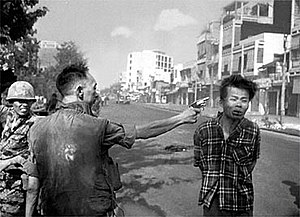
Also caught on U.S. television was an event on February 1: The Chief of South Vietnam's National Police, Major General Nguyễn Ngọc Loan, personally executing Nguyễn Văn Lém. It looked like one of America's best friends in the conflict was shooting a handcuffed teenage boy in the head, a brutal act.

In fact, Lém was 36 years old, held the rank of Captain, and had murdered not just a friend of General Loan, Lieutenant Colonel Nguyen Tuan, but also Tuan's wife, six of his seven children, and his 80-year-old mother. Women, children, even the elderly were not safe. The Vietcong even went after the families of their enemies. They were worse than the Mafia.

Eddie Adams of the Associated Press was standing next to the NBC cameraman who filmed the shooting, and clicked his shutter at the moment of impact for bullet against head. He won the Pulitzer Prize for the photo, but regretted he hadn't gotten a photo of what Lém did to deserve it.

"Two men died in that photograph," Adams said. "The General killed the Viet Cong. I killed the General with my camera." 

After the fall of Saigon, General Loan fled to America, and lived out his life in Virginia, near Washington, D.C. He died in 1998. Adams lived until 2004.

There was one survivor of Lém's killing of Tuan's family: Huan Nguyen, Tuan's son, was 9, and survived 2 bullet wounds. After the fall of Saigon, he was smuggled out of the country. He grew up in Oklahoma, and enlisted in the U.S. Navy in 1993. He is the highest-ranking officer of Vietnamese descent in U.S. military history: In 2019, he was promoted to the rank of Rear Admiral.

But people saw the film and the photo of the shooting, and began to ask themselves why we were supporting such an ally. Were they unworthy allies? There had been plenty of corruption in the South Vietnamese government. (Loan has never been accused of any of it.)

The Battle of Khe Sanh was also underway, lasting from January 21 to July 9. The U.S. lost 274 men, while Vietcong losses may have been as high as 15,000. Still, U.S. troops withdrew from the area, and the Vietcong legitimately claimed victory.

Each was a "Pyrrhic victory." The phrase originates from a quote from Pyrrhus of Epirus, whose triumph against the Romans in the Battle of Asculum, in what is now Southern Italy, in 279 BC destroyed much of his forces, forcing the end of his campaign. According to legend, he said, "If we are victorious in one more battle with the Romans, we shall be utterly ruined." The more common translation is, "Another such victory, and I am undone."

A few days after the Tet Offensive, CBS Evening News anchorman Walter Cronkite went to Vietnam to personally see what was going on. He had dinner with General Creighton Abrams, who had become a friend in World War II, and was now the commander of all forces in Vietnam. Abrams told Cronkite a painful truth: "We cannot win this goddamned war, and we ought to find a dignified way out."

On February 27, 1968, back at the CBS News desk in New York, Cronkite said this:

To say that we are mired in stalemate seems the only realistic, if unsatisfactory conclusion. On the off chance that military and political analysts are right, in the next few months we must test the enemy's intentions, in case this is indeed his last big gasp before negotiations.
But it is increasingly clear to this reporter that the only rational way out then will be to negotiate, not as victors, but as an honorable people who lived up to their pledge to defend democracy, and did the best they could.
Upon seeing this report, President Lyndon B. Johnson said, "If I've lost Cronkite, I've lost Middle America." Just 32 days later, with this in mind, having taken National Security Council meetings where nobody seemed to know how to solve the war, with Senator Eugene McCarthy having come close to beating him in the New Hampshire Primary, and with Senator Robert F. Kennedy having gotten into the race for President, Johnson announced that he would not seek another term as President, and would devote the last 9 months of his Presidency to seeking a peace deal.

He didn't get it. Why is a story for another time. His successor could have ended the war any time he wanted. He ended it 3 days into his 2nd term, 1 day after Johnson died. A little more than 2 years after that, Vietnam was united, and it was Communist.

*

January 31, 1968 was a Wednesday. Baseball and football were out of season. These 4 games were played in the NBA that night:

* The New York Knicks beat the Cincinnati Royals, 128-126 in overtime at the Cincinnati Gardens. For the Royals, Oscar Robertson scored 42 points, and Jerry Lucas had 22 points and 22 rebounds. For the Knickerbockers, Walt Bellamy had 23 points, Cazzie Russell 21, Willis Reed 20, Walt Frazier 19 and Dick Van Arsdale 18.

* The Boston Celtics beat the Chicago Bulls, 118-109 at the Boston Garden.

* The Baltimore Bullets beat the Detroit Pistons, 113-108 at the Baltimore Civic Center (now the CFG Bank Arena). Dave Bing scored 41 for the Pistons, while Earl "the Pearl" Monroe got 35 for the Bullets.

* And the Los Angeles Lakers beat the St. Louis Hawks, 110-102 at The Forum outside Los Angeles in Inglewood, California.

There were 3 games played in the American Basketball Association, which was in its 1st season:

* The New Jersey Americans beat the Dallas Chaparrals, 119-111 at the Teaneck Armory in Teaneck, New Jersey. The next season, the Americans moved to Long Island, and became the New York Nets. The Chaps moved in 1973, to become the San Antonio Spurs. Both teams were admitted to the NBA in 1976, then the Nets became the New Jersey Nets in 1977, and the Brooklyn Nets in 2012.

* The Indiana Pacers beat the Pittsburgh Pipers, 119-113 at the Indiana Fairgrounds Coliseum (now the Corteva Coliseum) in Indianapolis. The Pacers were admitted to the NBA in 1976.

* And the Anaheim Amigos beat the Denver Rockets, 112-105 at the Anaheim Convention Center outside Los Angeles. The Rockets became the Denver Nuggets in 1974, and were admitted to the NBA in 1976.

And there were 3 games played in the NHL:

* The New York Rangers lost to the Chicago Black Hawks, 3-2 at the old Madison Square Garden. The Rangers would play only 3 more games there before moving to the new Garden on February 18.

* The St. Louis Blues beat the Pittsburgh Penguins, 9-4 at the St. Louis Arena.

* And the Minnesota North Stars beat the Los Angeles Kings, 6-1 at the Metropolitan Sports Center in the Minneapolis suburb of Bloomington, Minnesota.

December 31, 1999 & January 1, 2000: The Millennium

December 31, 1999:  The Millennium arrives. The people of planet Earth survived. At a terrible cost. But we hadn't destroyed ourselves. ...