Showing posts with label sweden. Show all posts

Friday, December 9, 2022

December 10, 1901: The 1st Nobel Prize Ceremony

December 10, 1901: The 1st Nobel Prize ceremony is held in Stockholm, Sweden, on the 5th Anniversary of the death of Alfred Nobel.

Alfred Bernhard Nobel was born on October 21, 1833 in Stockholm. An engineer and inventor, his 355 patents included dynamite, in 1867. But he also founded a company that made military armaments and parts therefor.

There is a well known story about the origin of the Nobel Prize, although historians have been unable to verify it, and some dismiss the story as a myth. The story is as follows: In 1888, his brother Ludvig died while visiting Cannes, on the French Riviera. A local newspaper mistook him from Alfred, and published an obituary that spread, first throughout France, then throughout Europe, condemning him, saying, "Dr. Alfred Nobel, who became rich by finding ways to kill more people faster than ever before, died yesterday," and, "The merchant of death is dead."

Alfred realized that this was how people thought of him, and decided to change that. With no wife or children to leave his fortune to (though he was straight), he changed his will to found the Nobel Foundation, to annually award the Nobel Prizes, without distinction of nationality. He died on December 10, 1896.

A committee in Nobel's native Sweden awards the Prizes in the categories of Physiology or Medicine, Chemistry, Physics, Economic Science, and Literature. Another, in Norway, awards the Nobel Prize for Peace, although that is frequently given to someone involved in great humanitarian causes, rather than for efforts in stopping a war or maintaining a peace.

Marie Curie was the 1st female winner, for Physics in 1903. The 1st American winner was Theodore Roosevelt, for Peace in 1906. The 1st Asian winner was Rabindranath Tagore of India, for Literature in 1913. The 1st Hispanic winner was Carlos Saavedra Lamas of Argentina, for Peace in 1936. The 1st black winner was Ralph Bunche, for Peace in 1950; 10 years later, Albert Luthuli of South Africa was the 1st black African Nobel laureate, also for Peace.

*

December 10, 1901 was a Tuesday. Baseball was out of season. Football was in midweek. Basketball barely existed. And hockey had not yet turned professional. So there were no scores on this historic day.

Friday, November 11, 2022

November 11, 1985: Pelle Lindbergh Is Killed

November 11, 1985: Pelle Lindbergh is killed in a drunken driving crash, ending his life and his hockey career at the age of 26.

Göran Per-Eric Lindbergh was born on May 24, 1959 in Stockholm, the capital of Sweden. He starred as the goaltender for hometown hockey teams Hammarby and AIK, and helped his country win the Bronze Medal at the 1980 Winter Olympics in Lake Placid, New York. (It gets forgotten in the wake of the wins over the Soviet Union in the Semifinal and Finland in the Final, but Sweden actually came closer to beating the U.S. team than any other, with a tie in the opening game.)

In 1979, Pelle became the 1st European-born goalie to be selected in the NHL Entry Draft, by the Philadelphia Flyers. He made his NHL debut toward the end of the 1981-82 season, and was selected to the NHL All-Rookie Team and the NHL All-Star Game the following season.

The Flyers won the Stanley Cup in 1974 and 1975, and reached the Finals in 1976, with Hall-of-Famer Bernie Parent in goal. They remained strong through 1978-79, but late in that season, Parent took a stick through the eyehole in his mask, permanently damaging his vision, and he never played again.

And, ever since, the Flyers have had some talent, but they haven't found that lockdown goalie. With Pete Peeters, they reached the Finals in 1980, but lost. Lindbergh looked like the answer, especially in 1985, when he made his 2nd All-Star Game, became the 1st European to receive the Vezina Trophy as the NHL's top goalie, and helped get the Flyers into the Finals again, losing to the Edmonton Oilers' dynasty.

While the Oilers seemed to have a hammerlock on the Clarence Campbell Conference (now the Western Conference), the Prince of Wales Conference (now the Eastern Conference) looked wide-open. The Montreal Canadiens' dynasty of 1976-79 had gotten old, and the New York Islanders' dynasty of 1980-84 was already starting to break up due to injury.

There was room for a new dominant team in the East, and with Lindbergh in goal; Mark Howe, Brad Marsh, Brad McCrimmon and Ed Hospodar as defensemen; and forwards like Dave Poulin, Peter Zezel, Brian Propp, Tim Kerr, Dave Brown, Rick Tocchet, and the twins Ron and Rich Sutter, the Flyers looked like they could become that team.

On November 9, 1985, the Flyers hosted a team party at the Coliseum, their practice facility in Voorhees, Camden County, New Jersey. Part of the stereotype of hockey players is that they like to drink, and Lindbergh drank a lot that night. Unfortunately, he got into his car, a customized Porsche 930 Turbo, and headed back toward his apartment across the Delaware River in Philadelphia.

He didn't even make it 2 miles: He crashed into a wall in front of Somerdale Park School, damaging his brain stem and his spinal cord. His blood-alcohol content was .24, and the legal limit in New Jersey was then .10. He had 2 passengers, not easy in a 2-seater, not players but friends of players: Edward Parvin had a fractured skull, and Kathy McNeal had a broken pelvis, a ruptured liver and a ruptured spleen.
They both survived. Lindbergh was brain-dead. His family was brought in from Sweden, and he was kept on life support long enough for them to arrive and say their goodbyes. The machines were turned off on November 11, and his parents gave their permission to have his organs harvested for donation.

Lindbergh received the most votes in the fan balloting for the 1986 NHL All-Star Game. It was the 1st time an athlete was posthumously voted to an All-Star Game. It's only happened once since, with Sean Taylor of the Washington Redskins being selected to the 2008 Pro Bowl.

Given his early death, the Flyers have never again given out his uniform Number 31. But, given the cause of his death, they can't officially retire it. They have instituted the Pelle Lindbergh Memorial Trophy, given to their most improved player. He hasn't been elected to the Hockey Hall of Fame, but he has been elected to the Swedish Hockey Hall of Fame.

The Flyers played the rest of the season in a daze. But they made Ron Hextall their new starting goalie, and he got them into the Stanley Cup Finals in 1987. They reached the Finals again in 1997 and 2010. But they've never won another Cup. Given Hextall's performance in the 1987 Finals, it's hard to say Lindbergh would have made the difference that time. But in 1997, when they got swept by the Detroit Red Wings, Lindbergh would have been 38 years old, which is hardly too old to be a Cup-winning goalie.

UPDATE: In 1988, the Flyers established a team Hall of Fame. As of the 2025-26 season, from their 1985 and '87 Stanley Cup Finalists, they have elected Tim Kerr, Brian Propp, Mark Howe, Dave Poulin and Ron Hextall. Kerr, Propp, Howe, Hextall were also elected to the Philadelphia Sports Hall of Fame. Pelle Lindbergh has been elected to neither. Nor has he been elected to the Hockey Hall of Fame in Toronto.

*

November 11, 1985 was a Monday. The baseball season was over. On ABC Monday Night Football, the Denver Broncos beat the San Francisco 49ers, 17-16 at Mile High Stadium in Denver. And there was 1 game played in the NBA: The New Jersey Nets lost to the San Antonio Spurs, 111-104 at the HemisFair Arena in San Antonio.

And there were 2 games scheduled for the NHL that night, neither of them involving the Flyers. In an "Original Six" matchup, the New York Rangers lost to the Chicago Black Hawks, 5-4 at Madison Square Garden. Bob Murray scored the winner for the Hawks, 53 seconds into overtime. And the Vancouver Canucks beat the Detroit Red Wings, 5-0 at the Pacific Coliseum in Vancouver.

Wednesday, September 28, 2022

September 28, 1994: The Sinking of MS Estonia

September 28, 1994: MS Estonia sinks in the Baltic Sea, en route from Tallinn, Estonia, to Stockholm, Sweden, killing 852 people – including 50 Swedes, 285 Estonians, 1 Canadian and 1 Englishman, but no Americans. There were 137 survivors.

The "cruiseferry" was built in 1980, for the Finnish shipping company Rederi Ab Sally. It was employed on ferry routes between Finland and Sweden by various companies, under the names Viking Sally until 1990, Silja Star until 1991, and then Wasa King until 1993.

At that point, it was sold to Nordström & Thulin, for use on Estline's Tallinn-Stockholm route. The 263-mile ferry trip usually takes about 10 1/2 hours. But on September 28, 1994, according to an official inquiry, failure of the locks on the bow visor caused water to flood the car deck, and quickly capsize the ship.

It remains the worst peacetime maritime disaster in European waters. Memorials have been dedicated in both terminal cities.

*

September 28, 1994 was a Wednesday. Baseball's Strike of '94 was on, football was in midweek, and it was too early for the NBA and NHL seasons to be playing.

But there were games in European soccer's UEFA Champions League, and, since this was an event in Europe, those results are worth posting:

* The most controversial of these games was played at Stadio Giuseppe Meazza, a.k.a. the San Siro, in Milan, Italy, AC Milan were playing Austrian team Casino Salzburg, when Casino's goalkeeper, Otto Konrad, was hit on the head with a plastic bottle thrown from the stands. He had to be substituted and taken to the hospital. Milan won, 3-0, but, as punishment for failing to control their fans, UEFA, the governing body for European soccer, docked them 2 points in the CL table, and were banned from playing their next 2 official home matches at the San Siro.

* Manchester United and Galatasaray played to a draw, 0-0 at Ali Sami Yen Stadium, Gala's home, in Istanbul, Turkey.

* SL Benfica beat RSC Anderlecht of Belgium, 3-1 at the old Estádio da Luz in Lisbon, Portugal.

* IFK Göteborg beat FC Barcelona, 2-1 at Gamla Ullevi in Gothenburg, Sweden.

* Bayern Munich beat Dynamo Kyiv, 1-0 at the Olympiastadion in Munich, Germany.

* AFC Ajax, of Amsterdam, beat AEK Athens, 2-1 at Nikos Goumas Stadium in Athens, Greece.

* Hajduk Split of Croatia beat Steaua București, 1-0 at Stadionul Steaua in Bucharest, Romania.

* And Paris Saint-Germain beat Spartak Moscow, 2-1 at Luzhniki Stadium in Moscow, Russia.

Saturday, August 20, 2022

August 20, 1916: The 1st Game of the U.S. National Soccer Team

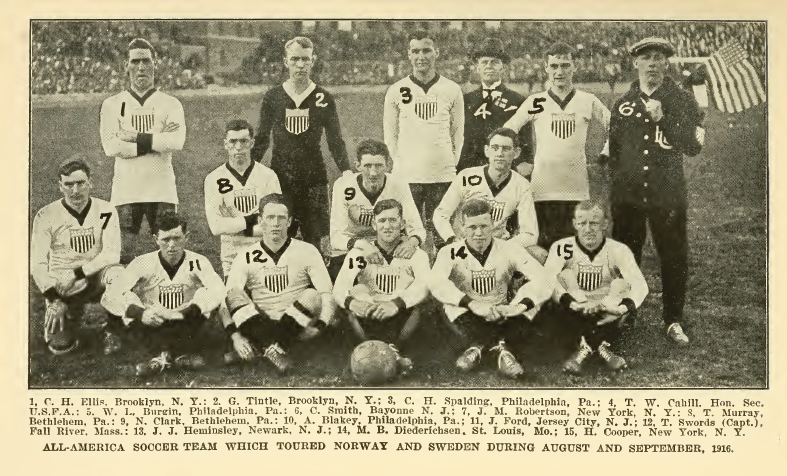
August 20, 1916: The United States of America fields a national soccer team for the 1st time.

Sponsored by the United States Soccer Federation (USSF), founded in 1913, the team took the pitch against Sweden at the Stockholm Olympiastadion, site of the 1912 Olympics, where Jim Thorpe had won the decathlon. A crowd of 16,000 attended. The referee was Hagbard Vestergaard of Denmark.

This was the U.S. team for the game, keeping in mind that uniform numbers were not used in soccer until 1933:

* Goalkeeper: George Tintle of Harrison, New Jersey
* Right Back: Tommy Murray of Bethlehem, Pennsylvania
* Left Back: Jimmy Robertson of New York
* Defender: Dick Spalding of Philadelphia
* Defender: Neil Clarke of Scotland, moved to Paterson, New Jersey
* Defender: Clarence Smith of Bayonne, New Jersey
* Outside Right: Jimmy Ford of Kearny, New Jersey
* Inside Right: Charles Ellis of New York
* Center Forward: John Hemingsley of Newark
* Inside Left: Thomas Swords of Fall River, Massachusetts (Captain)
* Outside Left: Harry "Buck" Cooper of Newark

As you can see, the tradition of soccer in Newark, its across-the-Passaic-River towns of Harrison and Kearny, and its across-Newark-Bay town of Bayonne goes back at least this far. Bethelehem, in the Lehigh Valley of northeastern Pennsylvania, was home to Bethlehem Steel Football Club, a "company team" (or, as the English would have called it, a "works side"), one of the top U.S. teams of the era.

And Fall River and nearby New Bedford, Massachusetts, manned by Portuguese immigrants and their sons, would have strong teams into the 1950s, including the legendary Ponta Delgada, named for an island in the Portugal-controlled Azores Islands. Because of Massachusetts' "blue laws," if these teams wanted to play on Sunday, they would go right across the State Line, and play at St. Mark's Stadium in Tiverton, Rhode Island.

James Robertson is a very common name among soccer players, especially in Scotland. A later Jimmy Robertson was the 1st player ever to score for both Tottenham Hotspur against Arsenal and for Arsenal against Tottenham in the North London Derby.

Konrad Törnqvist scored for Sweden, in only the 7th minute of the game. But Spalding equalized in the 22nd. Ellis scored in the 53rd. Cooper scored in the 68th. Törnqvist brought the Swedes back within 1 in the 81st, but the U.S. defense held on for a 3-2 win.

On September 3, still in Scandinavia, the U.S. team played Norway to a 1-1 draw in Kristiana. Ellis scored the only goal.

History seems to have lost track of some of these players. As far as I can tell, the last survivor was Cooper, who died in 1963.

The stadium still stands. Djurgårdens IF, Sweden's most successful soccer team, played there until the new Tele2 Arena opened, but maintain their offices there.
Due to World War I continuing through 1918, and then for longer for reasons I don't have, the U.S. national team didn't play another game until 1924, and then seemed to play only 2 or 3 games a year until World War II. This may have held them back. The U.S. team didn't play its 1st game on home soil until November 8, 1925, beating Canada 6-1 at Ebbets Field in Brooklyn, thanks to 5 goals from Archie Stark. Like so many early U.S. soccer stars, Stark was born in Glasgow, Scotland but grew up in Kearny, New Jersey.

This period did include reaching the Semifinal of the 1st World Cup in 1930, and reaching the World Cup again in 1934, before failing to qualify in 1938.

*

August 20, 1916 was a Sunday. Because many States still banned professional sports on Sunday, only 3 games were played in what would later be known as Major League Baseball:

* The New York Giants lost to the St. Louis Cardinals, 5-0 at Robison Field in St. Louis. Bob Steele allowed the Giants 8 hits, but kept the shutout. Rogers Hornsby, a rookie, went 2-for-2 with 2 walks for the Cardinals.

* The Boston Braves beat the Cincinnati Reds, 4-3 at Redland Field (renamed Crosley Field in 1934) in Cincinnati.

* The Brooklyn Robins (as the Dodgers were known from 1914 to 1931) beat the Chicago Cubs, 1-0 at Weeghman Park (renamed Cubs Park in 1920 and Wrigley Field in 1926) in Chicago. Jack Coombs allowed only 1 hit, a single by Max Flack. Coombs even got a hit for Brooklyn. So did the man who is still the Dodger franchise's all-time leader in hits, Zack Wheat. So did future managing legend Casey Stengel.

Wednesday, June 29, 2022

June 29, 1958: Brazil's Redemption

After the Final. Having kept his promise to his father,
17-year-old Pelé feels the moment.

June 29, 1958: The Brazil national soccer team, the Seleção, goes into the Final of the World Cup, against the host team, Sweden, and looking for redemption.

They had lost the Final in 1950, to neighboring Uruguay, on home soil, at the Estadio do Maracanã in Rio do Janeiro. The loss was a blow to the national psyche of Brazil, so often wrapped up in this sport of soccer. It is known as Maracanazo in Spanish, Maracanaço in Portuguese: "The Agony of Maracanã." The 1950 World Cup was supposed to be a statement for Brazil, showing the world that it was a modern country, worthy of respect and admiration around the postwar world. This was the country's coming-out party, and it was ruined.

Minister of Sport Aldo Rebelo said, "Losing to Uruguay in 1950 not only impacted on Brazilian football, it impacted on the country's self-esteem." Instead of hating Uruguay for the ruination, Brazilians blamed themselves.

In 1954, Brazil lost to Hungary in the Quarterfinal. At that point, Hungary were favored, so it wasn't as much of a blow. But by 1958, most the players from the 1950 team were gone, and replaced by new players, keeping in mind that many Brazilian players are known by nicknames:

* From Rio club Botafogo: Midfielders Garrincha and Didi, defender Nílton Santos.

* From Rio club Flamengo: Forward Mário Zagallo, midfielders Dida, Moacir and Joel.

* From Rio club Fluminense: Goalkeeper Carlos Castilho (a 1950 holdover, but a backup then).

* From Rio club Vasco da Gama: Defender and Captain Hilderaldo Bellini, defender Orlando Peçanha, forward Vavá.

* From Rio club Bangu: Defender Zózimo.

* From São Paulo FC: Midfielders Dino Sani and Nílton de Sordi, and defender Mauro Ramos.

* From São Paulo club Corinthians: Goalkeeper Gilmar, defender Oreco.

* From São Paulo club Palmeiras: Midfielder José Altafini.

* From São Paulo club Portuguesa: Defender Djalma Santos.

* And from São Paulo club Santos: Midfielders Zito and Pepe... and forward Pelé.

Pelé was born Edson Arantes do Nascimento. His father, known as Dondinho, had played for Fluminense, but his career came to an early end due to injury. Edson saw his father crying next to the radio after the 1950 World Cup Final, and promised him that, one day, the son would win the World Cup for the father. Now, he was 17 years old, might already have been the best player in the world.

This remains the only World Cup for which all 4 British “Home Nations” qualified. There were 4 Groups in the Group Stage, and each had 1 British team in it:

* Wales drew with a Hungary team weakened by the loss of players who had fled the country during their Revolution in 1956, drew with Mexico, and drew with Sweden, resulting in the need for a Playoff for the 2nd qualifier from their Group. They came from behind to beat Hungary, and advanced. They lost the Quarterfinal to Brazil.

* Northern Ireland beat Czechoslovakia, lost to Argentina, and drew with West Germany, to finish tied with the Czechs for 2nd in their Group. They beat the Czechs in a Playoff that went to extra time, and moved on to the Knockout Stage. They lost the Quarterfinal to France.

* Scotland weren't so lucky: They drew with Yugoslavia, then lost to Paraguay and France by 1 goal each, and finished last in their Group.

* And England, weakened by the Munich Air Disaster that killed 8 Manchester United players 4 months earlier, could only manage 3 draws: With the Soviet Union, then Brazil, then Austria. That forced them into a Playoff with the Soviets for the 2nd qualifier, and they lost.

Argentina lost their last Group Stage match, 6-1 to Czechoslovakia, at the Olympiastadion in Helsingborg on June 15, to finish last in their Group. The country remembers it as El Desastre de Suecia: The Disaster of Sweden.

Brazil topped their group, beating Austria 3-0 in Uddevalla, playing England to a 0-0 draw in Gothenburg, and beating the Soviet Union in Gothenburg. Pelé scored the only goal in Brazil's 1-0 win over Wales in the Quarterfinal at Gothenburg, and scored 3 in their 5-2 win over France at the Råsunda Stadium in Solna, part of the national capital of Sweden. The host nation had managed to reach the Final, despite never having gotten there before, and they haven't since.
Råsunda Stadium

As the host nation, Sweden got the first choice of uniform, and they chose yellow shirts with blue shorts -- Brazil's usual first-choice kit. Brazil was forced to wear their "change strip": Blue shirts and white shorts.

Nils Leidholm, the A.C. Milan legend, scored in only the 4th minute of the game, and the Swedish fans believed they were on their way to glory. But Vavá tied the game in the 9th, and gave Brazil the lead in the 32nd. Pelé made it 3-1 in the 55th, and Zagallo made it 4-1 in the 68th. Agne Simonsson scored in the 80th minute, to put the game back into doubt. But Pelé scored in stoppage time to give Brazil a 5-2 win, the Jules Rimet Trophy, and the redemption they sought.

Pelé had kept the promise he made to his father 8 years earlier. He would help Brazil win the World Cup again in 1962, although he would be injured during the Group Stage, and did not play in the Final in Santiago, Chile, beating Czechoslovakia. He helped them win again in 1970, beating Italy in the Final in Mexico City.

Brazil have gone on to win the World Cup a record 5 times, having beaten Italy in the Final again in the Rose Bowl in 1994, and beating Germany in Yokohama, Japan in 2002. They have also lost the Final to France in Paris in 1998.

You will notice that none of those 5 wins have been in Brazil. The World Cup has returned to that country only once, in 2014, and Brazil got to the Semifinal, but had an even more stunning loss at the Maracanã. It wasn't that they lost to Germany, who then beat Argentina in the Final. It wasn't even that they were looking forward to beating Argentina in the Final in the Maracanã themselves. The truly shocking part was the score: Germany beat Brazil, in the Maracanã, by a score of 7-1.

Opened in 1937, the Råsunda Stadium was Sweden's national stadium, and also the home field of Stockholm team AIK. It was demolished in 2013, having been replaced by the Friends Arena.

UPDATE: An article for ESPN.com, published after the 2026 World Cup, ranking all 23 tournaments, rated this one 14th, citing the 1950s' equivalent of big star power, but also suggesting that Brazil might have been a bit too dominant.

*

June 29, 1958 was a Sunday. These baseball games were played that day:

* The New York Yankees lost to the Kansas City Athletics, 12-6 at Kansas City Municipal Stadium. Bob Turley and once-and-future Yankee Ralph Terry were the starters, and neither got out of the 4th inning. Mickey Mantle went 1-for-4 with a home run, a walk and 2 RBIs. Yogi Berra went 2-for-5 with an RBI. Two future Yankees hit home runs for the A's: Roger Maris went 4-for-6 with 2 RBIs, and Héctor López went 1-for-2 with a walk and 2 RBIs.

* A doubleheader was scheduled for Connie Mack Stadium in Philadelphia. The Philadelphia Phillies won the 1st game, beating the St. Louis Cardinals, 5-4. Stan Musial went 3-for-5 with a walk. Harry Anderson doubled Solly Hemus home with the winning run in the bottom of the 13th inning.

Because Pennsylvania, the last State to legalize Sunday sports, still had a 7:00 PM curfew for the day, the game was suspended in the bottom of the 8th, with the Cards leading, 4-3. It was completed on July 29, and that score held. Musial got a hit as a pinch-hitter.

* A doubleheader was split at Forbes Field in Pittsburgh. The Pittsburgh Pirates won the 1st game, 4-3. The Chicago Cubs won the 2nd game, 8-3. Over the 2 games, Roberto Clemente went 1-for-5 (he left the 2nd game early), and Ernie Banks went 3-for-7 with 2 walks.

* The Baltimore Orioles swept a doubleheader from the Cleveland Indians, 11-6 and 5-2 at Cleveland Municipal Stadium.

* The San Francisco Giants beat the Cincinnati Reds, 2-0 at Crosley Field in Cincinnati. Al Worthington pitched 8 innings of 4-hit shutout ball, and Johnny Antonelli pitched a perfect 9th. Willie Mays went 2-for-5 with an RBI. Former Brooklyn Dodger star Don Newcombe pitched 8 strong innings, but was the losing pitcher. Frank Robinson appeared only as a pinch-hitter, and did not reach base.

* The Boston Red Sox beat the Detroit Tigers, 10-7 at Briggs Stadium (later Tiger Stadium) in Detroit. Ted Williams went 2-for-4 with a home run, a walk, and 3 RBIs. Al Kaline went 0-for-3.

* A doubleheader was split at Comiskey Park in Chicago. The Washington Senators won the opener, 12-0. Pedro Ramos pitched a 5-hit shutout. The Chicago White Sox won the nightcap, 12-11. Jim Rivera doubled Earl Battey home with the winning run in the bottom of the 11th inning.

* And the Milwaukee Braves beat the Los Angeles Dodgers, 10-6 at Milwaukee County Stadium. Hank Aaron went 4-for-5 with a grand slam off Don Drysdale, and 5 RBIs. Charlie Neal hit 2 home runs for the Dodgers.

Wednesday, June 15, 2022

June 15, 1912: Jim Thorpe, the Greatest Athlete In the World

June 15, 1912: Jim Thorpe wins the Olympic decathlon, and is proclaimed the greatest athlete in the world.

The 24-year-old native of Oklahoma, a member of the Sac and Fox tribe of Native Americans, had already starred in football for the Carlisle Indian School, outside Harrisburg, Pennsylvania. He made the U.S. track & field team for the 1912 Olympic Games in Stockholm, Sweden. He competed in the penathlon, a 5-contest even that consisted of the long jump, the javelin throw, the 200-meter dash, the discus throw, and the 1,500-meter run. (Not to be confused with the "modern pentathlon.") He won 4 of the 5 events, to take the Gold Medal.

He then entered the decathlon, a 10-contest, 2-day event. The 1st half was contested on Saturday, June 13. Thorpe finished 3rd in the 100 meters, 3rd in the long jump, and won the shot put to take the overall lead. He won the high jump, and finished 4th in the 400 meters. At the end of the 1st day, in the unusual scoring system for the decathlon, he was over 400 points ahead of the competitor in 2nd place, Swede Charles Lomberg. Another Swede, Hugo Wieslander, was also being cheered on by the home crowd.

The 14th was a Sunday, so there was no competition. On Monday, June 15, they resumed. Traditionally, the 6th event is the 110-meter high hurdles, and the 7th is the discus throw. This time, the events were reversed. Thorpe finished 3rd in the discus, and won the hurdles. Unless he dropped out for some reason, he was no longer catchable.

He finished tied for 3rd in the pole vault. He finished 4th in the javelin throw. And he won the 1,500 meters. The final totals: Thorpe 8,412 points, Wieslander 7,724, Lomberg 7,413. Another Swede, Gösta Holmér, finished 4th. A pair of Americans, James Donahue and Eugene Mercer, finished 5th and 6th, respectively.

Thorpe was presented with his Gold Medal by the Games' host, King Gustav V of Sweden. The King was overheard saying to Thorpe, "You, sir, are the greatest athlete in the world." To this, Thorpe replied, "Thanks, King." Ever since, the winner of the Olympic decathlon has been called "the world's greatest athlete."

But in 1913, the International Olympic Committee discovered that, prior to having competed in those Olympics, Thorpe had played baseball professionally. The fact that it wasn't the same sport made no difference, and the IOC stripped Thorpe of his medals.

A Gold Medal was given to 2nd-place finisher Wieslander, who had gone on to work with his country's cartography agency. He was uncomfortable with this, but it would not be until 1951 that he gave the Medal up -- not to Thorpe, but in a donation to the museum at the Swedish School of Sport and Health Sciences.

In 1950, the Associated Press named Thorpe the greatest track and field performer, the greatest football player, and the greatest overall athlete of the 1st half of the 20th Century. Their other honorees: Babe Ruth for baseball, George Mikan for basketball, Howie Morenz for hockey, Jack Dempsey for boxing, Bill Tilden -- despite his recent scandal -- for men's tennis, Suzanne Lenglen for women's tennis, and Man o' War as the greatest racehorse.

Thorpe died of cancer in 1953, having been hailed as the greatest athlete of the 1st half of the 20th Century for his achievements in track, football and baseball, but without having his Medals restored. The next year, the Medal that Wieslander donated was stolen, and it has never been recovered. Wieslander died in 1976.

In 1982, the IOC ruled that Thorpe's disqualification had been improper -- not because he was innocent, as had freely admitted at the time that he wasn't, but because no protest against his eligibility had been brought within 30 days. Whether the original rule was fair is a separate debate (it really wasn't, especially since he hadn't turned professional in the sport in question), but he was reinstated on a technicality. and reinstated Thorpe's Medals. Copies were made, and sent to Thorpe's children.

*

June 15, 1912 was, as I said, a Monday. These baseball games were played that day:

* The New York Highlanders lost to the St. Louis Browns, 2-1 at Sportsman's Park in St. Louis. The Highlanders had already been called the Yankees for a while, and made the name change official the next season.

* The New York Giants lost to the Pittsburgh Pirates, 5-4 at the Polo Grounds. Honus Wagner went 2-for-5.

* The Brooklyn Dodgers beat the St. Louis Cardinals, 5-4 in 11 innings at Washington Park in Brooklyn. Zack Wheat went 1-for-4.

* The Cincinnati Reds beat the Boston Braves, 6-3 at the South End Grounds in Boston.

* The Washington Senators beat the Cleveland Indians, 6-5 at League Park in Cleveland.

* The Philadelphia Athletics beat the Detroit Tigers, 6-1 at Navin Field in Detroit. That ballpark was renamed Briggs Stadium in 1938 and Tiger Stadium in 1961. Frank Baker lived up to the nickname he'd earned in the previous season's World Series, hitting a home run, part of a 3-for-4 with 2 RBIs day. Ty Cobb went 0-for-4.

* And the Boston Red Sox beat the Chicago White Sox, 4-3 at Comiskey Park. Future Hall-of-Famer Ed Walsh left due to injury after 2 innings. Tris Speaker went 2-for-4 with an RBI.

Sunday, June 5, 2022

June 7, 1905: The Norway-Sweden Dissolution

King Haakon VII of Norway

June 7, 1905: The Union between Norway and Sweden is dissolved. They have been 2 separate countries ever since.

From the establishment of the Kalmar Union in 1397 until the end of the Thirty Years War in 1648, Sweden was a legitimate world power, with the descendants of the Vikings giving them what was, at the time, the world's greatest navy.

The Kalmar Union was dissolved in 1524, leaving Norway as part of Denmark. Briefly following the 1814 fall of Napoleon Bonaparte, with whom Denmark was allied, Norway was independent. But the Convention of Moss formed the United Kingdoms of Sweden and Norway.

Under this format, Norway was again under the rule of a neighbor, in a "personal union": Norway was a country within the Kingdom of Sweden. They had their own parliament, judiciary, legal system, armed forces, flag and currency.

But King Charles XIII of Sweden was also the King of Norway, and thus their head of state, with some power over Norway, including control of their foreign policy. He was followed in 1818 by King Charles XIV John, in 1844 by King Oscar I, in 1859 by King Charles XV, and in 1872 by King Oscar II. (Oscar II is the man for whom the King Oscar brand of sardines was named.)

There largely existed feelings of goodwill between the two peoples, and the two Charleses and the two Oscars generally tried to act in the interest of both Kingdoms. But, in time, differences became more pronounced. We now tend to think of Sweden, and Scandinavia as a whole, as being politically liberal. At the time, Norway was. But Sweden was considerably more conservative. And Oscar II was occasionally vetoing laws passed by the Storting, Norway's parliament. As Felix Unger of The Odd Couple might have said, "Oh, Oscar, Oscar, Oscar!"
King Oscar II of Sweden

Norwegians also came to believe that their foreign policy interests were inadequately served by Sweden's ministry of foreign affairs. The Norwegian economy was more dependent on foreign trade, and thus more sensitive to Sweden's protectionism. Due to distance, Norway's trade and other links were stronger with Britain, and Sweden's were with Germany. And while Sweden's business dealings were mainly within Europe, Norway's were worldwide.

In early 1905, Norwegian Prime Minister Christian Michelsen formed a coalition government consisting of liberals and conservatives, whose only stated objective was to establish a separate Norwegian corps of consuls. The law was passed by the Norwegian parliament.
Christian Michelsen

As expected, and probably as planned, King Oscar vetoed the laws, and the Michelsen government tendered its resignation. The King refused to accept the resignations, so Michelsen and his ministers refused to countersign his decision. They returned to the capital of Christiania on June 7, 1905, triggering a constitutional crisis. (Christiania was renamed Oslo in 1925.)

Later that day, the Storting voted unanimously to dissolve the union with Sweden, taking the line that Oscar had effectively abandoned his role as King of Norway by refusing to appoint a replacement government. It also empowered the Michelsen cabinet to act as a caretaker government until further notice, vesting it with the executive authority normally vested in the crown.

The Swedish government could have overreacted to this by declaring war on Norway. But they hadn't had a war since the Napoleonic Wars in 1814. (And they still haven't: They stayed neutral through both World Wars, and Germany, already a major trading partner, pretty much left them alone both times.) Instead, it asked for a Norwegian plebiscite. The Norwegian government had anticipated this, and had already scheduled one for August 13, thus avoiding the appearance that it had been called in response to demands from Sweden. The Yes vote was 368,208. The No vote was 184. The Yes side won with 99.95 percent of the vote.

Within Sweden, there was much more support for letting Norway go than keeping it, and the Social Democratic Party led demonstrations against the possibility of war. Polar explorer Fridtjof Nansen lobbied for British support for Norwegian independence, and got it. France, Germany, Russia and Italy soon followed. Swedish conservatives wanted a war, but King Oscar decided it wasn't worth it.

On September 23, negotiators at Karlstad, Sweden completed an agreement for the dissolution. Norway's parliament approved it on October 9. Sweden's followed on October 13. On October 26, King Oscar II renounced all claims of himself and his descendants to the Norwegian throne.

On November 13, there was a 2nd plebiscite, and the voters of Norway chose a monarchy instead of a republic. On November 18, the crown was offered to Prince Carl of Denmark. He was the grandson of that country's King Christian IX, and thus had family ties to the royal houses of Denmark and Sweden. His wife, Princess Maud, was the daughter of King Edward VII of Britain. And he already had a son, Prince Alexander, to continue the line of succession.

After gaining the consent of his royal grandfather, Prince Carl accepted the crown, and, seeking a traditional Norwegian regnal name, became King Haakon VII. (Haakon VI died in 1380.) He reigned until his death in 1957, and Prince Alexander took the name King Olav V. He reigned until his death in 1991, and his son became King Harald V. Since the divide, Norway has had only those 3 monarchs.

King Oscar II of Sweden died in 1907. His son became King Gustav V. He reigned until 1950, and his son became King Gustav VI Adolf. Prince Gustaf Adolf, Duke of Västerbotten, son of Gustav VI, predeceased both his father and his grandfather, dying in a plane crash in 1947. But he already had a son, and when Gustav VI died in 1973, the Duke's son became King Carl XVI Gustaf.

As of June 7, 2022, Norway and Sweden have peacefully coexisted for 107 years, and Harald V of Norway and Carl XVI Gustaf are still on their respective thrones. Harald is 85 years old, and since 2003 has battled illnesses that have seen his son, Crown Prince Haakon, act as regent. He would, presumably, become King Haakon VIII.

The 1974 Instrument of Government, passed by the Swedish parliament, stripped Carl XVI of most of the power that Swedish monarchs previously had, so, like Harald and most of his other European counterparts, he is limited to ceremonial roles. He is 76. A 1980 law abolishing absolute primogeniture means that his daughter, Crown Princess Victoria, became Duchess of Västerbotten, and stands to become Sweden's 1st Queen regnant since Ulrika Eleonora died in 1741.

Harald V, Queen Margrethe II of Denmark, King Philippe of the Belgians, and Henri, Grand Duke of Luxembourg are all direct descendants of Oscar II.

Christian Michelsen served as the 1st Prime Minister of a fully independent Norway until October 23, 1907, resigning because the government had already descended into petty squabbles. He lived until 1925.

Here are the places generally considered part of Scandinavia, and their historic affiliations:

* Norway: Original unification, 872-1397; Kalmar Union, 1397-1524; Denmark-Norway, 1524-1814; Kingdom of Norway, February 25 to November 4, 1814; the United Kingdoms of Sweden and Norway, 1814-1905; Kingdom of Norway, 1905-present. Norway was occupied by Nazi Germany from April 9, 1940 to May 8, 1945, V-E Day.

* Sweden: Original unification, 970-1397; Kalmar Union, 1397-1523; Kingdom of Sweden, 1523-1814; the United Kingdoms of Sweden and Norway, 1814-1905; Kingdom of Sweden, 1905-present. As I said, Sweden stayed neutral, but trade-friendly to Germany, so the Nazis never invaded.

* Finland: Under Swedish rule, 1150-1809; Grand Duchy of Finland, within the Russian Empire, 1809-1917; Republic of Finland, 1917-present. Since the Finns hated the Russians, they sided with the Nazis during World War II, although they never had concentration camps or other anti-Jewish measures. Since independence, Finland had never had a monarchy, despite appearing to have one in the film King Ralph.

* Denmark: Original unification, around AD 500; Kalmar Union, 1397-1524; Denmark-Norway, 1524-1814; Kingdom of Denmark, 1814-present. The Nazis also began occupying Denmark on April 9, 1940, and gave it up on May 5, 1945, 3 days before D-Day.

* Greenland: Under Danish control since around 900.

* Faroe Islands: Under Danish control since around 1000.

* Iceland: Under Danish control, 874-1918; Kingdom of Iceland, with King Christian X of Denmark also reigning over Iceland, 1918-1944; Republic of Iceland, 1944-present.

*

June 7, 1905 was a Wednesday. James J. Braddock, the "Cinderella Man" who was Heavyweight Champion of the World from 1935 to 1937, was born. And these baseball games were played:

* The New York Giants beat the Pittsburgh Pirates, 5-3 at Exposition Park in Pittsburgh. Christy Mathewson was the winning pitcher. Honus Wagner went 1-for-4.

* The Brooklyn Superbas, who became the Dodgers in 1911, lost to the Cincinnati Reds, 5-4 at The Palace of the Fans in Cincinnati.

* The Boston Americans, who became the Red Sox in 1908, beat the St. Louis Browns, 2-1 at the Huntington Avenue Grounds in Boston.

* The Chicago White Sox beat the Philadelphia Athletics, 8-0 at Columbia Park in Philadelphia. Nick Altrock pitched a 7-hit shutout.

* The Chicago Cubs beat the Boston Braves, 10-2 at the West Side Grounds in Chicago.

* And the Philadelphia Phillies beat the St. Louis Cardinals, 7-4 at Robison Field in St. Louis.

* The Detroit Tigers and the Washington Senators were rained out at American League Park in Washington. The game was made up as part of a doubleheader on September 23. The Senators swept, 8-5 and 3-1.

* And the New York Highlanders, who became the Yankees in 1913, and the Cleveland Naps, who became the Indians in 1915 and the Guardians in 2022, were rained out at Hilltop Park in Upper Manhattan. The game was made up as part of a doubleheader on September 28. New York won the opener, 9-4; while Cleveland won the nightcap, 3-1 in 10 innings.

Friday, March 25, 2022

March 25, 1944: The Real "Great Escape"

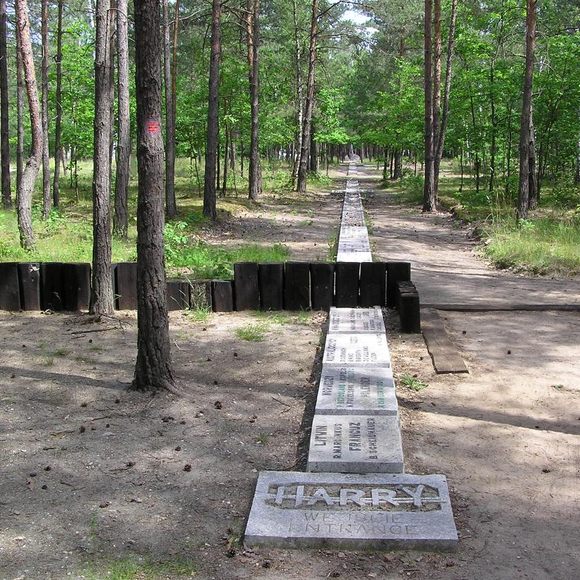
The route of the Harry tunnel from above

March 25, 1944: What becomes known as "The Great Escape" takes place. For 3 men, it was a success. For 73 others, it was a failure.

Stalag Luft III was a prisoner-of-war camp set up by Nazi Germany in Sagan, Lower Silesia, within German borders. Due to the changing borders after the war, the town is now in Poland, and named Żagań. The name "Luft," meaning "Air," indicates that all the prisoners were survivors of Allied planes that had been shot down.

Having dug 3 tunnels, codenamed TomDick and Harry, 76 Allied prisoners escaped. All but 3 were quickly recaptured: Bram van der Stok of the Netherlands, and Norwegians Per Bergsland and Jens Müller. van der Stok, due to his language skills and contacts with the French resistance, found safety with the British consulate in neutral Spain. The 2 Norwegians made it to neutral Sweden by train and boat, with the help of friendly sailors. But of the 73 men captured, the Nazis executed 50. Bergsland lived until 1992, van der Stock until 1993, Müller until 1999.

In 1950, Paul Brickell published the book The Great Escape, based on the story. In 1963, the book was adapted into a film. Only 3 of the 76 real escapees were Americans. But, given the nature of Hollywood, Americans were given starring roles in the film, some as foreigners.

*

March 25, 1944 was a Saturday. Baseball was in Spring Training. Football was out of season. The NBA hadn't been founded yet. One game was played in the Stanley Cup Playoffs: The Montreal Canadiens beat the Toronto Maple Leafs, 2-1 at Maple Leaf Gardens in Toronto.

England's Football League had suspended play for the duration of World War II, but there was another competition set up, known as the London Combination. In this, Reading FC, of Berkshire, beat Arsenal, 5-1 at White Hart Lane in Middlesex. (In 1963, the boundaries of London were redrawn so that White Hart Lane, home of Tottenham Hotspur, was now in North London. Arsenal's usual North London home, Highbury, had been appropriated by the government for the duration.)

Monday, March 14, 2022

March 14, 1950: A Senator Denounces Ingrid Bergman

March 14, 1950: Swedish actress Ingrid Bergman is denounced on the floor of the U.S. Senate, for her "immorality."

Bergman had starred in Casablanca; the film version of Ernest Hemingway's For Whom the Bell Tolls; Alfred Hitchcock's films Gaslight (winning an Academy Award for Best Actress), Spellbound and Notorious; and had played a nun in The Bells of St. Mary's, and a saint in Joan of Arc. She was not only beloved around the world, but was viewed as worthy of those nun and saint roles. She was Catholic, but she was married, to neurosurgeon Petter Lindström, with a daughter, Pia.

In 1949, she wrote a letter to Italian director Roberto Rossellini, saying she admired his films and wanted to work with him. He invited her to star in his film Stromboli. They began filming, and they began an affair. As a result, she became pregnant.

On February 2, 1950, Renato Roberto Ranaldo Giusto Giuseppe Rossellini, nicknamed "Robin," was born. On February 9, Bergman obtained a "quickie" Mexican divorce from Lindström. On February 12, Stromboli was released in America. It did well in Europe, where their affair wasn't considered as big a deal. In spite of Italy being, historically, a very conservative country, the film was awarded the Rome Prize for Cinema as the best film of the year.

But in America, it was a box-office bomb. RKO Pictures, the American distributor, lost $200,000 on it. Most reviews suggested that the film was weak, but fell short of being nasty: American critics seemed willing to dislike it on merit.

On March 14, Senator Edwin C. Johnson, Democrat of Colorado, a baseball executive who built the original version of what became Mile High Stadium in Denver, denounced Bergman on the floor of the U.S. Senate. He said that she had once been his favorite actress. But now:

Now that the stupid film about a pregnant woman and a volcano has exploited America with the usual finesse, to the mutual delight of RKO and the debased Rossellini, are we merely to yawn wearily, greatly relieved that this hideous thing is finished, and then forget it? I hope not. A way must be found to protect the people in the future against that sort of gyp.
At this point, the Hays Code was still in effect, and cuts to Rossellini's film had been made to make it fit for American release. But Senator Johnson wanted to go further: He proposed a bill wherein movies would be approved for licenses based on the moral compasses of those behind the picture, insisting that Bergman "had perpetrated an assault upon the institution of marriage," and going so far as to call her "a powerful influence for evil."

There was a double standard at work: Male actors were able to work their way through the bedrooms of Southern California without being shamed into stopping. Her co-star in For Whom the Bell Tolls, Gary Cooper, slept with pretty much all of his female co-stars. So did her co-star in The Bells of St. Mary's, Bing Crosby -- who, in that film and its prequel, Going My Way, had played a priest, and was known as a Catholic moralist. The affairs of male actors may have been poorly-kept secrets in Hollywood, but the legitimate news outlets kept them quiet.

(Both Cooper and Crosby had co-starred with Grace Kelly, who fooled around with them, and with pretty much every male co-star she had. It's been suggested that the reason she was allowed to marry Prince Rainier III of Monaco was to cover up a coming revelation about her character.)

Bergman allowed nationally-syndicated columnist Art Buchwald to read her mail during the scandal. In an interview years later, he said, "Oh, that mail was bad: Ten, twelve, fourteen huge mail bags. 'Dirty whore.' 'Bitch.' 'Son of a bitch.' And they were all 'Christians' who wrote it."  (Buchwald was Jewish.) Bergman later said, "People saw me in Joan of Arc, and declared me a saint. I'm not. I'm just a woman, another human being."

On May 24, she married Roberto Rossellini. On June 18, 1952, she gave birth to twin daughters, Isotta and Isabella. She could not return to America, but made the film Anastasia in 1956. It had been 6 years, and Ed Sullivan was willing to believe that America would welcome her back. He flew to Europe and filmed an interview with her, intending to air it on The Ed Sullivan Show. But when he got back to New York, CBS, which normally gave him a lot of leeway due to his show being the most popular one on the network, put its foot down, and said no, she could not appear, not even on film. Ed had wasted a lot of money, time and effort in a good cause.

But on March 27, 1957, she was announced as the winner of her 2nd Academy Award for the film, and the audience in the NBC Century Theatre in New York gave the announcement a rousing round of applause. Former co-star Cary Grant, one of the few celebrities to stick up for her all that time, accepted the award on her behalf, and brought it to her in London. She, Grant, Sullivan, and everyone else who had stood up for her were vindicated.

Later that year, she and Rossellini were divorced, following his affair with another actress; and she was reunited with her daughter Pia, in Rome. Petter Lindström, however, remained bitter towards Bergman. In 1958, Ingrid married Swedish theatrical producer Lars Schmidt. That marriage ended in divorce in 1975, the year she won a 3rd Oscar, for Best Supporting Actress for her role in Murder On the Orient Express.

She died in 1982, of cancer, on her 67th birthday. Rossellini had died in 1977. Lindström lived until 2000; Schmidt, until 2009. Pia Lindström became a journalist, Robin Rossellini a director like his father, Isabella Rossellini a model and an actress like her mother, and Isotta Rossellini became a literature professor. All 4 of Ingrid Bergman's children are still alive.

And Edwin C. Johnson? After serving 3 terms in the Senate, he did not run for a 4th in 1954, seeking to return to an office he had previously held, that of Governor of Colorado. He won, but did not run again in 1956, and never ran for office again. He died in 1970. In 1972, Senator Charles Percy, Republican of Illinois, officially entered an apology for Johnson's denunciation of Bergman into the Congressional Record.

*

March 14, 1950 was a Tuesday. Baseball was in Spring Training. Football was out of season. There were no NHL games played that day. There were 3 games played in the NBA:

* The New York Knicks lost to the Chicago Stags, 85-75 at the Chicago Stadium.

* The St. Louis Hawks beat the Boston Celtics, 86-76 at the Boston Garden.

* And the Indianapolis Olympians beat the Syracuse Nationals, 68-65 at the Butler Fieldhouse (now the Hinkle Fieldhouse) in Indianapolis.

Tuesday, February 22, 2022

February 22, 2008: "The Girl With the Dragon Tattoo" Is Published

Stieg Larsson

February 22, 2008: The Girl With the Dragon Tattoo is published in English, 3 years after it was first published in its native country, Sweden. Its author, Stieg Larsson, becomes hailed around the world.

He wasn't there to receive it, though. Karl Stig-Erland Larsson was born on August 15, 1954 in Skelleftehamm, Sweden. As a young man, he produced science-fiction fanzines, and later became a leftist journalist.

He said he was 15 years old when he saw 3 men gang-rape a woman he knew named Elisabeth, and felt guilty about having done nothing about it. He asked her for forgiveness, and she refused. So he decided to write a book about a character named Lisbeth who avenged her assault. But after his death, the story was questioned, as it was heard that he may have heard the story secondhand.

He had completed the 1st 3 books in what he was calling his Millennium series by November 9, 2004, when he had a heart attack while climbing the stairs to his office in the Swedish capital of Stockholm. He was 50 years old.

The 1st book in the series was Män som hatar kvinnor -- in English, "Men Who Hate Women." It was published in Sweden in 2005, and translated into English as The Girl With the Dragon Tattoo in 2008. Changing the title did generate some controversy, and not just because the original translation had her tattoo as that of a wasp. (The character actually has many tattoos.)

The novel starts with Mikael Blomkvist, a news magazine publisher facing jail time for libeling a billionaire. He quits, and accepts a freelance assignment from Henrik Vanger, another rich man, to discover the identity of the killer of a woman in his family. If successful, he will provide Blomkvist with the proof that can exonerate him.

But Vanger has already had him investigated, by Lisbeth Salander, a hacker with a punk/Goth appearance. When Blomkvist's main suspect kidnaps him, he tortures him, but reveals that he is not the killer. Just as he's going to kill Blomkvist, Lisbeth rescues him, inadvertently leading to the suspect's death.

Together, Blomkvist and Lisbeth discover that the murder victim is actually alive and well in Australia. Learning this, Vanger reneges on his promise. In retaliation, Lisbeth not only finds the evidence to exonerate Blomkvist, but the evidence to ruin Vanger.

The 2nd book was titled Flickan som lekte med elden: "The Girl Who Played With Fire." It was published in Sweden in 2006, and in English with the title unchanged in 2009. The 3rd book was titled Luftslottet som sprängdes: "The Castle in the Air That Was Blown Up." It was published in Sweden in 2007, and in English as The Girl Who Kicked the Hornet's Nest in 2009.

Swedish writer David Lagercrantz obtained the legal rights to continue the Lisbeth Salander books, publishing The Girl in the Spider's Web in 2015, The Girl Who Takes an Eye for an Eye in 2017, and The Girl Who Lived Twice in 2019.

Another Swedish writer, Karin Smirnoff, acquired the right to continue the series. (UPDATE: The Girl in the Eagle's Talons, intended as the first of yet another trilogy, was published later in 2022, and in English in 2023. The second, The Girl with Ice in Her Veins, was published in Swedish in 2025.)

Swedish studio Yellow Bird produced films based on the 1st 3 novels, all released in 2009. Swedish actress Noomi Rapace played Lisbeth. It was appropriate because, like the character, the actress is a natural redhead who died her hair black to become the person who made her famous.
In 2011, an English version of The Girl With the Dragon Tattoo was released, starring Rooney Mara as Lisbeth and James Bond actor Daniel Craig as Blomkvist. Although Mara was nominated for an Academy Award, the film tanked, and U.S. versions of the next 2 films have never been made. In contrast, none of the Lagercrantz novels have been made in Sweden; but, in 2018, the 1st of them, The Girl in the Spider's Web, was made in English, with English actress Claire Foy as Lisbeth.

*

February 22, 2008 was a Friday. Baseball and football were out of season. There were 13 games played in the NBA:

* The New York Knicks beat the Toronto Raptors, 103-99 at Madison Square Garden. Jamal Crawford scored 43 points for the Knicks.

* The New Jersey Nets lost to the Indiana Pacers, 113-103 at the Conseco Fieldhouse (now the Gainbridge Fieldhouse) in Indianapolis.

* The Sacramento Kings beat the Charlotte Bobcats, 116-115 at the Charlotte Bobcats Arena (now the Spectrum Center) in Charlotte.

* The Orlando Magic beat the Philadelphia 76ers, 115-99 at the Amway Arena in Orlando.

* The Dallas Mavericks beat the Memphis Grizzlies, 98-83 at the FedEx Forum in Memphis.

* The Cleveland Cavaliers beat the Washington Wizards, 90-89 at the Quicken Loans Arena (now the Rocket Arena) in Cleveland. LeBron James scored 33 points.

* The Detroit Pistons beat the Milwaukee Bucks, 127-100 at The Palace in the Detroit suburb of Auburn Hills, Michigan.

* The Chicago Bulls beat the Denver Nuggets, 135-121 at the United Center in Chicago. J.R. Smith scored 43 points for the Bulls.

* The Houston Rockets beat the New Orleans Hornets, 100-80 at the Smoothie King Center in New Orleans.

* The Phoenix Suns beat the Boston Celtics, 85-77 at the US Airways Center (now the Mortgage Matchup Center) in Phoenix.

* The Atlanta Hawks beat the Golden State Warriors, 117-110 at the Oakland Coliseum Arena (then named the Oracle Arena). Baron Davis scored 35 for the Hawks.

* The Los Angeles Clippers beat the Utah Jazz, 114-104 at the Staples Center (now the Crypto.com Arena) in Los Angeles.

* The Seattle SuperSonics beat their arch-rivals, the Portland Trail Blazers, 99-87 at the Key Arena in Seattle.

* So the only NBA teams that were not scheduled were the Miami Heat, the Minnesota Timberwolves, the San Antonio Spurs and the Los Angeles Lakers.

There were 5 games played in the NHL:

* The Dallas Stars beat the Edmonton Oilers, 5-2 at the American Airlines Center in Dallas.

* The Colorado Avalanche beat the Phoenix Coyotes, 3-2 in a shootout at the Jobing.com Arena (now the Desert Diamond Arena) in the Phoenix suburb of Glendale, Arizona.

* The Calgary Flames beat the Detroit Red Wings, 1-0 at the Saddledome in Calgary.

* And the Anaheim Ducks beat the St. Louis Blues, 2-1 at the Honda Center in Anaheim. It was somewhat appropriate that a Swedish athlete would be a hero on this day, and Samuel Påhlsson scored the winning goal in this game, just 32 seconds into overtime.

December 31, 1999 & January 1, 2000: The Millennium

December 31, 1999:  The Millennium arrives. The people of planet Earth survived. At a terrible cost. But we hadn't destroyed ourselves. ...