Showing posts with label great depression. Show all posts

Monday, November 21, 2022

November 21, 1934: The "Business Plot" Is Exposed

Smedley Butler

November 21, 1934: The New York Post and the Philadelphia Record break the story of what came to be known as "The Business Plot," a rich men's plan to launch a military coup and take over the American government.

The story is broken by Paul Comly French, a reporter who had once been the private secretary of Smedley Butler, a retired Major General (2 stars) in the U.S. Marine Corps.

Smedley Darlington Butler was born on July 30, 1881, in the Philadelphia suburb of West Chester, Chester County, Pennsylvania. His father, Thomas Stalker Butler, was a Republican Congressman. His maternal grandfather, Smedley Darlington, had previously held the same seat in Congress. Three earlier Darlingtons had served in Congress. Smedley's aunt, Isabel Darlington, was the 1st woman to practice law in Chester County.

He enlisted in the Marines, and served with distinction in the Spanish-American War, the Philippine Campaign and the Boxer Rebellion. His participation in the so-called "Banana Wars" in Central America caused him to look at war and its conduct differently.

He received his 1st Congressional Medal of Honor for his service in the American occupation of Veracruz, Mexico in 1914. He offered to return it, saying he had done nothing to earn it. He was ordered to keep it. He received a 2nd Medal of Honor for his role in repelling an ambush during the American occupation of Haiti in 1915.

He received his General's stars during World War I, and was appointed commanding officer of the Marine barracks at Quantico, Virginia, now the "home base" of the Corps (and of the FBI). In 1924, President Calvin Coolidge gave him leave from active duty so that he could become Director of Public Safety for Philadelphia.

He said, "Cleaning up Philadelphia was worse than any battle I was ever in." He brought crime down significantly, but his tactics were a bit heavy-handed. Still, there were many people who liked that, and they remembered it, thinking that Butler was their kind of man. He held the job for 2 years, returned to the Corps, and retired from the service in 1931.

He ran for the U.S. Senate in Pennsylvania in 1932, but, with the tide turning against Prohibition, which he supported, he lost the Republican Primary. He opposed the Bonus Army in a public statement that year, and there were many people who liked that.

That year, Governor Franklin D. Roosevelt of New York, a Democrat, was elected President of the United States. His "New Deal" lifted millions out of poverty, increasing taxes on rich people in order to do it. America's wealthiest men were furious, and some were not willing to wait until November 3, 1936, the next election, to do something about it.

In November 1934, Butler testified before a special committee of the U.S. House of Representatives. He told them that he was visited by Gerald P. MacGuire, a prominent Connecticut businessman. MacGuire had visited Germany and Italy, and saw how veterans' groups had aided the Fascist movements there, movements that had stopped Communist uprisings. He told Butler that he viewed FDR and his advisors, the so-called "Brain Trust," as Communists, and said they had to be stopped.

He told Butler that a group of businessmen had $50 million to spend, and a private army of 500,000 ex-soldiers, many of them members of the American Legion, ready to march on Washington, to remove Roosevelt from power, and establish a Fascist dictatorship. MacGuire told Butler that the group wanted him to be the dictator.

Butler said that he later met with Robert Sterling Clark, an heir to the Singer sewing machine fortune. Clark told him about some of the other men backing the plan:

Irénée du Pont, head of the DuPont Corporation, which had recently bought the Remington Arms company, which would produce the weapons and the ammunition for the coup.

* Thomas W. Lamont, running J.P. Morgan & Company on behalf of J.P. Morgan Jr., son of the company's founder, and an adviser to every President since Woodrow Wilson, including FDR, thus giving the group an "inside man." 

* Grayson Murphy, a director of Goodyear Tire, Anaconda Copper, and Bethlehem Steel, all companies capable of supplying the coup effort with necessary materiel.

* And the last 2 Democratic Party nominees for President before FDR: John W. Davis, a former Congressman from West Virginia and U.S. Ambassador to Britain, who was always more conservative than the mainstream of the Party; and Alfred E. Smith, who was also FDR's predecessor as Governor of New York, had lost very badly to Herbert Hoover in 1928, saw FDR beat Hoover even worse in 1932, and was intensely jealous of FDR's early success and popularity as President.

About all of this, Butler told French, whom he trusted due to his service. French did some digging, and found evidence that the plot was real, not just MacGuire and Clark blowing off steam at a President they hated. Armed with this knowledge, Butler met with MacGuire again, and said, "If you get 500,000 soldiers advocating anything smelling of Fascism, I am going to get 500,000 more, and lick the hell out of you, and we will have a real war right at home." And then he went to Congress, and spilled the beans.

French broke the story in the New York Post and the Philadelphia Record on November 21. On November 22, The New York Times wrote about it, calling it a "gigantic hoax." All the parties alleged to be involved publicly said there was no truth in the story, calling it a joke and a fantasy. Roosevelt's reaction to it is not known to have been recorded.

If the coup ever got beyond the talking stage, it was doomed without a leader -- or, more likely, a figurehead. It has been alleged that Hugh S. Johnson, a retired Army Brigadier General who had been running the National Recovery Administration for FDR, and had been named Man of the Year for 1933 by Time magazine, had also turned the plotters down.

In 1935, Butler published a book titled War Is a Racket, comparing what Dwight D. Eisenhower would later call "the military-industrial complex" to organized crime. He wrote, "I spent most of my time as a high class muscle man for Big Business... a gangster for capitalism" who "might have given Al Capone a few hints." That book, all by itself, showed that the big business boys were looking to the wrong man for their goal.
Plaque honoring Butler, Philadelphia City Hall:
"He enforced the law impartially,
he defended it courageously, he proved incorruptible."

MacGuire died of pneumonia shortly before Butler published his book. Grayson Murphy died in 1937, Smedley Butler in 1940, Hugh Johnson in 1942, Al Smith in 1944, Thomas Lamont in 1948, John W. Davis in 1955, Robert S. Clark in 1956, Paul French in 1960, and Irénée du Pont in 1963.

In 2018 and 2022, Thomas Lamont's great-grandson, Edward Miner Lamont Jr., a.k.a. Ned Lamont, was elected Governor of Connecticut -- as a liberal Democrat. He has conducted the office very differently from what his ancestor would have hoped.

*

November 21, 1934 was a Wednesday. This was also the day the Cole Porter musical Anything Goes, starring Ethel Merman, debuted on Broadway. I have a separate entry for that event.

This was also the day that the Yankees purchased the contract of Joe DiMaggio from the San Francisco Seals of the Pacific Coast League. I have a separate entry for that event.

Baseball was out of season. Football was in midweek. The NBA hadn't been founded yet. And while the NHL season began on November 8, there were no games scheduled for this day. So there were no scores.

Tuesday, November 15, 2022

November 15, 1948: Canada's Longest-Serving Prime Minister Retires

November 15, 1948: William Lyon Mackenzie King retires as Prime Minister of Canada and as Leader of the country's Liberal Party.

He was born on December 17, 1874 in Berlin, Ontario, a town renamed Kitchener due to anti-German sentiment during World War I. His maternal grandfather was William Lyon Mackenzie, the 1st Mayor of Toronto, and the leader of the Upper Canada Rebellion in 1837. Within his family, he was known as Willie, but, while at the University of Toronto, he adopted "W. L. Mackenzie King" as his signature, and began using "Mackenzie" as his preferred name with those outside the family.

Influenced by the settlement house movement, he was elected to Parliament in 1908, and was soon appointed the country's 1st Minister of Labour by Prime Minister Wilfrid Laurier. He lost his seat in the 1911 Conservative Party landslide, and was hired by John D. Rockefeller Jr. to work for the Rockefeller Foundation. He was criticized for working for them instead of serving his country, in any capacity, during World War I, though he was 39 years old when the war began.

But King had been working for his Party behind the scenes, and when Laurier died in 1919, leaving the Party Leadership vacant, he ran for it and won, with the aide of prominent Quebec politician Ernest Lapointe Lapointe was aptly-named, because, for the rest of his life, he would be King's point man on Quebec: King never learned how to speak French, but, through Lapointe, he kept Quebec's Liberals on his side. Now, to keep it, he needed to run for a seat in the House of Commons, and won a seat in 1921. Forming a coalition to outflank the Conservatives, he became Prime Minister.

That year, Julian Byng, 1st Baron Byng of Vimy, Canada's leading hero of World War I, was named Governor-General of Canada by King George V. In 1925, Arthur Meighen, the Prime Minister that King had defeated in 1921, returned to power with a coalition government, as he took the Tories to a lead in the Commons, but not a majority.

King, however, thought he could retake the government by peeling off some members of the coalition. He combined the Liberal and Progressive caucuses to gain a plurality, and hung on to power. But the following year, due to a scandal that didn't involve King himself, the coalition fell apart.

King turned to Lord Byng, and asked him to exercise his power and dissolve Parliament, so that a new election could be called. Byng refused, citing the will of the people that had given Meighen the lead in the most recent election, and the right to form his coalition. On June 29, 1926, Byng asked Meighen to form a government, and he did.

King accused Meighen of acting irresponsibly by accepting Byng's appointment, attracting Progressive Party support to take down the fledgling government. The government lost a motion regarding Meighen's acting Ministers by 1 vote, only 3 days after Meighen's appointment. With no other parliamentary leader to call upon, Byng called a new election for September 14.

King effectively campaigned against Byng, instead of against Meighen, and won the most seats in the House of Commons. It became known as "The King-Byng Affair," and Byng returned to Britain at the end of the year, while Meighen resigned as Conservative Leader. King had not only defeated his predecessor: He had, for all intents and purposes, forced the Governor-General to resign, showing the Crown that Canada was its own nation, with its own government, speaking for its own people. Since 1926, no Governor-General of Canada, and no monarch of Great Britain, has tried to impose his or her will on the Prime Minister. All of which makes it weirder that the Prime Minister would be named "King."

He strengthened the Provincial governments of the Western Provinces: Manitoba, Saskatchewan, Alberta and British Columbia. In collaboration with the Provincial governments, he inaugurated a system of old-age pensions based on need. In February 1930, he appointed Cairine Wilson as the 1st female Senator in Canadian history.

With the Great Depression having started, Mackenzie King was slow to react, and lost the 1930 election to a Conservative Party now led by Richard B. Bennett. But Bennett could not get Canada out of the Depression, and held off calling a new election for as long as he constitutionally could, finally standing for one in 1935. Campaigning under the slogan "King or Chaos," King and the Liberals won it. While there have been other Prime Ministers of Canada who lost the office and regained it, King remains the only one to have held it 3 times.

King not only had an indisputable majority government for the 1st time, he had, like his American counterpart Franklin Delano Roosevelt, the largest majority any party in his country had ever had, and for the same reason: The rejection of the country's conservative party for its handling of the Depression. But King knew he had to respond in 1935, as he had not in 1930. Instead of a "New Deal," which was FDR's term, he promised "a new era, where poverty and adversity, want and misery are the enemies which liberalism will seek to banish from the land."

He and FDR negotiated the Reciprocal Trade Agreement of 1935, aiding both countries. He started youth-work, farm-work, and conservation-work programs, similar to FDR's. His National Housing Act of 1938 led to the federal government building low-rent housing. He established Trans-Canada Air Lines, which became Air Canada in 1965; and nationalized both the Bank of Canada and the nation's railroads, forming the Canadian National Railway.

Canada entered World War II along with Britain in 1939. Despite this, an election was held on time in 1940, and the Liberals slightly increased their majority. Another was held on time in 1945 -- between V-E Day and V-J Day, as it turned out, just as Britain's was -- and the Liberals lost seats, but hung on to enough seats to keep their majority.

King hosted FDR and British Prime Minister Winston Churchill at the Quebec Conference in Quebec City in 1943, though he objected to Churchill seeming to ignore him. The men were the same age, having been born 17 days apart, and had similar back-and-forth electoral histories. But Churchill had served in a combat role in 2 wars, and had that over King. 

It's also worth pointing out that, like FDR, King ordered the internment of citizens of his country of Japanese descent. In some ways, Canada has been ahead of the curve compared to America; but it has had its own moments of bigotry.

He had attended the founding conference of the United Nations at San Francisco in the Spring of 1945, but played only a minor role. He realistically conceded that the major powers would dominate the UN, although he did argue for a "functional principle" that would give such middle powers as Canada an influence based on their contributions to the settlement of disputes.

After World War II, King introduced the Canadian Citizenship Act: Effective January 3, 1947, Canadians were citizens of Canada, not citizens of the United Kingdom. And he began the process of bringing the British Dominion of Newfoundland into Canada, gaining it status as the Province of Newfoundland and Labrador on March 31, 1949.

But King's health was declining, and he announced in May 1948 that he would not be Liberal Leader going in the next election. On August 7, a Party Convention selected Louis St. Laurent, his handpicked successor and his Minister of Justice, as its new Leader. King officially retired on November 15, having served as Prime Minister for 13 consecutive years, and 21 total years, in each case a record.

He did not live long thereafter, dying of pneumonia on July 22, 1950, at the age of 75, at "The Farm," his country estate in Kingsmere, Quebec, outside Ottawa. He bequeathed the estate to the government, which, in 1955, made it the official residence of the Speaker of the House of Commons. King is buried in Mount Pleasant Cemetery in Toronto.

King never married, and is not known to have had any children. Rumors have gone in several places: That he had quiet affairs with prominent women in the capital, some of them married to other politicians; that he satisfied his desires with prostitutes; and that he was gay. None has ever been proven. What was proven, and shocked people, were the publication of his diaries and their content of his interest in the occult, including seances where he tried to contact dead relatives, especially his mother; his dogs, which were known by the public to be a keen interest of his; and even, after 1945, President Roosevelt.

In 1951, the Mackenzie King Bridge opened over the Rideau Canal in the capital city of Ottawa. Since 1975, his portrait has appeared on Canada's $50 bill. In 1997, and again in 2016, Maclean's, Canada's leading newsmagazine, conducted polls that ranked King as the greatest Prime Minister in Canadian history. A 2011 poll ranked him 3rd, behind Wilfrid Laurier and John A. Macdonald, the country's 1st Prime Minister.

*

November 15, 1948 was a Monday. Fashion designer Jimmy Choo, famous for his women's shoes, was born on this day.

Baseball was out of season. Football was in midweek. No games were played in the league that became the NBA, or in the NHL. So there were no scores on this historic day.

Friday, November 11, 2022

November 11, 1934: Father Coughlin Turns Coat On FDR

November 11, 1934: Father Charles Coughlin, the "Radio Priest" who had previously been a strong supporter of Franklin D. Roosevelt, completely turns coat, and begins opposing him, as strongly as anyone in the country does -- at least, publicly.

The things FDR's opponents said about him, and his wife, and his children, and eventually even his dog, in public were bad enough. What they said about him in private was well over the line.

Charles Edward Coughlin was born on October 25, 1891 in Hamilton, Ontario, Canada. He became a priest in Toronto, and settled in Detroit. In 1926, he began his career as "The Radio Priest," with radio station WJR in Detroit, 760 on the AM dial, the station that would later become famous for broadcasting the games of baseball's Detroit Tigers, broadcasting his sermons from the National Shrine of the Little Flower, in suburban Royal Oak, Michigan.
His show was picked up by WGAR in Cleveland, which, like WJR -- and the NFL's Detroit Lions -- was owned by George A. Richards, under the banner of Goodwill Stations. By 1938, they had 58 affiliates. Regional networks like the Yankee Network and the Colonial Network in New England, the Mohawk Network in New York State, and the Quaker State Network in Pennsylvania, all in places with heavy Catholic populations, carried Coughlin's show.
At first, he seemed like a liberal. At the time, the Ku Klux Klan, at least in the North, were more interested in discriminating against Catholics than against black people. Father Coughlin took a stand against them. While denouncing Communism, as any good Catholic of the time would, he also denounced the predatory capitalists who had made Communism so attractive.
In 1932, he supported the Presidential campaign of the Democratic Party's nominee, Governor Franklin D. Roosevelt of New York. In 1933, as FDR put his New Deal into place, Coughlin made a short film of one of his radio broadcasts, saying, "The New Deal is Christ's deal," and, "It is either Roosevelt or ruin." In January 1934, he testified before Congress, saying, "If Congress fails to back up the President in his monetary program, I predict a revolution in this country which will make the French Revolution look silly!"
But he began to turn. On November 11, 1934, he founded the National Union of Social Justice, which opposed FDR. It wasn't exactly consistent: In some areas, he thought Roosevelt went too far in his methods of alleviating poverty; in others, he thought Roosevelt didn't go far enough.
Because they were opposed to Communism, he supported the Fascist governments of Adolf Hitler in Germany, Benito Mussolini in Italy, and, from 1936 onward, Francisco Franco in Spain. At the time, Communism was widely seen to be a Jewish movement, and his broadcasts became more anti-Semitic in nature.
In one 1935 show, he said the Jews were their own worst enemies; in another that year, he said the Jews' 3 biggest enemies were Bernard Baruch, one of the world's leading financiers, and probably the most famous Jewish person in America at that point; Eddie Cantor, star Jewish entertainer; and the Hollywood studios, many run by Jews, including Louis B. Mayer of Metro-Goldwyn-Mayer (MGM) and Harry Cohn of Columbia Pictures.
(To be fair, Mayer was a dictator in his studio, and Cohn was so despised in the industry that, when Cohn was asked why he didn't name his son after himself, he said he didn't want his son to be known as "Son of a Bitch Junior.")
But Coughlin also believed that unregulated capitalism was a Jewish plot. And he came to believe that FDR's policies didn't regulate capitalism enough -- which would seem to fly in the face of his attacks on Communism. He began to call the President "Franklin Double-Crossing Roosevelt."
He was unable to help defeat Roosevelt in 1936. By 1938, he was frequently denying that he was anti-Semitic, because he was frequently being called that. On November 20, 1938, WMCA in New York broadcast a homily entitled "Persecution: Jewish and Christian." In it, Coughlin denounced Jews in language that might have been lifted from the Nazi publication Der Stürmer.
An announcer broke in to distance the station from Coughlin’s talk. "Unfortunately, Father Coughlin has uttered many misstatements of fact,: he informed listeners. Donald Flamm, the president of WMCA, later pledged "not to permit a repetition" of Coughlin’s inflammatory remarks, words that were "calculated to stir up religious and racial hatred and dissension in this country."
By 1939, and the dawn of World War II in Europe, Coughlin was no longer being taken seriously. In 1942, the Archbishop of Detroit ordered Coughlin to stop making political statements. By the time he retired from active preaching in 1966, he was a relic. He died in 1979, at age 88.
*

November 11, 1934 was a Sunday. These games were played in the NFL:

* The New York Giants beat the Green Bay Packers, 17-3 at the Polo Grounds.

* The football version of the Brooklyn Dodgers beat the Philadelphia Eagles, 10-7 at Baker Bowl in Philadelphia.

* The Chicago Bears beat the Boston Redskins, 21-0 at Fenway Park in Boston.

* The Detroit Lions beat the Chicago Cardinals, 17-13 at Wrigley Field in Chicago. I can find no reason for why the Cardinals weren't playing at their usual home, Comiskey Park.

* And the St. Louis Gunners beat the Pittsburgh Pirates, 6-0 at Sportsman's Park in St. Louis. It was the Gunners' 1st game after the sale of the football version of the Cincinnati Reds was approved a delay. The Gunners would play 2 more games, losing them both, before folding.

Such was the state of the early NFL. In 1926, it had 22 teams. The next year, despite the country being in prosperity, they were down to 12. By 1932, they were down to 8. Of those 8, by 1937, 1 had folded, and 2 had moved.

Baseball was out of season. The NBA hadn't been founded yet. There was 1 game played in the NHL, and it was in Father Coughlin's adopted hometown: The Boston Bruins beat the Detroit Red Wings, 4-2 at the Olympia Stadium in Detroit.

November 11, 1933: The Beginning of the Dust Bowl

November 11, 1933: As if the Great Depression wasn't already bad, and hitting farm country harder than the cities, on came the Dust Bowl. For those of you who are sports fans: No, this was not a college football game.

On this day, a very strong dust storm stripped topsoil from desiccated South Dakota farmlands in one of a series of severe dust storms that year.

Such storms had been periodic since 1931, but this was when the Dust Bowl kicked into high gear. Beginning on May 9, 1934, a strong, two-day dust storm removed massive amounts of Great Plains topsoil. The dust clouds blew all the way to Chicago. Two days later, the same storm reached cities to the east, such as Cleveland, Buffalo, Boston, New York and Washington, Over the Winter of 1934-35, red snow fell on New England.

On April 14, 1935, known as "Black Sunday," 20 of the worst "black blizzards" occurred across the entire sweep of the Great Plains, from Canada south to Texas. The dust storms caused extensive damage and appeared to turn the day to night. Witnesses reported that they could not see 5 feet in front of them at certain points.

Denver-based Associated Press reporter Robert E. Geiger was in Boise City, Oklahoma that day. His story about Black Sunday marked the first appearance of the term "Dust Bowl," coined by Edward Stanley, Kansas City news editor of the AP.

Dust Bowl conditions fomented an exodus of the displaced from the Texas Panhandle, the adjoining Oklahoma Panhandle, and the surrounding Great Plains to adjacent regions. More than 500,000 Americans were left homeless. More than 350 houses had to be torn down after one storm alone. The severe drought and dust storms had left many homeless; others had their mortgages foreclosed by banks, or felt they had no choice but to abandon their farms in search of work.

Many Americans migrated west looking for work. Parents packed up "jalopies" with their families and a few personal belongings, and headed west in search of work. In particular, residents of Oklahoma and Arkansas -- "Okies" and "Arkies" -- headed west on U.S. Route 66, which became known as "The Mother Road," for California, "the land of milk and honey," hearing of jobs available picking fruits and vegetables. These jobs proved to be worse than farming, as they were no longer their own bosses, and the bosses were brutal until the labor unions came in.

The Plains States lost about 3.5 million people in the 1930s. More migrants arrived in California in 1936 than in any other year, including the Gold Rush year of 1849. Many of them brought their Southern mindsets with them, and were every bit as biased against the black and Hispanic people of California as they were against the black people of their home States. Ray Manzarek, keyboard player for rock band The Doors, said that, in the 1960s, a big chunk of the Los Angeles Police Department was the sons of Southerners who had come from the Dust Bowl, and they enjoyed practicing police brutality on minorities and hippies.

What did the federal government do about the Dust Bowl? President Franklin D. Roosevelt quickly set the New Deal to work on the problem. The Soil Conservation Service, forerunner of the Natural Resources Conservation Service, was founded. He also created the Civilian Conservation Corps (CCC), which created the Great Plains Shelterbelt: A line of 200 million trees from Canada to Abilene, Texas, to block the wind and cut the giant dust storms off.

In 1939, John Steinbeck published The Grapes of Wrath, about a family that escaped the Dust Bowl, only to find life in California just as hard as life in Oklahoma. The following year, it was made into a film. That same year, Woody Guthrie recorded one of the earliest "concept albums," Dust Bowl Ballads, making himself a legend of folksinging.

*

November 11, 1933 was a Saturday. Actor James Boyd, who played J. Arthur Crank and Paul the Gorilla on the 1970s PBS kids show The Electric Company, was born on this day.

Among the college football games played that day were these:

* Alabama beat Virginia Tech, 27-0 at Denny Stadium (now Bryant-Denny Stadium) in Tuscaloosa, Alabama. This was the 1st season of the Southeastern Conference, and Alabama won the title.

* Duke beat Maryland, 38-7 at Byrd Stadium in the Washington suburb of College Park, Maryland. Duke won the Championship of the Southern Conference, which, 20 years later, would sort-of evolve into the Atlanta Coast Conference.

* Michigan beat Iowa, 10-6 at Michigan Stadium in Ann Arbor. Michigan won the Big Ten Conference.

* Nebraska beat Kansas, 12-0 at Memorial Stadium in Lincoln, Nebraska. Nebraska won the Big Six Conference, the league that would become the Big Eight, and, later, the Big Twelve.

* Rice beat Arkansas, 7-6 at Rice Field in Houston. Nevertheless, Arkansas went on to win the title in the Southwest Conference.

* Purdue beat Notre Dame, 19-0 at Notre Dame Stadium in South Bend, Indiana.

* Among the service academies, Army beat Harvard, 27-0 at Harvard Stadium in Boston; and Navy lost to Columbia, 14-7 at Baker Field in Manhattan.

* In the other major game played in New York City that day, Fordham beat New York University (NYU), 20-12 at Yankee Stadium.

* And among New Jersey's teams, Princeton beat Dartmouth, 7-0 at Palmer Stadium in Princeton; and Rutgers beat Lafayette, 20-13 at Fisher Field in Easton, Pennsylvania.

* Stanford beat the University of Southern California (USC), 13-7 at the Los Angeles Memorial Coliseum. Stanford won the Pacific Coast Conference, the league that would become the AAWU, the Pac-8, the Pac-10 and the Pac-12.

Baseball was out of season. The NBA hadn't yet been founded. There were 3 games played in the NHL:

* The Montreal Maroons beat the Boston Bruins, 3-2 at the Montreal Forum.

* The Ottawa Senators beat the Montreal Canadiens, 2-0 at the Ottawa Auditorium.

* The Toronto Maple Leafs beat the New York Rangers, 4-3 at Maple Leaf Gardens in Toronto.

* And the New York Americans, the Detroit Red Wings and the Chicago Black Hawks were not scheduled.

And in English soccer, defending Champions Arsenal, of North London, beat Wolverhampton Wanderers, a.k.a. Wolves, 1-0 at Molineux Stadium in Wolverhampton, outside Birmingham.

Tuesday, November 8, 2022

November 8, 1932: Franklin Delano Roosevelt Is Elected President

November 8, 1932: Governor Franklin D. Roosevelt of New York is elected President of the United States, defeating the incumbent Republican, President Herbert Hoover. Due to the Great Depression, in just 4 years, Hoover went from winning 40 States to losing 42, from winning 444 Electoral Votes to 87 to losing 472 to 59, and from winning 58.2 percent of the popular vote to losing it 57.4 to 39.7.

Hoover got 15.7 million votes, actually gaining about half a million, despite everything. But FDR got 22.8 million, beating Al Smith's 1928 total by 7 million.

This was not so much an enthusiastic hiring of FDR as it was a vindictive firing of Hoover. And, yes, Hoover can be blamed for how he handled the Depression: He didn't think he could do much, and the things that he did do, that worked a little, he should have done harder, and didn't. Indeed, much of FDR's New Deal was based not just on what he, and before him Smith, had done in the office of Governor of New York, but on some things Hoover did as President, like the Reconstruction Finance Corporation (RFC).

But Hoover shouldn't be blamed for the Depression itself. There was no oversight for the economy. There was a Federal Reserve Board, but there wasn't yet a Securities & Exchange Commission (SEC) to keep stock traders honest, or a Federal Deposit Insurance Corporation (FDIC) to protect banks. Those would come with FDR's New Deal the next year.

In addition, the farm belt had already been in a depression since the end of World War I, 11 years earlier, because the armed forces, its biggest market, had shrunk back to prewar levels. It would take World War II to make the U.S. military-industrial complex big enough to be a permanent market for American agriculture, from meat and grain to dairy and vegetables.

Hoover's predecessor, President Calvin Coolidge, possibly seeing the Crash of 1929 coming, said in 1927, "I do not choose to run for President in 1928." In layman's terms, he left Hoover holding the bag. No one blames the man who got a full term in 1924 on "Coolidge Prosperity" for the Crash that came less than 8 months after he left office. But they should.

Also with blame was Andrew Mellon. Appointed Secretary of the Treasury by Warren Harding, and kept all through the Coolidge years and most of Hoover's term, America's 3rd-richest man (behind John D. Rockefeller and Henry Ford) was a Pittsburgh-based banking titan, whose name lives on after a merger with the Bank of New York: BNY Mellon. But he basically let big business do whatever it wanted.

And then there were the Wall Street speculators. As we've seen, Greed is not good.

FDR said, "I pledge you, I pledge myself, to a new deal for the American people." At the time, he didn't know what that "New Deal," a play on his cousin Theodore Roosevelt's "Square Deal," would be. But the voters didn't care: They wanted something done. Or, as FDR put it in his Inaugural Address, "They want action, and action now!"

And he gave it to them. And they rewarded him with a 2nd term, and a 3rd, and a 4th.

Time magazine named him its Man of the Year in 1932 -- and again in 1934, as his New Deal reforms took hold; and again in 1941, as he tried to resist the Axis Powers even though Congress wouldn't declare war until it was too late.

*

November 8, 1932, like all modern U.S. Election Days, was a Tuesday. The baseball season was over. Football was in midweek. The NBA hadn't been founded yet. And the NHL season didn't start for another 2 days. So there were no scores on this historic day post for the event.

Saturday, November 5, 2022

November 5, 1935: Parker Brothers Begins Selling "Monopoly"

November 5, 1935: Parker Brothers, an American manufacturer of toys and games, begins selling the board game "Monopoly." 

"Monopoly" is derived from "The Landlord's Game," created by Lizzie Magie in 1903, as a way to demonstrate that an economy that rewards individuals is better than one where monopolies hold all the wealth, and to promote the economic theories of Henry George, in particular, his ideas about taxation. When Parker Brothers first published "Monopoly" in 1935, the game did not include the less capitalistic taxation rule, resulting in a more aggressive game. 

In the game, players roll two dice to move around the game board, buying and trading properties and developing them with houses and hotels. Once a player buys all 3 properties on a block, thus establishing a monopoly, they can put a first house on it; once each has a first house, a second; a third; a fourth; and, after the fourth house, a hotel. Each new build increases a property's rent.

Players collect rent from their opponents and aim to drive them into bankruptcy. Money can also be gained or lost through "Chance" and "Community Chest" cards and tax squares. Players receive a salary every time they pass "Go," and can end up in jail, from which they cannot move until they have met one of three conditions: Paying a fine, rolling a "double" on the dice, or rolling the dice 3 times regardless of result (thus "serving their time").

The original game was based on locations in the shore resort of Atlantic City, New Jersey, including the Boardwalk and 4 railroads that once served the city: The Reading, the Pennsylvania, the Baltimore & Ohio (B&O), and the Short Line.

"Monopoly" has become a part of international popular culture, having been licensed locally in more than 103 countries, and printed in more than 37 languages. Variations on it are affiliated with individual cities, sports teams, universities, and other pop-culture phenomena such as movies and television shows. As of 2015, it was estimated that the game had sold 275 million copies worldwide. Parker Brothers was eventually absorbed into Hasbro in 1991.

A recent joke is that "Monopoly" must be an old game: There's a luxury tax, and rich people can go to Jail. This certainly appealed to people in 1935, with the Great Depression still going on.

*

November 5, 1935 was a Tuesday. Baseball was out of season. Football was in midweek. The NBA hadn't been founded yet. And the NHL season started 2 days later. So there were no scores on this historic day.

Tuesday, November 1, 2022

November 1, 1938: War Admiral vs. Seabiscuit

War Admiral (left, wearing Number 1) and Seabiscuit (right, Number 2)

November 1, 1938: In a rare "match race" between champion horses, Seabiscuit, the leading handicap-winner of the last 2 years, defeats the heavily-favored War Admiral, the 1937 Triple Crown winner, at Pimlico Race Course in Baltimore, home of the Preakness Stakes. It is probably the most famous match race in North American history.

Seabiscuit was older, 5 years old to War Admiral's 4. Most thoroughbreds are retired before they're 5. But War Admiral was Seabiscuit's uncle: War Admiral was a son of Man o' War, the great racehorse of the early 1920s, and Seabiscuit was a grandson of Man o' War.

When Man o' War was 3 years old in 1920, the Triple Crown -- winning the Kentucky Derby in Louisvlle, the Preakness in Baltimore, and the Belmont Stakes just outside New York City, all in the same year -- wasn't yet a big deal. Sir Barton, the year before, had become the 1st horse to do it. Man o' War was eligible to run in all 3, but only ran in the Preakness and the Belmont, winning both. In 1937, at age 3, War Admiral won all 3, ridden by Charles Kurtsinger.

In 1936, at age 3, Seabiscuit hadn't been entered in any of them. It took him until 1937 to start winning stakes races, all of them on the West Coast. In those days, the East and the West really were 2 different racing "circuits," and a horse that ran at one rarely ran at another. Air travel was risky even for humans, and for a strong yet delicate, and easily scared, animal like a horse, it was frowned up. Even train travel wasn't considered good for horses.

But Seabiscuit had been transported across the country, and had won a race at Yonkers, just north of New York City. (It's been mainly a harness racing track since, and the Yonkers Trot is part of the Triple Crown for "trotters," as opposed to "pacers." Don't ask about the difference: It speaks to those who claim that horse racing is cruelty to animals.) So taking him back east to challenge War Admiral, who was again the leading racehorse of 1938, was not a crazy idea.

John "Red" Pollard was Seabiscuit's rider, until an injury on another horse knocked him out for the season. Pollard recommended his friend and fellow Canadian, George Woolf, as a replacement. It was a good choice, as he was used to riding and winning, especially at Santa Anita, Seabiscuit's "home field."

Two attempts to get War Admiral and Seabiscuit to race, both at Belmont Park, ended when Seabiscuit was scratched, as his handlers didn't like tracks that were heavy due to recent rain. Finally, it was set up for November 1, 1938, at Pimlico. The distance was set at the same distance as the Course's best-known race, the Preakness: 1 mile and 3/16ths.

It was dubbed "The Match of the Century," and a full house of 40,000 was on hand. An estimated 40 million listened on radio. (No television yet.) War Admiral was set as a 1-4 favorite -- making Seabiscuit a 4-1 underdog. Pretty much the only racing writers predicting a Seabiscuit victory came from his home base in California.

There was no paddock to be loaded into: The horses were stood together, side by side, and a bell was rung to start them off. Head-to-head races tend to favor fast starters, and War Admiral was considered the fastest starter the "Sport of Kings" had ever known, faster even than his daddy (his opponent's grandpa). And yet, Seabiscuit broke faster, leading by a length after only 20 seconds.

Halfway down the backstretch, War Admiral closed and pulled ahead. Pollard had advised Woolf that, if War Admiral had the lead, he should ease up on Seabiscuit, and let him see his opponent, and then ask for more effort.

It worked: Seabiscuit retook the lead with 200 yards to go. War Admiral ran his best race ever for that distance, but it didn't matter: Seabiscuit won by 4 lengths.

Seabiscuit got hurt in his next race, and, as they recovered together in 1939, Pollard joked that they had four good legs between them (out of six). By the time the 1940 racing season began, Seabiscuit was 7 years old, and, as I said, most thoroughbreds are retired no later than 4. By the standards of most stallions, Seabiscuit was still rather young; but, by the standards of his sport, he was ancient.

And yet, after losing 2 races, Pollard guided him to victory in his 3rd that season, the San Antonio Handicap in Texas. A week later, he won the one West Coast race that had previously eluded him, the Santa Anita Handicap. He was then retired.

Woolf was a diabetic, and lost consciousness and fell during a race at Santa Anita on January 3, 1946. He died the next day, only 42 years old. Later in 1946, Kurtsinger fell victim to pnuemonia and died, only 39. Seabiscuit died in 1947, just short of his 14th birthday. Man o' War also died in 1947, at 31, which is old for any kind of horse. War Admiral lived on until 1959, age 25. Pollard suffered 2 more nasty injuries in races in 1938, and ended up marrying his nurse. He lived on until 1981. 

In 1999, Laura Hillenbrand published Seabiscuit: An American Legend, postulating that the reason the American people took to Seabiscuit is that he was an underdog who beat the big boys. Parallels could be drawn to similar sports underdogs who became champions during the Great Depression, including the St. Louis Cardinals' "Gashouse Gang" that won the 1934 World Series, and Jim Braddock, the "Cinderella Man" who won the Heavyweight Championship of the World in 1935.

Her book was made into the 2003 film SeabiscuitTobey Maguire played Pollard. Gary Stevens, winner of each of the Triple Crown races 3 times, played Woolf. Chris McCarron, who won each of those races twice, and once held the record of 546 thoroughbred races won in a single year, played Kurtsinger.

*

November 1, 1938 was a Tuesday. The baseball season was over. Football was in midweek. The NBA hadn't been founded yet. And the NHL season wouldn't start for another 2 days. So there were no scores on this historic day.

Monday, October 31, 2022

October 31, 1936: FDR Welcomes Conservatives' Hatred

October 31, 1936: Madison Square Garden -- the 3rd one, on 8th Avenue between 49th and 50th Streets, then still fairly new, but known to my generation as "The Old Garden" -- hosts its greatest moment. And it had nothing to do with sports.

It is 3 days before a Presidential election. President Franklin Delano Roosevelt, the incumbent Democrat, is running for re-election. The Republican nominee is the Governor of Kansas, Alfred M. Landon. Landon is not the problem: His campaign was rather inoffensive.

Considerably more offensive are the charges that many have made against Roosevelt and his series of programs for lifting the country out of the Great Depression, programs he put under the umbrella term "The New Deal." FDR summarized these, in a more palatable way, in a speech to the nation over the radio networks of the time, a.k.a. one of his "Fireside Chats," on June 28, 1934:

A few timid people, who fear progress, will try to give you new and strange names for what we are doing. Sometimes they will call it "Fascism," sometimes "Communism," sometimes "Regimentation," sometimes "Socialism." But, in so doing, they are trying to make very complex and theoretical something that is really very simple and very practical.

A story FDR liked to tell as he ran for a 2nd term in 1936 was this:

A wealthy man in a fine suit and top hat fell into deep water. He didn't know how to swim, and was on the verge of drowning. Hearing his cries, another man dove into the water, and saved him, as his top hat floated away. The man who had almost drowned regained his breath, and, for a moment, seemed grateful.

Three years later, though, he returned, and denounced his rescuer for not saving his hat, too!

The very rich, and their hired spokesmen, said FDR was trying to "destroy capitalism." Sound familiar? Their successors have said it about every Democratic Presidential nominee since.
Presidential candidates have frequently held rallies close to the election, sometimes in New York, sometimes in their hometowns. John F. Kennedy had his at the Boston Garden in 1960. Bill Clinton, having already had the Democratic Convention at the 4th and current version of The Garden, had one at the Meadowlands Arena 2 days before.

FDR, from Hyde Park, in Dutchess County, actually closer to Albany than to Midtown Manhattan, did have a home in Manhattan, so New York, for practical purposes, could be called his hometown. And so he had his close-to-Election Day rally at The Garden, which was arguably already, even though it did not use the slogan for decades to come, the world's most famous arena. He said:

We had to struggle with the old enemies of peace -- business and financial monopoly, speculation, reckless banking, class antagonism, sectionalism, war profiteering. They had begun to consider the Government of the United States as a mere appendage to their own affairs. We know now that Government by organized money is just as dangerous as Government by organized mob.

Never before in all our history have these forces been so united against one candidate as they stand today. They are unanimous in their hate for me -- and I welcome their hatred.

I should like to have it said of my first Administration that, in it, the forces of selfishness and of lust for power met their match. I should like to have it said of my second Administration that, in it, these forces met their master!...
Here is an amazing paradox! The very employers and politicians and publishers who talk most loudly of class antagonism and the destruction of the American system now undermine that system by this attempt to coerce the votes of the wage earners of this country. It is the 1936 version of the old threat to close down the factory or the office if a particular candidate does not win. It is an old strategy of tyrants to delude their victims into fighting their battles for them.

FDR went on in this vein for some time. Tweaking the details, this speech could have been given by a Democratic leader in every Presidential election that has followed.
*
October 31, 1936 was a Saturday. Actor Michael Landon was born on this day.
Baseball season was over. The NHL season began 5 days later. The NBA hadn't been founded yet. And while the NFL had been known to schedule games for Saturdays in this era, they did not do so on this occasion. But there were college football games, including the following:
* Number 1 Minnesota were beaten by Number 3 Northwestern, 6-0 at Dyche Stadium (now Ryan Field) in the Chicago suburb of Evanston, Illinois. This was the 1st season with the Associated Press poll, of the nation's college football writers. This win, and Number 2 Pitt's tie, vaulted Northwestern to Number 1 in the next poll. They went on to win the Big Ten Conference title, but blew their undefeated season in their last game, losing to Notre Dame. Despite not even winning their own league, Minnesota were awarded the National Championship by the AP. So the poll system was flawed from the very beginning.
* Number 2 University of Pittsburgh and Number 5 Fordham played to a 0-0 tie at the Polo Grounds. This was the 2nd of 3 straight seasons in which Pitt and Fordham played each other at the Polo Grounds, without either scoring. Finally, in 1938, they played at Pitt Stadium, and Pitt won, 24-13.
* Number 4 University of Washington beat Oregon, 7-0 at Multnomah Stadium (now Providence Park) in Portland, Oregon. Washington won the Pacific Coast Conference title, but Pitt beat them in the Rose Bowl
* Number 6 Army were upset by Colgate, 14-7 at Michie Stadium in West Point, New York.
* Number 8 Louisiana State beat Vanderbilt, 19-0 at Dudley Field (now First Bank Stadium) in Nashville. LSU finished the regular season undefeated, and won the Southeastern Conference title.
* Number 9 Tulane beat Louisiana Tech, 22-13 at Tulane Stadium in New Orleans.
* Number 10 Marquette beat Number 20 Saint Mary's of California, 20-6 at Marquette Stadium in Milwaukee. 
* Number 11 Nebraska beat Missouri, 20-0 at Memorial Stadium in Lincoln, Nebraska. Nebraska won the Big Six Conference title (later the Big Seven, the Big Eight, and the Big Twelve). They were not invited to any of the early bowl games, but they did have inter-sectional matchups, losing to Pittsburgh at home, and beating Oregon State in Portland.
* Number 12 Yale were upset by Dartmouth, 11-7 at the Yale Bowl in New Haven, Connecticut.
* Number 16 Auburn were upset by Number 19 Santa Clara, 12-0 at Kezar Stadium in San Francisco. Santa Clara were invited to the Sugar Bowl, and beat LSU.
* Number 20 Pennsylvania beat Navy, 16-6 at Franklin Field in Philadelphia.
* Notre Dame beat Ohio State, 7-2 at Notre Dame Stadium in South Bend, Indiana.
* North Carolina beat North Carolina State, 21-6 at Kenan Stadium in Chapel Hill, North Carolina.
* Mississippi State beat Sewanee University, 68-0 at Municipal Stadium in Jackson, Mississippi. Sewanee, based in Sewanee, Tennessee, downgraded their football program in 1940, dropping out of the Southeastern Conference. Since 1973, they have played in NCAA Division III.
* The night before, Duquesne University of Pittsburgh lost to the University of Detroit, 14-7 at University of Detroit Stadium. Duquesne rebounded from this, and were invited to the Orange Bowl, where they beat Mississippi State. Duquesne closed its football program after the 1950 season, and restored it at the NCAA Division I-AA (now NCAA FCS) in 1993. The University of Detroit closed its football program after the 1964 season, and haven't restarted it. They've been the University of Detroit Mercy since 1980.
* Texas Christian University beat Baylor, 28-0 at Amon G. Carter Stadium in Fort Worth, Texas. TCU, led by quarterback Sammy Baugh, won the Southwest Conference title. They were invited to play in the inaugural Cotton Bowl in Dallas, and beat Marquette, 16-6. Marquette closed its football program after the 1960 season.
* In New York City, in addition to Fordham's scoreless tie with Pitt, New York University beat Lafayette, 46-0 at Yankee Stadium; and Manhattan beat City College, 28-7 at Ebbets Field.
And among New Jersey's teams, Number 17 Princeton were held to a tie by Harvard, 14-14 at Harvard Stadium in Boston; and Rutgers lost to Lehigh, 19-0 at Neilson Field in New Brunswick.

Saturday, October 29, 2022

October 29, 1929: Crash and Depression

October 29, 1929: Black Tuesday. The stock market completes the crash that began the preceding Thursday. The Roaring Twenties are over. The Dirty Thirties, and the Great Depression, have begun.

The incumbent Republican President, Herbert Hoover, gets blamed for it, when it was his Republican predecessors, Warren Harding and Calvin Coolidge, who set the table for it. Hoover shouldn't be blamed for the Depression. And he shouldn't be blamed for doing nothing: He tried a few things.
What he should be blamed for is giving up. Some of the things he tried worked a little, but not enough, and he abandoned his efforts. And in 1932, he lost in a landslide, to the Democratic Governor of New York, Franklin Delano Roosevelt.

Emptied pockets, to show that you had no money, became known as Hoover flags. Newspapers used as cover by homeless people became known as Hoover blankets. Shanty towns became Hoovervilles. And hitching a horse up to your car, because you couldn't afford gasoline but you didn't dare sell your car, earned the vehicles the nickname Hoover wagons. In Canada, where Richard Bennett rode the Depression to become Prime Minister in 1930, but was turned out in 1935 because he governed more like Hoover than Roosevelt, they were known as Bennett buggies.
Did you think I was making it up?

The happy, peppy songs of the Roaring Twenties -- including a song recorded just before, but released just after, the crash, which was saved by FDR making it his campaign theme song, "Happy Days Are Here Again" -- were gone. Songs of the Depression either spoke of hardship, like "Brother, Can You Spare a Dime?" (evoking both now-fallen industry and World War I), "Boulevard of Broken Dreams" (not the Green Day song of 2005), "Gloomy Sunday," and "Remember My Forgotten Man"; or tried to defy it, like "We're In the Money" and "Life Is Just a Bowl of Cherries."

Movies also reflected this. Monster movies abounded, with Dracula and Frankenstein both released in 1931, and King Kong and The Invisible Man in 1933, each inspiring many imitators. Gangster movies peaked then, with James Cagney's The Public Enemy, Edward G. Robinson's Little Caesar, and the original version of Scarface, starring Paul Muni, all made in 1931, the latter not released until 1932.

At the height of the stock boom in early September 1929, America's unemployment rate was 3.2 percent. By the end of 1930, it was 8.7. 1931, 15.9. At the 1932 election, 23.6. At the depth, on March 4, 1933, when FDR was inaugurated and the banking crisis was critical, the rate was 24.9 percent. Fully 1 out of 4 Americans who wanted to work couldn't get work. Some people have suggested the rate was considerably higher than that, as much as 31 percent, or nearly 1 in 3.

FDR ended up building on some of what worked under Hoover, and in New York State under his leadership there, and put it in overdrive. Banking reforms stopped the financial bleeding, securities reforms prevented much of the abuses that had been done (stopped it, that is, until deregulation in the 1980s), and his public works and other construction programs created millions of jobs.

His New Deal had worked very well, but the problems remained vast. When he was sworn in for a 2nd term on January 20, 1937, having gotten the unemployment rate down to 14 percent (either cut by a third or a half, depending on whose figures you believe), FDR said the work was far from done: "I see one-third of a nation ill-housed, ill-clad, ill-nourished." And it may have been more like two-fifths, or 40 percent, because that included what we would now call "the working poor."

That year, FDR did what conservatives have always suggested for economic hardship: Cut spending. It backfired, and unemployment went from a Depression-low of 14.3 percent to 19.0 percent by the time of the 1938 elections, resulting in the Republicans' best performance between 1928 and 1946, although not enough to gain control of either house.

But 1937 was the year Social Security began handing out checks, and 1938 was the year the 1st federal minimum wage took effect. By 1941, unemployment was back under 10 percent. It still didn't get back to tolerable levels until the U.S. entered World War II, and a lot of unemployed men went into the armed forces, and a lot of employed men did as well, their stateside jobs becoming available to unemployed men -- and women.

From the dawn of the American Civil War in 1860 to 1928, the Republican Party had gone 14-4 in Presidential elections. (Okay, they may have stolen those of 1876, 1880 and 1888.) And in the 4 that the Democratic Party won -- 1884, 1892, 1912 and 1916 -- they still didn't get a majority of the popular vote in any of them, not even with the 1912 split in the Republicans that led to an Electoral Vote landslide for Woodrow Wilson. The GOP also held both houses of Congress for most of a 70-year stretch from 1860 to 1930.

But when the Great Depression began, and turned out to be worse than previous depressions -- 1837-43, 1857-59, 1873-78, 1893-98, 1920-22 -- people took their anger out on the Republicans. Herbert Hoover went from winning 21.4 million votes in 1928 to 15.7 million in 1932. He went from a popular vote percentage of 58.2 percent in 1928 to 39.6 in 1932. He went from winning 40 States to 6, and only in Maine and Vermont did he get more than 51 percent. In the Electoral Vote, he went from 444 to 59. This was not so much an embrace of FDR and his as-yet vague New Deal as it was a firing of Hoover and the Republicans.

The Democrats won 7 of the next 9 elections. The 2 the Republicans won, 1952 and 1956, were by Dwight D. Eisenhower, and "Ike" basically won them because he was the commanding General of World War II. America was embracing him, not Republican principles. Even when Richard Nixon won in 1968, it was a 3-way race, in which he got 48 percent of the vote. Aside from Ike, no Republican got at least 50 percent between Hoover in 1928 and Nixon himself in 1972. 

Furthermore, in Congressional elections, the Republicans lost the House of Representatives in 1930, and held it only in 1947-48 and 1953-54, until 1994. They lost the Senate in 1932, and held it only in 1947-48, 1953-54, and 1981-86, until 1994.

Among the effects the Depression had on sports: Connie Mack lost everything he had aside from his stock in the Philadelphia Athletics, forcing him, by the end of the 1932 season, to break up his dynasty. The American Basketball League lost several teams, thus delaying pro basketball's rise to major league status until after World War II. And several NFL teams went under, putting the League's future in jeopardy.

In addition, when cartoonist Willard Mullin went to Ebbets Field , and heard a fan call his beloved Brooklyn Dodgers "you bums," he drew a bum, with a five o'clock shadow, just one tooth, and patches all over his clothes, and everyone in New York could identify with it, because they had all been seriously affected by poverty, or knew someone who had been.
The Dodgers were "Dem Bums" from then on, even including Mullin's drawing on the covers of their yearbooks, until Walter O'Malley moved them to Los Angeles after the 1957 season. As late as 1975, the Houston Astros had cartoon representations of the other National League teams on the cover of their yearbook, and the Dodgers, in their 18th season in Los Angeles, were still represented by a bum.

But the Great Depression of which the Crash of 1929 was the chief cause (but not the only cause, as is commonly believed) also led Americans to search for heroes wherever they could find them. As they so often do, they turned to sports. Babe Ruth, still a star up to his 1935 retirement, became even more popular. So did Lou Gehrig. Dizzy Dean, Hank Greenberg, Joe DiMaggio and Bob Feller would debut within the next 7 years, and would become legends. So would football stars Bronko Nagurski, Don Hutson and Slingin' Sammy Baugh, and the Heisman Trophy would be established.

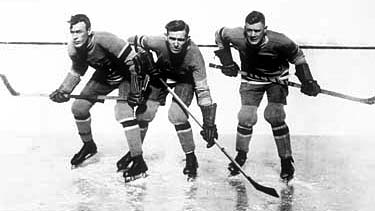
The New York Rangers' forward line of Frank Boucher and the brothers Bill and Frederick "Bun" Cook, previously known as the A Line for the Subway line that went to Madison Square Garden (the 50th Street stop used for the old Garden is now used by the C and the E, and is bypassed by the A), became known as the Bread Line. 
Left to right: Bill Cook, Frank Boucher, Bun Cook

Desperate for any paying customers, sports promoters would try anything, from the college basketball doubleheaders that began at the old Garden in 1934 to night games for outdoor events, which began in baseball's minor leagues and Negro Leagues in 1930, and in the majors in 1935.

The Depression also led, in 1933, to the repeal of Prohibition, which led to the booze industry being able to create jobs, as well as people once again legally being able to enjoy its products; and the repeal of Pennsylvania's "blue laws" prohibiting certain activities on Sunday, including sports.

That allowed for crowds that couldn't be gotten on any other day of the week, except Saturday, since there were no lighted stadiums in the big cities, which would also change soon. That may have kept the Athletics and the Philadelphia Phillies in business, and made the NFL's Philadelphia Eagles and Pittsburgh Pirates (changing their name to the Steelers in 1940), both founded in 1933, economically viable.

The Great Depression left scars on people that never went away. My grandmother grew up in Queens in that era, and knew how important it was to save money. She grew up in the Depression, so, due to her pinching pennies as an adult, my mother also "grew up in the Depression." And because of that, I "grew up in the Depression." Am I saying that I'm cheap? Yes, I am cheap, but not by choice.

In 1992, during another bad recession, I stayed with my grandmother over Thanksgiving Weekend. On the Saturday, I helped her with grocery shopping. We walked out of the car, and, crossing the parking lot, I saw a penny on the ground. I knew she was superstitious, and that a penny, heads-up, was good luck, but tails-up was not. This penny was tails-up, so I left it alone.

She saw it, stopped, pointed, and said, "Aren't you going to pick that up?"

I said, "It's tails-up, it's not good luck." I figured she would accept this answer.

I was wrong. After nearly 40 years of living in New Jersey, her N'Yawk accent kicked back in, and she said, "Whaaaat? It's money!"

I picked it up.


She died in 2006. Now, every time I see a coin on the ground, I presume that she left it there for me, pick it up, and say, "Thanks, Grandma."

But, as Mom pointed out, Grandma and her contemporaries never had a "Depression survivors group," the way war veterans have social clubs, and survivors of other forms of trauma have support groups. And t
here is no memorial specifically for them on the National Mall in Washington, although the FDR Memorial includes a tribute to them. They had their songs, and their movies, rather than tangible tributes.

We dare not forget them now. We have had hard recessions in 1973-76, 1980-83, 1990-93, 2001-03, 2007-10 and 2020-21. But not another Depression, because of the safeguards we put into place in the 1930s. If we fail to support these safeguards, then everything those people suffered through, and everything those who worked to help them did to do so, will have been in vain.

*

October 29, 1929 was, as stated, a Tuesday. Baseball season was over. The NBA hadn't yet been founded. And the NHL season didn't start until November 14. So there were no scores on this historic day.

But there was one score on this historic day, and it was in the NFL: The Boston Bulldogs beat the Orange Tornadoes, 6-0. Instead of at either team's home field, this game was played at Minersville Park in Minersville, Pennsylvania, home of the Pottsville Maroons, the perhaps unfairly-denied Champions of 1925.

The Depression doomed the Bulldogs, and they did not play the 1930 season. The Tornadoes, originally the Orange Athletic Club of Orange, Essex County, New Jersey, played home games at Knights of Columbus Stadium in East Orange. In 1930, they moved to nearby Newark City Schools Stadium, becoming the Newark Tornadoes. But they had to drop out of the NFL. They continued as a minor-league team until 1965, then, like aging New Yorkers and New Jerseyans tend to do, moved to Florida, and played as the Orlando Panthers from 1966 to 1970, before finally going out of business.

December 31, 1999 & January 1, 2000: The Millennium

December 31, 1999:  The Millennium arrives. The people of planet Earth survived. At a terrible cost. But we hadn't destroyed ourselves. ...