Showing posts with label lewis milestone. Show all posts

Friday, November 4, 2022

November 4, 1943: “The North Star” Premieres

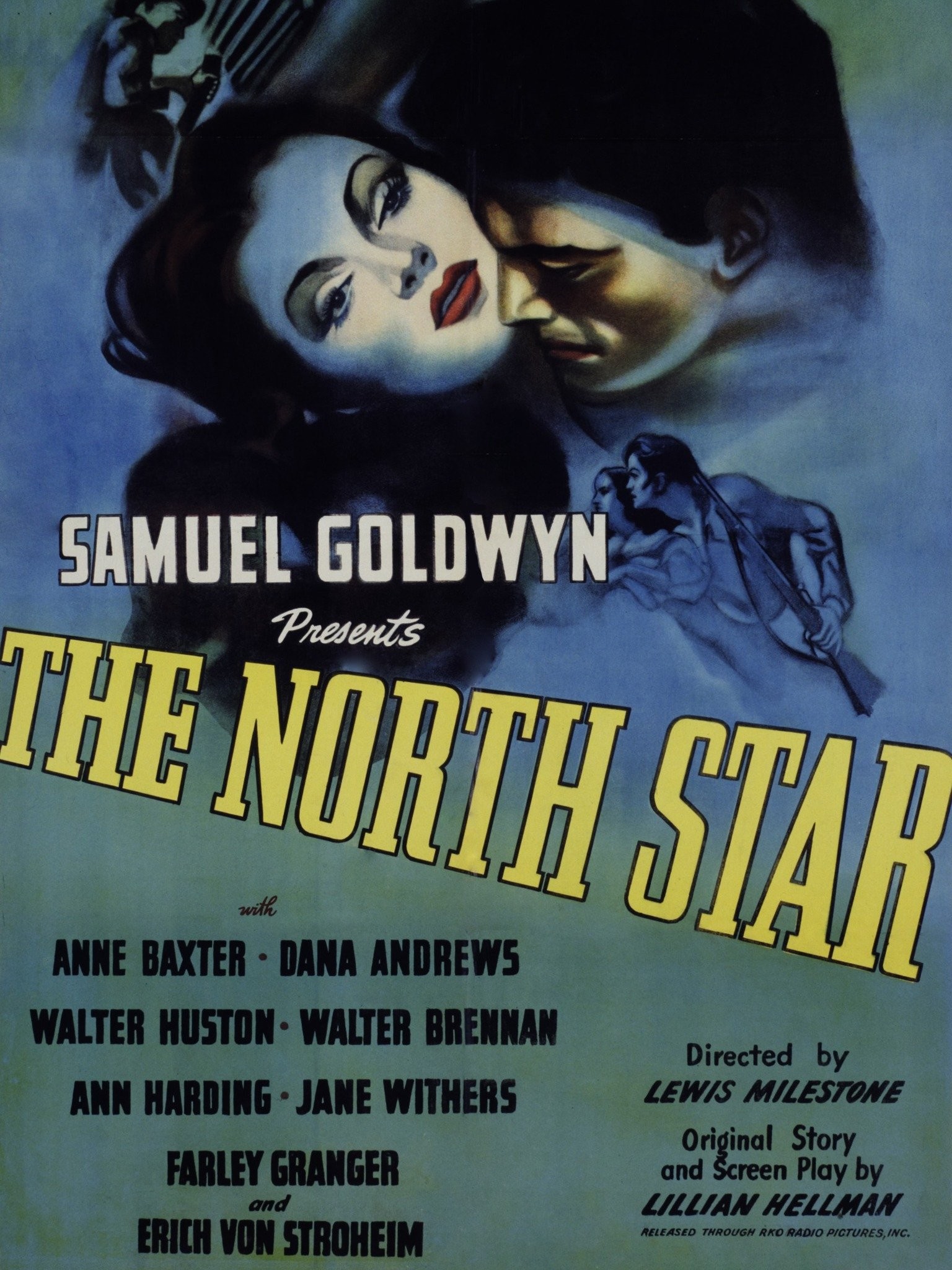
November 4, 1943: The North Star premieres, directed by Lewis Milestone, with a screenplay by Lillian Hellman.

It's set in the early days of the Nazis' invasion of the Soviet Union, the Summer of 1941. Anne Baxter, Dana Andrews, Walter Huston, Walter Brennan, Robert Lowery (who would play Batman in a 1949 film serial), Ann Harding (no relation to Warren), Farley Granger (no relation to Stewart) and Dean Jagger (no relation to Mick) are among the Ukrainian villagers who resist.

Erich von Stroheim, the German actor and director billed in the silent film era as "The Man You Love to Hate," plays a Nazi doctor who takes blood from village children, in some cases killing them, to save Nazi soldiers wotj transfusions.

Brennan turned out to be one of the wackier anti-Communists in Hollywood, and probably repudiated this film at some point due to its pro-Soviet propaganda. Hellman would later be blacklisted for her pro-Soviet views. Later rehabilitated, her reputation was ruined again by charges that her memoirs were full of lies. She died in 1984.

The North Star hit differently starting in 2022, with Ukraine being a separate nation, invaded by the one from which it separated, Russia.

*

November 4, 1943 was a Thursday. Baseball season was over. Football was in midweek. The NBA hadn't been founded yet.

There were 2 games in the NHL. The Toronto Maple Leafs and the Detroit Red Wings played to a tie, 5-5 at the Olympia Stadium in Detroit. And the Montreal Canadiens beat the Chicago Black Hawks, 5-3 at the Chicago Stadium. The New York Rangers and the Boston Bruins were not scheduled.

Wednesday, August 24, 2022

August 24, 1930: "All Quiet On the Western Front" Premieres

August 24, 1930: All Quiet On the Western Front premieres, directed by Lewis Milestone, and based on the novel published the year before by Erich Maria Remarque. The original German title was Im Westen nichts Neuesmeaning, "In the West, Nothing New."

The film begins with young recruits joining the German Army, ready to serve in "The Great War," as World War I was originally known. They are quickly disillusioned by the conditions of trench warfare. Since the movie was made in America, the cast was entirely American, including Lew Ayers as the lead character, Paul Bäumer.

After recovering from being wounded, Paul is given a furlough, and returns to his home town. There, he is shocked about how little the "home front" knows about the war. Returning to the classroom where his professor had talked him and his classmates into enlisting, he tells the class what war is really like. The professor, who has clearly never been in a war -- the Franco-Prussian War was nearly half a century before -- calls him a coward, and the students go along with this, and Paul has to leave.

In the final scene, Paul is back on the front line. He sees a butterfly just beyond his trench. Smiling, he reaches out for the butterfly. While reaching, however, he is shot and killed by an enemy sniper. A harmonica plays throughout the scene, until the sniper's bullet is heard, at which point Paul's hand and the harmonica both stop. The final sequence shows the 2nd Company arriving at the front for the first time, fading out to the image of a cemetery.

The film won Best Picture, and Milestone won Best Director, at the Academy Awards. It was remade in 1979, starring Richard Thomas and Ernest Borgnine, and another remake is set to premiere later in 2022, this time directed by German director Edward Berger, and Austrian actor Paul Kammerer as Paul Bäumer.

Erich Maria Remarque, then still using his birth name of Erich Paul Remark, was wounded while fighting for Germany in 1917. In 1933, the Nazis declared his writing "unpatriotic." Copies were removed from all libraries and restricted from being sold or published anywhere in the country. The film was banned in some countries because it was sympathetic to Germany, and in others because it promoted pacifism. It wasn't shown in Germany until 1952.

Remarque's sister was executed for anti-Nazi activities. He married actress Ilse Jutta Zambona, divorced her, then remarried her to prevent her from being deported from Switzerland to Germany, moved with her to New York, and finally returned to Switzerland.

He and Zambona cheated on each other, many times. He had affairs with actresses Hedy Lamarr, Dolores del Rio and Marlene Dietrich. Divorcing Zambona again, he married actress Paulette Goddard, who had been living in Switzerland since the time that she was married to actor Charlie Chaplin. Remarque was still married to her when he died in 1970.

Lewis Milestone lived until 1980, Lew Ayres until 1996.

*

August 24, 1930 was a Sunday. Rock and roll pioneer Jackie Brenston was born on that day. And these baseball games were played:

* A doubleheader was split at Yankee Stadium. The New York Yankees won the opener, 5-3. Allen "Dusty" Cooke won the game with a home run in the bottom of the 11th inning. Red Ruffing went the distance for the win. The Cleveland Indians won the nightcap, 4-2. Wes Ferrell outpitched Herb Pennock. Over the 2 games, Babe Ruth went 0-for-8 with a walk, and Lou Gehrig went 6-for-8 with a walk, but no RBIs.

* The New York Giants lost to the Chicago Cubs, 3-2 at Wrigley Field in Chicago. Bill Terry went 1-for-4, Mel Ott went 2-for-4.

* A doubleheader was split at Fenway Park in Boston. The Boston Red Sox won the 1st game, 2-0. Milt Gaston pitched a 3-hit shutout. The Chicago White Sox won the 2nd game, 5-4. Smead Jolley singled Bill Cissell home with the winning run in the top of the 11th inning.

* The Washington Senators beat the Philadelphia Athletics, 7-3 at Griffith Stadium in Washington. Rube Walberg went 3-for-4, but still ended up as the losing pitcher, as Alvin "General" Crowder held off the powerful lineup that included Jimmie Foxx, Mickey Cochrane and Al Simmons.

* A doubleheader was split at Redland Field (later Crosley Field) in Cincinnati. The Pittsburgh Pirates won the 1st game, 9-6. Pie Traynor went 4-for-5. The Cincinnati Reds won the 2nd game, 2-0. Ray Kolp pitched a 5-hit shutout.

* The St. Louis Browns beat the Detroit Tigers, 7-5 at Navin Field (later Briggs Stadium and Tiger Stadium) in Detroit.

* The St. Louis Cardinals swept the Philadelphia Phillies, 9-4 and 6-4 at Sportsman's Park in St. Louis.

* And the Brooklyn Dodgers (or the Brooklyn Robins, as they were known under Wilbert Robinson's management from 1914 to 1931) and the Chicago Cubs were rained out at Ebbets Field. The game was made up as part of a doubleheader on September 27. The Dodgers won the 1st game, 8-2. The Cards won the 2nd game, 7-1.

Monday, May 16, 2022

May 16, 1929: The 1st Academy Awards

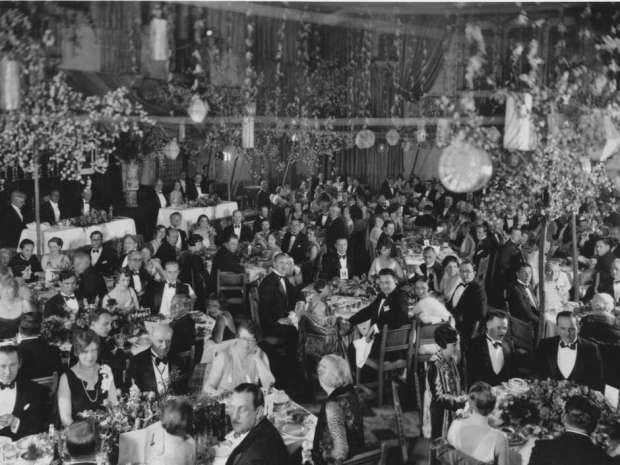
May 16, 1929: The 1st Academy Awards ceremony is held, at a private dinner at the Hollywood Roosevelt Hotel in Los Angeles. The Academy of Motion Picture Arts and Sciences (AMPAS) honored the best films of 1927 and 1928 -- a last gasp for, and perhaps a fond farewell to, the Silent Film Era. And it was the only Academy Award ceremony that was not broadcast on either radio or television.

* Best Picture: Wings, a film about pilots in World War I, starring Clara Bow, Charles "Buddy" Rogers and Richard Arlen.

* Best Director. Comedy: Lewis Milestone, for Two Arabian Knights, produced by Howard Hughes. Another film set in the combat of World War I, it starred William Boyd, Mary Astor and Louis Wolheim.

* Best Director, Drama: Frank Borzage, for 7th Heaven, about poor people in Paris, starring Janet Gaynor and Charles Farrell.

* Best Writing: Ben Hecht, for Underworld, directed by Josef von Sternberg, a crime drama starring Clive Brook, Evelyn Brent and George Bancroft.

* Best Actor: Emil Jannings, for The Last Command, another von Sternberg film, about the Russian Revolution, also starring Brent, and William Powell.

* Best Actress: Janet Gaynor, for 7th Heaven.
Janet Gaynor with a charter "Oscar"

In 1939, the gold statuette that is the trophy for the Academy Award was officially named "Oscar." The origin of the name is disputed. Margaret Herrick, the Academy's executive director, supposedly first saw the award in 1931, and said, "Why, he looks just like my uncle Oscar." That story was first repeated in 1934. That same year, Walt Disney won one, and thanked the Academy for his "Oscar." This conflicts with the claim of Bette Davis, who won them in 1935 and 1938, and said she named the trophy after her 1st husband, bandleader Harmon Oscar Nelson.

Venues for the ceremonies:

* 1929: Hollywood Roosevelt Hotel (1 time)
* 1930, 1932-34, 1940, 1943: Ambassador Hotel (6)
* 1931, 1935-39, 1941-42: Biltmore Hotel (8)
* 1944-46: Chinese Theatre (3)
* 1947-48, 1988-89, 1991, 1995, 1997-98, 2000-01: Shrine Auditorium (10)
* 1949: Academy Theatre (1)
* 1950-60: Pantages Theatre (11)
* 1961-68: Santa Monica Civic Auditorium (8)
* 1969-87, 1990, 1992-94, 1996, 1999: Dorothy Chandler Pavilion (25)
* 2002-20, 2022: Dolby Theatre (20)
* 2021: Union Station (1, a smaller ceremony, due to COVID restrictions)

In 1989, after 70 years of presenters saying, "And the winner is... " before opening the envelope and revealing the winner, they began saying, "And the Oscar goes to... " That's the way it's been ever since. With one notable exception. In 2003, with his wife, Catherine Zeta-Jones, already a winner for Best Supporting Actress for her role in Chicago, Michael Douglas announced the Best Picture winner with his father, Kirk Douglas. Each of them was a previous Oscar winner. Once Kirk, his voice affected by a stroke, read off the nominees, Michael said, "Now, you're supposed to say, 'And the Oscar goes to.'" But, as one of the earliest surviving winners, Kirk, who lived to be 103, went the old way, and said, "And the winner is... " And they announced it together: "Chicago!"

*

May 16, 1929 was a Thursday. Jazz singer Betty Carter was born on this day.

Football, basketball and hockey were out of season. These baseball games were played that day:

* The New York Yankees lost to the Boston Red Sox, 5-3 at Yankee Stadium. Ed Morris outpitched Waite Hoyt, and Bill Regan won it with a triple in the top of the 12th inning. Babe Ruth went 1-for-6 with an RBI, and Lou Gehrig went 0-for-5.

* The New York Giants beat the Boston Braves, 9-5 at Braves Field in Boston. The game went 10 innings, and pitcher Freddie Fitzsimmons helped his own cause with an RBI single in the top of the 10th. Travis Jackson hit a home run.

* The Brooklyn Robins -- as the Dodgers were known while Wilbert Robinson managed them from 1914 to 1931 -- beat the Philadelphia Phillies, 14-13 at Baker Bowl in Philadelphia.

* The Philadelphia Athletics beat the Washington Nationals, 4-1 at Griffith Stadium in Washington. Lefty Grove went the distance for the win.

* The Pittsburgh Pirates beat the St. Louis Cardinals, 6-2 at Forbes Field in Pittsburgh.

* The Chicago White Sox beat the Detroit Tigers, 6-2 at Navin Field in Detroit. (It was renamed Briggs Stadium in 1938, and Tiger Stadium in 1961.)

* The Chicago Cubs beat the Cincinnati Reds, 9-3 at Wrigley Field in Chicago.

* And the St. Louis Browns beat the Cleveland Indians, 7-6 at Sportsman's Park in St. Louis.
December 31, 1999 & January 1, 2000: The Millennium

December 31, 1999:  The Millennium arrives. The people of planet Earth survived. At a terrible cost. But we hadn't destroyed ourselves. ...