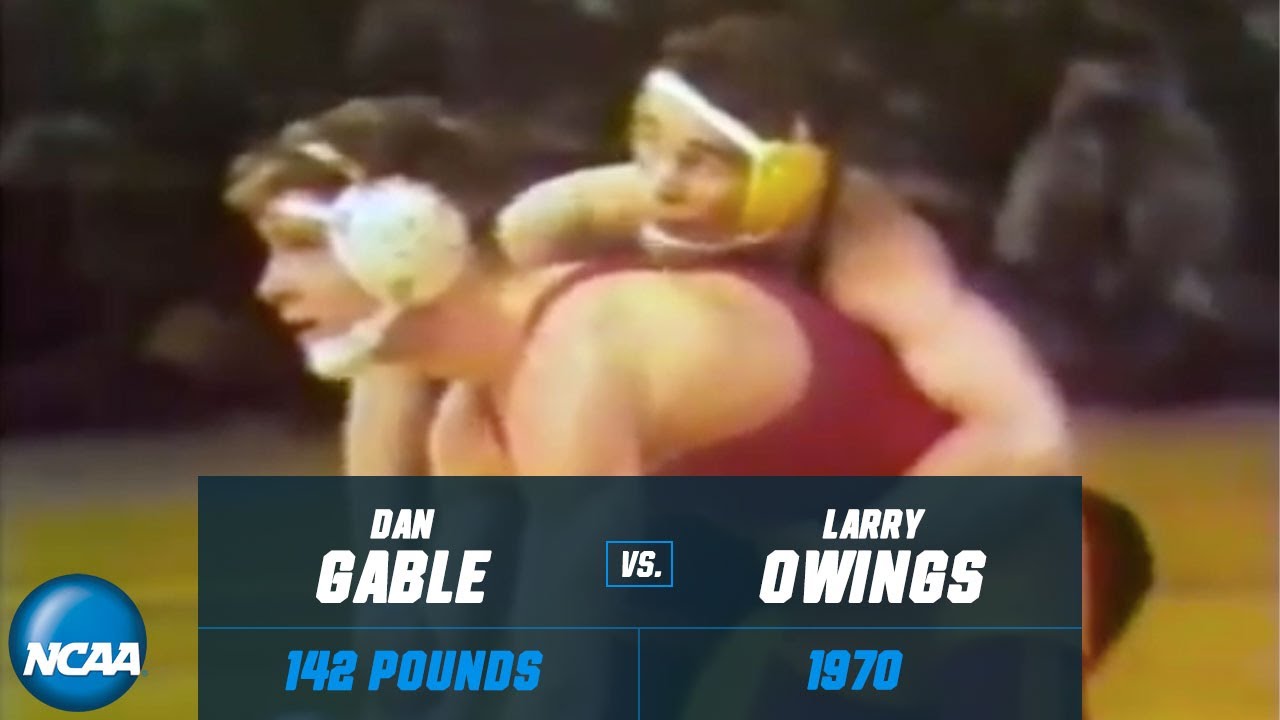
March 28, 1970: The NCAA Wrestling Championships are held, at McGaw Hall (now known as Welsh-Ryan Arena), on the campus of Northwestern University in Evanston, Illinois, just north of Chicago.
The team title is won by Iowa State University. They had previously won in 1950, 1965 and 1969. On an individual basis, however, the tournament is known not for any of its winners, but for a defeated finalist: Dan Gable.
He is the greatest wrestler who ever lived, and the greatest wrestling coach who ever lived, and you can take all your WWE stars and stick them where the Sun don't shine.
At Waterloo West High School in Waterloo, Iowa, his career record as a wrestler was 64-0, winning 3 State Championships. He was also a State Champion swimmer, their quarterback, and a baseball player. At Iowa State University, he went 117-1, winning 2 National Championships, losing only in the NCAA Final in his senior year. In other words, he won 225 amateur wrestling matches before he was finally beaten.
(Gable could have won 3 National Championships, but, until 1972, the NCAA didn't allow freshmen to compete on varsity teams in any sport, with a few exceptions, such as during wartime or following a team tragedy, as happened later in 1970 with the football teams at Wichita State and Marshall universities.)
That loss was in the 142-pound weight class, which would be Welterweight in boxing. The bout was close: 13-11. The wrestler who defeated him was Larry Owings of the University of Washington, who was named the tournament's outstanding wrestler.
He kept competing as an amateur, winning Gold Medals in 1971, at the Pan American Games in Cali, Colombia; and at the World Championships in Sofia, Bulgaria, behind the Iron Curtain. That got the attention of the Soviet Union athletic machine: Rightly proud of their wrestling achievements, and looking to the 1972 Olympic Games in Munich, West Germany, they vowed to "scour the Eastern Bloc to find a wrestler who could take down Dan Gable."
He kept competing as an amateur, winning Gold Medals in 1971, at the Pan American Games in Cali, Colombia; and at the World Championships in Sofia, Bulgaria, behind the Iron Curtain. That got the attention of the Soviet Union athletic machine: Rightly proud of their wrestling achievements, and looking to the 1972 Olympic Games in Munich, West Germany, they vowed to "scour the Eastern Bloc to find a wrestler who could take down Dan Gable."
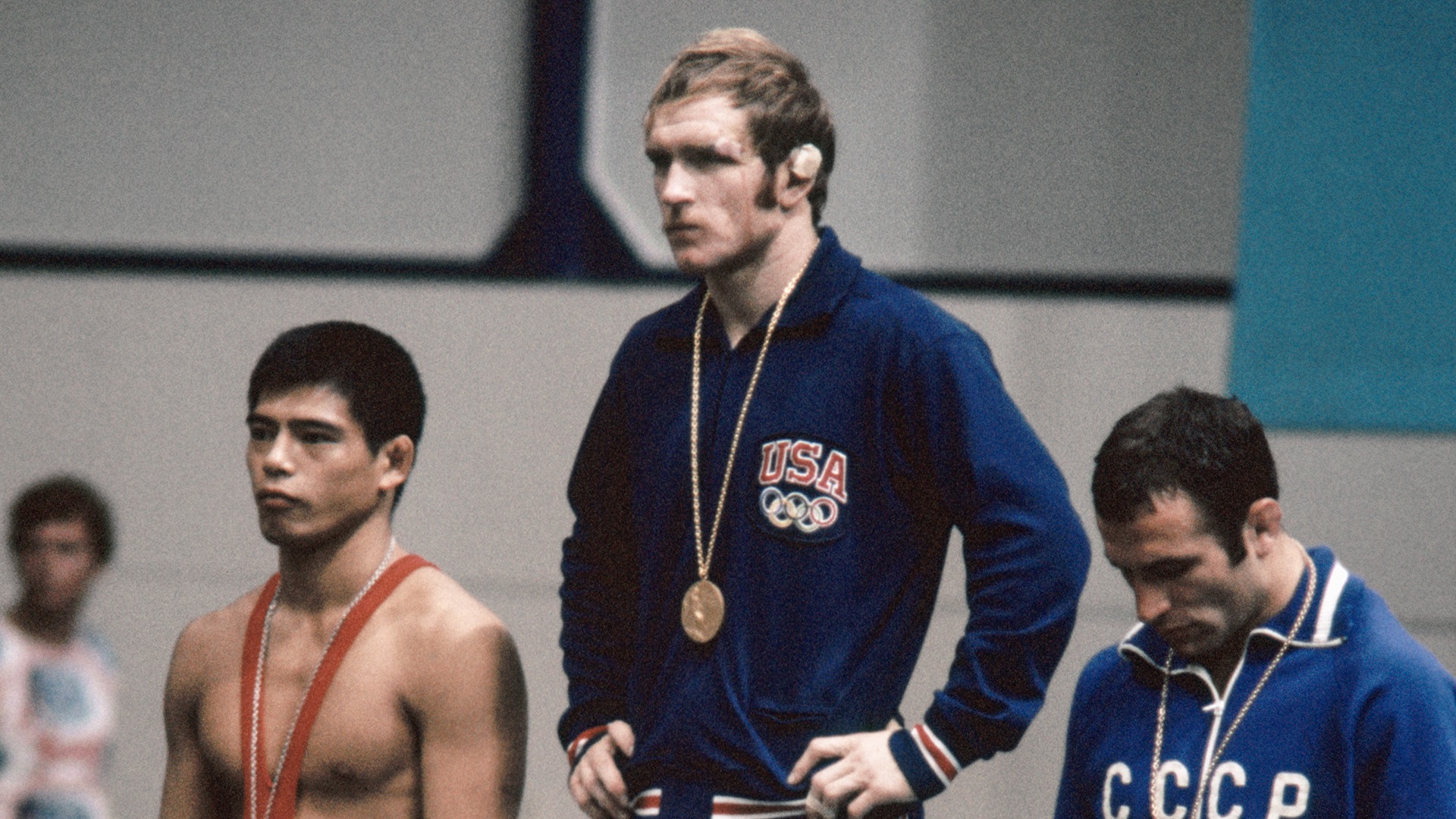
They were unsuccessful: Despite an injured knee and stitches in his head after an injury in his 1st match, he won the Gold Medal in the 150-pound weight class, without surrendering a single point in any match, an absolutely dominating performance.
He defeated Safer Sali of Yugoslavia (the part that is now the Republic of North Macedonia), Klaus Rost of West Germany, Stefanos Ioannidis of Greece, Kikuo Wada of Japan, and Włodzimierz Cieślak of Poland. In the Final, with 3 wrestlers, each competing against the other 2, Gable beat Wada again, and both beat the Soviet contender, Ruslan Ashuraliyev. So Gable beat 3 wrestlers from Warsaw Pact nations.
Despite having been an Iowa State graduate, he went to their arch-rivals, the University of Iowa, in 1976. He coached them to 9 straight National Championships from 1978 to 1986, finally being dethroned in 1987 by... Iowa State.
He coached until 1997, with a dual meet record of 355-21-5, 16 team National Championships, 152 All-Americans, 45 individual National Champions, and 4 Olympic Gold Medalists. He also coached the U.S. Olympic team in 1980 (boycotted), 1984 and 2000. He also, literally, wrote the book on coaching the sport: Coaching Wrestling Successfully, published in 1999. Of course, he is in the National Wrestling Hall of Fame. He should be: He is both the Babe Ruth and the Casey Stengel of his sport.
And what, you might ask, happened to Larry Owings? The native of Canby, Oregon was unable to follow up his great achievement, losing in the NCAA Tournament Final in 1971 and 1972, and was not selected to the U.S. Olympic Team for Munich. He became a high school wrestling coach and a building contractor in Oregon and Washington State. He has particularly been an advocate for women's wrestling, and has also been elected to the National Wrestling Hall of Fame. As of March 28, 2022, both Gable and Owings are still alive.

Larry Owings (left) and Dan Gable, 2018
The NCAA first conducted a National Championship Tournament for wrestling in 1928, and Iowa State were the 1st hosts. They did not win: Oklahoma A&M did. Changing their name to Oklahoma State in 1958, they have won by far the most titles, 34, although none since 2006. Iowa have won 24, Penn State 10, Iowa State 8, Oklahoma 7, Minnesota 3; and 1 each by Indiana, Cornell, Northern Iowa, Michigan State, Arizona State and Ohio State.
(UPDATE: Penn State won in 2023 and 2024, raising their total to 12.)
*
March 28, 1970 was a Saturday. Actor Vince Vaughn was born. This was also the day that Major League Baseball held a preseason exhibition game to raise money for Dr. Martin Luther King's Southern Christian Leadership Conference. I have a separate entry for that event.
Baseball was otherwise in Spring Training. Football was out of season. One game was played in the NBA. Appropriately, it was in Dr. King's hometown: The Atlanta Hawks beat the Chicago Bulls, 124-104 at the Alexander Memorial Coliseum (now the McCamish Pavilion), on the Georgia Tech campus in Atlanta. Three games were played in the American Basketball Association:
* The New York Nets lost to the New Orleans Buccaneers, 100-92 at the New Orleans Municipal Auditorium. After this season, the Bucs would become the Memphis Pros, then the Memphis Tams, then the Memphis Sounds, and fold in 1975. The Nets would enter the NBA in 1976, moving to New Jersey in 1977 and Brooklyn in 2012.
* The Kentucky Colonels beat the Carolina Cougars, 101-98 at the Greensboro Coliseum in Greensboro, North Carolina. The Cougars became the Spirits of St. Louis in 1974. The Spirits and the Colonels both survived to the end of the ABA in 1976, but neither team was admitted to the NBA.
* And the Dallas Chaparrals beat the Denver Rockets, 150-126 at the Moody Coliseum in Dallas. Both of these teams still exist, though not under those names: The Chaparrals became the San Antonio Spurs in 1973; and the Rockets, anticipating entering the NBA, which already had the Houston Rockets, took on the name of the 1st NBA team from their city, the Denver Nuggets. Both teams entered the NBA in 1976, along with the Nets and the Indiana Pacers.
There were 5 games in the NHL:
* The New York Rangers and the Montreal Canadiens played to a tie, 1-1 at the Montreal Forum.
* The Boston Bruins and the Detroit Red Wings played to a tie, 5-5 at the Boston Garden.
* The Pittsburgh Penguins beat the Philadelphia Flyers, 2-1 at The Spectrum in Philadelphia.
* The Chicago Black Hawks and the Toronto Maple Leafs played to a tie, 1-1 at Maple Leaf Gardens in Toronto.
* The Los Angeles Kings beat the Minnesota North Stars, 4-2 at The Forum outside Los Angeles in Inglewood, California.
* And the St. Louis Blues and the California Golden Seals were not scheduled.
And in English soccer, Arsenal played Birmingham-area team Wolverhampton Wanderers to a draw, 2-2 at the Arsenal Stadium, a.k.a. Highbury, in North London.


