Showing posts with label roald amundsen. Show all posts

Tuesday, December 13, 2022

December 14, 1911: Roald Amundsen Reaches the South Pole

December 14, 1911: Roald Amundsen becomes the 1st person to reach the South Pole. 

It made sense for a Norwegian to attempt to become the 1st person to reach the North Pole, 90 degrees North latitude: The only countries whose mainlands have points further north than Norway's northernmost point are Canada and Russia. This does not count Denmark, which owns Greenland, which has a more northerly point of land than any country: Kaffeklubben Island, at 83.63 degrees North.

It made sense for Amundsen to be the Norwegian to attempt it. In 1906, aboard the sloop Gjøa, he became the leader of the first expedition to sail the long-sought Northwest Passage. He did make an attempt to reach the North Pole, but in 1909, American expeditioner Robert Peary claimed to have gotten there first. Maybe Peary should have kept trying: It is now believed that he did not, in fact, beat Amundsen and everyone else to it.

It did not make much sense for a Norwegian to be the first person to attempt to reach the South Pole, 90 degrees South latitude. The country with the southernmost land is Chile, Hornos Island, at 55.97 degrees South latitude; followed by Argentina and Australia. (Villa Las Estrellas, on King George Island, is the northernmost point on Antarctica, at 62.11 degrees South.) Since Australia was part of the British Empire, a Royal Navy officer, Captain Robert F. Scott, made the first serious attempt at it.

But since Amundsen did have experience in a polar expedition, he thought he could reach the South Pole first. On June 3, 1910, he sailed his ship Fram out of his national capital of Oslo. Upon reaching the Portuguese colony of Madeira, he sportingly sent Scott a telegram stating his intentions. On January 14, 1911, he reached the continent of Antarctica, on the Ross Ice Shelf, and established base camp there.

An attempt set out on September 8, but had to turn back. A 2nd attempt was made on October 19, with 4 sleds, each pulled by 13 dogs. On December 8, they reached 88 degrees, 23 minutes south, the furthest point anyone had yet reached, in 1909 by Ernest Shackleton. They were 97 miles away. They went on.

On December 14, 1911, Amundsen stopped, took some measurements, and told his crew, "Gentlemen, I am certain we are at the South Pole." He asked crewmates to take their own measurements, and a central point within them was decided as the Pole. They pitched a tent, topped with a Norwegian flag. Amundsen wrote a message for Scott, in case he made it, and left it inside the tent.
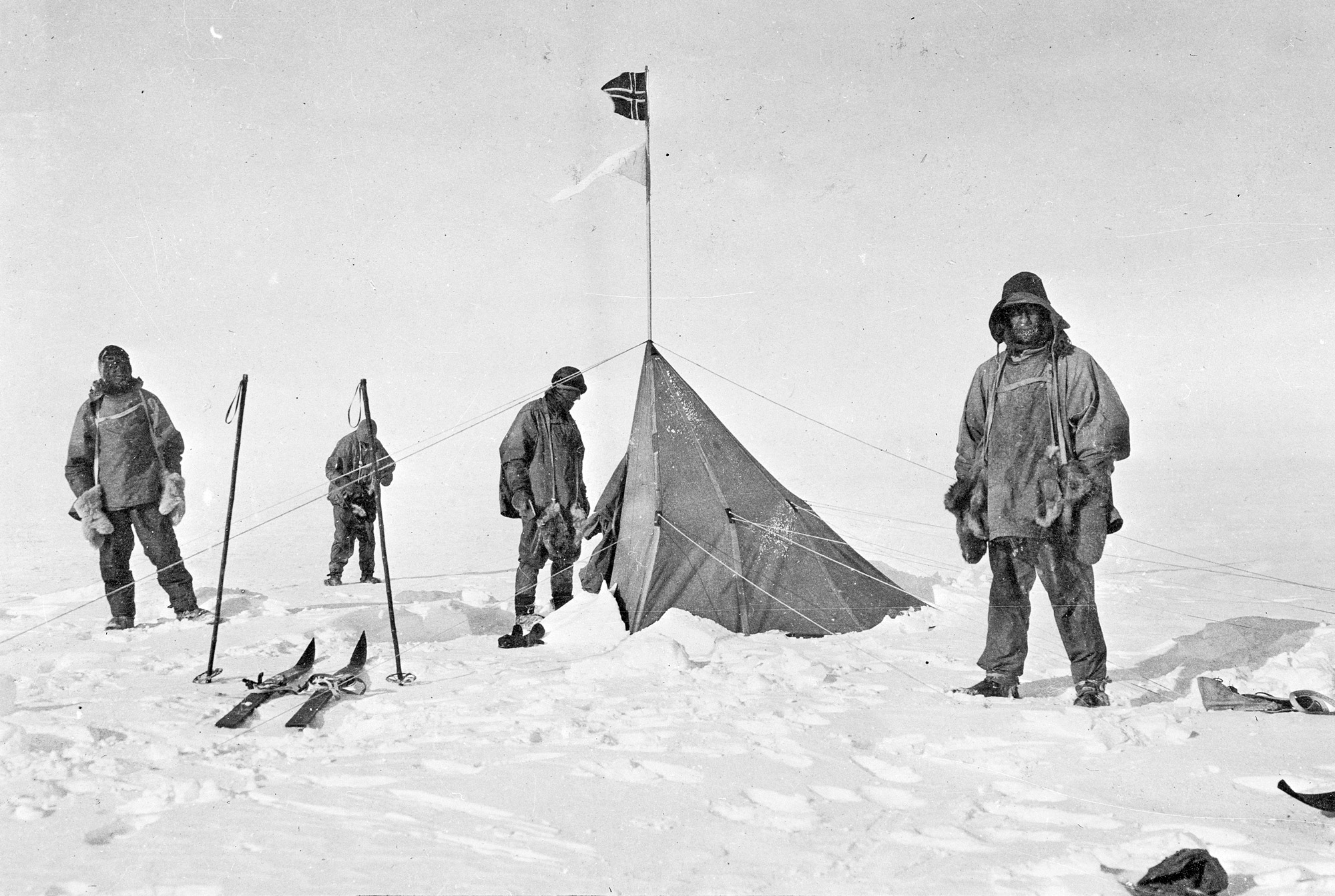
On March 7, 1912, the Fram reached Hobart, Tasmania, Australia. Amundsen made his claim, and learned that no word had yet been reached from Scott. Scott had reached the Pole on January 17, but found Amundsen's tent and note. Scott never made it back alive: Snowstorms prevented him from getting back to his base camp. A search party found him on November 12, with a last entry in his diary dated March 29. He was 43 years old.
Robert F. Scott

Scott was hailed as a hero in death. Amundsen lived on, and on May 12, 1926, led a team on the airship Norge to become the 1st people to fly over the North Pole. On June 18, 1928, he led a team searching the Arctic for the lost airship Italia. His plane, a Latham 47 "flying boat," also disappeared, and has never been found. He was 56.

*

December 14, 1911 was a Thursday. American novelty musician Lindley "Spike" Jones was born on this day. Baseball was out of season. Football season was over. There was no NBA yet. And the professional hockey season was about to start. So there were no scores on this historic day.

Tuesday, April 5, 2022

April 6, 1909: Robert Peary Reaches the North Pole (Or So He Said)

April 6, 1909: Robert Peary becomes the 1st person to reach the North Pole -- or so he would claim.

A native of Portland, Maine, civil engineer for the U.S. Navy, in 1892 he led the first team to cross Greenland by dogsled, conclusively proving that it is an island. In 1902, he reached the northernmost point in Greenland, Capra Morris Jesup, at 83 degrees, 38 minutes north latitude. The dream of reaching the North Pole, 90 degrees north, now seemed within reach.

He had competition. Roald Amundsen, from Norway, accomplished in 1906 what explorers had been trying to do for 400 years: He successfully sailed the Northwest Passage. But his attempts to reach the North Pole had fallen short.

Frederick Cook, from the Catskill Mountains of New York, claimed to have reached the Pole on April 22, 1908. All the evidence he gathered was examined, and a commission at the University of Copenhagen, in the capital of Denmark, the country with jurisdiction over Greenland, concluded that he hadn't made it. Cook lived until 1940, still insisting that he had.

On a 1906 expedition, Peary got as far as 86 degrees, 30 minutes. In 1908, at age 52, he set out again. On April 6, 1909, according to his own readings, he woke up at his camp at 89 degrees, 57 minutes north, about 3 miles away.

He sent his chief scout, Matthew Henson, a 42-year-old black navigator from Southern Maryland, ahead to see if he could find a safe path. He returned, saying, "I think I'm the first man to sit on top of the world," Peary was unhappy at being denied the ultimate credit, but he was satisfied that Henson knew what he was talking about, and ordered the expedition to go to the location Henson found. Peary knew that, as commanding officer, he would get most of the credit, had pictures of the group taken at the alleged Pole, and ordered their return.
Matthew Henson

Based on the evidence Peary had with him, he officially got the credit. Cook was still sure he was first. Amundsen still believed that neither of them had gotten there, and that he could still be the first. But he put that goal on hold, and switched to trying to be the first to reach the South Pole. Two years later, he did that.
Roald Amundsen

Convinced to the end that they had made it, Peary died in 1920; Henson, in 1955.

On May 9, 1926, Richard E. Byrd attempted to fly over the North Pole in an airplane. He was widely credited with achieving this, but his claim subsequently became subject to doubt.

Three days later, on May 12, 1926, the airship Norge carried Amundsen and 15 other men over the North Pole, en route from Spitsbergen, Norway to Alaska, the first achievement of the Pole about which there is no controversy.

The first person definitely to set foot on the Pole was the Russian Aleksandr Kuznetsov, who landed an aircraft there on April 23, 1948. Byrd lived until 1957; Kuznetsov, until 1966.
Aleksandr Kutznetsov

On August 3, 1958, a U.S. Navy submarine, the USS Nautiluswas the first to sail under the ice pack to reach the North Pole. On March 17, 1959, the USS Skate became the first submarine to surface at the North Pole.

The team of Ralph Plaisted, Walt Pederson, Gerry Pitzl and Jean-Luc Bombardier is regarded by most polar authorities to be the first to succeed in a surface traverse by snowmobile across the ice to the North Pole, on April 20, 1968, making the first confirmed surface conquest of the Pole before being airlifted out.

On April 6, 1969, 60 years to the day after Peary's claimed reach, British explorer Sir Wally Herbert became the first person to indubitably reach the Pole on foot, having sledged from Alaska. His expedition was supported by air drops.
In 1989, based on the available evidence, including his own experience, Herbert determined that Peary hadn't made it, though he had set what was then a record, coming within 60 miles. Unlike Cook, however, Herbert determined that circumstances had messed with Peary's measures, and that his claim, unlike Cook's, was more flawed than fraud.

One more thing must be said: It's almost as if, as soon as it became generally accepted that Henson, not Peary, was the first man at the North Pole, that's when people began saying that Peary never actually got to the Pole.

Almost as if they still don't want Henson, the black man, to get the credit.

*

April 6, 1909 was a Tuesday. Baseball season hadn't started yet. Football was out of season. Professional basketball barely even existed. And the hockey season ended on March 13, with the Ottawa Senators winning the Stanley Cup. So there were no scores on this historic day.

December 31, 1999 & January 1, 2000: The Millennium

December 31, 1999:  The Millennium arrives. The people of planet Earth survived. At a terrible cost. But we hadn't destroyed ourselves. ...