Showing posts with label lee j. cobb. Show all posts

Sunday, November 20, 2022

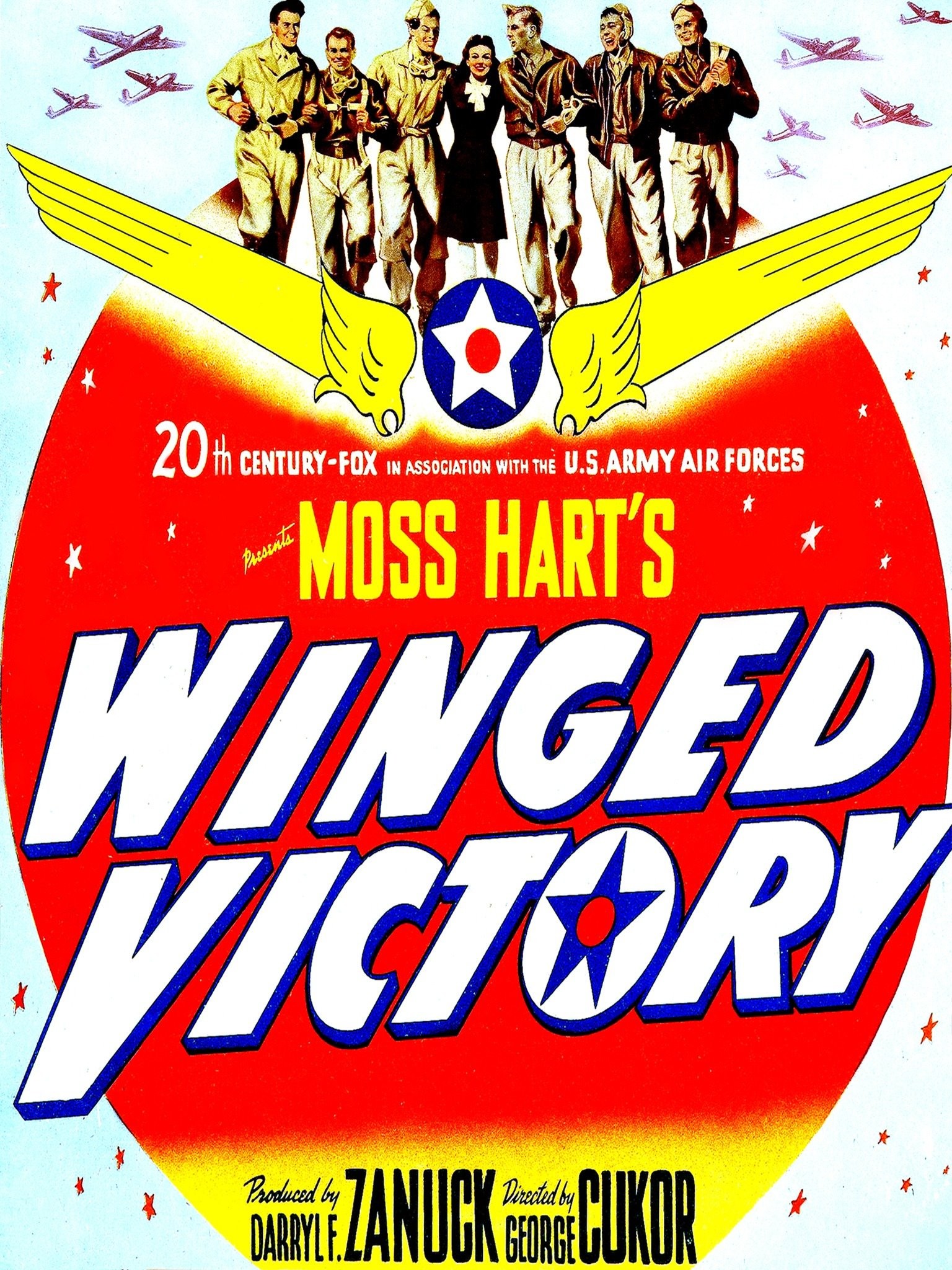
November 20, 1943: “Winged Victory” Premieres

Poster for the film version

November 20, 1943: Moss Hart's war-effort play Winged Victory premieres at the Forty-Fourth Street Theatre in New York. The theater, at 216 W. 44th Street, was demolished in 1945.

The story is about 5 friends who enlist in the U.S. Army Air Forces in the hopes of becoming pilots. (The Air Force would not be separated from the Army until 1947.) One fails the eye test, and becomes a gunner instead. One crashes and dies in a test flight. The others are still alive at the end of the play -- but, of course, in real life, World War II was ongoing, so we don't know if they survived the war in full.

A staggering amount of future stars would appear in the play during its run, including Red Buttons, Lee J. Cobb, Mario Lanza, Brad Dexter (of The Magnificent Seven), John Forsythe, Karl Malden, Kevin McCarthy (of Invasion of the Body Snatchers), Gary Merrill, Barry Nelson (the first man to play James Bond, in a 1955 U.S. TV production), George Reeves (the Superman of 1950s TV), Martin Ritt, and Victor Sen Yung (Hop Sing on Bonanza).

In 1944, it was made into a film, starring Lon McCallister, Jeanne Crain and Edmond O'Brien, and also including Cobb, Buttons, Nelson, Merrill and Reeves.

*

November 20, 1943 was a Saturday. Actress Veronica Hamel was born. So was Suze Rutolo, who appeared on the cover of the album The Freewheelin' Bob Dylan, as she and Bob were then dating.

Ordinarily, the 3rd Saturday in November would begin 8 days of college football's major rivalries. But World War II was on, so this was, as the First Lady at the time, Eleanor Roosevelt, put it, it was no ordinary time. Military bases had teams that took on college teams. These were among the games played that day:

* Number 1 Notre Dame beat Number 2 Iowa Pre-Flight, 14-13 at Notre Dame Stadium in South Bend, Indiana. Iowa Pre-Flight was a U.S. Navy flight school, operated on the University of Iowa campus in Iowa City. But not as a substitute for the Iowa team (or Iowa State's). This was the only game that IPF lost all season, as they beat Big Ten schools Iowa, Illinois, Ohio State and Minnesota; and also Iowa State. They also beat Missouri, who lost their coach, and eventually the namesake of their stadium, Don Faurot, to IPF.

With their quarterback, Angelo Bertelli, being awarded the Heisman Trophy, Notre Dame lost the next week, to another military team, Great Lakes Naval Training Station, located in the northern suburbs of Chicago. This ruined Notre Dame's undefeated season. And they didn't go to a bowl game, refusing all invitations, as they always did between the seasons of 1925 and 1968. They were still awarded the National Championship.

* Rivalry: Number 3 Purdue beat Indiana, 7-0 at the original Memorial Stadium in Bloomington, Indiana. (That facility was replaced by the current one in 1960.)

* Rivalry: Number 4 Michigan beat Ohio State, 45-7 at Michigan Stadium in Ann Arbor.

* Number 5 Navy did not play that week. Number 7 Army beat Brown, 59-0 at Michie Stadium in West Point, New York. The Air Force had not yet been separated from the Army, let alone given its own academy, with its own football team.

* Rivalry: Number 6 Duke beat North Carolina, 27-6 at Kenan Stadium in Chapel Hill, North Carolina.

* Number 8 USC and Number 10 Washington had the week off. Due to wartime travel restrictions, for once, the Rose Bowl featured 2 West Coast teams, and USC beat Washington, having not played them during the regular season.

* Rivalry: Number 9 Northwestern beat Illinois, 53-6 at Dyche Stadium in the Chicago suburb of Evanston, Illinois.

* Number 14 Texas had the week off. In the Cotton Bowl, they were held to a tie by Randolph Field, an Army Air Forces team based in San Antonio.

* Number 15 Georgia Tech beat Clemson, 41-6 at Grant Field in Atlanta. Number 19 Tulsa had the week off. Tulsa went into the Sugar Bowl undefeated with a tie, but Georgia Tech beat them.

* Rivalry: Villanova beat Temple, 34-7 at Temple Stadium in Philadelphia.

* Rivalry: Penn State beat the University of Pittsburgh, 14-0 at Pitt Stadium in Pittsburgh.

* Rivalry: Minnesota beat Wisconsin, 25-13 at Memorial Stadium in Minneapolis.

* Rivalry: Tulane University beat Louisiana State University, 27-0 at Tulane Stadium in New Orleans. Texas A&M had the week off. Texas A&M went on to beat LSU in the Orange Bowl.

* Rivalry: Kansas beat Missouri, 7-6 at Memorial Stadium in Lawrence, Kansas.

* Rivalry: Iowa beat Nebraska, 33-13 at Memorial Stadium in Lincoln, Nebraska. While Iowa Pre-Flight had a fine season, this was the only game that Iowa won all season.

* Columbia was the only New York City school playing that season, and they lost to Colgate, 41-0 at Baker Field in Upper Manhattan. Fordham, NYU and CCNY suspended their programs for the season.

* And among the New Jersey schools, Princeton lost to Number 20 Dartmouth, 42-13 at Palmer Stadium in Princeton; and Rutgers lost to Lafayette, 9-2 at Fisher Field in Easton, Pennsylvania. Due to wartime travel restrictions, Rutgers played both Lafayette and Lafayette's arch-rivals, Lehigh, twice -- and they played each other twice. All of this was done again in 1944.

Baseball was out of season. The NBA hadn't been founded yet. There was 1 game in the NHL: The Montreal Canadiens beat the Toronto Maple Leafs, 7-2 at Maple Leaf Gardens in Toronto.

Friday, September 23, 2022

September 23, 1957: "The Three Faces of Eve" Premieres

September 23, 1957: The film The Three Faces of Eve premieres, directed by Nunnally Johnson. It is based on the book of the same title by psychiatrists Corbett H. Thigpen and Hervey M. Cleckley, who also helped write the screenplay. They wrote about their patient, whom they identified only as "Eve" to protect her privacy. Joanne Woodward played all three "faces of Eve," and won the Academy Award for Best Actress, the 1st performer of either gender to win an "Oscar" for playing multiple personalities.

There is a misconception that schizophrenia and "split personalities" are the same thing. They're not. Schizophrenia is characterized by hallucinations, of the ear more than the eye; delusions, and disorganized thinking and behavior.

Then there is the similarly labeled schizoid personality disorder, characterized by a lack of interest in social relationships, a tendency toward a solitary or sheltered lifestyle, secretiveness, emotional coldness, detachment, and apathy. Affected individuals may be unable to form intimate attachments to others and simultaneously possess a rich and elaborate but exclusively internal fantasy world. But this is not what Eve had, either.

What Eve had was then known as multiple personality disorder, and is now generally called disassociative identity disorder. When the film begins in 1951, Dr. Curtis Luther (played by Lee J. Cobb) takes "Eve White" on as a patient. She is a timid, self-effacing wife and mother who has severe and blinding headaches and occasional blackouts. While speaking with Dr. Luther, a "new personality,", the wild, fun-loving Eve Black, emerges. Eve Black knows everything about Eve White, but Eve White is unaware of Eve Black. Hence, the updated term "disassociative."

Eventually, the actions of the Eve Black personality, including an assault on Eve White's daughter, Bonnie, cause Eve White's husband, Ralph (David Wayne), to divorce her and take Bonnie away.

Under hypnosis at one session, a 3rd personality emerges, a relatively stable woman, but with no name and little memory of her past. She chooses to take the name Jane. Dr. Luther eventually prompts her to remember a traumatic event in Eve's childhood. Her grandmother had died when she was six, and according to family custom, relatives were supposed to kiss the dead person at the viewing, making it easier for them to let go. While Eve screams, her mother forces her to kiss the corpse. Apparently, Eve's terror led to the creation of different personalities.

After discovering the trauma, Jane remembers her entire past. When Dr. Luther asks to speak with Eve White and Eve Black, Jane says they are gone. Jane marries a man named Earl (Ken Scott) whom she met when she was Jane, and reunites with her daughter Bonnie.

That's where the movie ends. That's not where the story ends. Under the pseudonym Evelyn Lancaster, "Jane" published her own book in 1958, titled The Final Face of Eve. If only: In her next book, I'm Eve, published in 1977, she revealed her full name: Christine Costner Sizemore, born on April 4, 1927 in Edgefield, South Carolina, and that she was not cured by the time of the movie, needing more treatment, saying that, now cured, she was in her 23rd and, she hoped, true self.
Lee J. Cobb died in 1976, Nunnally Johnson in 1977, Hervey Cleckley in 1984, Ken Scott in 1986, David Wayne in 1995, and Corbett Thigpen in 1999. Chris Sizemore, apparently cured, outlived all of them, dying on July 24, 2016, at the age of 89.

In 1960, with the establishment of the Hollywood Walk of Fame, Joanne Woodward was the 1st celebrity to agree to pose with her star for photographers, and therefore was, incorrectly, singled out in the collective public imagination as the first awardee.

As of September 23, 2022, she is still alive. However, she was diagnosed with Alzheimer's disease, and last appeared in public in 2013. She is probably better known for having been married to actor Paul Newman than for The Three Faces of Eve or any other role she played. She and Paul had 3 daughters: Nell, Melissa and Clea.

Terry Ann Ross, who was 5 years old when playing Bonnie, gave up acting while still a child, and appears to also be still alive.

*

September 23, 1957 was a Monday. There were 4 games in baseball's major leagues that day:

* The Milwaukee Braves beat the St. Louis Cardinals, 4-2 at Milwaukee County Stadium. Hank Aaron hit a home run in the bottom of the 11th inning, giving the Braves the win, and clinching the National League Pennant for them. I have a separate entry for this event.

* The Boston Red Sox beat the Washington Senators, 9-4 at Griffith Stadium in Washington. Frank Malzone hit a home run for the Red Sox. Ted Williams went 1-for-1... with 3 walks. Harmon Killebrew hit a home run as a pinch-hitter.

* The Cleveland Indians beat the Detroit Tigers, 5-4 at Cleveland Municipal Stadium. Dick Brown singled Billy Harrell home with the winning run in the bottom of the 11th inning. Cal McLish -- in full, Calvin Coolidge Julius Caesar Tuskahoma McLish -- went the distance for the win. Hitting home runs for the Indians were Brown, Rocky Colavito, and a rookie named Roger Maris. It is interesting that, on a night when Aaron hit a major home run, Maris -- who, like Aaron, would break a home run record set by Babe Ruth -- also hit a home run. For the Tigers, Al Kaline went 3-for-4 with 2 walks and 2 RBIs.

* And the Kansas City Athletics beat the Chicago White Sox, 6-5 at Kansas City Municipal Stadium.

There was another notable sporting event: Carmen Basilio won a split decision over Sugar Ray Robinson to win the Middleweight Championship of the World at Yankee Stadium. They would have a rematch 6 months later, at Chicago Stadium on March 23, 1958. It was another split decision, awarded to Robinson.

Thursday, July 28, 2022

July 28, 1954: "On the Waterfront" Premieres

Eva Marie Saint (left) and Marlon Brando

July 28, 1954: On the Waterfront premieres, directed by Elia Kazan. It is regarded as one of the greatest movies ever made.

The film is widely considered to be Kazan's answer to those who criticized him for identifying 8 Communists in the film industry before the House Committee on Un-American Activities (HUAC) in 1952. Budd Schulberg, who had previously written about boxers (and would again), wrote the script, after Kazan's friend, playwright Arthur Miller, backed out. Leonard Bernstein composed the musical score.

Terry Malloy (Marlon Brando) was a former boxer, who never made it, because his brother Charley (Rod Steiger), desperate for cash, made a deal with a corrupt union leader, Johnny Friendly (Lee J. Cobb), who strong-armed Terry into throwing a fight. In a famous scene in the back of a taxicab, Terry tells Charley, "You don't understand! I coulda had class! I coulda been a contender! I coulda been somebody! Instead of a bum, which is what I am. Let's face it."

(When people do impressions of Brando, they have multiple choices. It's often this scene. But they also do Stanley Kowalski yelling, "Stella!" from A Streetcar Named Desire; Colonel Kurtz's last words, "The horror... " from Apocalypse Now; and and various quotes from Don Vito Corleone in The Godfather.)

In saying this, Terry, now a poor longshoreman on the docks of Hoboken, New Jersey, across the Hudson River from Manhattan, tells Charley that he's going to testify against Friendly before the Waterfront Crime Commission. This is in revenge for Friendly having coerced him into luring Joey Doyle, a fellow dockworker, onto a rooftop, where Friendly's thugs pushed him to his death for testifying.

Terry had been dating Joey's sister Edie (Eva Marie Saint, in her 1st film role). She talks a local priest, Father Barry (Karl Malden), into rallying the dockworkers against Friendly. But they are more afraid of Friendly than than they are of God, and refuse. That fear grows the next day, when another boxer-turned-dockworker "owned" by Friendly, Timothy "Kayo" Dugan, testifies behind closed doors, in an attempt to keep his identity hidden, but it gets out, and he is killed.

Terry is subpoenaed, and Friendly sends Charley to tell him not to testify, leading to the conversation in the cab. Having failed in his mission, Charley is killed by Friendly, and left on a hook for Terry to see, as one final warning not to testify, meaning, if he does, he will be the next to go.

My mother told me her parents took her to see this movie, because they wanted to see it and they couldn't get a babysitter. She was 7 years old, and she said the sight of Charley on the hook traumatized her. I was 17 when I first saw it, and I can understand why.

The murder has the opposite effect on Terry: He is more determined than ever, and he does testify. The next day, He appears at the dock for the daily ritual where workers are chosen from the assembled longshoremen. Everyone is called to work except Terry, who taunts Friendly outside the nearby shack, shouting that he is proud of testifying. They get into a shouting match, and start fighting. Terry is winning until Friendly's thugs beat the hell out of him, leaving him all but dead.

Finally, the other dockworkers get it: They tell Friendly that they're on strike until Terry goes back to work. In his condition, he can't. Father Barry tells him that he lost the battle, but has a chance to win the war if he can walk into the warehouse. Father Barry and Edie get him on his feet, and he stumbles up the gangway to stand before the warehouse, where the boss nods to Terry, letting him in, and tells them to get to work. The men follow Terry inside, ignoring Friendly. Friendly threatens them all, but it's over: Even his thugs are no longer afraid of him, so his power is gone, and he is completely ignored.

Tony Galento, Tami Mauriello and Abe Simon, all of whom had fought Joe Louis for the Heavyweight Championship of the World, played dockworkers in this film. Fred Gwynne, later to star on The Munsters, played dockworker Mladen "Slim" Sekulovich. Mladen Sekulovich was Karl Malden's real name.

(Malden would also play the warden in The Birdman of Alcatraz, and "Sekulovich" was one of the names he rattled off in solitary confinement along with Burt Lancaster's Robert Stroud, the titular birdkeeper.)

The film was nominated for 12 Academy Awards. It won 8, including Best Picture, Best Actor for Brando, Best Supporting Actress for Saint, and Best Director for Kazan. Saint did not attend the award ceremony: She was pregnant, and her son Darrell Hayden was born 2 days later. Eva and director Jeffrey Hayden had one of the longest marriages in Hollywood history, marrying in 1951, and were still married when he died in 2016. In addition to Darrell, they later had a daughter, Laurette.

In 1999, Malden played a priest on an episode of The West Wing. Onto their Oval Office set, he brought the same Bible he'd used in On the Waterfront.

Cobb died in 1976, Bernstein in 1990, Steiger in 2002, Kazan in 2003, Brando in 2004, Malden and Schulberg in 2009. As of July 28, 2022, Saint is still alive, the last surviving actor from the film.

*

July 28, 1954 was a Wednesday. Hugo Chávez, dictatorial President of Venezuela from 1999 until his death in 2013, was born on this day.

And these baseball games were played:

* The New York Yankees beat the Chicago White Sox, 7-5 at Comiskey Park in Chicago. Mickey Mantle went 3-for-5 with a home run and 3 RBIs. Yogi Berra went 4-for-5 with an RBI. Still, Eddie Lopat only lasted 1 inning, and the Yankees trailed 5-1 after 7 innings, before coming from behind, scoring 3 runs in the 8th and 3 more in the 9th. Bob Grim was the winning pitcher in relief.

* The New York Giants beat the St. Louis Cardinals, 10-0 at the Polo Grounds. Johnny Antonelli allowed 10 hits, but only 1 walk, and kept the shutout. Dusty Rhodes hit 3 home runs. Willie Mays added 1.

* The Brooklyn Dodgers beat the Chicago Cubs, 3-1 at Ebbets Field. Roy Campanella hit a home run. Jackie Robinson went 0-for-3, but drove in a run with a bases-loaded walk. The only Cub run came on a home run by Ralph Kiner. Rookie Ernie Banks went 0-for-4.

* The Philadelphia Phillies beat the Cincinnati Redlegs, 3-2 at Connie Mack Stadium. (That ballpark had been Shibe Park until the year before. The Reds called themselves the Redlegs from 1953 to 1958, because of the Red Scare.)

* The Baltimore Orioles beat the Washington Senators, 2-1 at Memorial Stadium in Baltimore.

* The Milwaukee Braves beat the Pittsburgh Pirates, 6-4 at Forbes Field in Pittsburgh. Rookie Hank Aaron went 3-for-5 with 3 RBIs, although he did not hit a home run.

* The Cleveland Indians beat the Boston Red Sox, 2-1 at Cleveland Municipal Stadium. Early Wynn was the winning pithcer. Ted Williams went 2-for-4 with an RBI.

* The Detroit Tigers beat the Philadelphia Athletics, 10-2 at Briggs Stadium (renamed Tiger Stadium in 1961) in Detroit. Bud Souchock hit 2 home runs, and Al Kaline went 1-for-4.

Sunday, April 10, 2022

April 10, 1957: "12 Angry Men" Premieres

April 10, 1957: The film 12 Angry Men premieres, directed by Sidney Lumet, based on the made-for-TV play by Reginald Rose. (The film's title has always included the numeral 12, without spelling out the word "Twelve.")

The play had aired as part of the CBS anthology series Studio One on September 20, 1954, and was acted out live. Robert Cummings, who had just come off the Alfred Hitchcock film Dial M for Murder, played Juror #8, the only one who starts out with any doubts. He later started billing himself as "Bob," and starred in the sitcom The Bob Cummings Show, sometimes titled Love That Bob! in syndication. Franchot Tone, an older actor known for playing gentlemanly types, was cast against type as Juror #3, the play's main antagonist.

The 12 men are a jury, at the New York County Courthouse in Lower Manhattan, deciding the case of an 18-year-old man, played by John Savoca, who lived with his father, accused of killing the father after years of abuse.

Rudy Bond plays the Judge, who reminds the jury that their verdict must be unanimous, or the case will have to be tried all over again; that if there is any "reasonable doubt" as to the defendant's guilt, they must find him Not Guilty; and that, if they find him Guilty, the penalty is death by execution -- which, in the State of New York at that time, meant the electric chair. And these were the men who had to decide his fate:

* Juror #1 (played by Martin Balsam, later to win a Tony and a Best Supporting Actor Oscar): The jury foreman; a calm and methodical assistant high school football coach.
* #2 (John Fiedler): A meek and unpretentious bank teller who is easily flustered, but eventually stands up for himself.
* #3 (Lee J. Cobb, known for playing Willy Loman in Death of a Salesman and Johnny Friendly in On the Waterfront): A hot-tempered owner of an answering service, who is estranged from his son.
* #4 (E.G. Marshall, later to play a District Attorney on the TV series The Defenders): An unflappable, conscientious, and analytical stockbroker who is concerned only with facts, not opinions.
* #5 (Jack Klugman, later to play Oscar Madison on The Odd Couple and, more pertinent here, a medical examiner on Quincy, M.E.): The youngest juror, a fan of the Baltimore Orioles baseball team, who grew up in a violent slum, and is sensitive to bigotry towards "slum kids" like the defendant.
* #6 (Edward Binns): A tough but principled and courteous house painter who stands up to others, especially over the elderly being verbally abused.
* #7 (Jack Warden, later to star in the TV version of The Bad News Bears): A wisecracking salesman, who is eager to get out, because he has tickets to the New York Yankees' game that night.
* #8 (Henry Fonda, aside from Cobb the only castmember who was already a "big name"): An architect, who mentions having 3 children.
* #9 (Joseph Sweeney, then 72 years old but looking even older, the only actor from the 1954 teleplay to reprise his role): Easily the oldest juror, to whom age has granted wisdom, and picked up on the witnesses' behaviors and their possible motivations.
* #10 (Ed Begley, who later won a Best Supporting Actor Oscar, and the father of actor Ed Begley Jr.): A garage owner who is unafraid to voice his opinions, including bigoted ones.
* #11 (George Voskovec, a Czech immigrant): A polite European watchmaker and naturalized American citizen, who demonstrates strong respect for democratic values, such as due process.
* #12 (Robert Webber): An indecisive and easily distracted advertising executive.

The foreman immediately polls the jurors, and the vote is Guilty 11, Not Guilty 1. Only #8 votes to acquit, because he has doubts, and he doesn't want a man (especially one who is only 18) to die when there's doubt as to his guilt. Some of the others mock him for this, saying the case is open-and-shut.

He takes this for a little while, and asks for another vote, which he says will stay out of: If it's 11-0 Guilty, he'll go along. The vote is 10-1, with the elderly #9 voting Not Guilty, not because he's now sure of innocence, but because he respects #8's motives, and agrees there should be more discussion. The hardliners, #s 3 and 10, are upset; while #7 just wants to make his game. That becomes academic, as it starts to rain, so the game is postponed. But the thunder and lightning end up being matched by the stormy atmosphere in the jury room.

A neighbor testified to witnessing the defendant stab his father, from her window, through the windows of a passing elevated train. #8 argues that the noise of the passing train would have obscured everything the witness claimed to have overheard. This causes #s 5 and 11 to accept that the doubt is more than reasonable, and to change their votes: It's now 8-4 Guilty.

Another witness testified that he heard the defendant threaten to kill his father, heard the father's body hit the floor, ran to his door, and saw the defendant running downstairs. But the witness walked with a limp, and, after looking at a diagram of the witness's apartment and conducting an experiment, the jurors determine that it is impossible he could have made it to the door in time. #3, infuriated, argues with and tries to attack #8, yelling a death threat, and it takes 3 jurors to physically restrain him. Knowing that anyone could be driven by anger to say, "I'll kill you!", and having seen the logistics of the disabled witness' apartment, #s 2 and 6 change their votes. The jury is now evenly split, 6-6.

A point is made that the defendant was noticeably shorter than his father. #5, who grew up in a slum, and had seen a switchblade knife used before, demonstrates that these facts made it all but impossible for the defendant to have killed the father with the knife that the prosecution claimed was the murder weapon: If that was the right weapon, the right way to kill with it would have been to stab the target in the abdomen, taking the least amount of time to wound the target, and causing the most blood loss. But the fatal would was high in the chest, which would have required the killer to turn the knife in his hand, and then raise his hand. Thus, the father would have had time to stop the son from doing it. #s 1, 7 and 12 change their votes: It's now 9-3 Not Guilty.

One of the remaining Guilty voters is #4. He believes that, in spite of the passing train, the woman in the apartment across the street is still a reliable witness. This causes #12 to switch back, and it's 8-4 Not Guilty.

But #9, the old man, sees #4 remove his glasses, and rub the impressions the glasses made on his nose. #9 says that the witness in question, though she did not wear glasses in court, did the same rubbing while on the witness stand, meaning that she wore glasses.

This causes #8 to remember that the witness claimed she was trying to sleep when she saw the murder. This means she wouldn't have had her glasses on, and couldn't possibly have made out the face of the killer with any accuracy. This causes the previously adamant #4 to accept the available facts, and change his vote. #s 10 and 12 do the same. It's now 11-1 Not Guilty, and only #3 remains. 

But it's going to be a hung jury, because #3 is still completely convinced of the son's guilt. He goes on a rant about rotten kids. (This was the era of Blackboard Jungle, Rebel Without a Cause, and the young Elvis Presley.) He takes a picture out of his wallet, showing his own son, about the same age, talks of their estrangement, and gets so angry that he tears the picture up. Seeing that he has symbolically "killed" the image of his son, he breaks down in tears, realizes his faulty logic, and makes it a unanimous Not Guilty vote.

Only at the end do we learn the names of any of the jurors: #9 introduces himself to #8 as McCardle, and #8 tells #9 his name is Davis.

Joseph Sweeney died in 1963, Ed Begley Sr. in 1970, Lee J. Cobb in 1976, George Voskovec in 1981, Henry Fonda and Rudy Bond (the judge) in 1982, Robert Webber in 1989, Edward Binns in 1990, Martin Balsam in 1996, E.G. Marshall in 1998, John Fiedler in 2005, and Jack Warden in 2006. Jack Klugman was the last survivor of the actors who played the jurors, living until 2012. He outlived John Savoca, who played the defendant at age 17, by 5 years.

*

April 10, 1957 was a Wednesday. The baseball season was 5 days away from starting -- so the Yankees being rained out did not reflect reality, at least not on this day.

Football was out of season. The NBA Finals were between Games 5 and 6, and the Boston Celtics would beat the St. Louis Hawks in 7 games. And the Stanley Cup Finals were between Games 2 and 3, and the Montreal Canadiens would beat the Boston Bruins in 5 games. So there were no scores on this historic day.

December 31, 1999 & January 1, 2000: The Millennium

December 31, 1999:  The Millennium arrives. The people of planet Earth survived. At a terrible cost. But we hadn't destroyed ourselves. ...