Showing posts with label ara parseghian. Show all posts

Monday, November 28, 2022

November 28, 1964: USC Upsets Notre Dame

November 28, 1964: As occasionally happens, the game between the University of Southern California and the University of Notre Dame becomes one of the most important games of the college football season.

USC vs. Notre Dame is the biggest inter-sectional rivalry in American college football, and has been since it was established in 1926. No other pair of traditional rivals has as many National Championships, or as many Heisman Trophy winners. Notre Dame has had more 1st-round picks in the NFL Draft than any other school, and USC is 2nd in that regard. And both teams' fans are regarded as insufferable by pretty much everyone who hasn't bought into the schools' respective myths.

In odd-numbered years, the game is played at Notre Dame Stadium in South Bend, Indiana, in mid-to-late October, when the leaves are changing. In even-numbered years, the game is played at the Los Angeles Memorial Coliseum, on the Saturday of Thanksgiving weekend, when it would be too cold to play it in the Midwest.

In 1964, the Fighting Irish had a new head coach, Ara Parseghian. He had played for Woody Hayes at Miami University of Ohio and Paul Brown with the Cleveland Browns; coached under Hayes at Miami; succeeded him at that job when Hayes was hired at Ohio State, then coached at Northwestern.

In that 1st season, he had quarterback John Huarte, who would win the Heisman Trophy; defensive tackle Alan Page, who would be elected to the Pro Football Hall of Fame; and linebacker Jim Lynch, whose Kansas City Chiefs would beat Page's Minnesota Vikings in Super Bowl IV, 5 years later.

They won their 1st 9 games, most of them easily, although one of them should have been an omen, a visit to the University of Pittsburgh where they came away with only a 17-15 win. And none of their opponents had been nationally ranked. Still, they went into the season finale at USC ranked Number 1.

John McKay was in his 5th season at USC, and had already won a National Championship in 1962. Despite having the next season's Heisman winner, running back Mike Garrett, the Trojans did not have a good season. While Notre Dame had beaten Michigan State, 34-7 at home, USC lost to them, 17-7 away. They also lost to Ohio State in Columbus and the University of Washington at home. That dropped them to 4-3.

Their next game was away to Stanford, whom Notre Dame had beaten at home, 28-6. But the Trojans got on their horses and beat Stanford, 15-10. After a week off, they played arch-rival UCLA, and won, 34-13. It may not have been clear that they were ready to face the Number 1 team in the country. Nevertheless, 83,840 fans plowed into the Los Angeles Memorial Coliseum to watch it.

Sure enough, Notre Dame led 17-0 at the half. But in the 3rd quarter, USC drove down the field, and Garrett scored on a 1-yard run to get on the board. With 4:45 left, Craig Fertig threw a 23-yard touchdown pass to Fred Hill, but the extra point was missed.

But their defense held the Irish, and, with 1:35 to go, Fertig threw a 15-yard pass to Rod Sherman, and USC led, 20-17. Their defense held again, and one of the biggest upsets in recent college football was complete.

Neither team went to a bowl game. Notre Dame bounced back, and won the National Championship in 1966; USC, the year after. McKay would lead USC to another in 1972, while Parseghian led Notre Dame to one the following year. Then came 1974, and another epic game between the teams.

*

November 28, 1964 was a Saturday. This was also the day that "Leader of the Pack" by The Shangri-Las hit Number 1. I have a separate entry for that event.

These other notable college football games were played:

* Rivalry: Army beat Navy, 11-8 at John F. Kennedy Stadium in Philadelphia.

* Rivalry: Boston College beat Holy Cross, 10-8 at Alumni Stadium outside Boston in Chestnut Hill, Massachusetts.

* Rivalry: Georgia beat Georgia Tech, 7-0 at Sanford Stadium in Athens, Georgia.

* Rivalry: Florida beat Miami, 12-10 at Florida Field (now Ben Hill Griffin Stadium) in Gainesville, Florida.

* Rivalry: Vanderbilt beat Tennessee, 7-0 at Dudley Field (now FirstBank Stadium) in Nashville.

* Rivalry: Oklahoma beat Oklahoma State, 21-16 at Lewis Field (now Pickens Stadium) in Stillwater, Oklahoma.

* Rivalry: Texas Christian University (TCU) beat Southern Methodist University (SMU), 17-6 at the Cotton Bowl in Dallas.

* Rivalry: Arizona beat Arizona State, 30-6 at Arizona Stadium in Tucson.

Two days earlier, on Thanksgiving Day:

* Rivalry: Number 2 Alabama beat Auburn, 21-14 at Legion Field in Birmingham, Alabama. 'Bama won the Southeastern Conference title. 

* Rivalry: Number 5 Texas beat Texas A&M, 26-7 at Memorial Stadium in Austin, Texas.

* Idle: Number 3 Arkansas, who had beaten Texas, and won the Southwest Conference title; Number 6 Michigan, who had won the Big Ten Conference title; Number 7 Nebraska, who, despite losing the week before to arch-rival Oklahoma, had won the Big Eight Conference title; Number 8 Louisiana State University (LSU); Number 9 Oregon State, who had won the title in the Athletic Association of Western Universities (AAWU), the league that became the Pacific-Eight (or Pac-8) the next year; Number 10 Ohio State, which had blown the Big 10 title by losing their finale to Michigan; and New Jersey teams Rutgers and Princeton.

And so, at a time when the National Championship was awarded by the Associated Press' sportswriters' poll after the regular season, with Notre Dame's loss, Alabama, coached by Bear Bryant and quarterbacked by Joe Namath, rose to Number 1.

But Texas beat Alabama in the Orange Bowl, and Arkansas beat Nebraska in the Cotton Bowl, to earn a share of the National Championship with Alabama. Michigan beat Oregon State in the Rose Bowl, and LSU beat Syracuse in the Sugar Bowl.

Both the NFL and the AFL played the next day, plus games 2 days earlier, on Thanksgiving. The CFL played its championship game, the Grey Cup, and the BC Lions beat the Hamilton Tiger-Cats, 34-24 at Exhibition Stadium in Toronto. It was the 1st Grey Cup for the Vancouver-based team. I have a separate entry for this event.

Baseball was out of season. There were 4 games in the NBA:

* The New York Knicks beat the St. Louis Hawks, 106-91 at the old Madison Square Garden.

* The Boston Celtics beat the Cincinnati Royals, 129-98 at the Boston Garden.

* The Philadelphia76ers beat the Detroit Pistons, 101-93 at Cobo Hall (now Huntington Place) in Detroit.

* And the San Francisco Warriors beat their arch-rivals, the Los Angeles Lakers, 109-106 at the Civic Auditorium in San Francisco. Just another day at the office for Wilt Chamberlain: 40 points and 30 rebounds.

There were 2 games played in the NHL. The New York Rangers beat the Toronto Maple Leafs, 4-1 at Maple Leaf Gardens in Toronto. The Montreal Canadiens beat the Boston Bruins, 2-1 at the Montreal Forum. The Detroit Red Wings and the Chicago Black Hawks were not scheduled.

And in English soccer, Manchester United beat Arsenal, 3-2 at the Arsenal Stadium, a.k.a. Highbury, in North London.

Wednesday, November 23, 2022

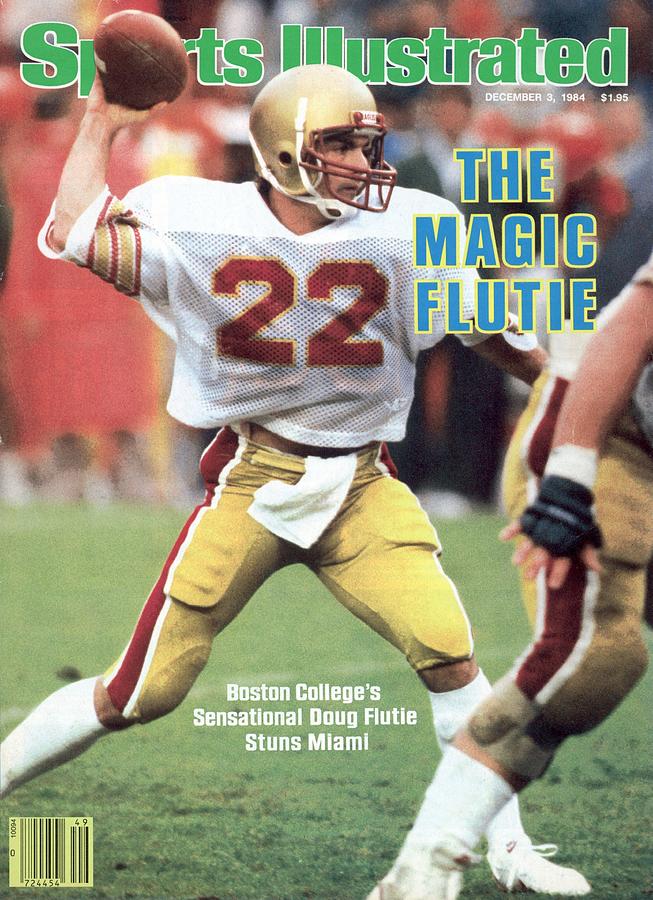
November 23, 1984: Doug Flutie's Miracle In Miami

November 23, 1984: It is the day after Thanksgiving, and this was the early days of retail treating it as "Black Friday," the biggest shopping day of the year, which has come to, traditionally, set the tone for the Christmas season: Either they will make big profits, and be "in the black"; or they will be wearing black for mourning.

Thanksgiving weekend is also a time for football. The day before, many high school games were played, much more so than are played today. I was a sophomore at East Brunswick High School in Central New Jersey, and my Bears came back from a 27-13 deficit to beat Colonia High School of Woodbridge, 33-27, and clinch the Championship of the Middlesex County Athletic Conference and an undefeated regular season. It's often regarded as the greatest football game in the school's history. Unfortunately, we lost the Central Jersey Group IV Final, costing us a "State Championship" and an undefeated full season, something, to this day, we've never had.

There was only one college football game that Thanksgiving Day, a minor rivalry to everyone but those connected to the schools playing: Miami University of Ohio beat the University of Cincinnati, 31-26 at Nippert Stadium in Cincinnati. Miami University, in Oxford, Ohio, was founded in 1809, 8 years before Ohio gained Statehood. In contrast, the University of Miami, in suburban Coral Gables, Florida, wasn't founded until 1925.

In the NFL, both of the traditional home teams won: The Detroit Lions beat the Green Bay Packers, 31-28 at the Silverdome in Pontiac, Michigan; and the Dallas Cowboys beat the New England Patriots, 20-17 at Texas Stadium in Irving.

There was only one college game played on the day after Thanksgiving, on CBS. So anybody who wanted to watch a football game at that point was watching it. At the time, there was a Big East Conference, but they did not sponsor a football competition. If they did, this game would have decided its Championship. The fact that both teams involved have since moved to the Atlantic Coast Conference (ACC) should not attract from what that meant.

The University of Miami were the defending National Champions, having shocked the University of Nebraska in the previous season's Orange Bowl game, in the stadium of the same name, which was the Hurricanes' usual home field.

Bernie Kosar quarterbacked them as a freshman, and now, as a sophomore, had led them to an 8-3 record. They had won the Kickoff Classic at the Meadowlands, beating then-Number 1 Auburn. They beat Number 17 Florida on neutral ground in Tampa. They beat Number 16 Notre Dame away. But they had lost to Number 14 Michigan away, losing the Number 1 ranking in the process. They had lost to Number 15 Florida State at home.

And, in their last game before this one (they had a week off in between), they lost an embarrassing one: They led Maryland 31-0 at the half, and lost, 42-40. For many years thereafter, it was the biggest comeback in NCAA Division I-A (now FBS, the Football Bowl Subdivision) history. The Maryland quarterback was Frank Reich, substituting for the injured Boomer Esiason. In the 1992 NFL Playoffs, subbing for the injured Jim Kelly -- who had played at Miami -- Reich led the Buffalo Bills to what is still the biggest comeback in NFL history, from 35-3 down to beat the Houston Oilers, 41-38 in overtime.

Their opponents for this game would be Boston College. BC had some good teams in the 1930s and '40s, but hadn't done much since. In 1981, they were struggling, losing to the University of Pittsburgh, ranked Number 2 in the country, and coach Jack Bicknell turned to a 5-foot-9 3/4-inch freshman quarterback from nearby Natick, Massachusetts, and said, "Okay, Flutie, see what you can do."

And Doug Flutie went in, and nearly pulled the upset. They ended the season 5-6. The next season, Sports Illustrated noted that Flutie would be the starting quarterback, and whoever was writing the article finished with, "Good luck, Flutie."

Flutie made his own luck, leading BC to an 8-3-1 record. Their non-wins were all against then-ranked teams: A tie away to Number 16 Clemson, and losses away to Number 16 West Virginia, home to Number 8 Penn State, and to Number 18 Auburn in the Citrus Bowl. It was their 1st bowl game in 39 years.

As a junior in 1983, Flutie led them to a 9-3 season, losing at home to Number 12 West Virginia, away to unranked Syracuse, and in the Liberty Bowl to Notre Dame. On October 29, in a game too big for their 32,000-seat on-campus Alumni Stadium, they played defending National Champion (but, at the time, unranked) Penn State at Sullivan Stadium, home of the NFL's New England Patriots (later renamed Foxborough Stadium). Before a crowd of 56,605, and millions more watching on ABC, the Eagles beat the Nittany Lions, 27-17. Flutie, already the classic "local boy makes good," became a national star.

BC were 7-2 going into their game with Miami. They had beaten Number 9 Alabama in Birmingham, but had lost 2 games, away to Number 20 West Virginia and away to Penn State -- by a combined 8 points. BC were ranked Number 10, Miami Number 12. In spite of these rankings, Miami were a 6-point betting favorite. (Keep in mind: In football, home-field advantage is traditionally said to be worth 3 points.) Flutie was the favorite for the Heisman Trophy, although Kosar was also a contender for it. The winning quarterback would get his Heisman vote totals boosted significantly.

The game was played at the Orange Bowl, in a driving rainstorm throughout. It was almost as if there was a real hurricane going on. It kicked off at 2:30 PM Eastern Time, and BC jumped out to a 14-0 lead. Miami scored a touchdown before the 1st quarter ran out, and tied the game with a touchdown early in the 2nd quarter.
BC scored on a run by Flutie, then Miami scored on a Kosar touchdown pass, then BC did so on a touchdown pass from Flutie to his college roommate, Gerard Phelan. At halftime, the score was Boston College 28, Miami 21. So there had already been as much action as in most full games.

In the 3rd quarter, Miami scored another touchdown, and the teams traded field goals. The quarter ended with the game tied, 31-31. BC kicked another field goal to make it 34-31, but Melvin Bratton broke off a 52-yard run to make it 38-34 Miami. It seemed like Miami had the game won. Flutie led a drive that ended with a touchdown, and it was 41-38 BC. But Kosar led a drive that ended with another touchdown run by Bratton, and it was 45-41 Miami.

BC got the ball back with 28 seconds left in regulation, on their own 20 yard line. Flutie got the Eagles to the Hurricanes' 48-yard line. There were 6 seconds left. Time for one more play. A field goal wouldn't have helped, it would have been 65 yards anyway, and the weather and the wet grass would have made it a tricky proposition regardless of how close it was. There was no choice: The play had to result in a touchdown.

Before the play, CBS announcer Brent Musberger said, "One thing is certain: Those brave folks who sat out here in the Orange Bowl, and put up with this terrible weather, saw a whale of a football game, and they should give both teams a rousing ovation when this one is over." His broadcast partner, former Notre Dame coach Ara Parseghian, whose career included a 10-10 tie with Michigan State in 1966, known as "The Game of the Century," followed this with, "This is one of the better ones that I've seen."

Flutie called "55 Flood Tip": No running backs, and all eligible receivers run straight routes to the end zone. He was flushed out of the pocket by the Miami defense, and had to scramble. He had to attempt his 46th pass of the game, on the run, throwing from his own 37-yard line, meaning the ball had to fly at least 63 yards, into a 30-mile-per-hour wind, and through the rain.

Flutie heaved the ball. Since a Roger Staubach to Drew Pearson play in the 1975 NFL Playoffs, such a pass had been known as a "Hail Mary." Some Catholics find the expression offensive. In this case, given that Boston College is a Catholic school -- specifically, Jesuit -- it might have been appropriate.

Three Miami defensive backs blanketed receiver Kelvin Martin. There would be no way he could catch the ball. Phelan was behind them. It would require perfect placement of both man and ball for him to catch it. He did. Boston College 47, Miami 45. Ballgame. No chance to try for an extra point, with everyone running onto the field, and no need for it.

"Caught by Boston College!" Musberger yelled. "I don't believe it! It's a touchdown! The Eagles win it! I don't believe it! Phelan is at the bottom of that pile!" The entire team piled onto Phelan. As Musberger noted, "Jack Bicknell is the only person over there on the sidelines! He couldn't get the headset off fast enough! Doug Flutie has done it! And your heart goes out to Bernie Kosar. He did everything he could."

Kosar had passed for 447 yards, then a school record, with 2 touchdowns. And Bratton had run for 4 touchdowns. It was all for naught, as Flutie passed for 472 yards, becoming the 1st major college quarterback with 10,000 career passing yards. He also threw for 3 touchdowns. Miami punted only once all game; BC, just 3 times.

The game became known as the Miracle in Miami, and if there was any doubt before the game that Flutie would win the Heisman Trophy, that doubt disappeared into Phelan's hands. Ohio State running back Keith Byars finished 2nd. Robbie Bosco, who quarterbacked Brigham Young University to a controversial National Championship, finished 3rd. Kosar was 4th. Jerry Rice of Mississippi Valley State, who went on to become the greatest receiver in football history, finished 9th. Bo Jackson of Auburn, who would win it the next season, did not finish in the Top 10 this season.

Miami went on to lose the Fiesta Bowl to UCLA. Kosar would have a good pro career with the Cleveland Browns, before winning a Super Bowl ring as Troy Aikman's backup on the Dallas Cowboys.

Flutie's last college game was in the Cotton Bowl, and BC beat the University of Houston. But NFL teams passed on him due to his lack of height. This was so dumb. How dumb was it? Well, let's absolve the following teams, because they drafted Hall-of-Famers: The San Francisco 49ers, Rice; the Buffalo Bills, Bruce Smith; and the Minnesota Vikings, Chris Doleman. And, besides, the 49ers had Joe Montana, while the Bills had the rights to Jim Kelly. And several other teams drafted All-Pros. But lots of teams needed a quarterback, and didn't draft Flutie, and struggled for years to come.

Flutie signed with the New Jersey Generals of the United States Football League, and led them to the Playoffs. When the USFL folded, the Chicago Bears signed him, against the wishes of head coach Mike Ditka. Ditka refused to start him over an already-injured Jim McMahon, and the Bears haven't won a Super Bowl since. In 1987, the Bears traded Flutie to his hometown New England Patriots, but they kept him as a backup to Tony Eason, and didn't get too far, and released him after the 1989 season, and got even worse.

Flutie signed with the Vancouver-based BC Lions of the Canadian Football League. In 1992, he was traded to the Calgary Stampeders, and he led them to the CFL Championship, the Grey Cup. He did the same for the Toronto Argonauts in 1996 and '97. All 3 times, he was named the game's Most Valuable Player. He was named the CFL's Most Outstanding Player 6 times in 7 years from 1991 to 1997.

Finally, at the age of 36, the NFL could ignore him no longer. With Kelly having retired after the 1996 season, the Bills signed Flutie, and he led them to the Playoffs, made the Pro Bowl, and was named the NFL Comeback Player of the Year. He got them back into the Playoffs in 1999, but coach Wade Phillips benched him for the Playoff game against the Tennessee Titans, in favor of Rob Johnson. The Bills lost, and didn't make the Playoffs again for 18 years.

Flutie played 4 years for the San Diego Chargers, and closed his career with the Patriots, as a backup to Tom Brady. In his last game, against the Miami Dolphins, on New Year's Day 2006, he did something no NFL player had done since 1941: He converted a dropkick. It was good for a point-after-touchdown, and the Patriots won.

Doug Flutie is not in the Pro Football Hall of Fame. It is, quite specifically, not "The National Football League Hall of Fame." It includes a few players who would not have made it if not for their performances in the All-America Football Conference (1946-49) and the 1960s version of the American Football League, including Billy Shaw, who played 9 seasons for the Bills, all in the AFL, and never played a down in the NFL.

Still, voters for it tend not to consider CFL statistics. There are really only 2 NFL players who are not in the Hall whose qualifications would be noticeably boosted if their CFL tenures were included, and they're both quarterbacks: Joe Theismann and Doug Flutie. Another quarterback, Warren Moon, is the only player in the Hall with significant CFL performance, although Bud Grant won 4 Grey Cups as a coach in Winnipeg before becoming a Hall of Fame coach in Minnesota.

Oddly, for all the exposure BC got from the Flutie years, their Alumni Stadium wasn't expanded to its present 44,500 seats until the 1994 season.

*

November 23, 1984 was a Friday. As I said, this was the only college game played that day. No pro games were played. Baseball was out of season, although future player Justin Turner was born. There were 7 games played in the NBA:

* The New York Knicks beat the Detroit Pistons, 120-97 at the Silverdome in the Detroit suburb of Pontiac, Michigan. Bernard King led all scorers on the day with 45 points.

* The Boston Celtics beat the Washington Bullets, 118-110 at the Boston Garden. Larry Bird scored 29 points. So it was a good day for Boston sports.

* The Golden State Warriors beat the Cleveland Cavaliers, 107-106 at The Coliseum in the Cleveland suburb of Richfield, Ohio.

* The Kansas City Kings beat the Indiana Pacers, 122-105 at the Market Square Arena in Indianapolis.

* The Utah Jazz beat the Houston Rockets, 111-98 at the Salt Palace in Salt Lake City.

* The Philadelphia 76ers beat the Phoenix Suns, 119-107 in overtime at the Arizona Veterans Memorial Coliseum. Julius "Dr. J" Erving had 31 points. Moses Malone had 23 points. A rookie named Charles Barkley came off the bench to score 17 points and grab 19 rebounds.

* And the Chicago Bulls beat the Seattle SuperSonics, 113-94 at the Seattle Center Coliseum. A rookie named Michael Jordan led all scorers in this game with 23 points.

And there were 6 games played in the NHL:

* The New York Islanders beat the Washington Capitals, 5-1 at the Capital Centre in the Washington suburb of Landover, Maryland.

* The Philadelphia Flyers beat the Buffalo Sabres, 4-2 at the Buffalo Memorial Auditorium.

* In an "Original Six" matchup, the Detroit Red Wings beat the Toronto Maple Leafs, 6-5 at the Joe Louis Arena in Detroit.

* The New Jersey Devils lost to the Minnesota North Stars, 5-4 at the Metropolitan Sports Center in the Minneapolis suburb of Bloomington, Minnesota. Craig Hartsburg scored the winning goal with 1:25 left in overtime.

* The St. Louis Blues beat the Calgary Flames, 3-1 at the Saddledome in Calgary.

* And the Winnipeg Jets beat the Vancouver Canucks, 5-1 at the Pacific Coliseum in Vancouver.

Saturday, November 19, 2022

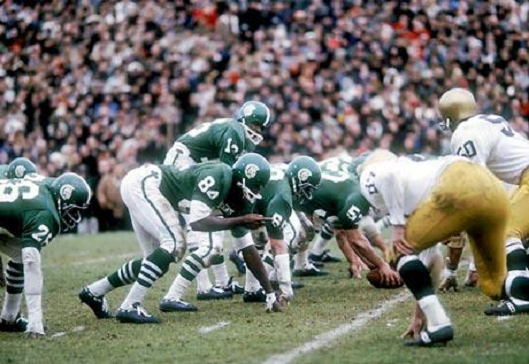
November 19, 1966: Michigan State vs. Notre Dame: "The Game of the Century"

Ara Parseghian (left) and Duffy Daugherty

November 19, 1966: One of college football's occasional "Games of the Century" is played, at Spartan Stadium in East Lansing, Michigan.

Michigan State University, coached by Hugh "Duffy" Daugherty and known as "Duffy's Toughies," defending National Champions and now back-to-back Big Ten Champions, were undefeated, and ranked Number 1 in one of the major polls in use at the time and Number 2 in the other.

The University of Notre Dame, based in South Bend, Indiana, coached by Ara Parseghian, was also undefeated, and ranked 1st in one poll and 2nd in the other.
Spartan Stadium

ABC televised the game nationally, albeit on a tape delay, with Chris Schenkel and former Oklahoma coach Bud Wilkinson calling it. This was the 1st time, except for New Year's Day bowl games, that a single college football game went coast-to-coast over national television -- and in color, no less.

This was a time when the words "in color" and "coast-to-coast" still had a special meaning, because neither of them, as yet, was a given. The 1965-66 TV season was when most American TV series, if they had not already done so, switched from black & white to color. But that still wasn't a given for unscripted shows like sports broadcasts.

As for "coast-to-coast": Even today, ABC/ESPN and CBS split some of their games regionally: While the East Coast and the Midwest might see, for example, Ohio State vs. Penn State, the South and the West Coast might see, say, Southern California vs. Texas. But each network usually staggers its schedule so that, on any given Saturday, there's at least one game that most of the country, unless their own team is otherwise occupied, will want to see. In 1966, such a thing was still a novelty.

These two teams weren't even supposed to play each other, let alone on this day. Notre Dame had usually played the University of Iowa on the 3rd Saturday in November from 1945 onward. But after 1964, Iowa opted out of that arrangement. Since Michigan State only had 9 regular-season games scheduled, and it was a relatively short trip -- 149 miles, or 2 1/2 hours by road -- the game was set up, and as luck would have it, they both came in undefeated, Number 1 vs. Number 2.

The teams had first played each other in 1897, before either one was a major football power. At this point, they had played each other every year since 1948, with 1966 having started out as an exception.

Michigan State had gone to the Rose Bowl the year before. At the time, the Big Ten Conference had 2 unbelievably stupid rules: No team could go to the Rose Bowl in back-to-back years, and only the Conference Champion -- or, if disqualified by the preceding stupid rule, the 2nd-place team -- could go to any bowl game. This meant that, regardless of the result of their game against Notre Dame, MSU were not going to play in a bowl game. (Purdue, quarterbacked by future Miami Dolphin Super Bowl winner Bob Griese, finished 2nd, and went on to their 1st-ever Rose Bowl, and won it for what remains the only time in their history.)

Notre Dame had a policy against bowl games, and hadn't been to one since Knute Rockne's legendary "Four Horsemen" (Harry Stuhldreher, Jim Crowley, Don Miller & Elmer Layden) beat Ernie Nevers' Stanford in the Rose Bowl on New Year's Day 1925. They wouldn't stop turning down bowl invitations until the 1970 season. So for both the Spartans and the Fighting Irish, this was it.
Michigan State in the home green.
Notre Dame in the road white.

At first, it didn't go too well for Notre Dame: Their leading rusher, Nick Eddy, did not play due to a shoulder injury. Quarterback Terry Hanratty got sacked by the massive (for the time, anyway) Spartan defensive lineman (and future actor) Charles "Bubba" Smith, and had to leave the game with an injury. Center George Goeddeke hurt his ankle while blocking for a punt.

Early in the 2nd quarter, the Spartans took a 7-0 lead on a Regis Cavender touchdown. God only knows what Regis Philbin, at age 32 already a known entertainer, and a Notre Dame graduate, so much of a fan that his request to be buried in the school's Cedar Grove Cemetery was granted, thought of a man named Regis scoring against his beloved Irish.

Dick Kenney, a barefooted kicker, added a field goal to make it 10-0 Michigan State. Barefoot kickers are now illegal in high school in every State except Massachusetts and Texas. They're still legal in college and in the NFL, but have been very rare since the 1980s.

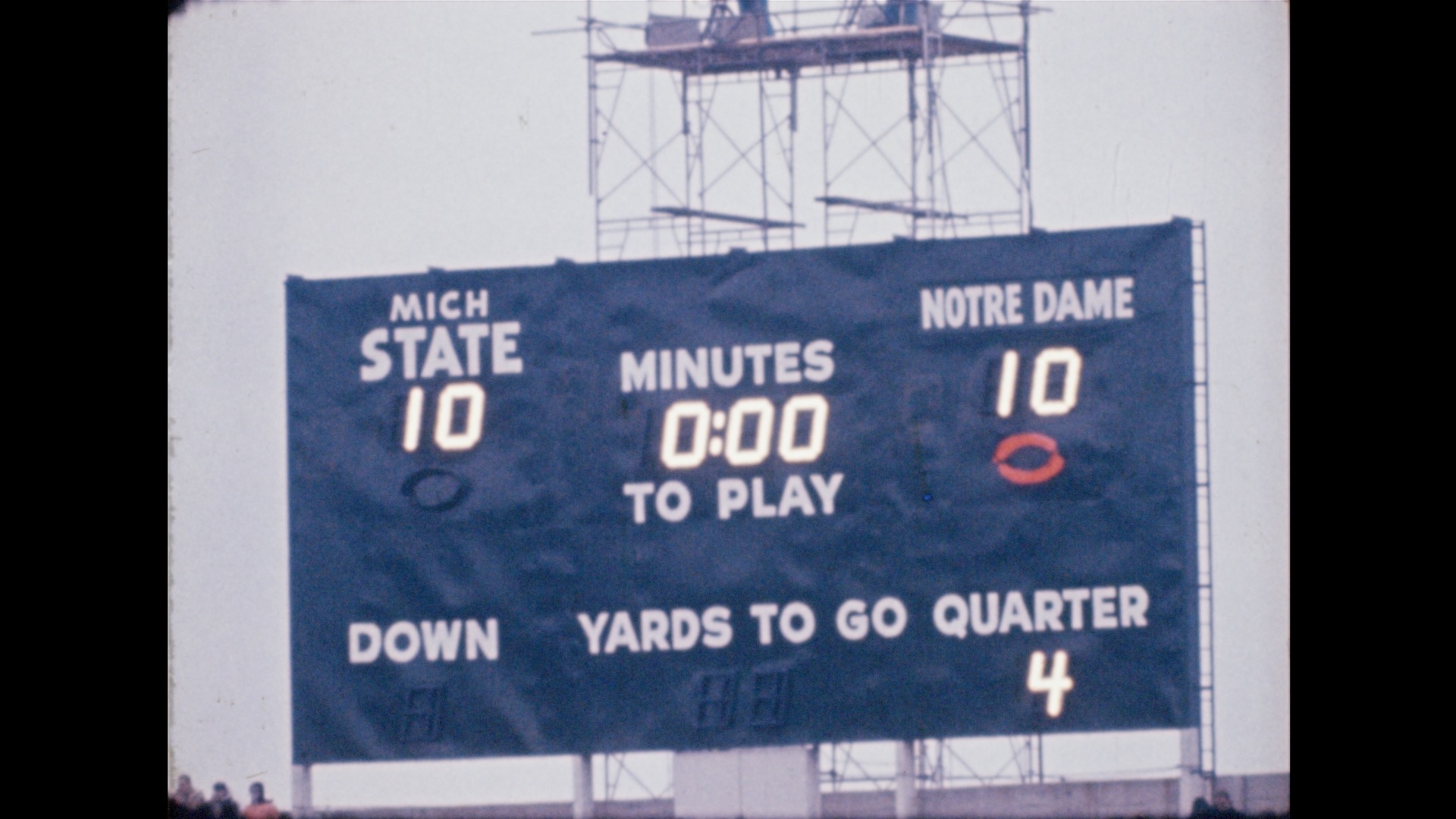
Notre Dame came back. Backup quarterback Coley O'Brien threw a touchdown pass to Bob Gladieux, and it was 10-7 Spartans at the half. On the 1st play of the 4th quarter, Joe Azzaro kicked a field goal to tie it. There was still plenty of time left for either team to win the game.

A Spartan pass play gave both teams a good chance to score: Quarterback Jimmy Raye -- a black quarterback, not the first at Michigan State but rare on national television at that point -- attempted to pass to Gene Washington  but Washington outran the pass, doubled back, and Tom Schoen intercepted it. That gave the Irish a chance, but Azzaro just missed what could have been a game-winning field goal.

(This Gene Washington went on to play for the Minnesota Vikings and Denver Broncos, and should not be confused with the man of the same name who went on to All-Pro honors with the San Francisco 49ers and then became an executive in the NFL's main office.)

The last series of the game began with 1 minute and 10 seconds left on the clock, and Notre Dame had the ball on its own 30-yard line. Gaining 40 yards in 70 seconds would have put them in position for Azzaro to try again to win it with a field goal.

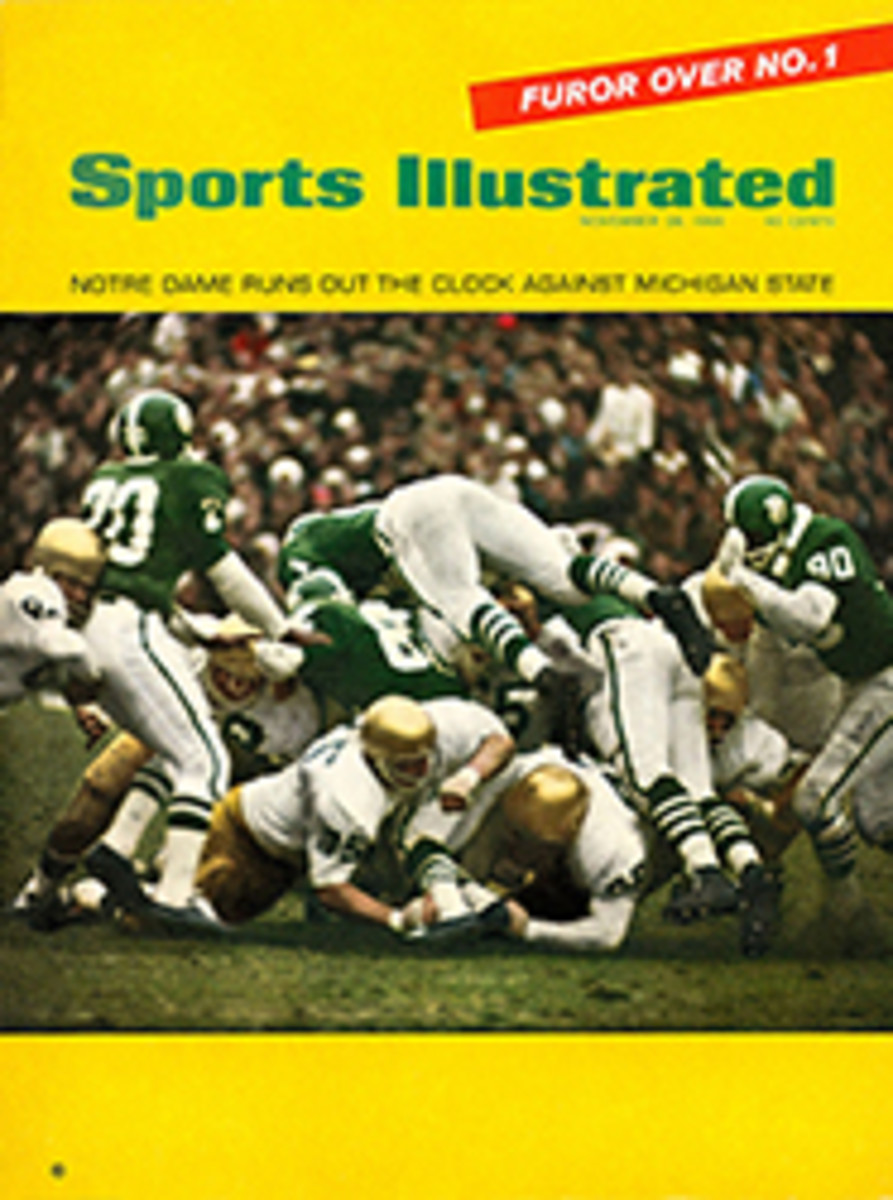
But Parseghian chose to run out the clock. He called 4 running plays, one of which gained a 1st down, then O'Brien was sacked by Bubba Smith, and then O'Brien ran up the middle on the final play. None of these plays got the ball across midfield, let alone within field goal range. Final score, Michigan State 10, Notre Dame 10. The home crowd booed the final play-call.
I've seen ESPN Classic's broadcast of the game's surviving footage, which is all but the 1st quarter. The video is clear, the color is bright, and both teams, while looking small compared to the college teams of today, fought hard, and both seemed worthy of the National Championship -- until the last 70 seconds, of course.

Normally, the national media gives Notre Dame the benefit of the doubt, since they are so swept up in the myth of the Golden Dome -- Knute Rockne, George Gipp and Rockne's "Win One for the Gipper" speech, the Four Horsemen, Frank Leahy and "Leahy's Lads," and Paul Hornung... and this was well before Rudy Ruettiger and his movie, Joe Montana, and Lou Holtz's tenure.

Not this time. In Sports Illustrated's writeup of the game, Dan Jenkins, until his death in 2019 perhaps the greatest living writer on the subject of college football, titled his article "Tying One for the Gipper." Jenkins quoted one observer as saying, "Parseghian had no guts."
Was that fair? Here was Ara's explanation: "We'd fought hard to come back and tie it up. After all that, I didn't want to risk giving it to them cheap. They get reckless and it could cost them the game. I wasn't going to do a jackass thing like that at this point."

Both teams ended the season 9-0-1. And the polls? Both the Associated Press (the college football writers) and United Press International (the coaches), still issuing their final polls before the bowl games, ranked Notre Dame Number 1 in their last poll, Michigan State Number 2, and undefeated Alabama Number 3.

Alabama, led by Paul "Bear" Bryant and actually having a bowl game to win, did so, beating Number 6 Nebraska in the Sugar Bowl, and finishing 11-0. They should have thus gotten their 3rd straight National Championship, having split the 1965 polls with Michigan State.

Both Notre Dame and Alabama claim to be 1966 National Champions, but Notre Dame still gets the official recognition. Keith Dunnavant came out with a book about the '66 Crimson Tide squad and how they were screwed by the polls, titling it The Missing Ring.

Ara Parseghian won another National Championship at Notre Dame in 1973, this time beating Alabama in a Number 1 vs. Number 2 matchup in the Sugar Bowl. That year, Ohio State and Michigan played to a 10-10 tie, thus tying for the Big Ten title, and the Conference sent Ohio State to the Rose Bowl. Despite this, Ohio State coach Woody Hayes joined with Bo Schembechler, once his player and assistant coach but now the Michigan coach, in his outrage, and together they got the only-the-Rose-Bowl rule changed for the 1975 season.

Duffy Daugherty remained Michigan State's coach until 1972, and lived until 1987, seeing the 20th Anniversary of this game. Parseghian retired after the 1974 season, and became a broadcaster in the sport. He died in 2017, at the age of 94. living long enough to see the 50th Anniversary of this game. He never took his good health for granted, and continued to raise money for research into diseases that have hit his family. Until the Kardashians became famous, he was easily the most famous American of Armenian descent. A statue of him stands outside Notre Dame Stadium. Yet, even in death, he still gets dogged by charges of cowardice for 1966.

I'm not a Notre Dame fan. Indeed, I once did a blog post of "The Top 10 Reasons to Hate Notre Dame." Ara's successor, Dan Devine, who led them to the 1977 National Championship with Joe Montana at quarterback, once said, "There's Notre Dame fans, and then there's Notre Dame haters, and, frankly, they're both a pain in the ass."

But I think we can let Ara off the hook. Like Schembechler, Ara both played for Hayes and coached under him at Miami University of Ohio before becoming a great head coach himself. Woody's philosophy was simple: Run the football. Or, as it became known, "Three yards and a cloud of dust." I'm not sure if Woody came up with those words himself, but words that have been attributed to him are, "There are three things that can happen when you throw the football, and two of them are bad." In other words, an incomplete pass and an interception.

When Ara had 70 seconds of play remaining, and 70 yards to go for a touchdown, and at least 40 yards to go for a field goal, no doubt he heard Woody's wisdom in his mind. After all, at the time, the man was still, along with Bear Bryant at Alabama, recognized as one of the top 2 coaches in college football, well ahead of some men who would soon be adding to their records: Parseghian himself, Darrell Royal at Texas, John McKay at USC, Bob Devaney at Nebraska, and Joe Paterno, then in his 1st season at Penn State.

At the time, Woody and the Bear were it. Ara wanted to be "it," and, to do that, he couldn't lose this game. So he chose to not risk losing on an interception that might put Michigan State in position to win with a last-second field goal. It worked, and, as times changed, Ara became part of that top tier of great college football coaches.

In 1946, Army was undefeated and ranked Number 1, and Notre Dame was undefeated and ranked Number 2, and they finished the regular season against each other, at the original Yankee Stadium, in the 1st college football game to get the "Game of the Century" tag from the national media.

That game did not live up to the hype, ending in a 0-0 tie. As they would say in that other kind of football, soccer, it was "a turgid nil-nil draw." The word "turgid" so perfectly suits 0-0 draws, regardless of what game you call "football."

Frank Leahy, Notre Dame's coach at the time, had "tied one for the Gipper" 20 years before Ara. Yet he never got the derision that Ara got. Probably because it wasn't on television: In order to see this game in its entirety, you had to be inside The Stadium. Newsreel highlights in movie theaters wouldn't have shown you all you needed to see. Nobody's ever said, "Leahy had no guts." Essentially, he played for a tie, and got away with it.

Duffy Daugherty didn't exactly go for the win, either. And it really did cost his team the National Championship. But nobody mocked him for it, and nobody, in Michigan or elsewhere, holds it against him now.

Also, the odds were against the Fighting Irish. Michigan State had the home field. They were the defending National Champions. They were favored to win. And Notre Dame went into the game with a major injury (their top rusher) and got more of them as the game went on (their starting quarterback and center). And still, they held Michigan State to just 10 points at home and avoided a loss. That's a pretty good achievement.

Finally, a win wasn't necessary. The polls proved it, giving Notre Dame the National Championship anyway. Ara knew that a loss would kill their national title dreams, just as they had against USC 2 years earlier. But a tie would still leave them undefeated.

And, at that point, as they nearly always do (except where this one game was concerned), the national media gave Notre Dame the benefit of the doubt, and crowned them National Champions, even though Alabama, undefeated and untied in 11 games as opposed to undefeated but tied in 10 games, was a more deserving National Champion.

Sounds like Ara Parseghian had more guts than the media: Not only were they gutless in claiming him to be a coward, but they ended up rolling over for the Irish anyway. If not for Ara himself.

Notre Dame and Michigan State last played each other on September 23, 2017, a few weeks after Parseghian's death. Notre Dame won, 38-18, raising their lead in the rivalry to 47-29-1. It should be 49-29-1, but due to the discovery of their use of ineligible players, the NCAA vacated all of their wins, including their wins over Michigan State, in the 2012 and 2013 seasons.

The schools have signed a contract to resume the rivalry, beginning in 2026, in South Bend.

*

November 19, 1966 was, of course a Saturday. Other notable college football games played that day:

* In the 2nd half of ABC's nationally-telecast doubleheader, Number 8 UCLA beat Number 7 USC, 14-7 at the Los Angeles Coliseum. This game forced a tie for the Championship in the Athletic Association of Western Universities (AAWU), and, head-to-head, UCLA should have had the tiebreaker. The next week, Notre Dame went into the Coliseum, and walloped USC, 51-0.

But USC still got the Rose Bowl bid, and lost to Purdue. UCLA, hampered by a rule in the league now known as the Pac-12 similar to the Big Ten's, couldn't go to a bowl, despite finishing the regular season 9-1. Wow, if ever a 20th Century college football season needed a playoff, this was it. The next season, USC and UCLA would play a "Game of the Century."

* Number 3 Alabama and Number 4 Nebraska both had the week off. The following week, Nebraska lost to arch-rival Oklahoma. But they still won the Big Eight Conference title. Alabama beat Southern Mississippi and then arch-rival Auburn, and beat Nebraska in the Sugar Bowl.

* Number 10 Purdue crushed arch-rival Indiana, 51-0 at Ross-Ade Stadium in West Lafayette, Indiana.

* Michigan beat Ohio State, 17-3 at Ohio Stadium in Columbus.

* Wisconsin beat Minnesota, 7-6 at Camp Randall Stadium in Madison, Wisconsin.

* Southern Methodist beat Baylor, 24-22 at the Cotton Bowl in Dallas, clinching the Southwest Conference title. But they lost the Cotton Bowl to Georgia, who were off this week, and ranked Number 7.

* Harvard beat Yale, 17-0 at Harvard Stadium in Boston.

* Penn State beat Pittsburgh, 48-24 at Pitt Stadium.

* Army and Navy both had the week off. The following week, Army beat Navy, 20-7 at John F. Kennedy Stadium in Philadelphia.

* In New York City, Columbia beat Brown, 40-38 at Baker Field.

* In New Jersey, Princeton beat Cornell, 7-0 at Palmer Stadium in Princeton.

* And Rutgers lost to Colgate, 26-7 at Rutgers Stadium in Piscataway.

One more football score I want to mention, but not in college, nor in the pros. The school that would one day become my high school, East Brunswick in Middlesex County, New Jersey, beat Sayreville 33-0. This enabled them to win both the Greater Jersey Group IV Conference, Central Division II Championship, and, due to their record, winning a share of their 1st Central Jersey Group IV Championship. Our first "State Championship." I have a separate entry for this event.

There were 5 games played in the NBA that day:

* The New York Knicks beat the expansion Chicago Bulls, 116-104 at the old Madison Square Garden.

* The Philadelphia 76ers beat the Cincinnati Royals, 134-110 at the Philadelphia Civic Center.

* The Boston Celtics beat the Baltimore Bullets, 147-125 at the Baltimore Civic Center. (The building still stands, under the name of the CFG Bank Arena.)

* The St. Louis Hawks beat the Detroit Pistons, 105-87 at the Kiel Auditorium in St. Louis.

* And the San Francisco Warriors beat the Los Angeles Lakers, 144-109 at the Los Angeles Memorial Sports Arena. For the Warriors, Rick Barry scored 45, and Nate Thurmond had 24 points and 27 rebounds.

And the entire NHL -- all of the "Original Six" teams -- were in action:

* The New York Rangers played the Boston Bruins to a tie, 3-3 at the Boston Garden.

* The Toronto Maple Leafs beat the Montreal Canadiens, 5-1 at Maple Leaf Gardens in Toronto.

* And the Chicago Black Hawks beat the Detroit Pistons, 7-2 at the Chicago Stadium.

Also on this day, Gail Devers, an American sprinter who won Olympic Gold Medals, was born. So was celebrity chef Rocco DiSpirito. So was actor and martial artist Jason Scott Lee. Although not related to Bruce Lee, he played Bruce in a film biography.

December 31, 1999 & January 1, 2000: The Millennium

December 31, 1999:  The Millennium arrives. The people of planet Earth survived. At a terrible cost. But we hadn't destroyed ourselves. ...