Showing posts with label new york state. Show all posts

Sunday, December 25, 2022

December 25, 1989: The Death of Billy Martin

December 25, 1989: Billy Martin is killed when his pickup truck crashes outside his home in Johnson City, New York. He was 61. There is dispute as to whether he was the driver or the passenger, or whether it was his friend, Bill Reddy.

Growing up as a fan of the New York Yankees, I looked upon Billy as a hero, as the Yankees' only real manager, as their Number 1 forever. In the file of "Stupid things I used to think": As an 8-year-old boy, I actually thought that he wore Number 1 because he was the manager of the defending World Champions. After all, didn't Tommy Lasorda, manager of the team he beat, wear Number 2?

I was even at Yankee Stadium on August 10, 1986, the day he got that uniform number retired and received his Monument Park Plaque. He said that day, "I may not have been the greatest Yankee to put on the uniform, but I am the proudest." (The Yankees got pounded that day, 13-3, by, of all teams, the one from the city that Billy hated the most, Kansas City.)

I had no idea just what was going on in Billy's head, either as a 1950s player or a 1970s & '80s manager. He'd been dealt a tough hand as a boy, and he took it out on the world as a man. While he was an interesting player, helping the Yankees win 5 World Series, and an occasionally brilliant manager, taking 4 different teams to the postseason a total of 5 times and winning the 1977 World Series with the Yankees, he did some things, both inside the ballpark and out, that cannot be excused.

To lots of people, including Yankee owner George Steinbrenner and star slugger Reggie Jackson, he could go from beautiful to shameful and back to beautiful in a matter of hours. Star pitcher Ron Guidry said, "Billy's all right, if you approach him right. I try to avoid him altogether."

He was an enigma, wrapped in a fight, soaked in a bottle. He never found peace in life, and made it hard for others to find peace. I hope he found it in death.

He was laid to rest in Gate of Heaven Cemetery in Hawthorne, New York -- a moment's walk away from the grave of Babe Ruth.

*

December 25, 1989 was a Monday. This was also the day that Romania overthrew its dictator Nicolae CeauČ™escu, and executed him and his wife Eleana.

Baseball was out of season. On ABC Monday Night Football, the Minnesota Vikings beat the Cincinnati Bengals, 29-21 at the Metrodome in Minneapolis. There was a college bowl game, between ranked teams: Michigan State, ranked Number 22, defeated Number 25 Hawaii, 33-13, in the Aloha Bowl, despite the game being played on Hawaii's home field, Aloha Stadium in Honolulu.

The NHL does not play on Christmas Day. The NBA does, and 1 game was played: The Atlanta Falcons beat the Cleveland Cavaliers, 115-104 at The Omni in Atlanta.

Thursday, November 3, 2022

November 4, 1884: Cleveland vs. Blaine, the Era's Nastiest Election

November 4, 1884: One of the closest and nastiest elections in American history ends. Grover Cleveland was the Democratic nominee. At age 47, he was the Governor of New York, and had previously been the Mayor of Buffalo and the Sheriff of Erie County.

The New York World endorsed him for 4 reasons, according to its publisher, Joseph Pulitzer: "1. He is an honest man. 2. He is an honest man. 3. He is an honest man. 4. He is an honest man." How honest was he? He managed to win public offices in the State of New York despite resisting the efforts of Tammany Hall, the State's Manhattan-based Democratic political machine.

At the Democratic Convention in Chicago, Representative Edward S. Bragg of Wisconsin, who had been a Union General during the Civil War, told the delegates, "They love him, gentlemen, and they respect him, not only for himself, for his character, for his integrity and judgment and iron will. But they love him most of all for the enemies he has made."

Apparently, he made enemies at the Buffalo Evening Telegraph. On July 21, that newspaper published a story that he had fathered a child out of wedlock, institutionalizing the mother to keep her quiet, and putting the kid up for adoption. Republicans began singing, "Ma! Ma! Where's my Pa?" And political cartoons lampooned the father/mother/son relationship.
Note the "Grover the Good" tag on Cleveland's coat,
as the kid screams, "I want my Pa!"
Presumably, irony on the part of the artist.

Cleveland's advisers asked him what to do. He said, "Above all, tell the truth." Given that this answer was completely vague, they did the wisest possible thing with it: They said nothing, and let the charge flow, implying that it was true.

In contrast, the Republican nominee was, as the song went, "Blaine! Blaine! James G. Blaine! The continental liar from the State of Maine!" At 54, he was a U.S. Senator, and had been Speaker of the U.S. House of Representatives, and Secretary of State under President James Garfield. Indeed, he was standing next to Garfield when he was shot. Had shooter Charles Guiteau's aim been a little off, Garfield would likely have been running for re-election against Cleveland, and, without Blaine's many scandals (which had nothing to do with Garfield), Garfield might have won easily.
James Gillespie Blaine

In spite of Blaine being, most likely, the American politician who had the most of what would now be called "political IOUs," many Republicans really wanted General William Tecumseh Sherman, hero of the Civil War, and brother of an 1880 candidate, Senator John Sherman of Ohio. He flat-out refused: "I will not accept if nominated, and will not serve if elected." What became known as a "Shermaneseque Declaration" is sometimes incorrectly written as, "If nominated, I will not run. If elected, I will not serve."
William Tecumseh Sherman, circa 1884

Cleveland's Vice Presidential nominee was Thomas A. Hendricks, who served Indiana as Governor and in both houses of Congress, and had been Samuel Tilden's Vice Presidential nominee in 1876. Blaine's running mate was John A. Logan, a Civil War General and a U.S. Senator from Illinois.

Mark Twain, the most popular author in America, was weeks away from publishing The Adventures of Huckleberry Finn. He was well-known to be a Republican, but, this time, he was one of the "Mugwumps": Republicans supporting Cleveland, because, for them, Blaine's corruption had gone too far. He said:

This present campaign is too delicious for anything. To see grown men, apparently in their right mind, seriously arguing against a bachelor's fitness for President because he has had private intercourse with a consenting widow! These grown men know what the bachelor's other alternative was -- & tacitly they seem to prefer that to the widow. Isn't human nature the most consummate sham & lie that was ever invented?

Moorfield Storey, a prominent Boston lawyer who later served as President of the American Bar Association, and as the 1st President of the National Association for the Advancement of Colored People (though he was white), noted:

We are told that Mr. Blaine has been delinquent in office but blameless in private life; while Mr. Cleveland has been a model of official integrity, but culpable in his personal relations. We should therefore elect Mr. Cleveland to the public office which he is so well qualified to fill, and remand Mr. Blaine to the private station which he is admirably fitted to adorn.

(Historians seem to disagree on whether Blaine was faithful to this wife, Harriet Stanwood.)

On October 29, 6 days before the election, Blaine had attended a dinner at the famed Delmonico's restaurant in Lower Manhattan. One of the speakers, a Presbyterian minister named Samuel Burchard, called the Democrats "the Party of Rum, Romanism and Rebellion!"

In other words: They were against the movement for the Prohibition of alcohol, they had great support among Roman Catholics (and thus, it was believed, would be puppets of the Pope in a country dominated by Protestants), and supported slavery and the South during the Civil War.

That line hit the newspapers, including Pulitzer's World. If Rev. Burchard intended it as a hit piece, what would now be called an "October Surprise," it backfired completely: It cost Blaine the State of New York, which had a lot of Catholic and anti-Prohibition voters, and was wobbling on Cleveland, even though he had been popular as Governor and as Mayor of Buffalo.

And the speech hitting the papers made all the difference: By winning New York, Cleveland took the Electoral Vote, 219 to 182. He won just 48.9 percent of the popular vote, to Blaine's 48.3. In fact, Cleveland ran for President 3 times, and won the popular vote all 3 times (though he lost the Electoral Vote in 1888, winning it again in 1892), but on none of those occasions did he win a majority of it.

When Cleveland was beaten in 1888, under dubious circumstances, his opponent, Benjamin Harrison, returned Blaine to the State Department, but he resigned due to ill health in 1892, and died just before the term ended in 1893.

Had Burchard -- not related to another Republican activist by that name, a Congressman from Wisconsin -- kept his mouth shut at that dinner late in the 1884 campaign, Blaine would have become the 22nd President of the United States, and Cleveland would only be remembered for, "Ma! Ma! Where's my Pa?" Instead, the Democrats' answer was, "Gone to the White House, ha, ha, ha!"

So what was the truth? In 1874, between offices and in private law practice (he had been Sheriff, but not yet Mayor), Cleveland paid child support for Maria Halpin and her son, named Oscar Folsom Cleveland. Maria was, apparently, mentally ill, and was indeed institutionalized, though there is no evidence that it was on Cleveland's request. The boy was adopted, was given the name James E. King Jr., and became a doctor like his adoptive father.

The thing was, in those days, long before DNA or even blood tests would have shed some light on the subject, Grover Cleveland was not the only possible father. Another possible father was Cleveland's law partner, whose name was... Oscar Folsom. But of the several possible fathers, Cleveland was the only one who was not married at the time, and thus would be the one least scandalized if the story got out -- or so he thought.

By today's standards, we would find what Cleveland did next to be much worse: He married Frances Folsom, the daughter of Oscar Folsom, who had died and left her guardianship to him. She was 21 when they married in 1886, making her easily the youngest First Lady ever (next is Julia Tyler, 24), and their wedding ceremony was the 1st ever held in the White House itself.

But as icky as their relationship sounds, it lasted for the rest of his life, until 1908. Grover and Frances Cleveland had 5 children: Ruth, Esther, Marion, Richard and Francis. Ruth was not, as the legend says, the namesake of the Baby Ruth candy bar. She died of diphtheria at age 12. The rest all lived until at least 1974, and Francis lived until 1995, 111 years after his father was first elected President. (It would be as if, in 2022, a child of Woodrow Wilson were still alive, or if Malia or Sasha Obama were to live until 2119.)

Rev. Burchard died in 1891, Blaine in 1893, and Harrison in 1901. Frances Cleveland died in 1947 -- as did Oscar Folsom Cleveland/Dr. James E. King Jr.

Cleveland and the other President who lived most of his life in Buffalo, Millard Fillmore, both have statues in front of City Hall, facing Niagara Square. The Square's centerpiece is the McKinley Monument, a memorial to President William McKinley, who was assassinated there.
Cleveland statue at Buffalo City Hall

There are high schools named for Cleveland in his birthplace of Caldwell, New Jersey; in Ridgewood, Queens, New York City; in his adopted hometown of Buffalo, New York; and in St. Louis, Los Angeles, Portland and Seattle. In 1928 and 1934, gold certificates standing in for $1,000 bills were issued with Cleveland's portrait. These would be America's last bills with a value above $100.

Cleveland remains the only President born in New Jersey, although he lived most of his life in New York State, before returning to New Jersey, to Princeton, where he lived his post-Presidential life.

Cleveland has been played by Stuart Holmes in The Monroe Doctrine and The Oklahoma Kid, both in 1939; William Davidson in Lillian Russell in 1940; Carroll O'Connor in Profiles in Courage in 1965; Pat McCormick in Buffalo Bill and the Indians in 1976; A.J. Freeman in Timestalkers in 1987; and Richard Herd in The Adventures of Brisco County, Jr. in 1994.

William Hoke Smith, usually known by his middle name, served as Secretary of the Interior during Cleveland's 2nd term. Hoke Smith was publisher of the Atlanta Journal, the South's largest newspaper, and promoted Cleveland's candidacy in 1892. So the Cabinet appointment was basically a payoff for his support, something that seems out of character for Cleveland. Smith was a progressive on many issues, but, like most major Southern politicians of his time, he was a white supremacist. He turned out to be the last surviving member of Cleveland's Cabinet, living until 1931.

*

November 4, 1884 was a Tuesday. The baseball season was over. There were no college football games played that day. Hockey was still all-amateur and all in Canada. And basketball hadn't been invented yet. So there were no scores on this historic day.

Sunday, October 30, 2022

October 30, 1975: "FORD TO CITY: DROP DEAD"

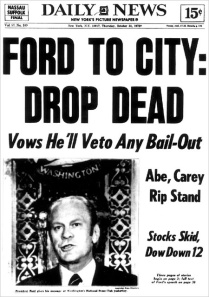
October 30, 1975: The New York Daily News, responding to President Gerald Ford's statement that he wouldn't allow the federal government to bail out New York City's desperate finances, prints the most famous newspaper headline ever: "FORD TO CITY: DROP DEAD."

Ford didn't actually say that, but that was the message he sent, intentionally or otherwise.

Both sides compromised, as the City did a few more things to try to get its financial house in order, and this satisfied Ford to the point where he changed his mind and signed a bailout bill.

But Ford was damned when he did, and damned when he didn't. The bailout he actually did sign infuriated many conservatives, who already had a few problems with the mildly conservative Ford, and they voted for former Governor Ronald Reagan of California in the Republican primaries, and Reagan very nearly won the GOP nomination, and when Ford won the nomination anyway, many of those conservatives stayed home on Election Day, November 2, 1976.

This may have made the difference in throwing some States, including New York, to the Democratic nominee, former Governor Jimmy Carter of Georgia. White conservatives in Queens, Brooklyn, Staten Island, Long Island and Westchester abandoned him. Not that they voted for Carter (Southern or not, conservative by Democratic standards or not, they still viewed all Democrats as "socialists"), but they didn't vote at all.

It also upset undecided voters and disaffected Democrats. A lot of people remembered only the headline, and forgot that Ford changed his mind about the bailout, and held it against him, and a lot of people in the City who might not have been comfortable with Carter either voted for Carter or stayed home, enough to throw the State of New York to Carter. It may have made, literally, all the difference in the world.  Had Ford simply won the State, he would have won a full term.

True, the Nixon pardon, lingering feelings over Watergate, the shaky economy, his debate gaffe about Eastern Europe, and conservatives issues with him over things like foreign policy and federal spending also hurt him.

But the day after the '76 election, Mayor Abe Beame posed in front of City Hall with the headline, as if to say, "City to Ford: Don't tell someone to drop dead unless you can make him drop dead. We just made your campaign drop dead."
Beame outside Gracie Mansion on November 3,
a year and 4 days after the headline,
and the day after the election.
A year later, with the City's finances still not fully straightened out, and crime seemingly out of control, the City’s voters told Beame to "drop dead," and elected Congressman Ed Koch as its Mayor.

*

October 30, 1975 was a Thursday. Baseball season had just ended with a classic World Series. Football was in midweek. These 2 games were played in the NBA that night:

* The New York Knicks beat the Kansas City Kings, 117-113 at Madison Square Garden. Nate "Tiny" Archibald scored 35 points, but the Knickerbockers got 32 from Walt "Clyde" Frazier and 26 from Spencer Haywood.

* And the Cleveland Cavaliers beat the Chicago Bulls, 108-91 at The Coliseum in the Cleveland suburb of Richfield, Ohio.

And there was a game in the American Basketball Association, entering its final season: The San Antonio Spurs beat the San Diego Sails, 102-100 at the HemisFair Arena in San Antonio.

There were 5 games played in the NHL:

* The Boston Bruins beat the St. Louis Blues, 3-2 at the Boston Garden.

* The Philadelphia Flyers beat the Toronto Maple Leafs, 6-2 at The Spectrum in Philadelphia.

* The Buffalo Sabres and the Vancouver Canucks played to a 4-4 tie at the Buffalo Memorial Auditorium.

* The Washington Capitals beat the Kansas City Scouts, 6-2 at the Kemper Arena (now the Hy-Vee Arena) in Kansas City. In 1976, the Scouts would become the Colorado Rockies. In 1982, they would become the New Jersey Devils.

* And the Los Angeles Kings beat the Pittsburgh Penguins, 4-0 at The Forum outside Los Angeles in Inglewood, California.

And there were 4 games played in the World Hockey Association:

* The Calgary Cowboys beat the Indianapolis Racers, 7-5 at the Market Square Arena in Indianapolis.

* The Winnipeg Jets beat the Cincinnati Stingers, 4-0 at the Winnipeg Arena.

* The Phoenix Roadrunners beat the Denver Spurs, 3-2 at the McNichols Arena in Denver.

* And the Houston Aeros beat the San Diego Mariners, 4-2 at the San Diego Sports Arena (now the Pechanga Arena).

October 30, 1912: Vice President James S. Sherman Dies

October 30, 1912: Vice President James S. Sherman dies in his hometown of Utica, New York. He was 57 years old, and he remains the last incumbent Vice President to die in office.

There have been 7 Vice Presidents who have died in office: George Clinton, under James Madison, on April 20, 1812; Elbridge Gerry, also under Madison, on November 23, 1814; William R. King, under Franklin Pierce, on April 18, 1853; Henry Wilson, under Ulysses S. Grant, on November 22, 1875; Thomas A. Hendricks, under Grover Cleveland, on November 25, 1885; Garret Hobart, under William McKinley, on November 21, 1899; and Sherman, under William Howard Taft.

There have been 9 Vice Presidents who have vacated the office due to a vacancy in the Presidency: John Tyler, upon the death of William Henry Harrison, April 4, 1841; Millard Fillmore, upon the death of Zachary Taylor, July 9, 1850; Andrew Johnson, upon the death by assassination of Abraham Lincoln, on April 15, 1865; Chester Arthur, upon the death by assassination of James Garfield, September 19, 1881; Theodore Roosevelt, upon the death by assassination of McKinley, September 14, 1901; Calvin Coolidge, upon the death of Warren Harding, August 2, 1923; Harry Truman, upon the death of Franklin D. Roosevelt, April 12, 1945; Lyndon Johnson, upon the death by assassination of John F. Kennedy, November 22, 1963; and Gerald Ford, upon the resignation due to scandal of Richard Nixon, August 9, 1974.

Two Vice Presidents have resigned: John C. Calhoun, due to a dispute with President Andrew Jackson, on December 28, 1832, at which point he had already been thrown off the ticket for re-election and replaced, anyway; and Spiro Agnew, under Richard Nixon, due to a plea deal on corruption charges, on October 10, 1973.

James Schoolcraft Sherman was born on October 25, 1855 in Utica, New York. He was a member of the interrelated Baldwin, Hoar, and Sherman families, prominent lawyers and politicians of New England, New York and Ohio. The Shermans he was related to included Roger Sherman, who signed both the Declaration of Independence and the Constitution of the United States; and General William Tecumseh Sherman and his brother John, a Senator from Ohio, Secretary of the Treasury under Rutherford B. Hayes, and Secretary of State under McKinley.

James S. Sherman married Carrie Babcock in 1881, and they had 3 sons: Sherrill, Richard and Thomas. James was elected Mayor of Utica as a Republican in 1884, and to the U.S. House of Representatives in 1886 and 1888. Losing in the Democratic landslide of 1890, he returned to the House in 1892, and was continually re-elected until 1908, when he was elected Vice President on a ticket with William Howard Taft.

At first, Sherman and Taft found themselves at odds over both tariff policy and the role of the Vice President. During the beginning of his term, Taft, who had been associated with progressives, had to deal with the Speaker of the House, Joseph G. Cannon of Illinois, who was the leader of the Republicans' conservative wing. Sherman, who had more experience in Congress, was expected to be a liaison for Taft with Cannon. "I am going to rely on you, Jim, to take care of Cannon for me. Whatever I have to do there will be done through you," proposed Taft.

Some later Vice Presidents have done this for their bosses. Sherman refused, saying, "Not through me. You will have to act on your own account. I am to be Vice President, and acting as a messenger boy is not part of the duties as Vice President." This is why, from Jimmy Carter with Walter Mondale from 1976 onward, Presidential nominees have talked things out with potential Vice Presidents before offering their names to the Party's Convention, so that the would-be VP knows what the would-be Prez wants, and can accept or decline on that basis.

But as Taft became embattled with parts of the progressive faction of the Republican Party, the two of them worked together more harmoniously – a relationship eased further by First Lady Helen Taft's enjoyment of the company of James and Carrie Sherman. Mrs. Taft, who wanted to be First Lady more than her husband wanted to be President -- he really wanted to be Chief Justice of the Supreme Court, which he eventually became -- was definitely the power behind the throne.

Taft declared that Sherman accomplished much on Capitol Hill by his "charm of speech and manner, and his spirit of conciliation and compromise," backed by a "stubborn adherence" to his principles. In other words, he ended up doing what Taft had wanted him to do in the first place.

So Sherman became the 1st Vice President to be nominated for re-election since Calhoun in 1828. (Calhoun had served a term with John Quincy Adams and a term with Jackson.) But the conservative-progressive split in the party led former President Theodore Roosevelt to challenge Taft, who had been his handpicked successor, for the nomination. Taft controlled the Delegates, and won.

Roosevelt then formed the Progressive Party, splitting the Republican vote, and making it nearly impossible for either of them to beat the Democratic Party's nominee, Governor Woodrow Wilson of New Jersey.
Roosevelt was shot while campaigning in Milwaukee on October 14, but recovered. What hardly anyone knew was that Wilson's health wasn't as good as it appeared. But in the most danger of all was Sherman: In 1904, he had been diagnosed with Bright's disease, a kidney disorder that is treatable now, but, at the time, was usually a death sentence within 5 years. Sherman should have told Taft about it as far back as being offered the Vice Presidential nomination in 1908 -- although it almost certainly wouldn't have had any effect on either the 1908 or the 1912 election.

On October 30, 1912, 6 days before the election, Sherman died at his home in Utica. Wilson and his running mate, Governor Thomas R. Marshall, finished 1st in a landslide in the Electoral Vote, but did not get a majority of the popular vote. Roosevelt and his running mate, Governor Hiram Johnson of California, finished 2nd.

Nicholas Murray Butler, the much-admired President of Columbia University, was designated by the Republican Party to receive whatever Electoral Votes to which Sherman would have been entitled. But, since Taft won only 2 States, Vermont and Utah, he and Butler each received only 8 Electoral Votes.

The Vice Presidency remained vacant until Inauguration Day, March 4, 1913, when Wilson and Marshall were sworn in. In that interim, the next person in line for the Presidency, under the law in effect at the time, the Presidential Succession Act of 1886, was the Secretary of State, Elihu Root.
Elihu Root

Carrie Sherman lived on until 1931. She was buried next to her husband at Forest Hill Cemetery in his hometown of Utica. Several other political figures are buried there, including Horatio Seymour, Governor of New York, and the Democratic nominee for President in 1868; and Roscoe Conkling, who was, at a time when that office did not yet officially exist, effectively the Senate Majority Leader in the 1870s. Despite their difference of party, Conkling married Seymour's sister.

*

October 30, 1912 was a Wednesday. There were no scores on this historic day: Baseball season had ended with the Boston Red Sox winning the World Series over the New York Giants 14 days earlier, football was in midweek, professional basketball barely existed, and it was too early for the National Hockey Association and Pacific Coast Hockey Association seasons to start.

Monday, October 24, 2022

October 24, 1901: Over Niagara Falls In a Barrel

October 24, 1901: Annie Edson Taylor celebrates her 63rd birthday, with a stunt: Going over Niagara Falls in a barrel.

Annie was born on October 24, 1838, in Auburn, New York, 137 miles east of Niagara Falls. During her teaching studies, she met David Taylor. They were married, and had a son who died in infancy. Her husband died soon after. After she was widowed, she spent her working years in between jobs and locales.

Eventually, she ended up in Bay City, Michigan, where she hoped to be a dance instructor. Since there were no dance schools in Bay City at that time, Taylor opened her own. She moved around a bit, failing in various businesses.

By 1900, she had fallen upon hard times. She claimed to be only 42 years old at the time, suggesting that she could make money more easily if she were younger. Having always associated with "the best class of people, the cultured and the refined," Taylor believed that she needed money to hold her place in the world. In the 1900 U.S. Census, she declared her year of birth as 1860, and got away with it.

Hoping to secure her later years financially, she decided she would be the first person to ride over Niagara Falls in a barrel. Niagara Falls -- both the city on the New York side and the city on the Ontario side -- had already become a tourist attraction, with the falls leading to the area becoming known as "The Honeymoon Capital of the World."

Taylor used a custom-made barrel for her trip, constructed of oak and iron and padded with a mattress. Several delays occurred in the launching of the barrel, particularly because no one wanted to be part of a potential suicide. Two days before Taylor's own attempt, a domestic cat was sent over the Horseshoe Falls in her barrel, to test its strength to see if the barrel would break or not. Contrary to rumors at the time, the cat survived the plunge, and, 17 minutes later, after she was found with a bleeding head, posed with Taylor in photographs.

On October 24, 1901, the barrel was put over the side of a rowboat, and Taylor climbed in, along with her lucky heart-shaped pillow. After screwing down the lid, friends used a bicycle tire pump to compress the air in the barrel. The hole used for this was plugged with a cork, and Taylor was set adrift near the American shore, south of Goat Island.

The river currents carried the barrel over the Canadian Horseshoe Falls, which has since been the site for all successful daredevil stunting at Niagara Falls. Rescuers reached her barrel shortly after the plunge. Taylor was discovered to be alive and relatively uninjured, except for a small gash on her head. The trip itself took less than 20 minutes, but it was some time before the barrel was actually opened. Taylor was helped out of the barrel by Carlisle Graham, a friend of hers, who had been the 1st man to run the rapids on a raft.

After the journey, Taylor told the press, "If it was with my dying breath, I would caution anyone against attempting the feat... I would sooner walk up to the mouth of a cannon, knowing it was going to blow me to pieces than make another trip over the Fall."

She briefly earned money speaking about her experience, but was never able to build much wealth. She wrote a memoir, and returned to Niagara Falls to sell it. Her manager, Frank M. Russell, ran away with her barrel, and most of her savings were used towards private detectives hired to find it. It was eventually located in Chicago, only to permanently disappear some time later.

She spent her final years posing for photographs with tourists at her souvenir stand, attempting to earn money from the New York Stock Exchange, briefly talking about taking a second plunge over the cataracts in 1906, attempting to write a novel, re-constructing her 1901 plunge on film (which was never seen), working as a clairvoyant, and providing magnetic therapeutic treatments to local residents.

She died on April 29, 1921, aged 82, in Lockport, New York, near Niagara Falls, and was interred next to Graham, in the "Stunter's Rest" section of Oakwood Cemetery in Niagara Falls, New York.

Others who have attempted stunts in purposely going over Niagara Falls:

* Bobby Leach, 1911, a former circus performer, in a metal barrel, survived with both kneecaps and his jaw broken.
* Charles Stephens, 1920, an Englishman, in a metal barrel, died in the attempt.
* Jean Lussier, 1928, a Canadian, in a ball with a spring frame, survived unharmed.
* George Stathakis, 1930, a Greek, in a metal barrel, landed without injury, but was stuck behind a curtain of water, and suffocated before he could be recovered.
* Red Hill Jr., 1951, son of a famed Niagara Falls lifesaver, in a craft he called "The Thing," which broke up on impact, killing him.
* Nathan Boya, 1961, the 1st African-American to attempt it, in a metal ball he helped design called the "Plunge-O-Sphere," surviving without injury.
* Karel Soucek, 1984, a Czech, in a barrel, surviving, his only injury coming when his wrist bounced up on impact, causing his watch to cut his face.
* David Munday, 1985, an American, doing it again in 1993, making him the 1st person man to succeed twice.
* Steve Trotter, an American, in a barrel, also did it twice, in 1985 and 1995, the 2nd time with Lori Martin, who also survived.
* Peter De Bernardi and Jeffery Petkovich, in 1989, in a reinforced barrel, the 1st 2-person attempt, both survived.
* Jessie Sharp, 1990, made the attempt in a plastic kayak, which was found, but his body never was.
* Robert Overacker, 1995, tried it on a jet ski, but his parachute failed to open, and he was killed.
In addition, 4 men are known to have survived suicide attempts from jumping over the falls. Three of them -- in 2009, 2012 and 2019 -- survived, and so their names were not released. The 1st of them, Kirk Jones in 2003, survived, making him the 1st person to survive any kind of fall over the falls without aid. But he tried again in 2017, and succeeded.
*

October 24, 1901 was a Thursday. Baseball season was over. Football was in midweek. Basketball barely existed. And hockey had not yet turned professional. So there were no scores on this historic day.

Thursday, September 29, 2022

September 29, 1959: The Long Island Expressway Opens

September 29, 1959: The Long Island Expressway opens, running 71 miles from the Queens-Midtown Tunnel in New York City to Calverton, in Riverhead, Sussex County. Bannered as Interstate 495, it is the most important east-west traffic artery on Long Island, consisting of Nassau County to the west and Suffolk County in the east. Although Suffolk County is far larger in area, they have roughly the same population.

The LIE -- and reports of traffic moving well on it are often a lie -- helped to make possible the Island's tremendous growth after World War II.

Other noteworthy east-west highways on Long Island are New York State Routes 25 (the Jericho Turnpike), 25A (known as Northern Boulevard in Queens) and 27 (the Sunrise Highway and, further east, the Montauk Highway); and the Southern State Parkway, which is not bannered as a New York State Route.

The LIE's exits start with 13, in the Hunters Point section of Queens, for the Pulaski Bridge into Brooklyn. Exits 13 to 32 are in Queens, 33 to 48 are in Nassau, and 49 to 73 are in Suffolk. Exits 22A (the Grand Central Parkway) and 22B (the Van Wyck Expressway) can be used to access the New York Mets' Citi Field and La Guardia Airport. Exit 22B can also be used to access John F. Kennedy International Airport, which is the southern terminus of the Van Wyck.

Exit 31 can be used for the Cross Island Parkway, leading to Belmont Park Racetrack and the New York Islanders' new UBS Arena. Exit 39 can be used for the Northern State Parkway, which flows into the Meadowbrook Parkway and leads to the Nassau Coliseum and Hofstra University. However, the LIE stops before the forking of Long Island, and well short of the resort towns known as "The Hamptons."

There have been plans for crossings of Long Island Sound that would have involved the LIE:

* Oyster Bay in Nassau County with Rye in Westchester County.
* Glen Cove in Nassau with Rye.
* Asharoken in Suffolk County with Norwalk, Connecticut.
* Shoreham in Suffolk with New Haven, Connecticut.
* East Marion in Suffolk with Old Saybrook, Connecticut.
* A long bridge from Orient Point, the tip of the North Fork, across Plum Island to Little Gull Island, to Fishers Island, to Napatree Point in Rhode Island.
* Most ambitious of all, a really long bridge from Montauk Point, the tip of the South Fork, across Block Island in Rhode Island, to Point Judith on the Rhode Island mainland.

For now, the only crossings of the Sound are the Bridgeport & Port Jefferson Ferry, and the Cross Sound Ferry from Orient to New London, Connecticut.

*

September 29, 1959 was a Tuesday. There was only one score on this historic day, but it was a significant one. It was Game 2 of the National League Playoff, at the Los Angeles Memorial Coliseum. I have a separate entry for this event.

Only 36,528 fans came out to the 93,000-seat bowl on the edge of South Central, by the campus of the University of Southern California. Like in 1946, but not in 1951, the Los Angeles Dodgers made sure the Playoff series didn't go to a Game 3. Unlike both of those times, it ended in their favor. They scored 3 runs in the bottom of the 9th to send the game to extra innings. With 2 outs in the 12th, 1st baseman Gil Hodges drew a walk, catcher Joe Pignatano singled, and right fielder Carl Furillo singled home Hodges with the Pennant-winning run, 6-5.

Wednesday, September 21, 2022

September 21, 1938: The New England Hurricane of 1938

September 21, 1938: The Northeastern United States is hit by one of the most damaging hurricanes in the nation's history. Hurricanes didn't start to be identified with girls' names until 1953, and with boys' names until 1979. This one was the 5th of the Atlantic hurricane season, so its name would have started with an E.

For the New York Tri-State Area, it's known as the Long Island Express Hurricane. When New York newscasters warn about coming hurricanes, they're not nearly as concerned about them hitting the New Jersey shore, which runs north-to-south. They're much more concerned with east-to-west shorelines: The South Shore of Staten Island, Coney Island in Brooklyn, the Rockaways in Queens, and the shores of Long Island Sound, less the North Shore of Long Island than its South Shore and the Sound Shore of Connecticut.

It was an Autumnal Equinox, resulting in higher tides than usual even without the storm. Having gained strength on the morning of September 21, by passing over only water, no land, as it passed Florida, Georgia, the Carolinas and the Chesapeake Region, this hurricane ripped up the Jersey Shore, putting Wildwood under 3 feet of water, wrecking much of the Atlantic City Boardwalk, destroying the Brigantine Bridge, and ripping up the boardwalks in Bay Head and Point Pleasant Beach.

At 3:45 PM, it made landfall at Bellport, Suffolk County, and it quickly laid waste to both Long Island and Connecticut. The East River overflowed and flooded a Consolidated Edison plant at 133rd Street, producing New York City's biggest blackout between the Blizzard of 1888 and "The Night the Lights Went Out" in 1965. A Staten Island Ferry boat got stuck in a terminal. All the bridges and tunnels were shut down.

Long Island lost all power, although that had nothing to do with Con Ed's issues. Montauk Point, at the eastern tip of Long Island, was turned into an island by flooding. Long Island's fishing industry and its apple crop were ruined for the year.

The hurricane turned east, and the danger topped out in Rhode Island, as it moved into Narragansett Bay. Houses on the bay were swept out to see. A school bus was blown into Mackerel Cove in Jamestown, killing 7 children. The Whale Rock Lighthouse was torn off its base, causing it to fall into the sea, and it has never been replaced. The body of lighthouse keeper Walter Eberle was never found. Downtown Providence, the State capital, was flooded, and some people drowned in their cars.

Massachusetts, especially the islands of Martha's Vineyard and Nantucket, was hit hard as well. The Connecticut River flooded in Springfield. New Bedford was left under 8 feet of water, and 2/3rds of its harbor's boats were lost. The foundations of houses swept away in Fall River can still be seen on the beach. Gloucester got the tallest wave of the storm, 50 feet.

We may never know how many people died as a result of the storm: Estimates range from 600 to 800, but it is generally believed that 100 of them were outside Rhode Island. Over 4,500 homes and 26,000 cars were destroyed, and 20,000 electrical poles were torn down. Over 2 billion trees were uprooted in New York State and New England, as New England lost 35 percent of its total forest area.

This hurricane stands out partly because it hit 2 major media centers, New York and Boston; but also because it struck at a setback period in the Great Depression, and at a time when news of war clouds was coming over from Europe, as Adolf Hitler had his designs on Czechoslovakia. It was news that, literally, hit home for thousands of people, on top of the seemingly endless bad news they already had.

*

September 21, 1938 was a Wednesday. There were 5 baseball games played that day. Somehow, one of them was at National League Park, formerly and soon again to be Braves Field, in Boston, and they got all 9 innings in before the storm arrived. The St. Louis Cardinals beat the Boston Bees, the once-and-future Braves, 4-0. Paul "Daffy" Dean pitched a 7-hit shutout, backed by a home run by Joe Medwick.

The Boston Red Sox were not affected, as they were playing the St. Louis Browns at Sportsman's Park in St. Louis. Jimmie Foxx hit his 47th home run of the season, and ended it with 50. When the Sox got home, they found that Fenway Park had been spared major damage.

No games were played in New York City. The storm didn't affect the New York Yankees, as they were playing the Chicago White Sox at Comiskey Park in Chicago. The White Sox won, 5-2, as Thornton Lee, later to be a 2-time All-Star, outpitched eventual Hall-of-Famer Lefty Gomez. Lou Gehrig went 2-for-4 with a solo home run, while Joe DiMaggio went 0-for-3, although he did draw a walk.

New York's National League teams weren't so lucky. The New York Giants had already home games on September 13 and 16 pushed back a day by rain. Their games with the Cincinnati Reds at the Polo Grounds on the 20th and the 21st were turned into a doubleheader on the 22nd, which the Giants swept, 6-1 and 2-1. Then they had to go to Boston to play the Bees, and while their ballpark wasn't damaged, they got rained out on the 23rd. They played a doubleheader on the 24th (the Giants swept) and another on the 25th (the Bees swept).

The Brooklyn Dodgers were also rained out at Ebbets Field on September 13 and 16, and made up an earlier rainout as part of a doubleheader on the 18th, and were scheduled to do so again on the 22nd. They were able to do that. They got rained out with the Pittsburgh Pirates on the 21st, but their schedule got backed up anyway. The Giants were supposed to play the Dodgers at Ebbets Field on the 26th, and got rained out again, forcing a doubleheader for the 27th, which was split.

The Chicago Cubs and the Philadelphia Phillies were supposed to play at Shibe Park in Philadelphia on the 21st and the 22nd. Both games got pushed back, as the field was still too wet to play on for the 22nd. They played a doubleheader on the 23rd, and the Cubs swept, 3-2 and 7-6. This was crucial: While the Yankees were running away with the American League Pennant, the National League went to the wire. When dawn came on the 21st, the Pirates led the Cubs by 3 1/2 games, the Reds by 5, and the Giants by 6 1/2. The Cubs went on a tear, and taking 2 of 3 against the Pirates late in the month helped them to win the Pennant by 2 games over the Pirates, 5 over the Giants, and 6 over the Giants.

Also on the 21st, the Detroit Tigers played a doubleheader against the Philadelphia Athletics at Briggs Stadium (later Tiger Stadium). The Tigers won the 1st game, 8-6, and were winning the 2nd game, 3-0, when it was called due to darkness after 5 innings. Hank Greenberg went 3-for-5 with 6 RBIs in the 1st game, including his 54th of what turned out to be 58 home runs, but was 0-for-3 in the 2nd game when it was called.

The Cleveland Indians and the Washington Senators were not scheduled.

Tuesday, September 13, 2022

September 14, 1901: William McKinley Dies, Theodore Roosevelt Becomes President

Artist's depiction of the Inauguration.
No photographs were allowed.

September 14, 1901: President William McKinley dies in Buffalo, New York, 8 days after having been shot at the Pan-American Exposition in the city. He was 58 years old.

Vice President Theodore Roosevelt had been vacationing with his family in the Adirondack Mountains of New York State when he received word that McKinley was shot. He rushed by train to Buffalo, visited McKinley, and was told by the doctors that the President would recover. He took them at their word, got on a train, and went back to his family.

But on the night of September 13 -- a Friday the 13th -- word reached TR that McKinley had taken a turn for the worse. He got on a stagecoach to the North Creek Station on the New York Central Railroad. Upon his arrival there, in the middle of the night on September 14, he was informed that McKinley had died at 2:15 AM.
North Creek Station

Upon arrival in Buffalo, he was put up at the home of Ansley Wilcox, a lawyer, a New York State political figure, and a friend of his. At 3:00 PM, several members of McKinley's Cabinet gathered there, including Secretary of War Elihu Root and Attorney General Philander Knox. Senator Chauncey Depew of New York was also on hand.
The Ansley Wilcox House

Roosevelt would not let the journalists on hand take any photographs, probably for safety reasons: The kind of flash photography used at the time would have been a fire hazard. John R. Hazel, a judge for the United States District Court for the Western District of New York, administered the Oath of Office. Roosevelt had to wear a borrowed formal suit, and there was no Bible on which to place his hand.
Judge John R. Hazel

Roosevelt made no speech, no "Inaugural Address," aside from his statement when Hazel asked him if he was ready to take the Oath: "I will take the oath. And in this hour of deep and terrible national bereavement, I wish to state that it shall be my aim to continue, absolutely without variance, the policy of President McKinley, for the peace and honor of our beloved country."

Under the Presidential Succession Act of 1886, from McKinley's death on September 14, 1901 until the next Presidential term began on March 4, 1905, the man next in line for the Presidency was the Secretary of State, John Hay.
John Hay

The great fear of McKinley loyalists is that TR wouldn't continue McKinley's policies. Senator Mark Hanna of Ohio, the political boss who did more than anyone else to turn McKinley from a failed Congressman into a popular Governor and then a beloved President, but had opposed Roosevelt's replacement of the late Garret Hobart as Vice President on the 1900 Republican ticket, said, "That damned cowboy is President now!"

TR managed to have it both ways: He continued McKinley's expansionist foreign policy, but was considerably more progressive in domestic policy, just as Hanna had feared. In many ways, he became the 1st modern President of the United States.
He hated the nickname "Teddy,"
although he didn't mind people using his initials, "TR."

Hanna despised Roosevelt, and may have put up a candidate to oppose him in the 1904 election, possibly himself. But he died early in the year, and TR rough-rode his way to a landslide win. On March 4, 1905, he got a real Inauguration, at the U.S. Capitol, and used the same Bible he used when he was sworn in as Governor of New York in 1899.

Ansley Wilcox died in 1930. His house, at 641 Delaware Avenue, has been preserved as Theodore Roosevelt Inaugural National Historic Site. Judge John Hazel lived until 1951.

In a 2016 episode of the YouTube series Epic Rap Battles of History, "Epic" Lloyd Ahlquist played Theodore Roosevelt, while British comedian Dan Bull played Winston Churchill. In reality, the two men met only once, at a dinner at the Governor's Mansion in Albany, New York on December 10, 1900, with TR about to leave the Governorship as Vice President-elect, and Churchill, then only 26 years old but already a hero of the Boer War and a member of Britain's House of Commons, on a lecture tour of America.

Although the two men would seem to have a lot in common, TR once wrote a letter about the then-young British politician and writer, saying, "I do not like Winston Churchill," accusing both him and his father, Lord Randolph Churchill, a former Chancellor of the Exchequer, of "inordinate thirst for that cheap form of admiration which is given to notoriety, as to make them poor public servants." Winston's feelings about TR do not appear to have been recorded. TR's daughter Alice suggested it was because they were so much alike that they didn't get along. Churchill biographer Robert Pilpel wrote, "It was a case of likes repelling."

*

September 14, 1901 was a Saturday. Although it was already known by gametime, via telegraph, that McKinley had died, the day's scheduled baseball games were played. They would, however, be postponed on September 19, the day of his funeral. These were the games:

* Boston Beaneaters 9, New York Giants 2 at the South End Grounds in Boston. Kid Nicholas went the distance for the win.

* Boston Americans 12, Washington Senators 1 at the Huntington Avenue Grounds in Boston. Cy Young advanced to 30-9 on the season.

* Doubleheader at Columbia Park in Philadelphia. 1st game: Philadelphia Athletics 7, Baltimore Orioles 2. 2nd game: A's 3, O's 2. Eddie Plank started the 2nd game, but left after 2 innings. Over the 2 games, Nap Lajoie went 5-for-10 with 2 RBIs.

* Doubleheader at Exposition Park in Pittsburgh. 1st game: Pittsburgh Pirates 5, Cincinnati Reds 3. 2nd game: Pirates 8, Reds 4. Over the 2 games, Honus Wagner went 0-for-4 with an RBI.

* Cleveland Blues 5, Detroit Tigers 3 at Bennett Park in Detroit. Sam Crawford did not play.

* No games for the Brooklyn Superbas, the Chicago White Sox, the Milwaukee Brewers and the St. Louis Cardinals.

The college football season began the next week. In English soccer, Woolwich Arsenal lost to Preston North End, 2-0 at Deepdale Stadium in Preston, Lancashire.

September 13, 1971: The Attica Prison Riot

September 13, 1971: The Attica Prison Riot is put down after 4 days. It was one of those early 1970s events that served as the "hangover on the morning after" for the 1960s.

Central New York has a lot of European city names on their cities. Syracuse was named after Siracusa in Sicily, and next-door is a town named Liverpool. They have a Paris, an Amsterdam, a Rome, a Lisbon, and a Manchester. A Milan is in the Lower Hudson Valley, a Berlin is outside Albany, a Hamburg is outside Buffalo, and a Madrid is considerably further North, on the St. Lawrence River. 

Named for the region of Greece that includes the capital of Athens, Attica is another. It is in Wyoming County, 37 miles east of Buffalo. The Attica Correctional Facility opened in 1931, and has counted among its inmates bank robber Willie Sutton, Black Panther leader H. Rap Brown, 1970s serial killer David "Son of Sam" Berkowitz, John Lennon's killer Mark Chapman, 1990s serial killer Joel Rifkin, and Long Island Rail Road shooter Colin Ferguson. (Berkowitz, Chapman, Rifkin and Ferguson are all still alive as of September 13, 2022, but each has since been moved to a different prison.)

On September 9, inspired by the various civil rights movements that had been happening over the last 10 years, 1,281 of the 2,200 inmates rioted, and took control of the prison, taking 42 staff hostage. Over the next 4 days, authorities agreed to 28 demands. What they would not agree to was complete amnesty for the rioters, or for the removal of the prison's superintendent.

Nelson Rockefeller, beginning his 4th term as Governor of New York, and generally considered to be the national leader of the Republican Party's liberal wing (there was such a thing at the time), decided he had to be as tough a Governor as the rising star of the Party's conservative wing, Ronald Reagan of California. He sent the State Police in. The death toll was 43: 33 inmates, and 10 correctional officers and civilian employees.

In the aftermath, some changes were made to the New York State Prison system, to make life more tolerable, especially for nonviolent offenders. There has not been a major incident in a prison in the State since.

But the excess of killing helped to damage Rockefeller's reputation. He resigned in 1973, a year before his 4th term ended, and a few months after his draconian new drug laws infuriated people further. He served as Vice President in the last 2 years of Gerald Ford's Presidency, but was not nominated for a full term in 1976, and died under scandalous circumstances in 1979.

Three movies have been made about the riot: Attica in 1980, Against the Wall in 1994, and The Killing Yard in 2001. In the 1975 film Dog Day Afternoon, a dramatization of a bank robbery gone wrong in Brooklyn in 1972, Al Pacino's character, holding hostages, sees the large police presence outside, and starts chanting, "Attica! Attica! Attica!" and the crowd gathered outside joins in. That scene has been parodied many times.

*

September 13, 1971 was a Monday. Fashion designer Stella McCartney, daughter of Paul and Linda, was born. So was Goran Ivanišević, the Croatian tennis player who won Wimbledon in 2001.

It was the off-season for the NBA, the ABA and the NHL. The NFL season started the next week, so there was no Monday Night Football game on the night. But there were Major League Baseball games scheduled:

* The New York Yankees beat the Boston Red Sox, 4-0 at Fenway Park in Boston. Stan Bahnsen pitched a 3-hit shutout, and was backed by 3 hits and 2 RBIs by Roy White.

* The New York Mets beat the Montreal Expos, 4-2 at Shea Stadium, in a game shortened to 5 innings due to rain. Mike Jorgensen hit a home run.

* A doubleheader was split at Memorial Stadium in Baltimore. The Baltimore Orioles won the opener 9-1, and the Detroit Tigers won the nightcap 10-5. In the nightcap, the Orioles' Frank Robinson hit the 500th home run of his career.

* The Cincinnati Reds beat the Atlanta Braves, 2-1 at Riverfront Stadium in Cincinnati. The game was tied in the bottom of the 13th inning. With Johnny Bench up, manager Sparky Anderson called for a double steal. Pete Rose was safe at 3rd base, and Braves 3rd baseman Darrell Evans couldn't handle the throw from catcher Earl Williams, allowing Rose to score. Hank Aaron appeared as a pinch-hitter, but did not reach base.

* The Pittsburgh Pirates beat the Chicago Cubs, 5-1 at Wrigley Field in Chicago.

* The Chicago White Sox beat the Milwaukee Brewers, 6-3 at Milwaukee County Stadium.

* The Philadelphia Phillies beat the St. Louis Cardinals, 6-5 at Busch Memorial Stadium in St. Louis. Willie Montanez won it with a home run in the top of the 10th.

* The Oakland Athletics beat the Kansas City Royals, 2-1 at Kansas City Municipal Stadium. Rick Monday drove in the winning run with a single in the top of the 11th.

* The Houston Astros beat the San Diego Padres, 3-2 at the Astrodome in Houston.

* A doubleheader was split at Anaheim Stadium in the Los Angeles suburbs. The California Angels won the 1st game 3-2, and the Minnesota Twins won the 2nd game 1-0. Jim Kaat allowed 9 hits, but kept the shutout.

* The Los Angeles Dodgers beat their arch-rivals, the San Francisco Giants, 5-4 at Candlestick Park in San Francisco. The Dodgers got home runs from Dick Allen (in his only season with them), Willie Davis and Willie Crawford. The Giants got one from Jim Ray Hart. Willie Mays was hit by a pitch in the 1st inning, didn't get a hit, and had to leave the game after 5 innings.

* And the Cleveland Indians and the Washington Senators got rained out at Cleveland Municipal Stadium. The game was rescheduled as part of a doubleheader the next day. The Indians won the opener 6-1.

The nightcap made everybody regret the doubleheader idea, especially the Indians. They led 5-2 going into the 9th inning, but the Senators tied it. It went 16 innings before being suspended by the 1:00 AM curfew the American League had at the time. It was completed on September 20, moved to Robert F. Kennedy Stadium in Washington, but with the Indians still the official home team and batting 2nd.

Sam McDowell was brought into pitch for the top of the 17th, but he lost his control in the top of the 20th inning, and his defense didn't help, as an error helped a 3-run Washington inning. The Indians took a run back in the bottom of the 20th, and had the tying runs on base and the winning run at the plate, but Vada Pinson struck out to end it as an 8-6 Senators win.

The winning pitcher for the Senators was Denny McLain, who, like McDowell, had pitched the entirety of the 4-inning resumption on September 20. It was the 127th win of the former Detroit hero-turned-rogue's career. He would win only 4 more before shoulder miseries ended his career.

Ten days later, the Senators played their last home game, the announcement that they were moving to the Dallas area to become the Texas Rangers already made. Only 14,000 people showed up at the 45,000-seat RFK Stadium, and before the Senators could get the last out of a 7-5 win over the Yankees, some of them stormed the field, and the umpires awarded the game to the Yankees by forfeit. So this 20-inning win over the Indians was the last hurrah for Washington baseball until the Expos became the Washington Nationals in 2005.

Monday, August 29, 2022

August 29, 1977: Renée Richards Competes In Women's Singles

August 29, 1977: The U.S. Open tennis tournament gets underway, at the Forest Hills Stadium in Queens, New York City. It is the last time the venue will host the tournament, as the new National Tennis Center will open the next year, also in Queens, in Flushing-Meadow Corona Park.

Among the players competing in women's singles at this tournament is RenĂ©e Richards. A native of Forest Hills, she fought hard for the right to compete in women's singles.

Because she wasn't always RenĂ©e Richards. As we now understand things, she was always a she -- but, physically speaking, that was not always the case.

Richard Raskin was born on August 19, 1934 in New York City. At Horace Mann School, one of the country's leading prep schools, he was good enough as a baseball pitcher to be scouted by the New York Yankees. He was a wide receiver on the football team, and was also on the tennis and swim teams.

He went to Yale University, and was Captain of the men's tennis team. He was considered by some to be one of the best college tennis players in the country. He went to medical school, and became an eye doctor. He enlisted in the U.S. Navy, and won service championships in tennis.

But he was harboring a secret: Since college, he had been dressing as a woman. She had heard about what is now called gender-reassignment surgery, but was then called "a sex-change operation." She began receiving the hormone treatments that have become a precursor to such surgery, but chose not to go through with it at that time. In 1970, still Richard Raskind and officially male, he married model Barbara Mole, and fathered a son, Nicholas, in 1972.

But in 1975, they divorced. By that point, the transition process had begun. As Dr. RenĂ©e Richards, she set up an ophthalmology practice in the Los Angeles suburb of Newport Beach, California. She applied to play in women's singles at the 1976 U.S. Open, but refused to take the Barr body test for gender verification, and was denied admittance to the big Summer tournaments: Wimbledon, the U.S. Open, and the Italian Open.

She sued the U.S. Tennis Association (USTA) in New York State court, alleging gender discrimination under the New York Human Rights Law. As the case dragged on, she took the Barry body test, and the results were ambiguous. She was told she would have to take it again before being allowed to play, refused -- understandable, since she had given in to the demand to take it once -- and was denied admittance to the Open by the USTA.

On August 16, 1977 -- the day Elvis Presley died -- Judge Alfred M. Ascione found in Richards' favor. He ruled, "This person is now a female," and that requiring Richards to pass the Barr body test was "grossly unfair, discriminatory and inequitable, and a violation of her rights." He further ruled that the USTA practiced an intentional discrimination against Richards, and granted Richards an injunction against the USTA and the USOC, allowing her to play in the 1977 U.S. Open.

On August 29, she played in the 1st round, against British star Virginia Wade, and lost. However, she and her tennis partner, Betty Ann Stuart, reached the women's doubles Final, losing in straight sets to Martina Navratilova and Betty Stöve. She competed in the next 4 U.S. Opens, getting to the 3rd round in 1979. She never competed in any of the other majors. In 1979, competing in mixed doubles -- teams of one man and one woman, having already endured jokes about her having competed in "mixed singles" -- she reached the Semifinals.

After the 1981 U.S. Open, she moved her residence and her practice to New York. She wrote a memoir, Second Serve, which was made into a 1986 CBS TV-movie starring Vanessa Redgrave. In 2017, with "trans" people becoming more visible and vocal than ever, she sat for an interview with Katie Couric for the documentary Gender Revolution. As of August 29, 2022, Dr. Richards is retired from medical practice, and living in Carmel, in New York's Lower Hudson Valley.

*

August 29, 1977 was a Monday. A pair of baseball All-Stars, pitcher Roy Oswalt and outfielder Aaron Rowand, were born.

And these Major League Baseball games were played:

* The New York Yankees beat the Kansas City Royals, 5-3 at Yankee Stadium. Chris Chambliss hit a 3-run home run in the bottom of the 8th, providing the comeback win, and making Sparky Lyle a winning pitcher in relief of Catfish Hunter. Cliff Johnson also hit a home run. Reggie Jackson went 0-for-4. For the Royals, George Brett and Al Cowens hit home runs.

* The Montreal Expos beat the Cincinnati Reds, 7-2 at the Olympic Stadium in Montreal. Tony PĂ©rez hit a home run against his former team, and Gary Carter added one. For the Reds, Johnny Bench hit a home run, but Pete Rose went 0-for-4.

* The Oakland Athletics beat the Boston Red Sox, 8-7 at Fenway Park in Boston. Bill Campbell, the reliever the Sox signed through free agency to compete with the Yankees, collapsed against the cash-stripped A's, allowing the tying run in the 8th and a home run to Mitchell Page to lose it in the 9th, wasting a 3-homer performance by Jim Rice. Carl Yastrzemski went 1-for-5 with an RBI.

* The Philadelphia Phillies beat the Atlanta Braves, 3-2 at Veterans Stadium in Philadelphia. Davey Johnson, later to manage several teams, won the game in the bottom of the 14th inning by drawing a bases-loaded walk against Steve Hargan, forcing Greg Luzinski home. Luzinski had also homered. Mike Schmidt went 1-for-4 with 2 walks.

* The Baltimore Orioles beat the California Angels, 6-1 at Memorial Stadium in Baltimore. Rudy May outpitched Nolan Ryan. Eddie Murray, about to be named American League Rookie of the Year, went 0-for-2, but drew a walk and had an RBI on a sacrifice fly.

* The Cleveland Indians beat the Chicago White Sox, 9-2 at Cleveland Municipal Stadium. Indians 2nd baseman Duane Kuiper hit a home run, the only one he would hit in 3,754 major league plate appearances over 12 seasons.

* The Minnesota Twins swept a doubleheader from the Toronto Blue Jays, 7-6 and 6-5 at Metropolitan Stadium in the Minneapolis suburb of Bloomington, Minnesota. Bob Gorinski won the opener with a sacrifice fly in the bottom of the 10th inning, scoring Larry Hisle.

* The San Diego Padres beat the St. Louis Cardinals, 4-3 at San Diego Stadium (later Jack Murphy Stadium). Mike Ivie hit a home run in the bottom of the 8th to help the Padres come from behind. Dave Winfield went 0-for-3. Lou Brock went 1-for 3 with a walk and a stolen base.

It was the 893rd steal of his career. At the time, this was thought to give him the all-time record, surpassing Ty Cobb. A later check of the records showed that stole 897, not 892; and that 1890s star Billy Hamilton had 914. Brock finished his career with 938, which was definitely a record, and remains so for the National League. However, Rickey Henderson went on to shatter all records, with 1,406.

* The Los Angeles Dodgers beat the Chicago Cubs, 4-1 at Dodger Stadium in Los Angeles.

* And the New York Mets, the Houston Astros, the Pittsburgh Pirates, the San Francisco Giants, the Detroit Tigers, the Milwaukee Brewers, the Seattle Mariners and the Texas Rangers were not scheduled.

December 31, 1999 & January 1, 2000: The Millennium

December 31, 1999:  The Millennium arrives. The people of planet Earth survived. At a terrible cost. But we hadn't destroyed ourselves. ...