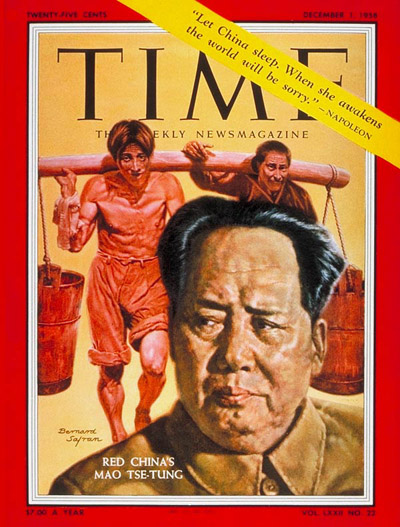
May 16, 1966: Mao Zedong, founder of the People's Republic of China and Chairman of its Communist Party, strikes back against his internal enemies.
In 1958, he launched a plan to transform the country into a modern industrialized state, a plan he called "the Great Leap Forward." He thought that establishing "people's communes" in the countryside, focused mostly on producing steel, would be a good way to go about it.
Taking people who only knew farming and getting them to leave their fields to become steelworkers had worked in America, earlier in the 20th Century. But that was by those men's own choices, because they believed that packing everything up and leaving the South to go North, or West, and learn the necessary skills, however hard it might be, was a better life than living in segregation and rural poverty -- a poverty so bad, it made white men as well as black ones leave.
In contrast, Mao was forcing his decision on people who didn't ask for it, and were completely unprepared for it, and over 30 million people starved to death. Li Jingquan, the Party boss in Sichuan, told Mao that 10.6 million people had died in his province alone by 1961.
In terms of numbers, the Great Leap Forward may have been the greatest blunder in human history. But there's a big difference between a blunder and a crime.
Mao abandoned the program after getting the numbers. Thereafter, moderates in China reversed many of the Great Leap Forward policies, and even began cutting Mao out of economic decision-making. Having an ego as big as his country, Mao didn't like this. In 1964, he saw that the Soviet Union had removed Nikita Khrushchev from power, and figured the same thing could happen to him, and he needed to do something about it. So he determined who had questionable loyalty, and secured his position by removing them from powerful positions, replacing them with sycophants.
Then, on May 16, 1966, there was a "notification": Mao declared the beginning of what he called the "Cultural Revolution." He said the moderate approaches that followed the catastrophe of the Great Leap Forward were bad, and that the Communist Party of China had to re-impose Maoism.
He called on the followers of the cult of personality he'd built to rise up in violent class struggle, proclaiming, "To rebel is justified." On January 5, 1964, he published Quotations from Chairman Mao Tse-Tung (that's how his name was usually written in English during his lifetime). By 1966, he had over 1 billion copies of this "Little Red Book" made up, so that it could fit in the pocket of every person in China. (The country didn't have a billion people yet, but it would become the 1st country to reach that figure.) Among the better-known of these quotations:
* "War is a continuation of politics."
* "Politics is war without bloodshed, while war is politics with bloodshed."
* "In waking a tiger, use a long stick."
* "Despise the enemy strategically, but take him seriously tactically."
* "Political power grows out of the barrel of a gun."
* "All reactionaries are paper tigers."
Countless people were persecuted, massacres were abundant, and millions more died. And, because intelligent people are more likely to question the leader, intellectuals were maligned, and schools were closed. In an intentionally cruel reversal of his Great Leap Forward, Mao forcefully transported 17 million young, urban intellectuals to the countryside to be made to work as farmers, as punishment for their less-than-fully-loyal thinking.
All of this proved every bit as ineffective, if not as fatal. By 1971, knowing that the Cultural Revolution was failing, and that his health was also beginning to fail, Mao was willing to meet with the President of the United States, Richard Nixon. Mao died in 1976, and the power struggle thereafter was won by Deng Xiaoping. Because he was willing to experiment with free-market reforms, he was able to do what Mao was not: Turn China into a modern industrial nation -- though still a brutal totalitarian regime.
*
May 16, 1966 was a Monday. Singer Janet Jackson was born. The youngest of the 9 singing siblings from Gary, Indiana, she not only became the 2nd-most successful, but was able to establish her own "brand," separate from Michael, although they did occasionally work together. Pro Football Hall-of-Famer Thurman Thomas was also born that day.
It was also the release day for two legendary rock and roll albums: Pet Sounds by The Beach Boys, and Blonde On Blonde by Bob Dylan. I have a separate entry for that dual event.
As Monday is often a travel day in baseball, football was out of season, and this was before the NBA and Stanley Cup Playoffs extended that far into the calendar year, only 1 major sporting event was played that day.
The Minnesota Twins beat the Washington Senators, 2-1 at Metropolitan Stadium in the Minneapolis suburb of Bloomington, Minnesota. Camilo Pascual went the distance for the win for the defending American League Champions. Harmon Killebrew went 1-for-3 with a walk. The Senators' only run came on a home run by Jim King.
The current Senators franchise had been founded in 1961, to take the place of the old Senators franchise, who had moved to Minnesota. The "New Senators" also moved, after the 1971 season, to become the Texas Rangers.