Showing posts with label heavyweight championship of the world. Show all posts

Sunday, December 25, 2022

December 26, 1908: The Shocking Triumph of Jack Johnson

December 26, 1908: Jack Johnson, a 30-year-old black man from Texas, known as the Galveston Giant, knocks out Canadian fighter Tommy Burns at Sydney Stadium in Sydney, Australia. This makes Johnson the 1st black man to win the Heavyweight Championship of the World.

(Johnson wasn't really a giant: He was 6 feet even, but a solid 200 pounds at his peak fighting condition.)

It was what we would now call a technical knockout: It was stopped after the 14th round, because Burns, considerably lighter and possibly ill with the flu, was totally outmatched.

Ironically, Burns might well be totally forgotten today had he won the fight. After all, who remembers who he beat for the title? (It was Marvin Hart.)

This "conquest of the white man," and his flamboyant lifestyle, made Johnson the most hated man in America. Even many black people hated him, for making them look bad. He didn't care: He was still going to be Jack Johnson.

So America's white establishment looked for a "Great White Hope" who could beat Johnson. Four times in 1909, a fighter was put up against Johnson:

* Philadelphia Jack O'Brien, the Light Heavyweight Champion, fought him in Philadelphia. It was a draw, but O'Brien didn't want a rematch.

* Tony Ross fought him in Pittsburgh, and Johnson beat him.

* Al Kaufman fought him in San Francisco, and Johnson beat him.

* Stanley Ketchel, the Middleweight Champion, a vicious fighter known as the Michigan Assassin, made a deal with Johnson, the same deal that O'Brien had made with him: They would fight to a draw, and thus split the proceeds from the film rights. It was a good plan. Except Ketchel got greedy, for the title and the money, and knocked Johnson down. All that did was make Johnson mad, and he not only knocked Ketchel out, he knocked out a bunch of his teeth. The film of the fight is clear enough to see Johnson brushing Ketchel's teeth out of his glove.

Now, the search for a Great White Hope became truly intense. Novelist Jack London, tapping into the racism of the time, had a nationally syndicated newspaper column, and used it to address Jim Jeffries, who had been Heavyweight Champion from 1899 to 1904, and retired undefeated to an alfalfa farm outside Los Angeles. London wrote, "Jeff, it's up to you."

Johnson was willing to fight Jeffries. Having waited so long for his shot at the title, he knew he had no right to duck anybody. Jeffries had gotten fat in his retirement. He went on a crash diet and exercise program, and actually got back down to his usual fighting weight. But losing so much weight so soon weakened him. And the fight was the middle of the desert, in Reno, Nevada. Jeffries was used to California heat, but not this kind of heat, and the South Texas native Johnson was used to it. And Johnson was in peak physical condition.

So the fight was a mismatch. It was scheduled for a maximum of 45 rounds, which sounds brutal for the modern era, where the norm became 15, and eventually 12 by the 1980s. Jeffries hung on for 12 rounds, but in the 13th, Johnson did what (it was said -- the records may be wrong) no other fighter had ever done: He knocked Jeffries down. Jeffries got up. He shouldn't have, because Johnson knocked him out in the 15th.

In 1912, Johnson was arrested for violating the Mann Act, which forbade "transporting women across State lines for immoral purposes." The woman in question was Lucille Cameron. Contrary to what is often reported, Cameron was not already Johnson's wife, which would have made the charge impossible to prove in court -- not that an all-white jury would have cared. But she refused to cooperate, and soon married Johnson.

In 1913, Johnson was arrested on the Mann Act again. This time, in a Chicago courtroom presided over by Judge Kenesaw Mountain Landis, later to become the 1st Commissioner of Baseball and the perpetuator of the sport's "color line," Johnson was convicted by an all-white jury, and sentenced to a year and a day in prison.

He skipped bail, and escaped first to Canada, then to France. Having only defended his title once since the Jeffries fight, he could now only do so abroad. On December 19, 1913, in Paris, in the 1st-ever Heavyweight Championship fight between 2 black men, he may have recognized the significance, and held back a little, as he fought Battling Jim Johnson (no relation) to a rather lackluster draw. In 1914, he defeated Frank Moran in Paris. In early 1915, he knocked Jack Murray out in Buenos Aires, Argentina.

Finally, it all caught up with him. Jess Willard, a 6-foot-6 Kansan, became the latest "Great White Hope." On April 5, 1915, at Oriental Park, a horse racing track in Havana, Cuba, in a fight scheduled for 45 rounds, and held in heat even worse than in Reno 4 years earlier, perhaps he finally got tired of being Jack Johnson, and threw the fight. Or maybe, at 37, the oldest Heavyweight Champion ever (and he would remain so until Jersey Joe Walcott in 1951), he just wasn't in shape anymore. Willard knocked him out in the 26th round.

Jack and Lucille Johnson continued to live abroad. Finally, on July 20, 1920, Jack crossed the border from Mexico to America, and surrendered to federal agents. He was taken to the federal penitentiary at Leavenworth, Kansas (with some irony, in Willard's home State), and began serving his sentence. He was released early, on July 9, 1921.

Lucille was the 3rd of what turned out to be 4 wives for Jack Johnson. Only the 1st was black. On June 10, 1946, he was driving on U.S. Route 1 near Franklinton, North Carolina, when he crashed into a telegraph pole, and died. He was 68 years old.

*

December 26, 1908 was a Saturday. Baseball was out of season. Football season had ended. Professional basketball did not exist. And the biggest hockey league of the time, the Eastern Canada Amateur Hockey Association, didn't start its season for another 11 days.

But there were scores. It was Boxing Day, and, in Britain, there was a tradition of soccer teams playing each other on back-to-back days, a home-and-home series on Christmas Day and Boxing Day. On the 25th, Woolwich Arsenal and Leicester Fosse played each other to a 1-1 draw at the Filbert Street stadium in Leicester. On the 26th, they played at The Arsenal's home, the Manor Ground, in Plumstead, South-East London, and Arsenal won, 2-1. Eventually, Woolwich Arsenal would move to North London, and become simply Arsenal Football Club; while Leicester Fosse became Leicester City.

Wednesday, December 14, 2022

December 14, 1920: George Gipp Dies

December 14, 1920: George Gipp dies of pneumonia, possibly related to a streptococcus infection, at St. Joseph's Hospital in South Bend, Indiana, seat of the University of Notre Dame, where he was a student. He was 25 years old.

He was born on February 18, 1895, 13 days after Babe Ruth, and 16 days after George Halas, in Laurium, on the Upper Peninsula of Michigan. He went to Notre Dame hoping to play baseball. But their head coach, Knute Rockne, thought he would be a good back, both offensive and defensive, in football. Gipp had never played the sport before, but tried it anyway.

Rockne proved to be right: Gipp was named an All-American for the 1920 football season, as Notre Dame went undefeated, 9-0:

* October 2: Beat Kalamazoo College at home, 39-0. (They are now in NCAA Division III.)
* October 9: Beat Western State at home, 42-0. (Also based in Kalamazoo, they are now named Western Michigan University.)
* October 16: Beat Nebraska in Lincoln, 16-7.
* October 23: Beat Valparaiso at home, 28-3. (Valparaiso is based in the Indiana town of the same name.)
* October 30: Beat Army at West Point, 27-17.
* November 6: Beat Purdue at home, 28-0.
* November 13: Beat Indiana at Washington Park in Indianapolis, 13-10.
* November 20: Beat Northwestern in Evanston, 33-7.
* November 25, Thanksgiving Day: Beat Michigan Agricultural in East Lansing, 25-0. (Now known as Michigan State.)

Notre Dame outscored its opponents 251-44, for an average of 29-5. And Gipp was a major reason why, on both sides of the ball. There were no official National Championships in those days, but, retroactively, some sources have listed Notre Dame as such. (Other sources awarded it to Harvard or the University of California.) 

So how did he get sick? Most likely, he was giving punting lessons in cold weather. Being in northeastern Indiana, the cold weather is the reason that the Notre Dame-USC game is played in October when it's the Fighting Irish's turn to host it, and on Thanksgiving Saturday when it's USC's turn to host in Los Angeles.

The more popular version, but the less likely one, is that Gipp, a known carouser, returned to campus after curfew one night, and found his residence hall locked. He went to Washington Hall, the campus' theatre building, because he knew the back door was often unlocked, and spent many post-curfew nights in the hall. This time, the door was locked, so he slept outside, and that's how he got pneumonia.

This story is believable because Gipp was a carouser. He was a gambler, a womanizer, and a drunkard. He was a cardplayer and a pool hustler. He would bet on anything. He even bet on his own team, just like Pete Rose would decades later. He also tended to not show up for classes (mandatory) or Mass (equally mandatory for a Catholic school in those days).

And the University, including Rockne himself, covered up for him. Under modern NCAA rules, Gipp might have singlehandedly gotten Notre Dame put on probation.

At any rate, there were no antibiotics available then. Had there been, he could have recovered quickly, spent a nice Christmas at home on the U.P., and played in the early National Football League and become a star, making bundles of money. He, rather than Red Grange of Illinois and the Chicago Bears a few years later, could have become the NFL's 1st real star. (Or maybe its 2nd, after Jim Thorpe, who was already playing for the Canton Bulldogs.) Alas, in those pre-antibiotic days, you really could die from something as simple as "strep throat."

He was buried in Lake View Cemetery, outside Calumet, Michigan. Laurium put up a monument to him.

On November 10, 1928, Notre Dame played Army at Yankee Stadium. A crowd of 78,188 saw the Cadets lead the Fighting Irish 6-0 at halftime. It wasn't that surprising: Army was undefeated, 6-0, while Notre Dame was only 4-2.

In his halftime pep talk, instead of discussing strategy, Rockne told his players, who would have been in junior high school in 1920, about George Gipp. As Rockne told it, he went to see Gipp on his deathbed, and Gipp told him: 

I've got to go, Rock. It's all right. I'm not afraid. Some time, Rock, when the team is up against it, when things are wrong, and the breaks are beating the boys, ask them to go in there with all they've got, and win just one for the Gipper. I don't know where I'll be then, Rock. But I'll know about it, and I'll be happy.

Having told the 1928 players that story, Rockne concluded by saying, "Gentlemen, this is that game." And the players left the locker room in tears, and came from behind, and beat Army 12-6.

That's the story. But it makes no sense. First of all, why choose this game? Because it was in New York? Because it was against Army? Certainly, Rockne didn't need to be afraid of losing his job: He was already an icon in South Bend.

Second of all, they were only down by 6 points. Maybe if they needed a much bigger effort, to overcome a 2-touchdown deficit, such a speech might be warranted.

Third of all, like I said, those players were just kids when Gipp died. They never saw him play. It's not like there was television back then. The newsreels probably never showed Gipp. For all they knew, Rockne could have been lying, and Gipp could have walked into the room at that moment, and they wouldn't have recognized him. (Another coach, Edward "Slip" Madigan of St. Mary's in the San Francisco Bay Area, allegedly once tearfully told his players about his sick son, and said to win the game for him, when the son walked in, just fine.) Gipp's legend shouldn't have had any effect on the 1928 Fighting Irish.

And fourth of all, if the locker room speech did happen, Rockne probably made it up. As one sportswriter put it, decades later, If Gipp said anything to Rockne as he was dying on December 14, 1920, it was probably more along the lines of, "Put a hundred bucks on the 4 horse in tomorrow's 7th race at Arlington for me."

Rockne was killed in a plane crash near Bazaar, Kansas on March 31, 1931. So, whatever the truth of the final meeting between Gipp and Rockne was, it died with Rockne.

On October 4, 1940, the film Knute Rockne, All-American premiered. Pat O'Brien played the coach. Ronald Reagan, who had played guard at Eureka College in Illinois, now an NCAA Division III school, played Gipp, and played the speech scene straight.
Reagan as Gipp

As Reagan went into politics in the 1960s, and was elected President in 1980, he often played up his connection to Notre Dame. At the 1988 Republican Convention, at the Superdome in New Orleans, knowing he couldn't run for a 3rd term, he told the new nominee, his Vice President, George H.W. Bush (who played baseball at Yale), "Go out there, and win one for the Gipper!" Meaning himself. Bush did win the election.

As Reagan fell victim to Alzheimer's disease, and could no longer make public appearances, campaign signs reading, "WIN ONE FOR THE GIPPER" appeared at rallies for Bob Dole in 1996 and George W. Bush in 2000. Reagan died in 2004, and during Bush's re-election campaign, there were more "Gipper" signs than ever before. They still come up, every 4 years: For John McCain in 2008, for Mitt Romney in 2012, and for Donald Trump in 2016 and 2020.

Reagan's political career was built on many, many lies. The "Win one for the Gipper" story was the first. If the truth about Gipp had been widely known in 1966, when Reagan was making his 1st run for public office, for Governor of California, he might never have won an election. After all, the other movie people tended to remember him for was Bedtime for Bonzo, where he worked with a chimpanzee.

George Gipp was a real person, and he really was a great football player. But the thing everybody remembers about him almost certainly isn't true. But, like Reagan's campaign promises, Rockne's Gipper speech was a fraud -- or, as the actual Irish would say, it was blarney -- that worked very well.

*

December 14, 1920 was a Tuesday. There were no scores on this historic day: The college football season was over except for the Rose Bowl, baseball was out of season, the NBA hadn't been founded yet, and while the NHL season was underway, no games were scheduled.

But there was one notable sporting event that day. Jack Dempsey defended the Heavyweight Championship of the World, knocking Bill Brennan out in the 12th round, at the 2nd Madison Square Garden, the one that stood off the actual Madison Square, at 26th Street and 5th Avenue, from 1890 to 1925. It was his only fight at any building with the name Madison Square Garden.

Monday, December 5, 2022

December 5, 1947: The 1st Louis vs. Walcott Fight

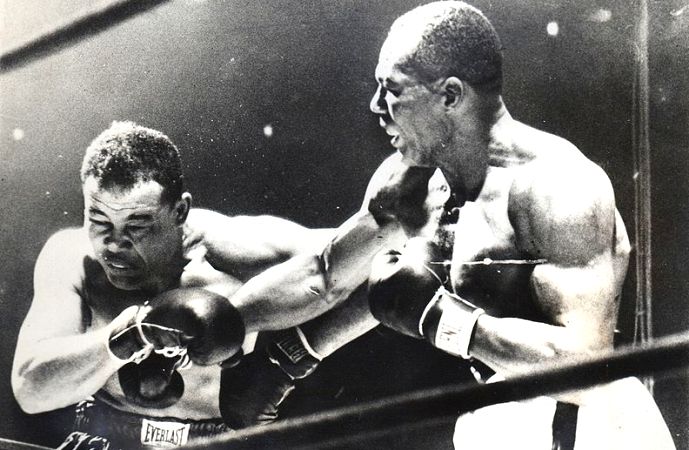
December 5, 1947: Joe Louis defends the Heavyweight Championship of the World against Jersey Joe Walcott, at the old Madison Square Garden. Joseph Louis Barrow had held the title for 10 years. Arnold Raymond Cream, a son of an immigrant from the U.S. Virgin Islands, had named himself after Joe Walcott, from the Caribbean island of Barbados, who held the Welterweight Championship from 1901 to 1906. Jersey Joe, from Pennsauken, across the Delaware River from Philadelphia, was 33, and was thus becoming the oldest man ever to fight for the heavyweight title to that point.

Louis, 56-1 going into the fight, has been called the greatest Heavyweight Champion ever. Those who disagree cite his fighting of what came to be called "The Bum-of-the-Month Club." Most of his opponents were not on his level, although a few were, including Max Schmeling and Billy Conn.

But Louis had trouble with mobile boxers, and Walcott, 42-13-1, was one of them. He knocked Louis down in the 1st round, stunning the live crowd and a nationwide radio audience. He knocked Louis down again in the 4th. As the fight went on, it looked like the twilight of a god: Louis, only 4 months younger than Walcott, looked done.

The fight went the distance, and many observers believed Walcott deserved to be named the winner. But Louis was given a split decision. It was a very controversial decision, even mentioned on an episode of M*A*S*H, 35 years later.

The decision wasn't based on race, as Walcott was also black. It was almost certainly based on money: A rematch could be held in warm weather, outdoors, at the enormous Yankee Stadium, and make more money. Louis won that fight by knockout, on June 25, 1948.

Walcott finally won the title on July 18, 1951, by beating Ezzard Charles. He and Walcott fought 4 times, Charles winning the 1st 2, Walcott the last 2. At 37, he was the oldest man ever to win the title. He lost the title a year later, to Rocky Marciano.

He later refereed the 2nd Muhammad Ali-Sonny Liston fight. In 1971, he was elected Sheriff of his native Camden County, the 1st black Sheriff in New Jersey, serving for 3 years. From 1975 to 1984, he was the Chairman of the New Jersey State Athletic Commission. He died in 1994, 10 months before George Foreman replaced him as the oldest Heavyweight Champion ever. He had outlived Louis by 13 years.

*

December 5, 1947 was a Friday. Baseball was out of season. Football was in midweek: Neither the college ranks, nor the NFL, nor the rebel All-America Football Conference played any games that night. And there were no games scheduled in the NHL.

One game was played in the Basketball Association of America, the league that became the NBA 2 years later: The Boston Celtics beat the Providence Steam Rollers, 73-69 at the Boston Garden.

Saturday, November 26, 2022

November 26, 1982: Holmes vs. Cobb: The Bloodbath That Changed Boxing

November 26, 1982: Larry Holmes wins a unanimous decision over Randall "Tex" Cobb at the Astrodome in Houston, and retains the Heavyweight Championship of the World.

This fight was broadcast live on ABC on the night after Thanksgiving, meaning families may have been watching it together. It was 13 days after Korean boxer Kim Duk-koo was fatally injured in a live televised fight with Lightweight Champion Ray "Boom-Boom" Mancini.

Between them, these 2 fights led to changes in boxing. The maximum of 15 rounds was reduced to 12. A standing eight-count for any knockdown was required. And any fighter knocked out automatically had his license suspended for 45 days, for his own safety.

Howard Cosell, for years ABC's lead boxing announcer, called the Holmes-Cobb fight. He was so appalled by the beating the Cobb took that he vowed never to broadcast another professional prizefight. He kept that vow, as the only fights he broadcast thereafter were the amateur ones, with tighter rules, in the 1984 Olympics in Los Angeles. Upon hearing that Cosell was quitting boxing, Cobb said, "I can do my sport no greater service."

As of November 26, 2022, Holmes and Cobb are both still alive. As far as I know, neither has been mentally impaired due to boxing.

*

November 26, 1982 was a Friday: As I said, the day after Thanksgiving. Baseball was out of season. The NFL was in midweek. There were 2 college football games that day, both of them major rivalries, and both clashes between highly-ranked teams. Number 2 Penn State beat Number 5 University of Pittsburgh, 19-10 at Beaver Stadium in State College, Pennsylvania. And Number 3 Nebraska beat Number 11 Oklahoma at Memorial Stadium in Lincoln, Nebraska.

Penn State was then an independent, and thus had no Conference Championship to win. Nebraska clinched the Big Eight Conference title. Penn State went to the Sugar Bowl in New Orleans, which became a de facto National Championship game, because they were playing the Southeastern Conference Champions, Number 1 Georgia. Nebraska went to the Orange Bowl in Miami, and played Number 13 Louisiana State University.

The games were being played at the same time, the Orange Bowl on NBC and the Sugar Bowl on ABC, and Nebraska's only hope of winning the National Championship was to blow LSU out, and hope that Penn State beat previously undefeated Georgia in a dull game. Instead, it was a very good game, although for those of us who don't like Penn State, it was a bad result: The Nittany Lions won, 27-23. And the Tigers held the Cornhuskers to another classic, with Nebraska winning, 21-20. So Penn State got the National Championship.

There were 8 games in the NBA:

* The New Jersey Nets lost to the Phoenix Suns, 110-99 at the Arizona Veterans Memorial Coliseum.

* The Boston Celtics beat the Utah Jazz, 137-103 at the Boston Garden.

* The Philadelphia 76ers beat the Cleveland Cavaliers, 120-102 at The Coliseum in the Cleveland suburb of Richfield, Ohio.

* The Detroit Pistons beat the Portland Trail Blazers, 132-118 in overtime at the Silverdome in the Detroit suburb of Pontiac, Michigan.

* The Washington Bullets beat the Indiana Pacers, 87-85 at the Market Square Arena in Indianapolis.

* The San Antonio Spurs beat the Chicago Bulls, 122-120 at the HemisFair Arena in San Antonio. George Gervin led all scorers on the day with 44 points.

* The Los Angeles Lakers beat the San Diego Clippers, 117-115 at the San Diego Sports Arena (now the Pechanga Arena). Magic Johnson scored 32 points.

* And the Seattle SuperSonics beat the Denver Nuggets, 127-106 at the Seattle Center Coliseum.

And there were 6 games in the NHL:

* The New Jersey Devils and the Vancouver Canucks played to a tie, 4-4 at the Pacific Coliseum in Vancouver.

* The Chicago Black Hawks beat the Hartford Whalers, 4-3 at the Hartford Civic Center (now the PeoplesBank Arena).

* The Washington Capitals beat the Toronto Maple Leafs, 5-3 at the Capital Centre in the Washington suburb of Landcover, Maryland.

* The Buffalo Sabres beat the St. Louis Blues, 8-6 at the Buffalo Memorial Auditorium.

* The Pittsburgh Penguins and the Minnesota North Stars played to a tie, 6-6 at the Metropolitan Sports Center in the Minneapolis suburb of Bloomington, Minnesota.

* And the Edmonton Oilers beat the Winnipeg Jets, 6-5 at the Winnipeg Arena.

Sunday, November 20, 2022

November 20, 1976: "Rocky" Premieres

Sylvester Stallone and Talia Shire

November 20, 1976: The film Rocky premieres -- and the fact that it hit movie screens at all is as much of an underdog story as the story it tells.

Sylvester Stallone, a struggling actor, wrote the screenplay in 3 days in March 1975. It entered a complicated production process after Stallone refused to allow the film to be made without him in the lead role. United Artists eventually agreed to cast Stallone after he rejected a six-figure ($100,000 or more) deal for the film rights.

Principal photography began in January 1976, with filming primarily held in Philadelphia. Several locations featured in the film are now considered cultural landmarks. When Stallone ran up the 72 steps of the Philadelphia Museum of Art, they became known as the Rocky Steps. With an estimated production budget of under $1 million, Rocky popularized the "rags to riches" and "American Dream" themes of sports dramas which preceded it.

The film begins in November 1975, and Apollo Creed (played by former NFL player Carl Weathers), the Heavyweight Champion of this fictional world, is preparing to begin 1976, America's Bicentennial year, with a fight in the country's founding city, Philadelphia, on New Year's Day. (In real life, that year, Philly hosted the MLB, NBA and NHL All-Star Games, and the NCAA Final Four, but not a Heavyweight Championship Fight.)

The intended opponent has to back out due to an injury. Every other major contender is unavailable. Apollo decides to hire a local challenger, just so the investment in setting up the fight can pay off. The choice is Robert "Rocky" Balboa, of Italian descent, lefthanded, and with a pedestrian record, mostly in small gyms. Offered $150,000 -- $816,000 in 2022 money -- he accepts.

He begins training with Mickey Goldmill (Burgess Meredith), a Jewish boxer in the 1920s who became a trainer. Rocky's unusual training methods include punching sides of beef in a meat locker, drinking raw eggs, and running round the city, including up the 72 steps of the Philadelphia Museum of Art -- which, at the end of Rocky V, he admits to his son Rocky Jr. (then played by Sly's real-life son, Sage Stallone), he'd never been inside.

Rocky's best friend is Paulie Pennino (Burt Young), and he begins to date Paulie's sister, Adrian (Talia Shire -- making Rocky lucky that he wasn't dating the character Shire was previously best known for, because her brother was Michael Corleone, The Godfather). Rocky and Mickey take Paulie on as a cornerman for the fight. Rocky tells Adrian he doesn't think he can win, but that his real goal is to go the full 15 rounds with Apollo, something no fighter has yet done.

New Year's Day arrives, and the fight is held at The Spectrum. (Although most of the movie was filmed in Philadelphia, the Los Angeles Memorial Sports Arena stood in for the home of the NBA's 76ers and the NHL's Flyers.) Before the fight, Joe Frazier, former Heavyweight Champion (1968-73), who lived his adult life in Philadelphia and opened a renowned boxing gym there, is introduced, playing himself. This indicates that he existed in the film’s universe, possibly as the champion immediately before Apollo, whose braggadocio and style were meant to evoke Muhammad Ali, if an overtly patriotic one who would never have dodged the draft. Which begs the question: Did Ali exist in those films? If so, did he never get the title back?

To everyone's shock, a left hook from Rocky knocks Apollo down, the 1st knockdown of his career. More stunned than hurt, he realizes that this apparent "tomato can" is serious, and he starts pounding him, winning the round anyway. Afterward, his trainer, Duke Evers (Tony Burton) tells Apollo what he already knows: "He doesn't know it's a damn show! He thinks it's a damn fight!"

The fight is hard. After the 14th round, Rocky's eye is swollen, and he can't see out of it. In a scene I've always found hard to watch, he says, "Cut me, Mick, cut me," and Mickey cuts his eyelid open with a razor, a wound that will have to be surgically repaired.

At the same time, in a moment reminiscent of Frazier and Eddie Futch at this point in the Thrilla in Manila, 3 months before this in real life, Duke (whom we learn in Rocky IV essentially raised him) tells Apollo, "Champ, you're bleedin' inside. I'm gonna stop the fight." Apollo says, "You ain't stoppin' nothin'!" Rocky is equally determined to finish, telling Mickey, "You stop this fight, and I'll kill you!"

Somehow, both survive the 15th round, and they are practically holding each other up at the final bell. Apollo says, "There ain't gonna be no rematch!" Rocky says, "Don't want one!"

Paulie distracts security, so that Adrian can get into the ring. Just as impressionists do Marlon Brando yelling, "Stella!" in A Streetcar Named Desire, impressionists always copy Stallone by yelling, "Adrian!" (Sure enough, film critic Roger Ebert, giving the film 4 stars, said that Stallone reminded him of the young Brando.) They embrace in the ring.

Rocky got what he wanted: The girl, and the respect, including the self-respect, that came from going the distance with the greatest boxer in the world. The audience can be excused for missing the announcement of a split decision in Apollo's favor, as the music composed by Bill Conti reaches its crescendo and the film ends.

The film was a smash, becoming beloved, especially by Italian-Americans, and has become regarded as the ultimate "sports underdog movie." It was nominated for 9 Academy Awards, including acting nominations for Stallone, Shire, Meredith and Young. None won. The film won 3: Best Picture, Best Director for John G. Avildsen, and Best Film Editing (although boxing experts have called the staging of the fights in the Rocky films unrealistic). Conti and lyricists Carol Connors and Ayn Robbins were nominated for Best Original Song for the film's theme, "Gonna Fly Now," which hit Number 1 early in 1977.

Tourists in Philadelphia began running up the Art Museum steps, and posing with their arms raised like Rocky when they got to the top. They sought out other locations from the movie, including the Italian Market, centered on South 9th Street. (The rowhouse containing Rocky's apartment is not, however, in South Philadelphia: It's at 1898 East Tusculum Street, in the Kensington Section of Northeast Philly.)

But some fans couldn't handle the fact that Rocky lost in the end. So there had to be a sequel. Rocky II was released in 1979, and showed Rocky and Adrian's wedding, and Adrian nearly dying giving birth to Rocky Jr. The rematch, on Thanksgiving 1976, also went 15 harsh rounds, and they knocked each other down. Rocky got up at the count of 9, Apollo didn't. Rocky was the Champion.

Rocky III, in 1982, featured a twist: Both boxers from the 1st 2 films needed redemption. In the opening credits, Rocky is shown successfully defending his title 10 times. But none of them are as good as James "Clubber" Lang, played by Mr. T, a Chicago brawler who has become the Number 1 contender. Mickey doesn't want Rocky fighting Clubber. Rocky says it will be his last fight. Clubber knocks him out in the 2nd round, and Mickey dies of a heart attack.

At his lowest ebb, Rocky is approached by Apollo, who claims that Rocky has lost "the eye of the tiger." (A song by the band Survivor, "Eye of the Tiger," serves as the film's theme song, and hit Number 1 in 1983.) Apollo takes Rocky and Paulie to his old stomping grounds, the Watts ghetto of Los Angeles, and trains him Creed-style, until Rocky is more than ready for the rematch at Madison Square Garden on New Year's Day 1982.

Wearing Apollo's famed star-spangled boxing trunks, he fights like Apollo: He dodges punches instead of his usual tactics of simply taking them and showing how tough he is, dances around the ring, and taunts his opponent. Clubber's anger gets the better of him, and Rocky knocks him out in the 3rd round.

For this film, a statue of Rocky was commissioned, and places on the Art Museum steps. It was later moved to The Spectrum, but after that arena closed in 2010, instead of being moved across the street to its replacement, the Wells Fargo Center, it was moved back to the Art Museum, where it remains.

Rocky IV was released in 1985, at a rather chilly moment in the Cold War. Ivan Drago (Dolph Lundgren) is the 1st Soviet professional boxer. He wants to fight Rocky, but Rocky is done. Apollo, great patriotic American that he is, steps in, and they fight in Las Vegas. But the steroided-up Drago literally kills Apollo in the 2nd round.

Rocky agrees to avenge his friend, and a fight with Drago is set for Christmas Day in Moscow. (The Pacific Coliseum in Vancouver stood in as the arena.) Rocky, Paulie and Duke (and, eventually, Adrian) train in Siberia, old-school, while Drago has the best training that 1980s Soviet technology can offer. And the Moscow crowd is totally behind Drago, with a Mikhail Gorbachev lookalike and various Red Army generals in the stands. And Drago is in his prime, while Rocky is nearly 40 years old. He has had no advantages whatsoever: The king of the underdogs has never been this much of an underdog before.

It looks like the fight will be no contest, but in the 2nd round, Rocky launches a punch that cuts Apollo. Duke tells him, "You see? He's not a machine! He's a man!" The implication is, a man can be beaten. As the fight goes on, Drago is way ahead on points, but Rocky has bloodied him a bit. The Soviet crowd, seeing Rocky's courage, begins to chant his name. Finally, in the 15th round, his face a pulp, and his vision again affected -- he tells Paulie, "I see three of him," and Paulie, as if addressing a drunk, says, "Hit the one in the middle" -- Rocky knocks Drago out.

After the fight, he addresses the crowd. He says that two men trying to kill each other is better than 20 million trying to do it. The crowd saw the humanity in him, and he saw it in them. He tells them, "If I can change... and you can change... everybody can change!" As the translation to Russian hits the crowd, they cheer one more time.

That should have been the end of the story. (Indeed, the original plan was for Rocky to win, then die, and close with Adrian giving a speech at the funeral.) But Stallone couldn't resist the desire for another story, or the money that would come with it. Rocky V, released in 1990, is a film that not all "Ring Cycle" fans agree should be considered canon, and it's regarded as the worst film in the series.

It begins right after the Drago fight, and Rocky can't stop his hands from shaking. When he gets back, its shown that Drago's punches didn't kill him, but did inflict brain damage. And a crooked account zapped Rocky's finances, so he has to move out of his Main Line mansion back to the old neighborhood. Rocky and Adrian are used to this, but Rocky Jr. has only known being rich, and he's not prepared to face city kids. His father teaches him some pointers, and he wins a fight, and is okay from there.

Rocky starts running Mickey's old gym, where he trains Tommy "The Machine" Gunn (played by real-life boxer Tommy Morrison). Union Cane (Michael Anthony Williams) wins the title vacated by Rocky's retirement. He is guided by promoter George Washington Duke. (He should not be confused with Apollo's trainer Duke Evers. He is played by Richard Gant, as an obvious parody of real-life promoter Don King).

Gunn rises through the ranks, and Duke signs him to a contract. Rocky is depressed, telling Adrian that training Gunn gave him new purpose, but Adrian tells him that Gunn never had his heart, and that's something that can't be taught. Sure enough, when Gunn beats Cane for the title, he walks right past Rocky, and gives all the credit to Duke at the press conference.

The public turns on Gunn, saying that he's not a "real champion," because Cane wasn't, because he didn't beat the champ (Rocky). Gunn and Duke know they have to have a fight with Rocky, so they go to the bar with a TV crew, and challenge Rocky on the spot. Rocky refuses. They keep taunting him, Paulie tells them to get lost, and Gunn sucker-punches Paulie, knocking him out.

Seeing this, Rocky challenges Gunn to a fight -- not with sanctioning and rules and promotions, but right outside, in the street. That's not what Duke wants, as he can't make any money off of it, but Gunn is fine with it: He knows the cameras will record it, and people will see him beat Rocky, and know who the real Champion is.

Unusually, Rocky has the upper hand at first. Gunn steps up his game, and knocks Rocky down. The force of the punches, and the brain damage he's suffered, making him think he's being hit by Lang and Drago. But it also causes him to hallucinate seeing Mickey, which spurs him to get up. With the crowd, including his wife, son and brother-in-law watching, Rocky knocks Gunn out. He then comes face-to-face with Duke, and looks like he wants to punch him. Duke says, "Come on, pug: Touch me, and I'll sue." Rocky punches him, and says, "Sue me for what?"

That should have been the end. He'd fought a champion. He'd fought a scarier one. He'd fought a scarier one still. He'd defeated the greatest opponent a man could ever face: His own self-doubt -- many times over. The story should have ended there. When I heard that a Rocky VI was in the works, I asked, "Who's he fighting next, Godzilla?" As it turns out, the opponent was one that eventually beats us all: Father Time.

Rocky Balboa -- no Roman numeral -- was released in 2006. Rocky seems to be fully recovered, at least physically, from the trauma he suffered against Drago. He runs a restaurant, named Adrian's. Unfortunately, the reason he named it after his wife is that Adrian had died. (Shire didn't want to do another Rocky movie.) Rocky Jr. (now played by Milo Ventimiglia), now going by his given name Robert, is a lawyer, and he and his father don't see eye-to-eye. He and Paulie both accuse Rocky of living in the past.

The current Heavyweight Champion of the World is Mason "The Line" Dixon (Antonio Tarver, then the real-life Light Heavyweight Champion). He's undefeated, but hardly undisputed: He's been accused of never having fought a true contender. To bruise his ego further, ESPN broadcasts a computer simulation of a fight between Dixon and prime Rocky (something to which neither fighter agreed), and Rocky wins by knockout.

Rocky sees this, and, despite being 60 years old, renews his boxing license, and starts training again. Hearing this, Dixon's promoters suggest a charity exhibition fight in Las Vegas. Concerned for his father's well-being, Robert seeks him out, and they reconcile over Adrian's grave. Duke Evers returns to train Rocky, making him stronger than ever despite being more than middle-aged.

In the fight, Dixon dominates at first, but injures his left hand in the 2nd round. Rocky knocks him down. The fight continues, intended for 10 rounds, and going that far. A microphone picks up Rocky calling Dixon "a great champion." Rocky's last fight ends the way his first fight for the title did: With his belief in himself renewed, and a standing ovation from the crowd, but with his opponent winning a split decision. Unlike Apollo, however, Dixon's reputation grows.

Okay, so that was the end of it, right? I mean, who's left for Rocky to face? Godzilla? Aliens? Does he travel to our world, and face Muhammad Ali? Does he fight Superman, like Ali once did in a comic book?

Creed premiered in 2015. Michael B. Jordan played Adonis "Donnie" Creed, son of Apollo. Rocky trains him, along with Tony Evers Jr., Duke's son, a.k.a. "Little Duke" (Wood Harris). The elder Duke and Paulie have since died (though Tony Burton and Burt Young had not yet), and Robert does not appear in the film. And Rocky fights the deadliest, most heartless opponent of all: Cancer.

Donnie fights the Light Heavyweight Champion, a British boxer named "Pretty" Ricky Conlan (Tony Bellew), in Conlan's hometown of Liverpool, at Goodison Park, home of soccer team Everton F.C. As with Balboa-Creed I, the title character loses a split decision to the Champion, but gains the respect of the world. At the end, his treatment working, a weakened Rocky is led up the Art Museum steps by Donnie.

Creed II was released in 2018. Still trained by Rocky and Little Duke, Donnie wins the Heavyweight Championship, and marries his girlfriend, singer Bianca Taylor (Tessa Thompson, who was in the previous film).

Drago returns. I had always wondered what happened to him after losing: Did the country, both its people and his government, turn on him? His wife, Ludmilla, a former Olympic swimmer (Brigitte Nielson -- Stallone's real-life girlfriend at the time of Rocky IV), sure did: She divorced him, and Drago has been raising their son Viktor alone, in the Ukraine, holding modest jobs while training Viktor (Florian Munteanu) to become a boxer.

Donnie can't resist the challenge from the son of the man who killed his father. Viktor badly injures him, inflicting kidney damage, but is disqualified for punching Adonis while he is already down. As in the previous generation, the rematch is held in Moscow, and, never having gone beyond 4 rounds before, the younger Drago can't handle it. In the 10th round, behind on points, Donnie knocks Viktor down twice, and looks like he might really hurt him. Ivan throws in the towel, hugs his son, and tells him he's proud of him.

Father and son both get their redemption moment. Inspired by this, Rocky, again estranged from Robert, again makes peace with him, and meets his grandson, Logan. The film closes with Adonis, Bianca, and their infant daughter Amara at Apollo's grave.

So, that's it, right? No: Creed III is scheduled to be released in early 2023. And Stallone has talked about a Rocky prequel, showing his rise, which makes no sense, since Rocky didn't have a rise: He went straight from street-level boxer to a title shot. Pretty much the only loose thread left is Clubber Lang: Does he, like Ivan Drago, train a son as part of a redemption arc? Does Donnie have to fight Clubber Jr.? So far, Mr. T has refused to appear in any more Rocky films. If they recast the part of Clubber, as Mr. T (both in character and out) would say, I pity the fool who has to take up the iconic role.

Burgess Meredith died in 1997, Tommy Morrison (from AIDS) in 2013, Tony Burton in 2016, and the 1st film's director, John G. Avildsen, in 2017. As of November 20, 2022, pretty much everybody else of consequence in the Rocky films is still alive, including Talia Shire, Burt Young and Carl Weathers, whose characters are said to have died.

UPDATE: Young died in 2023, Weathers in 2024. Creed III was released on schedule, with Michael B. Jordan not only starring, but directing. It was the 1st film in the Rocky series in which Stallone did not appear. Donnie has avenged his defeat to Conlan, and retired, running his father's old L.A. gym with Little Duke. He is training the new Champion, Felix Chavez, nicknamed "El Guerrero," "The Warrior" (former Welterweight Champion José Luis Benavidez Jr.) for a fight against Viktor Drago.

Damian Anderson (Jonathan Majors), an old friend of Donnie's, and a former Golden Gloves Champion, has just gotten out of prison. He hires a former fellow inmate to attack Viktor, sidelining him for the fight (something Donnie learns too late), and manipulates Donnie into giving him a title shot against Felix. "Dame" gets away with using dirty tactics, and wins the fight, and then publicly smears Donnie.

Bianca convinces Donnie to come out of retirement, and teach Dame a lesson. "The Battle of Los Angeles" is fought at Dodger Stadium, and Donnie is knocked down in the last round, barely getting up in time, before he knocks Dame out. They reconcile after the fight.

Creed III was a box-office success, and a Creed IV was announced. Come on, Mr. T: One more time. Have some fun in your old age.

*

November 20, 1976 was a Saturday. Olympic Gold Medal-winning gymnast Dominique Dawes was born. This was also the day that Rupert Murdoch bought the New York Post, and baseball pitcher Wayne Garland received a contract he couldn't live up to. I have separate entries for those events.

Baseball was out of season. It was a college football day. Among the games played that day were these:

* Number 1 University of Pittsburgh and Number 16 Penn State had the week off, to prepare for each other as arch-rivals the next week. Pitt won, 24-7 at Three Rivers Stadium in Pittsburgh.

* Rivalry: Number 2 UCLA lost to Number 3 USC, 24-14 at the Los Angeles Memorial Coliseum. USC thus clinched the Pacific-Eight Conference title. They ended up beating Michigan in the Rose Bowl, then waited to see if Pitt lost the Sugar Bowl, which would have given USC the National Championship.

* Rivalry: Number 4 Michigan beat Number 8 Ohio State, 22-0 at Ohio Stadium in Columbus, to clinch the Big Ten Conference title.

* Number 5 Texas Tech were upset by Number 9 University of Houston, 27-19 at Jones Stadium in Lubbock, Texas. This gave UH the Southwest Conference title.

* Rivalry: Number 6 Maryland beat Virginia, 28-0 at Scott Stadium in Charlottesville, Virginia. This clinched the Atlantic Coast Conference title. Maryland received a bid to the Cotton Bowl, where Houston beat them.

* Number 7 Georgia had the week off, to prepare for arch-rival Georgia Tech the next week. They won, 13-10 at Sanford Stadium in Athens, Georgia. Having already won the Southeastern Conference title, they advanced to the Sugar Bowl, but lost to Pitt, who clinched an undefeated season and the National Championship.

* Number 11 Texas A&M beat Texas Christian University (TCU), 59-10 at Kyle Field in College Station.

* Number 13 Notre Dame beat the University of Miami, 40-27 at Notre Dame Stadium in South Bend, Indiana. This was not one of the more memorable games between those schools.

* Number 15 Colorado beat Kansas State, 35-28 at KSU Stadium (now Bill Snyder Family Stadium) in Manhattan, Kansas. This clinched the Big Eight Conference title, and a berth in the Orange Bowl. This was the 1st season in which the Big 10 allowed any of its schools to go to a bowl game other than the Rose, and Ohio State beat Colorado.

* Number 16 Oklahoma State beat Number 14 Iowa State, 42-21 at Lewis Field (now Boone Pickens Stadium) in Stillwater, Oklahoma.

* Rivalry: Kansas upset Number 19 Missouri, 41-14 at Faurot Field in Columbia, Missouri.

* Army and Navy had the week off, preparing for each other as arch-rivals the next week (Navy won, 38-10 at John F. Kennedy Stadium in Philadelphia); while Air Force beat Wyoming 41-21 at Falcon Stadium in Colorado Springs, Colorado.

* Rutgers also had the week off. Five days later, on Thanksgiving, they beat Colgate, 17-9 at the new Giants Stadium in the Meadowlands, and completed an undefeated season, 11-0.

* Rivalry: Villanova beat Temple, 24-7 at Veterans Stadium in Philadelphia.

* Rivalry: The University of Richmond beat William & Mary, 21-10 at City Stadium in Richmond, Virginia.

* Rivalry: North Carolina beat Duke, 39-38 at Kenan Stadium in Chapel Hill, North Carolina.

* Rivalry: Clemson beat South Carolina, 28-9 at Memorial Stadium in Clemson, South Carolina.

* Rivalry: Kentucky beat Tennessee, 7-0 at Neyland Stadium in Knoxville, Tennessee.

* Rivalry: Mississippi State beat Mississippi (Ole Miss), 28-11 at Mississippi Memorial Stadium in Jackson.

* Rivalry: Louisiana State University (LSU) beat Tulane, 17-7 at Tiger Stadium in Baton Rouge, Louisiana.

* Rivalry: Indiana beat Purdue, 20-14 at Ross-Ade Stadium in West Lafayette, Indiana, to win the Old Oaken Bucket.

* Rivalry: Illinois beat Northwestern, 48-6 at Memorial Stadium in Champaign, Illinois.

* Rivalry: Wisconsin beat Minnesota, 26-17 at Camp Randall Stadium in Madison, Wisconsin.

* Rivalry: Brigham Young University (BYU) beat Utah, 34-12 at Rice Stadium (later Rice-Eccles Stadium) in Salt Lake City, to win the Beehive Boot.

* Rivalry: Stanford beat the University of California, 27-24 at California Memorial Stadium in Berkeley.

* Rivalry: Oregon beat Oregon State, 23-14 at Parker Stadium (now Reser Stadium) in Corvallis, Arkansas.

* Rivalry: Washington beat Washington State, 51-32 at Martin Stadium in Pullman, Washington.

There were 6 games played in the NBA:

* The New York Knicks beat the Denver Nuggets, 120-115 at Madison Square Garden. David Thompson scored 35 points in defeat.

* The Washington Bullets beat the San Antonio Spurs, 109-103 at the Capital Centre in the Washington suburb of Landover, Maryland.

* The Philadelphia 76ers beat the Atlanta Hawks, 123-106 at The Omni in Atlanta.

* The Detroit Pistons beat the Boston Celtics, 116-110 at Cobo Hall (now Huntington Place) in Detroit. Bob Lanier scored 40 points.

* The Houston Rockets beat the Kansas City Kings, 127-126 in overtime at The Summit in Houston. (It's now the Central Campus of the Lakewood Church, Joel Osteen's "megachurch.") Ron Boone scored 37 points in defeat.

* And the Golden State Warriors beat the Buffalo Braves, 130-93 at the Oakland Coliseum Arena.

There were 4 games played in the NHL:

* The New York Rangers lost to the St. Louis Blues, 3-1 at the St. Louis Arena.

* The Toronto Maple Leafs beat the Minnesota North Stars, 8-3 at Maple Leaf Gardens in Toronto. Darryl Sittler, Dave "Tiger" Williams and Jack Valiquette each scored 2 goals.

* The Colorado Rockies beat the Pittsburgh Penguins, 5-2 at the Civic Arena in Pittsburgh.

* And the Buffalo Sabres beat the Los Angeles Kings, 4-3 at The Forum outside Los Angeles in Inglewood, California.

And there were 3 games played in the World Hockey Association:

* The New England Whalers and the Minnesota Fighting Saints played to a tie, 3-3 at the Hartford Civic Center (now the PeoplesBank Arena).

* The Indianapolis Racers beat the Winnipeg Jets, 8-4 at the Market Square Arena in Indianapolis.

* And the Houston Aeros beat the Phoenix Roadrunners, 5-2 at the Arizona Veterans Memorial Coliseum in Phoenix.

And in English soccer, Arsenal and Liverpool played to a 1-1 draw at the Arsenal Stadium, a.k.a. Highbury, in North London.

Saturday, November 5, 2022

November 5, 1994: George Foreman Regains the Heavyweight Title

November 5, 1994: A 45-year-old overweight minister wins the Heavyweight Championship of the World. It doesn't sound possible. It is, when it's George Foreman.

Wearing the same trunks he wore 20 years minus a week earlier, when he lost the title to Muhammad Ali, Big George knocks Michael Moorer out in the 10th round at the MGM Grand Garden in Las Vegas. He thus breaks Jersey Joe Walcott's record as oldest Heavyweight Champion. (Walcott was 38 when he lost the title to Rocky Marciano in 1952).

He doesn't hold the title for long, as organizational shenanigans beyond his control forced him to give it up. But he had made his point. Today, who remembers the guys who made George Foreman give up the title (except for Ali)? Ah, but everybody remembers George, and everybody likes George. Which was not the case the first time around: After retiring from boxing for the 1st time in 1977, he totally changed his life, and became a different and better person. His last fight was a loss to Shannon Briggs in 1997. His final record was 76-5 -- 31-3 after his comeback.

*

November 5, 1994 was a Saturday. Among the college football games played that day were these:

* Number 1 Nebraska beat Kansas, 45-17 at Memorial Stadium in Lincoln, Nebraska. Nebraska won the Big Eight Conference title.

* Number 2 Penn State beat Indiana, 35-29 at Memorial Stadium in Bloomington, Indiana. Penn State won the Big Ten Conference title, in only their 2nd season in the league.

* Number 3 Auburn beat East Carolina, 38-21 at Jordan-Hare Stadium in Auburn, Alabama.

* Number 4 Florida beat Southern Mississippi, 55-17 at Ben Hill Griffin Stadium in Gainesville, Florida. Florida won the Southeastern Conference title.

* Number 5 Miami beat Number 10 Syracuse, 27-6 at the Carrier Dome (now the JMA Wireless Dome) in Syracuse, New York. Miami won the Big East Conference title, but Nebraska beat them in the Orange Bowl, avenging their 1984 Orange Bowl defeat, and finally winning Coach Tom Osborne his 1st National Championship.

* Number 6 Alabama beat Louisiana State, 35-17 at Tiger Stadium in Baton Rouge, Louisiana.

* Number 7 Colorado beat Oklahoma State, 17-3 at Folsom Field in the Denver suburb of Boulder, Colorado.

* Number 8 Florida State beat Georgia Tech, 41-10 at Bobby Dodd Stadium in Atlanta. Florida State won the Atlantic Coast Conference title. Then, in their last regular-season game, came from 31-3 down to tie, 31-31 at Doak Campbell Stadium in Tallahassee, a game known as the Choke at Doak. A rematch was ordered for the Sugar Bowl, as the SEC Champion always received a bid, while the ACC Champion was not locked into a bowl. Florida State won it, 23-17.

* Number 9 Utah were upset by New Mexico, 23-21 at University Stadium in Albuquerque, New Mexico.

* Number 10 Colorado beat Oklahoma State, 45-32 at Lewis Field (now Boone Pickens Stadium) in Stillwater, Oklahoma. Colorado beat Notre Dame in the Fiesta Bowl. Notre Dame had the week of November 5 off.

* Number 11 Texas A&M beat their arch-rivals, Texas, 34-10 at Memorial Stadium in Austin, Texas.

* Number 12 Washington were upset by Stanford, 46-28 at the old Stanford Stadium in the San Francisco suburb of Palo Alto, California.

* Number 13 Virginia were upset by Number 23 Duke, 28-25 at Wallace Wade Stadium in Durham, North Carolina.

* Number 16 Washington State were upset by Number 22 Southern California, 23-10 at Martin Stadium in Pullman, Washington. USC did not win the Pacific-Ten Conference title, but did receive a bid to the Cotton Bowl, where they beat Texas Tech, the Southwest Conference Champions.

* Number 19 North Carolina were upset by Clemson, 28-17 at Kenan Stadium in Chapel Hill, North Carolina.

* Number 21 Oregon beat Arizona State, 34-10 at Autzen Stadium in Eugene, Oregon. Oregon won the Pac-10 title, but lost the Rose Bowl to Penn State. Despite finishing undefeated, Penn State finished Number 2 in the last poll, behind Nebraska. They needed to worry less about who was winning the National Championship, and what defensive coordinator Jerry Sandusky was doing.

* Among the service academies, Air Force beat Army, 10-6 at Michie Stadium in West Point, New York; and Navy beat Tulane, 17-15 at the Superdome in New Orleans.

* And Rutgers beat Temple, 38-21 at the new Rutgers Stadium (now SHI Stadium) in Piscataway, New Jersey.

The baseball players were on strike, and the season would have been over by this point, anyway. The NHL players were locked out, meaning that 2 of the "Big Four" sports in North America were stopped cold due to management's unfairness to the players.

There were 11 games in the NBA:

* The New Jersey Nets lost to the Dallas Mavericks, 112-103 at the Reunion Arena in Dallas.

* The Cleveland Cavaliers beat the Charlotte Hornets, 115-107 at the Charlotte Coliseum.

* The Detroit Tigers beat the Atlanta Hawks, 114-109 in overtime at The Omni in Atlanta.

* The Orlando Magic beat the Philadelphia 76ers, 122-107 at the Orlando Arena.

* The Indiana Pacers beat the Boston Celtics, 112-103 at the Market Square Arena in Indianapolis.

* The Washington Bullets beat the Chicago Bulls, 100-99 in overtime at the United Center in Chicago.

* The Milwaukee Bucks beat the Los Angeles Lakers, 97-96 at the Bradley Center in Milwaukee.

* The Houston Rockets beat the Minnesota Timberwolves, 115-85 at the Target Center in Minneapolis.

* The Golden State Warriors beat the Denver Nuggets, 108-104 at the McNichols Arena in Denver.

* The Portland Trail Blazers beat the Los Angeles Clippers, 112-95 at the Portland Memorial Coliseum. Clyde Drexler scored 41 points.

* And the Seattle SuperSonics beat the Utah Jazz, 110-103 at the Tacoma Dome. The Sonics played the 1994-95 season there while the Seattle Center Coliseum was being rebuilt as the KeyArena.

Saturday, October 15, 2022

October 16, 1909: Johnson vs. Ketchel

Jack Johnson
October 16, 1909: Heavyweight Champion Jack Johnson fights Middleweight Champion Stanley Ketchel, at the Mission Street Arena in the San Francisco suburb of Colma, California. Talk about "punching above your weight": Ketchel was one of the best middleweights ever, but, absent a lucky punch, there's no way he should have had a chance against Johnson.
Stanley Ketchel

And, at first, he knew it. He and Johnson agreed to make it look good, but let it end in a draw, which, under the rules of the time, would be the case if neither fighter quit or was knocked out. That way, Johnson, the 1st black man ever to win the heavyweight crown, would keep it -- Ketchel's crown was not officially up for grabs -- and the big black man from Texas, known as the Galveston Giant (at the time, 6 feet, one-half inch was considered tall), and the wiry Pole, born StanisÅ‚aw Kiecal in Grand Rapids, and known as the Michigan Assassin, would split the film distribution rights 50-50. It was a good deal.
The problem was, Ketchel was nuts. Boxing historian Bert Sugar once referred to him as "Stanley Ketchel, who was half animal, anyway." After 11 rounds, he must have seen a weakness in Johnson (which no one else saw), and decided he could take him. He knocked Johnson down in the 12th -- and may have thought that he'd gotten the lucky punch he needed.
As with later heavyweight champs Joe Louis and Rocky Marciano, knocking Johnson down was the worst thing you could have done with him, because, instead of stopping him, it only made him mad. Jack hit Stanley so hard, he not only went down, but a couple of his teeth became embedded in Johnson's glove. I've seen the film, and the legend is true: Johnson brushed the teeth out of one glove with the other.
Both men came to sad ends: Ketchel was murdered a year later, only 24 years old; while Johnson lost his title in 1915, after 3 years on the run from American authorities, forcing him to fight in other countries, and served a year in prison, eventually being killed in a car crash in 1946, at the age of 68.
*
October 16, 1909 was a Saturday. This was also the day that the Pittsburgh Pirates, with Honus Wagner, won Game 7 of the World Series over the Detroit Tigers, with Ty Cobb. I have a separate entry for that event.

These notable games were played in college football:

* In a match of unbeatens, at the original Franklin Field in Philadelphia, the University of Pennsylvania beat Brown University, 13-5.

* In another match of unbeatens, on "The Plain" at the U.S. Military Academy in West Point, New York, Yale beat Army, 17-0.

* At Worden Field on the campus of the U.S. Naval Academy in Annapolis, Maryland, Villanova upset Navy, 11-6.

* Michigan beat Ohio State, 33-6 at Ferry Field in Ann Arbor, Michigan.

* Alabama beat Clemson, 3-0 at the Birmingham Fairgrounds in Birmingham, Alabama.

* At the Polo Grounds in New York, Carlisle beat Syracuse, 14-11.

* In New Jersey, in another battle of unbeatens, Princeton beat Sewanee, of Sewanee, Tennessee, 20-0.

* And Rutgers lost to Franklin & Marshall, 15-0 in Lancaster, Pennsylvania.

Also, Woolwich Arsenal lost 6-2 to Sunderland, at Roker Park in Sunderland, in the North-East of England.

Sunday, October 2, 2022

October 2, 1980: Muhammad Ali's Last Stand

Even in defeat, Ali was the main story,
not the man who actually won the fight.

October 2, 1980: Muhammad Ali, 38 years old, tries to win the Heavyweight Championship of the World for the 4th time.
Sugar Ray Robinson and Archie Moore had been champion boxers in their 40s, but it was a mistake for Ali to even think about getting back in the ring. He is already beginning to show signs of Parkinson's disease, from the poundings he had taken in the ring from 1975 to 1978.
He hadn't fought in 2 years. He has gotten his weight down to 217 1/2 pounds, his lowest since he won the title for the 2nd time, from George Foreman in 1974. But, at the same time, he'd lost too much weight too fast, and it had drained him, as it had Jim Jeffries against Jack Johnson in 1910, and Joe Louis against Rocky Marciano in 1951.
And he was facing Larry Holmes, who was 30, and 35-0, with 26 knockouts. The native of Easton, in northeastern Pennsylvania, was already known as "The Easton Assassin," and had beaten Earnie Shavers, who nearly beat Ali in 1977, twice; Ken Norton, who beat Ali in 1973, lost to him later that year, and nearly beat him in 1976; Alfredo Evangelista, whom Ali beat in 1977; and Mike Weaver, who would later win a share of the Heavyweight Championship.
The fight was held at the outdoor boxing stadium at Caesar's Palace, outside Las Vegas in Paradise, Nevada. It was a mismatch: Holmes won each of the 1st 10 rounds, and Ali looked like, in boxing terms, a very old man. His trainer, Angelo Dundee, stopped the fight. It was the only time in his 61 professional fights that The Greatest neither won nor at least went the distance.
For the only time in its history, Sports Illustrated put the loser, but not the winner, of a prizefight on its cover, with the headline "THE LAST HURRAH," invoking Edwin O'Connor's 1956 novel about an aging politician in his last campaign. Ali had lost 3 times before, but this was the first time he had truly looked like a beaten man. The expression on his face in the cover photo shows that he knew it. For its article on the fight, SI titled it "Doom In the Desert."
Like the rising Marciano, when he inflicted a similar punishment on the aging Louis in 1951, Holmes was seen crying after his victory. He gained very little from the win, and may even have lost respect from many of Ali's fans. This was unfair: If there's anybody with whom they should have been angry, it should have been Ali, for even trying this fight.
Father Time doesn't always win, but he always wins the rematch. Watching this was like watching Elvis in Omaha in the last TV special.
And still, Ali fought once more, on December 11, 1981, losing to Trevor Berbick in Nassau. It became known as "The Trauma in Bahama." That fight may have damaged him even further. He did as much good as he could in the last 34 years of his life, but Parkinson's severely limited this. He really should have quit after the 3rd fight with Joe Frazier in 1975, "The Thrilla in Manila."
*
October 2, 1980 was a Thursday. Football was in midweek, and the NBA and the NHL were in their preseasons. These Major League Baseball games were played:
* The New York Yankees beat the Detroit Tigers, 3-2 at Yankee Stadium. Ron Guidry outpitched Jack Morris, and was supported by home runs from Reggie Jackson and Oscar Gamble.
* The Boston Red Sox beat the Toronto Blue Jays, 4-1 at Fenway Park in Boston. Carl Yastrzemski did not play.
* The Philadelphia Phillies beat the Chicago Cubs, 4-2 at Veterans Stadium in Philadelphia.
* The Chicago White Sox beat the Oakland Athletics, 9-4 at Comiskey Park in Chicago. Rookie Rickey Henderson went 2-for-5 with a home run and 3 RBIs, but no stolen bases.
* The Kansas City Royals beat the Seattel Mariners, 6-2 at Royals Stadium (later Kauffman Stadium) in Kansas City. George Brett went 0-for-2 with a walk, and an RBI on a sacrifice fly. His batting average, which had been up to .401 in early September, dropped to .389, and he would finish at .390.
* The Minnesota Twins swept a doubleheader from the Texas Rangers, 6-3 and 4-1 at Arlington Stadium in the Dallas suburb of Arlington, Texas.
* The Houston Astros beat the Atlanta Braves, 3-2 at the Astrodome in Houston.
* The San Francisco Giants beat the Los Angeles Dodgers, 3-2 at Candlestick Park in San Francisco.
* And the New York Mets, the Baltimore Orioles, the California Angels, the Cincinnati Reds, the Cleveland Indians, the Milwaukee Brewers, the Montreal Expos and the San Diego Padres were not scheduled.

December 31, 1999 & January 1, 2000: The Millennium

December 31, 1999:  The Millennium arrives. The people of planet Earth survived. At a terrible cost. But we hadn't destroyed ourselves. ...