Showing posts with label 1934. Show all posts

Saturday, December 31, 2022

December 31, 1934: The Oval Office Opens

December 31, 1934: The modern Oval Office opens, in the West Wing of the White House in Washington. It has been the seat of power for every President of the United States from Franklin Delano Roosevelt onward.

There is an Oval Room on the 2nd floor of the main building of the White House, and it inspired previous Oval Offices. In 1903, Theodore Roosevelt had the greenhouse on the west side of the building torn down, to make for more office space. He took a corner office, and had it built in an oval shape.

His successor, William Howard Taft, didn't like the design, and had it totally rebuilt. In 1929, a fire gutted the West Wing, and Herbert Hoover had to have it redone. Finally, FDR, wanting to remove every last vestige of Hoover, had it torn down and rebuilt.

That office has been the site of some of the most important speeches broadcast from the White House: FDR's "Fireside Chats" from 1935 to 1944, Dwight D. Eisenhower's announcement of sending federal troops to desegregate Little Rock Central High School in 1957, his Farewell Address warning of the dangers of the military-industrial complex in 1961, John F. Kennedy's announcement of the naval blockade during the Cuban Missile Crisis in 1962, his announcement of a civil rights bill in 1963, Lyndon Johnson's announcement that he wouldn't seek re-election in 1968, Richard Nixon's "Silent Majority" address in 1969, his resignation in 1974, Jimmy Carter's "Crisis of Confidence" speech in 1979, and Ronald Reagan's memorial to the Space Shuttle Challenger victims in 1986.

To this day, people working in the West Wing feel that others measure their influence by how close they are to "The Oval." Its importance is emphasized in its recreation in every Presidential Library from FDR's onward, decorated to look as it did during that President's tenure.

*

December 31, 1934 was a Monday. Baseball was out of season. The NFL season had ended 22 days earlier, with the New York Giants beating the Chicago Bears in the Championship Game. No college bowl games were played. The NBA hadn't been founded yet. And the NHL had no games scheduled for this date. So there were no scores on this historic day.

Thursday, December 29, 2022

December 29, 1934: The 1st Madison Square Garden Doubleheader

December 29, 1934: Madison Square Garden in Midtown Manhattan hosts its 1st college basketball doubleheader. It was set up by Edward S. "Ned" Irish, then head of promotions for The Garden.

Irish, then 29 years old and a native of Brooklyn, had covered Manhattan College basketball games for the New York World-Telegram, and saw that their games, especially against other teams in New York City, had more demand than the seats had supply. So he quit his job to become promotions director for The Garden, whose current version, built in 1925, was between 49th and 50th Streets, and 8th and 9th Avenues.
Ned Irish

For the 1st doubleheader, each game featured a New York City-based team vs. one from outside the city. In the 1st game, New York University, of Manhattan, beat the University of Notre Dame, of South Bend, Indiana, 25-18. NYU would finish the 1934-35 season 19-1, and were recognized as National Champions. In the 2nd game, St. John's University, of Queens, lost to Westminster College, of New Wilmington, Pennsylvania, 37-33.

If those scores seem low to you, consider the state of the sport at the time: It was almost all slow, skinny white guys; there was no shot clock; and, until 1938, there was a center jump after every basket. In other words, what would become known as the fast break was not only difficult, it was completely impractical.

A crowd of 16,138 attended, then the largest crowd ever to pay to see a basketball game, at any level, marking the experiment as a success. Another doubleheader was set up for a week later, on January 5, 1935. NYU beat Kentucky, 23-22, before a new record high, 16,539.

Though defeated, Kentucky coach Adolph Rupp liked the idea so much that he suggested that there should be a national college basketball tournament. That was such a good idea that, by the end of the decade, there were 2: The National Invitation Tournament (NIT) started in 1938, the 1st one won by Temple University of Philadelphia; and the NCAA Tournament started in 1939, the 1st one won by the University of Oregon.

After the 1934-35 season, being invited to play in a "Garden doubleheader" was a sign that a school had made the big time. Already known as "The Mecca of Boxing," The Garden became known as "The Mecca of Basketball."
But the point-shaving scandal of 1951 crippled New York City basketball, with only St. John's among the City's schools emerging unscathed. After that, the pro game became more popular, with Ned Irish becoming the founding owner of the New York Knicks. The event that opened the new Garden in 1968 was a doubleheader. Dave DeBusschere scored the new Garden's 1st basket -- not for the Knicks, but for the Detroit Pistons in the 1st game of the doubleheader.

In 1959, Irish sold the Knicks to Irving Felt, but remained team president. He was elected to the Basketball Hall of Fame in 1964. In 1968, he and Felt moved the Knicks into the current Madison Square Garden, between 31st and 33rd Streets, and 7th and 8th Avenues. He retired as team president in 1974, and died in 1982.

The event that opened the new Garden in 1968 was a doubleheader. Dave DeBusschere scored the new Garden's 1st basket -- not for the Knicks, but for the Detroit Pistons, in the 1st game of the doubleheader.

*

December 29, 1934 was a Saturday. ABC News reporter Tom Jarriel was born on this day.

The NBA hadn't been founded yet. Baseball was in the off-season. No college football games were played that day, as there were, as yet very few bowl games. The NFL season had ended 20 days earlier, with the New York Giants beating the Chicago Bears in the Championship Game.

There were 2 games played in the NHL: The New York Americans beat the Montreal Canadiens, 3-1 at the Montreal Forum. and the Montreal Maroons beat the Toronto Maple Leafs, 4-2 at Maple Leaf Gardens in Toronto.

And in English soccer, Arsenal and Hampshire team Portsmouth played to a 1-1 draw at Highbury in North London.

Monday, December 12, 2022

December 13, 1934: The Arrest of Albert Fish

December 13, 1934: Albert Fish is arrested in New York. I'll try to make this post as PG-rated as possible. It won't be easy.

Hamilton Howard Fish was born on May 19, 1870 in Washington, D.C. In spite of his name and birthplace, he appears not to be related to the political family that produced Hamilton Fish, a Governor of New York and U.S. Senator who served as President Ulysses S. Grant's Secretary of State; his sons, Hamilton Fish II, a Congressman, and Nicholas Fish, an Ambassador; a grandson, Hamilton Fish III, an All-American football player at Harvard and a longtime Congressman, where he was a Hudson Valley neighbor and nemesis of President Franklin D. Roosevelt; his son, Hamilton Fish IV, also a longtime Congressman; and his son, Hamilton Fish V, a failed Congressional candidate who runs the magazine The Washington Spectator.

This Hamilton Fish was 5 years old when his father died, and his mother put him in an orphanage. He was physically abused, but began to enjoy the physical pain. There, he was nicknamed "Ham and Eggs," and he eventually asked to be called Albert, after a dead sibling.

There had already been mental illness in the family, but Albert took it to an extreme. By the time he was 20, he was living in New York, prostituting himself and molesting boys. His mother arranged a marriage for him, hoping it would guide him to a normal life. The marriage produced 6 children, and there is no evidence that he ever abused any of them.

But marriage did nothing to stop him. In 1903, he was imprisoned -- for grand larceny, not for what would then have been quaintly called a "morals charge." By 1910, he took to kidnapping and torturing boys. He chose victims he believed wouldn't be searched for: The intellectually disabled, and African-Americans. His wife left him in 1917, but they hadn't divorced when he illegally married another woman in 1930.

On May 28, 1928, he kidnapped, murdered and ate 10-year-old Grace Budd of Manhattan. In 1930, another man was arrested for the murder, tried, and acquitted. In the meantime, Fish was committed to the famed psychiatric ward at Bellevue Hospital in New York. Finally, in November 1934, a letter arrived at the Budd family home. The police put the evidence together, and arrested Fish on December 13.

Fish was insane, so his claims of over 100 murders can't possibly be verified. He ended up being tried for 3. The sensational headlines led to nicknames: The Boogey Man, the Brooklyn Vampire, the Werewolf of Wysteria and the Moon Maniac. He was convicted, and was executed in the electric chair at Sing Sing Prison in Ossining, New York on January 16, 1936.

*

December 13, 1934 was a Thursday. Baseball was out of season. Football was in midweek. The NBA hadn't been founded yet. There were 3 games in the NHL:

* The New York Americans beat the Boston Bruins, 4-3 at the old Madison Square Garden. David "Sweeney" Schriner scored the winning goal, 2:12 into overtime.

* The Toronto Maple Leafs beat the Montreal Maroons, 4-2 at the Montreal Forum. This game also went to overtime. However, at the time, the NHL did not play until there was a winning goal: If a goal was scored in an overtime period, they kept playing to the end of the period. As a result, the Leafs got overtime goals from Charlie Conacher at 5:09, and Frank "Buzz" Boll at 7:53.

* And the Detroit Red Wings beat the St. Louis Eagles, 11-2 at the St. Louis Arena. The shell of the Ottawa Senators moved to St. Louis for the season, and didn't make it to the next one. The Wings got 3 goals from Cooney Weiland (better known as a Bruins player), and 2 each from Ebbie Goodfellow and Lorne Duquid.

Thursday, December 8, 2022

December 9, 1934: The Sneaker Game

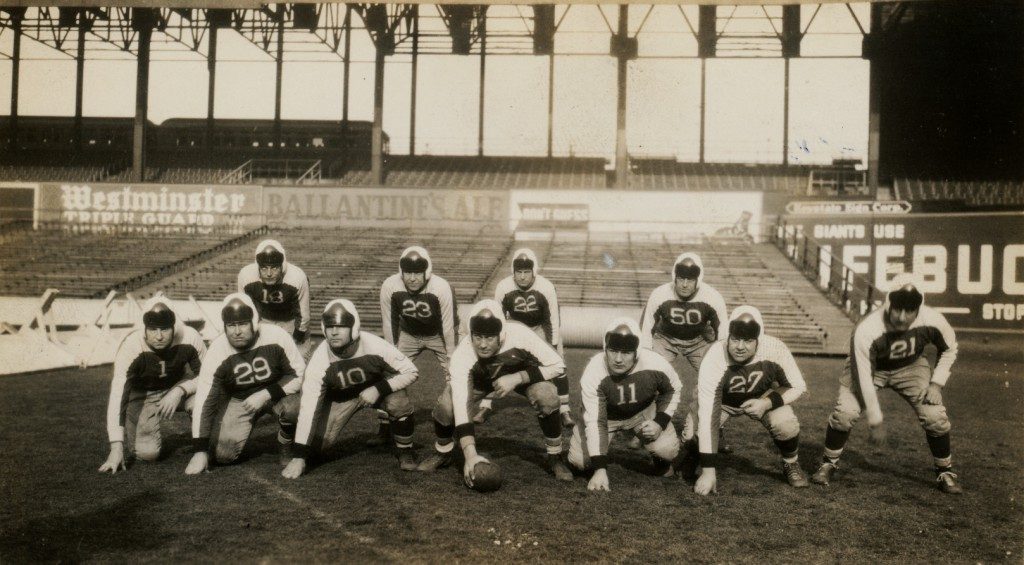
The starting offense of the 1934 New York Giants.
Back row, left to right: 18, Dale Burnett; 23, Bo Molenda;
22, Ed Danowski; and 50, Ken Strong.
Front row, left to right: 1, Ray Flaherty;
29, Red Badgro; 10, Potsy Jones; 7, Mel Hein;
11, Butch Gibson; 27, Bill Morgan; and 21, Ike Frankian.

December 9, 1934: For the 1st time, a New York football team wins a championship game. And they proved the old adage that revenge is a dish best served cold.

The New York Giants, named for the baseball team of the same name, were founded in 1925, and won the NFL Championship in 1927, at a time when the title went to the team that finished 1st in a single-division League. The Giants went 11-1-1, outpacing the Green Bay Packers at 7-2-1.

For the 1933 season, the NFL split into 2 Divisions, Eastern and Western. The Giants won the East, and the Chicago Bears won the West. While there had been a Playoff for the League title the season before, and the Bears had won it, 1933 was the year of the 1st official NFL Championship Game. It was played at Wrigley Field in Chicago, and the Bears came from behind to beat the Giants, 23-21.

The Giants won the East again in 1934, with an 8-5 record. The Bears won the West again, going 13-0, and riding a 17-game winning streak. With Red Grange and Bronko Nagurski, who would become charter members of the Pro Football Hall of Fame, the Bears were favorites.

In spite of a much more pedestrian record, the Giants were every bit as loaded as the year before. Center Mel Hein would also be a charter inductee in Canton, and would be joined by running back and kicker Ken Strong, and ends Red Badgro and Ray Flaherty. Each team's head coach would also be elected to the Hall of Fame: Steve Owen of New York and George Halas of Chicago. Each team's owner also would: Tim Mara and Halas.

As the Western winner hosted the Championship Game the year before, now it was the Eastern winner's turn to host. But the night before the game, a freezing rain hit New York, and when the Giants got to the Polo Grounds, they found the field frozen solid. The bad weather kept the crowd to 35,039, about 20,000 short of a sellout.
The Polo Grounds, looking more fit for football
than it ever did for baseball

Flaherty came up with an idea: The Giants should wear sneakers, to get a better footing on the field than the standard football cleats. But it was a Sunday: Sporting goods stores were closed. So Owen sent Abe Cohen, a tailor who served as the Giants' clubhouse attendant, to Manhattan College, 5 miles Uptown, to see if he could get some sneakers.

The athletic director -- contrary to legend, not the original Brother Jasper who founded Manhattan's athletic program and gave rise to the teams' name, the Jaspers, as he would have been long dead by this point -- gave Cohen the sneakers belonging to the basketball team, 9 pairs.

But by the time Cohen got back to the Polo Grounds, the 2nd half was already underway. Strong had opened the scoring with a field goal, but the Bears answered in the 2nd quarter with a Nagurski touchdown and a Jack Manders field goal. The Giants switched to the sneakers, but another Manders field goal made it 13-3 going into the 4th quarter.

But the sneakers did the trick. Ed Danowski threw a touchdown pass to Ike Frankian, making it 13-10 Chicago. The Bears could do nothing on their next drive. The Giants got the ball back, and Strong had enough footing to break away for a 42-yard touchdown run.

Strong scored another touchdown, this time from 11 yards out, as the Bears kept slipping, unable to keep up with the surer-footed Giants. Nagurski later said, "We immediately said something was wrong because they suddenly had good footing and we didn't... They just out-smarted us."

Danowski capped the game with a 9-yard quarterback keeper. The Giants won, 30-13, and their 27 points remain a record for the 4th quarter in an NFL championship game. (The New England Patriots scored 19 points in the 4th quarter of Super Bowl LI.) It became known as "The Sneaker Game." (It's never been called "The Sneaker Bowl.")

Beattie Feathers, a rookie running back out of the University of Tennessee, had become the 1st player to rush for over 1,000 yards in an NFL season. However, he was injured with 2 games remaining in the regular season. It probably wouldn't have mattered if he had been available to the Bears: He would have had to have helped them make up 3 touchdowns.

The Giants won another NFL Championship Game in 1938, but lost it in 1935, 1939, 1941, 1944 and 1946. In 1956, the Giants' 1st season playing their home games at the old Yankee Stadium, they again hosted the Bears in an NFL Championship Game. Again, the field was frozen solid. This time, with the legend of 1934 in mind, they had sneakers ready from the start, and it was no contest: The Giants won, 47-7.

Burned by it twice, Bears owner/coach and NFL co-founder George Halas talked the other owners into outlawing the sneaker tactic. The Giants would play on frozen fields in the NFL Championship Games of 1958 (at Yankee Stadium), 1961 (at Lambeau Field in Green Bay), 1962 (at Yankee Stadium again) and 1963 (at Wrigley Field in Chicago), and lost them all. 

Packer coach and general manager Vince Lombardi had been a Giants assistant in 1958, and had coached against them in 1961 and 1962. He knew that the cold weather of Green Bay made for a home-field advantage at Lambeau Field, but he didn't want a frozen field. So he had heating coils installed under the field, and it became known as "Lombardi's Electric Blanket." But on the morning of the 1967 NFL Championship Game, it was so cold, the machine keeping the coils heated broke, and the field froze. The game became known as the Ice Bowl, but the Packers won, anyway.

Since then, all natural-grass fields in the NFL have had similar heating systems. And, by the time the Giants made the Playoffs again, in 1981, many of the NFL's fields, including their own at Giants Stadium, were artificial. So while there have been many cold games in the NFL since, including a few at the Meadowlands, there has never been a frozen field since Lambeau became "the Frozen Tundra."

In 1999, The Sporting News released their list of the 100 Greatest Football Players. Mel Hein was ranked 38th. In 2010, the NFL Network released their list of the 100 Greatest Players. Hein was dropped to 96th.


*


December 9, 1934 was a Sunday. Actress Judi Dench and blues singer Junior Wells were born on this day.

This was the end of the football season, baseball was out of season, and there was no NBA yet. But there were 3 games played in the NHL that day:

* The New York Giants lost to the Chicago Black Hawks, 4-0 at the Chicago Stadium.

* The New York Americans and the Montreal Canadiens played to a tie, 2-2 at the old (then still relatively new) Madison Square Garden.

* And the Detroit Red Wings beat the St. Louis Eagles, 3-1 at the Olympia Stadium in Detroit. The Eagles had been the Ottawa Senators until this season, but the Great Depression did them in, and they folded at the end of the season. St. Louis would not return to the NHL until 1967, and Ottawa not until 1992.

* The Toronto Maple Leafs and the Montreal Maroons were not scheduled.

Tuesday, November 29, 2022

November 29, 1934: The 1st NFL Game On National Radio

Detroit in the dark (blue) jerseys, Chicago in the white

November 29, 1934: For the 1st time, an NFL game is broadcast nationwide on radio. In fact, that's why it's played at all: To sell radios.

George A. Richards owned Detroit radio station WJR, 760 on the AM dial, an affiliate of the NBC Blue Network, which later became ABC. He bought the NFL's Portsmouth Spartans, who had momentary success by reaching the 1932 NFL Championship Game, but losing it to the Chicago Bears. But they could never get fans in Southern Ohio.

So Richards bought the team, brought them to Detroit, and renamed them the Lions, to tie in with the city's baseball team, the Tigers, and because the lion is "the king of the jungle," and he wanted to build a team that would be "the king of the NFL."

At first, it worked. Their opener, on September 23, at the University of Detroit's Dinan Field, was a 9-0 win over the New York Giants, who had been in the 1933 NFL Championship Game. The Lions ended up winning their 1st 10 games, before losing on November 25 to the Green Bay Packers.

Next up, on Sunday, December 2, at Wrigley Field in Chicago, was a game against the team that had won the  last 2 NFL Championship Games, the previous year against the Giants and the year before against the Spartans/Lions. It was the Chicago Bears, with 2 legends in their backfield, Harold "Red" Grange and Bronislau "Bronko" Nagurski.

Richards knew that Thanksgiving was coming up, the ultimate family holiday. When everyone would be gathered around the radio. (No television in those days.) Maybe if there was a special program on the day, more radios would be sold, and Richards would make more money.

So he talked to Bears owner-coach George Halas about adding a game between the teams, on Thursday, in Detroit. (Up until 1940, Thanksgiving Day was always on the last Thursday in November. Since then, it's been the 4th Thursday in November, which is not necessarily the last Thursday of the month.) Halas, having played and coached in several Thanksgiving Day games over the years, and hardly opposed at the time to playing games so close together, liked the idea. He didn't care about selling radios. He did care about a visiting team's share of the gate receipts. And he certainly cared about selling the Bears (to fans, not to any one person) and selling the NFL. So he talked the other NFL owners into allowing it.

It worked like a charm: One of the biggest national audiences in radio history was tuned in, and over 26,000 fans crammed into the small stadium. And it looked like the Lions were living up to their responsibility, taking a 16-7 halftime lead, thanks to 2 touchdowns by LeRoy "Ace" Gutowsky.

But Jack Manders, so accurate he was known as "Automatic Jack," kicked 2 field goals in the 3rd quarter, enabling Chicago to close within 16-13. And in the 4th quarter, Joe Zeller intercepted a pass from Glenn Presnell and returned it to the Lions' 4-yard line. You wouldn't expect Nagurski to pass for a touchdown, but he did, to Bill Hewitt. Despite being held to 116 rushing yards, the Bears beat the Lions, 19-16.

Three days later, at Wrigley, the Bears beat the Lions again, 10-7. The Lions had started 10-0, but ended 10-3. In contrast, the Bears finished the season at 13-0, and as Western Division Champions. This time, though, they lost the Championship Game, to the Giants.

The Bears would go undefeated and then lose the Championship Game again in 1942. It would take until the 1972 season for a team to have an undefeated regular season and then win the NFL Championship, as the Miami Dolphins won Super Bowl VII.

But in spite of the 3-game collapse, the Lions turned Detroit on to pro football, after the failure of 3 different NFL teams: The Heralds (who changed their name to the Tigers for their 2nd season) in 1920 and '21, the Panthers in 1925 and '26, and the Wolverines in 1928. In 1935, the Lions were less impressive in the regular season, going 7-3-2, but beat the Bears on Thanksgiving, and then beat the Giants to win their 1st NFL Championship.

The Lions continued to play on Thanksgiving until 1938, playing the Bears each time, then resumed in 1945, and have played on the day every season since. Counting their 2021 loss to the Chicago Bears, a far more dire contest than the 1934 inaugural, they are 37-43-2 on T-Day. Of their 82 games, 21 have been against the Green Bay Packers, and 19 against the Bears.

*

November 29, 1934 was Thanksgiving, and therefore a Thursday. There were 2 other NFL games that day. The Chicago Cardinals beat the Packers, 6-0 at Comiskey Park in Chicago. And, in a football version of the great baseball rivalry (but different organizations in each case), the New York Giants beat the Brooklyn Dodgers, 27-0 at Ebbets Field.

Baseball was out of season, and the NBA wasn't founded yet. There were 2 NHL games, and Detroit and Chicago were involved, but not against each other. The Detroit Red Wings lost to the Montreal Maroons, 2-1 at the Montreal Forum. And the Chicago Black Hawks lost to the New York Americans, 2-0 at the old Madison Square Garden.

Of course, by 1942, both the Maroons and the Amerks would be out of business. In contrast, the Red Wings and the Blackhawks (they switched to writing it as 1 word in 1986) are still at it today. And it's a better Detroit vs. Chicago rivalry than Lions vs. Bears, or Tigers vs. White Sox, or even Pistons vs. Bulls.

Sunday, November 27, 2022

November 27, 1934: Baby Face Nelson Is Killed

November 27, 1934: Baby Face Nelson is killed, ending a bad year for America's criminal element that also saw the bloody ends of John Dillinger, Pretty Boy Floyd, and the team of Bonnie Parker and Clyde Barrow.

Lester Joseph Gillis was born on December 6, 1908 in Chicago. He got off to an early start: He was arrested on July 4, 1921, at the age of 12, after he accidentally shot a playmate in the jaw with a pistol that he had found. He served over a year in the State reformatory.

Using the name George Nelson, and, known as "Baby Face" for his appearance, he fell in with a group of young thieves, and as soon as he was old enough to drive, he drove trucks loaded with bootleg liquor. After robbing homes of rich people for their jewelry, he began robbing banks in 1930. The Great Depression was on, and, like other gangsters, the poor began seeing him as a hero for preying on the banks that were preying on the poor. But he was no hero: He was a murderer, and was sent to the State Prison at Joliet in 1931.

In 1932, he escaped during a prisoner transfer. By the Summer of 1933, having pulled a few more bank robberies, he formed his own gang. Witnesses reported that Nelson wildly sprayed sub-machine gun bullets at bystanders as he made his getaway from his robberies. He killed an agent at a resort lodge in Wisconsin. Early in 1934, he helped Dillinger escape from prison in 1934. They worked together, which may be way, after the FBI killed Dillinger, they made Nelson the new "Public Enemy No. 1."

On November 27, 1934, Nelson, his wife Helen Gillis (she called him "Les," short for "Lester"), and associate John Paul Chase headed south in a stolen V8 Ford towards Chicago on U.S. Route 14, in Barrington, Illinois. Nelson caught sight of a sedan driven in the opposite direction by agents Thomas McDade and William Ryan. Both parties simultaneously recognized each other, and a shootout resulted, which became known as the Battle of Barrington.

Nelson was hit in the lower abdomen, but kept firing, hitting an agent. Another agent shot Nelson in both legs, knocking him down. He managed to get up and find cover, and killed an agent, before Chase drove Nelson and his wife away. It was for naught: Nelson had been hit 9 times, and the initial abdominal wound was enough to kill him. Chase drove to a safe house in suburban Wilmette, where Nelson died, a few days short of his 26th birthday.

Helen Gillis surrendered 2 days later, on Thanksgiving, and served a year in prison for harboring a fugitive, namely her husband. She never remarried, remained close to her husband's family, and lived until 1987. Chase also served time in prison, including at Alcatraz. He died in 1973.

*

November 27, 1934 was a Tuesday. Baseball was out of season. Football was in midweek. The NBA hadn't been founded yet. There were 2 games played in the NHL. The New York Rangers lost to the Montreal Canadiens, 3-2 at the old Madison Square Garden. And the Chicago Black Hawks beat the Boston Bruins, 3-2 at the Boston Garden.

Saturday, November 26, 2022

November 26, 1934: "Imitation of Life" Premieres

November 26, 1934: Universal Pictures releases the 1st film version of Fannie Hurst's 1933 novel Imitation of Life, directed by John M. Stahl, starring Claudette Colbert and Louise Beavers.

Born in 1889 outside Cincinnati, and growing up in St. Louis, Hurst was Jewish, and interested in the plight of the poor. She was one of the most-read female novelists of the 1920s and '30s, but was mostly forgotten after World War II. She died in 1968.
Fannie Hurst

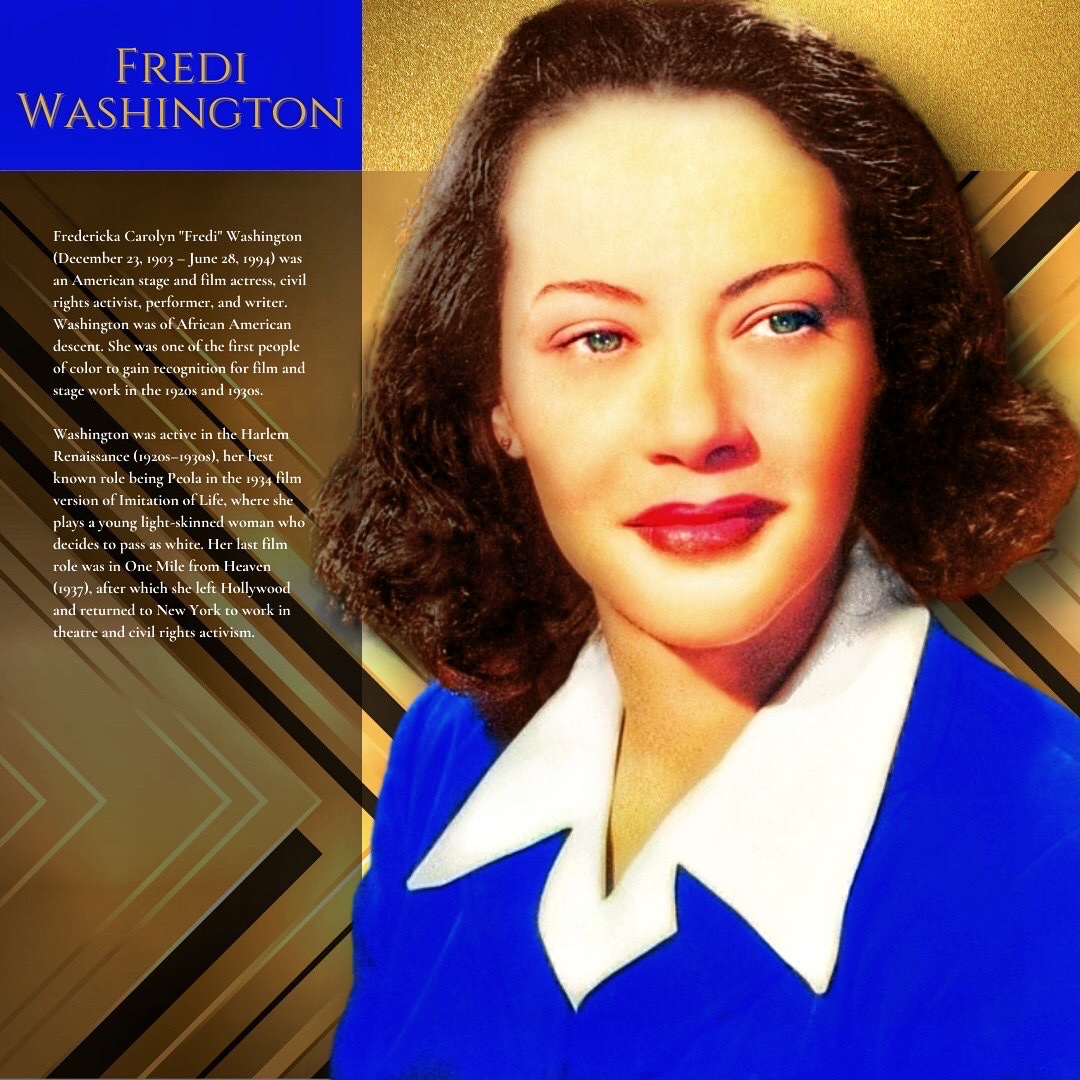
The film gives Beavers, usually featured in small roles as a maid, her best screen role, and features the largest supporting role played by a black person in a Hollywood film up until then. Its storyline partially revolves around a young mulatto girl, played by Fredi Washington, rejecting her mother, played by Beavers, and trying to "pass for white," the first Hollywood film to deal with this subject seriously. I'm amazed that it was released after the Hays Code got serious earlier in the year.
Fredi Washington

The film was remade in 1959, set in 1947, starring Lana Turner and Susan Kohner, who was the daughter of a Mexican woman rather than being half-black.

Louise Beavers appeared in many more films, including Bing Crosby's Holiday Inn in 1942, and lived until 1962. Fredericka "Fredi" Washington left Hollywood in 1937, only 33 years old, and threw herself into civil rights work. That year, along with W.C. Handy, Paul Robeson, Ethel Waters and Noble Sissie, she founded the Negro Actors Guild of America. She turned to stage and radio work, and was involved with the NAACP until her death in 1994, at the age of 90.

*

November 26, 1934 was a Monday. Baseball was out of season. Football was in midweek. The NBA hadn't been founded yet. And the NHL was in season, but no games were scheduled. So there were no scores on this historic day.

Friday, November 25, 2022

November 25, 1934: The NFL's 1st 1,000-Yard Rusher

November 25, 1934: The Chicago Bears beat their crosstown rivals, the Chicago Cardinals, 17-6 at Wrigley Field. They move to 11-0 on the season.

Beattie Feathers, a rookie running back out of the University of Tennessee, rushes for 42 yards, giving him 1,004 rushing yards on the season. This makes him the 1st player in the NFL's history, 15 seasons thus far, to rush for more than 1,000.

Unfortunately, Feathers was injured in the game. He would miss the Bears' Thanksgiving Day win over the Detroit Lions, their season finale against the Lions, and the NFL Championship Game against the New York Giants, which the Bears lost, ruining what had been, up until then, an undefeated season.

William Beattie Feathers was born on August 20, 1909 in Bristol, Virginia, on the State Line with Tennessee. He led Tennessee High School to a State Championship, but turned down Virginia, Virginia Tech, and every other football-playing college in the Old Dominion to play for Bob Neyland at the University of Tennessee.

He played with the Bears from 1934 to 1937, with the football version of the Brooklyn Dodgers in 1938 and 1939, and with the Green Bay Packers in 1940. He was the head football coach at Appalachian State University in 1942; coached football at North Carolina State from 1944 to 1951, and also coached their baseball team in 1945; was head baseball coach and assistant football coach at Texas Tech from 1954 to 1960; and, at Wake Forest University, was assistant football coach from 1961 to 1977, and head baseball coach from 1972 to 1975.

He was elected to the College Football Hall of Fame and the Virginia Sports Hall of Fame. He died on March 11, 1979 in Winston-Salem, North Carolina, near the Wake Forest campus.

The NFL would settle on a 12-game schedule in 1947, expanding to 14 in 1961, 16 in 1978, and 17 in 2021. The number of yards a player has had to average per game to reach 1,000 for the season has dropped to 84, then to 72, then to 63, and now to 59. As a result, 1,000 yards rushing in a season, so long a benchmark for an elite running back, now has very little meaning.

To put that into perspective: Jim Brown set a record in 1963, with 1,863 yards; O.J. Simpson raised it to 2,000 in 1973; and Eric Dickerson raised it to 2,105 in 1984 -- thus, Brown averaged 133, Simpson averaged 143, and Dickerson averaged 132, and to break his record in a 17-game season, a player would have to average 124 per game.

*

November 25, 1934 was a Sunday. These other NFL games were played that day:

* The New York Giants beat the Boston Redskins, 3-0 at the Polo Grounds.

* The Philadelphia Eagles beat the Brooklyn Dodgers, 13-0 at Ebbets Field.

* And the Green Bay Packers beat the Detroit Lions, 3-0 at Titan Stadium in Detroit.

Baseball was out of season. The NBA hadn't been founded yet. These NHL games were played:

* The New York Americans beat the New York Rangers, 3-1 at the old (then new) Madison Square Garden. It was a rare moment of glory for the Amerks, who went out of business in 1942.

* The Detroit Red Wings beat the St. Louis Eagles, 4-1 at the Olympia Stadium in Detroit. The Eagles, who had been the Ottawa Senators, only lasted this season, before giving up.

* The Chicago Black Hawks beat the Boston Bruins, 4-0 at the Chicago Stadium.

* And the Toronto Maple Leafs, the Montreal Canadiens and the Montreal Maroons were not scheduled.

Monday, November 21, 2022

November 21, 1934: Joe DiMaggio Becomes a Yankee

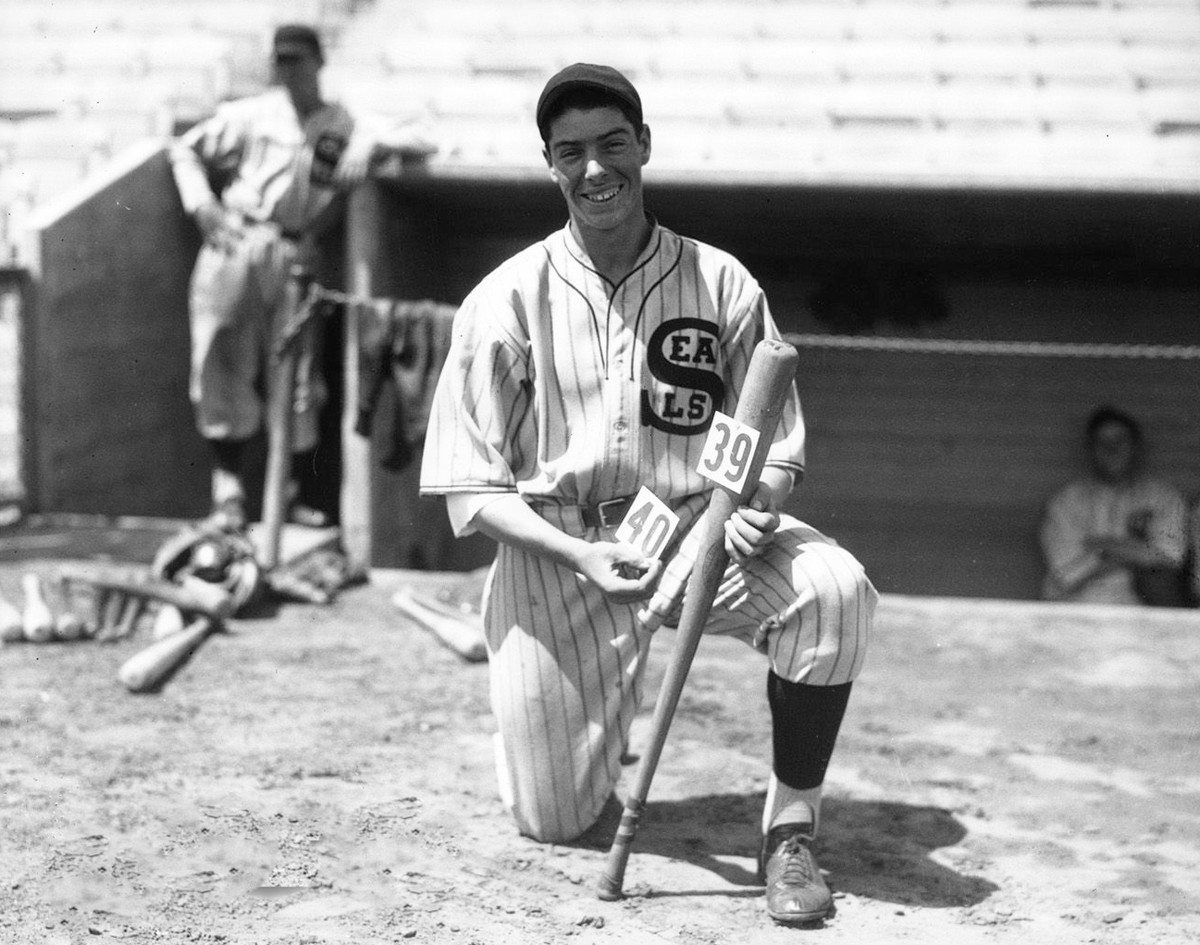
November 21, 1934: The New York Yankees purchase the contract of Joe DiMaggio from the San Francisco Seals of the Pacific Coast League for $50,000, also sending the Seals 5 players.

The Seals played in the PCL from its founding in 1903 until 1957, when the New York Giants moved to San Francisco. They were named for Seal Rock, an island in San Francisco Bay where seals gathered. They won 14 Pennants: 1909, 1915, 1917, 1922, 1923, 1925, 1928, 1931, 1935, 1943, 1944, 1945, 1946, 1957. And they formed a rivalry across the Bay with the Oakland Oaks. From 1931 onward, they played at Seals Stadium, considered one of the best minor-league ballparks. The Giants used it in 1958 and 1959, before Candlestick Park opened.

A minor-league hockey team would also be named the San Francisco Seals. When the NHL expanded to the Bay Area, the team played in Oakland, and was known as the Oakland Seals, and then as the California Golden Seals, before moving.

Giuseppe DiMaggio was an immigrant from Sicily, who immigrated first to Martinez, California, in what's now called the East Bay, and then to San Francisco. He was a professional fisherman, and he expected his sons to fish with him. He forbid his boys to play the American game of baseball.

In 1932, his oldest son, Vince disobeyed him, and signed with the Seals. Giuseppe told him not to come back. A month later, he came back, and slammed a wad of cash down on the kitchen table. Seeing more money at once than he'd ever had in his life, Giuseppe welcomed Vince back, and also let sons Giuseppe Jr. (Joe) and Dominic (Dom) play pro ball.

They also signed with the Seals. In 1933, Joe became a star, putting together a 61-game hitting streak, foreshadowing the 56-game streak he would have with the Yankees in 1941. But a knee injury in 1934 had scared the Eastern major league teams away. The Yankees took a chance on him, wanting him so badly that they let the Seals keep him for one more season in 1935. (In international soccer, it would have been considered a "loan deal.") Joe led the Seals to the Pennant that year.

Joe debuted with the Yankees in 1936, just 21 years old, and was instantly a star. Babe Ruth had retired, but Lou Gehrig was still there, and took Joe under his wing. For 3 years, Gehrig and DiMaggio pounded American League pitching. In 1939, Gehrig fell to the illness that would kill him, but Joe, catcher Bill Dickey, and some great pitching carried the Yankees to a 106-win season and a World Series win. Joe won the AL's batting title, and the 1st of his 3 AL Most Valuable Player awards.

He only played 13 seasons, losing 3 in the middle due to serving in World War II, and more at the end because he retired at age 37 due to a heel injury that had bothered him for his last 4 seasons. In those 13 seasons, he made the All-Star Game every year, helping the Yankees win 10 Pennants and 9 World Series.

The Yankees of Ruth and Gehrig had been "Murderers' Row." It was the DiMaggio era, 1936 to 1951, that made them more than a single-generation great team. It was "The Yankee Clipper," with his stoic greatness and resistance to injury, that made them, as the saying went, "the lordly Yankees."

Vince, who played his best years with the Pittsburgh Pirates, was an All-Star in the 1943 and 1944 seasons. Dom, who played his entire career with the Boston Red Sox, was an All-Star 7 times: 1941, 1942, 1946, 1949, 1950, 1951 and 1952. There are still Red Sox fans who say he was a better center fielder than Joe. They also say he should join Joe in the Baseball Hall of Fame. The 1st claim is ridiculous: The number of men who have played center field on Joe's level is very small. The 2nd claim has some merit.

Vince died in 1986, Joe in 1999, Dom in 2009.

*

November 21, 1934 was a Wednesday. This was also the day that American newspapers broke the story of the "Business Plot," a proposed military coup that would be backed by some of America's richest men to depose President Franklin D. Roosevelt and install a fascist government, a plan torpedoed when their intended commander, Marine General Smedley Butler, blew the whistle on it in a Congressional committee hearing. I have a separate entry for that event.

This was also the day the Cole Porter musical Anything Goes, starring Ethel Merman, debuted on Broadway. I have a separate entry for that event.

Baseball was out of season. Football was in midweek. The NBA hadn't been founded yet. And while the NHL season began on November 8, there were no games scheduled for this day. So there were no scores.

November 21, 1934: "Anything Goes" Premieres

November 21, 1934: The musical Anything Goes premieres at the Alvin Theatre in New York. Along with Kiss Me, Kate, Cole Porter called it "one of my two perfect musicals."

Cole Albert Porter was born on June 8, 1891 in Peru, Indiana, to a wealthy family. His mother, the daughter of a coal and lumber speculator who was believed to be the richest man in Indiana at the time, indulged his love of music. Together, they wrote his first operetta when he was only 10 years old.

He was valedictorian of his Massachusetts prep school, and his grandfather rewarded him with a trip to Europe and admission to Yale University, which made him a worldly young man. He joined the famed Whiffenpoofs a cappella singing group, and wrote "Bulldog," which is still Yale's fight song to this day.

His frequent trips to Manhattan on the New York, New Haven & Hartford Railroad (now the New Haven Line of Metro-North Commuter Railroad) indulged his love of musicals, but also indulged his love of nightlife, including gay liaisons.

To indulge his grandfather, he moved on to Harvard Law School, but the school's dean knew where his talent lay, and helped him switch to Harvard Music School. His mother was told, and supported it; his grandfather was not told. He staged musicals at Harvard, and by 1915, was staging them on Broadway.

He worked with the Duryea Relief organization during World War I, and hosted debauched parties in Paris. In 1918, he met Linda Lee Thomas, and their marriage gave both what they needed: She got security, and a man who adored her for her personality, if not lusting for her; he got the cover of a marriage to deflect public suspicion of what he really wanted in bed. The marriage lasted until her death in 1954.

His musicals were good enough to help him get by, if not to become famous, until 1928, when Paris became his 1st big hit show. His 1929 show Fifty Million Frenchmen included the song "You Do Something to Me," which truly launched him: Along with Irving Berlin, George & Ira Gershwin, Richard Rodgers & Lorenz Hart, and Johnny Mercer and his various collaborators, Cole Porter became one of the leaders of what became known as "The Great American Songbook." More than that, it kept him afloat during the Great Depression, when many writers, producers and theater owners went under.

In 1932, he staged a musical titled The Gay Divorce -- "gay" in its original sense of "happy," not as in "homosexual," no matter what the tendencies of Broadway in general and Porter in particular. It starred Fred Astaire, and it was his last show before he went to Hollywood, including the 1934 film version, The Gay Divorcee. It included "Night and Day," which remains Porter's best-known song.

In 1934, producer Vinton Freedley came up with a new approach to producing musicals. Instead of commissioning book, music and lyrics, and then casting the show, Freedley sought to create an ideal musical with stars and writers all engaged from the outset.

The stars he wanted were Ethel Merman, William Gaxton and comedian Victor Moore. He planned a story about a shipwreck and a desert island, and for the book he turned to P. G. Wodehouse and Guy Bolton. For the songs, he decided on Porter. By telling each of these that he had already signed the others -- in other words, lying to them -- Freedley gathered his ideal team together.

A drastic last-minute rewrite was necessitated by the Morro Castle fire off the coast of New Jersey in September, which dominated the news and made Bolton and Wodehouse's book seem tasteless. Nevertheless, the show, Anything Goes, was an immediate hit.

Its songs include the title number, "I Get a Kick Out of You," "All Through the Night" and, along with "Night and Day," probably the best-known Porter song, "You're the Top." (Often mis-listed and mis-sung as "You're the Tops.") It name-checks several current big names in the world: Mickey Mouse, Mahatma Gandhi (pronounced "GAN-dee," to rhyme with "Napoleon brandy"), Greta Garbo, Fred Astaire, Eugene O'Neill, Jimmy Durante, Irving Berlin, and "Mrs. Astor," although not specifying which one.

Anything Goes was filmed in 1936, with Merman, Bing Crosby and Ida Lupino. There was a remake in 1956, but with a seriously rewritten story, this time with Crosby and Mitzi Gaynor. Merman and Frank Sinatra starred in a made-for-TV version in 1954, for NBC's The Colgate Comedy Hour. A performance of a 2021 London revival, with Broadway (and TV show Younger) star Sutton Foster and British musical legend Robert Lindsay, was broadcast on PBS' Great Performances in 2022.

Anything Goes was the 1st of 5 Porter shows featuring Merman. He loved her loud, brassy voice, and wrote many numbers that displayed her strengths. Jubilee, written with Moss Hart in 1935, was not a major hit, but included the songs "Begin the Beguine" and "Just One of Those Things." He also wrote for movies, including "I've Got You Under My Skin" for Born to Dance in 1936, and "In the Still of the Night" for Rosalie in 1937. (This is not the doo-wop hit of The Five Satins in 1956, although Dion & the Belmonts had a hit with it in 1960.) He wrote "Don't Fence Me In" for a 1934 film musical that was never made, but it became a hit when Roy Rogers sang it in the 1944 film Hollywood Canteen.

On October 24, 1937, only 46 years old, Porter was riding a horse at Piping Rock Club in Locust Valley, Long Island, New York, when his horse rolled on him and crushed his legs, leaving him substantially crippled and in constant pain for the rest of his life. Though doctors told Porter's wife and mother that his right leg would have to be amputated, and possibly the left one as well, he refused to have the procedure. He remained in the hospital for seven months before being allowed to go home to his apartment at the Waldorf Towers.

He resumed work as soon as he could, finding it took his mind off his perpetual pain. In 1938, he staged Leave It to Me!, with Mary Martin singing "My Heart Belongs to Daddy." His 1939 show DuBarry Was a Lady starred Merman and Bert Lahr, but it was too risqué for the censors, and some lines and songs had to be cut. "Friendship," one of Merman's best-known songs, was kept.

In 1940, Porter wrote Panama Hattie. Most of its songs have been forgotten, but it was his longest-running hit yet. It also led to one of the best jokes on The Muppet Show: In 1977, Merman guested, and, after she sang a medley of her hits, the camera panned to the box where the old hecklers Statler and Waldorf, both named for famous New York hotels, sat. Waldorf said, "I remember Ethel Merman in the opening of Panama Hattie!" Statler, apparently believing himself to be the younger of the two, told him, "You remember Teddy Roosevelt in the opening of the Panama Canal!" (In fact, while Roosevelt got the Canal built, it didn't open until 1914, when Woodrow Wilson was President.)

Composer biographies were common in 1940s films, even for still-living writers like Porter. In 1946, Cary Grant played Porter in Night and Day. Porter himself was at a commercial low point, but in 1948, he staged Kiss Me, Kate, a modernization of William Shakespeare's The Taming of the Shrew, which led to a rebound in his career. The following year, the Tony Awards debuted, and Kiss Me, Kate won the 1st-ever Tony for Best Musical.

After Porter resisted it for 20 years after the horseback accident, ulcers on his right leg finally forced its amputation in 1958. Broadway writer Noël Coward, a close friend, visited him, and saw how he was no longer in pain, and predicted that his musical output would get back to normal levels, and he would be a hit all over again.

Sadly, that turned out to be wishful thinking: He never wrote another song, and lived in seclusion until kidney failure ended his life on October 15, 1964 outside Los Angeles in Santa Monica, California. He was 73. Both the music industry, through rock and roll, and Broadway, with more sophisticated musicals like My Fair Lady and Fiddler On the Roof, had passed him by.

But not completely. The roster of singers who've recorded compilation albums of his songs is staggering: Ella Fitzgerald, Frank Sinatra, Rosemary Clooney, Anita O'Day, Julie London, Dionne Warwick, and, as recently as 2021, in his last album before being overtaken by Alzheimer's disease, Tony Bennett recorded Love for Sale, a series of Porter duets with Lady Gaga, born 22 years after Porter died.

In 1966, Frankie Valli & The Four Seasons had a Top 10 hit with "I've Got You Under My Skin." In a 1974 episode of M*A*S*H, set in 1951, "Trapper" John McIntire (played by Wayne Rogers) sang it during a surgery session. In a 1982 episode of the show, set in 1953, Hawkeye Pierce (played by Alan Alda), having lost a bet to Trapper's replacement, B.J. Hunnicutt (played by Mike Farrell), had to climb on top of a table in the mess tent, drop his pants (but not his underwear), and "sing 'You're the Tops' without your bottoms." Not long before her death in 1984, Merman recorded a new version of "Friendship" for Friendship brand margarine.

In 1989, interviewed for the CBS News show 48 Hours while on tour for his album Flowers In the Dirt, Paul McCartney, 47 years old and 19 years into his post-Beatles solo career, made no bones about his love for rock and roll, but also made the point that he didn't start out that way: He said, "I was out to be another Cole Porter. Still am, babe."

In 1990, noting that Porter was gay and that AIDS had devastated the gay community, including the gay overlap with the Broadway sub-community, the fundraising album Red Hot + Blue was recorded. It included David Byrne of Talking Heads on "Don't Fence Me In," Neneh Cherry on "I've Got You Under My Skin," and Sinéad O'Connor on "You Do Something to Me."

The Alvin Theatre, where Anything Goes premiered, was at 250 West 52nd Street in Midtown Manhattan. In 1983, it was renamed the Neil Simon Theatre. It is still in operation. Oddly, no Broadway Theatre has yet been named for Cole Porter.

*

November 21, 1934 was a Wednesday. This was also the day that American newspapers broke the story of the "Business Plot," a proposed military coup that would be backed by some of America's richest men to depose President Franklin D. Roosevelt and install a fascist government, a plan torpedoed when their intended commander, Marine General Smedley Butler, blew the whistle on it in a Congressional committee hearing. I have a separate entry for that event.

This was also the day that the Yankees purchased the contract of Joe DiMaggio from the San Francisco Seals of the Pacific Coast League. I have a separate entry for that event.

Baseball was out of season. Football was in midweek. The NBA hadn't been founded yet. And while the NHL season began on November 8, there were no games scheduled for this day. So there were no scores.

November 21, 1934: The "Business Plot" Is Exposed

Smedley Butler

November 21, 1934: The New York Post and the Philadelphia Record break the story of what came to be known as "The Business Plot," a rich men's plan to launch a military coup and take over the American government.

The story is broken by Paul Comly French, a reporter who had once been the private secretary of Smedley Butler, a retired Major General (2 stars) in the U.S. Marine Corps.

Smedley Darlington Butler was born on July 30, 1881, in the Philadelphia suburb of West Chester, Chester County, Pennsylvania. His father, Thomas Stalker Butler, was a Republican Congressman. His maternal grandfather, Smedley Darlington, had previously held the same seat in Congress. Three earlier Darlingtons had served in Congress. Smedley's aunt, Isabel Darlington, was the 1st woman to practice law in Chester County.

He enlisted in the Marines, and served with distinction in the Spanish-American War, the Philippine Campaign and the Boxer Rebellion. His participation in the so-called "Banana Wars" in Central America caused him to look at war and its conduct differently.

He received his 1st Congressional Medal of Honor for his service in the American occupation of Veracruz, Mexico in 1914. He offered to return it, saying he had done nothing to earn it. He was ordered to keep it. He received a 2nd Medal of Honor for his role in repelling an ambush during the American occupation of Haiti in 1915.

He received his General's stars during World War I, and was appointed commanding officer of the Marine barracks at Quantico, Virginia, now the "home base" of the Corps (and of the FBI). In 1924, President Calvin Coolidge gave him leave from active duty so that he could become Director of Public Safety for Philadelphia.

He said, "Cleaning up Philadelphia was worse than any battle I was ever in." He brought crime down significantly, but his tactics were a bit heavy-handed. Still, there were many people who liked that, and they remembered it, thinking that Butler was their kind of man. He held the job for 2 years, returned to the Corps, and retired from the service in 1931.

He ran for the U.S. Senate in Pennsylvania in 1932, but, with the tide turning against Prohibition, which he supported, he lost the Republican Primary. He opposed the Bonus Army in a public statement that year, and there were many people who liked that.

That year, Governor Franklin D. Roosevelt of New York, a Democrat, was elected President of the United States. His "New Deal" lifted millions out of poverty, increasing taxes on rich people in order to do it. America's wealthiest men were furious, and some were not willing to wait until November 3, 1936, the next election, to do something about it.

In November 1934, Butler testified before a special committee of the U.S. House of Representatives. He told them that he was visited by Gerald P. MacGuire, a prominent Connecticut businessman. MacGuire had visited Germany and Italy, and saw how veterans' groups had aided the Fascist movements there, movements that had stopped Communist uprisings. He told Butler that he viewed FDR and his advisors, the so-called "Brain Trust," as Communists, and said they had to be stopped.

He told Butler that a group of businessmen had $50 million to spend, and a private army of 500,000 ex-soldiers, many of them members of the American Legion, ready to march on Washington, to remove Roosevelt from power, and establish a Fascist dictatorship. MacGuire told Butler that the group wanted him to be the dictator.

Butler said that he later met with Robert Sterling Clark, an heir to the Singer sewing machine fortune. Clark told him about some of the other men backing the plan:

* Irénée du Pont, head of the DuPont Corporation, which had recently bought the Remington Arms company, which would produce the weapons and the ammunition for the coup.

* Thomas W. Lamont, running J.P. Morgan & Company on behalf of J.P. Morgan Jr., son of the company's founder, and an adviser to every President since Woodrow Wilson, including FDR, thus giving the group an "inside man." 

* Grayson Murphy, a director of Goodyear Tire, Anaconda Copper, and Bethlehem Steel, all companies capable of supplying the coup effort with necessary materiel.

* And the last 2 Democratic Party nominees for President before FDR: John W. Davis, a former Congressman from West Virginia and U.S. Ambassador to Britain, who was always more conservative than the mainstream of the Party; and Alfred E. Smith, who was also FDR's predecessor as Governor of New York, had lost very badly to Herbert Hoover in 1928, saw FDR beat Hoover even worse in 1932, and was intensely jealous of FDR's early success and popularity as President.

About all of this, Butler told French, whom he trusted due to his service. French did some digging, and found evidence that the plot was real, not just MacGuire and Clark blowing off steam at a President they hated. Armed with this knowledge, Butler met with MacGuire again, and said, "If you get 500,000 soldiers advocating anything smelling of Fascism, I am going to get 500,000 more, and lick the hell out of you, and we will have a real war right at home." And then he went to Congress, and spilled the beans.

French broke the story in the New York Post and the Philadelphia Record on November 21. On November 22, The New York Times wrote about it, calling it a "gigantic hoax." All the parties alleged to be involved publicly said there was no truth in the story, calling it a joke and a fantasy. Roosevelt's reaction to it is not known to have been recorded.

If the coup ever got beyond the talking stage, it was doomed without a leader -- or, more likely, a figurehead. It has been alleged that Hugh S. Johnson, a retired Army Brigadier General who had been running the National Recovery Administration for FDR, and had been named Man of the Year for 1933 by Time magazine, had also turned the plotters down.

In 1935, Butler published a book titled War Is a Racket, comparing what Dwight D. Eisenhower would later call "the military-industrial complex" to organized crime. He wrote, "I spent most of my time as a high class muscle man for Big Business... a gangster for capitalism" who "might have given Al Capone a few hints." That book, all by itself, showed that the big business boys were looking to the wrong man for their goal.
Plaque honoring Butler, Philadelphia City Hall:
"He enforced the law impartially,
he defended it courageously, he proved incorruptible."

MacGuire died of pneumonia shortly before Butler published his book. Grayson Murphy died in 1937, Smedley Butler in 1940, Hugh Johnson in 1942, Al Smith in 1944, Thomas Lamont in 1948, John W. Davis in 1955, Robert S. Clark in 1956, Paul French in 1960, and Irénée du Pont in 1963.

In 2007, Harper's Magazine published an article by Scott Horton, an attorney known for his work in human rights law and the law of armed conflict, claiming that one of the businessmen involved in the plot was a partner of the New York financial services company Brown Brothers Harriman & Company: Prescott Bush, later a U.S. Senator from Connecticut, the father of one President, and the grandfather of another, the one who was in office at the time of the article. The evidence was interesting, but not entirely convincing.

In 2018 and 2022, Thomas Lamont's great-grandson, Edward Miner Lamont Jr., a.k.a. Ned Lamont, was elected Governor of Connecticut -- as a liberal Democrat. He has conducted the office very differently from what his ancestor would have hoped.

*

November 21, 1934 was a Wednesday. This was also the day the Cole Porter musical Anything Goes, starring Ethel Merman, debuted on Broadway. I have a separate entry for that event.

This was also the day that the Yankees purchased the contract of Joe DiMaggio from the San Francisco Seals of the Pacific Coast League. I have a separate entry for that event.

Baseball was out of season. Football was in midweek. The NBA hadn't been founded yet. And while the NHL season began on November 8, there were no games scheduled for this day. So there were no scores.

Sunday, November 20, 2022

November 20, 1934: The Defiance of William Haines

November 20, 1934: The Marines Are Coming premieres. It is the final film of William Haines -- by his choice, if not entirely so.

I wanted to tell Haines' story, but I couldn't find either the date of his arrest, the date of his ultimatum from MGM, or the date of his response to it.

Charles William Haines was born on January 2, 1900 in Staunton, Virginia. He was discovered by a talent scout, and signed with Goldwyn Pictures in 1922. His career gained momentum when he received favorable reviews for his role in the silent film The Midnight Express in 1924. (This was not the same story as the 1978 prison-escape film Midnight Express.)

Haines was cast in the 1926 film Brown of Harvard, and his performance solidified his screen persona as a wisecracking, arrogant leading man. By the end of the 1920s, Haines had appeared in a string of successful films, and was a popular box-office draw. The change from silent films to "talkies" helped him, as audiences could now hear his wisecracks.

On a trip to New York in 1926, Haines met James Shields. Haines convinced Shields to move to Los Angeles, promising to get him work as an extra. The pair soon began living together, and viewed themselves as a committed couple, though newspapers did not mention their relationship. Haines also became one of the top interior designers in Southern California. For all I know, he may have been the source of the stereotype of interior designers tending to be homosexual.

In 1933, "Billy" cheated on "Jimmie." Worse, he got arrested in the process, caught fooling around in gay activity with a sailor. Metro-Goldwyn-Mayer boss Louis B. Mayer gave him an ultimatum: Marry a woman or lose every job he has in Hollywood. This was the depth of the Great Depression, so the threat of poverty was very real.

William Haines told Louis B. Mayer what he could do with his threat, and stuck by his boyfriend. Maybe he caught some courage from that sailor. But it was a huge risk, because Mayer probably had more power in Los Angeles than the Mayor, Frank Shaw, did at that point.

Haines took a hell of a gamble with his defiance, at a very inopportune time. It paid off: Not only did he and Shields stay together for the rest of Haines' life, but Haines' actor friends stood up for him, and continued to hire him to design or redesign their homes. He lost his fame, but not his fortune.

He only appeared in 2 more movies, in small "poverty row" studios: Young and Beautiful and The Marines Are Coming. The latter film was about a young Marine who is discharged in disgrace -- not for the same reason as Haines faced disgrace in real life -- and ends up becoming a soldier of fortune and proving himself there. It wasn't quite a mirror of his real life, but it was a great way to go out.

William Haines beat Louis B. Mayer and "the studio system," but he also smoked, and cancer is an opponent that doesn't care if you're straight or gay, rich or poor. He died on December 26, 1973, at St. John's Hospital -- a Catholic hospital, which apparently didn't care, or perhaps didn't know, that he was gay -- in the Los Angeles suburb of Santa Monica, California, a few days short of his 74th birthday. Shields couldn't take it, and, just 10 weeks later, took some barbiturate pills and got drunk, and joined Haines in death.

*

November 20, 1934 was a Tuesday. This was also the day of the premiere of Lillian Hellman's play The Children's Hour, which depicted a fictional gay scandal. I have a separate entry for this event.

Baseball was out of season. Football was in midweek. The NBA hadn't yet been founded. There were 3 games in the NHL:

* The New York Americans lost to the Montreal Maroons, 3-0 at the old (but then fairly new) Madison Square Garden.

* The Boston Bruins beat the Detroit Red Wings, 1-0 at the Boston Garden.

* The Toronto Maple Leafs beat the St. Louis Eagles, 5-2 at the St. Louis Arena.

* And the New York Rangers and the Montreal Maroons were not scheduled.

November 20, 1934: "The Children's Hour" Premieres

Playbill from the original production

November 20, 1934: The Children's Hour premieres at at Maxine Elliott's Theatre. The play by Lillian Hellman is one of the first mainstream depictions of a gay scandal in popular culture, and runs for nearly 2 years.

It is a drama set in an all-girls boarding school run by two women, Karen Wright (played by Katherine Emery) and Martha Dobie (Anne Revere). An angry student, Mary Tilford (Florence McGee), runs away from the school and, to avoid being sent back, tells her grandmother that the two headmistresses are having a lesbian affair. The accusation proceeds to destroy the women's careers, relationships, and lives.

It was adapted into a film in 1936, but the Hays Code forced a change to a heterosexual love triangle, and a change of title to These Three. It was adapted again in 1961, with Audrey Hepburn, Shirley MacLaine and James Garner, directed by William Wyler. With the Hays Code still in effect, the relationship between Audrey's Katherine and Shirley's Martha is called "unnatural," leaving the slightest amount of ambiguity. One notable change: In the original version, Martha commits suicide by shooting herself; in this version, she kills herself by the less violent (but no less effective) method of hanging.

Maxine Elliott's Theatre was at 109 West 39th Street in Midtown Manhattan. Built in 1908, it later served as a radio studio for the Mutual Broadcasting Network, and a radio and TV studio for CBS. It was demolished in 1960, and the Spring Mills Building went up on the site.

*

November 20, 1934 was a Tuesday. This was also the date of, for all intents and purposes, the conclusion of a real-life gay scandal: The premiere of The Marines Are Coming, the last film of William Haines. I have a separate entry for that event.

Baseball was out of season. Football was in midweek. The NBA hadn't yet been founded. There were 3 games in the NHL:

* The New York Americans lost to the Montreal Maroons, 3-0 at the old (but then fairly new) Madison Square Garden.

* The Boston Bruins beat the Detroit Red Wings, 1-0 at the Boston Garden.

* The Toronto Maple Leafs beat the St. Louis Eagles, 5-2 at the St. Louis Arena.

* And the New York Rangers and the Montreal Maroons were not scheduled.

December 31, 1999 & January 1, 2000: The Millennium

December 31, 1999:  The Millennium arrives. The people of planet Earth survived. At a terrible cost. But we hadn't destroyed ourselves. ...