Showing posts with label europe. Show all posts

Sunday, October 30, 2022

October 30, 1973: The Bosphorus Bridge Opens

October 30, 1973: The Bosphorus Bridge opens in Istanbul, Turkey, connecting the city's European and Asian sections by road, where, previously, the connections had only been by ferry.

It was the 1st bridge to ever connect one continent with another. It is now 1 of 3 bridges over the Bosphorus Strait, followed by the Fatih Sultan Mehmet Bridge in 1988 (named for Sultan Mehmed II, a.k.a. Mehmed the Conqueror, who conquered the city, then named Constantinople, in 1453) and the Yavuz Sultan Selim Bridge in 2016.

Every year, on its anniversary, its operating authority hosts a "fun run." It also happens to have opened on the anniversary of Galatasaray Spor Kulübü (Sport Klub), founded on October 30, 1905. 

Part of the nasty rivalry between Turkey's 2 biggest sports clubs, especially its soccer teams, comes from the fact that they are on opposite sides of these 3 bridges: Fenerbahçe (FEN-er-BAH-chah, or "Fener") is in the Kadıköy district on the Asian side, while Galatasaray is in the Galata Palace area on the European side.


In the 2022-23 season, there are 6 Istanbul clubs in the Turkish Süper Lig, but Fener is the only one on the Asian side. Joining Gala on the European side are Beşiktaş, İstanbul Başakşehir, Kasımpaşa and Fatih Karagümrük.

*

October 30, 1973 was a Tuesday. Baseball season was over. Football was in midweek. There were 4 games played in the NBA:

* The Atlanta Hawks beat the Phoenix Suns, 122-101 at The Omni in Atlanta.

* The Buffalo Braves beat the Seattle SuperSonics, 105-103 at the Buffalo Memorial Auditorium.

* The Milwaukee Bucks beat the Kansas City-Omaha Kings, 112-78 at the Kansas City Municipal Auditorium.

* And the Portland Trail Blazers beat the Los Angeles Lakers, 114-112 at the Portland Memorial Coliseum.

There were 2 games played in the American Basketball Association. The New York Nets lost to the San Antonio Spurs, 104-92 at the HemisFair Arena in San Antonio. And the Memphis Tams beat the Carolina Cougars, 110-99 at the Mid-South Coliseum in Memphis.

There were 3 games played in the NHL:

* The New York Rangers and the Vancouver Canucks played to a tie, 3-3 at the Pacific Coliseum in Vancouver.

* The Toronto Maple Leafs beat the Detroit Red Wings, 7-0 at Maple Leaf Gardens in Toronto.

* And the Los Angeles Kings beat the St. Louis Blues, 3-2 at the St. Louis Arena.

And there were 3 games played in the World Hockey Association:

* The Chicago Cougars beat the Winnipeg Jets, 4-1 at the International Amphitheatre in Chicago.

* The Houston Aeros beat the Minnesota Fighting Saints, 6-1 at the Sam Houston Coliseum.

* And the Quebec Nordiques beat the Los Angeles Sharks, 6-4 at the Los Angeles Memorial Sports Arena.

Wednesday, October 26, 2022

October 26, 1938: England vs. The Rest of Europe & Hockey Comes to TV

Tommy Lawton

October 26, 1938: The Arsenal Stadium, a.k.a. Highbury after its North London neighborhood, hosts a match between the England national team and a team representing "The Rest of Europe." The game commemorates, on the actual anniversary day, the 75th Anniversary of the founding of the Football Association. A crowd of 40,185, including King George VI, sees England win 3-0. It was the 2nd full England match to be shown live on British television.

The England team consisted of Arsenal's left back Eddie Hapgood (Captain) and left half Wilf Copping, Chelsea's goalkeeper Vic Woodley, Tottenham's right back Bert Sproston and inside right Willie Hall, Huddersfield's right half Ken Willingham, Wolverhampton Wanderers' centre half (and future title-winning manager) Stan Cullis, Stoke City's outside right Stanley Matthews, Everton's centre forward Tommy Lawton and outside left Walter Boyes, and West Ham United's inside left Len Goulden. Hall, Lawton and Goulden scored.

The Rest of Europe team included 5 players from recent World Cup winners Italy, 2 Germans, a Frenchman, a Belgian, a Hungarian, and a Norwegian. Only 1 of the 5 Italians was on the forward line, so even then, Italy was a defense-first footballing nation. It was Silvio Piola, considered too young for their 1934 World Cup winners, but starred on the 1938 version while playing his club soccer for Lazio in Rome. The Belgian, Ray Braine, was his country's 1st professional footballer, when he signed for Sparta Prague -- not in his own country, which had yet to allow professionalism, but in Czechoslovakia -- in 1930.
Ray Braine

The last survivor of each team was Cullis, who lived until 2001; and Pietro Rava of Italy and Juventus, who lived until 2006.

Also on this day, for the 1st time, an ice hockey match is televised. Oddly, this does not occur in Canada, or in America, or in any of the European nations that we now associate with the game, such as Russia or Sweden. It is in England, on the BBC, between Harringay Racers of North London and Streatham Redskins of South London. The broadcaster, at least, was a Canadian: Winnipeg-born Stuart MacPherson.

I don't have a record of the result, although Harringay finished ahead of Streatham in the English National League in the 1938-39 season. Harringay won it the preceding season, 1937-38, and Streatham had won it in 1934-35. Harringay folded in 1957, and have since been replaced by a new team using the name. Streatham are still in business.

In 1940, New York station W2XBS (forerunner of WNBC-Channel 4) would become the 1st TV station to broadcast an NHL game, a 6-2 New York Rangers win over the Montreal Canadiens at the old Madison Square Garden. Just 3 days after that, they would broadcast the 1st televised basketball game, also at the old Garden. That station had already done, all in New York City in 1939, the 1st TV broadcasts of baseball, at Ebbets Field; college football, at Columbia University's Baker Field; and the NFL, at the Polo Grounds.

In 1952, CBC would bring Hockey Night In Canada from radio to TV, and it quickly became, and remains, Canada's favourite (that's how it's "spelt" up there) TV show. But the U.S. -- ABC/ESPN, NBC and Fox have all tried -- has never really gotten hockey broadcasts right. "Glow puck," anyone?

*

October 26, 1938 was a Wednesday. Baseball season was over. Football was in midweek. The NBA hadn't been founded yet. And the NHL season wouldn't start for another 8 days. So there were no other scores on this historic day.

Sunday, September 18, 2022

September 18, 1944: Friedrich Hayek Publishes "The Road to Serfdom"

September 18, 1944: Friedrich Hayek publishes The Road to Serfdom. It becomes part of conservative political scripture.

Friedrich August von Hayek was born on May 8, 1899 in Vienna, then the capital of the Austro-Hungarian Empire. His family was ethnically Czech, but the official language of the Empire was German, and "Hayek" was the German spelling of the Czech name "Hájek." (Salma Hayek, a Mexican actress also of partial Lebanese descent, appears not to be a relative of his.)

As a teenager, he fought in the Austrian Army in World War I. He later said that this experience, coupled with his desire to help avoid the mistakes that led to the war, drew him into economics. After earning doctoral degrees in law and political science from the University of Vienna, he taught in the new Republic of Austria, and then at the London School of Economics. He was a conservative, but decidedly not a Fascist: Unwilling to accept Austria's 1938 Anschluss with Nazi Germany, he became a British citizen that year.

Among his students at LSE were David Rockefeller, grandson of oil baron John D. Rockefeller, brother of future Vice President Nelson Rockefeller, and himself later the chairman of Chase Manhattan Bank; and John Kenneth Galbraith, who went against his teachings and became the leading liberal economist of the 2nd half of the 20th Century.

Hayek was concerned about the general view in Britain's academia that Fascism was a capitalist reaction to socialism. His book The Road to Serfdom arose from those concerns. The title was inspired by the French classical liberal thinker Alexis de Tocqueville's writings on the "road to servitude."

Serfdom was a condition of debt bondage and indentured servitude that developed in the Early Middle Ages in Europe, and lasted into the Renaissance era. Russia did not end it until 1861. In other words, there are millions of Americans descended from the Russian Empire -- Russians, Ukrainians, Poles, Lithuanians, Latvians, Estonians; Protestants, Catholics, Jews and Muslims -- whose ancestors were in bondage only 4 years before America ended the enslavement of black people, and whose families were in bondage for centuries more.

There is a difference between the conditions, showing that serfs, while severely oppressed, were far better off than slaves. Unlike slaves, serfs could not be bought, sold, or traded individually, though they could, depending on the area, be sold together with land. Serfs who occupied a plot of land were required to work for the lord of the manor who owned that land. In return, unlike slaves, they were entitled to protection, justice, and the right to cultivate certain fields within the manor to maintain their own subsistence.

Hayek wrote, "I warn of the danger of tyranny that inevitably results from government control of economic decision-making through central planning." He further argued that the abandonment of individualism and classical liberalism, with its embrace of the free market, inevitably leads to a loss of freedom, the creation of an oppressive society, the tyranny of a dictator, and the serfdom of the individual. He argued that Fascism, Nazism and state-socialism had common roots in central economic planning and empowering the state over the individual. 

This misguided belief has carried over into 21st Century thinking. While some American right-wingers do identify with the Nazis, the majority of them, desperate to not be identified with the murderers of 11 million civilians, 6 million of them Jews, have argued that the Nazis and the Communists were both left-wing. After all, it's right there in the Nazis' name: "National Socialist." Except the Nazis were no more socialist than East Germany, "the German Democratic Republic," was democratic or a republic.

Hayek argued that Western democracies, including the U.S. and the U.K., had "progressively abandoned that freedom in economic affairs without which personal and political freedom has never existed in the past."

He had it completely backwards: Without the progress of programs like FDR's New Deal, most people never had that kind of freedom. There is no "free market," and there never has been, and there never will be, until all are free to go to market. Conservatives have no desire to make that happen. Liberals have that desire, but, all too often, not the will, for fear of conservatives calling them "socialists" or "Communists" -- or, to use a term of which Hayek would have approved, a term conservatives like to use when they want to appear smarter than liberals, "statists."

After publishing the book, he taught at the University of Chicago, which had published the U.S. edition of the book. He later returned to Europe, teaching in Germany and Austria. He was awarded the Nobel Prize in Economics in 1974, but shared it with Swedish economist Gunnar Myrdal. As conservative economics took hold in Britain with Margaret Thatcher in 1979, and in America with Ronald Reagan in 1981, he became an occasional guest on talk shows, seemingly vindicated by history.

He died on March 23, 1992, on the campus of the University of Freiburg in Germany, still convinced that he had to share his Nobel Prize because the Nobel Committee wanted to give it to a leftist economist to balance him out.

Someone once said that books like Hayek's, and the supply-side economics they advocated, were the revenge of Austria, which had been a very conservative empire, on Western Europe and America for beating them in World War I.

*

September 18, 1944 was a Monday. There was only one score on this historic day: The Boston Braves beat the Brooklyn Dodgers, 6-5 at Braves Field in Boston. Butch Nieman singled home Phil Masi with the winning run in the bottom of the 10th inning, making a winning pitcher of Nate Andrews, in relief of Johnny Hutchings.

Oddly, the losing pitcher for the Dodgers was Ben Chapman, normally an outfielder. Due to the manpower drain of World War II, Chapman pitched in 11 games that season, and 13 in 1945. He pitched in only 1 in 1946, by which point he was the manager of the Philadelphia Phillies. The following year, he would oppose the Dodgers, and launch the most disgusting bench-jockeying in baseball history, against Jackie Robinson.

Monday, August 1, 2022

August 1, 1975: The Helsinki Accords

Ford (left) and Brezhnev

August 1, 1975: President Gerald Ford and Premier Leonid Brezhnev sign the Helsinki Accords in Finland.

The United States, Canada, and all then-existing European countries, including the Soviet Union, except the microstate of Andorra and the Communist nation of Albania, signed the Final Act, in an attempt to improve the détente (French for "relaxation") between the East and the West.

The Accords' signatory nations agreed to accept the borders of European nations as they then stood, and to not invade them. While the Soviet Union did exercise influence in Poland in the early 1980s, and attempted to keep Lithuania, Latvia and Estonia from achieving independence in 1990 and '91, never again did they invade a separate European nation to stop them from exercising even the smallest of freedoms, as they had in Hungary in 1956 and Czechoslovakia in 1968, and threatened to do in West Berlin in 1948 and 1961.

Most of the world approved of the Helsinki Accords. American conservatives did not, and they were a major reason why Ronald Reagan opposed Ford in the 1976 Republican Primaries.

*

August 1, 1975 was a Friday. These Major League Baseball games were played:

* The New York Yankees beat the Cleveland Indians, 5-4 at Shea Stadium, where the Yankees were groundsharing with the Mets while the original Yankee Stadium was being renovated. Jim "Catfish" Hunter was the winning pitcher. The Yankees hit no home runs, but John "Boog" Powell and Jake Brohamer, neither of whom is remembered as a Cleveland player, hit them for the Indians. Indians player-manager Frank Robinson put himself in the lineup as a pinch-hitter, and drew a walk.

This was the last game the Yankees played with Bill Virdon as manager. The next day, team owner George Steinbrenner fired him, and replaced him with Billy Martin, his 1st time managing his former team.

* The New York Mets beat the Pittsburgh Pirates, 4-2 at Three Rivers Stadium in Pittsburgh. George Stone outpitched Ken Brett. Willie Stargell did not play.

* A doubleheader was split at Jarry Park in Montreal. The Philadelphia Phillies won the opener, 8-6. In the top of the 10th inning, Johnny Oates attempted a sacrifice bunt, and Montreal Expos 1st baseman José Morales threw it away, allowing Mike Schmidt to score. The Expos won the nightcap, 6-4. Over the 2 games, Schmidt went 4-for-6 with a home run, 2 walks and 4 RBIs, and Larry Parrish went 3-for-8 with a home run, a walk, and 3 RBIs.

* The Boston Red Sox beat the Detroit Tigers, 8-7 at Fenway Park in Boston. The Tigers scored 4 runs in the top of the 9th, but the Sox scored 2 in the bottom half. The winning run came when rookie Jim Rice bunted, and pitcher Gene Pentz threw the ball away, allowing Carl Yastrzemski to score, making Jim Willoughby the winning pitcher in relief of Luis Tiant. Yaz went 2-for-4. Bill Freehan and Willie Horton each hit 2 home runs off Tiant.

* The Baltimore Orioles swept a doubleheader from the Milwaukee Brewers, 6-4 and 3-1 at Memorial Stadium in Baltimore. Jim Palmer was the winning pitcher in the 1st game. Hank Aaron drove in 2 runs with a pinch-hit single, and Robin Yount was sent in to pinch-run for him. Brooks Robinson went 2-for-3 with a walk. Ross Grimsley won the nightcap. Robinson sat it out. Aaron went 0-for-2 with a walk in the 2nd game, but had an RBI on a sacrifice fly. Yount went 0-for-3.

* The St. Louis Cardinals beat their arch-rivals, the Chicago Cubs, 9-4 at Wrigley Field in Chicago. Lou Brock appeared as a pinch-hitter, and singled home 2 runs.

* The Chicago White Sox were leading the Minnesota Twins, 5-1 at Metropolitan Stadium in the Minneapolis suburb of Bloomington, Minnesota, when the game was called due to rain. Uncharacteristically, Rod Carew went 0-for-3.

* The Kansas City Royals beat the Oakland Athletics, 6-0 at Royals Stadium (now Kauffman Stadium) in Kansas City. Steve Busby pitched a 6-hit shutout. Stan Bahnsen started for the A's, but didn't get out of the 4th inning. George Brett hit a home run. Reggie Jackson went 0-for-4.

* The Texas Rangers beat the California Angels, 2-1 at Arlington Stadium in the Dallas suburb of Arlington, Texas. Gaylord Perry outpitched Ed Figueroa.

* The San Diego Padres beat the Atlanta Braves, 4-0 at San Diego Stadium (later Jack Murphy Stadium and Qualcomm Stadium). Randy Jones pitched a 3-hit shutout. Dave Winfield went 1-for-4.

* The Los Angeles Dodgers beat the Cincinnati Reds, 5-3 at Dodger Stadium in Los Angeles. Ron Cey hit a home run in the bottom of the 10th to win it. Pete Rose went 5-for-5, and Johnny Bench went 2-for-4 with a home run and 2 RBIs, but it was for nought.

* And the San Francisco Giants beat the Houston Astros, 3-2 at Candlestick Park in San Francisco.

August 1, 1914: World War I Begins

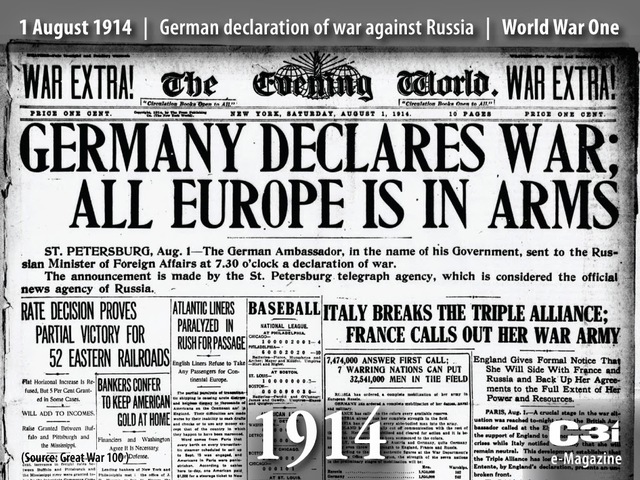
The evening edition of Joseph Pulitzer's sensationalist newspaper,
The New York World, August 1, 1914.

August 1, 1914: The Great War begins. What will later be known as the World War and World War I. It does not, however, end by Christmas as both sides suggest (in victory for themselves, of course). And, as you can guess by the fact that there's a Roman numeral on the war's name, it did not turn out to be "The War to End All Wars."

Here's the chronology:

* June 28: Archduke Franz Ferdinand, heir to the throne of the Austro-Hungarian Empire, and his wife, Archduchess Sophie, are assassinated in Sarajevo by Gavrilo Princip, a Serbian nationalist. Anti-Serb riots break out in Sarajevo (in present-day Bosnia) and Zagreb (in present-day Croatia). Austria spent the next 4 weeks trying to figure out how to punish Serbia for this.

* July 25: Austria-Hungary severs diplomatic ties with Serbia, and mobilizes its armed forces.

* July 28: Austria-Hungary declares war on Serbia. If it had been limited to just those 2 countries, the world would have been a lot better off.

* July 31: In support of their ally, Serbia, the Russian Empire mobilizes. That gets the attention of Austria's ally, the German Empire. And Jean Jaurès, the leader of the French Socialist Party and a man using his newspaper L'Humanité to advocate for peace, is assassinated in Paris. 

* August 1: Germany declares war on Russia. Keep in mind, Russia has not yet declared war on Austria. France mobilizes, in support of their ally Russia. Nearly all stock exchanges in Europe close. With a lot of their business now unavailable to them, the New York Stock Exchange closes as well.

* August 2: Germany occupies Luxembourg. It also issues an ultimatum to Belgium to allow their troops passage into France. It also secures the neutrality of the Ottoman Empire by treaty. That won't hold: Eventually, the Ottomans get into the war on the Germans' side.

* August 3: Germany declares war on France. Belgium refuses Germany's ultimatum.

* August 4: Germany invades Belgium. The British Empire declares war on Germany, because it had guaranteed Belgium's safety. This brings not just Great Britain into the war, but also Canada, South Africa, Australia, New Zealand, and every other land then controlled from London. The United States of America affirms its neutrality.

* August 6: Austria-Hungary declares war on Russia.

The fighting is ferocious on all 3 fronts: The Western Front (Britain and France vs. Germany), the Eastern Front (Russia vs. Germany), and the Southern Front (Russia and Serbia vs. Austria). The Ottomans get in. Italy gets in. Both are on the side of the Central Powers (Germany and Austria).

In 1917, Russia falls into revolution, and gets out. This seemed to give Germany the edge. But, with Germany egging Mexico on against America, America got in as well. On November 11, 1918, Germany surrendered.

*

August 1, 1914 was a Saturday. There was, as yet, no NFL, NBA or NHL, although there was a National Hockey Association, but it was during their off-season. But there were Major League Baseball games played that day. In the American League:

* The New York Yankees split a doubleheader with the Cleveland Naps at League Park in Cleveland. The hosts won the 1st game, 7-0. In their last year with Napoleon "Nap" Lajoie as their 2nd baseman, best hitter, manager and namesake, the team that became the Indians the next season tagged Yankee starter Marty McHale for 4 runs, and he was removed before he could even get 2 outs.

The Yankees won the 2nd game, 9-2. Charlie Keating entered the game with a 1-10 record, but went the distance for the Bronx ballclub (by no means "Bombers" yet), and helped his own cause with 2 hits. Charlie Mullen backed him with 3 hits.

* The Washington Senators beat the Detroit Tigers, 3-0 at Navin Field in Detroit. (The ballpark was renamed Briggs Stadium in 1938 and Tiger Stadium in 1961.) Walter Johnson allowed 7 hits, but kept the shutout.

* The Boston Red Sox beat the Chicago White Sox, 4-2 at Comiskey Park in Chicago. Babe Ruth, who had made his major league debut with the Red Sox on July 11, did not appear in this game.

* And the Philadelphia Athletics beat the St. Louis Browns, 9-5 at Sportsman's Park in St. Louis.

In the National League: 

* The New York Giants lost to the Cincinnati Reds, 6-1 at the Polo Grounds.

* The Brooklyn Robins swept a doubleheader from the Pittsburgh Pirates at Ebbets Field. This was the once-and-future Dodgers' 1st year with Wilbert Robinson as their manager, and they were named the Robins for him as long as he was with them, through the 1931 season, after which they became the Dodgers again. They won the 1st game 7-1, and the 2nd game 10-1.

* The Philadelphia Phillies beat the Chicago Cubs, 10-4 at Baker Bowl in Philadelphia.

* And the Boston Braves beat the St. Louis Cardinals, 4-3 in 10 innings at Fenway Park in Boston. With the South End Grounds now being too small to accept the crowds the World Champions-to-be were getting, they began building Braves Field, and had begun groundsharing with the Red Sox at Fenway in the interim.

And 1914 was the 1st of 2 seasons for the Federal League:

* The only team the FL had in New York City, the Brooklyn Tip-Tops, beat the Indianapolis Hoosiers, 5-2 at Washington Park, the former home of the Dodgers. In spite of this game, the Hoosiers went on to win the Pennant.

* The Baltimore Terrapins beat the Kansas City Packers, 5-0 at Terrapin Park in Baltimore. When the FL folded, the International League's Baltimore Orioles moved into Terrapin Park, renamed it Oriole Park, and stayed until a 1944 fire forced them to move into nearby Municipal Stadium. In the early 1950s, Municipal Stadium was converted into Memorial Stadium, and the St. Louis Browns moved there to become the major league version of the Orioles in 1954.

* The St. Louis Terriers beat the Buffalo Blues, 5-3 at the International Fair Association Grounds in Buffalo.

* And the Chicago Whales beat the Pittsburgh Rebels, 3-1 at Exposition Park, former home of the Pirates, which stood roughly where PNC Park does now. 

Wednesday, June 15, 2022

June 15, 1919: The 1st Transatlantic Flight

Arthur Brown (left) and John Alcock

June 15, 1919: The 1st transatlantic flight is made.

What's that? You thought it was by Charles Lindbergh in 1927? No, that was the 1st flight between the North American and European continents, an achievement made famous well before it was done, due to a cash prize being awarded.

It's also worth noting that Lindbergh's fame was greater than it might otherwise have been because he did it alone, hence his nickname, "The Lone Eagle." It didn't have to go to a solo pilot. Indeed, mere days before Lindbergh did it, a 2-man team of Frenchmen, Charles Nungesser and François Coli, attempted to go the other way, from Paris to New York. They were seen flying over Ireland, and were never seen again. Their wreckage has never been found: It may have fallen into the Atlantic Ocean, or it may have crashed into the dense woods in Maine or Canada's Maritime Provinces.

John Alcock, 24, was a native of Greater Manchester. Arthur Whitten Brown, 32, was born in Glasgow, Scotland, and grew up in Manchester. Both served in the Royal Air Force in World War I, and both were prisoners of war. Alcock's His plane's engine failed while he was providing air support during the Gallipoli Campaign in 1915, and he was taken prisoner by the Ottomans. Brown was shot down by the Germans. Both survived their ordeal.

They met shortly after the Armistice, and, both intrigued by the £10,000 prize offered by national newspaper The Daily Mail for the 1st transatlantic air crossing in under 72 hours, decided to go for it. They chose a modified Vickers Vimy bomber biplane with Rolls-Royce engines. Unlike Lindbergh with his Spirit of St. Louis, and Nungesser and Coli with their White Bird, they did not choose a special name for their plane.

They chose the closest possible route: From St. John's, Newfoundland, the easternmost city in the Western Hemisphere, to the west coast of Ireland, the westernmost point in Europe. (Newfoundland would remain a British Dominion until 1949, when they applied for admission to Canada as a Province, and got it.)

At 1:45 PM on June 14, they took off from Lester's Field in St. John's. The takeoff was difficult, and they just missed the tops of some trees. Within their 1st 4 hours, their generator failed, costing them their radio and their heat. Then an exhaust pipe burst, causing a noise that meant that Alcock and Brown couldn't even hear each other. And then they hit fog.

In the 10th hour of the flight, the fog lifted, and Brown could see the stars and use a sextant, and found that they were on course. But their electric heating suits had failed, and in the open cockpit, they were terribly cold. In their 13th hour, they hit snow. They got wet, and their instruments began to ice up. It began to look like they would have to fly low and bail out, and hope that someone would rescue them before they drowned or died of hypothermia.

But their luck held out. At 8:40 AM, Greenwich Mean Time, less than 16 hours after takeoff, they saw what they thought was a suitable green field, and set down. It was a rough landing, because the field was actually Derrygilmalgh Bog, near Clifden in County Galway, Ireland. But you know the old saying: Any landing you can walk away from is a good landing.

They had done it. Brown, perhaps feeling a bit cocky, said that if the weather had been good, they would have had enough fuel left to go all the way to London. They were honored by their country, as King George V invested them as Knight Commanders of the Most Excellent Order of the British Empire at Windsor Castle a week after the achievement.

Alcock did not have long to enjoy his share of the laurels and the publicity. On December 18, 1919, he was flying the new Vickers Viking amphibious aircraft at the Paris Airshow, but crashed, and was killed. Brown lived a bit longer: Like co-inventor of the airplane Orville Wright, he died in 1948.

In 1954, a statue of them was dedicated at London Heathrow Airport. In 2019, to celebrate the 100th Anniversary of the flight, the statue was moved to Clifden, near the site of the landing. Another statue is in their shared hometown of Manchester. The plane was repaired, and is on display at the Science Museum in South Kensington, London.

*

June 15, 1919 was a Sunday. Sunday baseball was not yet legal in all cities, or all States, that were home to teams in what we now call Major League Baseball. Only 8 of a possible 16 teams were in action. Not in action: In the American League, the Boston Red Sox, the Cleveland Indians, the Philadelphia Athletics and the St. Louis Browns; and in the National League, the Boston Braves, the Cincinnati Reds, the Philadelphia Phillies and the Pittsburgh Pirates. But these games were played:

* The New York Yankees lost to the St. Louis Browns, 1-0 at the Polo Grounds. Urban Shocker, possessor of one of the great names in baseball history, and a pitcher whom the Yankees had traded away, came back to haunt them, pitching a 5-hit shutout.

* The New York Giants beat the Chicago Cubs, 5-4 in 10 innings at Cubs Park, later to be renamed Wrigley Field. Ironically, one of the players on the losing side for the Cubs was Fred Merkle, whose baserunning "Boner" cost the Giants the 1908 National League Pennant against the Cubs. Grover Cleveland Alexander was the losing pitcher in relief.

* The Brooklyn Robins, the once-and-future Dodgers, beat the St. Louis Cardinals, 3-2 at Robison Field in St. Louis.

* And the Detroit Tigers beat the Washington Senators, 8-5 at National Park in Washington, later to be renamed Griffith Stadium. Ty Cobb went 1-for-4 for the Tigers. 

Saturday, June 4, 2022

June 4, 1927: The 1st Ryder Cup Tournament

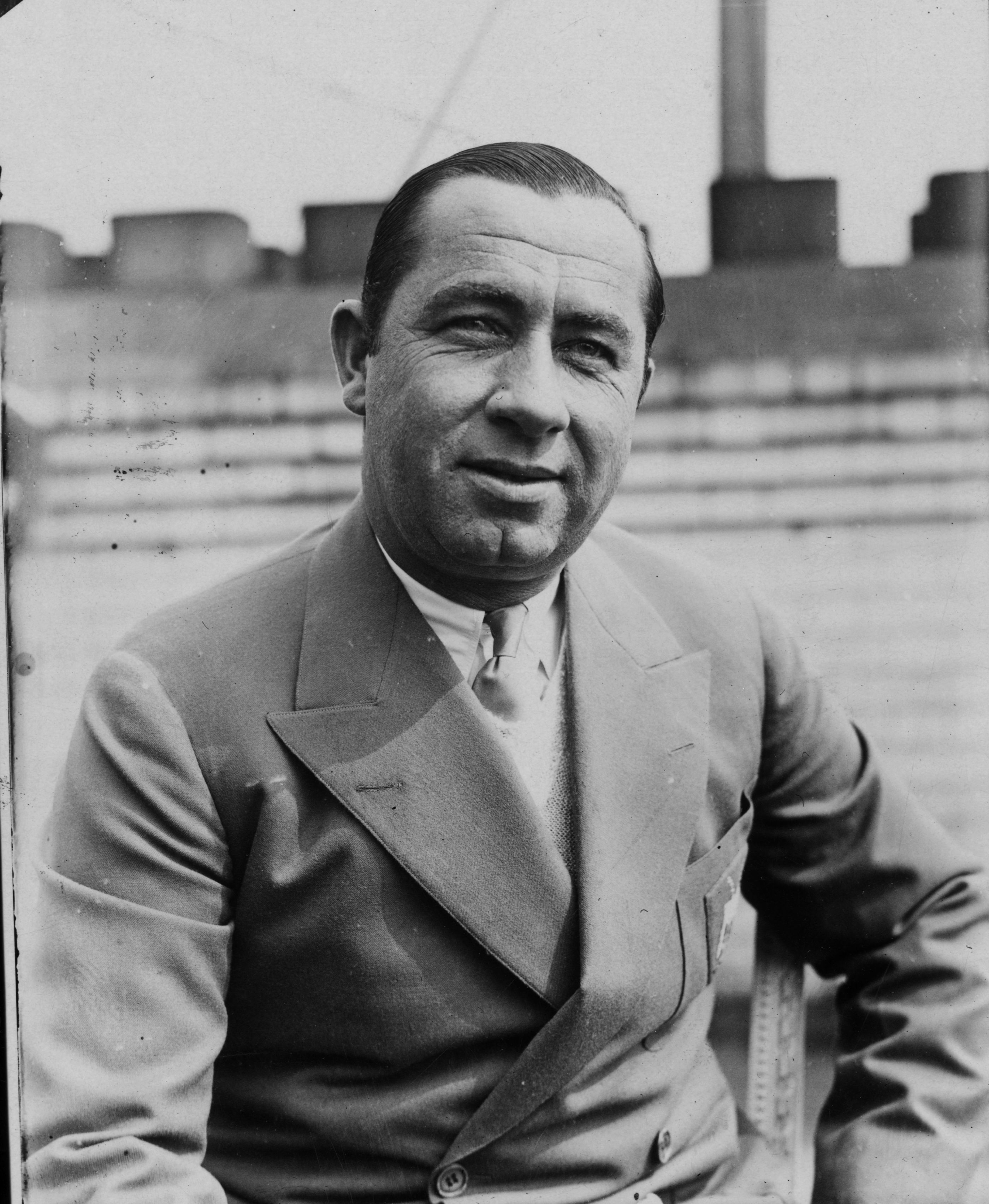
Walter Hagen

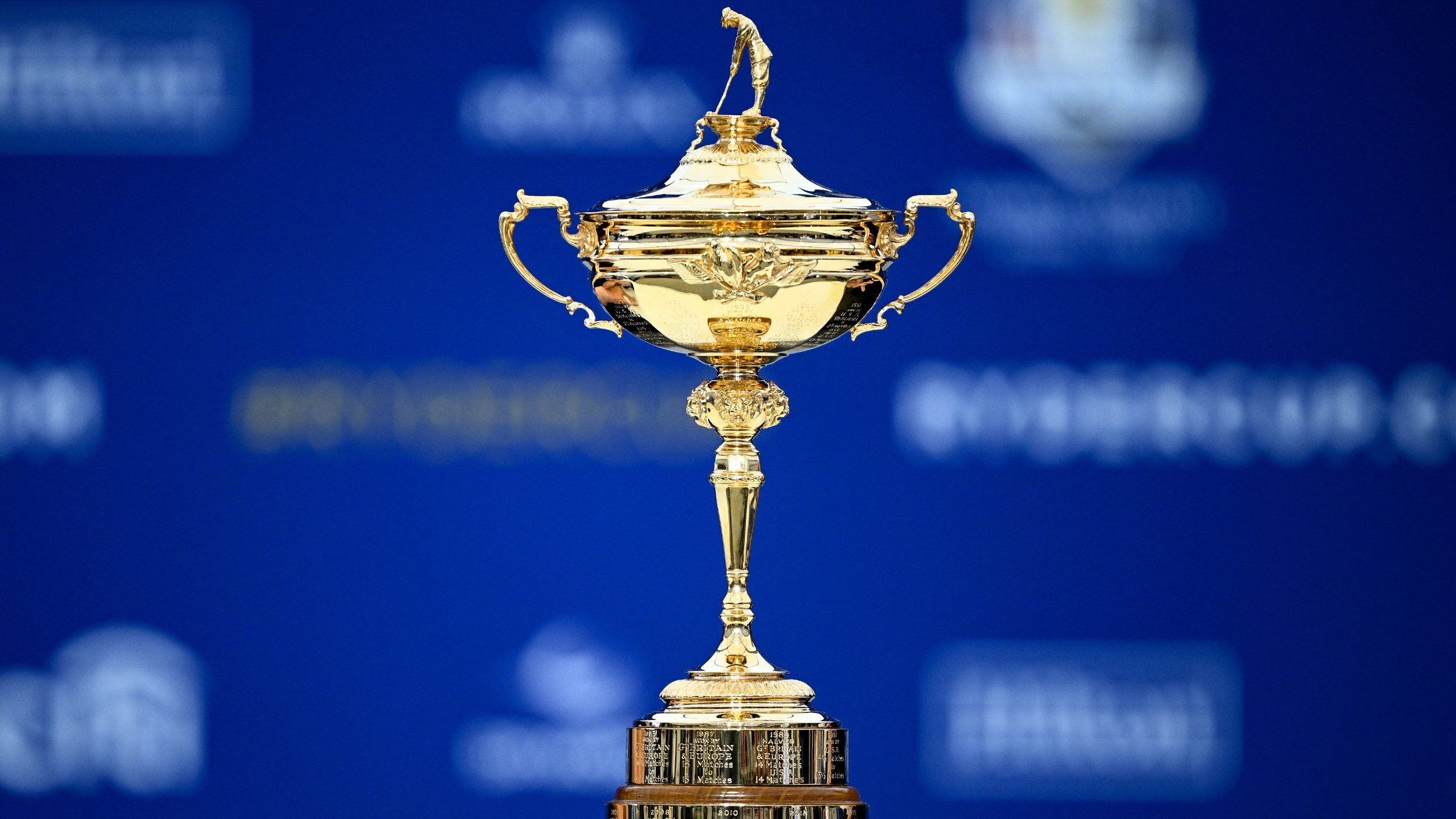
June 4, 1927: The 1st Ryder Cup golf tournament is held, at the Worcester Country Club in Worcester, Massachusetts, 43 miles west of downtown Boston. The American team, captained by Walter Hagen, defeated the British team, captained by Ted Ray, 912–212.

NOTE: For a long time, with this project, I resisted putting in references to golf, because of the kind of people who tend to play it. I finally caved in, although I haven't included as many references as I would if it were a real sport, which it is not.

Hagen (1892-1969) was the 1st golfer to really catch the attention of Americans who weren't rich. Known as the "father of professional golf," the native of Rochester, New York brought publicity, prestige, big prize money, and lucrative endorsements to the sport.

He won the U.S. Open in 1914 and 1919; the PGA Championship in 1921, 1924, 1925, 1926 and 1927; and the British Open in 1922, 1924, 1928 and 1929. His 11 majors are still 3rd all-time behind Jack Nicklaus and Tiger Woods. By the time The Masters came around in 1935, he was already in decline, and only played it once, in 1936, finishing in a tie for 11th place. Still, he captained the 1st 6 U.S. Ryder Cup teams, through 1935. The Wilson sporting goods company still sells Walter Hagen brand golf clubs.

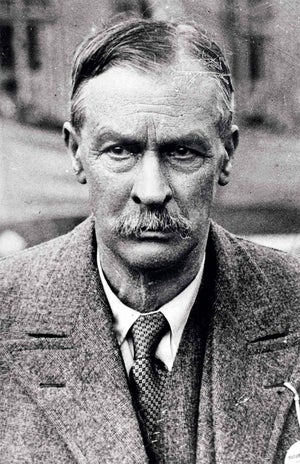
The Ryder Cup is named for Samuel Ryder (1858-1936), an English businessman and golf enthusiast, who originated the idea of selling garden seeds in "penny packets," and built a very successful business on the concept.
Samuel Ryder

The Ryder Cup is a match play golf event, with each match worth one point. From this inaugural event through 1959, the format consisted of 4 foursome (alternate shot) matches on the first day, and 8 singles matches on the second day, for a total of 12 points. Therefore, 612 points were required to win the Cup. All matches were played to a maximum of 36 holes.
Initially contested between Great Britain and the United States, the home team won the first five contests. Still, with the competition's resumption after World War II, repeated American dominance eventually led to a decision to extend the representation of "Great Britain and Ireland" to include continental Europe starting in 1979.

The Cup was first held in Britain in 1929, at the Moortown Golf Club, outside Leeds, in Yorkshire; in Scotland, the birthplace of golf, in 1973, at Muirfield, outside Edinburgh; and on the European continent in 1997, at Valderrama Golf Club, in Sotogrande, Andalusia, in southern Spain.

The event was held every 2 odd-numbered years from 1927 to 1937, before the 1939 event was canceled due to World War II. Play was resumed in 1947, and was again played in odd-numbered years through 1999. The 9/11 attacks delayed the 2001 event to 2002, and was then held in even-numbered years through 2018. The COVID-19 epidemic delayed the 2020 event until 2021, and it is now, again, set to be held in odd-numbered years.

As of the 2021 tournament, the U.S. has won the event 27 times, the opposition 15, and there have been 2 ties.

*

June 4, 1927 was a Saturday. British actor Geoffrey Palmer was born. These baseball games were played:

* The New York Giants lost to the Cincinnati Reds, 5-1 at Redland Field (later rename Crosley Field) in Cincinnati.

* The Brooklyn Robins (as the Dodgers were known from 1914 to 1931, while Wilbert Robinson managed them) lost to the St. Louis Cardinals, 4-0 at Sportsman's Park in St. Louis.

* The Chicago White Sox beat the Boston Red Sox, 6-4 at Fenway Park in Boston.

* The St. Louis Browns beat the Washington Senators, 5-3 at Griffith Stadium in Washington. Walter Johnson, in what turned out to be his final season, was the losing pitcher.

* The Boston Braves beat the Chicago Cubs, 10-8 at Wrigley Field in Chicago.

* The New York Yankees and the Detroit Tigers were rained out at Yankee Stadium. The game was made up as part of a doubleheader on August 3. The Tigers won the opener, 6-5. The Yankees won the nightcap, 8-6. Over the 2 games, Babe Ruth went 2-for 8 with a walk and an RBI; while Lou Gehrig went 2-for-6 with a home run in each game, a walk, and 3 RBIs.

* The Philadelphia Athletics and the Cleveland Indians also made up a June 4 rainout as part of a doubleheader on August 3, at Shibe Park in Philadelphia. The A's swept, 9-2 and 7-4. Over the 2 games, former Detroit star Ty Cobb went 3-for-8 for the A's. Bill Lamar, filling in for usual A's left fielder Al Simmons, went 3-for-9 with 3 RBIs. After sitting out the 1st game, a's catcher Mickey Cochrane went 3-for-5 with 3 RBIs in the 2nd game.

* And the Philadelphia Phillies and the Pittsburgh Pirates were also rained out on June 4. They waited until August 4 to make it up, also as part of a doubleheader, at Forbes Field in Pittsburgh. The Pirates swept, 8-5 and 7-3. Ray Kremer was not only the winning pitcher in the 2nd game, he went 3-for-4 with a home run and 2 RBIs.

For the Bucs, Paul Waner went 4-for-9 with a walk and an RBI, Lloyd Waner went 5-for-10 with an RBI, Hazen "Kiki" Cuyler went 4-for-9 with an RBI, and Glenn Wright went 2-for-7 with 2 walks and 4 RBIs. For the Phils, Cy Williams went 3-for-8 with a walk and 3 RBIs, Freddy Leach went 4-for-9, and Dick Spalding went 5-for-8 with a walk and 3 RBIs.

Tuesday, May 31, 2022

June 1, 1889: The Orient Express

June 1, 1889: The most famous train route in human history, the Orient Express, begins full operations.

Well, not quite full. It opened on June 4, 1883, going from Paris, France to Vienna, Austria. Nobody would confuse Vienna with the Orient, not even if Mozart had written The Mikado 100 years before Gilbert & Sullivan had.
Gare de l'Est, Paris, opened in 1849

On October 3, 1883, the route was extended to Constantinople, the capital of the Ottoman Empire. In 1923, the Ottoman Empire became the Turkish Republic, "Türkiye" in their native language, "Turkey" in English; and the capital was moved to Ankara. In 1929, the national government told the world to start calling Constantinople "Istanbul."

Still, it wasn't a single train. The original trip required passengers to disembark in Romania, to be ferried across the Danube to Bulgaria, where they would catch another train to the Bulgarian city of Varna, followed by a 150-mile ferry ride to Constantinople. The final leg of the train ride to Constantinople wasn't finished until 1885. Finally, on June 1, 1889, a single train left Gare de l'Est (Station of the East) in Paris for Sirkeci Railway Station in what became Istanbul.
Sirkeci Station, Istanbul, opened in 1872

Connections were made from Paris to London via Calais and a ferry across the English Channel to Dover. The main route went from Paris to Lausanne, Switzerland; to Milan and Venice, Italy; to Belgrade, Yugoslavia (now in Serbia); to Sofia, Bulgaria; to Istanbul -- and, on the way back, in reverse. An average Paris-to-Istanbul, or Istanbul-to-Paris, ride took nearly 3 days: 2 days, 20 hours of what the standards of the time considered exceptional luxury.

There were alternate routes, from Paris through Strasbourg (France), Munich, Vienna, Budapest (Hungary) and Bucharest (Romania) to Istanbul; and from Paris through Zurich (Switzerland), Innsbruck (Austria) to Vienna, Budapest, Bucharest and Istanbul. All routes were shut down during the World Wars.

The ride became popular among writers. Agatha Christie's most famous story remains the 1934 Murder On the Orient Express, in which the train, heading for Paris, gets stuck in the snow in Yugoslavia, and Hercule Poirot must solve a murder. Other fictional characters known to have ridden the famed luxury train include Count Dracula in Bram Stoker's 1897 novel Dracula, and James Bond in the 1963 film From Russia with Love.
But, as in America, rail travel in Europe became superseded by air travel. The route stopped serving Istanbul in 1977, cut back to a through overnight service from Paris to Bucharest, which was cut back further in 1991 to Budapest, then in 2001 to Vienna, before departing for the last time from Paris on June 8, 2007. After this, the route, still called the Orient Express, was shortened to start from Strasbourg, leaving daily after the arrival of a TGV from Paris. On December 14, 2009, the Orient Express ceased to operate entirely, and the route disappeared from European railway timetables.

UPDATE: In late 2022, the hospitality company Accor announced plans to launch its own Orient Express from Paris to Istanbul, to start in mid-2026.

*

June 1, 1889 was a Saturday. There were 6 games that day in what would eventually be called Major League Baseball:

* In the National League, the New York Giants lost to the Washington Nationals, 9-5 at the Swampoodle Grounds in Washington. This version of the Nationals were dropped from the NL after the 1899 season, and the current team with the name has no connection to it.

* Also in the NL, the Boston Beaneaters beat the Philadelphia Phillies, 7-2 at the South End Grounds in Boston.

* In the American Association, the Philadelphia Athletics beat the Cincinnati Reds, 8-4 at the Jefferson Street Grounds in Philadelphia. These Athletics went out of business after the "Players' League War" of 1890. The Reds were admitted to the NL in 1892.

* Also in the AA, there was a doubleheader at Oriole Park in Baltimore. The Baltimore Orioles won the opener, 5-4. The Kansas City Cowboys won the nightcap, 10-8. The Orioles were admitted to the NL in 1892, but dropped after 1899, and the current team with the name has no connection to it.

* And, also in the AA, the Columbus Solons beat the Louisville Colonels, 8-3 at Recreation Park in Columbus, Ohio. The Colonels were admitted to the NL in 1890, but were dropped after the 1899 season. The Solons folded with the AA after the 1891 season.

Tuesday, May 24, 2022

May 24, 1956: The 1st Eurovision Song Contest

Lys Assia

May 24, 1956: The 1st Eurovision Song Contest is held at Teatro Kursaal in Lugano, Switzerland. It is primarily a radio program at this stage, as few Europeans can afford TV sets. Only 7 countries participated: In alphabetical order, Belgium, France, (West) Germany, Italy, Luxembourg, the Netherlands, and Switzerland.
 
The winner is the Swiss entry, "Refrain," with music by Géo Voumard, lyrics by Émile Gardaz, and sung by Rosa Mina Schärer, under the name Lys Assia. Gardaz died in 2007, Voumard in 2008, Schärer in 2018.

Most Eurovision winners turn out to be forgettable. Indeed, what may be the most famous winner came in 1967, England's entry, "Puppet On a String" by Sandie Shaw. And, presaging American Idol by decades, that wasn't even the most significant entry! A songwriting team from Luxembourg, writing in French, got Greek singer Vicky Leandros to sing their composition, "L'amour est Bleu." It finished 4th. Luxembourg and Leandros won in 1972, with "Après toi."

If you listen to American "oldies" stations, you know "L'amour est Bleu," although you may never have heard its words, in any language: In 1968, French conductor Paul Mauriat would record his orchestra playing it as an instrumental, and use its English title: "Love Is Blue." He hit Number 1 with it.

There was a 4-way tie vote in 1969: Britain, France, Spain and the Netherlands. Sweden won in 1974, with "Waterloo," launching the career of ABBA. Ireland and Sweden have won it the most, 7 times. Britain has won 4 times.

Here are the winners:

Ireland, 7: 1970, 1980, 1987, 1992, 1993, 1994 and 1996.
Sweden, 6: 1974, 1984, 1991, 1999, 2012 and 2015. (UPDATE: They won again in 2023.)
Luxembourg, despite its small size, 5: 1961, 1965, 1972, 1973 and 1983.
France, 4: 1958, 1960, 1962 and 1977.
Britain, 4: 1967, 1976, 1981 and 1997.
Israel, even though it's in Asia, 4: 1978, 1979, 1998 and 2018.
Netherlands, 4: 1957, 1959, 1975 and 2019.
Denmark, 3: 1963, 2000 and 2013.
Norway, 3: 1985, 1995 and 2009.
Italy, 3: 1964, 1990 and 2021.
Ukraine, 3: 2004, 2016 and 2022.
Switzerland, 2: 1956 and 1988. (UPDATE: They won again in 2024.)
Germany, 2: 1982 (as West Germany) and 2010.
Austria, 2: 1966 and 2014. (UPDATE: They won again in 2025.)
Spain, 1: 1968.
Monaco, 1: 1971.
Belgium, 1: 1986.
Estonia, 1: 2001.
Latvia, 1: 2002.
Turkey, even though most of the country is in Asia, 1: 2003.
Greece, 1: 2005.
Finland, 1: 2006.
Serbia, 1: 2007.
Russia, 1: 2008.
Azerbaijan, even though it's in Asia, 1: 2011.
Portugal, 1: 2017.

(UPDATE: Bulgaria was a first-time winner in 2026.)

*

May 24, 1956 was a Thursday. Larry Blackmon, the lead singer of the hip-hop group Cameo, was born.

There were only 2 scores on this day, both in baseball. The New York Yankees beat the Detroit Tigers, 11-4 at Briggs Stadium in Detroit. The ballpark was renamed Tiger Stadium in 1961. Tom Sturdivant was the winning pitcher. It was just another day at the office for Mickey Mantle, as he went 5-for-5, with a home run, a walk, and 3 RBIs. The Bronx Bombers also got home runs from Joe Collins, Eddie Robinson and Andy Carey. Al Kaline went 0-for-3 with a walk.

And the Philadelphia Phillies beat the Brooklyn Dodgers, 6-4 at Connie Mack Stadium in Philadelphia. Robin Roberts outpitched a rookie named Don Drysdale -- and a veteran named Sal Maglie. As the ace of the New York Giants, Maglie was the player Dodger fans had hated the most, but he would turn out to be integral to the Dodgers' National League Pennant win. Roberts got a hit in his own cause. Willie "Puddin' Head" Jones went 3-for-4 with 2 home runs and 4 RBIs. The Dodgers got home runs from Jackie Robinson, Duke Snider and Carl Furillo.

Sunday, February 6, 2022

February 7, 1878: The Longest-Reigning Pope

Not only is this the earliest known photograph of a Pope,
but it's a photograph of a man born in 1792.

February 7, 1878: Pope Pius IX dies of a heart attack in the Vatican. He was 85 years old, and had reigned for 31 years. Aside from the 1st Pope, Saint Peter himself, 34 years, he is the longest-reigning Supreme Pontiff of the Roman Catholic Church.

He was born on May 13, 1792, in Senigallia, in the Marche region of Italy, on the coast of the Adriatic Sea, with the name Giovanni Maria Mastai FerrettiIn 1814, as a theology student in his hometown of Sinigaglia, he met Pope Pius VII. The following year, he entered the Papal Noble Guard, but was soon dismissed after an epileptic seizure. He threw himself on the mercy of Pius VII, who elevated him, and supported his continued theological studies.

His seizures became less frequent. He was ordained as a priest in 1819, and earned the trust of the next Pope, Leo XII, who appointed him Archbishop of Spoleto in 1827. Pope Gregory XVI named him a Cardinal in 1839, and Cardinal Ferretti was named his successor on June 16, 1846, at the age of 54. He took the regnal name Pius IX, in honor of his patron, Pius VII.

He modernized the Papal States, before they were absorbed into the Kingdom of Italy in 1870. He was also Pope during the Irish Potato Famine of 1845 to 1849, for which he raised aid; the European Revolutions of 1848, which led him to become considerably more conservative; the rise (1852) and fall (1870) of France's Second Empire; the Crimean War of 1853 to 1856, which he did nothing to end; the American Civil War of 1861 to 1865, which he did nothing to end, nor did he do anything to encourage the abolition of slavery in America; the unification of Germany in 1871, which saw him at odds with Chancellor Otto von Bismarck; and the Paris Commune, also in 1871, which he opposed.

He convened the First Vatican Council in 1869, which raised the role of Mary in the Church, and ratified his doctrine of Papal infallibility.

He developed erysipelas, especially on his legs, which made walking painful and eventually nearly impossible. A heat wave in 1877 sent his health into decline, but he lived long enough to see the death of his former enemy, King Victor Emmanuel II of Italy, on January 9, 1878. On February 7, he had a seizure, which gave him a fatal heart attack.

He was beatified in 2000, but, as of 2022, has not been canonized as a saint. In 1874, while he was still alive, a street in Montreal was named for him: Pie-IX Boulevard (pronounced "Pee-noof"). It forms part of Quebec Route 125, and part of the border of Montreal's 1976 Olympic Park. The station serving that Park on the Montreal Metro (subway) system is named Pie-IX. In 1937, as part of the Boulevard, the Pie-IX Bridge was built over the Prairies River. It was rebuilt in 1967.

Pius IX was succeeded by Leo XIII, and he reigned for 25 years. So, for 56 years, 1846 to 1903 -- in America, the Presidencies of James K. Polk to Theodore Roosevelt -- there were 16 Presidents, but only 2 Popes. (Of course, there had only recently been a 2nd monarch of Great Britain, as Queen Victoria had been on that throne from 1837 to 1901, succeeded by King Edward VII.)

Leo XIII was followed in 1903 by Pius X, in 1914 by Benedict XV, in 1922 by Pius XI, in 1939 by Pius XII, in 1958 by John XXIII, in 1963 by Paul VI, in 1978 by John Paul I, and then, after just 33 days, the shortest-reigning modern Pope, by John Paul II. His reign of 26 years is the 2nd-longest in the modern era. He was succeeded in 2005 by Benedict XVI. He resigned in 2013 (all the other changes mentioned here were through the death of the preceding Pope), and was succeeded by Francis.

*

February 7, 1878 was a Thursday. There were no scores on this historic day.

February 6, 1962: The Birth of European Rock and Roll

Françoise Hardy, 1968

February 6, 1962: Petit Conservatoire airs on French television. On it, Françoise Hardy, having just turned 18, sings "La fille avec toi" (meaning, "The Girl With You") and plays guitar. The hostess asked the young singer what the English-language "Yeah! Yeah!" in her lyrics meant.

The transliteration "Yé-yé" was used by sociologist Edgar Morin in an article published in French newspaper Le Monde (The World) on July 7, 1963, in which he analyzed the burgeoning youth-led pop music scene. This, combined with The Beatles' touring of Europe, is widely credited as the birth of rock and roll in Europe.

The yé-yé phenomenon was particularly big in France, led by Hardy, Serge Gainsbourg, Sylvie Vartan, and Johnny Hallyday, who became known as "The Elvis of France"; and Spain, where it was seen as a revolt against the Fascist/Catholic regime of Francisco Franco.

Hardy became an actress, and, as one of France's biggest celebrities, her love-life became gossip fodder. She continued singing and acting into the 2000s, when she developed cancer. After years of fighting various health issues, as of February 6, 2022, she is still alive, but not well enough to perform in public.

*

February 6, 1962 was a Tuesday. Another birth that day that would have an effect on rock and roll was that of William Bruce Rose Jr., a.k.a. Axl Rose.

Baseball and football were out of season. The NHL did not schedule any games for that night. But there were 4 games played in the NBA, and every one of them featured a great performance by a player on the team that lost:

* The Syracuse Nationals beat the Chicago Packers, 127-123 at the old Madison Square Garden. This was the 1st game of a doubleheader.

Yes, the NBA had a team in Chicago named for the arch-rivals of the city's football team. It didn't catch on, and in 1963, they moved to become the Baltimore Bullets, eventually becoming the Washington Wizards. In this game, Walt Bellamy scored 38 points for the Packers.

* The New York Knicks beat the Los Angeles Lakers, 116-112, in the 2nd game at The Garden. Jerry West scored 36.

* The Detroit Pistons beat the Cincinnati Royals, 119-118 at the Cincinnati Gardens. Oscar Robertson scored 47 points for the Royals.

* And the Boston Celtics beat the St. Louis Hawks, 129-114 at the Kiel Auditorium in St. Louis. Bob Pettit scored 37.

December 31, 1999 & January 1, 2000: The Millennium

December 31, 1999:  The Millennium arrives. The people of planet Earth survived. At a terrible cost. But we hadn't destroyed ourselves. ...