Showing posts with label vatican. Show all posts

Saturday, November 5, 2022

November 5, 1943: The Bombing of the Vatican

November 5, 1943: Vatican City, the seat of the Roman Catholic Church, and neutral in World War II despite having been completely surrounded by the City of Rome, the capital of (until a few months ago) Fascist Italy, is bombed by Nazi Germany's air force, the Luftwaffe.
Four bombs are dropped on the microstate. There is some damage, but there are no deaths. The aircraft responsible is never identified. There would be another bombing on March 1, 1944, causing less damage, but taking a life. In neither case was Pope Pius XII within range of the bombs.
Vatican City, usually listed as just "The Vatican, is the world's smallest independent nation, with just 121 acres of land, about half of which is parkland; and, as of 2022, 453 permanent residents. It is dominated by St. Peter's Basilica, the center of the Catholic world. The original Basilica was finished around AD 360, and the current one dates to 1626. There are no chain restaurants -- indeed, no public restaurants at all -- but, one block east into Rome, there is a McDonald's.
*
November 5, 1943 was a Friday. Playwright and actor Sam Shepard was born. So was Friedman Paul Erhardt, the TV chef billed as Chef Tell.
Baseball season was over. Football was in midweek. The NBA hadn't been founded yet. And while the NHL season had started, no games were scheduled for this day. So there were no scores on this historic day.

Tuesday, October 11, 2022

October 11, 1962: The Second Vatican Council Is Convened

October 11, 1962: Pope John XXIII opens the Second Ecumenical Council of the Vatican, the 21st ecumenical council of the Roman Catholic Church, and the 1st since the First Vatican Council in 1869-70. This Second Council becomes widely known as "Vatican II."

The Pope called the Council because he felt the Church needed "updating" -- what he called, in Italian, aggiornamento. In order to connect with 20th Century people in an increasingly secularized world, some of the Church's practices needed to be improved, and its teaching needed to be presented in a way that would appear relevant and understandable to them. For this, Time magazine named him its Man of the Year for 1962.

Many Council participants were sympathetic to this, while others saw little need for change and resisted efforts in that direction. But support for aggiornamento won out over resistance to change, despite the fact that he died while it was in progress, on June 3, 1963. His successor, Pope Paul VI, was a full supporter of John's reforms, and kept the Council going, closing it on December 8, 1965.

As a result, the 16 magisterial documents produced by the council proposed significant developments in doctrine and practice: An extensive reform of the liturgy, a renewed theology of the Church, of revelation and of the laity, a new approach to relations between the Church and the world, to ecumenism, to non-Christian religions, and to religious freedom.

Among the more notable reforms was allowing Mass in each country's native language, so that it was no longer necessary to deliver the Mass in Latin; and removing the restriction on eating meat on Friday. (The exception is during Lent, when it is still forbidden. For those times when St. Patrick's Day, which is usually during Lent, falls on a Friday, exceptions are sometimes made, due to the tradition of corned beef and cabbage.)

John XXIII, born Angelo Giuseppe Roncalli, and known in his time as "The Good Pope," was canonized in 2014: St. John XXIII.

*

October 11, 1962 was a Thursday. Actress Joan Cusack was born.

It was a travel day in the World Series, which the New York Yankees would win over the San Francisco Giants. Football was in midweek. The NBA season started 5 days later.

There were 2 games played in the NHL. The New York Rangers lost to the Detroit Red Wings, 2-1 at the old Madison Square Garden. And the Boston Bruins beat the Montreal Canadiens, 5-0 at the Boston Garden. The Toronto Maple Leafs and the Chicago Black Hawks were not scheduled.

Wednesday, September 28, 2022

September 28, 1978: Pope John Paul I Dies After Just 33 Days In Office

September 28, 1978: Pope John Paul I dies of a heart attack at the Apostolic Palace in the Vatican. He was 65, young for a Pope, and had been in office only 33 days.

He was born on October 17, 1912 in Canale d'Agordo, in the province of Veneto, Italy, as Albino Luciani. He was ordained as a priest in 1935, and rose to become Patriarch of Venice in 1969. On August 26, 1978, he was elected Pope. He was the 1st Pope to take 2 names, those of the last 2 Popes, both of whom had been very popular: John XXIII and Paul VI, who had died on August 6.

He said he wanted to "humanize" the papacy. Most Popes, recognizing that they were the monarch of the Church, spoke of themselves with "the royal we," but John Paul I publicly called himself "I." Instead of a coronation, he called his ceremony an inauguration, as if he were, instead, a President. He quickly proved popular, and became known as "the Smiling Pope."

And then, on September 29, he was found dead in his bed. It was determined that he had suffered a heart attack the night before. There would have to be a 3rd Pope in a matter of weeks, and on October 16, Karol Wojtyla was elected, taking the name Pope John Paul II. And 1978 became known as "The Year of the Three Popes."

Despite rumors, later encouraged by the film The Godfather Part III, there is no known evidence that Pope John Paul I was murdered. He was beatified in 2022, and is considered a candidate for sainthood.

Although the current Pope, Francis, is of Italian descent, he is from Argentina. Benedict XVI was from Germany, and John Paul II was from Poland. For 455 years, all the Popes had been Italian. John Paul I currently stands as the last Pope from Italy.

*

September 28, 1978 was a Thursday. There were 7 Major League Baseball games played that day:

* The New York Yankees beat the Toronto Blue Jays, 3-1 at Yankee Stadium. The Yankees only got 4 hits, but Thurman Munson got 2 of them. Reggie Jackson went 0-for-3 with a walk. Ron Guidry went the distance to get to 24-3 on the season, and broke Jack Chesbro's team record for strikeouts in a season, 240 in 1904. He would finish 25-3 with 248 strikeouts, and a 1.74 ERA. But that finish would be in a Playoff for the American League Eastern Division title, because...

* The Boston Red Sox beat the Detroit Tigers, 1-0 at Fenway Park in Boston. The only run came on a home run by Jim Rice in the 4th inning. It was his 45th of the season, and he would finish with 46. Rice was named the AL's Most Valuable Player, ahead of Guidry, which, by definition -- Guidry carried his team to the Division title, Rice didn't -- was a fraud. Mike Torrez pitched a 3-hit shutout, and would face Guidry in the Playoff game.

On radio station WBCN, in Boston, perhaps the most Catholic city in America, disc jockey Charles Laquidara earned himself a lot of hate mail by beginning his broadcast with this teaser: "Pope dies, Sox still alive."

* The Baltimore Orioles beat the Cleveland Indians, 3-2 at Memorial Stadium in Baltimore. Eddie Murray went 0-for-2, but an RBI on a sacrifice fly.

* The Houston Astros beat the Atlanta Braves, 4-3 at Atlanta-Fulton County Stadium.

* The Cincinnati Reds beat the Los Angeles Dodgers, 8-7 at Riverfront Stadium in Cincinnati. The Dodgers led 4-0 going into the bottom of the 8th, then the Reds scored 2 runs. The Dodgers scored 2 more in the top of the 9th, but the Reds scored 6 in the bottom of the 9th to win it. Pete Rose went 4-for-6 with an RBI. Dave Concepcion and Ken Griffey Sr. each got 3 hits. Johnny Bench went 1-for-4 with an RBI.

* The California Angels beat the Chicago White Sox, 11-7 at Anaheim Stadium (now Angel Stadium of Anaheim).

* And the Texas Rangers beat the Seattle Mariners, 4-3 at the Kingdome in Seattle.

Also, Peter Cambor, who plays Special Agent Nate Getz on NCIS: Los Angeles, was born on this day.

Saturday, August 6, 2022

August 6, 1966: The Beatles "Get Canceled" by America's Religious Right

The Beatles -- left to right: Ringo, Paul, John and George --
on their 1966 World Tour,
looking uneasy, maybe even shellshocked.
Which would have been understandable.

August 6, 1966: What would later be called "cancel culture" hits the biggest act in world entertainment at the time: The Beatles.

On March 4, 1966, The Evening Standard, a London-based newspaper but, like many, serving Great Britain nationally, published an article titled "How Does a Beatle Live?" written by Maureen Cleave. She had interviewed all 4 group members regularly, and accompanied them on their 1st visit to America in February 1964. She is widely believed to have had an affair with John, and to have been the subject of his song "Norwegian Wood (This Bird Has Flown)."
In her latest interview with John Lennon, she portrayed him as restless and searching for meaning in his life. The year before, he had written the song "Help!" While most American teenagers thought it was just a great rock and roll song, it was more than that: John was physically and mentally exhausted from 2 years of nonstop Beatlemania, and all the money he'd made hadn't reduced his stress. So he really was looking for help and meaning.

He and bandmate George Harrison had been reading about religion. Unlike George, who found a connection with Eastern, especially Indian, faiths, John found no comfort in it, or in any other religion. Cleave quoted him as saying:

Christianity will go. It will vanish and shrink. I needn't argue about that; I'm right and I'll be proved right. We're more popular than Jesus now; I don't know which will go first – rock 'n' roll or Christianity. Jesus was all right but his disciples were thick and ordinary. It's them twisting it that ruins it for me.

People in Britain barely noticed: The article provoked no controversy there. Church attendance there was in decline, and Christian churches were attempting to transform their image, to make themselves more "relevant to modern times."

At first, that was also the case in America. Later in March, Newsweek printed the quote. In May, Detroit magazine printed the interview. On July 3, The New York Times Magazine printed it. Still, there was no reaction worth mentioning.

On July 29, Datebook magazine published the interview, and also Cleave's most recent interview with Paul McCartney, in its September 1966 "Shout-Out" issue, which was dedicated to controversial youth-orientated themes, including recreational drugs, sex, long hair, and the Vietnam War.

Although only Paul was shown on the cover, Art Unger, the magazine's editor, put a quote from Lennon's interview on the cover: "I don't know which will go first – rock 'n' roll or Christianity!" In author Robert Rodriguez's description, the editor had chosen what he thought would be Lennon's "most damning comment" for maximum effect.

Except, while it probably should have been, that wasn't the quote that upset people: It was the line, "We're more popular than Jesus now."

And he was right. Granted, 2,000 years from now, if human civilization survives, there will likely be more Bibles sold than Beatle albums. But, at the time, kids were more interested in 4 young men from current Liverpool than in 1 young man from ancient Israel and his 12 disciples.

The people that freaked out over John's remarks shouldn't have asked, "How dare he say that?" They should have asked, "What can we do to make Jesus, once again, more popular than The Beatles?" (Disclaimer: I don't have an answer now, and I probably wouldn't have had an answer had I been around then.)

In Birmingham, Alabama, WAQY disc jockey Tommy Charles said, on the air, "That does it for me. I am not going to play The Beatles anymore." He destroyed their records on the air. Local UPI reporter Al Benn filed a news report in New York City, culminating in a major story in The New York Times on August 5. Radio stations all over the country, including in supposedly liberal cities like New York and Boston, announced that they would no longer play Beatle songs.
On August 6 came the kind of event that one would have expected in Nazi Germany: In Reno, Nevada, station KCBN announced a public bonfire for that night, where the band's albums would be burned.
Many stations in Southern cities followed. Paul compared it to what the Nazis did with books they didn't like, and called it "hysterical low-grade American thinking."
Brian Epstein, the group's manager, who was Jewish, shrugged it off at first. saying, "If they burn Beatles records, they've got to buy them first." But then the press office at the Vatican -- though not Pope Paul VI himself -- weighed in, issuing this statement: "Some subjects must not be dealt with profanely, not even in the world of beatniks." Now, it wasn't just a bunch of ignorant, bigoted, archconservative Southern Baptists that were angry at the Fab Four: It was, officially, the Roman Catholic Church.
What's more, there were death threats. Now, John was scared: He had put his bandmates, and even their loved ones -- by this point, all but Paul were married, John and Ringo Starr each had one son, and George had a sister and her children living in St. Louis -- at physical risk.
And so, for what turned out to be the only time in his public life, John Lennon ate crow, and apologized for something he'd said or done.
On August 11, the Beatles flew from London to Chicago, where the North American leg of their World Tour was to begin. That night, at the Astor Tower Hotel, at a press conference in front of TV cameras, John said, "I suppose if I had said television was more popular than Jesus, I would have got away with it. I'm sorry I opened my mouth. I'm not anti-God, anti-Christ, or anti-religion. I was not knocking it. I was not saying we are greater or better."
He stressed that he had been remarking on how other people viewed and popularized the band. He described his own view of God by quoting the Bishop of Woolwich, "not as an old man in the sky. I believe that what people call God is something in all of us."
He was adamant that he was not comparing himself with Christ, but attempting to explain the decline of Christianity in the UK. He closed with what could be considered a halfhearted apology: "If you want me to apologize, if that will make you happy, then, okay, I'm sorry." (Shades of more recent "I'm sorry if I offended anyone" statements.)
Most American journalists accepted this. A New York Times editorial said that the matter was over. Even the Vatican's newspaper, L'Osservatore Romano (The Roman Observer), decided that the apology was sufficient.
But it wasn't over. On August 13, in South Carolina, the Ku Klux Klan "crucified" a Beatles record on a large wooden cross, which they burned. On the same night, radio station KLUE in Longview, Texas held a Beatles bonfire. The next day, a lightning bolt struck its transmission tower, briefly knocking it off the air. Maybe this was God confirming that He had accepted John's apology as well.
It still wasn't over. On August 15, The Beatles played District of Columbia Stadium (later renamed Robert F. Kennedy Stadium), in Washington, which was still considered a semi-Southern city at that point, and the KKK picketed the concert. On August 19, The Beatles played their only scheduled concert in the South, at the Mid-South Coliseum in Memphis. The Klan picketed this show, too. During the concert, a spectator threw a firecracker onstage, and all 4 members later said that they thought someone had fired a gun.
(Memphis was, of course, the hometown of Elvis Presley. If anyone asked Elvis for his thoughts on the matter, they've never been made public.) 
To make matters worse, John couldn't keep his mouth shut. On August 17, before their concert at Maple Leaf Gardens in Toronto, he gave his approval to Americans fleeing to Canada to avoid the military draft. At a press conference in New York before their concert at Shea Stadium on August 22, John said the Vietnam War was "wrong." The year before, they had filled all 55,000 available seats at the Flushing Meadow stadium. This time, "only" 40,000 showed up, with pickets both for and against them facing off against each other. (There was no fight between these factions.)
It was their most stressful tour ever, and George said he'd rather leave the band than ever go on another tour. They decided they wouldn't, and would be only a recording band from that point onward, although they did not publicly announce it yet. George agreed to stay -- for now.
The last concert on the tour was at Candlestick Park in San Francisco on August 29. They were supported by The Ronettes, The Cyrkle, Bobby Hebb, and The Remains. (The Cyrkle were also managed by Epstein's company.) Attendance: 25,000, meaning about 17,000 empty seats. (In 1971, the NFL's San Francisco 49ers joined baseball's San Francisco Giants there, leading to an expansion to 69,000 seats.)
As usual, they roared through their set, playing 11 songs in 33 minutes, unable to hear themselves over all the screaming, partly due to the fact that, in spite of having a year pass since their first round of stadium concerts, no one had yet figured out how to stage a rock concert in a ballpark. (By the 1970s, that problem would be solved.) The last song they played was a cover of Little Richard's "Long Tall Sally," sung by Paul.
While they'd decided not to tour again, even the four of them did not know that this would be their last paying concert together, ever. There would be the concert on the roof of the building where Apple Records was based, on January 30, 1969. And each of them would have notable solo gigs, with Paul and Ringo living and continuing to tour into the 2020s. But The Beatles would never have another official concert.
In 1970, for his solo album John Lennon/Plastic Ono Band, John recorded a song titled "God," in which he rattled off things and people he didn't believe in: Magic, the I-Ching, the Bible, tarot cards, Adolf Hitler, Jesus, John F. Kennedy, Buddha, mantras, Gita, yoga, kings, Elvis, Zimmerman (meaning Bob Dylan), and, finally, The Beatles. He said, "I just believe in me. Yoko and me. And that's reality." In 1971, for his album Imagine, he recorded a song of the same title, asking people to imagine there's no Heaven or Hell, "and no religion, too."
In contrast, in 1970, for his solo album All Things Must Pass, George recorded "My Sweet Lord," in which he seemed to want to get to know God better -- but the background singers, after chanting, "Hallelujah," began chanting, "Hare Krishna," and moved on to chanting the names of the Hindu gods Brahma, Vishnu and Shiva.
Maureen Cleave, who wrote the original article, died in 2021, at the age of 87.
*

August 6, 1966 was a Saturday. Back in Britain, a preseason exhibition game, or "friendly," was played between two of the most popular soccer teams in the country. Arsenal Football Club of North London traveled to Ibrox Stadium in Glasgow, Scotland, home of Rangers Football Club.

Arsenal were in a transition, having just survived relegation the season before, and had hired a new manager, Bertie Mee. He would build them into England's greatest team once again. But that would take 5 seasons. In contrast, Rangers were, as usual, one of the better teams in Scotland, and had won the Scottish Cup the last season. Rangers won this match, 2-0.

And these baseball games were played:

* The New York Yankees beat the Cleveland Indians, 5-4 at Cleveland Municipal Stadium. Jim Bouton and Sam McDowell started, but, in relief, it was Whitey Ford who was the winning pitcher, and Luis Tiant the losing pitcher. Clete Boyer and Horace Clarke hit home runs. Neither Mickey Mantle nor Roger Maris played.

* The New York Mets lost to the St. Louis Cardinals, 10-8 at Shea Stadium. The Cardinals led 5-0 after 3 innings, then the Mets led 8-4 after 4, but the Cards won. Lou Brock went 2-for-4 with a walk, a stolen base and an RBI. Ken Boyer hit a home run for the Mets over the team he had captained to a World Championship, and won a Most Valuable Player award for, just 2 years earlier.

* The Philadelphia Phillies beat the Atlanta Braves, 6-5 at Connie Mack Stadium in Philadelphia. Hank Aaron went 1-for-3 with 2 walks. Joe Torre went 2-for-5.

* The Baltimore Orioles beat the Washington Senators, 4-0 at Memorial Stadium in Baltimore. Dave McNally pitched a 7-hit shutout. Frank Robinson went 3-for-4 with an RBI. Brooks Robinson went 1-for-3 with an RBI.

* The Pittsburgh Pirates beat the Cincinnati Reds, 9-3 at Forbes Field in Pittsburgh. Roberto Clemente went 0-for-4, but had an RBI on a bases-loaded walk. Willie Stargell did not play. Pete Rose went 2-for-4 with 2 RBIs.

* The Boston Red Sox beat the Detroit Tigers, 8-2 at Tiger Stadium in Detroit. Carl Yastrzemski went 0-for-2 with 2 walks. Tony Conigliaro went 1-for-5. Al Kaline went 1-for-4.

* The Chicago Cubs beat the San Francisco Giants, 5-2 at Wrigley Field in Chicago. Ernie Banks went 2-for-4 with a home run and 2 RBIs. Robin Roberts started for the Cubs, but only pitched 3 innings, and made just 5 more major league appearances before retiring. Willie Mays went 2-for-4.

* The Minnesota Twins beat the Kansas City Athletics, 5-0 at Kansas City Municipal Stadium. Jim "Mudcat" Grant pitched a 4-hit shutout. Harmon Killebrew went 1-for-3 with a walk.

* The Los Angeles Dodgers beat the Houston Astros, 4-3 at the Astrodome in Houston. Don Drysdale outpitched Mike Cuellar.

* And the Chicago White Sox beat the California Angels, 7-1 at Anaheim Stadium (now Angel Stadium of Anaheim).
Friday, February 11, 2022

February 11, 2013: Pope Benedict XVI Abdicates

February 11, 2013: Pope Benedict XVI announces he will resign the Papacy, effective on February 28. He cites a "lack of strength of mind and body." He was 85 years old.

He was the 1st Pope to resign since Gregory XII in 1415, and the 1st to do so by his own choice since Celestine V in 1294.

He was given the title of Pope Emeritus, and retained the right to be addressed as Your Holiness.

Benedict had become Pope on April 19, 2005, upon the death of John Paul II. Born Joseph Aloisius Ratzinger in Bavaria, southern Germany, in 1927, he was drafted into the Hitler Youth at the age of 14. He was eventually held as a prisoner of war by the U.S. Army, and released. There has never been any serious evidence that he committed war crimes while serving the Nazis.

He eventually served as Archbishop of Munich, and was Dean of the College of Cardinals when John Paul II died, making him an international betting favorite to be the new Pope. When this proved to be correct, he choice his regnal name in memory of St. Benedict of Nursia, founder of the Benedictine monasteries; and Pope Benedict XV, who reigned during World War I and worked for peace in its aftermath.

He proved to be a more conservative Pope than had been seen in a long time. Certainly, more so than John XXIII, Paul VI, and both John Pauls. I'd seen pictures of him in full regalia, with a smile that made him look almost sinister, like a villain in a James Bond film.

In April 2008, he visited America, including New York on the 20th, visiting the site of the World Trade Center and delivering a Papal Mass at Yankee Stadium. The crowds were respectful, but he never engendered the kind of love that John Paul II got on his American visits (including at Yankee Stadium in 1979), or that Paul VI got (he delivered the 1st Papal Mass in the Western Hemisphere at Yankee Stadium in 1965).

On April 16, 2021, Pope Emeritus Benedict XVI celebrated his 94th birthday. He is the longest-lived person to have been the Pope.

On March 13, 2013, Jorge Mario Bergoglio was elected Pope, taking the name Francis. He has proved considerably more popular, all over the world.

I was 8 years old when Paul VI died. I have little memory of him. And John Paul I reigned for only a month before he died, so I don't remember much about him. John Paul II and Francis both went around the world looking as if they enjoyed meeting people and spreading the word of a God of love. I never got that feeling from looking at Benedict XVI. It wasn't just the fact that he didn't stay on the Papal throne for the rest of his life that made him an anomaly.

UPDATE: Pope Emeritus Benedict XVI died on December 31, 2022, at the age of 95.

*

February 11, 2013 was a Monday. Baseball and football were out of season. There were 8 NBA games played that day: 

* The Brooklyn Nets beat the Indiana Pacers, 89-84 in overtime at the Bankers Life Fieldhouse (now the Gainbridge Fieldhouse) in Indianapolis.

* The Los Angeles Clippers beat the Philadelphia 76ers, 107-90 at the Wells Fargo Center (now the Xfinity Mobile Arena) in Philadelphia.

* The Charlotte Bobcats beat the Boston Celtics, 94-91 at the Time Warner Cable Arena (now the Spectrum Center) in Charlotte.

* The Atlanta Hawks beat the Dallas Mavericks, 105-101 at the American Airlines Center in Dallas.

* The Minnesota Timberwolves beat the Cleveland Cavaliers, 100-92 at the Quicken Loans Arena (now the Rocket Arena) in Cleveland.

* The New Orleans Hornets beat the Detroit Pistons, 105-86 at The Palace in the Detroit suburb of Auburn Hills, Michigan.

* The San Antonio Spurs beat the Chicago Bulls, 103-89 at the United Center in Chicago.

* And the Washington Wizards beat the Milwaukee Bucks, 102-90 at the Bradley Center in Milwaukee.

And there were 6 games played in the NHL:

* The New York Islanders lost to the Carolina Hurricanes, 6-4 at the Nassau Coliseum.

* The Toronto Maple Leafs beat the Philadelphia Flyers, 5-2 at the Air Canada Centre (now the Scotiabank Arena) in Toronto.

* The Columbus Blue Jackets beat the San Jose Sharks, 6-2 at the Nationwide Arena in Columbus.

* The Los Angeles Kings beat the St. Louis Blues, 4-1 at the Scottrade Center (now the Enterprise Center) in St. Louis.

* The Phoenix Coyotes beat the Colorado Avalanche, 3-2 at the Pepsi Center (now the Ball Arena) in Denver. Shane Doan scored the winning goal, with 59 seconds left in overtime.

* And the Minnesota Wild beat the Calgary Flames, 2-1 in a shootout at the Saddledome in Calgary.

Sunday, February 6, 2022

February 7, 1878: The Longest-Reigning Pope

Not only is this the earliest known photograph of a Pope,
but it's a photograph of a man born in 1792.

February 7, 1878: Pope Pius IX dies of a heart attack in the Vatican. He was 85 years old, and had reigned for 31 years. Aside from the 1st Pope, Saint Peter himself, 34 years, he is the longest-reigning Supreme Pontiff of the Roman Catholic Church.

He was born on May 13, 1792, in Senigallia, in the Marche region of Italy, on the coast of the Adriatic Sea, with the name Giovanni Maria Mastai Ferretti. In 1814, as a theology student in his hometown of Sinigaglia, he met Pope Pius VII. The following year, he entered the Papal Noble Guard, but was soon dismissed after an epileptic seizure. He threw himself on the mercy of Pius VII, who elevated him, and supported his continued theological studies.

His seizures became less frequent. He was ordained as a priest in 1819, and earned the trust of the next Pope, Leo XII, who appointed him Archbishop of Spoleto in 1827. Pope Gregory XVI named him a Cardinal in 1839, and Cardinal Ferretti was named his successor on June 16, 1846, at the age of 54. He took the regnal name Pius IX, in honor of his patron, Pius VII.

He modernized the Papal States, before they were absorbed into the Kingdom of Italy in 1870. He was also Pope during the Irish Potato Famine of 1845 to 1849, for which he raised aid; the European Revolutions of 1848, which led him to become considerably more conservative; the rise (1852) and fall (1870) of France's Second Empire; the Crimean War of 1853 to 1856, which he did nothing to end; the American Civil War of 1861 to 1865, which he did nothing to end, nor did he do anything to encourage the abolition of slavery in America; the unification of Germany in 1871, which saw him at odds with Chancellor Otto von Bismarck; and the Paris Commune, also in 1871, which he opposed.

He convened the First Vatican Council in 1869, which raised the role of Mary in the Church, and ratified his doctrine of Papal infallibility.

He developed erysipelas, especially on his legs, which made walking painful and eventually nearly impossible. A heat wave in 1877 sent his health into decline, but he lived long enough to see the death of his former enemy, King Victor Emmanuel II of Italy, on January 9, 1878. On February 7, he had a seizure, which gave him a fatal heart attack.

He was beatified in 2000, but, as of 2022, has not been canonized as a saint. In 1874, while he was still alive, a street in Montreal was named for him: Pie-IX Boulevard (pronounced "Pee-noof"). It forms part of Quebec Route 125, and part of the border of Montreal's 1976 Olympic Park. The station serving that Park on the Montreal Metro (subway) system is named Pie-IX. In 1937, as part of the Boulevard, the Pie-IX Bridge was built over the Prairies River. It was rebuilt in 1967.

Pius IX was succeeded by Leo XIII, and he reigned for 25 years. So, for 56 years, 1846 to 1903 -- in America, the Presidencies of James K. Polk to Theodore Roosevelt -- there were 16 Presidents, but only 2 Popes. (Of course, there had only recently been a 2nd monarch of Great Britain, as Queen Victoria had been on that throne from 1837 to 1901, succeeded by King Edward VII.)

Leo XIII was followed in 1903 by Pius X, in 1914 by Benedict XV, in 1922 by Pius XI, in 1939 by Pius XII, in 1958 by John XXIII, in 1963 by Paul VI, in 1978 by John Paul I, and then, after just 33 days, the shortest-reigning modern Pope, by John Paul II. His reign of 26 years is the 2nd-longest in the modern era. He was succeeded in 2005 by Benedict XVI. He resigned in 2013 (all the other changes mentioned here were through the death of the preceding Pope), and was succeeded by Francis.

*

February 7, 1878 was a Thursday. There were no scores on this historic day.

Tuesday, January 4, 2022

January 4, 1919: The 1st Meeting Between a President and a Pope

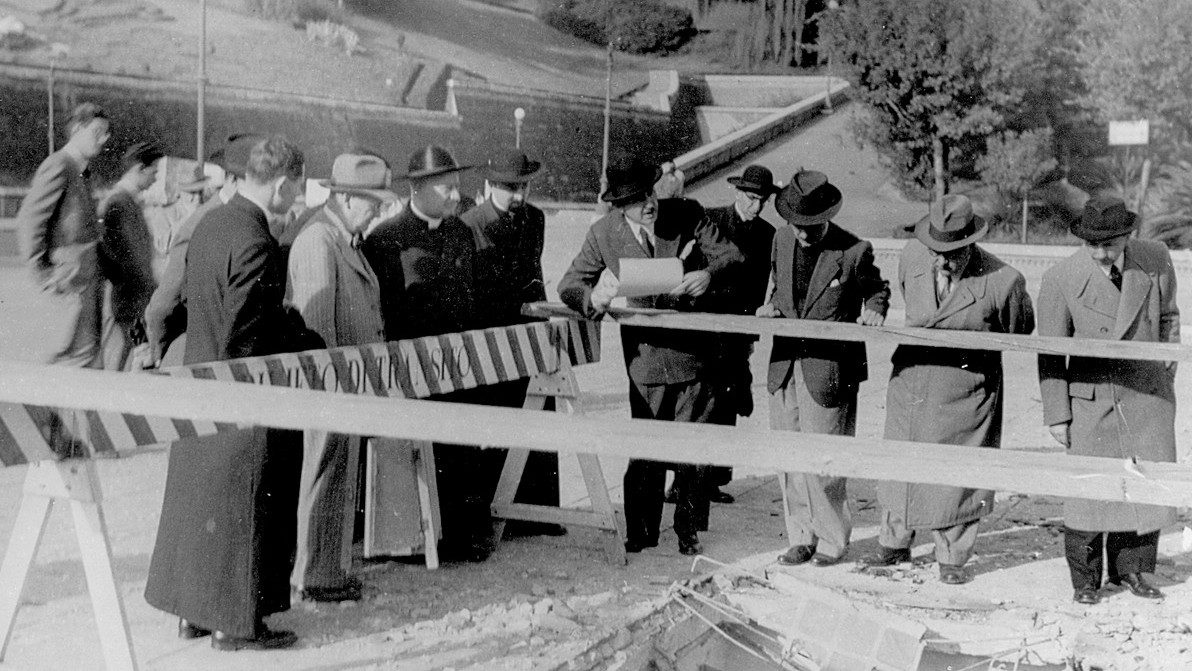
There is no known photograph of the meeting.

January 4, 1919: For the 1st time, a sitting President of the United States meets a reigning Pope, face to face.

It was during the 1st visit of a President to Europe. While Theodore Roosevelt had visited the building of the Panama Canal in 1906, this was the 1st time a President had left the Western Hemisphere. Woodrow Wilson was heading there for the Paris Peace Conference in the aftermath of World War I.

Giacomo Paolo Giovanni Battista della Chiesa became Pope Benedict XV on September 3, 1914, about a month into the war, which he called "the suicide of civilized Europe." He tried to get the belligerents to make peace, but it was no use: German Protestants rejected any "Papal Peace" as insulting, while the French Prime Minister, Georges Clemenceau, regarded the Vatican initiative as being anti-French.

Having failed with diplomatic initiatives, Benedict focused on humanitarian efforts to lessen the impacts of the war, such as attending prisoners of war, the exchange of wounded soldiers, and food deliveries to needy populations in Europe. After the war, he repaired the difficult relations with France, which re-established relations with the Vatican in 1921.

Cardinal James Gibbons, the Archbishop of Baltimore and a friend of Wilson's, helped secure a meeting between the President and the Pope. The Cardinal had sent a letter to the President imploring him to visit the Pope, after learning that Wilson was to go to Europe.

Wilson was accompanied by the Pontifical North American College rector, Charles O'Hearn. Benedict took Wilson by the hand, and led him into the study for their meeting, with the Pope later presenting Wilson with a gift: A mosaic of St. Peter. An interpreter had to be present for the meeting, since the Pope was speaking in French, and Wilson only spoke English.

After presenting his personal physician, Admiral Cary Grayson, Wilson told Benedict, "This is the man who keeps me well." Benedict said, "Apparently, he has done a splendid job." (No one, including Benedict, with the exception of Wilson and Grayson, knew that Wilson was lying.) The Pope blessed the entourage, despite Wilson's slight confusion, after the Pope assured Wilson his blessing did not discriminate against those of other faiths, since Wilson was a Presbyterian, and the son of a minister.

However, there was friction between the two during their private audience. Benedict wanted to be involved in the discussions at Versailles, but Wilson disagreed with this. In the end, the leaders of the victorious Allies got their way, and the Pope was not involved.

As things turned out, neither man lived much longer. Pope Benedict XV came down with influenza, which turned into pneumonia, and died on January 22, 1922. One of the younger Popes, he was only 67. Wilson suffered a stroke later in 1919, and never fully recovered, dying on February 3, 1924, at the same age.

There would not be another meeting between a sitting President and a reigning Pope until December 6, 1959, when Dwight D. Eisenhower met John XXIII at the Papal residence at the Apostolic Palace. Every President since "Ike" has met with a Pope at least once.

*

January 4, 1919 was a Saturday. Baseball and football were out of season. Pro basketball barely existed. There was 1 game played in the NHL: The Montreal Canadiens beat the Ottawa Senators, 5-2 at the Jubilee Arena in Montreal. The Canadiens' goals were scored by Newsy Lalonde, Odie Cleghorn, Didier Pitre, Bert Corbeau and Joe Malone; the Senators', by Cy Denneny and Frank Nighbor.

December 31, 1999 & January 1, 2000: The Millennium

December 31, 1999:  The Millennium arrives. The people of planet Earth survived. At a terrible cost. But we hadn't destroyed ourselves. ...