
June 9, 1973: The Belmont Stakes is held at Belmont Park, just over the New York City line in Elmont, Nassau County, New York. The big story: Secretariat is going for the Triple Crown.
Secretariat was born on March 30, 1970, at Meadow Stud in Caroline County, Virginia, the son of Something Royal and Bold Ruler, winner of the 1957 Preakness Stakes. (Being a son of Bold Ruler also made Secretariat an uncle of Kentucky Derby winners Dust Commander, Cannonade, Foolish Pleasure, Bold Forbes, Seattle Slew and Spectacular Bid; and of Ruffian, the leading filly of the 1970s.) He was born with a "star" with a narrow stripe on his nose, and 3 of his 4 legs had "white socks."
Meadow Stud's owner, Penny Chenery, asked her secretary, Elizabeth Ham, for suggestions for a name. Mrs. Ham was an old lady who had worked at the Secretariat of the League of Nations -- the failed attempt at a peacekeeping organization after World War I, which led to the United Nations being founded after World War II, and it has its own Secretariat -- and she suggested "Secretariat." So that's what was chosen.
But Secretariat grew to be a big horse, with a gorgeous dark brown coat that looked red from a distance. So "Big Red" was an obvious nickname.
He made his 1st race on July 4, 1972 at Aqueduct Racetrack in Queens, New York City, and finished 4th. But 11 days later, he ran at Aqueduct again, and won. After 2 races with Paul Feliciano aboard, he was given a new jockey, a 31-year-old French-Canadian named Ron Turcotte. He wore the colors of Meadow Stud: Blue and white checks on the body, blue and white stripes down the sleeves.
Secretariat ran 7 more races as a 2-year-old, winning all but 1, missing that 1 by just 2 lengths. He entered 1973 as the leading 3-year-old horse in the country, a favorite to win the "Triple Crown" races.
Those races are the Kentucky Derby, traditionally run on the 1st Saturday in May at Churchill Downs, in Louisville, Kentucky, a mile and one-quarter; the Preakness Stakes, usually run 2 Saturdays later at Pimlico Race Course, in Baltimore, a mile and three-sixteenths; and the Belmont Stakes, usually run on the 1st Saturday in June at Belmont Park, known due to its distance, a mile and a half, as "the true test of champions."
In 1919, Sir Barton became the 1st horse to win all 3 in a single year, and it became known as "the Triple Crown of American thoroughbred racing." For fillies, each of those tracks hosts a race the day before, known as the Triple Tiara: The Kentucky Oaks, the Black-Eyed Susan Stakes, and the Acorn Stakes.
Secretariat began his 3-year-old season at Aqueduct, winning the Bay Shore Stakes on March 17 and the Gotham Stakes on April 7, but only finished 3rd, 4 lengths back, at the Wood Memorial on April 21. Along with the Florida Derby at Gulfstream Park outside Miami, and the Santa Anita Derby at Santa Anita Park outside Los Angeles, the Wood is considered one of the major warmups for the Triple Crown races. Each of the 3 is a mile and one-eighth, a little shorter than the Kentucky Derby, but slightly longer than the Preakness. And Secretariat hadn't won it.
So, on May 5, 1973, he went into the paddock at Churchill Downs, wearing Number 1A, as a joint entry with another Meadow Stud horse, Angle Light, as the favorite with odds of 3-2 (or one and a half to one). He won the race in 1 minute, 59 and 2/5ths seconds. Each quarter-mile was faster than the last: Secretariat was running faster at the end. Runner-up Sham was 2 1/2 lengths back.
It wasn't just a record: It was the 1st time the Kentucky Derby, the most famous American horse race, billing itself as "The Most Exciting Two Minutes In Sports," had been run in under 2 minutes since its mile-and-a-quarter length was set. It would take until 2001 before another horse ran the Derby in under 2 minutes, Monarchos. Secretariat's record still stands.
On May 19, Secretariat went into the Preakness as a 3-10 favorite, wearing Number 3. He won it in 1:53, a new record. Again, Sham was 2 1/2 lengths behind, and also broke the previous record.
Horse racing had been in a bit of a slump. It used to be that the 3 biggest sports in America were baseball, boxing, and horse racing, "the Sport of Kings." It helped that there had been 6 Triple Crown winners in 19 years between 1930 and 1948. But there hadn't been any since.
It took a while for the Triple Crown to become a big deal: Man o' War was considered the greatest racehorse of all time when he ran in 1920, and while he won both the Preakness and the Belmont, his owner thought it was too soon too risk running him in the Derby. (Man o' War ran 21 races, and won 20. The horse that beat him was named Upset, but the term "upset" for an unexpected win in sport was already in common use, so it wasn't named after the horse.)
The Triple Crown was won again by Gallant Fox in 1930, Omaha in 1935, War Admiral in 1937, Whirlaway in 1941, Count Fleet in 1943, Assault in 1946, and Citation in 1948. Citation, in particular, had been so dominant, that when racing fans were asked to name the greatest thoroughbred of all time, he was the 1st one to seriously challenge Man o' War for the title.
From 1949 to 1972, there were 7 horses that won the Kentucky Derby and the Preakness, but not the Belmont: Tim Tam in 1958, Carry Back in 1961, Northern Dancer in 1964, Kauai King in 1966, Forward Pass in 1968, Majestic Prince in 1969, and Cañonero II in 1971.
It had been 25 years since Citation did it. Could it be done again? Secretariat was big, and he was fast, and he loved to run. But he had never run a mile and a half before. (Then again, most Derby and Preakness contenders, let alone winners, don't run that far until they get to the Belmont. And somebody has to win the mile-and-a-half race.) The story got huge, made bigger by the fact that Belmont Park is just outside New York City, so the New York media got involved.
The national media got involved: Secretariat's bid for the Triple Crown became a nice distraction from the growing national scandal of Watergate, and the unsatisfying end to the Vietnam War. An emotionally weary nation had found a hero who wasn't even human. But could he finish the job?
On June 9, 1973, wearing Number 2 -- an omen that he would finish 2nd, not 1st? -- Ron Turcotte mounted Secretariat, and guided him into the paddock at Belmont. There were only 5 horses in the field. The odds were 1-10: Secretariat was considered so likely to win the race, a 10-dollar bet would win you only 1 dollar.
A crowd of 69,138 packed into the stands. Millions more watched on CBS. The weather was warm, but not hot. The Sun was out. The track was fast. The conditions could not have been better for a good race.
The gates were opened, and, as expected, Secretariat and Sham were the fastest, Secretariat on the inside. The 1st quarter-mile was run in 23 and 3/5th seconds; the 2nd, in 22 and 3/5ths. Together, they were 10 lengths ahead of the other horses.
In the 3rd quarter-mile, Sham began to lag, and would finish last. Secretariat, on the other hand, picked up speed. Charles "Chic" Anderson, describing the race for CBS, delivered the most famous commentary in the history of any race, be it man, animal or automobile:
They're on the turn, and Secretariat is blazing along! The first three-quarters of a mile are 1:09 and 4/5ths! Secretariat is widening now! He is moving like a tremendous machine! Secretariat by 12! Secretariat by 14 lengths on the turn!
Secretariat broke the Belmont Stakes 1st-mile record set by his father, Bold Ruler, in 1957: 1 minute, 34 and 1/5th second. Except Bold Ruler ran out of gas, and finished 3rd. Secretariat did not: Anderson yelled, "Secretariat is all alone! He's out there, almost a sixteenth of a mile away from the other horses!"
Looking at the footage now, from a 21st Century perspective, following some racing tragedies, including that of Barbaro in the 2004 Preakness -- and having seen enough TV shows and movies featuring time travel -- even though I knew it was settled history, it was easy to think, "Don't break down. You're doing this magnificent thing, don't ruin it by breaking down. Please, God, don't let him break down."
But, as Doctor Who would say, it was a fixed point in time. Secretariat did not break down. He kept going and going. When he crossed the finish line, Anderson said he'd won by 25 lengths. That would have matched the record set by Triple Crown winner Count Fleet in 1943. In fact, it was 31 lengths. The time was 2 minutes, 24 seconds even. That's an average speed of 37.5 miles per hour. The greatest race any horse has ever run.
The performance was so spectacular, the fact that he'd just won the 1st Triple Crown in a quarter of a century became secondary. It's like asking someone who remembers the 1956 World Series, "Who won it?" and being told about Don Larsen's perfect game in Game 5, before being told the Yankees won it in 7.
Did I say, "perfect"? That night, Jack Whitaker, part of CBS' broadcast team, received a phone call from Jack Nicklaus, who was preparing to defend his title at golf's U.S. Open the following weekend, at Oakmont Country Club outside Pittsburgh. (Johnny Miller ended up winning it.)
Nicklaus: "Jack, I gotta tell you, when I saw Secretariat running, I had tears in my eyes."
Whitaker: "That's because you've been pursuing perfection your whole life, and you finally saw it."
How can you follow up something like that? You couldn't. Not then: There would be no Breeders' Cup until 1984. Secretariat ran 6 more races, before retiring at the end of that season. He won 4 of them: The Arlington Invitational outside Chicago, the Marlboro Cup and the Man o' War Stakes back at Belmont, and the Canadian International at Woodbine in Toronto. His career record: 21 races, 1st in 16, 2nd in 3, 3rd in 1, 4th in 1. Earnings: $1,316,808 -- about $8.6 million in 2022 money.
The Triple Crown was subsequently won by Seattle Slew in 1977 and Affirmed in 1978. Another long drought with several near-misses (horses winning the Derby and the Preakness, but not the Belmont) followed, until the Triple Crown was again won, by American Pharoah in 2015 and Justify in 2018.
Unlike his father, Bold Ruler, Secretariat did not have many champion descendants. His grandson, A.P. Indy, won the Belmont Stakes and the Breeders' Cup Classic in 1992; Indy's son Rags to Riches won the Belmont in 2007; and Indy's great-grandson California Chrome won the Kentucky Derby and the Preakness in 2014.
Secretariat had been retired to stud at Claiborne Farm, outside Paris, Kentucky. He developed a hoof infection called laminitis, and did not respond to a month's worth of treatment. He was euthanized on October 4, 1989, at the age of 17. He was buried at Claiborne.
(Barring such infections, an average lifespan for a racehorse is between 25 and 28. Silver Charm, winner of the Kentucky Derby and the Preakness in 1997, is the oldest living winner of either of those races, at 28. The oldest living winner of any of the 3 is Editor's Note, 29, winner of the 1996 Belmont.)
In 2005, ESPN ranked the Top 20 greatest individual sports performances ever. Secretariat's Belmont win came in 2nd, behind Wilt Chamberlain's 100-point game in 1962. ESPN also estimates that Secretariat has had more streets in the United States named after him than any other athlete: 263. (There are probably more streets named Ruth, but most of them are not named for Babe Ruth. Many real estate developers name streets after their children.)
Statues of Secretariat now stand outside the National Museum of Racing and Hall of Fame at Saratoga Race Course in Saratoga, New York; the Kentucky Horse Park and Keeneland Race Course, both in Lexington, Kentucky; and, with Turcotte aboard, in Turcotte's hometown of Grand Falls, New Brunswick, Canada.
Unfortunately, Turcotte himself had a grand fall: During a 1978 race at Belmont, he fell from his mount, and was paralyzed. As of June 9, 2022, he is 80 years old, still lives in Grand Falls, and is an advocate for disability research.
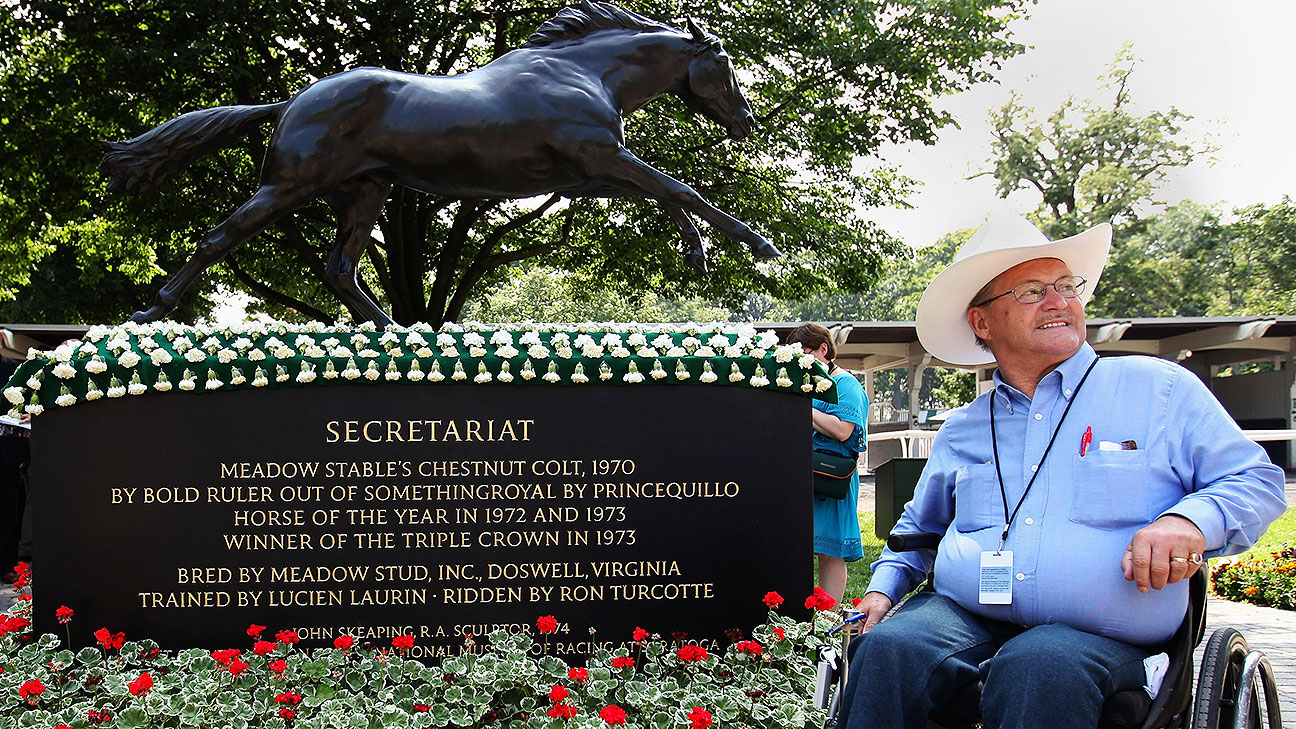
Turcotte at Secretariat's statue at the Kentucky Horse Park
In 1975, Sports Illustrated horse racing writer William Nack, who covered every race "Big Red" ever ran, published Secretariat: The Making of a Champion. In 2010, it served as the basis for the film Secretariat. Diane Lane starred as Penny Chenery, real-life jockey Otto Thorwarth played Turcotte, Kevin Connolly played Nack, and the horse that played Secretariat was not identified.
*
June 9, 1973 was a Saturday. Football was out of season. Both the NBA and the NHL awarded their titles a month earlier. These Major League Baseball games were played that day:
* The New York Yankees beat the Kansas City Royals, 6-4 at the new Royals Stadium in Kansas City. (It was renamed Kauffman Stadium in 1993.) The Yankees scored 5 runs in the top of the 9th to win it.
Cliché Alert: Walks can kill you, especially
the leadoff variety. The inning began with Roy White drawing a walk. Matty Alou grounded to 1st, advancing White. Bobby Murcer drew a walk. Ron Blomberg singled White home. Jim Ray Hart drew a walk to load the bases. Graig Nettles drew the 4th walk of the inning, forcing Murcer home. Thurman Munson grounded to 3rd, and Blomberg was out at home, but the bases were still loaded. A 5th walk was drawn by Gene Michael, forcing home Alou. And Horace Clarke singled home Nettles and Munson. Pat Dobson was the winning pitcher, in relief of Fred Beene.
* The New York Mets beat the Los Angeles Dodgers, 4-2 at Shea Stadium. Jon Matlack outpitched Al Downing. Willie Mays hit the 655th home run of his career.
* The Montreal Expos beat the San Francisco Giants, 9-6 at Jarry Park in Montreal.
* The Philadelphia Phillies beat the San Diego Padres, 4-1 at Veterans Stadium in Philadelphia. Ken Brett was the winning pitcher, and hit a home run.
* The Baltimore Orioles beat the Minnesota Twins, 7-4 at Memorial Stadium in Baltimore. Brooks Robinson went 1-for-4. So did Harmon Killebrew. Rod Carew went 2-for-5.
* The Atlanta Braves beat the St. Louis Cardinals, 8-2 at Atlanta Stadium. (It was renamed Atlanta-Fulton County Stadium in 1975.) Hank Aaron hit the 687th and 688th home runs of his career. Joe Torre went 3-for-4 with an RBI. Lou Brock went 0-for-3, but did draw a walk. The Cards couldn't win despite having players named Mike Tyson (a white shortstop) and Spinks (Scipio Spinks, a black pitcher from Chicago, no relation to Leon and Michael, who were from St. Louis.)
* The Chicago White Sox beat the Cleveland Indians, 6-3 at Cleveland Municipal Stadium.
* The Cincinnati Reds beat the Chicago Cubs, 8-4 at Wrigley Field in Chicago. Tony Pérez hit a home run. Pete Rose went 0-for-5, but did have an RBI on a groundout. Joe Morgan went 1-for-4. Johnny Bench went 2-for-4 with an RBI.
* The Boston Red Sox beat the Texas Rangers, 12-1 at Arlington Stadium in the Dallas suburb of Arlington, Texas. Carl Yastrzemski went 1-for-4 with an RBI. He did not hit a home run for the Red Sox, but Carlton Fisk, Tommy Harper and Orlando Cepeda did.
* The Pittsburgh Pirates beat the Houston Astros, 4-1. Willie Stargell went 1-for-2 with 2 walks and 2 RBIs.
* The Milwaukee Brewers beat the California Angels, 1-0 at Anaheim Stadium. (It was renamed Edison International Field in 1997, and Angel Stadium of Anaheim in 2004.) Jim Colborn and Frank Linzy combined on a 4-hit shutout. Rudy May allowed only 2 hits, but lost because 1 of them was a home run by Ollie Brown. Frank Robinson went 0-for-2 with a walk for the Angels.
* And the Oakland Athletics beat the Detroit Tigers, 4-0 at the Oakland Coliseum. Ken Holtzman pitched a 2-hit shutout. Reggie Jackson went 1-for-4 with 3 RBIs. Al Kaline went 0-for-3.
And Tedy Bruschi, a linebacker who would win 3 Super Bowls with the New England Patriots, was born on this day. So was Keesha Sharp, who played Monica Charles Brooks on the sitcom Girlfriends.


