Showing posts with label detroit red wings. Show all posts

Friday, December 2, 2022

December 2, 1995: The Curse of St. Patrick

December 2, 1995: In an NHL "Original Six" matchup, the Detroit Red Wings beat the Montreal Canadiens, 11-1 at the Montreal Forum. Vyacheslav Kozlov scored 4 of those Detroit goals. Mark Recchi had the lone tally for the Habs.

This was the game in which Canadiens' goalie Patrick Roy was infamously hung out to dry by Canadiens management. General manager Réjean Houle told head coach Mario Tremblay to leave Roy in the net. He left Roy there until 11:57 of the 2nd period, after the Canadiens' defense, strong enough to win the Stanley Cup 2 1/2 years earlier, had collapsed to the point where he'd allowed 9 goals in that time.

Roy skated over to where team president Ronald Corey was sitting, and said, "It's my last game in Montreal." Roy was suspended, and, 4 days later, came "Le Trade": Roy and team Captain Mike Keane, a right wing who had also been feuding with Tremblay, were traded to the Colorado Avalanche for goaltender Jocelyn Thibault, left wing Martin Ručinský and right wing Andrei Kovalenko.

Ironically, until the season before, the Avalanche had been the Quebec Nordiques. Roy was from Quebec City, and had grown up loving the Nords and hating the Habs, before winning 3 Vezina Trophies and helping them win 3 Stanley Cups. 

He helped the Avs win the Cup that season, and again in 2001. In addition to the '96 Cup with the Avs, Keane would win the Cup again with the Dallas Stars in 1999. What did the Habs get? Not much, although Kovalenko did score the last goal at the Forum, as the team was preparing to move into the new Molson Centre (now the Bell Centre).

Canadien fans took Roy's side in the dispute. They let their displeasure be known all season long, including into the move, with the new arena having room for an additional 3,300 fans. It took until 2008 for Roy and the team to reconcile enough to get him to come for the retirement of his Number 33.

The winningest team in hockey history took until 2021 to return to the Stanley Cup Finals, losing it to the Tampa Bay Lightning. It is known as "The Curse of St. Patrick," even if, as he has proven in his subsequent coaching and management career, Roy is no saint. He had helped them win their 23rd and 24th Stanley Cups. They are still looking for their 25th.

*

December 2, 1995 was a Saturday. These 9 other games were played in the NHL:

* The New York Rangers beat the Ottawa Senators, 4-2 at the Ottawa Civic Centre (now the TD Place Arena).

* The New York Islanders beat the New Jersey Devils, 4-1 at the Nassau Coliseum.

* The Boston Bruins beat the Buffalo Sabres, 6-4 at the FleetCenter (now the TD Garden) in Boston.

* The Florida Panthers beat the Hartford Whalers, 5-3 at the Hartford Civic Center (now the PeoplesBank Arena).

* The Toronto Maple Leafs and the Mighty Ducks of Anaheim played to a tie, 4-4 at Maple Leaf Gardens in Toronto.

* The Chicago Blackhawks and the Winnipeg Jets played to a tie, 2-2 at the Winnipeg Arena.

* The St. Louis Blues beat the Edmonton Oilers, 7-3 at the Edmonton Coliseum (formerly the Northlands Coliseum).

* The Dallas Stars and the Los Angeles Kings played to a tie, 2-2 at The Forum outside Los Angeles in Inglewood, California.

* The San Jose Sharks beat the Washington Capitals, 5-3 at the San Jose Arena (now the SAP Center).

* And the Philadelphia Flyers, the Pittsburgh Penguins, the Vancouver Canucks, the Calgary Flames, the Colorado Avalanche and the Tampa Bay Lightning were not scheduled.

The University of Texas, America's Number 9-ranked college football team, defeats their arch-rivals, Texas A&M University, ranked Number 16. The score is Longhorns 16, Aggies 6, at A&M's home, Kyle Field in College Station.

Elsewhere in Texas, the University of Houston beat crosstown rival Rice University, 18-17 at Rice Stadium. These would be the last 2 football games ever played in the Southwest Conference. I have a separate entry for the league's end.

These other college football games were played that day:

* Number 2 Florida beat Number 23 Arkansas, 34-3, at the Georgia Dome in Atlanta, in the Southeastern Conference Championship Game.

* Army beat Navy, 14-13 at Veterans Stadium in Philadelphia.

* And Oklahoma State beat the University of Hawaii, 24-20 at Aloha Stadium in Honolulu.

Nebraska won the National Championship defeating Florida in the Fiesta Bowl. Texas lost the Sugar Bowl to Virginia Tech. Texas A&M beat Michigan in the Alamo Bowl in San Antonio. The last Cotton Bowl of the SWC era had no Texas-based team: Colorado beat Oregon, 38-6. Southern California beat Northwestern in the Rose Bowl, and Florida State beat Notre Dame in the Orange Bowl.

Baseball was out of season. There were 10 NBA games on this day:

* The New York Knicks beat the Philadelphia 76ers, 94-85 at Madison Square Garden.

* The New Jersey Nets beat the Cleveland Cavaliers, 79-78 at the Brendan Byrne Arena at the Meadowlands.

* The Washington Bullets beat the Boston Celtics, 135-107 at the USAir Arena (formerly the Capital Centre) in the Washington suburb of Landover, Maryland.

* The Detroit Pistons beat the Atlanta Hawks, 104-96 at The Palace in the Detroit suburb of Auburn Hills, Michigan.

* The Houston Rockets beat the Charlotte Hornets, 113-98 at The Summit in Houston. (The arena has since been converted into the Central Campus of the Lakewood Church, Dr. Joel Osteen's "megachurch.") Clyde Drexler scored 41 points. 

* The San Antonio Spurs beat the Phoenix Suns, 101-93 at the Alamodome in San Antonio. David Robinson scored 37 points.

* The Denver Nuggets beat the Minnesota Timberwolves, 109-105 at the McNichols Area in Denver.

* The Chicago Bulls beat the Los Angeles Clippers, 104-98 at the Los Angeles Memorial Sports Arena. Michael Jordan scored 37 points.

* The Golden State Warriors beat the Indiana Pacers, 100-97 at the Oakland Coliseum Arena.

* The Sacramento Kings beat the Orlando Magic, 109-106 at the Arco Arena in Sacramento.

And in English soccer, North London team Arsenal went to Birmingham, and played Aston Villa to a 1-1 draw at Villa Park.

Thursday, November 10, 2022

November 10, 1963: Gordie Howe Becomes the NHL's All-Time Goals Leader

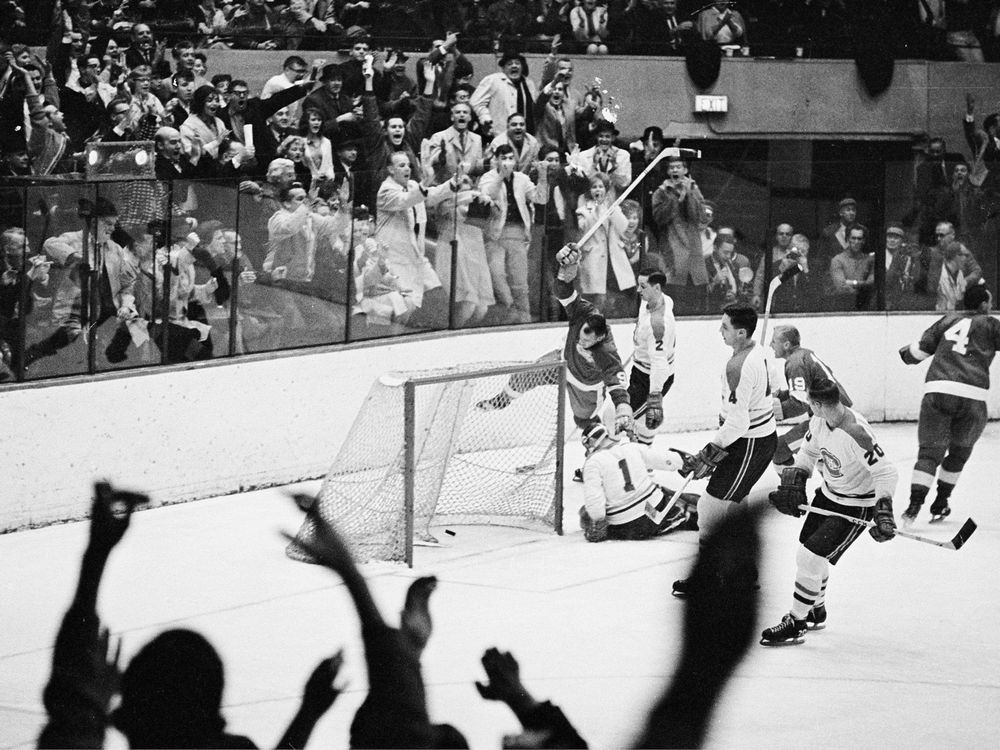
November 10, 1963: Gordie Howe of the Detroit Red Wings scored the 545th goal of his National Hockey League career. It makes him the League's all-time leader.

A right wing, Howe debuted with the Wings in 1946, and helped them win the Stanley Cup in 1950, 1952, 1954 and 1955. With center Sid Abel and left wing Ted Lindsay, he formed a forward line known, in honor of Detroit's automotive industry, as the Production Line. Abel retired after the 1952 Cup, and was replaced by Alex Delvecchio, thus forming what became known as Production Line II. With Red Kelly and Marcel Pronovost as defensemen, and Terry Sawchuk in goal, the Wings could field an all-Hall-of-Fame lineup.

Wings management made some cheap and petty decisions over the next few years, but still made the Stanley Cup Finals in 1956, 1961, 1963, 1964 and 1966, though losing them all. Howe kept on playing, and kept on scoring. Although he never scored more goals in a season than the 49 he managed in 1953, he became the 2nd player to score 500 of them in NHL play, on March 14, 1962.

The 1st was Maurice Richard, the Montreal Canadiens right wing known as the Rocket, who scored a record 544 of them from 1942 to 1960. In 1970, Bobby Hull of the Chicago Black Hawks would become the 3rd player to score 500 goals. All 3 of these men wore Number 9 for their teams, making it hockey's most iconic number. (Wayne Gretzky, who would end up surpassing all of them in goals and points, paid homage to them by wearing Number 99, after joining his first junior team, on which 9 was already taken.)

Howe tied the record at 544 on October 27, 1963, but needed another 6 games to get the record-breaker. Appropriately, it was at home, at the Olympia Stadium. Also appropriately, it was against the Canadiens. Richard had retired 3 years earlier, but was in attendance. The Canadiens' goalie was Lorne "Gump" Worsley. The Wings won the game, 3-0, with all the goals coming in the 2nd period. Bruce McGregor and Alex Faulkner scored, and then, with the Wings shorthanded because Faulkner had been penalized for high-sticking, Howe scored with 4:54 left in the period -- the digits in the time rearrangeable to 544.
The 545th goal

Howe would score 786 goals for the Red Wings before retiring in 1971. He came out of retirement to play in the World Hockey Association. In 1979, 4 teams, including Howe's Hartford Whalers, were brought into the NHL, allowing him to play 1 last season in the NHL, his 26th, his 32nd counting his WHA tenure. He scored 801 regular-season goals in the NHL, 174 more in the WHA, and, between the 2 leagues, another 96 in Playoff play, for a total of 1,071.

Wayne Gretzky would surpass Howe for NHL goals with 802, in 1994. He finished with 894 goals in the NHL, 46 in the WHA, and 122 in the Playoffs, for a total of 1,066. So, in a way, Howe is still the all-time goals leader.

*

November 10, 1963 was a Sunday. An American version of the British comedy TV show That Was the Week That Was premiered on NBC. I have a separate entry for that event. And Mike Powell, the world record holder in the long jump, was born on this day.

There was 1 other game in the NHL that day: The Boston Bruins beat the Chicago Black Hawks, 4-2 at the Boston Garden. The New York Rangers and the Toronto Maple Leafs were not scheduled.

Only 1 game was played in the NBA: The Los Angeles Lakers beat the New Yo
rk Knicks, 104-79 at the Los Angeles Memorial Sports Arena. Len Chappell scored 23 for the Knicks, and Johnny Green 22, but no other Knick got into double figures. In contrast, Elgin Baylor led the Lakers with 21, but all 5 starters had at least 11.

There were 7 games in the NFL:

* The New York Giants beat their arch-rivals, the Philadelphia Eagles, 42-14 at Yankee Stadium.

* The Baltimore Colts beat the Detroit Lions, 24-21 at Memorial Stadium in Baltimore.

* The Pittsburgh Steelers beat their arch-rivals, the Cleveland Browns, 9-7 at Pitt Stadium in Pittsburgh.

* The Chicago Bears beat the Los Angeles Rams, 6-0 at Wrigley Field in Chicago.

* The Green Bay Packers beat the Minnesota Vikings, 28-7 at the new Green Bay City Stadium. It was renamed Lambeau Field 2 years later.

* The NFL version of the St. Louis Cardinals beat the Washington Redskins, 24-20 at the 1st Busch Stadium in St. Louis. It was previously the last Sportsman's Park.

* And the San Francisco 49ers beat the Dallas Cowboys, 31-24 at Kezar Stadium in San Francisco.

There were 2 games played in the American Football League. The New York Jets lost to the Houston Oilers, 31-27 at Jeppesen Stadium in Houston. And the San Diego Chargers beat the Boston Patriots, 7-6 at Fenway Park in Boston. The AFL Championship Game would also be a San Diego win over Boston, but by a considerably larger margin.

Thursday, November 3, 2022

November 3, 1954: The Debut of Godzilla

The original Japanese version

November 3, 1954: The New York Yankees begin a tour or Japan, and draw a record crowd of 64‚000 when they play the 1st game against the All-Japan Stars at Nippon Life Stadium in Osaka.

On the 25-game tour, 3rd base prospect Andy Carey slugs 13 home runs‚ and catching prospect Elston Howard bats .468 on the 25-game tour. Each has thoroughly impressed the Yankee brass, and both get promoted to the Yankees for 1955 -- in Howard's case, making him the 1st black player for the Yankees in a regular-season game.

But the Yankees are not the biggest thing to hit Japan on this date. On the same day, the film Gojira premieres, directed by Ishirō Honda, and distributed by Toho Company, Limited. It is the debut of the creature known in the English-speaking world as Godzilla.

The name Godzilla is a romanization of the original Japanese name Gojira (ゴジラ), which is a combination of two Japanese words: gorira (ゴリラ), meaning "gorilla"; and kujira (クジラ), meaning "whale." The word alludes to the size, power and aquatic origin of the creature. As developed by Toho, the monster is an offshoot of the combination of radioactivity and ancient dinosaur-like creatures, indestructible and possessing special powers, including the ability to shoot a radioactive beam out of its mouth.

The Godzilla costume was worn by actor Haruo Nakajima. In the film, Godzilla is an ancient sea creature that has been mutated by atomic testing in the Pacific Ocean, and progresses to attacking fishing boats, threatening Japan's food supply and economy; to attacking islands, and finally the home islands themselves, including the capital of Tokyo.

Japanese authorities estimate him at 50 meters tall (about 164 feet, the size of a 20-story building). After depth charges, fighter jets, tanks and an electrified fence along the coast fail to stop the creature, an "oxygen destroyer" is used, cutting off its air supply, and, apparently, killing it.

This film was released in America in 1956, under the title Godzilla, King of the Monsters! (The exclamation point was the producers', not mine.) For American audiences, scenes were added with Raymond Burr as an American observer. In 1985, Godzilla 1985 was released, a sequel to the original, and Burr reprised the role.

The franchise has now reached 32 films in Japan, with a 33rd planned for a 2023 release. In 1962, King Kong vs. Godzilla was released, and the legendary giant ape beats the big lizard. Among the monsters, or kaiju (meaning "strange beast") that Godzilla later battles are Mothra, a giant moth, in 1964; Ghidorah, a 3-headed winged dinosaur, also in 1964; Rodan, a flying dinosaur, also in 1964; Ebirah, a giant lobster, in 1966; Hedorah, a "smog monster," in 1971; Megalon, a giant beetle, in 1973; and Mechagodzilla, a giant robot version of Godzilla, in 1974.

An all-American version came out in 1998, depicting Godzilla not as an upright dinosaur, but as a bent-over, "more realistic" creature, which attacks New York, rips the roof off Madison Square Garden, and lays eggs there. The eggs hatch, and the "baby Godzillas" are occupied eating all the concessions in the arena, buying the American military time, as the genderless, asexual Godzilla is lured into the Brooklyn Bridge, tangled in its cables, and destroyed along with the bridge. Finally, a jet drops a bomb on The Garden, killing all of the baby Godzillas. Except one last egg remains, and hatches as the film ends...

This film was seriously panned by the critics. But no legend stays off the big screen forever. A separate American franchise began in 2014, and has released 3 films, with a 4th planned for 2024. This is the Legendary Pictures "Monsterverse," and includes the 2021 film Godzilla vs. Kong. This time, to emphasize the studio's insistence that Godzilla, now 393 feet high, nearly 50 stories high, is the absolute "King of the Monsters," Godzilla won, but Kong, now 337 feet, still helped him beat the other monsters in the film.
The Monsterverse's Godzilla

Ishirō Honda and Raymond Burr both died in 1993. Haruo Nakajima died in 2017.

A 2024 episode of the YouTube series Epic Rap Battles of History featured "Nice" Peter Shukoff voicing Godzilla, and "Epic" Lloyd Ahlquist voicing King Kong.

*

November 3, 1954 was a Wednesday. Baseball season was over. Football was in midweek. The NBA season had begun, but no games were scheduled for this day. One game was played in the NHL: The Detroit Red Wings and the Toronto Maple Leafs played to a 1-1 tie at Maple Leaf Gardens in Toronto.

British rock singer Adam Ant was born on this day. So was Kathy Kinney, who played Mimi Bobek on The Drew Carey Show.

Wednesday, November 2, 2022

November 2, 1975: The Eddie Giacomin Game

November 2, 1975: A surreal event takes place at Madison Square Garden. The New York Rangers had traded popular goaltender Eddie Giacomin to the Detroit Red Wings, sparking outrage among their fans. As it happened, the Rangers' next home game was against the Wings.

Seeing Giacomin in not the white jersey with the blue Number 1, but the red jersey with the white Number 31, the Garden crowd chanted, "Ed-DIE! Ed-DIE! Ed-DIE!" all night long, and actually booed the Rangers when they scored.
The Red Wings won, 6-4, and, for perhaps the only time in Madison Square Garden history, the home fans cheered a visiting team's victory.

It was the end of an era that had seen the Rangers rise to championship contention, but the closest they'd gotten to the Stanley Cup was the 1972 Finals, losing to the Boston Bruins in 6 games. They were knocked out of the previous season's Playoffs by a 3rd-year expansion team, the suburban Islanders.

Just 9 days after The Giacomin Game, they would trade Brad Park, Jean Ratelle and Joe Zanussi to the Bruins for Phil Esposito and Carol Vadnais. The Rangers would miss the Playoffs in 1976 and '77, before bouncing back in '78 and reaching the Finals in '79.

With new management coming in, the Rangers made peace with Eddie, and retired his Number 1 in 1990. He was elected to the Hockey Hall of Fame in 1987.
UPDATE: Eddie Giacomin died on September 14, 2025, a few weeks before the 50th Anniversary of this game. He was 86 years old.

In 1998, The Hockey News released their list of the 100 Greatest Hockey Players. Phil Esposito ranked 18th, and Brad Park 49th. In 2017, both were named to the NHL's 100th Anniversary 100 Greatest Players, as was Jean Ratelle. But neither Eddie Giacomin nor Rod Gilbert was named to either list.


*


November 2, 1975 was a Sunday. There were 4 other NHL games played on this day:

* The Boston Bruins beat the California Golden Seals, 5-0 at the Boston Garden. This would be the last season in Oakland for the Seals franchise, who became the Cleveland Barons for 1976-77. For 1978-79, they merged with the Minnesota North Stars.

* The Philadelphia Flyers beat the Kansas City Scouts, 10-0 at The Spectrum in Philadelphia. This couldn't have been much more of a mismatch: The Flyers were the 2-time defending Stanley Cup Champions, while the Scouts were a 2nd-year expansion team. After this season, they moved to Denver to become the Colorado Rockies, a name that would later be given to Denver's baseball team. In 1982, the NHL's Rockies became the New Jersey Devils. Bobby Clarke, Orest Kindrachuk and Mel Bridgman each scored 2 goals.

* The Buffalo Sabres beat the Pittsburgh Penguins, 7-2 at the Buffalo Memorial Auditorium.

* And the Chicago Black Hawks beat the Vancouver Canucks, 6-1 at the Chicago Stadium.

There were 4 games in the World Hockey Association:

* The Cleveland Crusaders beat the Phoenix Roadrunners, 5-2 at The Coliseum in the Cleveland suburb of Richfield, Ohio.

* The Quebec Nordiques beat the Winnipeg Jets, 1-0 at the Winnipeg Arena.

* The Calgary Cowboys beat the New England Whalers, 4-3 in overtime at the Stampede Corral in Calgary.

* And the Edmonton Oilers beat the San Diego Mariners, 5-3 at the Northlands Coliseum in Edmonton.

There were 3 games played in the NBA: 

* The Houston Rockets beat the Milwaukee Bucks, 104-89 at The Summit in Houston. (The arena has since been converted into the Central Campus of the Lakewood Church, Dr. Joel Osteen's "megachurch.")

* The Los Angeles Lakers beat the Atlanta Hawks, 116-113 in overtime at The Forum in the Los Angeles "suburb" of Inglewood, California. Kareem Abdul-Jabbar scored 39 for the Lakers.

* And the Washington Bullets beat the Seattle SuperSonics, 94-85 at the Seattle Center Coliseum.

There are 4 ABA games played:

* The New York Nets beat the Utah Stars, 123-111 at the Nassau Coliseum. Julius "Dr. J" Erving scored 35 points.

* The Kentucky Colonels beat the Denver Nuggets, 106-103 at Freedom Hall in Louisville.

* The Spirits of St. Louis beat the Virginia Squires, 106-99 at the St. Louis Arena.

* And the San Diego Sails beat the San Antonio Spurs, 105-102 at the San Diego Sports Arena. (It's now named the Pechanga Arena.)

These NFL games were played on the day: 

* The New York Jets lost to the Buffalo Bills, 24-23 at Shea Stadium. (The New York Giants played at Shea the day before, beating the San Diego Chargers, 35-24.)

* The Baltimore Colts beat the Cleveland Browns, 21-7 at Memorial Stadium in Baltimore.

* The Pittsburgh Steelers beat the Cincinnati Bengals, 30-24 at Riverfront Stadium in Cincinnati.

* The New Orleans Saints beat their arch-rivals, the Atlanta Falcons, 23-7 at the brand-new Superdome in New Orleans.

* The Washington Redskins beat their arch-rivals, the Dallas Cowboys, 30-24 in overtime at Robert F. Kennedy Stadium in Washington.

* The Miami Dolphins beat the Chicago Bears, 46-13 at Soldier Field in Chicago.

* The Minnesota Vikings beat the Green Bay Packers, 28-17 at Lambeau Field in Green Bay.

* The St. Louis Cardinals beat the New England Patriots, 24-17 at Busch Memorial Stadium.

* The Houston Oilers beat the Kansas City Chiefs, 17-13 at Arrowhead Stadium in Kansas City.

* The Oakland Raiders beat the Denver Broncos, 42-17 at Mile High Stadium in Denver.

* The Detroit Lions beat the San Francisco 49ers, 28-17 at Candlestick Park in San Francisco.

The next night, on ABC Monday Night Football, the Los Angeles Rams beat the Philadelphia Eagles, 42-3 at Veterans Stadium in Philadelphia.

Also on this day, child actor Danny Cooksey was born. As an adult, no longer recognizable, he turned to cartoon and video game voiceovers. And Italian film director Pier Paolo Pasolini was murdered. I have a separate entry for this event.

Monday, October 31, 2022

October 31, 1963: The Indianapolis Holiday On Ice Explosion

October 31, 1963: A propane leak at a concession stand at the Indiana State Fair Coliseum in Indianapolis causes an explosion that kills 74 people during a Holiday On Ice show.

Opened in 1939, the 6,800-seat building was not seriously damaged. It still stands, known as the Indiana Farmers Coliseum. It was the 1st home of the Indiana Pacers, from 1967 to 1974, and they won the American Basketball Association title there in 1970, 1972, and 1973.

A recent photo of the Coliseum

It has also been home to a series of minor-league hockey teams. The Indianapolis Capitals won the Calder Cup, the championship of the American Hockey League, in 1942 and 1950. The Indianapolis Ice won the Turner Cup, the championship of the International Hockey League, in 1990; and the Ray Miron Cup, the championship of the Central Hockey League, in 2000. The Indiana Ice won the Clark Cup, the championship of the United States Hockey League, in 2009 and 2014. The current team is called the Indy Fuel.

UPDATE: The name was the Indiana State Fairgrounds Coliseum from its opening in 1939 to 1991, the then the Pepsi Coliseum until 2012, then the Fairgrounds Coliseum until 2014, then the Indiana Farmers Coliseum until 2024, before adopting its current name, the Corteva Coliseum. Corteva, Inc. (also known as Corteva Agriscience), headquartered in Indianapolis, is devoted to products for seed and crop protection. The company's name combines "cor" (Latin for "heart") with "teva" (the Hebrew word for nature).

*

October 31, 1963 was a Thursday. Baseball Hall-of-Famer Fred McGriff and All-Star Matt Nokes were born on this day. So were Brazilian soccer star Dunga, actors Rob Schenider and Dermot Mulroney, and Smiths guitarist Johnny Marr.

Baseball season was over. Football was in midweek. And there were no NBA games scheduled for this Halloween. There was 1 NHL game: The Detroit Red Wings beat the New York Rangers, 4-1 at the Olympia Stadium in Detroit. 

Friday, October 21, 2022

October 21, 1953: "The Conservative Mind" Is Published

Kirk usually favored cigars, rather than a pipe, as seen here.

October 21, 1953: The Conservative Mind, edited by Russell Kirk, is published by Regnery Press, still basking in its publication, 2 years earlier, of William F. Buckley's God and Man at Yale.

A 34-year-old native of the suburbs of Detroit, Kirk was heavily influenced by Our Enemy, the State, a far-right book written by Albert Jay Nock, published in 1935. In his own book, Kirk developed what he called six canons of conservatism:

  1. A belief in a transcendent order, which he described variously as based in tradition, divine revelation, or natural law;
  2. An affection for the "variety and mystery" of human existence;
  3. A conviction that society requires orders and classes that emphasize natural distinctions;
  4. A belief that property and freedom are closely linked;
  5. A faith in custom, convention, and prescription; and
  6. A recognition that innovation must be tied to existing traditions and customs, which entails a respect for the political value of prudence.

Number 1 seems to suggest that, for conservatives, a belief in God, or in some form of higher power, is necessary. This would lead to the linking of conservatism and evangelical Christianity, which has harmed both the philosophy and the religion. Number 2 sounds more like a tenet of liberalism than one of 21st Century conservatism.

Numbers 3 and 4 seem to mark conservatism as a political philosophy of, by and for rich people. Numbers 5 and 6 tie in with a classic tenet of conservatism, outlined in the years leading up to the English Civil War of the 1640s, in which he would die, by Lucius Cary, 2nd Viscount Falkland, for whom the British islands off the coast of Argentina would be named: He wrote, "Where it is not necessary to change, it is necessary not to change."

In the book, Kirk included writings by Edmund Burke, John C. Calhoun and Benjamin Disraeli, as politicians whose work he considered to be conservative. But he also included George Washington, John Adams and Alexander Hamilton among their numbers, which is dubious.

He included writings by authors he considered conservative, including Sir Walter Scott, George Santayana and T.S. Eliot, which makes sense; but also Alexis de Tocqueville, Ralph Waldo Emerson and Robert Frost, which most certainly does not. (In 1961, the elderly Frost spoke at the Inauguration of President John F. Kennedy.)

Unlike Friedrich Hayek's 1944 The Road to Serfdom, and Milton Friedman's 1962 Capitalism and Freedom, The Conservative Mind hardly mentions economics at all. Kirk grounded his version of conservatism in tradition, political philosophy, literary efforts, and religious faith, rather than free-market economic reasoning.

Whittaker Chambers called The Conservative Mind the most important book of the 20th Century. Conservative newspaper columnist James J. Kilpatrick called it the best and clearest exposition of the conservative philosophy. Along with The Road to Serfdom, Capitalism and Freedom, and Chambers' 1952 memoir Witness, it became required reading for right-of-center Americans thereafter.

Kirk died in 1994. The following year, the conservative magazine The Weekly Standard began publication, and started a Conservative Hall of Fame. Its 1st 2 inductees were Ronald Reagan and Russell Kirk -- before either Buckley, Hayek, Milton Friedman, Chambers or Kilpatrick.

But the times were changing: The conservative intellectual "revolution" led by House Speaker Newt Gingrich, based on the writings of Kirk and Buckley and on the 1980s' "Reagan Revolution," was about to fall apart, replaced by the evangelical conservatism of George W. Bush, and, later still, by the narcissistic kleptocracy of Donald Trump

*

October 21, 1953 was a Friday. The baseball season had ended 14 days earlier, when the New York Yankees won Game 6 to clinch the World Series over the Brooklyn Dodgers. Football was in midweek. The NBA season started 9 days later. There was 1 game played in the NHL: The Toronto Maple Leafs and the Detroit Red Wings played to a tie, 1-1 at Maple Leaf Gardens in Toronto.

Sunday, October 16, 2022

October 16, 1946: The NHL's Postwar Jump Start

Gordie Howe (left) and Clarence Campbell.
Not in 1946.

October 16, 1946: With the World Series having ended the day before, with the St. Louis Cardinals beating the Boston Red Sox in Game 7, there was only one sporting event on this day. And it is the NHL debut of Gordie Howe.

The 18-year-old native of Saskatoon, Saskatchewan wore Number 17, instead of the familiar 9 that he will start wearing the next season. The right wing scores against Turk Broda, and the Detroit Red Wings play the Toronto Maple Leafs to a 3-3 tie at the Olympia Stadium in Detroit.

The goal will be the 1st of 786 that the man who becomes known as Mr. Hockey will score for the Wings, going on to win 4 Stanley Cups and becoming the greatest player the game has ever known, and I don't want to hear about no Number 99: Gordie was better. We lost him in 2016, at the age of 88.

This new season was one of big changes in the NHL. Former player Red Dutton, who had been interim President of the League after the death of original President Frank Calder in 1943, was finally able to hand the office over to Calder's handpicked successor, Clarence Campbell, who had been away in the Canadian Army, even after World War II.

Campbell's experience in law and in hockey made him an ideal choice as President. Campbell hired Ken McKenzie, who would become the league's first publicity director, in September 1946, as his first hiring. McKenzie would go on to found The Hockey News and other publications, including the annual NHL Guide.

Campbell extended the regular season from 50 games to 60 games. Linesmen were now hired for each game from neutral cities. The NHL adopted the system of hand gestures to symbolize penalties, devised by the man then recognized as its best referee, Bill Chadwick.

(Chadwick was so well-regarded that, following his retirement as a referee and his election to the Hockey Hall of Fame, the New York Rangers hired him as a color commentator. "The Big Whistle" broadcast for the Broadway Blues from 1967 to 1981.)

Campbell presided over the NHL until 1977, including the expansions of 1967, 1970, 1972 and 1974, increasing the number of teams from 6 to 18. Except for Montreal Canadiens fans, still angry at his handling of a situation involving Maurice Richard in 1955 -- and, except for his mistake of showing up at the Forum for the next game, he handled it exactly right -- he was universally admired, for having grown the game tremendously.

Additionally, the league modified the captaincy rule, so that captains wore the letter "C" and alternate captains wore the letter "A" on the front of their jerseys. The rule was that only the Captain -- and thus whoever was on the ice wearing a C or an A -- can talk to the officials on behalf of their team, not any other player, not any of the coaches.

Tommy Gorman, who had been associated with the National Hockey League since its inception in 1917, announced his retirement as general manager of the Montreal Canadiens, the defending Stanley Cup Champions. He left behind him 7 Stanley Cup wins -- 3 with the Ottawa Senators, 1 each with the Chicago Black Hawks and the Montreal Maroons, and 2 with the Canadiens -- and a Hall of Fame career as a coach and general manager.

Frank Selke, released from the Toronto Maple Leafs, took over as the Montreal GM. The Canadiens were in financial trouble at this time, despite their winning team, and Selke would turn things around by buying up talent and keeping the cream of the crop, selling some players to teams that needed talent. He went on to build the greatest dynasty hockey ever knew in the late 1950s.

*

October 16, 1946 was a Wednesday. Actress Suzanne Somers and English soccer goalkeeper Geoff Barnett were born.

Also on this day, 10 Nazi war criminals, convicted of crimes against humanity, are executed by hanging at the Palace of Justice in Nuremberg, Germany. They include Joachim von Ribbentrop, Adolf Hitler's Foreign Minister; Julius Streicher, Nazi Germany's top propaganda publisher; General Alfred Jodl, Chief of the Armed Forces, who had signed the surrender papers on V-E Day; and Field Marshal Wilhelm Keitel.

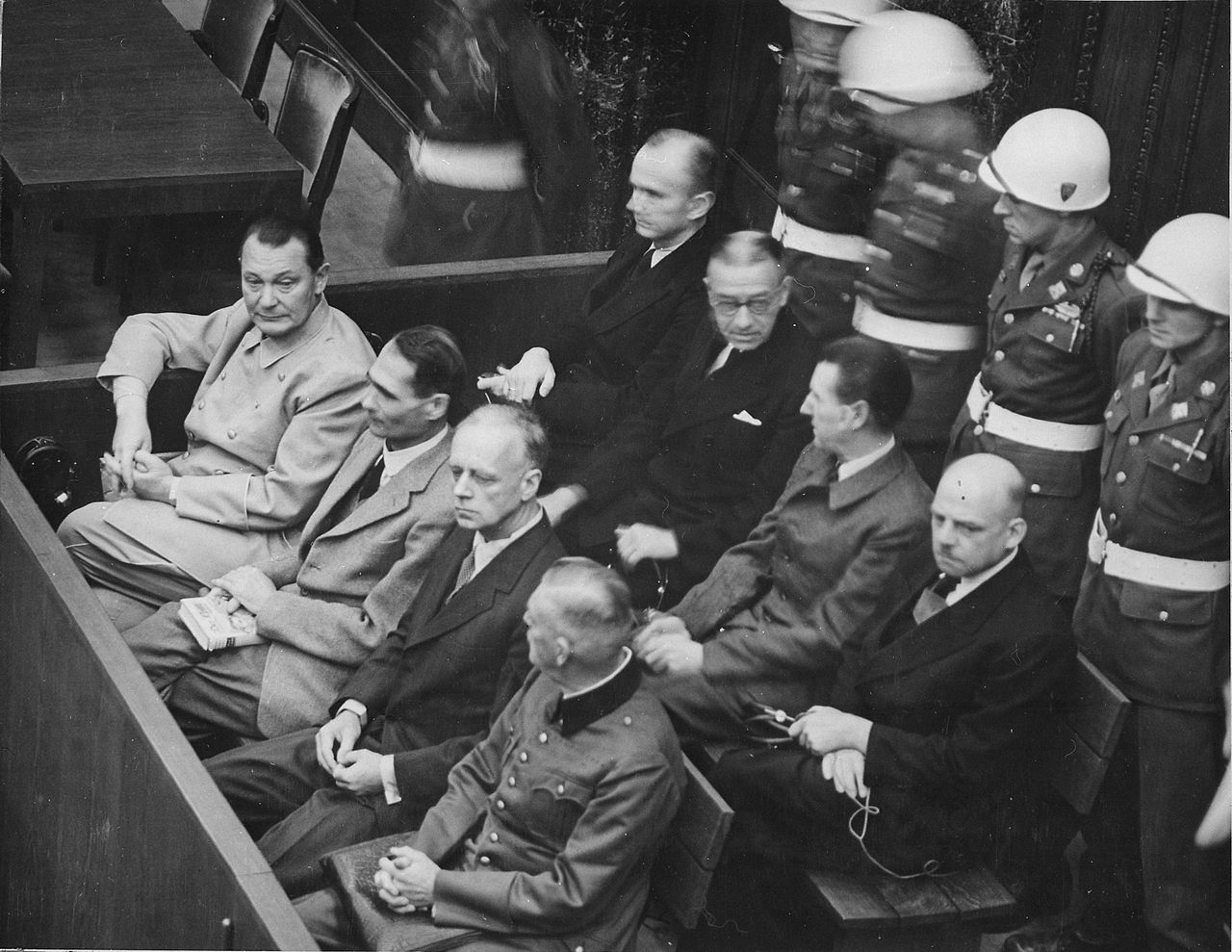
Not among the condemned, but scheduled to be so, was Reichsmarschall Hermann Göring, the highest-ranking Nazi official to have survived V-E Day. He had made an appeal, asking to be shot as a soldier instead of hanged as a common criminal, but the court refused. So he committed suicide with a potassium cyanide capsule the night before he was to be hanged.

October 16, 1946: The Nuremberg Executions

Göring, at the far left (or so to speak)

In the year 1947, America was able to do fun things again. In that year, we desegregated baseball, established network television, began watching Howdy Doody Time on said television, invented the microwave oven and the transistor, and began looking for UFOs.

But first, in 1946, we had serious work to tend to: Punishing Nazis.

October 16, 1946: Ten Nazi war criminals, convicted of crimes against humanity, are executed by hanging at the Palace of Justice in Nuremberg, Germany. They included:

* Joachim von Ribbentrop, age 53, Adolf Hitler's Foreign Minister.
* Julius Streicher, 61, Nazi Germany's top propaganda publisher.
* General Alfred Jodl, 56, Chief of the Armed Forces, who had signed the surrender papers on V-E Day.
* Field Marshal Wilhelm Keitel, 64.
* Hans Frank, 46, Governor-General of occupied Poland.

You may have seen the "Hitler Rants Parodies," based on a scene from the 2004 film Downfall, starring Bruno Ganz as Hitler. Christian Redl played Jodl in that scene, and Dieter Mann played Keitel.

As for the other 2 Generals that Hitler had asked to remain in the room: Hans Krebs, played by Rolf Kanies, and Wilhelm Burgdorf ("Mein Führer, this is an outrage!"), played by Justus von Dohnányi, both committed suicide in the Bunker on May 2, 1945. Krebs was 47, and Burgdorf was 50.

Minister of Propaganda Joseph Goebbels, not named, also remained in the room. He committed suicide in the Bunker the day before. He was 47, and was played by Ulrich Matthes. Also not named, but remaining in the room, was Martin Bormann, head of the Nazi Party Chancellery. He escaped on May 2, but saw the Soviets closing in, and committed suicide. He was 44, and was played by Thomas Thieme. SS leader Heinrich Himmler committed suicide in British custody on May 23. He was also 44. He did not appear in the scene, but did appear in the film, and was played by Ulrich Noethen.

Not among the condemned, but scheduled to be so, was Reichsmarschall Hermann Göring, the highest-ranking Nazi official to have survived V-E Day. He had made an appeal, asking to be shot as a soldier instead of hanged as a common criminal, but the court refused. So he committed suicide with a potassium cyanide capsule the night before he was to be hanged. He was 53. He also was not in the scene, but was in the film, played by Mathias Gnädinger.

*

October 16, 1946 was a Wednesday. Actress Suzanne Somers was born.

With the World Series having ended the day before, with the St. Louis Cardinals beating the Boston Red Sox in Game 7, there was only one sporting event on this day. And it is the NHL debut of Gordie Howe. The 18-year-old native of Floral, Saskatchewan wore Number 15, instead of the familiar 9 that he will start wearing the next season. The right wing scores against Turk Broda, and the Detroit Red Wings play the Toronto Maple Leafs to a 3-3 tie at the Olympia Stadium in Detroit.

The goal will be the 1st of 786 that the man who becomes known as Mr. Hockey will score for the Wings, going on to win 4 Stanley Cups and becoming the greatest player the game has ever known, and I don't want to hear about no Number 99: Gordie was better. We lost him in 2016, at the age of 88.

Saturday, October 15, 2022

October 15, 1927: The Olympia Stadium Opens

October 15, 1927: The Olympia Stadium opens, at 5920 Grand River Avenue on the northwest side of Detroit. "The Old Red Barn" seated 11,563 people. At the time, the only sports arenas in the world that seated more were Madison Square Garden in New York (then new, but eventually known as "the old Madison Square Garden") and the London Olympia. In 1965, it was expanded to 15,609 seats.

The first event there was the International Stampede and Rodeo, running until October 22. On November 22, the Detroit Cougars of the National Hockey League played their 1st game there, after playing their 1st season in the NHL, the previous one, across the river at the Border Cities Arena in Windsor, Ontario, Canada. (It's now named the Windsor Arena.)

Johnny Sheppard of the Cougars scored the 1st goal in the building. However, the Ottawa Senators, the defending Stanley Cup Champions, won the game, 2-1. The Cougars changed their name to the Detroit Falcons in 1930, and the Detroit Red Wings in 1932.

The Wings would host the Stanley Cup Finals in 1934, 1936, 1937, 1941, 1942, 1943, 1945, 1948, 1949, 1950, 1952, 1954, 1955, 1956, 1961, 1963, 1964 and 1966. Led by stars such as Larry Aurie, Ebbie Goodfellow, Herbie Lewis and Syd Howe (no relation to Gordie), the Wings won the Cup in 1936, 1937 and 1943. Led by the Production Line of Gordie Howe, Ted Lindsay and Sid Abel, the Wings won again in 1950 and 1952. With Abel replaced by Alex Delvecchio, they won again in 1954 and 1955.
In 1946-47, the 1st season of the Basketball Association of America, the league that would become the NBA, the Olympia was home to both that league's Detroit Falcons and the National Basketball League's Detroit Gems. Both teams lasted just 1 year, although the Gems moved to become the Minneapolis, and later the Los Angeles, Lakers. The NBA's Detroit Pistons played there from 1957 to 1961.

Boxing was a major tenant of the arena. Of the 6 times that Jake LaMotta fought Sugar Ray Robinson, he only won the 2nd, and that was at the Olympia on February 5, 1943. LaMotta would win the Middleweight Championship in Detroit, by knocking out Marcel Cerdan, but that was at Briggs (later Tiger) Stadium, not the Olympia.

The Olympia was 1 of 16 buildings to have hosted concerts by both Elvis Presley and The Beatles. The Beatles played there on September 6, 1964 and August 13, 1966. Elvis sang there early in his career, on March 31, 1957; and late in his career on September 11, 1970; April 6, 1972; September 29 and October 4, 1974; and April 22, 1977. (He also sang at the Pontiac Silverdome on December 31, 1975.)

After the riot of 1967, the transition of Detroit's sports teams from the city to the suburbs was underway. Pontiac planned a domed stadium, hoping that all 4 Detroit teams might move there. The Lions did, playing at the Silverdome from 1975 to 2001, before moving to Ford Field at the northern edge of downtown. The Pistons did, playing there from 1978 to 1988, before building a new arena nearby in Auburn Hills, The Palace, where they stayed until 2017.

The Tigers and the Red Wings refused to move to Pontiac, or to Auburn Hills. The Tigers remained at Tiger Stadium until 1999, then moved into Comerica Park. Ford Field was built next-door. The Red Wings moved to the waterfront Joe Louis Arena in 1979.

The Wings played their last game at the Olympia on December 15, 1979, playing the Quebec Nordiques to a 4-4 tie. Greg Joly of the Wings scored the last goal. The Wings moved into the Joe Louis Arena on December 27, before moving to the Little Caesars Arena in 2017, sharing it with the Pistons. On February 21, 1980, the last event was held at the Olympia, an old-timers' hockey game.

It was the neighborhood, not the building, that was falling apart: Lincoln Cavalieri, its general manager in its last years, once said, "If an atom bomb landed, I'd want to be in Olympia." It was not a nuclear attack, but an ordinary demolition crew, that took it down in 1987. The Olympia Armory, home of the Michigan National Guard, is now on the site.

From the outside, it looked more like a big brick movie theater, complete with the Art Deco marquee out front. The letters on the marquee were preserved, and have been put on display at the Little Caesars Arena.

*

October 15, 1927 was a Saturday. The baseball season was over. The NHL season hadn't started yet. The NBA hadn't been founded yet. There was 1 NFL game: Because Pennsylvania prohibited professional sports on Sunday until 1933, the Northeast Philadelphia-based Frankford Yellow Jackets played home games on Saturdays. On this one, they beat the Buffalo Bisons, 54-0.

But most of the day's action was in college football:

* Notre Dame played Navy for the 1st time, at Municipal Stadium in Baltimore. Notre Dame won, 19-6. Municipal Stadium, which opened in 1922, was converted into Memorial Stadium in 1953-54.

* Illinois and Iowa State played to a 12-12 tie at Memorial Stadium in Champaign, Illinois. This was the only blemish on the Illini's record, as they won the Big Ten and National Championships.

* Missouri beat Washington University of St. Louis, 13-0 at Francis Field in St. Louis. Missouri went on to win the Championship of the Missouri Valley Conference, a precursor to the Big Eight/Twelve.

* Georgia Tech beat Alabama, 13-0 at Grant Field in Atlanta. They ended up winning the Southern Conference.

* Texas A&M beat Arkansas, 40-6 at Kyle Field in College Station, Texas. They went on to win the Southwest Conference.

* USC and Stanford played to a 13-13 tie, at Stanford Stadium in the San Francisco suburb of Palo Alto, California. This forged a tie for the Pacific Coast Conference title, and, since USC had been to the Rose Bowl more recently, Stanford was invited instead. They beat the University of Pittsburgh.

* Army beat Davis & Elkins College, 27-6 at Michie Stadium in West Point, New York. Davis & Elkins, in Elkins, West Virginia, now compete in NCAA Division II.

* In New York City, New York University beat Fordham, 32-0 before 43,000 at Yankee Stadium.

* Columbia lost to Colgate, 13-7 at Baker Field.

* City College of New York beat Upsala College (now defunct) of East Orange, New Jersey, 79-0 at Lewisohn Stadium.

* In New Jersey, Princeton hosted Washington and Lee University of Lexington, Virginia at Palmer Stadium, and won, 13-0.

* And Rutgers lost to George Washington University, 6-0 at Neilson Field in New Brunswick, New Jersey.

Also, Arsenal drew with Leicester City, 2-2 at Highbury in North London. 

Thursday, October 13, 2022

October 13, 1960: The Bill Mazeroski Game

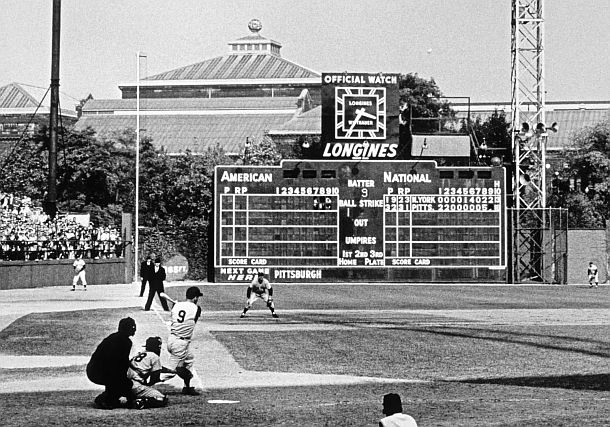
In case you're curious, the building behind the scoreboard
is the Carnegie Library of Pittsburgh.

October 13, 1960: Perhaps the greatest game in the history of baseball is played. But if you are among Yankee Fans age 70 and over, mention it at your peril.

The 1960 World Series may have been the wildest Fall Classic ever. The Pittsburgh Pirates, Champions of the National League for the 1st time in 33 years, faced the New York Yankees, the team they faced in their last appearance. Since that 1927 World Series, the Yankees had appeared in 19 of them, winning 16.

In Pittsburgh, the Pirates won Game 1, 6-4., but the Yankees won Game 2, 16-3. In New York, the Yankees won Game 3, 10-0, but the Pirates won Game 4, 3-2, and Game 5, 5-2. The Series went back to Pittsburgh, and the Yankees won Game 6, 12-0.

And so, on this Thursday afternoon, 36,683 people jammed themselves into Forbes Field for Game 7. Millions more listened to Pirates announcer Bob Prince and Yankees announcer Mel Allen call the game for television on NBC. Still more millions listened to NBC radio, with Baltimore Orioles announcer Chuck Thompson and Chicago Cubs announcer Jack Quinlan.

The game began at Forbes Field, precisely at 1:00 PM, Eastern Daylight Time, as home plate umpire Bill Jackowski said, "Play ball!" The other umpires: at 1st base, Nestor Chylak; and 2nd base, Dusty Boggess; at 3rd base, Johnny Stevens; in left field, Stan Landes; and in right field, Jim Honochick.
Forbes Field

The starting pitcher for the Pirates was Vernon Law, who would be named the winner of the Cy Young Award. Leading off for the Yankees was 2nd baseman Bobby Richardson, who lined out to short. Shortstop Tony Kubek popped up to 2nd. Right fielder Roger Maris closed the inning by popping up to 3rd.

The starting pitcher for the Yankees was Bob Turley, who had won the Cy Young and the World Series Most Valuable Player awards in 1958. He got center fielder Bill Virdon to fly to left, and shortstop Dick Groat, who would be named NL MVP that season, to pop up to his opposite number, Kubek.

Cliché Alert: Walks can kill you. Turley walked left fielder Bob Skinner. Then 1st baseman Rocky Nelson hit a home run to right field. Turley got right fielder Roberto Clemente -- eventually to become the most famous Pirate player who ever lived -- to pop up to 2nd, but after 1 inning, it was Pirates 2, Yankees 0.
Roberto Clemente

Things would get worse for the Yankees in the 2nd inning. Center fielder Mickey Mantle flew to center. Yogi Berra, now playing left field after switching positions with Elston Howard, now the catcher, grounded to 3rd. And 1st baseman Bill "Moose" Skorwon grounded to short.

Pirate catcher Smoky Burgess led off the bottom of the 2nd with a single to right. Perhaps overreacting to a bad 1st inning by Turley, Yankee manager Casey Stengel replaced him with Bill Stafford. This didn't work: Stafford walked 3rd baseman Don Hoak, and 2nd baseman Bill Mazeroski beat out a bunt.

Law grounded back to Stafford, who started a double play, eliminating Burgess at the plate and Law at 1st. But Hoak advanced to 3rd, Mazeroski to 2nd. Virdon singled to right, scoring Hoak. Maris mishandled the ball, allowing Mazeroski to score and Virdon to reach 2nd. Stafford got Groat to ground to 3rd, but after 2, it's Pirates 4, Yankees 0.

It got no better for the Yankees. In the top of the 3rd, Johnny Blanchard, catching in place of the injured Howard, grounded back to Law. The 3rd baseman, Clete Boyer, popped up to 2nd. Stengel sent Hector Lopez up to pinch-hit for Stafford, and he singled to left, but Richardson flied to left.

The new Yankee pitcher was Bobby Shantz, the 1952 AL MVP with the Philadelphia Athletics, whom Stengel put in the bullpen, and was rewarded by Shantz helping to win the 1958 World Series. He got Skinner to ground to 1st, walked Nelson, and got Clemente to ground into a 4-6-3 double play. End of 3, Pirates 4, Yankees 0.

Kubek popped to short. Maris hit a sinking liner to right that Clemente caught. Mantle singled to right, but Berra flew out in that direction. Shantz got Burgess and Hoak to both ground to 2nd, and Mazeroski to pop to short. Maybe Stengel should have started Shantz. After 4, Pirates 4, Yankees 0.

Skowron led off the 5th with a home run, but that's all the Yankees got. Blanchard flied to center, Boyer lined to 2nd, and, allowed to bat for himself, Shantz popped up to 1st. Shantz then got Law to ground to 3rd, Virdon to ground to 2nd, and Groat to hit a line shot right back at him, which he caught. End of 5, Pirates 4, Yankees 1.

Finally, in the top of the 6th, the Yankees woke up. Richardson singled to center. Kubek worked Law for a walk. Pirate manager Danny Murtaugh had seen enough, and replaced Law, bringing his closer, Roy Face, into the game in the 6th inning. Big risk, and it didn't work: He got Maris to pop up to 3rd, but Mantle singled up the middle to score Richardson, and Berra hit one down the right field line, for a 3-run homer, giving the Yankees the lead. Face got Skowron to pop to 3rd and Blanchard to ground to 1st, but the damage was done.

Shantz breezed through the Pirates in the bottom of the 6th, getting Skinner to line to right, Nelson to ground to 1st, and Clemente to ground back to him. Yankees 5, Pirates 4. Now, we had a game worth of Game 7 of the World Series.

The 7th inning was comparatively uneventful. Boyer flied to center. Shantz was again allowed to bat for himself, and rewarded Stengel's confidence by singling to left. Richardson grounded to 3rd, resulting in a force play that eliminated Shantz at 2nd. Kubek lined to right, and the 7th Inning Stretch was on.

Shantz allowed Burgess to single to center. Murtaugh sent Joe Christopher in to run for him. Hoak lined to left, and the fine-fielding Mazeroski got a taste of his own medicine, as he grounded to short, resulting in a Kubek-to-Richardson-to-Skowron double play. End of 7, Yankees 5, Pirates 4.

The 8th inning moved this game from merely interesting to classic. Hal Smith took Burgess' place behind the plate for Pittsburgh, and this would prove crucial. Maris grounded back to Face. Mantle lined to short. But, again, comes the cliche about the danger of walks: Berra drew one, and this was followed by a single by Skowron, and RBI single by Blanchard, and an RBI double by Boyer. Stengel again allowed Shantz to bat for himself, but he lined out to right. However, it was now 7-4 Yankees.

But the Pirates were far from done. Murtaugh sent Gino Cimoli up to bat for Face, and he singled to right. And then came a play that changed baseball history. Forbes Field was known for having the worst infield in the major leagues. And Virdon hit a grounder to short. It should have been an easy play for Kubek, and the start of a double play. But the ball hit a pebble, and jumped up and struck Kubek in the throat. He went down like a ton of bricks.

He had to leave the game. Stengel put Joe DeMaestri in to play short, and got Jim Coates up in the bullpen. The delay in getting Kubek off the field gave Coates time to get ready -- perhaps, a little too much time. Groat singled Cimoli home, to make it 7-5 Yankees. Stengel finally removed the heroic Shantz, and brought in Coates. Skinner bunted the runners over. Nelson flied out to right. But Clemente singled home Virdon, and Smith, batting for the 1st time in the game, hit a home run to left. The Pirates had the lead again.

Stengel brought Ralph Terry in to pitch. He got Hoak to fly to left. But after 8 innings, it was Pirates 9, Yankees 7. The Buccos were just 3 outs away from their 1st World Championship in 35 years.

But the Bronx Bombers refused to go down quietly. Bob Friend, who had been the Pirates ace before Law came into his own that year, was brought in to close it out. But Richardson dunked a single into short left-center. Dale Long, himself a former Pirate, who hit home runs in a record 8 straight games for them in 1956, was sent up to pinch-hit for DeMaestri. Now, Stengel would need his 3rd shortstop of the game. He singled to right, and, just like that, the tying runs were on with nobody out.

Murtaugh brought in Harvey Haddix. The previous year, Haddix had pitched a perfect game against the Milwaukee Braves for 12 innings. But because Lew Burdette, hero of the Milwaukee Braves' 1957 World Series triumph over the Yankees, was also pitching a shutout, the game kept going, and the Braves not only broke up the perfect game, the no-hitter and the shutout in the 13th inning, but won the game. Now, Haddix was being asked to save Game 7 of the World Series.

He got Maris to pop up to Smith. But Mantle, the Yankee superstar of the era, singled to right, scoring Richardson. Gil McDougald, who had announced his retirement and, win or lose, was playing in his last game, pinch-ran for Long. He would go in to play 3rd base, and Boyer would move to short -- if the Yankees could get that 9th run (or more) and send the game to a bottom of the 9th.

Yogi Berra was the batter. He hit a sharp grounder to 1st. Had the Pirates' other 1st baseman been in place, Dick Stuart, this could have been a disaster: Although he hit the ball nearly as far as Mantle, he was an atrocious fielder, eventually earning the nicknames "Stonefingers" and "Dr. Strangeglove." But Nelson grabbed the ball, and ran to 1st for the 2nd out. He should have tagged Mantle for the out that won the World Series.

But Mickey, not the brightest of men off the field, was a genius on it. He executes a head-fake, and makes Nelson think he's going to break for 2nd. That makes Nelson look toward Mazeroski at 2nd, and allows Mantle to get back to 1st base safely, and allows McDougald to score. Tie ballgame. Haddix got Skowron to ground to short for a force play, but the inning ended with the score tied 9-9.

On NBC radio, Thompson said, "Well, a little while ago, when we said this one was going right down to the wire, little did we know." He also mentioned that Art Ditmar was throwing -- but did not specify, "in the Yankee bullpen." That led a lot of Yankee Fans to incorrectly hold Ditmar responsible for what happened next, and he got a lot of nasty mail about it, and he got very bitter about it.

The leadoff batter in the bottom of the 9th was Mazeroski, 24 years old, born in Wheeling, West Virginia, and grown up on the other side of the Ohio River, 14 miles to the north, in Rush Run, Ohio. He grew up as a fan of his home State's Cleveland Indians, but Rush Run is considerably closer to the site of Forbes Field, 53 miles, than it is to that of Cleveland Municipal Stadium, 141 miles.

He had debuted with the Pirates in 1956, and had already become regarded as the best-fielding 2nd baseman in the major leagues. But he wasn't really known as a hitter: He had batted .273 that season, with 11 home runs and 64 RBIs. Those were decent numbers, especially for a righthanded hitter in that ballpark: Similar to Yankee Stadium at the time, Forbes had a 300-foot right field pole, but a 457-foot center field fence and was 360 feet to left. So, Maz was a good hitter, but not the player who would be expected to be the big hitting hero.

Terry's 1st pitch to Mazeroski was high, ball 1. Blanchard didn't like that, and went out to talk to Terry for a moment. Terry threw a 2nd pitch. The time was 3:36 PM. Chuck Thompson's call on radio:

Here's a swing, and a high fly ball, going deep to left, this may do it! Back to the wall goes Berra, it is over the fence, home run, the Pirates win!
Yogi played in 75 World Series games, more than anyone.
This is one he probably wanted back.

After pausing to let the cheering be heard, Thompson started again, and was so excited, he got the score wrong at first:

Ladies and gentlemen, Mazeroski has hit a one-nothing pitch over the left field fence at Forbes Field to win the 1960 World Series for the Pittsburgh Pirates by a score of ten to nothing! Once again, that final score, the Pittsburgh Pirates, the 1960 World Champions, defeat the New York Yankees. The Pirates ten, and the Yankees nine! And Forbes Field is an insane asylum!

Mel Allen, so often accused of being a "homer" for the Yankees, called it this way on TV:

There's a drive into deep left field, look out now! That ball is going, going, gone! And the World Series is over! Mazeroski hits it over the left field fence, and the Pirates win it 10–9, and win the World Series!

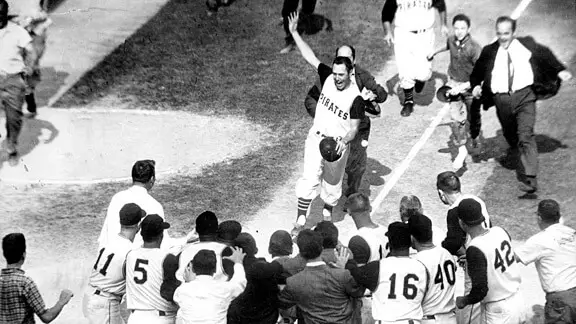
The ball went over Berra's head, at around the 406-foot mark in left field, and landed among the cherry trees in Schenley Park. Mazeroski took off his batting helmet and swung it around as he circled the bases. 
The ball was found by Andy Jerpe, 14 years old. Mazeroski would sign the ball for him, but he foolishly used the ball in a neighborhood game, and it was lost. No one knows where it is now. The Pirates don't have it. Neither does the Baseball Hall of Fame.

The Yankees outscored the Pirates 55-27 during the Series, but the Pirates won it, 4 games to 3. Richardson had a Series record 12 RBIs, and remains the only player from a losing side to be named the MVP of a World Series. Mazeroski? He batted .320 in that Series, and that was his 2nd homer in it, for his 5th RBI in it, and he played his usual good games in the field. He got robbed. But I'm sure he'd rather have the title.

After the game, Berra issued one of his "Yogi-isms," saying, "We made too many wrong mistakes." Mantle would later say that, of the 12 World Series he played in, this was the only time he believed that the better team lost. He also said he cried on the entire flight home, and this was confirmed by multiple teammates.

*

Was Yogi right? Did the Yankees make too many mistakes, "wrong" or "otherwise"? Pirate outfielder Gino Cimoli told Bob Prince, the Pirates' Hall of Fame broadcaster, in the locker room afterward, "They broke all the records, and we won the game! How 'bout that!" (So he closed by invoking the catchphrase of Allen, the Yankees' Hall of Fame broadcaster)

So why did the Yankees lose? How did the Pirates win?

The Yankees were in the process of making changes, including the manager: Team owners Del Webb and Dan Topping had decided that the 70-year-old Stengel, who missed several games that year due to an illness, would be fired even if the Yankees won the World Series.

They made Casey read a statement in which he said he is resigning. When Casey finished reading the statement, he put the paper down, and told the press, "I guess this means they fired me." He later said that they forced him out due to his age: "I'll never make the mistake of being 70 again."

Competitively, firing Casey may have been the right decision: Ralph Houk managed the Yankees to the next 3 American League Pennants, and the next 2 World Championships. Given that 4 new teams were being expanded into existence, and managerial changes are common, the Yankees would have lost Houk if they hadn't made him manager.

Still, Casey was treated shabbily. Topping and Webb could have done something. Casey was rich, having made savvy investments when he was younger, and owning a bank in the Los Angeles suburb of Glendale, California, where he lived in the off-season. They could have sold him a piece of the ownership. They could have made him a well-paid special consultant. They could have let him stay, or walk away, with dignity.

Instead, they canned him. It would be 10 more years, after they sold the team, before new Yankee president Mike Burke invited Casey back, to make peace and to retire his Number 37.

The Bill Mazeroski Game was also the last game as Yankee general manager for George Weiss. For all his cheapness and bigotry, Weiss was an organizational genius. First as farm system director from 1932 to 1947, and then as GM, he helped to build 23 Pennants (counting the 4 won in the 4 years after he left), and 17 World Series.

But he saw the writing on the wall. He knew that the system he used, of trading multiple players, usually a mix of over-the-hill veterans and prospects, for 1 of 2 players who could help the Yankees win the Pennant that year, couldn't work much longer, as the farm system was drying up.

He also knew that Topping and Webb didn't care, as they were planning to sell. At his resignation, Weiss told the press, "I give it 5 years." He was right: 1961, they won the Pennant and the World Series; 1962, they won the Pennant and the World Series; 1963, they won the Pennant but lost the World Series; 1964, they won the Pennant but lost the World Series; 1965, they finished in 6th place, the 1st of 7 straight seasons without even coming close to contending.

The Yankee stars of the 1950s, including the ones that had won 4 straight American League Pennants from 1955 to 1958, were on their way out. As a result, a lot of players -- 1960 AL Most Valuable Player Roger Maris, for one -- may have been good enough to be Yankees, but hadn't yet won the big one as Yankees.

The Yankees had last won the World Series in 1958, and would next win it in 1961, the year after the Mazeroski Game. How many players were on the World Series roster on both sides of this 3-year gap? Only 7: Mickey Mantle, Yogi Berra, Whitey Ford, Bill "Moose" Skowron, Elston Howard, Bobby Richardson and Tony Kubek. Bob Turley could have made it 8, but he was injured, and didn't play in the '61 Series.

The 1960 season was also the 1st in which catcher Yogi Berra and left fielder Elston Howard, whose natural position was catcher, had been switched, which is why Yogi was the left fielder tracking Mazeroski's homer, and it's his head, along with the outfield wall, that it went over.

The Pirates also had a distinct home-field advantage. Although Forbes Field had dimensions very similar to the pre-renovation Yankee Stadium, including a right-field pole 300 feet from home plate and a center field 457 feet away, it had only 35,000 seats, making it about half the size. As a result, while the noise at Yankee Stadium could be overwhelming, the fans were much closer to the field in Pittsburgh. Hence, Thompson's declaration that it was "an insane asylum."

Forbes Field was also known for having the worst infield in the National League. Even by the standards of ballparks that went up before World War II (and there were still 13 of the 16 teams, including the Yankees, playing in such ballparks in 1960), it was known to be bad. Since the Pirates, unlike any other team, played there regularly, they knew how to handle the comparatively high grass, the hard dirt, and the pebbles that were all over the place in said dirt.

Which leads us to the play that knocked Kubek out of the game. If that had happened to any of the the game's legendary losers, -- such as the Boston Red Sox, the Chicago Cubs, the Philadelphia Phillies, the Cleveland Indians, or, even though they didn't exist yet, the Mets -- it would be forever known as The Pebble, Capital T, Capital P, and we would never stop talking about it. 

But it happened to the Yankees, so hardly anybody makes a big deal out of it. And, of those who do, most think the Yankees had it coming.

And, of course, we must give due credit to the other team: The Pirates were not a better team than the Yankees, but they were worthy champions. They led the NL in batting average, on-base percentage, OPS, runs, hits and doubles; and were 2nd in slugging percentage and triples. Groat batted .325 in a season that got him named NL MVP. Clemente batted .314. Of their usual 8 starters, 6 had an OPS+ of 109 or higher: Clemente 121, Hoak 120, Dick Stuart 114, Groat 110, Smoky Burgess 110 and Skinner 109.

Only Stuart (23) had more than 16 home runs, a by-product of Forbes Field being a terrible park for righthanded hitters, and the team was 6th in the NL in homers. And none had at least 100 RBIs. But Clemente had 94, Skinner 86, Stuart 83, Hoak 79, and Mazeroski 64. Groat only had 50, a very low total for an MVP. Smith had only half as many plate appearances as you would get in a full season, and still had 45 RBIs.

In spite of Stuart, a born DH if ever there was one, and the bad infield, the Pirates were otherwise good defensively. Mazeroski's defensive prowess was already unquestioned: He did for 2nd base what Brooks Robinson later did for 3rd base. Despite the bad infield, Hoak only made 25 errors, and that was the most on the team. Groat, at shortstop, the most error-prone position, made 24. Stuart made 14 (a bad number for a 1st baseman, especially playing only 108 games, as Nelson was a frequent sub), Mazeroski only 10 in 151 games (an astoundingly low figure for a 2nd baseman).

The Pirates' .979 fielding percentage led the NL, and their 128 errors for their entire team were 3rd in the NL. In other words, this was a team that did not beat themselves.

Then there was the pitching. Between them, Law, Friend, Wilmer "Vinegar Bend" Mizell (later a Congressman from Mississippi) and Harvey Haddix (he of the 1959 game where he pitched 12 perfect innings but lost in the 13th, but was the winning pitcher in 1960 World Series Game 7) made 123 of the Pirates' 155 starts (the standard for the time, 154, plus a rainout makeup). Law went 20-9, Friend 18-12, Mizell 13-5 and Haddix 11-10. ERAs: Friend 3.00, Law 3.08, Mizell 3.12, Haddix 3.97. ERA+: Friend 125, Law 122, Mizell 121, Haddix 95. WHIP: Law 1.126, Friend 1.128, Mizell 1.201, Haddix 1.317.

The Pirates didn't really need a bullpen: Friend completed 37 of his 38 starts, Law all 35 of his, Haddix 28 of his 29, and Mizell all 23 of his. That's 121 complete games out of 123 starts, or 98.4 percent. (Don't show this stat to Brian Cashman.) It was when a 5th starter was needed that relief ace Face was needed, appearing 68 times, all in relief, a record at the time.

Face was the apparent inventor of the forkball, the pitch that was the "father" of the split-fingered fastball, and he used it to set a record for highest winning percentage in a season with at least 13 decisions: .947, 18-1, in 1959. A year later, he helped the Pirates win the World Series with a record of 10-8, 24 saves, and a glittering WHIP of 1.064.

Think about this: Baseball-Reference.com, a website which is your friend, whether you know it or not, lists photos of each team, each year, with its Top 12 Players according to WAR. And Clemente, a Hall-of-Famer, one of the Top 25 players of all time, is only 5th in WAR among '60 Bucs, behind Groat, Hoak, Friend and Law.

The Yankees weren't cheated, and they didn't give the Series away. They were simply defeated by a good team.

The Baseball Gods were cruel to Ralph Terry that day in Pittsburgh, but they would be kind to him for the next 2 years, allowing him to win 39 regular-season games for back-to-back Yankee World Championship teams, to add the 1962 Cy Young Award to his honors, and to add his own shutout in Game 7 of the 1962 World Series. So, as bad as certain moments of Yankee history, such as the Bill Mazeroski Game, have been, there's usually a sequel that sets it all right, and goats become heroes.
Ralph Terry

Still, this game stands out in the minds of Yankee Fans old enough to remember it. Don't ever ask actor-comedian Billy Crystal, who was 12 years old at the time, about it. You certainly can't ask paleontologist Stephen Jay Gould, then 19 and attending Antioch College in western Ohio, about it, since he died in 2002. But, when interviewed on the subject by Ken Burns for his 1994 miniseries Baseball, Gould said, "The one thing that must never be mentioned in my presence is Game 7 of the 1960 World Series."

In 1993, Joe Carter hit what we would now call a "walkoff home run" to win the World Series for the Toronto Blue Jays over the Philadelphia Phillies. His home run actually took the Jays from behind, 6-5, to win, 8-6. Mazeroski's team was tied when he came to the plate. But the Jays were already up 3 games to 2, and it was Game 6. Mazeroski remains the only player ever to win Game 7 of a World Series with a walkoff home run.

The image of Mazeroski swinging his helmet around in his right hand would later serve as the model for a statue of him that now stands outside the Pirates' current home, PNC Park. After the Pirates moved to Three Rivers Stadium in 1970, playing there until 2000, Forbes Field was demolished, and the University of Pittsburgh built classrooms on the site. The (approximate) location of Forbes Field is preserved under lucite, and it is the same plate (it wasn't moved to Three Rivers, although that stadium's plate was moved to PNC Park), so you can "touch" the plate that Mazeroski touched.

Part of the outfield wall was left standing. A line of bricks marks where the rest of the wall was, and a plaque marks the spot there the ball went over it.
The Pirates would also retire Mazeroski's Number 9, following a career that included 10 All-Star Games and 8 Gold Gloves, and ended in 1972. He and Clemente would be the only 2 players on this 1960 World Series-winning team still with the Pirates when they won their next World Series in 1971.

But it took until 2001 for him to be elected to the Baseball Hall of Fame. Why? Some people think he doesn't deserve it at all, because he doesn't have the hitting stats, and that he's only in because of the home run.

I think it's the exact opposite: I think the home run changed people's perception of him. Think about it: The 1st thing that comes to mind when you hear his name is, "He hit the home run that won the 1960 World Series."

Now, imagine that the Series had ended any other way, even one favorable to the Pirates. Suppose Mazeroski had led the inning off with a single, and scored the title-winning run on somebody else's hit. Then, the 1st thing that would come to mind when you hear his name is, "He's the greatest-fielding 2nd baseman who ever lived." He probably would have gotten in much sooner.

Today, William Stanley Mazeroski is 86 years old, retired and living in Panama City, Florida, and is a spring-training fielding instructor for the Pirates. 
At a still-standing, ivy-covered piece of the
Forbes Field outfield wall, October 13, 2010,
the 50th Anniversary of the home run.

One more note: Game 7, for all of its scoring, pitching changes, and other stops in the action, lasted 2 hours and 36 minutes, from first pitch to Mazeroski touching the plate. In fact, except for Game 2 going 3:14, none of these games went longer than 2:41.

In 1981, baseball historian John Thorn published Baseball's 10 Greatest Games. He included this game as one of them. (He also included Haddix' near-perfecto.) For 2 hours and 36 minutes, the New York Yankees and the Pittsburgh Pirates may have provided the greatest game in the history of baseball. And it definitely had the greatest ending in the history of baseball. Even if the team I would one day go on to root for lost it.

UPDATE: The Pirates have a team Hall of Fame. From their 1960 World Champions, they have inducted manager Danny Murtaugh; right fielder Roberto Clemente, 2nd baseman Bill Mazeroski, shortstop Dick Groat; and pitchers Vern Law, Bob Friend and Roy Face.

*

October 13, 1960 was a Thursday during football season, so no NFL or AFL games were played. And the NBA season hadn't started yet. There was one NHL game that day: The Montreal Canadiens beat the Detroit Red Wings, 4-3 at the Montreal Forum.

December 31, 1999 & January 1, 2000: The Millennium

December 31, 1999:  The Millennium arrives. The people of planet Earth survived. At a terrible cost. But we hadn't destroyed ourselves. ...