Showing posts with label harvey kuenn. Show all posts

Thursday, October 20, 2022

October 20, 1982: "That's a Winner!" In St. Louis

Bruce Sutter (left) hugs Darrell Porter

October 20, 1982: Game 7 of the World Series was played at Busch Memorial Stadium in St. Louis. It concludes the "Suds Series": Not only were the teams involved playing in the American cities best known for producing beer, but one was named the Milwaukee Brewers; while the other, the St. Louis Cardinals, was owned by August Anheuser Busch Jr., a.k.a. Gussie Busch, also the owner of Anheuser-Busch Brewing, producers of Budweiser.

For the Cardinals, it was their 17th Pennant, their 13th since entering the National League, but their 1st in 14 years. They were managed by Dorrel Norman Elvert Herzog. "Whitey" Herzog, or "The White Rat," was from near St. Louis, in New Athens, Illinois. He had been a mediocre infielder, and then managed the Kansas City Royals to 3 straight American League Western Division titles, but couldn't get them to the Pennant.

This was his 1st, with a team designed to take advantage of Busch Stadium's artificial turf and deep outfield. His "Whiteyball" was reminiscent of past Cardinal titlists, including the 1934 "Gashouse Gang" and the Billy Southworth teams of the 1940s.

For the Brewers, it was their 1st Pennant ever, coming from 2 games to none down in the AL Championship Series to beat the California Angels, 3-2. It was the 1st Pennant for any Milwaukee team since the 1958 Braves. They were managed by a Milwaukee native, former AL batting champion Harvey Kuenn, and had power hitters like "Stormin'" Gorman Thomas, Cecil Cooper, Don Money and Ben Oglivie, plus contact hitters like former Cardinal catcher Ted Simmons, Robin Yount and Paul Molitor, who was nicknamed "The Ignitor." They were known as "Harvey's Wallbangers."

At first, it looked like a wipeout: The Brewers won Game 1, 10-0. Ted Simmons, the Brewers' catcher, hit a home run against the team with whom he'd built his Hall of Fame credentials. Mike Caldwell, owner of one of the best curveballs of that era, pitched a 3-hit shutout, outpitching Bob Forsch. Molitor became the 1st player ever to get 5 hits in a single World Series game.

And when the Brew Crew jumped out to a 3-0 lead in the top of the 3rd inning in Game 2, with the next 3 games -- if they were all to be necessary -- in Milwaukee, it looked like the Cardinals were in deep trouble.

But the Cards came back, tying the game at 4-4 in the 6th, on a 2-RBI double by Darrell Porter. The Brewers were without their Hall of Fame reliever, Rollie Fingers: The 1981 AL Most Valuable Player and Cy Young Award winner, who'd helped the Oakland Athletics win 3 straight World Series in the 1970s, had a back injury that caused him to miss not just the last month of this season and the entire postseason, but the entire 1983 season.

Pete Ladd was forced to take the closer role, and in the bottom of the 8th, he walked Steve Braun with the bases loaded, and the Cardinals won, 5-4. There would be a relief pitcher ending up in the Hall of Fame who was this game's winning pitcher, but it was Bruce Sutter of the Cardinals, rather than Fingers.

Bill Haller was the home plate umpire. He was retiring, and this was his last time behind the plate. This made him the last home plate umpire to wear the "balloon" chest protector. When he umpired at 1st base in Game 7, it made him the last umpire to wear a tie as part of his uniform.

Each team's ace started Game 3 at Milwaukee County Stadium: Joaquín Andújar for the Cardinals, and former Cardinal Pete Vukovich, the 1982 AL Cy Young winner, for the Brewers. Andújar was backed by 2 home runs and 2 great defensive plays by Willie McGee, who probably should have been awarded the NL's Rookie of the Year. The Cardinals won, 6-3.

The Brewers scored 6 runs in the 7th inning to take Game 4, 7-5. Behind Caldwell and a home run by Yount, they won Game 5, 6-4. The only had to take 1 of the 2 remaining games in St. Louis to win their city's 1st World Championship since 1957.

But the Cardinals, already up 7-0, including a home run by Porter, exploded for 6 runs in the bottom of the 6th, including a home run by Keith Hernandez. They won, 13-1.

Game 7 was played on Hernandez's 29th birthday. As in Game 3, the starters were Andújar and Vuckovich. With 1 out in the bottom of the 6th, the Brewers led, 3-1, with Oglivie having hit a home run. They were 11 outs from the title.

But Vukovich was dealing with a shoulder injury, which would limit him to 14 innings in 1983, missing all of 1984, and retiring after 1986, right before his 34th birthday. He gave up a single to Ozzie Smith, and a double to Lonnie Smith (no relation).

Kuenn pulled him for Bob McClure. Instead of Fingers, the 1970s A's hero who ended up making a difference in this Series was Gene Tenace, who drew a walk to load the bases. Mike Ramsey (no relation to the 1980 Olympic hockey Gold Medalist of the same name) was sent in to pinch-run for Tenace. And then Hernandez singled both Smiths home to tie the game, and George Hendrick singled Ramsey home to give the Cards the lead.

Porter drove in another run in the 8th, and was named the Series' MVP. Sutter came on to close the game out, and did so by striking out the powerful Thomas. The final score was 6-3. On KMOX, the flagship station of their powerful radio network, Cardinal broadcaster Jack Buck said, "Sutter from the belt, to the plate, a swing and a miss! And that's a winner! That's a winner! A World Series winner for the Cardinals!"
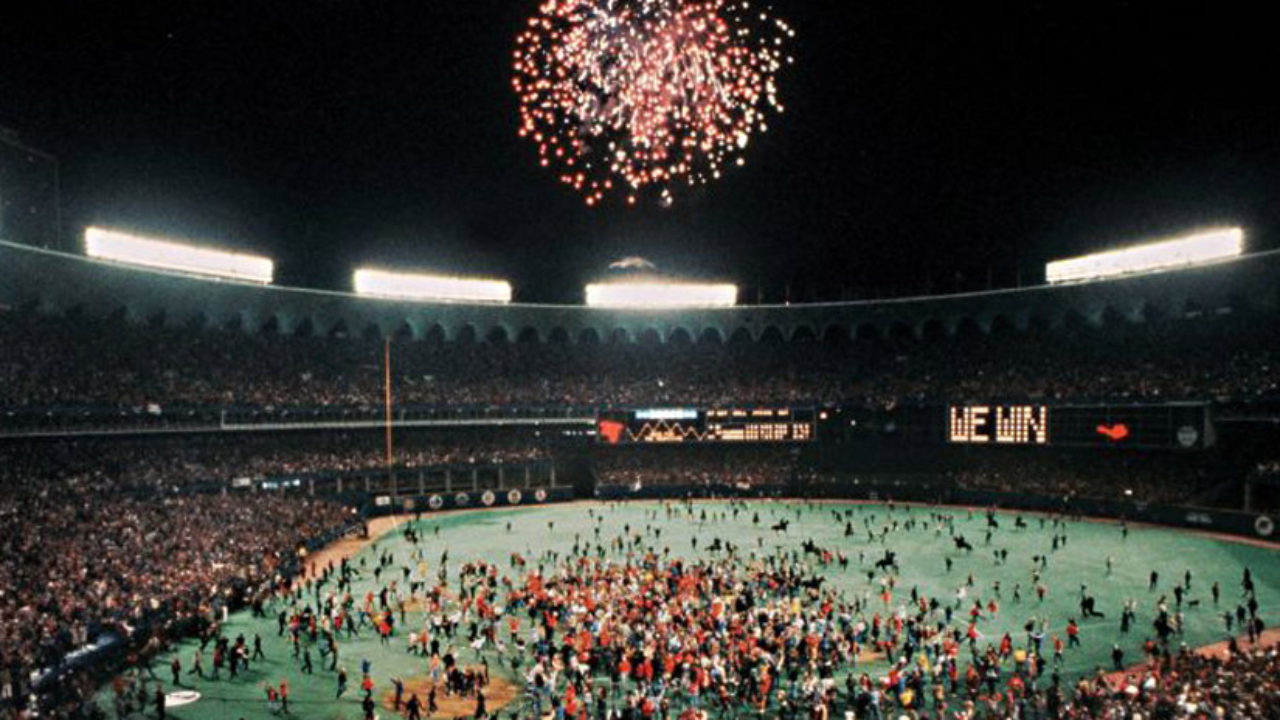
This "pitch invasion" did not result in any injuries,
unlike the one in Moscow earlier in the day.

This was also the only World Series ever broadcast by Dick Enberg, and the 11th and last for Tony Kubek, both on NBC. (Enberg had been a regular announcer for the team then known as the California Angels, while Kubek had previously been a star shortstop for the New York Yankees.)

The Cardinals won their 9th World Series, a total surpassed only by the Yankees. Since then, if you combine their Philadelphia and Oakland titles, it has been matched by the Athletics, although the Cards have now made it 11.

As far as I know, Hernandez is the only player ever to appear on the winning side of a World Series-winning game on his birthday.

Porter had been a member of the Kansas City Royals team that lost the 1980 World Series. Ironically, he would be a member of the Cardinal team that lost to the Royals in the 1985 World Series.

The next season, Herzog, also the Cardinals' general manager, had had enough of Hernandez's ego and cocaine use, and traded him to the New York Mets. This turned out to be a great move for the Mets, and a bad one for the Cards. They won the Pennant in 1985 and 1987, but lost the World Series each time; while Hernandez cleaned up his act, and led the Mets to win the 1986 World Series.

The Cardinals didn't make the Playoffs again until 1996, blowing a 3-1 NLCS lead to the Atlanta Braves. In 2004, they won the Pennant, but got swept in the World Series by the Boston Red Sox. In Game 3, pitcher Jeff Suppan, not used to running the bases, made a blunder at 3rd base. It probably didn't matter as far as determining the outcome, but someone noticed that Suppan wore Number 37, which had been Hernandez's number with the Cardinals.

That, and the team's inability to win a Series since 1982 led to talk of a "curse" on the team, "The Curse of Keith Hernandez." But such talk ended when they won the 2006 World Series, ending the "drought" at 24 years.

The Brewers should have been so lucky: After their 1982 Pennant, they have never won another. In 1998, the Brewers moved to the National League, into its Central Division, where they play the Cardinals several times a season. In 2008, they won the NL Wild Card, but lost the NL Division Series to the Philadelphia Phillies. In 2011, they won the Division and got to the NLCS, but lost to the Cardinals, who won another World Series. From 2018 to 2021, they made 4 straight postseasons, including winning the NL Central in 2018 and 2021, but failed to win the Pennant, losing the 2018 NLCS to the Los Angeles Dodgers in Game 7.

UPDATE: The Cardinals have a team Hall of Fame. From their 1982 World Champions, they have inducted team owner August "Gussie" Busch, coach Albert "Red" Schoendienst, scout George Kissell, broadcasters Jack Buck and Mike Shannon, manager and general manager Whitey Herzog; 1st baseman Keith Hernandez, 2nd baseman Tom Herr, shortstop Ozzie Smith, center fielder Willie McGee; and pitchers Bob Forsch and Bruce Sutter.

From their 1985 World Champions: Busch, Schoendienst, Kissell, Buck, Shannon, Herzog, Herr, Smith, McGee, Forsch; left fielder Vince Coleman, pitcher John Tudor, and former pitcher turned broadcaster Al Hrabosky. From their 1987 Pennant: All of those, plus 2nd baseman José Oquendo.

After losing the 1987 World Series, the Cardinals had some near-misses. In 1996, they blew a 3-1 lead in the National League Championship Series to the Atlanta Braves. In 2000, they lost the NCLS to the New York Mets. In 2001, they lost the NL Division Series to the Arizona Diamondbacks. In 2002, they lost the NLCS to the San Francisco Giants. In 2004, they won the Pennant, but were swept in the World Series by the Boston Red Sox, who not only ended an 86-year title drought (by means both fair and not), but avenged Series defeats to the Cardinals in 1946 and 1967. In 2005, the Cardinals lost the NCLS to the Houston Astros, who thus won their 1st Pennant in team history. Finally, in 2006, the Cardinals won another World Series.

Elected to the Cardinals Hall of Fame from this period, but not the one before or the one after, have been 1st baseman Mark McGwire, center fielder Ray Laknford, shortstop Édgar Rentería and pitcher Matt Morris.

Busch, Herzog, Schoendienst, Kissell, Buck, Shannon, Adamie, Hernandez, Herr, Smith, McGee, Porter, Forsch, Sutter, 3rd baseman Terry Pendleton, left fielders Bernard Gilkey and Kerry Robinson, right fielder Andy Van Slyke, catchers Tim Pagnozzi and Mike Matheny; pitchers Mark Littell, Danny Cox, Todd Worrell, Ricky Horton, Lee Smith, Alan Benes, his brother Andy Benes, and Rick Ankiel; and coach Lee Thomas were elected to the Missouri Sports Hall of Fame.

Busch, Schoendienst, Kissell, Buck, Shannon, Herzog, Sutter, Hernandez, Herr, Smith, Van Slyke, Cox, Worrell, Gilkey, Smith, Lankford, 2nd baseman Ken Oberkfell, 3rd baseman Gary Gaetti (after having been on the opposite side of the 1987 World Series, with the Minnesota Twins) were elected to the St. Louis Sports Hall of Fame.

*

October 20, 1982 was a Wednesday. This was also the day of the Luzhniki Stadium disaster, at a soccer game in Moscow. I have a separate entry for that event.

It was midweek for American football. The NBA regular season wouldn't start for another 9 days. There were 8 games played in the new National Hockey League season:

* The New Jersey Devils, having debuted on October 5, lost to the Los Angeles Kings, 7-4 at The Forum in the Los Angeles suburb of Inglewood, California.

* The New York Rangers beat the Vancouver Canucks, 6-5 at Madison Square Garden.

* The Montreal Canadiens and the Washington Capitals played to a tie, 3-3 at the Capital Centre in the Washington suburb of Landover, Maryland.

* The Toronto Maple Leafs beat the Minnesota North Stars, 5-2 at Maple Leaf Gardens in Toronto.

* The St. Louis Blues beat the Pittsburgh Penguins, 5-3 at the Civic Arena in Pittsburgh.

* The Quebec Nordiques beat the Detroit Red Wings, 5-3 at Joe Louis Arena in Detroit.

* The Chicago Black Hawks beat the Buffalo Sabres, 4-0 at the Chicago Stadium.

* And the Edmonton Oilers beat the Hartford Whalers, 4-2 at the Northlands Coliseum in Edmonton. 

Friday, September 9, 2022

September 9, 1965: Sandy Koufax's Perfect Game

September 9, 1965: The Los Angeles Dodgers host the Chicago Cubs at Dodger Stadium in Los Angeles. In the 1st 152 seasons of what we now call Major League Baseball, no game has ever had fewer hits, both teams combined.

Sandy Koufax started for the Dodgers. He had pitched a no-hitter in each of the last 3 seasons: 1962, 1963 and 1964. He was pitching as well as anybody ever had in the history of baseball.

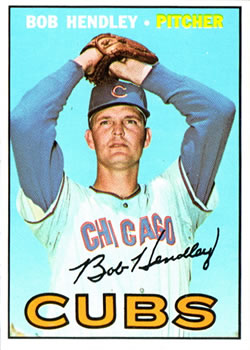
Bob Hendley started for the Cubs. He was not a particularly well-known pitcher. On this night, he pitched the game of his life. Unfortunately for him, it was only the 2nd-best pitched game... in that game.
Neither pitcher allowed a single baserunner until the bottom of the 5th. Cliché Alert: Walks can kill you, especially the leadoff variety. So can errors. Hendley walked Lou Johnson to start the inning. Ron Fairly sacrificed Johnson over to 2nd base. Johnson tried to steal 3rd base. Cub catcher Chris Krug made a bad throw, allowing Johnson to score. Johnson would also get a hit, the Dodgers' only hit: A "Texas Leaguer" double to right field with 2 out in the 7th, but would be stranded.

The Dodgers had 1 run, without a hit contributing to it. That was all Koufax needed: One run. He went to a 3-balls, 2-strikes count on Ernie Banks in the top of the 5th, but struck him out. He went to another full count on Billy Williams in the 7th, but got him to fly out. He struck out the side in the 8th: Ron Santo, Banks, and Byron Browne.

He went into the 9th inning without having allowed a baserunner. Krug led off. He got to a 2-and-2 count, before Koufax struck him out swinging. Joey Amalfitano came up. Koufax struck him out on 3 pitches, the last a swing and a miss.

Cub manager Lou Klein sent Harvey Kuenn up to bad for Hendley, who had pitched 8 innings, allowing 1 run, 1 hit, and 1 walk, striking out 3. Ordinarily, even in that pitching-friendly era of baseball, it would have been enough to win. Not on this night.

Kuenn was 34 years old, and nearing the end of the line. But he was a .303 lifetime hitter, the 1953 American League Rookie of the Year, the 1959 AL batting champion with a .353 average, a 4-time AL leader in hits, a 3-time AL leader in doubles, an All-Star in 8 seasons (including 2 in which there were 2 All-Star Games, so he's sometimes listed as a 10-time All-Star), and, while not really a power hitter, topping off at 12 home runs in 1956, he was certainly capable of driving in runs, topping off at 88 RBIs that same year. He had spent most of his career with the Detroit Tigers, but had helped the San Francisco Giants win the 1962 NL Pennant.

No less than Casey Stengel had said that Kuenn was "one of the most dangerous hitters in baseball. The guy can hurt you a million ways. He has no weakness at the plate that I have ever noticed." However, he was now batting just .217. He had previously made the last out in Koufax's 2nd no-hitter, over the Giants in 1963.

There is no surviving film or videotape of this game, just a recording of Vin Scully's broadcast on radio station KFI, 640 on the AM dial: "It is 9:46 PM. Two and two to Harvey Kuenn. One strike away. Sandy into his windup. Here's the pitch: Swung on and missed, a perfect game!" (Note: That's 9:46 PM Pacific Time, so it was 12:46 AM Eastern Time on September 10.)

The perfect game was also his 4th no-hitter, breaking the record of 3, which had been shared by Larry Corcoran, Cy Young and Bob Feller. Young's 2nd no-hitter was a perfect game.

Koufax threw 113 pitches, 79 of them for strikes. He struck out 14 batters. Home plate umpire Ed Vargo didn't have the chance to make bad calls. His single-game strikeout peak was 18, having done it in 1959 (before he found his control) and 1962. The 14 from this game would be part of a total of 382, a major league record at the time. Nolan Ryan would raise the record to 383 in 1973, a year in which he pitched 2 no-hitters. Koufax's 382 remains a National League record, and a major league record for lefthanded pitchers.

Koufax's 4 no-hitters would be a record until Ryan pitched a 5th in 1981, eventually reaching 7 -- although none of those was a perfect game. In a weird twist of events, Jeff Torborg caught Koufax's last no-hitter, and also caught Ryan's 1st in 1973. That made him the 2nd catcher to catch no-hitters in both leagues, following Gus Triandos. They have since been joined by Darrell Porter, Ron Hassey and Drew Butera.

Torborg also caught Bill Singer's no-hitter for the Dodgers, in 1970, so he was the 1st catcher to catch 3 no-hitters. Jason Varitek now holds the record, with 4.

The Dodgers went on to win the World Series. Koufax would be the story of that Series, in more ways than one.

Harvey Kuenn would go on to manage the Milwaukee Brewers to their 1st Pennant, in 1982. He died in 1988. Ed Vargo died in 2008. Lou Johnson, who got the Dodgers' only hit, died in 2020. Vin Scully died on August 2, 2022. As of September 9, 2022, Sandy Koufax, Jeff Torborg and Bob Hendley are still alive.

UPDATE: Torborg died in 2025.

*

September 9, 1965 was a Thursday. Future basketball star Dan Majerle was born. Hurricane Betsy hit the Gulf of Mexico region, killing 81 people. This was also the day that both the U.S. Department of Housing and Urban Development and Gatorade made their debuts. I have separate entries for those events.

There were only 4 other major league games that night:

* The New York Mets lost to the Cincinnati Reds, 3-2 at Crosley Field in Cincinnati. Rookie Tug McGraw, not yet converted into a reliever, started for the Mets, and allowed 2 runs over 7 innings. The Mets tied the game in the 8th, but Tony Pérez won it with a home run off Gordie Richardson in the bottom of the 9th. Frank Robinson -- as it turned out, in his last month with the Reds -- went 0-for-3 with a walk.

* The Minnesota Twins beat the Chicago White Sox, 10-4 at Comiskey Park in Chicago. Jim Kaat outpitched Joe Horlen. Harmon Killebrew did not play. The Twins were about to win Minnesota's 1st major league Pennant, the franchise's 1st since 1933, when they were the Washington Senators. But they would lose the World Series to the Dodgers.

* The California Angels beat the Kansas City Athletics, 7-2 at Kansas City Municipal Stadium.

* And the San Francisco Giants beat the Houston Astros, 4-0 at Candlestick Park in San Francisco. Juan Marichal, having returned from his suspension after hitting John Roseboro with his bat on August 22, pitched a 4-hit shutout. Tom Haller hit a home run. Willie Mays went 0-for-3.

Sunday, April 17, 2022

April 17, 1960: The Colavito-Kuenn Trade

Rocky Colavito

April 17, 1960: A trade is made in baseball. At the time, it was merely curious. In hindsight, it was very damaging.

Rocco "Rocky" Colavito had been the right fielder for the Cleveland Indians. He had the best right field arm in the American League, along with Roberto Clemente of the Pittsburgh Pirates having the best in the National League. He was also a heavy hitter: In the last 2 seasons, he had hit 41 and 42 home runs, and 113 and 111 RBIs.

He was the most popular player on the team, and his league-leading 42 homers helped them finish 2nd in the AL in 1959, behind the Chicago White Sox, whose Nellie Fox was named Most Valuable Player. It was generally agreed that, had the Indians won the Pennant instead, Colavito would have been named the MVP.

But just 1 day before the Indians were set to begin the 1960 season, their general manager, Frank Lane, traded Colavito to the Detroit Tigers for Harvey Kuenn. Kuenn had led the AL with a .353 batting average, and had led it in doubles 2 years in a row. This was the 1st time the defending batting champion and the returning home run leader had been traded for each other, in either League. People wondered why.
Harvey Kuenn

It has been suggested that "Trader Lane," a.k.a. "Frantic Frank," wanted to get rid of any star on the team, so as to keep salaries down. Kuenn was a good player, but he wasn't as big a star as Colavito. The effect on the Indians was immediate: After going 89-65 and finishing just 5 games out of 1st place in 1959, they fell to 76-78 in 1960, 21 games behind the Pennant-winning Yankees.
At first, the trade worked pretty well for Colavito: Tiger Stadium's short power alleys suited him well, and, in 1961, he had career highs with 45 home runs and 140 RBIs, helping Detroit win 101 games. But that was the year that Roger Maris hit 61 home runs and Mickey Mantle hit 54, leading the Yankees to 109 wins. So not only did his best year as a player, individually and team-wise, not give him the league lead in any major offensive category -- although, in this 1st year of AL expansion, he did become the 1st player to officially play in 163 games, thanks to a rainout and replay -- it didn't even get him as close to the Pennant as he got with the '59 Indians.

The Indians continued to struggle. In 1964, the Tigers traded Colavito to the Kansas City Athletics. The following year, the Indians got him back, in a 3-way deal with the A's and the White Sox that sent Tommie Agee and Tommy John to Chicago.

That season, Colavito had 108 RBIs, good enough to lead the AL. But in 1966, though his home run total went up from 26 to 30, his RBIs dropped to 72, and his batting average fell from .287 to .238. Injuries ended his career 2 years later, only 35 years old. He finished with 374 home runs and 9 All-Star berths -- but, oddly, no Gold Gloves. He is one of the best all-around baseball players not in the Hall of Fame.

Terry Pluto, longtime Cleveland newspaper columnist and the man who knows more about the franchise now known as the Cleveland Guardians than anyone, titled his 1994 book about the team's history The Curse of Rocky Colavito, pointing out that, from 1960 to 1993, the Indians never even finished within 10 games of 1st place, except for the strike-split season of 1981.

Pluto has also suggested that the worst trade the franchise has ever made is the one in which they got rid of Colavito. And the 2nd-worst was the one where they got him back. Fans can't blame that one on Frank Lane, who was already gone.

Lane died in 1981. Commissioner Bowie Kuhn asked Bobby Bragan, who had managed under Lane with the 1958 Indians, to be Major League Baseball's official representative at Lane's funeral. When Bragan got there, he saw that he was the only person connected with baseball there. Lane was that much of a pariah.

In 1971, as GM of the Milwaukee Brewers, Lane hired Kuenn, a native of the Milwaukee suburbs, as a Brewer coach. Lane was fired in 1972, but Kuenn was still there in 1982, when he was named Brewers manager, and led them to the American League Pennant. He died in 1988, from diabetes, only 57 years old.

As of April 17, 2022, Rocky Colavito is still alive, and remains beloved by Cleveland baseball fans.

UPDATE: He died on December 10, 2024, at the age of 91. He was the last surviving player to have participated in the TV show Home Run Derby in the Winter of 1959-60.

The Guardians have a team Hall of Fame. From Colavito's rookie season of 1955 to his near-MVP season of 1959, they have honored him, and also ill-fated pitcher Herb Score. It says something about the gap between their 1959 Pennant race and their 1995 American League Pennant that only these players have been honored from that period: Sam McDowell, Gaylord Perry, Frank Robinson and Andre Thornton. And Robinson is honored mainly because the Indians made him MLB's 1st black manager, not because he hit much for them.

Score has also been elected to the Greater Cleveland Sports Hall of Fame. So have 1970s players Andre Thornton Rick Manning and Mike Hegan, and coach Joe Nossek. But Colavito has not. And Manning, Hegan and Nossek have likely been elected because they were Cleveland natives. (Hegan was the son of Indians star Jim Hegan.)

*

April 17, 1960 was a Sunday. This was the same day as the car crash in England that killed early rock and roll star Eddie Cochran. I have a separate entry for that event.

Football was out of season. Hockey season had ended 3 days earlier, when the Montreal Canadiens beat the Toronto Maple Leafs for the Stanley Cup. Basketball season ended 5 days before that, when the Boston Celtics beat the St. Louis Hawks for the NBA Championship.

There were 5 baseball games played that day:

* The Milwaukee Braves beat the Philadelphia Phillies, 8-4 at Connie Mack Stadium in Philadelphia. Bob Buhl outpitched Robin Roberts. Eddie Mathews hit a home run. Hank Aaron went 0-for-4, but had an RBI on a sacrifice fly.

* The Pittsburgh Pirates swept a doubleheader from the Cincinnati Reds, 5-0 and 6-5 at Forbes Field in Pittsburgh. Bob Friend pitched a 4-hit shutout in the opener. Over the 2 games, Roberto Clemente and Frank Robinson both went 2-for-8 with 2 RBIs, although Clemente also hit a home run in the opener.

* The Los Angeles Dodgers beat the St. Louis Cardinals, 7-5 at the Los Angeles Memorial Coliseum. Larry Sherry pitched 6 innings for the win, and Sandy Koufax pitched 3 innings of relief for the save. Brooklyn holdovers Gil Hodges and Duke Snider, and Los Angeles acquisition Wally Moon, hit home runs for the Dodgers. Stan Musial homered for the Cards.

* And the San Francisco Giants beat the Chicago Cubs, 4-3 at the newly-opened Candlestick Park in San Francisco. Jim Davenport singled relief pitcher Billy Loes home with the winning run in the bottom of the 14th inning. Willie Mays went 1-for-5 with an RBI. Orlando Cepeda hit a home run. Ernie Banks went 1-for-5 with 2 walks and 2 RBIs.

December 31, 1999 & January 1, 2000: The Millennium

December 31, 1999:  The Millennium arrives. The people of planet Earth survived. At a terrible cost. But we hadn't destroyed ourselves. ...