Showing posts with label thanksgiving. Show all posts

Wednesday, November 30, 2022

November 30, 1905: Chicago vs. Michigan, College Football's 1st "Game of the Century"

Walter Eckersall

November 30, 1905: The Championship of college football's Western Conference -- forerunner of the Big Ten -- is decided at Marshall Field in Chicago, named for the department store mogul who funded its construction. It becomes the 1st of many college football games referred to as "The Game of the Century."

The University of Chicago, coached by Amos Alonzo Stagg, came into the game at 10-0. They had allowed only 5 points all season, in a 16-5 win over Indiana. They had scored 44 points against Illinois, 42 each against Iowa and Beloit College, 33 against Lawrence University, and 32 against Northwestern.

They were led by Walter Eckersall, and, while quarterback was a very different position at the time, with the forward pass not legalized until the next season, he was widely regarded as the best player in the country. Stagg, later to be known as "The Grand Old Man of Football," called Eckersall "a selfless performer, marked by complete dedication to victory."

Future Notre Dame star end and coach Knute Rockne grew up in Chicago, and saw Eckersall play in both high school and college. He said of Eckersall, "The first time I learned a football was not only something to kick, but something to think with, was when I saw a great football player in action."

Stagg had recruited Eckersall out of Hyde Park High School, on the city's South Side, not far from the UC campus. Fielding Yost had also tried to recruit him, for the University of Michigan. There, Yost had such a high-powered offense that they were known as "The Point-a-Minute Team." They came in at 12-0: 65-0 over Ohio Wesleyan, 44-0 over Kalamazoo College, 36-0 over Case University, 23-0 over Ohio Northern, 18-0 over Vanderbilt, 31-0 over Nebraska, 70-0 over Albion, 48-0 over Drake, 33-0 over Illinois, 40-0 over Ohio State, 12-0 over Wisconsin, and 75-0 over Oberlin.

Granted, this 495-0 performance wasn't exactly against a modern Football Bowl Subdivision "Power 5 Conference" schedule. And only one of those games, the win over Illinois, was played away from Regents Field in Ann Arbor, Michigan. It should be noted that Wisconsin came closer than anybody to beating each team, having come within 4-0 of Chicago.

Since the start of the 1902 season, the Chicago Maroons were 46-4-3. But the Michigan Wolverines were 54-0-1 in their last 55 games. Their last loss? November 29, 1900, 15-6 -- against Chicago at Marshall Field. The showdown was set for Thanksgiving Day, and a crowd of 27,000, believed to be the largest in college football history to that point, filed into Marshall Field. (At the time, Thanksgiving Day was the last Thursday in November. It became the 4th Thursday in November in 1941.)
Marshall Field, built 1893, renamed Stagg Field 1913

At first, the game was a punting duel between Eckersall and Michigan's John Garrels. It was scoreless early in the 3rd quarter, when a Garrels punt and a penalty pinned Chicago inside its own 10-yard line. On third down, as Eckersall attempted to punt, he encountered a fearsome rush, but evaded the Michigan tacklers, and was able to scramble to the 22-yard line and a 1st down.

After 3 more 1st downs, the drive stalled and Chicago were forced to punt again. Eckersall's booming punt carried into the end zone, where it was caught by Michigan's William Dennison "Denny" Clark, who attempted to run the ball out. He advanced the ball forward to the 1-yard line, but was hit hard by Art Badenoch, and then was brought back inside his own end zone by Mark Catlin.

Under the rules of the time, forward progress was not credited, and a ball carrier could be carried backwards or forwards until he was down. Therefore, Chicago were credited with a safety: 2 points. And that would produce the final score: Chicago 2, Michigan 0. Michigan's streak was over, and Chicago were awarded the Western Conference and National Championships.

Football observers like to say, "Defense wins championships." This is hardly ever true: You can't win if you don't score, and you can't score if you don't have the ball; and, if you have the ball, by definition, you are on offense. This time, defense really did win a Conference and a National Championship. The only other major football championship ever decided on a safety was the 1929 Rose Bowl, the Roy Riegels Game. (I have an entry for that event.)

Clark received the blame for the Michigan loss, and tried to live with it, but couldn't. In 1932, he shot and killed himself. He was 48 years old. In a suicide note to his wife, he reportedly expressed the hope that his "final play" would be of some benefit in atoning for his error at Marshall Field.
Denny Clark

Chicago would see its 14-game winning streak end on November 10, 1906, defeated by Minnesota. Since there was, as yet, no real professional football to speak of, Eckersall became a college football referee, considered the finest of his era. He also became a writer on the game for the Chicago Tribune. At the end of each season, as a counterweight to the Eastern-heavy "All-American" team selected by former Yale coach Walter Camp, Eckersall named an "All-Western" team, and it was considered prestigious in its day.

But "Eckie" was a heavy drinker, and died of cirrhosis of the liver on March 24, 1930. He was only 43 years old, and, to protect his public image, the Tribune reported the cause of death as a heart attack.

In 1949, the Chicago Public Schools constructed a sporting facility on the South Side, at 2423 East 82nd Street, named "Walter Eckersall Stadium." Eckersall, Stagg and Yost would all be charter inductees into the College Football Hall of Fame in 1951.

*

November 30, 1905 was a Thursday. Among the other notable college football games played that Thanksgiving Day: Alabama beat Tennessee, 29-0; Auburn beat Georgia, 20-0; Georgia Tech beat Clemson, 17-0; Holy Cross beat Fordham, 28-5; Indiana beat Ohio State, 11-0; Iowa beat St. Louis University, 31-0; Iowa State beat cross-State rival Drake, 17-12; Kansas beat arch-rival Missouri, 24-0 in Kansas City; Nebraska beat Illinois, 24-6; North Carolina beat Virginia, 17-0 in Norfolk, Virginia; Penn State beat the University of Pittsburgh, 6-0; the University of Pennsylvania beat Cornell, 6-5; and Utah beat Colorado State, 24-0.

Rutgers, Princeton, Harvard and Yale all completed their seasons the preceding Saturday. Army and Navy had the week off, to prepare for each other: They tied, 6-6, at Princeton's University Field.

Tuesday, November 29, 2022

November 30, 1899: The 1st (Official) Women In Any Army

November 30, 1899: The first women to serve, in uniform, in the armed forces of any nation began service as part of the Canadian Militia Expeditionary Force to Cape Town to serve in the Boer War. Georgina Pope and three other women are enlisted as army nurses.

As Patrick Robertson notes, "There was nothing new about female nurses serving in the military; they had done so in numerous campaigns since the Revolutionary War, but in every instance as civilian auxiliaries." And, in many examples throughout recorded history, women have fought in armies, navies, and even on pirate ships, disguised as men.

Cecily Jane Georgina Fane Pope was born on January 1, 1862, in Charlottetown, Prince Edward Island, and trained as a nurse at New York's famed Bellevue Hospital. Placed in command of the first group of nurses to go overseas, she served for more than a year in South Africa.

For the 1st 5 months, she and 4 other volunteer nurses served at British hospitals north of Cape Town. After this, Pope and another sister proceeded north to Kroonstad where, despite shortages in food and medical supplies, they took charge of a military hospital and successfully cared for 230 sufferers of enteric fever.

On September 21, 1901, Pope, along with two other nurses, Deborah Hurcomb and Sarah Forbes, received medals for their war service from the Duke of York, later King George V, during his tour to the Outposts of the British Empire. The following year, she became the 1st Canadian, of either gender, to receive the Royal Red Cross.

In 1908, Pope was appointed first matron of the Canadian Army Medical Corps. In 1917, at the age of 55, despite being in poor health herself, she went to work near Ypres, Belgium, and served for the remainder World War I. After her death on June 6, 1938, she was granted a full military funeral.

*
November 30, 1899 was a Thursday. Until 1938, America celebrated Thanksgiving Day on the last Thursday in November, regardless of whether it was the 4th or 5th Thursday. Since 1939, it's been on the 4th Thursday, regardless of whether it was the last. (Canada celebrated Thanksgiving on the 3rd Monday in October.)

Since this was a Thanksgiving Day, there were college football games played. Among them:

* The Carlisle Indian School beat Columbia, 45-0 at Manhattan Field, next-door to the Polo Grounds. Jim Thorpe was 12 years old, and thus ineligible to play in this game. But the Carlisle squad was already no joke: In their 1st season under head coach Glenn "Pop" Warner, they went 9-2, their victories also including wins over the University of Pennsylvania in Philadelphia and the University of California in San Francisco. They lost only to Harvard away and to Princeton at Manhattan Field. Columbia went 9-3 that season, their other losses being to Princeton and Cornell, in each case also at Manhattan Field.

* In what became a traditional rivalry, Boston College beat Holy Cross, 17-0 at the South End Grounds in Boston, then the home of the team that would become the Boston, then Milwaukee, then Atlanta Braves.

* In what was considered a major rivalry then, and would be for the 1st half of the 20th Century, if not thereafter, Penn beat Cornell, 29-0 at the original Franklin Field in Philadelphia. It was replaced by the current structure in 1922.

* Indiana beat Purdue, 17-5 at Stuart Field in West Lafayette, Indiana. The Old Oaken Bucket, the traditional trophy given to the winner of this game, was introduced in 1925.

* The University of Chicago beat Brown, 17-6 at Marshall Field in Chicago, named for Marshall Field, the department store magnate who was a generous donor to UC.

* Wisconsin beat Michigan, 17-5 on neutral ground at West Side Park in Chicago, then the home of the team that became the Chicago Cubs.

* And Iowa beat Illinois, 58-0 on neutral ground at Douglas Park in Rock Island, Illinois, across the Mississippi River from Davenport, Iowa. This would later be the home of the Rock Island Independents, and thus, on October 3, 1920, the site of the 1st game in what became the NFL.

November 29, 1934: The 1st NFL Game On National Radio

Detroit in the dark (blue) jerseys, Chicago in the white

November 29, 1934: For the 1st time, an NFL game is broadcast nationwide on radio. In fact, that's why it's played at all: To sell radios.

George A. Richards owned Detroit radio station WJR, 760 on the AM dial, an affiliate of the NBC Blue Network, which later became ABC. He bought the NFL's Portsmouth Spartans, who had momentary success by reaching the 1932 NFL Championship Game, but losing it to the Chicago Bears. But they could never get fans in Southern Ohio.

So Richards bought the team, brought them to Detroit, and renamed them the Lions, to tie in with the city's baseball team, the Tigers, and because the lion is "the king of the jungle," and he wanted to build a team that would be "the king of the NFL."

At first, it worked. Their opener, on September 23, at the University of Detroit's Dinan Field, was a 9-0 win over the New York Giants, who had been in the 1933 NFL Championship Game. The Lions ended up winning their 1st 10 games, before losing on November 25 to the Green Bay Packers.

Next up, on Sunday, December 2, at Wrigley Field in Chicago, was a game against the team that had won the  last 2 NFL Championship Games, the previous year against the Giants and the year before against the Spartans/Lions. It was the Chicago Bears, with 2 legends in their backfield, Harold "Red" Grange and Bronislau "Bronko" Nagurski.

Richards knew that Thanksgiving was coming up, the ultimate family holiday. When everyone would be gathered around the radio. (No television in those days.) Maybe if there was a special program on the day, more radios would be sold, and Richards would make more money.

So he talked to Bears owner-coach George Halas about adding a game between the teams, on Thursday, in Detroit. (Up until 1940, Thanksgiving Day was always on the last Thursday in November. Since then, it's been the 4th Thursday in November, which is not necessarily the last Thursday of the month.) Halas, having played and coached in several Thanksgiving Day games over the years, and hardly opposed at the time to playing games so close together, liked the idea. He didn't care about selling radios. He did care about a visiting team's share of the gate receipts. And he certainly cared about selling the Bears (to fans, not to any one person) and selling the NFL. So he talked the other NFL owners into allowing it.

It worked like a charm: One of the biggest national audiences in radio history was tuned in, and over 26,000 fans crammed into the small stadium. And it looked like the Lions were living up to their responsibility, taking a 16-7 halftime lead, thanks to 2 touchdowns by LeRoy "Ace" Gutowsky.

But Jack Manders, so accurate he was known as "Automatic Jack," kicked 2 field goals in the 3rd quarter, enabling Chicago to close within 16-13. And in the 4th quarter, Joe Zeller intercepted a pass from Glenn Presnell and returned it to the Lions' 4-yard line. You wouldn't expect Nagurski to pass for a touchdown, but he did, to Bill Hewitt. Despite being held to 116 rushing yards, the Bears beat the Lions, 19-16.

Three days later, at Wrigley, the Bears beat the Lions again, 10-7. The Lions had started 10-0, but ended 10-3. In contrast, the Bears finished the season at 13-0, and as Western Division Champions. This time, though, they lost the Championship Game, to the Giants.

The Bears would go undefeated and then lose the Championship Game again in 1942. It would take until the 1972 season for a team to have an undefeated regular season and then win the NFL Championship, as the Miami Dolphins won Super Bowl VII.

But in spite of the 3-game collapse, the Lions turned Detroit on to pro football, after the failure of 3 different NFL teams: The Heralds (who changed their name to the Tigers for their 2nd season) in 1920 and '21, the Panthers in 1925 and '26, and the Wolverines in 1928. In 1935, the Lions were less impressive in the regular season, going 7-3-2, but beat the Bears on Thanksgiving, and then beat the Giants to win their 1st NFL Championship.

The Lions continued to play on Thanksgiving until 1938, playing the Bears each time, then resumed in 1945, and have played on the day every season since. Counting their 2021 loss to the Chicago Bears, a far more dire contest than the 1934 inaugural, they are 37-43-2 on T-Day. Of their 82 games, 21 have been against the Green Bay Packers, and 19 against the Bears.

*

November 29, 1934 was Thanksgiving, and therefore a Thursday. There were 2 other NFL games that day. The Chicago Cardinals beat the Packers, 6-0 at Comiskey Park in Chicago. And, in a football version of the great baseball rivalry (but different organizations in each case), the New York Giants beat the Brooklyn Dodgers, 27-0 at Ebbets Field.

Baseball was out of season, and the NBA wasn't founded yet. There were 2 NHL games, and Detroit and Chicago were involved, but not against each other. The Detroit Red Wings lost to the Montreal Maroons, 2-1 at the Montreal Forum. And the Chicago Black Hawks lost to the New York Americans, 2-0 at the old Madison Square Garden.

Of course, by 1942, both the Maroons and the Amerks would be out of business. In contrast, the Red Wings and the Blackhawks (they switched to writing it as 1 word in 1986) are still at it today. And it's a better Detroit vs. Chicago rivalry than Lions vs. Bears, or Tigers vs. White Sox, or even Pistons vs. Bulls.

November 29, 1928: Providence, NFL Champions

Jimmy Conzelman

November 29, 1928: On this Thanksgiving Day, the people of Rhode Island have something to be thankful for: For the 1st time since the Providence Grays were baseball's World Champions in 1884, 44 years earlier, they have a World Championship team.

NOTE: Until 1939, America celebrated Thanksgiving Day on the last Thursday in November, regardless of whether it was the 4th Thursday or the 5th. From 1940 onward, it's been the 4th Thursday in November, whether it's the last one or not.

The Providence Steam Roller were established in 1916, by men working for the Providence Journal newspaper: Sports editor Charles Coppen and sportswriter Pearce Johnson. Three men shared in the ownership and management of the team: Coppen, Judge James Dooley, and sports promoter Peter Laudati. Johnson served as what would now be called the general manager.

The team soon became a regional power. In 1924, its schedule featured several NFL teams. The Steam Rollers posted a 3–2–1 record against those teams. The 1924 Steam Roller then went on to win the mythical "undisputed championship of the Northeast." The team's success that season was enough to make Steam Rollers management and fans start thinking about playing in the NFL.

They joined for the 1925 season, moving from their former home of Kinsley Park to a 10,000-seat cycling stadium called the Cycledrome, which wasn't quite big enough to hold a regulation football field, and so the corners of one end zone were cut off. Laudrati had both of these stadiums built. They went 6-5-1, then 5-7-1 in 1926.
The Providence Cycledrome
They hired star back Jimmy Conzelman, still only 29 years old and still playing, as head coach for 1927, and he improved the team to 8-5-1. Their other players included back Gus Sonnenberg, who went on to greater fame as a professional wrestler; and back George "Wildcat" Wilson, who had starred at the University of Washington.
They began the 1928 season by beating the football team named the New York Yankees, 20-7 at the Cycledrome. They lost at home to the Frankford Yellow Jackets, 10-6. They did not lose again that season: They beat the Dayton Triangles at home, 28-0; the Yankees at Yankee Stadium, 12-6; the Pottsville Maroons at home, 13-6; and the Detroit Wolverines at home, 7-0.
With Pennsylvania having "blue laws" prohibiting the playing of professional sports on Sundays, the Yellow Jackets would often schedule home-and-home series on back-to-back days: In Philadelphia on a Saturday, and then against the same team, at their stadium, on Sunday. On November 17, the Steam Roller went into Frankford Stadium in Northeast Philadelphia, and came away with a 6-6 tie. On November 18, at the Cycledrome, they beat the Yellow Jackets 6-0.
The following Sunday, they beat the football version of the New York Giants at home, 16-0. They were set to play the Maroons at Minersville Park in Pottsville, Pennsylvania. Jack Cronin rushed for a touchdown in the 2nd quarter, and that was it: Providence 7, Pottsville 0. With the Yellow Jackets already having lost 3 games, this game the Steam Roller the NFL Championship.
They closed the season on December 2, at home, playing the Green Bay Packers to a 7-7 tie. They finished 8-1-2, for a winning percentage of .889. The Yellow Jackets were 11-3-2, at .786; while the Wolverines were 7-2-1, at .778. (At the time, ties were not counted in winning percentage. If they had been, it would have been Providence .818, Frankford .750, Detroit .750, so it wouldn't have made a difference.)
Under the rules that began in 1933, Providence would have won the Eastern Division, and Detroit the Western Division, and they would have played each other in the NFL Championship Game. This being an even-numbered year, the Eastern Division winners would have hosted, so the Steam Roller would have done so. But this was still the pre-title game, single-division NFL, so the Steam Roller won the title outright.
But they couldn't hold it together. Conzelman could only guide them to 4-6-2 in 1929, and 6-4-1 in 1930. He left, and they finished 4-4-3 in 1931. Their last home game came on another Thanksgiving, November 26, a 38-7 loss to the Packers; and their last game, on November 29, was a 0-0 tie against the Giants at the Polo Grounds. The owners then turned the franchise back over to the NFL.
Providence has never gotten another NFL team. In 1971, the Boston Patriots changed their name to the New England Patriots, and moved to Foxborough, Massachusetts. It's almost exactly halfway between downtown Boston and downtown Providence. The Patriots have won 6 Super Bowls, but they do not claim New England's 1st NFL Championship, that of the 1928 Providence Steam Roller, as their own.
The Providence Journal, a.k.a. the ProJo, remains the largest-circulating newspaper in Rhode Island. A Peter Pan Bus Terminal now stands on the site of the Cycledrome.
*

November 29, 1928, being Thanksgiving, was a Thursday. There were 3 other NFL games that Thanksgiving Day:

* The Frankford Yellow Jackets beat the Green Bay Packers, 2-0 at Frankford Stadium in Philadelphia.

* The Detroit Wolverines beat the Dayton Triangles, 33-0 at Navin Field (the eventual Tiger Stadium) in Detroit.

* And the Chicago Bears beat the Chicago Cardinals, 34-0 at Wrigley Field in Chicago.

There were also 24 college football games on this day, but most of them were not the more familiar rivalries that would develop:

* Brown beat Colgate, 16-13 at Brown Stadium in Providence, Rhode Island.

* New York University (NYU) welcomed Oregon State to Yankee Stadium, and lost, 25-13 in front of a crowd of 40,000.

* Syracuse beat Columbia, 14-6 at Baker Field in Manhattan.

* The University of Pennsylvania beat Cornell, 49-0 at Franklin Field in Philadelphia.

* The University of Pittsburgh beat Penn State, 26-0 at Pitt Stadium in Pittsburgh.

* Maryland beat Johns Hopkins, 26-6 at Municipal Stadium in Baltimore.

* West Virginia beat Washington & Jefferson, 14-0 at the old Mountaineer Field in Morgantown, West Virginia.

* Virginia Military Institute (VMI) beat Virginia Polytechnic Institute (VPI, now usually called Virginia Tech), 16-6 at Maher Field in Roanoke, Virginia.

* North Carolina beat Virginia, 24-20 at Lambeth Field in Charlottesville, Virginia.

* North Carolina State beat South Carolina, 18-7 at Riddick Stadium in Raleigh, North Carolina.

* Mercer beat Wake Forest, 14-12 at Memorial Stadium in Asheville, North Carolina.

* Clemson beat Furman, 27-12 at Manly Field in Greenville, South Carolina. I guess Furman's home field wasn't manly enough.

* Georgia Tech beat Alabama Polytechnic (now Auburn University), 51-0 at Grant Field in Atlanta.

* Florida beat Washington & Lee University, 60-6 at Fairfield Stadium in Jacksonville.

* Alabama beat Georgia, 19-0 at Denny Stadium (now Bryant-Denny Stadium) in Tuscaloosa, Alabama.

* Kentucky and Tennessee played to a tie, 0-0 at Shields-Watkins Field (now Neyland Stadium) in Knoxville, Tennessee.

* Arkansas beat Southwestern College, 73-0 at Russwood Park in Memphis. Southwestern, in Memphis, is now known as Rhodes College, and competes at the NCAA Division III level.

* Mississippi (Ole Miss) beat Mississippi State, 20-19 at Scott Field (now Davis Wade Stadium) in Starkville, Mississippi.

* Louisiana State University (LSU) and Tulane played to a tie, 0-0 at Tulane Stadium in New Orleans.

* Oklahoma beat Missouri, 14-0 at Owen Field (now Gaylord Family Memorial Stadium) in Norman, Oklahoma.

* The University of Tulsa beat Oklahoma A&M (now Oklahoma State), 31-0 at McNulty Park in Tulsa, 
Oklahoma.

* Texas Christian University (TCU) beat Southern Methodist University (SMU), 15-6 at Ownby Stadium in Dallas.

* Texas beat Texas A&M, 19-0 at Memorial Stadium in Austin.

* Baylor beat Rice, 25-14 at Rice Field in Houston.

* The University of Detroit beat Georgetown, 33-13 at Titan Stadium in Detroit.

* Marquette beat Iowa State, 6-0 at Marquette Stadium in Milwaukee.

* Drake beat Creighton, 6-0 at Creighton Stadium in Omaha, Nebraska.

* Nebraska beat Kansas State, 8-0 at Memorial Stadium in Lincoln.

* The University of Colorado beat the University of Denver, 7-0 at Hilltop Stadium in Denver.

* New Mexico beat Colorado Mines, 32-13 at University Field in Albuquerque, New Mexico.

* Utah beat Utah A&M (now Utah State), 20-0 at Ute Stadium in Salt Lake City.

* Oregon beat UCLA, 26-6 at the Los Angeles Memorial Coliseum.

* Montana beat Gonzaga, 7-0 at Gonzaga Stadium in Spokane, Washington.

* And Washington beat Washington State, 6-0 at Husky Stadium in Seattle.

The NBA hadn't been founded yet, but there were 3 games played in the NHL:

* The New York Rangers beat the Chicago Black Hawks, 2-1 at the old Madison Square Garden, which was then new.

* The Montreal Canadiens and the Pittsburgh Pirates played to a tie, 1-1 at the Montreal Forum. The Pirates folded in 1930.

* And the Montreal Maroons and the Detroit Cougars played to a tie, 1-1 at the Olympia Stadium in Detroit. The Cougars became the Falcons in 1930, and the Red Wings in 1932. The Maroons folded in 1938.

November 29, 1894: William Penn, On Top of the World

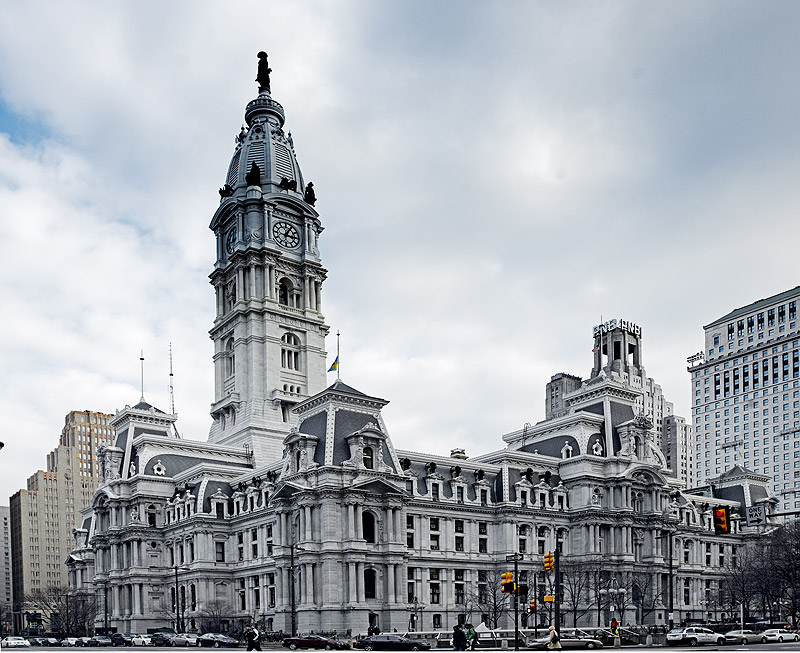
November 29, 1894: A 37-foot-high statue of William Penn, founder of the City of Philadelphia and the British Province that became the State of Pennsylvania (or, officially, "The Commonwealth of Pennsylvania"), is raised to the top of the City Hall that had been under construction in the French-inspired "Second Empire" style since 1871, and would continued to be worked on until being declared complete in 1901.

William Penn (1644-1718) was a writer, religious thinker, and influential Quaker from London, who founded the Province of Pennsylvania, receiving a charter from King Charles II on October 27, 1682. Penn was an advocate of democracy and religious freedom, known for his amicable relations and successful treaties with the Lenape tribe of Native Americans who had resided in present-day Pennsylvania prior to European settlements in the State.
The hat on Penn's statue is 548 feet above street level. This makes City Hall the tallest building in the world, surpassing the New York World Building in New York City, until the opening of the Singer Building in New York in 1908.
(Note: The Council on Tall Buildings and Urban Habitat (CTBUH) maintains a set of criteria for determining the height of tall buildings, and defines a "building" as "a structure that is designed for residential, business or manufacturing purposes" and that "has floors." Although the Eiffel Tower, which had opened in Paris in 1889, was considerably taller, less than half of it was habitable; therefore, while it was classified as the world's tallest structure, it was not a "building" at all.)

It remains the tallest City Hall in the country. Its location, at the junction of Broad Street and Market Street, at the center of Center City Philadelphia, makes it the transfer point for the City's 2 main Subway lines, the Broad Street Line (north-to-south) and the Market-Frankford Line (east-to-west). And, as the City of Philadelphia and the County of Philadelphia are contiguous, it also serves as the Philadelphia County Courthouse.

While many American cities embraced the concept of the skyscraper, a "gentlemen's agreement" forbade any structure from rising above the hat on the Penn statue. The idea was that Penn could look out over his city, in any direction, without his view being blocked. (The statue, of course, is in a fixed position, facing northeast.)

With that agreement in place, the World Series was won by the Philadelphia Athletics in 1910, 1911, 1913, 1929 and 1930, and the Philadelphia Phillies in 1980; the NFL Championship was won by the Frankford Yellow Jackets in 1926, and the Philadelphia Eagles in 1948, 1949 and 1960; the NBA Championship was won by the Philadelphia Warriors in 1947 and 1956, and the Philadelphia 76ers in 1967 and 1983; and the Stanley Cup was won by the Philadelphia Flyers in 1974 and 1975.

On May 27, 1987, One Liberty Place broke the gentleman's agreement, rising to 945 feet. For the first time, something in the city could "block Billy Penn's view." And, apparently, he didn't like this. Just 4 days after One Liberty Place opened, the Flyers lost Game 7 of the Stanley Cup Finals to the Edmonton Oilers.

In 1993, the Phillies lost the World Series. This included blowing a 14-9 lead in the 8th inning of Game 4, at home, before Joe Carter of the Toronto Blue Jays hit a Series-winning home run in Game 6. In 1995, the Flyers were tied 2-2 with the New Jersey Devils in the NHL Eastern Conference Finals, but lost Game 5 in the last minute of regulation, and then lost Game 6. In 1997, the Flyers were swept by the Detroit Red Wings in the Stanley Cup Finals. In 2000, the Flyers led the Devils 3-1 in the Eastern Conference Finals, and lost 3 straight, including losing Eric Lindros to a concussion. In 2001, the 76ers won the NBA Eastern Conference title, but lost the Finals to the Lakers. This remains their only Finals appearance since 1983.

In 2002, the Eagles lost the NFC Championship Game to the St. Louis Rams. In 2003, in their last game at Veterans Stadium, before moving into Lincoln Financial Field, the Eagles lost the NFC Championship Game to the Tampa Bay Buccaneers. Since entering the NFL in 1976, the Bucs had never won a Playoff game on the road, and had never won when the temperature was less than 32 degrees Fahrenheit. With this game, they had done both. If that could happen, and it could happen to the Eagles, then, it was reasoned, larger forces could be at work. This is when the idea of a "curse" began to be discussed. People looked to the last title won by a Philly team, and it was the 1983 76ers, so it had to be something after that.

Between that title and the rise of Liberty Place, the Flyers had lost the 1985 Stanley Cup Finals, but that was while Liberty Place was still under construction, so it's not counted. Nor was the death, early the next season, of Flyer goaltender Pelle Lindbergh, from drunk driving. There was the 76ers' 1986 Draft Day debacle, but that was also before Liberty Place was topped off. So a Curse of Howard Katz, or a Curse of Pelle Lindbergh, was possible. The city's media decided, instead, on Penn, for "blocking his view." (The fact that the two Liberty Place skyscrapers are behind his back, and weren't in his line of sight, seems not to have occurred to them.)

In 2004, the Eagles made it 3 straight NFC Championship Game losses, 2 straight at home, losing to the Carolina Panthers. That same year, it appeared that the curse even extended to horse racing. Smarty Jones, a horse bred and trained in suburban Chester County, Pennsylvania, won the Kentucky Derby and the Preakness Stakes, but fell short of the Triple Crown when he lost the Belmont Stakes by blowing a late lead. In 2005, finally winning an NFC Championship Game on their 4th straight try, the Eagles beat the Atlanta Falcons. But, despite threatening late, they could not beat the New England Patriots in Super Bowl XXXIX.

Someone must have decided that enough was enough. On June 18, 2007, ironworkers helped raise the final beam in the construction of the 974-foot Comcast Center. In addition to the Philadelphia tradition of finishing a building with an American flag and a small evergreen tree, they attached a statue of William Penn. Now, atop the new tallest building in town, his view was, again, unblocked.

Did it work? Not yet: Three months later, the Phillies came from 7 games back in the National League Eastern Division with 17 games to go, surged past the New York Mets, and won the Division title. But lost the NL Division Series to the Colorado Rockies -- the 1st postseason series win for the Rockies, who began play in 1993, the year of the Phillies' most recent Pennant.

But it all came together in 2008. The Phillies beat the Mets out for the Division again, beat the Milwaukee Brewers in the NLDS, and then beat the Los Angeles Dodgers in the NL Championship Series for their 1st Pennant in 15 years. It was on to the World Series, with a first: A father and son broadcasting for the opposing teams, Harry Kalas for the Phils, and Todd Kalas for the Tampa Bay Rays.

The Phillies won Game 1 in St. Petersburg, 3-2, before losing Game 2, 4-2. Coming home to Citizens Bank Park, they won Game 3, 5-4; and Game 4, 10-2. Game 5 began on Monday, October 27, but it rained throughout. The Phillies led 2-1 after 5 innings. Under normal conditions, games are considered to be official games after 5 innings, or 4 1/2 if the home team is leading at that point. However, both Rays and Phillies management knew before the first pitch that Commissioner Bud Selig, who was responsible for the scheduling of post-season games, would not allow a team to clinch the Series by winning a rain-shortened game.

The umpires let the game continue, and the Rays tied the game in the top of the 6th. When that half-inning ended, as Phils 2nd baseman Chase Utley remembered, "The infield was basically underwater." The umpires suspended the game. Rain continued to fall in Philadelphia on Tuesday, October 28, further postponing the game to Wednesday, October 29.

Game 5 was resumed in the bottom of the 6th, with the Philadelphia Phillies batting, and needing 1 run plus 9 outs to win the World Series. Geoff Jenkins doubled, was bunted to 3rd by Jimmy Rollins, and was driven in by a Jayson Werth single.

Rocco Baldelli tied the game with a home run in the 7th. Later in the inning, Utley took a grounder, faked a throw to 1stn base, then threw Jason Bartlett out at home for the 3rd out in a play later described as having saved the Series for the Phillies.

In the bottom of the 7th, Pat Burrell led off with a double. Eric Bruntlett, pinch-running for Burrell, scored on a single by Pedro Feliz to put the Phillies up by a run again, 4–3.

In the 2004 NLCS, pitching for the Houston Astros, Brad Lidge had given up a tremendous home run to Albert Pujols of the St. Louis Cardinals, to lose a game. It was said that he was never the same after that. That wasn't true: The Astros won the Pennant the next year. In 2008, Lidge was the Phillies' closer, and, going into Game 5, was 47-for-47 in save opportunities over the season. For fans still traumatized by the 1993 World Series, he was no Mitch Williams.

In the top of the 9th, Lidge gave up a single and a stolen base, but faced Eric Hinske with the chance to give the city its 1st World Series win since 1980, and its 1st World Championship in any sport since the 1983 76ers. Harry Kalas, the Hall of Fame voice of the Phils, had the call:

One strike away, nothing-and-two to Hinske. Fans on their feet. Brad Lidge stretches. The oh-two pitch: Swing and a miss! Struck him out! The Philadelphia Phillies are 2008 World Champions of baseball!

Brad Lidge does it again, and stays perfect for the 2008 season, 48-for-48 in save opportunities! And let the city celebrate! Don't let the 48-hour wait diminish the euphoria of this moment and celebration! Twenty-five years in this city that a team has enjoyed a World Championship, and the fans are ready to celebrate. What a night! Phils winning, 4–3, Brad Lidge gets the job done once again!

Harry would die early the next season. He deserved that title.

Three months later, the Eagles reached the NFC Championship Game, with a shot at Super Bowl XLIII, but lost to the Arizona Cardinals, a team that hadn't reached an NFL Championship Game, under any name, since 1948. That was embarrassing. 

The Phils won the Pennant again in 2009, but lost the World Series to the New York Yankees. They won the NL East again in 2010 and 2011, then fell apart for a few years. The Flyers reached the Stanley Cup Finals in 2010, but lost to the Chicago Blackhawks. It was beginning to look like the Phillies had broken a curse that had been put on them sometime after 1980, and the other teams in town were under seaprate curses. But in 2018, the Eagles broke a 57-year drought, beating the New England Patriots in Super Bowl LII.

Also in 2018, a new tallest building in the city opened: The Comcast Technology Center, at 1,121 feet, making it the tallest building in America not in either New York City or Chicago. As with its predecessor and sort-of namesake, a small statue of William Penn was put on top, just in case.

*

November 29, 1894, was a Thursday. Under the law of the time, being the last Thursday in November, it was Thanksgiving Day. Not until 1942 was it changed to the 4th Thursday in November, regardless of whether that was the last one. As a result of being Thanksgiving, before the era of professional football, the only sport played was college football, but there were 9 games, including 1 in Philadelphia:

* The University of Pennsylvania beat Harvard, 18-4 at the University Grounds in Philadelphia, 2 miles west of City Hall. Decades later, Penn would be retroactively awarded this season's National Championship.

* The Chicago Athletic Club beat Dartmouth, 4-0 at the Alumni Oval in Hanover, New Hampshire.

* Tufts beat Andover, 6-4 at Andover, Massachusetts.

* Brown beat MIT (Massachusetts Institute of Technology), 16-4 at Lincoln Field in Providence, Rhode Island.

* Cornell beat Lehigh, 10-6 at Percy Field in Ithaca, New York.

* Lafayette beat Bucknell, 44-0 at March Field in Easton, Pennsylvania.

* Purdue beat DePauw University (of Greencastle, Indiana, not DePaul of Chicago), 28-0 at the Fair Grounds in Indianapolis.

* Michigan beat the University of Chicago, 6-4 at Marshall Field in Chicago.

* And Illinois beat the Pastime Athletic Club of St. Louis, 10-0 at Sportsman's Park in St. Louis.

Monday, November 28, 2022

November 28, 1974: Elton John & John Lennon at The Garden On Thanksgiving

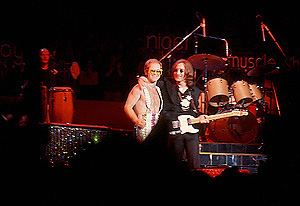
November 28, 1974: On Thanksgiving night, close to the height of his musical talent, fame and charisma, Elton John rocked Madison Square Garden in New York with considerable gusto. But that, by itself, wouldn't have put this concert on this blog.

At the end of the show, Elton brought on a special guest. He had made a bet with an old friend, former Beatle John Lennon, that if John's song "Whatever Gets You Through the Night," on which Elton had sung backup, hit Number 1 in the U.S., John would join him for this show. It did.

John kept his word, and the audience, totally unaware that he was coming, gave the building its greatest ovation ever, with the possible exception of the one when Willis Reed limped onto the court for the New York Knicks before Game 7 of the 1970 NBA Finals.

Together, the Walrus and the Rocket Man played 3 songs: "Whatever Gets You Through the Night," Elton's reworking of John's Beatle classic "Lucy in the Sky with Diamonds," and a song John introduced as being "by an old friend named Paul": "I Saw Her Standing There."

Those 3 songs -- possibly the inspiration for Lorne Michaels' never-accepted (except by George alone) invitation for the Beatles to reunite for 3 songs, getting paid $3,000, on Saturday Night Live in 1976 -- made this show a legend.

That, and the fact that it was John's last concert appearance of any kind. In 1982, referencing flower gardens and, perhaps, also Madison Square Garden, Elton had a hit with "Empty Garden (Hey, Hey, Johnny)":

And I've been knocking
but no one answers.
And I've been knocking
for most of the day.
Oh, and I've been calling:
Oh, hey, hey, Johnny
can you come out to play?

*

November 28, 1974, like all Thanksgiving Days, was a Thursday. The Dallas Cowboys beat their arch-rivals, the Washington Redskins, 24-23 at Texas Stadium in the Dallas suburb of Irving, Texas. This was the Clint Longley Game, and I have a separate entry for it.

And the Denver Broncos beat the Detroit Lions, 31-27. This was the Lions' last game at Tiger Stadium. They played their last 2 regular-season games on the road, did not make the Playoffs, and moved into the Silverdome in suburban Pontiac, Michigan the next season.

There was one college football game that day, and, at the time, it was a major rivalry. Penn State, then ranked Number 10 in the country beat the 18th-ranked University of Pittsburgh, 31-18 at Three Rivers Stadium in Pittsburgh. Since Pitt joined the Big East Conference in 1991, Penn State joined the Big Ten Conference in 1993, and especially since Pitt switched to the Atlantic Coast Conference in 2013, this rivalry has not been played annually anymore.

In recent times, to avoid losing television viewers to football, the NBA and the NHL usually don't play on Thanksgiving Day. However, there were 2 games in the NBA. The Cleveland Cavaliers beat the Philadelphia 76ers, 110-103 at The Coliseum in the Cleveland suburb of Richfield, Ohio. And the Portland Trail Blazers beat the Phoenix Suns, 88-85 at the Arizona Veterans Memorial Coliseum in Phoenix.

And 1 game was played in the American Basketball Association. The Kentucky Colonels beat the Virginia Squires, 108-95 at The Scope in Norfolk.

There was 1 game in the NHL, and Detroit was involved, but not at home. The Detroit Red Wings lost to the Buffalo Sabres, 5-2 at the Buffalo Memorial Auditorium. There were 4 games played in the World Hockey Association:

* The Vancouver Blazers beat the Toronto Toros, 6-2 at Maple Leaf Gardens in Toronto.

* The Quebec Nordiques beat the Indianapolis Racers, 7-5 at the new Market Square Arena in Indianapolis.

* The Houston Aeros beat the Edmonton Oilers, 2-0 at the Sam Houston Coliseum in Houston.

* And the Chicago Cougars beat the San Diego Mariners, 3-2 at the San Diego Sports Arena (now the Pechanga Arena).

November 28, 1974: The Clint Longley Game

November 28, 1974: For the last time, a football game is played at Tiger Stadium in Detroit. The Detroit Lions lose, 31-27 to the Denver Broncos. The Lions' 2 remaining regular-season games will be on the road. They split them, to finish 7-7, but, even if they'd won both, they still wouldn't have qualified for the Playoffs, much less gotten a home Playoff game.

The next season, the Lions began playing out in the suburbs, at the Silverdome in Pontiac. They move back into the city in 2002, at the new Ford Field.

But this milestone game is quickly forgotten by everyone outside Michigan. What happened that day at Texas Stadium in the Dallas suburb of Irving, Texas is still talked about.

The rivalry between the Dallas Cowboys and the Washington Commanders -- known from 1937 to 2019 as the Washington Redskins, and in the 2020 and '21 seasons as "The Washington Football Team" -- began in 1960, with the Cowboys' debut. The reason was personal. It wasn't based on proximity, that's for sure: The distance between the teams' respective stadiums is currently 1,367 miles. No, essentially, it is personal. And it's mostly Washington's fault.

But when Clint Murchison, leading the group that owned the Cowboys franchise, wanted entry into the NFL, a unanimous vote of the owners was required to admit them. The Redskins' owner, George Preston Marshall, refused. He also owned the team's radio network. (The NFL was already negotiating TV rights separately.) As the Southernmost team in the League at the time, he was marketing the 'Skins as the South's team. The Redskins were also the last NFL team that hadn't yet racially integrated. These facts are connected. Marshall didn't want to give up his Southern status.

So Murchison pulled a dirty trick: He bought the rights to the fight song, "Hail to the Redskins." He told Marshall that if he wanted the right to ever play the song at his games again, he would have to vote to admit the Cowboys. Certainly, as an oilman, Murchison could not be bought with mere money. (Marshall was rich, but not that rich.) Not wanting to lose the NFL's best-known fight song (even more than "Bear Down, Chicago Bears,"), Marshall caved.

In 1971, George Allen was named head coach of the Redskins. He knew that, in the newly-merged-and-realigned NFL, the Cowboys were well-positioned to dominate the NFC East -- in which, at least geographically, they didn't even belong. And, as a former coach of the Los Angeles Rams, he was already sick of the Cowboys for their success since 1966. So he made it his mission to beat the Cowboys, more than to win a title.

He made his players hate the Cowboys as much as he did. As Cowboy defensive end Harvey Martin said in an interview about the rivalry -- with some irony, given that the Cowboys played in the city where John F. Kennedy was assassinated, and that the Redskins' stadium was now named for JFK's assassinated brother, Robert F. Kennedy, "When you go to play the Redskins, you better have your guns on." The apotheosis of this was the Redskins' win over the Cowboys on New Year's Eve 1972, in the NFC Championship Game.

The biggest individual rivalry within the matchup was Allen vs. Cowboys head coach Tom Landry. Landry was always described as stoic, never using his face to betray his emotions. Allen was one of the most emotional head coaches in NFL history. In contrast, Landry and Joe Gibbs, who went on to coach the Redskins to 3 Super Bowl wins, 2 of them before Landry was finally forced out of the Cowboys' job, had a healthy respect for each other.

In the 1974 NFL Draft, the Cincinnati Bengals drafted Howard Clinton "Clint" Longley, a quarterback from Abilene Christian University in Texas (now an NCAA FCS school). Seeking a backup to his All-Pro quarterback, Roger Staubach, Landry had the Cowboys trade for Longley.

The Cowboys went into their game on Thanksgiving Day 1974 at 6-5, while the Redskins went in at 8-3. Two Sundays earlier, the Redskins had beaten the Cowboys, 28-21 at RFK Stadium. In the Turkey Day rematch, the Redskins led 16-3 in the 3rd quarter, and Staubach, who already looked like he was headed to the Pro Football Hall of Fame (and he was), left the game with an injury. Longley had to step in. Redskin fans were feeling very confident.

Before that quarter could end, Longley threw a touchdown pass to Billy Joe DuPree, and led another drive that ended with a touchdown run by Walt Garrison, giving them a 17-16 lead.

The Redskins retook the lead in the 4th quarter, on a run by, oddly enough, Duane Thomas, who had been a Super Bowl hero for the Cowboys 3 seasons earlier, but had worn out his welcome. But with 28 seconds left, no timeouts remaining, and the ball on the Cowboys' 44-yard line, Longley made up a play in the huddle, something Landry would not allow Staubach to do. (Years later, in his media career, Pittsburgh Steeler quarterback Terry Bradshaw, who beat the Cowboys in 2 Super Bowls, proudly said that his head coach, Chuck Noll, allowed him to call his own plays, but Landry wouldn't let Staubach do that.)

Drew Pearson took off, and got through the Redskins' talented defensive backfield including Hall-of-Famer Ken Houston and All-Pros Brig Owens, Mike Bass and Pat Fischer. Longley threw long, and Pearson caught it, for a 56-yard touchdown. Efren Herrera kicked the extra point to win it: Cowboys 24, Redskins 23.

Having just made his professional debut, and having played just a quarter and a half, Longley threw for 203 yards -- 147 yards even without the last bomb. Like former Oakland Raiders All-Pro quarterback Daryle Lamonica, he became known as "The Mad Bomber." That nickname would also later be given to San Diego Chargers Hall-of-Famer Dan Fouts.

The Cowboys missed the Playoffs anyway, the only time they did so between 1966 and 1983. Longley started only 2 games in his career, the 1975 regular-season finale, to give Staubach a rest before the Playoffs; and a game in 1976. That start would not be for the Cowboys: In their 1976 training camp, after nearly 2 years of telling Cowboy management, and Staubach, that he, rather than Staubach, should be the starter, Longley sucker-punched Staubach. Longley was traded, that very day, to the Chargers, for draft picks, one of whom turned out to be Heisman Trophy-winning and eventual Hall-of-Fame running back Tony Dorsett. 

Longley played 8 games with the Canadian Football League's Toronto Argonauts in 1977, and was released. He was signed by the football version of the St. Louis Cardinals for 1978, but was cut in preseason camp. He played that season for the semi-pro Shreveport Steamer (no S on the end). He was not signed by anyone for the 1979 season. In 1980, he went back to Canada, signed by the Hamilton-Tiger Cats. They released him after 12 days.

Longley sat for an NFL Films interview with Steve Sabol about the Cowboys-Redskins rivalry in 1991, and talked about his sucker-punch of Staubach. Years after that, interviewed for an NFL Network special on "One-Shot Wonders," Sabol said that the last he'd heard of Longley, he was "selling carpet remnants out of the back of a van in Marfa, Texas," in the State's Big Bend region. As of November 28, 2022, all I can tell you about Longley's current situation is that he is listed as still being alive, at the age of 70.

*

November 28, 1974 was, like all Thanksgiving Days, a Thursday. This was also the day of the Elton John concert at Madison Square Garden where John Lennon made his last concert appearance, and I have a separate entry for this event.

The Cowboys' Drew Pearson had played at South River High School in New Jersey. Ironically, as a sophomore there, his quarterback was future Redskin Joe Theismann. South River played New Brunswick at Rutgers on Thanksgiving every year from 1919 to 1976, first at Neilson Field, and then at Rutgers Stadium. The schools no longer play each other, due to New Brunswick now having a much higher enrollment. My Alma Mater, East Brunswick, next-door to South River (and to New Brunswick), did not play on Thanksgiving in 1974.

Also, 1974 was the 1st year that the New Jersey State Interscholastic Athletic Association played State Playoffs, and this would end up breaking up several longstanding rivalries.

Baseball was in the off-season. In recent times, the NBA and the NHL avoid scheduling games on Thanksgiving, to avoid trying to compete with football for television viewers.

But there were 2 games in the NBA that day. The Cleveland Cavaliers beat the Philadelphia 76ers, 110-103 at The Coliseum in the Cleveland suburb of Richfield, Ohio. And the Portland Trail Blazers beat the Phoenix Suns, 88-85 at the Arizona Veterans Memorial Coliseum. And there was 1 game in the American Basketball Association: The Kentucky Colonels beat the Virginia Squires, 108-95 at The Scope in Norfolk, Virginia.

There was 1 game in the NHL: The Buffalo Sabres beat the Detroit Red Wings, 5-2 at the Buffalo Memorial Auditorium. There were 4 games in the World Hockey Association:

* The Vancouver Blazers beat the Toronto Toros, 6-2 at Maple Leaf Gardens in Toronto.

* The Quebec Nordiques beat the Indianapolis Racers, 7-5 at the Market Square Arena in Indianapolis.

* The Houston Aeros beat the Edmonton Oilers, 2-0 at the Sam Houston Coliseum in Houston.

* And the Chicago Cougars beat the San Diego Mariners, 3-2 at the San Diego Sports Arena (now the Pechanga Arena).

November 28, 1929: The Ernie Nevers Game

November 28, 1929: Ernie Nevers puts on a Thanksgiving performance that is a feast for football fans' eyes.

A native of Superior, Wisconsin, and an All-American two-way back at Stanford University, Nevers debuted in the NFL with the Duluth Eskimos in 1926, but they folded after the 1927 season. He also played in Major League Baseball, pitching for the St. Louis Browns in the 1926, '27 and '28 seasons, going 6-12.

He claimed a back injury had let him to retire as a football player, and he spent the 1928 season assisting his former coach, Glenn "Pop" Warner, at Stanford. But 3 things became clear: He wasn't going to make it as a baseball player, he missed playing football, and he needed money. So, in 1929, he signed with the Chicago Cardinals.

As a running back and a placekicker, he had frequently scored every point the Eskimos had scored in a game. He resumed doing that with the Cardinals. On November 6, in the 1st night game in NFL history, he led the Cards to a 16-0 win over the host Providence Steam Roller. Here's how the 16 Cardinal points broke down: He ran for a touchdown, passed for a touchdown, kicked an extra point (but missed the other), and kicked a field goal.

He was just getting warmed up. On November 24, he scored 3 touchdowns and kicked an extra point, scoring all the Cardinals' points in a 19-0 win over the Dayton Triangles.

Just 4 days later, the Cardinals played the Chicago Bears on Thanksgiving Day, as they had done each year since 1922. It was a nasty rivalry, between the Cardinals, who groundshared with the White Sox at Comiskey Park on the South Side, and the Bears, who groundshared with the Cubs at Wrigley Field on the North Side. That 1st game, in 1922, included a vicious brawl that included Bears end, head coach, general manager and owner George Halas.

This time, at Comiskey, there was no brawl. There was only the Ernie Nevers Show. In the 1st quarter, he ran for a touchdown, but missed the extra point. Then he ran for another, and made the extra point. 13-0 Cardinals. In the 2nd quarter, he ran for another touchdown, and kicked the extra point. At the half, 20-0 Cardinals.

The Bears got on the board in the 3rd quarter, when Garland "Gardie" Grange, younger brother of Red Grange, caught a touchdown pass from Walt Holmer. Gardie was the Bears' kicker that season, and missed the extra point. Nevers ran for a 4th touchdown, and made the extra point. After 3 quarters, 27-6 Cardinals.

In the 4th quarter, Nevers made it 5 touchdowns, but missed the extra point. Finally, he ran for a 6th touchdown, and made the extra point. He attempted no field goals. Final score: Cardinals 40, Bears 6. Nevers had scored 40 points in a single game. That remains an NFL record.

Six touchdowns in a single game? On November 25, 1951, also against the Bears, William "Dub" Jones of the Cleveland Browns ran for 4 and caught passes for 2, in a 42-21 win at Cleveland Municipal Stadium. On December 12, 1965, for the Bears, Gale Sayers ran for 4, caught a pass for 1, and returned a punt for 1, in a 61-20 win over the San Francisco 49ers at Wrigley Field.

Six rushing touchdowns in a single game? That wouldn't be done again until, appropriately enough, another holiday: Christmas, December 25, 2020, when Alvin Kamara of the New Orleans Saints did it in a 52-33 win over the Minnesota Vikings at the Superdome in New Orleans.

But from the 1960s onward, when placekickers tended to be specialists, not also players starting at another position, 40 points in a game has not been seriously threatened. There have been instances of 7 field goals in a game (21 points), plus extra points. But Jones, Sayers and Kamara are the only players to score 36 since Nevers, and none of them kicked anything.

All that playing, including on both offense and defense, finally caught up to Nevers and the Cardinals. Three days after the 40-point performance, the Cards lost to the New York Giants, 24-21 at the Polo Grounds. Still, never ran for a touchdown, threw a touchdown pass, and set up the other Cardinal touchdown when he intercepted a pass from Benny Friedman and took it to the 1-yard line. This time, though, while the Cardinals converted all 3 extra points, Nevers only kicked 1 of them.

Nevers continued to play for the Cardinals through the 1931 season, then went back into coaching, including as head coach of the Cardinals in the 1930, '31, and '39 seasons. He served in the U.S. Marine Corps during World War II, rising to the rank of Major, and serving as the athletic director at the Marine base in San Diego.

He was a charter inductee into the Pro Football Hall of Fame in 1963. Although Stanford retired his Number 1, the Cardinal franchise, now based in Arizona, has never retired the Number 4 he wore with them. However, he is 1 of 8 figures from their Chicago years who have been inducted into their Ring of Honor. He died in 1976. In 2010, the NFL Network ranked him 89th on their list of the 100 Greatest Players, despite The Sporting News having not ranked him with their 100 Greatest Football Players in 1999.

*

November 28, 1929 was a Thursday, and a Thanksgiving Day. Berry Gordy Jr., founder and operator of Motown Records, was born on this day.

There were 2 other NFL games played that day. The New York Giants beat their then-crosstown rivals, the Staten Island Stapletons, 21-7 at Thompson Stadium in Staten Island. And the Green Bay Packers and the Frankford Yellow Jackets played to a 0-0 tie at Frankford Stadium in Northeast Philadelphia.

And there were 25 college games:

* Carnegie Tech beat NYU, 20-0 at Yankee Stadium.

* Syracuse beat Columbia, 6-0 at Baker Field in Manhattan.

* The University of Pennsylvania beat Cornell, 17-7 at Franklin Field in Philadelphia.

* The University of Pittsburgh beat Penn State, 20-7 at Pitt Stadium in Pittsburgh.

* Maryland beat Johns Hopkins, 28-6 at Homewood Field in Baltimore. (That was, and remains, Hopkins' home field. They now compete in NCAA Division III.)

* Virginia Military Institute (VMI) beat Virginia Polytechnic Institute (VPI, now usually known as Virginia Tech), 14-0 at Maher Field in Roanoke, Virginia (neutral ground).

* West Virginia beat Washington & Jefferson, 6-0 at the old Mountaineer Field in Morgantown, West Virginia.

* Tennessee and Kentucky played to a 6-6 tie at Stoll Field in Lexington, Kentucky.

* North Carolina beat Virginia, 41-6 at Kenan Stadium in Chapel Hill, North Carolina.

* Wake Forest beat Mercer, 13-0 at Memorial Stadium in Asheville, North Carolina.

* Clemson beat Furman, 7-6 at Riggs Field in Clemson, South Carolina.

* Georgia Tech beat Auburn, 19-0 at Grant Field in Atlanta.

* Florida beat Washington & Lee, 25-7 at Fleming Field in Gainesville, Florida.

* Georgia beat Alabama, 12-0 at Legion Field in Birmingham, Alabama.

* The University of Mississippi (then as now, nicknamed Ole Miss) and Mississippi A&M (which became Mississippi State in 1932) played to a 7-7 tie at Hemingway Stadium (now Vaught-Hemingway Stadium), Ole Miss' home in Oxford.

* Tulane beat Louisiana State 21-0 at Tiger Stadium in Baton Rouge, Louisiana.

* Arkansas beat Oklahoma A&M, 32-6 at Lewis Field in Stillwater, Oklahoma. (A&M became Oklahoma State in 1958.)

* Texas A&M beat Texas, 13-0 at Kyle Field in College Station, Texas.

* Marquette beat Kansas State, 25-6 at Marquette Stadium in Milwaukee.

* Missouri beat Oklahoma, 13-0 at Memorial Stadium (now Faurot Field) in Columbia, Missouri.

* Nebraska beat Iowa State, 31-12 at Memorial Stadium in Lincoln, Nebraska.

* Colorado College beat Colorado Mines, 13-0 at Washburn Field in Colorado Springs. (Colorado College became an NCAA Division III school, and they discontinued their football program in 2008. Colorado School of Mines is located in Golden, and now plays in NCAA Division II. Neither should be confused with either the University of Colorado or Colorado State University.)

* Utah beat Utah State, 26-7 at Ute Stadium in Salt Lake City.

* UCLA beat Montana, 14-0 at the Los Angeles Memorial Coliseum.

* And St. Mary's beat Oregon, 31-6 at Kezar Stadium in San Francisco.

Baseball was out of season. And the NBA hadn't been founded yet. But there were 3 games played in the NHL:

* The New York Americans beat the Ottawa Senators, 4-3 at the old (then the new) Madison Square Garden. Normie Himes scored the winner, just 24 seconds into overtime. (The Senators folded in 1934, the Americans in 1942.)

* The New York Rangers beat the Chicago Black Hawks, 3-2 at the Chicago Coliseum.

* And the Detroit Cougars beat the Montreal Maroons, 7-6 at the Montreal Forum. (The Cougars became the Detroit Falcons in 1930, and the Detroit Red Wings in 1932. The Maroons folded in 1938.)

Saturday, November 26, 2022

November 26, 1998: A Turkey of an Overtime Coin Flip

November 26, 1998: The Detroit Lions' annual tradition of hosting a game on Thanksgiving Day turns into a delicious result for them, because of a turkey of a turn of events.

The Lions were hosting the Pittsburgh Steelers at the Silverdome in the Detroit suburb of Pontiac, Michigan, in a game televised nationally on CBS. With Barry Sanders in the backfield, the Lions came into the game 4-7. With an offense with quarterback Kordell Stewart (known as "Slash" because he was a quarterback/runner/receiver) and running back Jerome Betts (known as "The Bus" because he was as big as one), the Steelers came in 7-4, and were leading the AFC Central Division.

The 1st quarter was scoreless. Norm Johnson kicked 2 field goals for the Steelers in the 2nd quarter, and Jason Hanson kicked 1 for the Lions, so it was 6-3 Pittsburgh at halftime. Stewart threw a touchdown pass to Will Blackwell to put the Steelers up 13-3. Hanson kicked another field goal, and it was 13-6 after 3 quarters.

In the 4th quarter, Charlie Batch threw a touchdown pass to Herman Moore, to tie the game. Hanson kicked a field goal to give the Lions their 1st lead of the game. But with 4 seconds left in regulation, Johnson kicked a 25-yard field goal, sending the game to overtime, 16-16.

Referee Phil Luckett called the team Captain to midfield for the overtime coin toss. As the visiting team, the Steelers had the right to call the toss, as they did at the beginning of the game. Luckett told Bettis to call the coin in the air.

Bettis had started to say, "Heads," but changed his mind in mid-syllable: "He -- Tails!" But Luckett went with the first syllable he said he heard, and ruled that Bettis had said, "Heads," which he hadn't. The coin landed tails, meaning the Steelers should have had the ball. Instead, Luckett ruled that the Lions had won the toss, and gave them the ball.

Batch took the Lions down the field, and, just 2 minutes and 52 seconds into overtime, with the Steelers never even getting the ball, Hanson kicked a 42-yard field goal to win it, 19-16.

The Steelers cried foul, but there was nothing they could do. The NFL was never going to order the overtime replayed. And while the win didn't affect the Lions much, as they lost the last 4 games of the season, to finish 5-11, the loss ruined the Steelers' season: It started a season-ending 5-game losing streak. They finished 7-9, and missed the Playoffs completely.

This play inspired 2 rule changes. First, the player making the call now does so while the ref is still holding the coin, and the ref repeats the call before flipping, with his microphone being piped into both the stadium public-address system and the television microphones. This way, no one, inside the stadium or outside, has any doubt as to what the Captain's call is.

That change took effect the next season. But it would be many more years before the NFL changed its rule so that the team winning the toss must score a touchdown to automatically win; if they only kick a field goal, the opposing team then gets the ball and a chance to win.

Luckett was also the referee 10 days later at the Meadowlands, when Vinny Testaverde of the New York Jets appeared to score a touchdown against the Seattle Seahawks, but the replay showed that the ball did not cross the plane of the goal line. Head linesman Earnie Frantz ruled it a touchdown, and Luckett, the man in charge, let it stand. The following season, the NFL instituted instant replay.

That didn't stop Luckett from being involved in a controversial play again the next season -- and this time, it was in the Playoffs. Luckett ruled that Frank Wychek's pass to Kevin Dyson, leading to Dyson's touchdown run that won the game for the Tennessee Titans against the Buffalo Bills was a lateral, and thus legal, and the play stood. This was the right call to make: It was a lateral.

Since 2012, Luckett has been a supervising official, in charge of instant replay.

*

November 26, 1998, like all Thanksgiving Days, was a Thursday. In the NFL's other game that day, the Minnesota Vikings beat the Dallas Cowboys, 46-36 at Texas Stadium in the Dallas suburb of Irving, Texas.

There were 2 college football games played that day, both of them intrastate matchups. Tulane, so rarely ranked since the 1st half of the 20th Century, were ranked Number 11, and beat Louisiana Tech, 63-30 at the Superdome in New Orleans. And Mississippi State, ranked Number 25, beat Mississippi, a.k.a. Ole Miss, 28-6 at Vaught-Hemingway Stadium in Oxford, Mississippi.

Baseball was in the off-season. Traditionally, the NBA and the NHL avoid scheduling games on Thanksgiving Day, so as not to compete with football for TV ratings. This time, however, the NHL scheduled 2 games, and a New York Tri-State Area team was in both. And both lost. The New York Islanders lost to the Ottawa Senators, 4-1 at the Corel Centre in the Ottawa suburb of Kanata, Ontario. (It's now the Canadian Tire Centre. The town was absorbed into Ottawa proper in 2001.) And the New Jersey Devils lost to the Phoenix Coyotes, 3-2 at the America West Arena (now the Footprint Center) in Phoenix.

December 31, 1999 & January 1, 2000: The Millennium

December 31, 1999:  The Millennium arrives. The people of planet Earth survived. At a terrible cost. But we hadn't destroyed ourselves. ...