
November 29, 1894: A 37-foot-high statue of William Penn, founder of the City of Philadelphia and the British Province that became the State of Pennsylvania (or, officially, "The Commonwealth of Pennsylvania"), is raised to the top of the City Hall that had been under construction in the French-inspired "Second Empire" style since 1871, and would continued to be worked on until being declared complete in 1901.
William Penn (1644-1718) was a writer, religious thinker, and influential Quaker from London, who founded the Province of Pennsylvania, receiving a charter from King Charles II on October 27, 1682. Penn was an advocate of democracy and religious freedom, known for his amicable relations and successful treaties with the Lenape tribe of Native Americans who had resided in present-day Pennsylvania prior to European settlements in the State.

The hat on Penn's statue is 548 feet above street level. This makes City Hall the tallest building in the world, surpassing the New York World Building in New York City, until the opening of the Singer Building in New York in 1908.
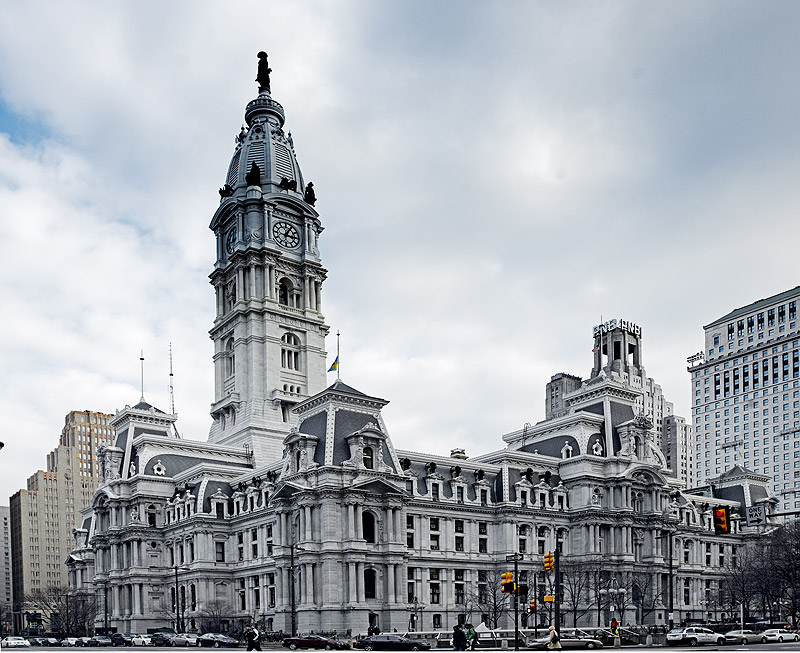
(Note: The Council on Tall Buildings and Urban Habitat (CTBUH) maintains a set of criteria for determining the height of tall buildings, and defines a "building" as "a structure that is designed for residential, business or manufacturing purposes" and that "has floors." Although the Eiffel Tower, which had opened in Paris in 1889, was considerably taller, less than half of it was habitable; therefore, while it was classified as the world's tallest structure, it was not a "building" at all.)
It remains the tallest City Hall in the country. Its location, at the junction of Broad Street and Market Street, at the center of Center City Philadelphia, makes it the transfer point for the City's 2 main Subway lines, the Broad Street Line (north-to-south) and the Market-Frankford Line (east-to-west). And, as the City of Philadelphia and the County of Philadelphia are contiguous, it also serves as the Philadelphia County Courthouse.
While many American cities embraced the concept of the skyscraper, a "gentlemen's agreement" forbade any structure from rising above the hat on the Penn statue. The idea was that Penn could look out over his city, in any direction, without his view being blocked. (The statue, of course, is in a fixed position, facing northeast.)
With that agreement in place, the World Series was won by the Philadelphia Athletics in 1910, 1911, 1913, 1929 and 1930, and the Philadelphia Phillies in 1980; the NFL Championship was won by the Frankford Yellow Jackets in 1926, and the Philadelphia Eagles in 1948, 1949 and 1960; the NBA Championship was won by the Philadelphia Warriors in 1947 and 1956, and the Philadelphia 76ers in 1967 and 1983; and the Stanley Cup was won by the Philadelphia Flyers in 1974 and 1975.
On May 27, 1987, One Liberty Place broke the gentleman's agreement, rising to 945 feet. For the first time, something in the city could "block Billy Penn's view." And, apparently, he didn't like this. Just 4 days after One Liberty Place opened, the Flyers lost Game 7 of the Stanley Cup Finals to the Edmonton Oilers.
In 1993, the Phillies lost the World Series. This included blowing a 14-9 lead in the 8th inning of Game 4, at home, before Joe Carter of the Toronto Blue Jays hit a Series-winning home run in Game 6. In 1995, the Flyers were tied 2-2 with the New Jersey Devils in the NHL Eastern Conference Finals, but lost Game 5 in the last minute of regulation, and then lost Game 6. In 1997, the Flyers were swept by the Detroit Red Wings in the Stanley Cup Finals. In 2000, the Flyers led the Devils 3-1 in the Eastern Conference Finals, and lost 3 straight, including losing Eric Lindros to a concussion. In 2001, the 76ers won the NBA Eastern Conference title, but lost the Finals to the Lakers. This remains their only Finals appearance since 1983.
In 2002, the Eagles lost the NFC Championship Game to the St. Louis Rams. In 2003, in their last game at Veterans Stadium, before moving into Lincoln Financial Field, the Eagles lost the NFC Championship Game to the Tampa Bay Buccaneers. Since entering the NFL in 1976, the Bucs had never won a Playoff game on the road, and had never won when the temperature was less than 32 degrees Fahrenheit. With this game, they had done both. If that could happen, and it could happen to the Eagles, then, it was reasoned, larger forces could be at work. This is when the idea of a "curse" began to be discussed. People looked to the last title won by a Philly team, and it was the 1983 76ers, so it had to be something after that.
Between that title and the rise of Liberty Place, the Flyers had lost the 1985 Stanley Cup Finals, but that was while Liberty Place was still under construction, so it's not counted. Nor was the death, early the next season, of Flyer goaltender Pelle Lindbergh, from drunk driving. There was the 76ers' 1986 Draft Day debacle, but that was also before Liberty Place was topped off. So a Curse of Howard Katz, or a Curse of Pelle Lindbergh, was possible. The city's media decided, instead, on Penn, for "blocking his view." (The fact that the two Liberty Place skyscrapers are behind his back, and weren't in his line of sight, seems not to have occurred to them.)
In 2004, the Eagles made it 3 straight NFC Championship Game losses, 2 straight at home, losing to the Carolina Panthers. That same year, it appeared that the curse even extended to horse racing. Smarty Jones, a horse bred and trained in suburban Chester County, Pennsylvania, won the Kentucky Derby and the Preakness Stakes, but fell short of the Triple Crown when he lost the Belmont Stakes by blowing a late lead. In 2005, finally winning an NFC Championship Game on their 4th straight try, the Eagles beat the Atlanta Falcons. But, despite threatening late, they could not beat the New England Patriots in Super Bowl XXXIX.
Someone must have decided that enough was enough. On June 18, 2007, ironworkers helped raise the final beam in the construction of the 974-foot Comcast Center. In addition to the Philadelphia tradition of finishing a building with an American flag and a small evergreen tree, they attached a statue of William Penn. Now, atop the new tallest building in town, his view was, again, unblocked.
Did it work? Not yet: Three months later, the Phillies came from 7 games back in the National League Eastern Division with 17 games to go, surged past the New York Mets, and won the Division title. But lost the NL Division Series to the Colorado Rockies -- the 1st postseason series win for the Rockies, who began play in 1993, the year of the Phillies' most recent Pennant.
But it all came together in 2008. The Phillies beat the Mets out for the Division again, beat the Milwaukee Brewers in the NLDS, and then beat the Los Angeles Dodgers in the NL Championship Series for their 1st Pennant in 15 years. It was on to the World Series, with a first: A father and son broadcasting for the opposing teams, Harry Kalas for the Phils, and Todd Kalas for the Tampa Bay Rays.
The Phillies won Game 1 in St. Petersburg, 3-2, before losing Game 2, 4-2. Coming home to Citizens Bank Park, they won Game 3, 5-4; and Game 4, 10-2. Game 5 began on Monday, October 27, but it rained throughout. The Phillies led 2-1 after 5 innings. Under normal conditions, games are considered to be official games after 5 innings, or 4 1/2 if the home team is leading at that point. However, both Rays and Phillies management knew before the first pitch that Commissioner Bud Selig, who was responsible for the scheduling of post-season games, would not allow a team to clinch the Series by winning a rain-shortened game.
The umpires let the game continue, and the Rays tied the game in the top of the 6th. When that half-inning ended, as Phils 2nd baseman Chase Utley remembered, "The infield was basically underwater." The umpires suspended the game. Rain continued to fall in Philadelphia on Tuesday, October 28, further postponing the game to Wednesday, October 29.
Game 5 was resumed in the bottom of the 6th, with the Philadelphia Phillies batting, and needing 1 run plus 9 outs to win the World Series. Geoff Jenkins doubled, was bunted to 3rd by Jimmy Rollins, and was driven in by a Jayson Werth single.
Rocco Baldelli tied the game with a home run in the 7th. Later in the inning, Utley took a grounder, faked a throw to 1stn base, then threw Jason Bartlett out at home for the 3rd out in a play later described as having saved the Series for the Phillies.
In the bottom of the 7th, Pat Burrell led off with a double. Eric Bruntlett, pinch-running for Burrell, scored on a single by Pedro Feliz to put the Phillies up by a run again, 4–3.
In the bottom of the 7th, Pat Burrell led off with a double. Eric Bruntlett, pinch-running for Burrell, scored on a single by Pedro Feliz to put the Phillies up by a run again, 4–3.
In the 2004 NLCS, pitching for the Houston Astros, Brad Lidge had given up a tremendous home run to Albert Pujols of the St. Louis Cardinals, to lose a game. It was said that he was never the same after that. That wasn't true: The Astros won the Pennant the next year. In 2008, Lidge was the Phillies' closer, and, going into Game 5, was 47-for-47 in save opportunities over the season. For fans still traumatized by the 1993 World Series, he was no Mitch Williams.
In the top of the 9th, Lidge gave up a single and a stolen base, but faced Eric Hinske with the chance to give the city its 1st World Series win since 1980, and its 1st World Championship in any sport since the 1983 76ers. Harry Kalas, the Hall of Fame voice of the Phils, had the call:
One strike away, nothing-and-two to Hinske. Fans on their feet. Brad Lidge stretches. The oh-two pitch: Swing and a miss! Struck him out! The Philadelphia Phillies are 2008 World Champions of baseball!
Brad Lidge does it again, and stays perfect for the 2008 season, 48-for-48 in save opportunities! And let the city celebrate! Don't let the 48-hour wait diminish the euphoria of this moment and celebration! Twenty-five years in this city that a team has enjoyed a World Championship, and the fans are ready to celebrate. What a night! Phils winning, 4–3, Brad Lidge gets the job done once again!
Harry would die early the next season. He deserved that title.
One strike away, nothing-and-two to Hinske. Fans on their feet. Brad Lidge stretches. The oh-two pitch: Swing and a miss! Struck him out! The Philadelphia Phillies are 2008 World Champions of baseball!
Brad Lidge does it again, and stays perfect for the 2008 season, 48-for-48 in save opportunities! And let the city celebrate! Don't let the 48-hour wait diminish the euphoria of this moment and celebration! Twenty-five years in this city that a team has enjoyed a World Championship, and the fans are ready to celebrate. What a night! Phils winning, 4–3, Brad Lidge gets the job done once again!
Harry would die early the next season. He deserved that title.
Three months later, the Eagles reached the NFC Championship Game, with a shot at Super Bowl XLIII, but lost to the Arizona Cardinals, a team that hadn't reached an NFL Championship Game, under any name, since 1948. That was embarrassing.
The Phils won the Pennant again in 2009, but lost the World Series to the New York Yankees. They won the NL East again in 2010 and 2011, then fell apart for a few years. The Flyers reached the Stanley Cup Finals in 2010, but lost to the Chicago Blackhawks. It was beginning to look like the Phillies had broken a curse that had been put on them sometime after 1980, and the other teams in town were under seaprate curses. But in 2018, the Eagles broke a 57-year drought, beating the New England Patriots in Super Bowl LII.
Also in 2018, a new tallest building in the city opened: The Comcast Technology Center, at 1,121 feet, making it the tallest building in America not in either New York City or Chicago. As with its predecessor and sort-of namesake, a small statue of William Penn was put on top, just in case.
*
November 29, 1894, was a Thursday. Under the law of the time, being the last Thursday in November, it was Thanksgiving Day. Not until 1942 was it changed to the 4th Thursday in November, regardless of whether that was the last one. As a result of being Thanksgiving, before the era of professional football, the only sport played was college football, but there were 9 games, including 1 in Philadelphia:
* The University of Pennsylvania beat Harvard, 18-4 at the University Grounds in Philadelphia, 2 miles west of City Hall. Decades later, Penn would be retroactively awarded this season's National Championship.
* The Chicago Athletic Club beat Dartmouth, 4-0 at the Alumni Oval in Hanover, New Hampshire.
* Tufts beat Andover, 6-4 at Andover, Massachusetts.
* Brown beat MIT (Massachusetts Institute of Technology), 16-4 at Lincoln Field in Providence, Rhode Island.
* Cornell beat Lehigh, 10-6 at Percy Field in Ithaca, New York.
* Lafayette beat Bucknell, 44-0 at March Field in Easton, Pennsylvania.
* Purdue beat DePauw University (of Greencastle, Indiana, not DePaul of Chicago), 28-0 at the Fair Grounds in Indianapolis.
* Michigan beat the University of Chicago, 6-4 at Marshall Field in Chicago.
* And Illinois beat the Pastime Athletic Club of St. Louis, 10-0 at Sportsman's Park in St. Louis.


No comments:
Post a Comment