Showing posts with label vaudeville. Show all posts

Thursday, November 17, 2022

November 17, 1933: The Marx Brothers' "Duck Soup" Premieres

Left to right: Chico, Zeppo, Groucho, Harpo

November 17, 1933: Duck Soup premieres, starring the Marx Brothers. It is considered their greatest and funniest film.

The Marx Brothers, sons of an Alsatian father and an East Frisian mother, both parents Jewish, and all 5 brothers born and raised in Yorkville on the Upper East Side of Manhattan, were:

* Leonard Joseph Marx, born March 22, 1887. There was one brother born before him, Manfred, but he died in infancy. His younger brothers noticed his early womanizing, and while the British term "bird" for a young woman remains popular, the long-ago American variant "chicken" does not. But he was called a "chicken chaser." This was shortened to "Chicko." At some point, somebody mistakenly dropped the K, and he was "Chico" from then on. Not knowing the origin, most people pronounced it "CHEEK-oh," but the brothers all pronounced it "CHICK-oh" to the end.

* Adolph Marx, later Arthur Marx, born November 23, 1888. He was called "Harpo" because he was an excellent harp player. He could also play the piano (and Groucho would later write a song titled "I Love a Piano," but Chico was the only one who made piano-playing part of his persona.

* Julius Henry Marx, born October 2, 1890. He gave 2 different stories about how he got "Groucho." There was a comic strip, Knocko the Monk, which had a supporting character, Groucho the Monk. But, in one of his last interviews, he said that comedian Art Fisher gave him the nickname because he was grouchy.

* Milton Marx, born October 23, 1892. His nickname, "Gummo," came from either his tendency to chew gum, or from wearing gum-soled shoes.

* Herbert Manfred Marx, born February 25, 1901. He later claimed he was called "Zeppo" because "Zep" was Italian-American slang for "baby," and he was the "baby brother," so this became "Zeppo." Harpo gave another version, in his memoir Harpo Speaks!: He said that "Herbie" liked to do chin-ups, as did a popular trained chimpanzee named Mr. Zippo. So they called him "Zippo" until he objected to the comparison, and they changed it to "Zeppo." But Groucho said it was short for "Zeppelin," and his ex-wife Barbara backed this explanation up.

The brothers tried their hand at vaudeville. Gummo had a stammer, which made appearing in a stage act difficult. He was the only one who didn't have his heart in show business. When he was drafted into the U.S. Army for World War I in 1918, he went in, and never returned to the act. Zeppo stepped into his place. Gummo survived the war, and became a successful businessman.

The other four succeeded at vaudeville, where W.C. Fields was beginning to make a name for himself. (Good thing he did: His birth name was William Claude Dunkenfeld.) He said that The Marx Brothers were the only act he couldn't follow on the live stage.

He is known to have appeared on the same bill with them only once, during an engagement at Keith's Orpheum Theatre in Columbus, Ohio, in January 1915. Fields later wrote, "They sang, danced, played harp and kidded in zany style. Never saw so much nepotism or such hilarious laughter in one act in my life. The only act I could never follow."

This success led to Broadway, and finally, in 1929, sound films. They made The Cocoanuts, followed by Animal Crackers in 1930, based on their 1928 musical. Groucho stars as Captain Jeffrey T. Spaulding -- his characters usually had a middle initial -- a famous explorer and hunter in Africa. He delivered a line that has lasted through the age: "One morning, I shot an elephant in my pajamas. How he got in my pajamas, I don't know."

That film made the brothers national stars, and it led to them going out to California for Hollywood. It was followed in 1931 by The House That Shadows Built and Monkey Business, and in 1932 by Horse Feathers.

Their personas had been set. Groucho, who wore glasses, smoked cigars, and used greasepaint to simulate a large mustache and large eyebrows, was the prominent wiseguy, who wasn't really worth the hype, but his wit allowed him to bluff his way through tough situations, often involving a woman played by Margaret Dumont (1882-1965), whose character loved his, but he wanted nothing to do with, until he found out how much money she had. Chico was a stereotypical Italian, with the thick accent, and a con artist, but with a talent for playing piano. Harpo, with his hobo's clothes, including a top hat and a long coat with deep pockets, was silent, communicating in pantomime and with a horn he would honk at opportune moments.

Zeppo's persona was less defined: As critic Percy Hammond put it, "One of the handicaps to the thorough enjoyment of the Marx Brothers in their merry escapades is the plight of poor Zeppo Marx. While Groucho, Harpo, and Chico are hogging the show, as the phrase has it, their brother hides in an insignificant role, peeping out now and then to listen to plaudits in which he has no share."

There had been a silent film titled Duck Soup in 1927, starring the comedy team of Stan Laurel and Oliver Hardy, as petty criminals hiding from forest rangers. It was remade with sound in 1930, as Another Fine Mess. (This was based on the line Ollie frequently gave Stan: "This is another fine mess you've gotten us into, Stanley!")

Leo McCarey worked on the 1927 film, which was considered lost until a copy was found in 2020. McCarey directed the Marx Brothers' film, and used the same title for the follow-up to Horse Feathers.

Duck Soup takes place in the fictional European nation of Freedonia, which is small and struggling, and threatened by its warlike neighbors. It is basically kept afloat by the money of Mrs. Gloria Teasdale (played by Dumont). This wealthy widow has become convinced that the only man who can properly lead the nation is Rufus T. Firefly (Groucho).

Firefly likes the idea of having the power, but he doesn't like the idea of having the responsibility. He also doesn't like Mrs. Teasdale: "You'd better beat it. I hear they're going to tear you down and put up an office building where you're standing. You can leave in a taxi. If you can't get a taxi, you can leave in a huff. If that's too soon, you can leave in a minute and a huff. You know, you haven't stopped talking since I came here? You must've been vaccinated with a phonograph needle." But he finds out how rich she is, and starts courting her.

One of those warlike neighboring nations is Sylvania. Their ambassador, Trentino (Louis Calhern, 1895-1956), also wants Mrs. Teasdale for her money, and he wants control of Freedonia. He sends 2 spies into the country to get dirt on Firefly: Chicolini (Chico) and Pinky (Harpo). As part of his cover, Chicolini sells peanuts outside Firefly's window. Firefly takes a liking to him, and appoints him Secretary of War.

Bob Roland (Zeppo), Firefly's secretary, suspects Trentino's treachery, and tells Firefly to get rid of him by insulting him. The idea is that Trentino will be goaded into slapping Firefly, and will thus be forced to leave the country. The plan backfires: Firefly slaps Trentino instead. Leading to the Groucho line, "Of course, you realize, this means war!"

(Mel Blanc would base the cartoon character Bugs Bunny on Groucho, with a New York accent, and a carrot in place of the cigar. On a few occasions, Blanc as Bugs reacted to an insulting situation by saying, "Dis means war!")

Thanks to vampish spy Vera Marcal (Raquel Torres, 1908-1987), Trentino learns that Freedonia's war plans are in Mrs. Teasdale's safe, and Chicolini and Pinky break into her mansion to steal the plans. This leads to the famous "mirror scene" between Groucho and Chico (which Harpo and Lucille Ball would, over 20 years later, parody on I Love Lucy), which leads to Chicolini getting caught. During his trial, war is officially declared, and Freedonia... breaks out into song and dance.

But Chicolini knows too much about Trentino, and offers his services to Freedonia in exchange for clemency. Pinky joins, too, and all four brothers' characters fight together. Just as it looks like Freedonia will lose the one-battle war, Trentino gets caught in a makeshift pillory. The brothers throw fruit at him until he surrenders, and Freedonia have won the war. The film ends with Mrs. Teasdale happily singing the Freedonian national anthem. And the brothers throw their remaining fruit at her.

Duck Soup would be Zeppo's last film. He left the act, and became an engineer and a theatrical agent. He married Barbara Blakeley, who later divorced him, and became the 4th and final Mrs. Frank Sinatra.

The three remaining brothers are how people tend to remember the Marx Brothers: Groucho, Harpo and Chico. They made A Night at the Opera in 1935, A Day at the Races in 1937, Room Service in 1938, At the Circus in 1939, Go West in 1940, and The Big Store in 1941. World War II ended the era of "screwball comedies" that were popular during the Great Depression, and killed, along with 75 million people, the Marx Brothers' momentum. They made only 2 more movies together, and in 1957, all 3 appeared, but no 2 in the same scene, in The Story of Mankind.

Harpo and Chico didn't really adjust to TV, but they were able to sit on the money they made from earlier films, and the residuals they got from those films being shown on TV. They made only 1 TV appearance together, in 1957, on Tonight! America After Dark, a late-night show hosted by Jack Lescoulie. It was a version of NBC's The Tonight Show, between hosts Steve Allen and Jack Paar.

From 1950 to 1961, NBC aired You Bet Your Life, a game show with Groucho as host. By this time, his familiar curly hair had receded, and he had actually grown a mustache. But he was still, essentially, playing himself, giving out insults that may, or may not, have been good-natured. Before Don Rickles and Robert Smigel's puppet Triumph the Insult Comic Dog, Groucho was the original "insult comic." But the show introduced a new generation to Groucho, and they sought out his films with his brothers on TV.

In 1960, Billy Wilder, then the biggest comedy director in Hollywood, wanted to make A Day at the U.N., a comedy about international intrigue set at the United Nations complex in New York. Groucho and Chico were willing to do it, but Harpo was too ill to try. On October 11, 1961, when it looked like Harpo might recover enough, Chico died, the first of the brothers to go. The project was canceled. Harpo died on September 28, 1964.

On October 1, 1962, Johnny Carson hosted The Tonight Show for the 1st time, and Groucho was one of his guests that night. He came on a few more times, and was also an occasional guest on The Dick Cavett Show.

In the 1970s, Groucho impersonations became common. Richard Dawson did them as a member of the cast of Rowan & Martin's Laugh-In, and then as a panelist on Match Game, even after Groucho died during that show's run. On M*A*S*H, Hawkeye (Alan Alda) did Groucho impressions a few times, and once did a full-makeup parody, with Trapper (Wayne Rogers), already having blonde curly hair, playing Harpo. And on All in the Family, the Stivics went to a costume party as Groucho (Rob Reiner as Mike) and Harpo (the curly blonde Sally Struthers as Gloria).

Gummo died on April 21, 1977. By this point, Groucho was ill, and no longer with it. He was never told that his brother had died, for fear it would shock him into a fatal heart attack. Groucho died on August 19, 1977, 3 days after Elvis Presley, so his death was barely noticed. Zeppo was the last survivor, living until November 30, 1979.

The last surviving actor from Duck Soup was Leonid Kinskey, who played one of Trentino's "agitators." He became a drinking buddy of actor Humphrey Bogart and, as a result was cast as one of the European exiles in Casablanca, as Sascha, the Russian bartender at Rick's Cafe Americain. He lived until 1998.

*

November 17, 1933 was a Friday. Baseball season was over. The NBA hadn't been founded yet. No games were scheduled in the NHL. And the NFL had to wait until the following Sunday.

There were 2 college football games played on the day. The University of Tulsa beat George Washington University, 13-6 at Griffith Stadium in Washington. And Texas Tech beat Baylor, 13-0 at Tech Field in Lubbock, Texas.

Wednesday, November 16, 2022

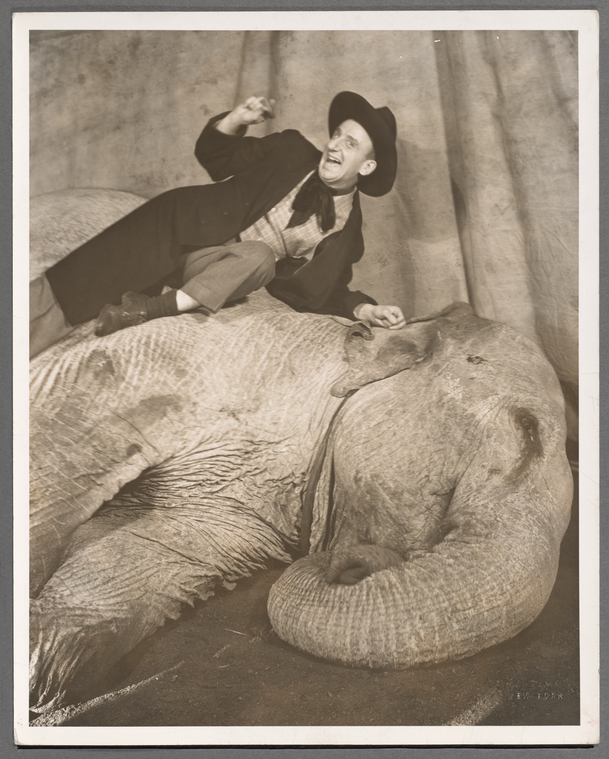
November 16, 1935: Billy Rose's "Jumbo" Premieres, Starring Jimmy Durante

November 16, 1935: Jumbo opens at the New York Hippodrome. The music was written by Richard Rodgers, the lyrics by Lorenz Hart, and the book by Ben Hecht and Charles MacArthur. It was produced by Billy Rose, one of the leading impresarios of the era.

It tells the story of a troubled circus that gets saved by a large elephant, a story based on how the real Jumbo was featured by P.T. Barnum from 1882 until its death in 1885. It is filmed in 1962, as Billy Rose's Jumbo, as Rose made a deal that, if it were ever made into a movie, his name would appear in the title, even if he had nothing to do with it.

William Samuel Rosenberg was born on September 6, 1899 in Manhattan. He began his entertainment career as a songwriter, writing the lyrics for such songs as "Me and My Shadow" with Edward Eliscu, "Does the Spearmint Lose Its Flavor on the Bedpost Overnight" (later "Does Your Chewing Gum Lose... ") with Marty Bloom, "I Found a Million Dollar Baby" with Mort Dixon, and "It's Only a Paper Moon" with Yip Harburg.

He moved into producing shows, including several on Broadway. In 1937, he established Billy Rose's Aquacade, a water stunt show, moving it to the New York World's Fair in 1939. The amphitheater where it was staged was one of the last remaining structures from that Fair.

He was married 5 times to 4 different women. The 1st of these was the famed comedienne Fanny Brice, on whom the musical Funny Girl was based. The 2nd was Olympic Gold Medal swimmer Eleanor Holm, who starred in his Aquacade. Their affair had broken up both of their marriages. His 3rd and 4th wife was showgirl Joyce Matthews, who had also married and divorced comedian Milton Berle twice.

In his later years, Rose continued to run theaters and produce shows, and was an activist for the State of Israel. He died on February 10, 1966, at his vacation home in Montego Bay, Jamaica.

The star of both the Broadway and the film versions of Jumbo was Jimmy Durante. In it, he led a live elephant across the stage. An actor playing a policeman asked him, "What are you doing with that elephant?" Durante said, "What elephant?" Thus was born the expression "the elephant in the room." Doris Day co-starred in the film version.

James Francis Durante was born on February 10, 1893, on the Lower East Side of Manhattan, the son of immigrants from Salerno in southern Italy. In 1918, Durante's Original New Orleans Jazz Band (he was the only member not from New Orleans) was (as far as is known) the 1st racially integrated jazz band. Known as "Ragtime Jimmy," he played piano and sang, but he couldn't resist stopping a song to tell a joke.

He was nicknamed "Schnozzola" (an Italianization of the Yiddish word "schnoz") for his enormous nose, but his heart was bigger. Through vaudeville, film, radio and television, he made people laugh from coast to coast. He was known for singing the 1934 hit "Inka Dinka Doo," the 1944 hit "You Gotta Start Off Each Day With a Song," and his version of the 1954 hit "Young at Heart." His catchphrases included "Ah-cha-cha-cha!" "Everybody wants to get into the act!" and "I got a million of 'em!"

In the 1942 film The Man Who Came to Dinner, he played Banjo, a character based on Harpo Marx of the Marx Brothers. In 1963, he played Smiler Grogan, the dying gangster whose stash of cash kicks off the "cast of thousands" comedy It's a Mad, Mad, Mad, Mad World. In 1969, he voiced the narrator of the Christmas special Frosty the Snowman. He inspired numerous cartoon characters, including Spike the bulldog in the Tom & Jerry cartoons, and Doggie Daddy (father of Augie Doggie) from the Hanna-Barbera cartoons.

He hosted 2 different TV shows in the 1950s, closing by saying, "And goodnight, Mrs. Calabash, wherever you are." "Mrs. Calabash" was his pet name for his 1st wife, Jeanne Olsen, died in 1943.

Jimmy was a poor kid who made it big, and, unlike some, he never forgot. He was a big supporter of President Franklin D. Roosevelt's New Deal. He was one of the performers at the Madison Square Garden fundraiser for President John F. Kennedy's birthday in 1962, which everyone remembered for Marilyn Monroe singing "Happy Birthday."

He died on January 29, 1980. The Shriners had a statue made of him, for his contributions to their cause, with an inscription that truthfully stated that his heart was even bigger than his nose.

The Hippodrome Theatre, also called the New York Hippodrome, was on 6th Avenue between 43rd and 44th Streets, a block east of Times Square. It operated from 1905 to 1939 and was called the world's largest theater by its builders, with a seating capacity of 5,300 and a stage measuring 100 by 200 feet. It had state-of-the-art theatrical technology, including a tank built into the stage apron that could be filled with water for aquatic performances. A modern office tower known as The Hippodrome Center opened on the site in 1952.

*

November 16, 1935 was a Saturday. Political columnist Elizabeth Drew was born.

Baseball was out of season. The NBA hadn't been founded yet. There were 2 games in the NHL. The New York Rangers lost to the Toronto Maple Leafs, 3-2 at Maple Leaf Gardens in Toronto. And the Montreal Maroons beat the Boston Bruins, 1-0 at the Montreal Forum.

And these notable college football games were played:

* Minnesota beat Michigan, 40-0. It was one of the worst defeats the Wolverines have ever sustained at Michigan Stadium in Ann Arbor. The Golden Gophers went on to go undefeated and win the Big Ten Conference and National Championships.

* In a major rivalry, Virginia and Virginia Tech played to a tie, 0-0 at Scott Stadium in Charlottesville, Virginia.

* In a major rivalry, Duke beat North Carolina, 25-0 at Duke Stadium (now Wallace Wade Stadium) in Durham, North Carolina. Duke won the Southern Conference Championship.

* In a major rivalry, Vanderbilt beat Tennessee, 13-7 at Shields-Watkins Field (later Neyland Stadium) in Knoxville, Tennessee. At the time, this was not an upset, let alone a major one, like it would be in the modern era.

* Louisiana State University beat Georgia, 13-0 at Sanford Stadium in Athens, Georgia. This clinched the Southeastern Conference Championship for LSU.

* The University of Pittsburgh beat Nebraska, 6-0 at Pitt Stadium in Pittsburgh. In spite of their defeat, Nebraska won the Big Six Conference title.

* Southern Methodist University beat Arkansas, 17-6 at The Hill in Fayetteville, Arkansas.

* Texas Christian University beat Texas, 28-0 at Memorial Stadium in Austin. Two weeks later, SMU beat TCU to win the Southwest Conference Championship. TCU went on to beat LSU in the Sugar Bowl.

* Stanford beat the University of Montana, 32-0 at Stanford Stadium in the San Francisco suburb of Palo Alto, California. The next week, Stanford beat the University of California, to win the Pacific Coast Conference title. They went on to beat SMU in the Rose Bowl, 7-0, eliminating SMU from National Championship consideration. A 7-6 loss to UCLA earlier in the season cost them an undefeated season and the National Championship.

* Army and Notre Dame played to a 6-6 tie in front of 78,114 people at Yankee Stadium.

* Navy beat Columbia, 28-7 at Thompson Stadium in Annapolis, Maryland.

* Fordham beat Muhlenberg, 45-0 at the Polo Grounds.

* The University of Pennsylvania beat Penn State, 33-6 at Franklin Field in Philadelphia.

* Princeton beat Lehigh, 27-0 at Palmer Stadium in Princeton, New Jersey.

* And the night before, New York University beat Rutgers, 48-0 at Ohio Field in The Bronx.

Friday, October 7, 2022

October 7, 1977: George Burns Plays God

October 7, 1977: The film Oh, God! premieres. George Burns plays God. He was almost old enough.

He was born on January 20, 1896, in Manhattan, as Nathan Birnbaum. When he went into show business, he named himself after two different, but unrelated, star baseball players of his youth: George Burns.

In 1922, already known in vaudeville, he met comedian Gracie Allen, born on July 26, 1895 (yes, she was older) in San Francisco, as Gracie Ethel Cecile Rosalie Allen. They married in 1926, and developed a stage act where Burns played the "straight man," and Allen played a silly, addle-headed woman whose convoluted logic Burns was often ill-equipped to challenge. Burns once told an interviewer, "I would say, 'So, Gracie, how's your brother?' and let her talk for 15 minutes while I smoked a cigar." The act always ended the same way: George would say, "Say goodnight, Gracie," and Gracie would say, "Goodnight, Gracie."

The Burns and Allen Show debuted on radio in 1936; the series ran, moving back and forth between NBC and CBS, until 1950. After their radio show's cancellation, Burns and Allen reemerged on television with a CBS situation comedy, The George Burns and Gracie Allen Show, which ran from 1950 to 1958.

Officially, the show, still popular, ended because Gracie was tired of learning lines. The truth was worse: She had a bad heart, and she died on August 27, 1964, at the age of 69. George later told an interviewer, "I go to her grave, and I tell her my jokes. She doesn't laugh. She's heard them all before."

George continued as a comic actor, and did standup on variety shows like The Ed Sullivan Show and The Tonight Show Starring Johnny Carson. The death of his close friend and fellow comedian Jack Benny in 1974 devastated him. But in 1976, playwright Neil Simon cast George in the film version of his play The Sunshine Boys. At 80, George Burns became the oldest male actor to yet win an Academy Award for Best Picture. He told the media, "It just goes to show that if you stick around long enough, you become new again."

(In 2021, Anthony Hopkins won at age 83 for his role in The Father. The oldest actress is Jessica Tandy, who won in 1990, at 80. for Driving Miss Daisy. The youngest? In 2002, Adrien Brody won at 29 for The Pianist; and in 1987, Marlee Matlin won at 21 for Children of a Lesser God. Tatum O'Neal won at 10 in 1974, for Paper Moon, but she won for Best Supporting Actress, even though she was the female lead. In 1981, Timothy Hutton was 20 when he won Best Supporting Actor for Ordinary People.)

Before Betty White, George Burns was America's favorite elderly celebrity -- or, at least, America's favorite person famous for being old. George, how many of those cigars do you smoke a day? "About 20 a day." And how much do you drink? "I drink 6 martinis a day." And you date young women? "Yes." Why don't you date women your own age? "There aren't any." But couldn't fooling around with a woman that young prove fatal? "If she dies, she dies." What does your doctor say about all of this? "He's dead."

He also liked to say, "I never tell a joke older than I am. There aren't any." In 1977, just before the release of Oh, God!, Burns was the guest host on The Muppet Show. Gonzo the Great held a violin, and said, "It's my new act: Gonzo fiddles while George Burns!" It was a play on the old line -- not possible, because the violin didn't exist in ancient times -- "Nero fiddles while Rome burns." George heard Gonzo, and said, "Finally! A joke that's older than I am!"

In 1971, Avery Corman write a novel titled, Oh, God! Larry Gelbart wrote a screenplay based on it, to be directed by Carl Reiner. Both men had written for Sid Caesar's Your Show of Shows in the 1950s, as had Mel Brooks. They cast Burns as God. "I originally offered the part to Mel," Gelbart said, "but he didn't want the demotion."

The story centers on supermarket manager Jerry Landers, who is chosen by God to spread His message, despite the skepticism of the media, religious authorities, and his own wife. Instead of wearing a long white beard and a long white robe, as God is often depicted, Burns dressed like a Florida retiree, complete with a sailor cap and loafers. When Jerry asks Him to prove he's God, by doing a miracle, God says, "The last miracle I did was the 1969 Mets."

Singer John Denver was cast as Jerry. Burns said, "Denver brought in his fans, and they got me to bring in the young kids." Teri Garr played Jerry's wife.

The movie was a hit. Burns said, "They're doing a sequel. I'm playing God again. Why not? At my age, anything I do is a miracle." Oh, God! Book II came out in 1980, and Oh, God! You Devil in 1984. Both times, Burns was the only returning actor, and there was no connection between the stories.

In the 3rd film, set mostly in Las Vegas, Burns spent much more on-screen time as the Devil, using the name Harry O. Tophet -- the initials spelling "HOT," as seen on his license plate, and "Tophet" was a place where pre-Judaism Canaanites would sacrifice their children to the god Moloch. As with his version of God, he didn't use a traditional appearance: No horns, no tail, no mustache, no beard, not even exaggerated eyebrows. But he did wear a red sportsjacket, compared to the blue windbreaker he wore as God.

Spoiler Alert: In the true spirit of Las Vegas, when the old enemies finally face each other, God wins the hero's soul back by bluffing through a poker hand. The Devil says, "Why did I fold?" And God says, "I put the fear of Me into you."

How many actors have played both God and the Devil? In live-action, only George Burns, and he played both at the same time. When he was 87 years old.

(Max von Sydow played Jesus in The Greatest Story Ever Told in 1965, and the Devil, using the name Leeland Gaunt, in Needful Things in 1993. Willem Dafoe played Jesus in The Last Temptation of Christ in 1988, and the Devil in a 2013 Mercedes-Benz commercial.)

George Burns had a running gag: "I can't die. I'm booked." He wasn't kidding: Years in advance, he had the London Palladium rented out for his 100th birthday, January 20, 1996. But at the age of 98, he fell getting out of the bathtub, and broke his hip. That has been the beginning of the end for many old people, and it looked like he was going to will himself to live to be 100, just for the sake of reaching the milestone. He did, but it was Jerry Seinfeld who took the London Palladium gig. George Burns died on March 9, 1996, just 49 days after turning 100.

*

October 7, 1977 was a Friday. In baseball, Game 3 was played in each League Championship Series. Dennis Leonard, a Brooklyn native, goes the distance, and the Kansas City Royals beat the New York Yankees, 6-2 at Royals Stadium (renamed Kauffman Stadium in 1993). The Royals take a 2-1 lead in the series, and need just 1 more win for their 1st Pennant.

They will be disappointed. But perhaps not as badly as the Philadelphia Phillies. But in the top of the 9th, trailing 5-3 and down to their last out, the Los Angeles Dodgers benefit from a sickening turn of events, which leads to a 6-5 Dodger win, and they take the Pennant the next day. Philadelphia fans call it "Black Friday." I have a separate entry for this event.

Football was in midweek. And the 1977-78 NBA, NHL and World Hockey Association seasons hadn't started yet.

Monday, September 5, 2022

September 5, 1976: "The Muppet Show" Premieres

Top row, left to right: Dr. Bunsen Honeydew, Uncle Deadly,
Waldorf, Statler, Link Hogthrob, Dr. Teeth, Beaker.
Second row: Lew Zealand, Animal, Floyd Pepper, Rowlf.
Third row: Fozzie Bear, Miss Piggy, Camilla.
Bottom row: Gonzo the Great, Kermit the Frog, Scooter.

September 5, 1976: The Muppet Show premieres on British network ITV. Joel Grey is the guest star. In America, it aired in syndication, debuting on September 13, with the episode featuring Rita Moreno. Given that the show took place in a theater, it made sense that, either way, the 1st guest star was a Broadway legend, as well as a Hollywood star.

It surprised me, as a kid who watched Sesame Street, that the only Muppet to cross over to this show (with rare exceptions) was Kermit the Frog, who hosted. I was being introduced to a bunch of Muppets I'd never seen before, and didn't know. But I came to know them: Miss Piggy, Fozzie Bear, Gonzo the Great, Rowlf the piano-playing dog, Kermit's nephew Robin, and the two old guys heckling from the corner box, Statler and Waldorf, named for old New York hotels.

The band was Dr. Teeth and the Electric Mayhem. Dr. Teeth played piano, a hippie chick named Janice played guitar, Floyd Pepper played bass, Zoot played saxophone, and, of course, the drummer was Animal.

Floyd wore a military jacket and was meant to evoke the Beatles' character Sgt. Pepper. I didn't notice that at the time, but I did notice that all of the Muppets, including the bandmembers, were lefthanded. Eventually, I learned that this was not simply a coincidence: The reason was that the puppeteers would use their right hands to move the faces, and their left hands to move the hands.

Regular sketches included Muppet News Flash; The Dance, with dance marathoners making dumb "quickie" jokes, clearly a lampoon of the Cocktail Party sketch on Laugh-In; The Swedish Chef, whose indecipherable recipes always went wrong; Veterinarians' Hospital, with Rowlf as a doctor assisted by Miss Piggy and Janice; Pigs In Space, with Miss Piggy serving alongside Link Hogthrob as captain ("hamming it up" while sounding like Ted Knight's Mary Tyler Moore Show character Ted Baxter) and Dr. Julius Strangepork (a German-accented homage to Dr. Strangelove and Albert Einstein); Muppet Labs, with Dr. Bunsen Honeydew and his beleaguered assistant Beaker; and Bear On Patrol, with Fozzie playing a cop reporting to a desk sergeant played by Link.

Jim Henson voiced Kermit, Waldorf, Rowlf, Dr. Teeth, Link, and the Newsman. Frank Oz voiced Miss Piggy, Fozzie (name derived from "F. Oz"), Animal and Sam the Eagle. Dave Goelz voiced Gonzo, Zoot and Bunsen Honeydew. Richard Hunt voiced Scooter, Statler, Janice, Beaker and Sweetums. Jerry Nelson, better known as The Count on Sesame Street, voiced Robin, Floyd, Dr. Strangepork, Gonzo's girlfriend Camilla the Chicken, mad bomber Crazy Harry, and the dragonlike Uncle Deadly (formerly known as Skrid when the Muppets appeared on The Ed Sullivan Show).

The show ran 5 seasons, and was basically what Laugh-In had set itself up as a few years earlier: The last gasp of vaudeville. Not counting guest Muppets from Sesame Street, there were 128 total guest stars in the show's history.

Three married couples appeared together as guests: Roy Rogers & Dale Evans (stayed married 'til death did they part), Kris Kristofferson & Rita Coolidge (divorced) and mimes Robert Shields & Lorene Yarnell (divorced). One pair of siblings appeared, but not together: Country singers Loretta Lynn and her much younger sister Crystal Gayle. One parent-child pair appeared, but not together: Indeed, Candice Bergen appeared before her father Edgar and her "brother," Charlie McCarthy, did.

Since the show was taped at what is now the BBC Studio in Elstree, in Borehamwood, Hertfordshire, in the northwest suburbs of London, it was more internationally-oriented than most American TV variety shows. There were 97 Americans, 21 British, 2 Canadians (Doug Henning and Anne Murray), 2 Frenchmen (Charles Aznavour and Jean-Pierre Rampal), 2 Swiss (both of them members of Mummenschanz, which also included an American), a Dane (Victor Borge), a German (Elke Sommer), a Spaniard (Señor Wences) and a Russian (Rudolf Nureyev). The only one born in Asia was Juliet Prowse, born in India while it was a British colony. She was raised in South Africa, also in the British Commonwealth at the time, making her, despite being white, the only African host.

The oldest performer was 86-year-old Señor Wences, younger than George Burns by a few months, but older than Burns was when each appeared on the show -- and Wences beat Burns in final age, 103 to 100. The youngest was a 15-year-old Brooke Shields, the next-youngest being a 28-year-old Christopher Reeve. Zero Mostel was not only the first of the show's guest stars to die, but he died before his episode could air.

There were 69 men and 59 women. There were 9 black guest hosts. In order of appearance: Lena Horne, Pearl Bailey, Harry Belafonte, Lou Rawls, Shirley Bassey, Lola Falana, Leslie Uggams, Gladys Knight and Ben Vereen. There were 4 Hispanics, not counting the Spain-born Señor Wences: Rita Moreno, Raquel (Tejeda) Welch, Joan Baez and Lynda (Cordova) Carter. There were no ethnically Asian guests. There were 5 guests who are now known to have been gay: Elton John was already out, Rudolf Nureyev didn't exactly hide it, Jim Nabors and Joel Grey came out late in life, and Liberace denied it to the end.

Although the guests came from across the spectrum of show business, no guest came from outside show business. And 9 of the guests would also appear in The Muppet Movie in 1978: Edgar Bergen, Milton Berle, James Coburn, Dom DeLuise, Bob Hope, Madeline Kahn, Cloris Leachman, Steve Martin and Paul Williams. (Charles Durning, who played the film's villain Doc Hopper, was never a Muppet Show guest.)

The last episode aired on March 15, 1981, with guest host Shirley Bassey, who, of course, sang the song for which she is best known: The theme to the James Bond film Goldfinger, in front of a bank vault while Link Hogthrob led a gang robbing it.

The cancellation was Henson's own choice: He wanted to stop making the show before the writing grew stale, or the quality faded. Also, with the The Muppet Movie's success, he wanted to move into movies, and thought it better to concentrate on that instead of the show. The Great Muppet Caper was released to theaters in 1981, and was also successful.

*

September 5, 1976 was a Sunday. Dutch actress Carice van Houten, known for her role as Melisandre on Game of Thrones, was born. And these Major League Baseball games were played:

* The New York Yankees lost to the Baltimore Orioles, 5-3 at Memorial Stadium in Baltimore. Ross Grimsley Jr. outpitched Jim "Catfish" Hunter. Al Bumbry, one of several Orioles in that period that drove the Yankees nuts, hit a home run. Reggie Jackson, in his only season with the Orioles, went 1-for-4. Thurman Munson went 3-for-5 with 2 RBIs.

* The New York Mets lost to the Philadelphia Phillies, 3-1 at Shea Stadium. Larry Christenson outpitched Mickey Lolich, for whom the Mets traded Rusty Staub in his prime to Detroit, not knowing Lolich was washed up. Christenson also hit 2 home runs. Mike Schmidt went 0-for-4.

* The Montreal Expos beat the Pittsburgh Pirates, 1-0 at Jarry Park in Montreal. Woodie Fryman pitched a 4-hit shutout, outpitching Jerry Reuss. José Morales, pinch-hitter extraordinaire, batted for Larry Parrish in the bottom of the 8th inning, and reached on an error by Pirate 2nd baseman Rennie Stenett, bringing Bombo Rivera home with the winning run.

* The Cincinnati Reds beat the Atlanta Braves, 6-4 at Atlanta-Fulton County Stadium. Pete Rose went 0-for-4 with a walk. Johnny Bench went 0-for-5.

* The Cleveland Indians beat the Boston Red Sox, 6-3 at Cleveland Municipal Stadium. Rick Waits outpitched, ironically, Reggie Cleveland. Indians manager Frank Robinson, in his last month as an active player, did not put himself into the game. Carl Yastrzemski went 0-for-4.

* The Milwaukee Brewers beat the Detroit Tigers, 8-6 at Tiger Stadium in Detroit. Hank Aaron, in his last month as an active player, did not appear in the game. Robin Yount went 0-for-4.

* The St. Louis Cardinals beat their arch-rivals, the Chicago Cubs, 1-0 at Wrigley Field in Chicago. Ron Fairly singled Lou Brock home with the game's only run in the top of the 11th inning. It made Al Hrabosky the winning pitcher, in relief of John Denny, who went 9 shutout innings. It made Joe Coleman Jr. the losing pitcher, in relief of Rick Reuschel, who went 8 shutout innings. Over 11 innings, the Cards allowed just 5 hits.

* The Minnesota Twins beat the Chicago White Sox, 18-1 at Metropolitan Stadium in the Minneapolis suburb of Bloomington, Minnesota. The Twins scored 10 runs in the 5th inning. They got home runs from Roy Smalley and Dan Ford. Rod Carew went 4-for-5.

* The Texas Rangers beat the Kansas City Royals, 3-1 at Royals Stadium (now Kauffman Stadium) in Kansas City. George Brett went 1-for-4.

* The Los Angeles Dodgers beat the Houston Astros, 4-0 at the Astrodome in Houston. Doug Rau pitched a 3-hit shutout.

* The California Angels beat the Oakland Athletics, 3-2 at Anaheim Stadium (now Angel Stadium of Anaheim). Nolan Ryan went the distance, allowing 3 hits and striking out 8.

* And a doubleheader was split at Candlestick Park in San Francisco. The San Francisco Giants won the opener, 5-0. John Montefusco pitched a 4-hit shutout. The San Diego Padres won the nightcap, 6-1.

Monday, April 11, 2022

April 11, 1906: The 1st Major Athlete-Actress Marriage

April 11, 1906: Baseball star Mike Donlin marries actress Mabel Hite in New York City.

Marriages between professional athletes and female celebrities -- singers, actresses, models -- are commonplace in the 21st Century. There were several examples in the 20th Century as well.

But before Tom Brady and Gisele Bündchen, before David Beckham and Victoria "Posh Spice" Adams, before Joe DiMaggio and Marilyn Monroe, before Bob Waterfield and Jane Russell, even before Jack Dempsey and Estelle Taylor, there was "Hitelin." That's what they would have been called with today's "supercouple" abbreviations.

Michael Joseph Donlin was born on May 30, 1878 in Peoria, Illinois, and grew up in Erie, Pennsylvania. A left fielder, he debuted in the major leagues with the St. Louis Cardinals in 1899. In 1901, he jumped to the American League, with the Baltimore Orioles, where he became a teammate of 3rd baseman and manager John McGraw.

Known as "Turkey Mike" for the way he seemed to "strut" around the field, he was handsome, a sharp dresser, and a raging alcoholic. He frequently got into trouble: In 1902, he was sentenced to 6 months in prison for assaulting 2 people in Baltimore while drunk, and was promptly released by the Orioles. After his released, he was signed by the National League's Cincinnati Reds. In 1903, he finished third in the league in hitting at .351.

In 1904, he had another drunken episode, in St. Louis. The Reds suspended him for 30 days, and then looked to trade him. McGraw, by then the manager of the New York Giants, took the bait, and, in the nation's biggest city, Donlin became one of its biggest baseball stars. He was popular with men and women alike. But there was steak to go with the sizzle: He batted .356 to help the Giants win the 1905 NL Pennant, and then the World Series.

Mabel Hite was born on May 30, 1883 -- making her exactly 5 years younger than her future husband -- in Ashland, Kentucky, where the Big Sandy River flows into the Ohio River, and the States of Kentucky, West Virginia and Ohio come together. She grew up in Kansas City, and by 11 was appearing in local theater productions.

In 1904, 3 months before Donlin was traded to the Giants, Hite made her Broadway debut. She married him on April 11, 1906. Each of them had been married and divorced once before. For the first time, an athlete and a entertainer married each other, and fed off each other's star power to increase their own.

Just a month after the wedding, Donlin broke his ankle on a bad slide, and missed the next 3 months. He took advantage of his time off to travel with Hite as she traveled with her stage show, and they both lived high off the hog.

For the 1907 season, Donlin demanded his same 1906 salary, plus a $600 bonus for staying sober. Giants owner John T. Brush decided that Donlin was out of his mind, and refused. Donlin announced his retirement, and sat out the entire season. Meanwhile, Hite starred in the musical A Knight for a Day, and became a bigger star than ever.

Donlin and the Giants, who still owned his rights, came to an agreement for the 1908 season, and he hit a 2-run home run in the bottom of the 9th to win on Opening Day. He showed no ill effects of his layoff, batting .334 and playing the best defense of his career, as the Giants nearly won the Pennant, losing in controversial fashion. Meanwhile, Hite starred in The Merry-Go-Round.

After that season, Donlin decided to try acting himself. He and Hite wrote a play titled Stealing Home. Her reviews were good; his, not so much. But the show was a smash. Claiming he made more money from his play, Donlin retired from baseball, vowing never to return. He was only 30 years old.

The Donlins traveled, performing the show, until ticket sales dropped off, and she had trouble getting new roles. So, in 1911, he returned to the diamond, playing 12 games for the Giants, before they traded him to the team that was about to be renamed the Boston Braves.

Just before the 1912 season, the Braves traded him to the Pittsburgh Pirates. Shortly thereafter, the play Mabel Hite and Her Clowns premiered. But she was not up to it, as she was suffering from cancer. She died on October 22, 1912, only 29 years old.

Donlin sat out the 1913 season, returned to the Giants, played 35 games in 1914, and retired for good. He developed a vaudeville act with major league pitcher Marty McHale for an act they titled, "Right Off the Bat." He married again in 1914, to comic actress Rita Ross.

He went to Hollywood, still in its silent film era, and appeared in several movies, including 2 with John Barrymore, who became a close friend; and The General, considered Buster Keaton's best film and one of the best films of the silent era.

In 1928, he appeared in Warming Up, a baseball-themed film that was the 1st talking picture at Paramount Pictures. A few professional players, major leaguers and Pacific Coast League players, appeared in it. The film is now considered to be lost.

Mike Donlin died on September 24, 1933, in Hollywood, of a heart attack, at the age of 55. The 1949 musical comedy Take Me Out to the Ball Game, starring Gene Kelly and Frank Sinatra, is thought to be based on Donlin.

*

April 11, 1906 was a Wednesday. There were no scores on this historic day: Baseball was in Spring Training, football was out of season, basketball barely existed, and the Stanley Cup had been decided the previous month, when the Ottawa Hockey Club, forerunners of the original Ottawa Senators, defeated the Montreal Wanderers.

Thursday, February 17, 2022

February 18, 1903: "In Dahomey" Launches Bert Williams

Bert Williams (left) and George Walker

February 18, 1903: In Dahomey: A Negro Musical Comedy premieres at the New York Theatre. It was the 1st full-length musical play written and played by black people to be performed at a major Broadway theater. It subsequently had successful tours of America and Britain.

The music was written by Will Marion Cook, who helped establish the cakewalk as a major American dance phenomenon in 1898. The lyrics were written by Paul Laurence Dunbar, then America's premier living black poet. The book was written by Jesse A. Shipp, an established actor.

The play is a satire on the American Colonization Society's back-to-Africa movement. Dahomey was a West African kingdom that lasted from around 1600 until 1904. (I'm presuming that the musical had nothing to do with its fall.) It was annexed into French West Africa, gained independence as the Republic of Dahomey in 1960, and was renamed Benin in 1975.

The show's stars were Bert Williams and George Walker, both already stars on America's vaudeville circuit. Regrettably, they were often forced to do stereotypical roles, and were even asked, as black men, to wear blackface, to appear darker-skinned. With this show, black creators had full control, and Williams and Walker were able to recite the words and sing the lyrics they wanted, their way. Even then, the term "represent the race" was used, and Williams and Walker were both said to be doing so.

In 1910, Booker T. Washington wrote of Williams: "He has done more for our race than I have. He has smiled his way into people's hearts; I have been obliged to fight my way."

But sad fates awaited. Paul Laurence Dunbar fell victim to tuberculosis. Like many Americans, he was advised to seek mountain air to help him with his breathing. Like dentist turned Wild West gunman John "Doc" Holliday, he went to Colorado. He was no more successful than Holliday, and died in 1906, only 33 years old.

Walker fell victim to syphilis, and died in 1911, only 37 years old. Williams became identified with his 1905 recording of the song "Nobody," and began to wish he'd never sung it. He once wrote, in a published essay:

People sometimes ask me if I would not give anything to be white. I answer... most emphatically, "No." How do I know what I might be if I were a white man? I might be a sandhog, burrowing away and losing my health for $8 a day. I might be a streetcar conductor at $12 or $15 a week. There is many a white man less fortunate and less well-equipped than I am. In fact, I have never been able to discover that there was anything disgraceful in being a colored man. But I have often found it inconvenient... in America.

Walker handled the business side of things, and, without him, Williams struggled. In 1910, Florenz Ziegfeld made him the 1st black performer in his Follies, where he was renowned for his partnership with white comedian Leon Errol. By 1917, the Follies were also featuring Will Rogers, Eddie Cantor, Fanny Brice and W.C. Fields, all of whom would become much bigger stars thanks to motion pictures following their switch to "talkies."

The manpower drain of World War I curtailed Williams' stage career, but he remained one of the biggest sellers of records. On February 27, 1922, during a performance in Detroit, he collapsed onstage. As with several other performers to whom this happened, at first, the audience didn't realize it wasn't part of the act. Helped to his dressing room, he said, "That's a nice way to die. They was laughing when I made my last exit."

He was taken back to New York, and died 5 days later, on March 4, 1922, at his home, at 2309 7th Avenue (now Adam clayton Powell Jr. Blvd.), between 135th and 136th Streets in Harlem, of pneumonia. There were no antibiotics in those days. He was only 47.

Over 2,000 people attended his funeral, but Errol was the only white pallbearer. Fields said, "Bert Williams was the funniest man I ever met, and the saddest man I ever knew."

Jesse A. Shipp lived on until 1934; Will Marion Cook, until 1944; Leon Errol, until 1951.

The New York Theatre, at 1514 Broadway at 44th Street, opened in 1895, and became known as the Olympia Theatre. In 1907, it became the original home of the Ziegfeld Follies. It was demolished in 1935, and retail has been on the site ever since, including New York City's last Toys "R" Us store, open from 2001 to 2015.

*

February 18, 1903 was a  Thursday. Baseball and football were out of season. Basketball barely existed. Hockey's Stanley Cup Playoffs were in progress, but no games were scheduled for this day. The Ottawa Hockey Club, forerunners of the original Ottawa Senators, went on to win the Cup.

December 31, 1999 & January 1, 2000: The Millennium

December 31, 1999:  The Millennium arrives. The people of planet Earth survived. At a terrible cost. But we hadn't destroyed ourselves. ...