Showing posts with label italy. Show all posts

Friday, December 23, 2022

December 24, 1871: "Aida" Premieres

December 24, 1871: Aida premieres at the Khedivial Opera House in Cairo, the capital of the country where the opera takes place, Egypt. Antonietta Anastasi-Pozzoni plays Princess Aida of Ethiopia. Pietro Mongini plays Captain of the Guard Radamès. The conductor is Giovanni Bottesini. The libretto was written by Antonio Ghislanzoni. And the composer is Giuseppi Verdi, making a triumphal return to opera after some time away.

Before I go any further: This is the earliest work of classical music for which I felt it necessary to do one of these entries. Some other notable works that came before my 1869 cutoff date:

* Johann Sebastian Bach: Toccata and Fugue in D Minor (a.k.a. the Phantom of the Opera's song), 1704; the Brandenburg Concertos, 1721.
* George Frideric Handel: Water Music, 1717; Messiah, including its "Hallelujah Chorus," 1741.
* Christian Petzol: Minuet in G, 1720. Long thought to have been written by Bach in 1725, in 1965 it was adapted by Sandy Linzer and Denny Randell as "A Lover's Concerto," a hit by female vocal group The Toys.
* Antonio Vivaldi: The Four Seasons, 1725.
* Wolfgang Amadeus Mozart: The Marriage of Figaro, 1786; Eine kleine Nachtmusik (A Little Night Music) and Don Giovanni (Don Juan), 1787; Symphony No. 40, 1788; The Magic Flute, 1791.
* Ludwig van Beethoven: Piano Sonata No. 14 (a.k.a. the Moonlight Sonata, a name not given to it until long after his death), 1801; Bagatelle No. 25 in A Minor (a.k.a. Für Elise), 1810, although it wasn't published until 1867; and his 9 Symphonies, 1800, 1803, 1805, 1807, 1808, 1808, 1813, 1814, and 1824.
* Niccolo Paganini: Carnival of Venice, 1829.
* Gioachino Rossini: William Tell, including its Overture (a.k.a. the Lone Ranger Theme), 1829.
* Johan Strauss: The Blue Danube, 1867.
* Edvard Grieg: Piano Concerto No. 1, 1869.

*

Giuseppe Verdi -- or, as the Danish pianist and comedian Victor Borge liked to call him, Joe Green, for the literal English translation of his name is "Joseph Green" -- was born as Giuseppe Fortunino Francesco Verdi on October 9, 1813 in Le Roncole, outside Parma, Italy. He would remain the greatest composer born on an October 9, until 1940, when John Lennon was born in Liverpool, England.

By the age of 8, Verdi was already paid to be the organist at his church. Although he liked to associate himself with the common people, his parents were landowners, so they could afford to assist his love of music. He was writing operas by 1834, and married Margherita Barezzi in the Spring of 1836. By the Summer of 1838, they had a daughter and a son; by the Summer of 1840, Margherita and both children had died. So many operas have been tragic, but, by 27, Verdi had already sustained more tragedy than anyone should.

In 1847, at 34, Verdi wrote I Masnadieri, (The Robbers), based on Friedrich Schiller's play Die Räuber. The female lead was Giuseppina Strepponi. At 32, she was famous for her voice, and infamous for already having had 5 (or 6, depending on who was telling the story) illegitimate pregnancies, although only 2 children survived infancy. She moved in with him, and, in mostly-Catholic, very conservative 19th Century Italy, that caused a scandal that hurt him commercially.

He didn't care, especially since her linguistic skill made her a good translator. From French, she translated Victor Hugo's 1832 play Le Roi S'Amuse (The King Amuses Himself), and it became Verdi's 1851 opera Rigoletto, with perhaps the most famous song in all of Italian opera, the Duke of Mantua's "La Donna è Mobile" ("Woman is Fickle").

From Spanish, she translated the 1836 play El Trovador (The Troubadour) by Antonio García Gutiérrez, and it became Verdi's 1853 opera Il Trovatore, which, thanks in large part to its Anvil Chorus, brought the public back over to his side. Also in 1853, in her honor, he wrote La Traviata (The Fallen Woman), based on La Dame aux Camélias (The Lady of the Camellias) by Alexandre Dumas fils, which eventually became the Greta Garbo film Camille.

In 1859, Verdi stepped back from composing, having married Strepponi, although they had no children together; and inherited his family's lands, and concentrated on running them. He supported the unification of Italy, which occurred in 1861, and became friends with King Victor Emmanuel II, who kept his numbering as King of Piedmont when he became King of united Italy. One of Verdi's few works in this period was La Forza del Destino (The Force of Destiny, or The Power of Fate), in 1862, another of his works to be based on a Spanish play.

Isma'il Pasha, the Khedive (Sultan) of Egypt, offered Verdi 150,000 francs to write an opera for his new Opera House in Cairo. Difficulties led to delays, which resulted in the 1st opera being performed there, on November 1, 1869, being an established Verdi work, Rigoletto. Verdi was living in Paris, and had sets and costumes made for the original work that he had intended to open the Opera House, but the Franco-Prussian War of 1870-71 prevented him from leaving the country with them. Finally, on December 24, 1871, Aida could premiere at the Khedivial Opera House.

The story tells of a war between Egypt, during its Old Kingdom period (2700-2200 BC, also known as the Age of the Pyramid Builders), and Ethiopia, and the love between Egyptian warrior Radamès and Aida, the captured daughter of the King of Ethiopia.

Verdi did not attend the premiere in Cairo, and was angry that the audience consisted of invited dignitaries, politicians and critics, but no members of the general public. He therefore considered the European premiere, in which he was heavily involved at every stage, to be its real première: February 8, 1872, at the home of Italian opera, Teatro alla Scala (usually written as just "La Scala") in Milan.

He had written the role of Aida for the Czech spinto soprano Teresa Stolz, and she sang it at that premiere. She was then engaged to Angelo Mariani, and asked him to conduct, but he declined, and Bottesini conducted it again. Giuseppe Fancelli played Radamès.

In his later years, having already turned Macbeth into an opera, Verdi wrote some operas based on other works of William Shakespeare, including Otello (the lack of an H differentiates it from the play Othello), The Merry Wives of Windsor, and Falstaff.

Giuseppina died in 1897, and Verdi was heartbroken. He died on January 27, 1901, 6 days after suffering a stroke. He was buried next to his wife at the Casa di Riposo (House of Repose) in Milan.

Isma'il Pasha was deposed as Khedive in 1879, and died in 1895. Pietro Mongini, the Cairo premiere's Radamès, died of a heart ailment in 1874, only 45 years old. Giuseppi Fancelli, the Milan premiere's Radamès, lived until 1887; conductor Giovanni Bottesini, until 1889; librettist Antonio Ghislanzoni, 1893; Teresa Stolz, the Milan premiere's Aida, until 1902; Antonietta Anastasi-Pozzoni, the Cairo premiere's Aida, until 1917. 

The Khedivial Opera House burned down on October 28, 1971, and wasn't replaced until a new Cairo Opera House opened at a different location in 1988. The site of the original building is now a parking garage, but its street is still named Opera Square.

Verdi's operas Rigoletto, Aida, Il Trovatore and La Forza del Destino were mentioned in "Does Your Mother Know You're Out, Rigoletto?" an episode of The Odd Couple that aired on ABC on November 5, 1971, almost exactly 100 years after Aida premiered -- and mere days after the Khedivial Opera House burned down.

*

December 24, 1871 was a Sunday. It was Christmas Eve. No major sporting events were held that day.

Sunday, December 18, 2022

December 18, 1966: The Honor of Franca Viola

December 18, 1966: Franca Viola wins a court case. In so doing, she wins honor -- not just for herself, but for millions of women in her country.

She was born on January 9, 1948 in Alcamo, a rural town on the Italian island of Sicily. In such places, old traditions died hard. At 15, became engaged to Filippo Melodia, the 23-year-old nephew of a local Mafia figure. He was soon arrested for theft, and her father demanded she break off the engagement. She did. He fled to Germany.

In 1965, at 17, Viola was engaged to another man, and Melodia had returned to Alcamo, and was trying unsuccessfully to re-enter her life, stalking her and threatening both her father and boyfriend.

In the early hours of December 26, 1965, Melodia and a group of 12 armed companions broke into the Viola home, and kidnapped Franca by dragging her into a car, in the process beating up Viola's mother, and also taking Franca's 8-year-old brother Mariano, who refused to let go of his sister.

Mariano was released a few hours later, but Franca was held for 8 days in the home of Melodia's sister and her husband, a farmhouse on the outskirts of the town, where she was repeatedly raped. Melodia told her that, now, she would be forced to marry him, so as not to become a "dishonored" woman -- honor being something Mafia figures have always claimed to value.

She told him she had no intention of marrying him and, moreover, that she would have him sued for kidnapping and rape. So he decided to do what, in his mind, constituted "going over her heard": On December 31, Melodia contacted Viola's father Bernardo for the paciata (Sicilian for 'appeasement', striking a deal between the families of the man and woman who "eloped").

In Italian law, if a woman married her rapist, the crime was expunged from the record: It was known as matrimonio riparatore:"rehabilitating marriage." In Italian culture, if a woman refused her husband, or if she refused her father's setup of a marriage, it was considered dishonorable. For all Italy's experimentation in art, music and (especially in the 1960s) film, it was then, and remains today, a rather conservative country.

Bernardo pretended to negotiate with the kidnappers, saying he agreed and consented to the marriage, while collaborating with the Carabinieri (Italy's national police) in preparing a rescueViola was freed and her kidnappers arrested on January 2, 1966, 7 days before her 18th birthday. She said her father asked her if she really wanted to marry Melodia. When she said she did not, he told her he would do everything possible to help her.

After Viola's refusal to marry the man who raped her, her family members were reportedly menaced, ostracised, and persecuted by most townspeople. Their vineyard and barn were torched. These events, and the eventual trial, resonated powerfully with the Italian media and public.

Melodia's lawyers claimed Viola had consented to an elopement, fleeing voluntarily to get married secretly, rather than being kidnapped. A jury refused to accept this, and, on December 18, 1966, found Melodia guilty. He was sentenced to 11 years in prison, later reduced to 10 years. Five of his friends were acquitted, and the others received relatively mild sentences.

Melodia was released from prison in 1976, and was killed on April 13, 1978, in a Mafia-style execution before he could return to Sicily.

In Italy, the article of law whereby a rapist could vacate his crime by marrying his victim was not abolished until 1981. And sexual violence became a crime against the person, instead of against "public morality," only in 1996.

In December 1968, shortly before turning 21, Franca Viola married the man she loved, Giuseppe Ruisi. The President of Italy (head of state, not head of government), Giuseppe Saragat, sent the couple a wedding gift. Pope Paul VI received them in a private audience soon after the wedding. They had two sons and one daughter. In 2014, President Giorgio Napolitano awarded her the title of Grande Ufficiale dell'Ordine al Merito della Repubblica (Grand Officer of the Order of Merit of the Republic), one of Italy's highest honors. As of December 18, 2022, Franca and Giuseppe, and their children, still live in Alcamo.
Franca Viola's story has been fictionalized in film, in 1970 with The Most Beautiful Wife, starring Ornella Muti; and in 2022 with The Girl from Tomorrow, starring Claudia Gusmano.

*

December 18, 1966 was a Sunday. Elsewhere in Italy, future soccer star Gianluca Pagliuca was born.

This was the last week of the regular season in the NFL, and these games were played:

* The New York Giants lost to the Dallas Cowboys, 17-7 at Yankee Stadium.

* The Philadelphia Eagles beat the Washington Redskins, 37-28 at District of Columbia Stadium (later renamed Robert F. Kennedy Stadium).

* The Pittsburgh Steelers beat the Atlanta Falcons, 57-33 at Atlanta Stadium (later renamed Atlanta-Fulton County Stadium).

* The Chicago Bears beat the Minnesota Vikings, 41-28 at Wrigley Field in Chicago.

* The Cleveland Browns beat the football version of the St. Louis Cardinals, 38-10 at Busch Memorial Stadium in St. Louis.

* The Green Bay Packers beat the Los Angeles Rams, 27-23 at the Los Angeles Memorial Coliseum.

* The Baltimore Colts beat the San Francisco 49ers, 30-14 at Kezar Stadium in San Francisco.

* And, with an odd number of teams in the NFL that season, each week had one team with the week off. This week, it was the Detroit Lions.

There were 3 games in the American Football League:

* The expansion Miami Dolphins beat the Houston Oilers, 29-28 at the Orange Bowl in Miami.

* The Buffalo Bills beat the Denver Broncos, 38-21 at War Memorial Stadium in Buffalo.

* And the Kansas City Chiefs beat the San Diego Chargers, 27-17 at Balboa Stadium in San Diego. This was the last game the Chargers played there: The next season, they moved into the new San Diego Stadium, which was renamed Jack Murphy Stadium in 1981 and Qualcomm Stadium in 1997. They played there until 2016, moving back to their original city, Los Angeles.

Baseball was out of season. There were 2 games in the NBA. The Cincinnati Royals beat the Baltimore Bullets, 138-114 at the Cincinnati Gardens. And the Los Angeles Lakers beat the Boston Celtics, 127-125 at the Los Angeles Memorial Sports Arena. Jerry West scored 35 points.

And in the last season of the NHL's "Original Six Era," all of the not-so-original 6 teams were in action:

* The New York Rangers lost to the Detroit Red Wings, 5-0 at the Olympia Stadium in Detroit.

* The Boston Bruins beat the Montreal Canadiens, 3-1 at the Boston Garden.

* And the Chicago Black Hawks beat the Toronto Maple Leafs, 3-1 at the Chicago Stadium.

Friday, December 16, 2022

December 16, 1899: Soccer Comes to Italy

Herbert Kilpin

December 16, 1899: The Milan Foot-Ball and Cricket Club is founded in Milan, Lombardy. Its founder is an expatriate Englishman, Herbert Kilpin. It is the 1st professional soccer team in Italy.

Kilpin, a 29-year-old native of Nottingham, had played for Notts Olympic, and went to Italy to work for a textile merchant linked with his employer in Nottingham. There, he joined Internazionale FC Torino. (Both teams were defunct by 1916.) He founded the Milan club, giving it the English Cross of St. George as its crest, and shirts of red and black stripes, giving it the nickname Il Rossoneri, the Red and Black. He said, "We will be a team of devils. Our colours will be red like fire and black like the fear we will invoke in our opponents." 

He led the team to Italian titles in 1901, 1907 and 1909, and married an Italian woman, before dying from the effects of alcoholism in 1916, only 46 years old. In 1908, a dispute led to some players leaving the team, and forming a new one, Internazionale Milano, or "Inter." They chose black and blue stripes, making them Il Nerazzurri, the Black and Blue. The existing team became Associazione Calcio Milan, or "A.C. Milan," or just "Milan."

Since 1926, A.C. Milan have played their home games at a stadium in the San Siro neighborhood, and it is called "The San Siro." Inter have played there since 1947. Ironically, its official name is Estadio Giuseppe Meazza, after an Inter player who helped Italy win the 1934 and 1938 World Cups. Although it is the most famous sports venue in the country, both teams have expressed interest in replacing it, with plans being suggested that they would collaborate, or build separate stadiums.
The San Siro, prior to an AC Milan match
in the UEFA Champions League

Through the 2021-22 season, A.C. Milan have won Italy's national league, Serie A, 19 times, including in said 2021-22 season; the Coppa Italia, Italy's version of the FA Cup, 5 times, most recently in 2003;  and the European Cup/UEFA Champions League 7 times, more than any team except Real Madrid: In 1963, 1969, 1989, 1990, 1994, 2003 and 2007.

Inter have also won Serie A 19 times, and the Coppa Italia 8, including in 2021-22. Unlike A.C. Milan, they have won the League and Cup "Double," in 2006 and 2010. They have won the European Cup/Champions League 3 times, in 1964, 1965 and 2010 -- meaning that, in 2010, they won the only "European Treble" in Italian history. (UPDATE: In 2023, Inter won a 9th Coppa Italia; in 2024, a 20th Serie A title.)
Inter's badge

Both teams trail the 30 Serie A titles won by Turin-based Juventus Football Club, and their 14 Coppi Italia, althtough both have exceeded Juve's 2 Champions League titles, of 1985 and 1996. (UPDATE: Juve won a 15th Coppa Italia in 2024.)

Calendar year 1899 was a great year for soccer, as, in addition to A.C. Milan, several other legendary clubs were founded:

* January 8: SK Rapid Wien, in Vienna, Austria.
* March 8: Frankfurter Fußball-Club Victoria von 1899, the predecessor of Eintracht Frankfurt, in Frankfurt, Germany.
* May 3: Ferencvárosi Torna Club, commonly known as Ferencváros, in Budapest, Hungary.
* May 13: Esporte Clube Vitória, in Salvador, Brazil.
May 14: Club Nacional de Football, in Montevideo, Uruguay.
* May 27: Rangers Football Club, in Glasgow, Scotland.
* August 31: Olympique de Marseille in Marseille, France.
* November 29: FC Barcelona in Barcelona, Spain.

*

December 16, 1899 was a Saturday. Actor and playwright Noël Coward was born.

In North America, baseball and football were out of season, basketball barely existed, and hockey was still all-amateur. In England, the soccer team I would one day support, then known as Woolwich Arsenal, Burton Swifts of Stoke-on-Trent, Staffordshire, to a 1-1 draw at the Manor Ground in Plumstead, South-East London.

Friday, December 2, 2022

December 2, 1943: The Attack On Bari

December 2, 1943: German Junkers Ju 88 bombers attack the port of Bari, in Apulia, roughly the "Achillies tendon" in "the boot of Italy." It was a key supply center for Allied forces fighting their way up the Italian Peninsula.

Over 20 Allied ships were sunk in the overcrowded harbor, including the U.S. Liberty Ship SS John Harvey, which was carrying mustard gas. Mustard gas, one of the deadliest weapons of World War I, had been banned thereafter, and was not supposed to be used in World War II. It was also reported to have been stacked on the quayside awaiting transport.

The presence of the gas was highly classified, and the U.S. had not informed the British military authorities in the city of its existence. This increased the number of fatalities, since British physicians -- who had no idea that they were dealing with the effects of mustard gas -- prescribed treatment proper for those suffering from exposure and immersion, which proved fatal in many cases.

Because rescuers were unaware they were dealing with gas casualties, many additional casualties were caused among the rescuers, through contact with the contaminated skin and clothing of those more directly exposed to the gas.

In order to try to cover-up the in-theater possession of chemical weapons by the Allies, the deaths were attributed to "burns due to enemy action." Reports were purged or classified but, since there were too many witnesses to keep the secret, in February 1944, the U.S. Chiefs of Staff issued a statement admitting to the accident, and emphasizing that the U.S. had no intention of using chemical weapons except in the case of retaliation.

U.S. records of the attack were declassified in 1959, and the British government admitted the poison gas release and harm caused to the surviving victims. Details of the attack were given in a 1967 article in the U.S. Navy journal Proceedings, and in a 1976 book by Glenn B. Infield, Disaster at Bari.

*

December 2, 1943 was a Thursday. Wayne Allard, a former U.S. Senator from Colorado, was born on this day.

Baseball was out of season. Football was in midweek. The NBA hadn't been founded yet. There were 2 games in the NHL. The Montreal Canadiens beat the Chicago Black Hawks, 6-2 at the Montreal Forum. And the Toronto Maple Leafs beat the Detroit Red Wings, 6-5 at Maple Leaf Gardens in Toronto. The New York Rangers and the Boston Bruins were not scheduled.

Monday, November 14, 2022

November 14, 1934: The Battle of Highbury

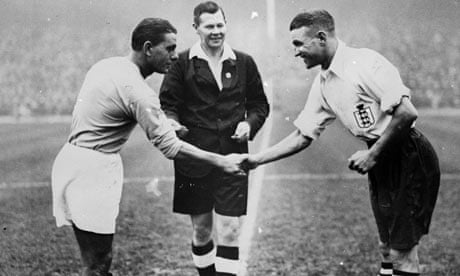
Left to right: Italy Captain Attilio Ferraris,
referee Otto Olsson, England Captain Eddie Hapgood

November 14, 1934: The most-hyped soccer game ever to that point is played. And, while the competition lived up to the hype, everything else was horrible.

In 1928, a dispute with the governing body of world soccer, the Fédération internationale de Football Association (FIFA), England left their jurisdiction. The other "home nations" of the United Kingdom of Great Britain and Northern Ireland -- Wales, Scotland and Northern Ireland -- followed suit. (To this day, I don't know why they compete as a single united kingdom in the Olympics Games, but, for every other event, the home nations each have their own separate teams.)

This made the home nations ineligible to play in FIFA's signature tournament, the World Cup, which began in 1930, with Uruguay winning on home soil. The 1934 tournament would be the 1st held in Europe, in Italy, then ruled by fascist dictator Benito Mussolini. With a team dominated by players from Juventus FC of Turin and FC Internazionale Milano of Milan, Italy won it.

But England, which "invented football" (at the least, it did so in an organized way), still thought it had the best team in the world. So they challenged Italy in a game to decide "the real world championship." Italy accepted. The game would be in England, so Mussolini couldn't use his authority to cheat. But he did offer an incentive: If they won, each player would receive a new Alfa Romeo car and a cash prize which, converted into 2022 U.S. money, was about $7,000, a pretty good figure during the Great Depression..

Italy manager Vittorio Pozzo sent out this lineup (with neither side wearing uniform numbers):

* Goalkeeper: Carlo Ceresoli of Inter. This was a change from the World Cup, where his keeper, and his Captain, was Gianpiero Combi of Juventus.
* Right Back: Eraldo Monzeglio of Bologna FC.
* Left Back: Luigi Allemandi of Inter.
* Right Half: Attilio Ferraris of SS Lazio of Rome, Italy's Captain for this game.
* Center Half: Luis Monti of Juventus.
* Left Half: Luigi Bertolini of Juventus.
* Outside Right: Enrique Guaita of AS Roma of Rome.
* Inside Right: Pietro Serantoni of Juventus.
* Center Forward: Giuseppe Meazza of Inter. He had been the inside right in the World Cup, but was moved to center forward for this game, replacing Angelo Schiavio of Bologna. The Milan stadium used by both Inter and AC Milan, known worldwide as the San Siro for its neighborhood, is officially named for Meazza, as he was the greatest Italian player of his generation.
* Inside Left: Giovanni Ferrari of Juventus.
* Outside Left: Raimundo Orsi of Juventus.

At the time, England did not have a "manager" as we now understand that term. Essentially, the team Captain was the head coach. Rather, a board of directors selected the starting eleven:

* Goalkeeper: Frank Moss of Arsenal FC. Arsenal, of North London, were the dominant team in England in the 1930s, winning 5 Football League titles and 2 FA Cups.
* Right Back: George Male of Arsenal.
* Left Back: Eddie Hapgood of Arsenal. So respected by his peers was Hapgood that he was named Captain of his country before he was named Captain of his club: Arsenal's Captain at the time was the great Scottish forward Alex James.
* Right Half: Cliff Britton of Everton FC, based in Liverpool.
* Center Half: Jack Barker of Derby County FC, in the East Midlands.
* Left Half: Wilf Copping of Arsenal. A purely defensive player, he never scored a goal for Arsenal. But he was the most feared player in the league. Not that he was dirty: Not once was he ever booked for a foul. (This was before Mike Riley, a known Arsenal hater, was in charge of English referees.)
* Outside Right: Stanley Matthews of Stoke City FC. At 19, he was the youngest player on the team. He would eventually become the grand old man of English football, playing for Stoke in Division One at age 50. In between tenures at Stoke, he would play for Lancashire side Blackpool FC. Playing his career for struggling teams, "The Wizard of Dribble" only won 1 trophy in his career, the 1953 FA Cup. In that game, his teammate Stan Mortensen became the 1st, and remains the only, player to score 3 goals in an FA Cup Final. And yet, the game is still called "The Matthews Final," such was his dominance of the game.
* Inside Right: Ray Bowden of Arsenal.
* Center Forward: Ted Drake of Arsenal. Recently acquired from Hampshire team Southampton FC, he became the top scorer in the country. The following year, he would tie the League record by scoring 7 goals against Birmingham team Aston Villa.
* Inside Left: Cliff Bastin of Arsenal. Normally an outside left, he would score 178 goals for "The Gunners," a team record that would last until surpassed by Ian Wright in 1997. He finished with 185, which was surpassed by Thierry Henry with 228.
* Outside Left: Eric Brook of Manchester City FC.

Seven players from Arsenal. It remains the only time 1 team has had 7 players in the England starting XI. So the match was set for Arsenal's home, Arsenal Stadium, known for its neighborhood as "Highbury." Although having little experience at the international level, these players were battle-tested in the toughest league in the world.

The referee was Otto Olsson, of Sweden. The crowd was given as 56,044 people. England wore white shirts and navy blue shorts, while Italy wore sky blue shirts and white shorts.

But when the game began at 3:00 on that Wednesday afternoon -- 10:00 in the morning, U.S. Eastern Time -- it was pouring rain, and the rain continued throughout the game. And the Italians were dirty from the outset. In only the 1st minute of the game, Drake had a one-on-one with Ceresoli, who crashed into him. Olsson awarded a penalty, but it was taken by Brook, who missed it.

Just a minute later, Monti tackled Drake, and broke his own foot in the process. A minute later, Brook headed in a cross from Matthews, and it was one-nil to England. Shortly thereafter, Hapgood took an elbow to the face, breaking his nose. In the 10th minute, Brook fired a free kick that Matthews said was "like a thunderbolt." It was 2-0 England. Just 2 minutes later, Drake made it 3-0. It looked like a wipeout.

By the 15-minute mark, both Monti and Hapgood had to leave the pitch. Both sides were down to 10 men. Pozzo changed tactics, and the Italian defense got tighter. And dirtier: Drake was punched, Brook's arm was broken, and Bowden got his ankle hurt. Olsson booked none of these offenses.

The Italians kept their tactics up in the 2nd half, and the tide of the game turned. Meazza scored twice within 4 minutes on either side of the hour mark. He fought hard for an equalizer, denied by saves from Moss and once hitting the post. When Olsson blew his whistle for full-time, it was still England 3, Italy 2.

England claimed to be the true world champions, their "gentlemen" having defeated the World Cup winners at their dirtiest, in a match that Matthews, whose length and greatness of career can be compared to American baseball pitcher Nolan Ryan and Canadian hockey player Gordie Howe, called it the most violent match in which he had ever played.

But Italy received its players as heroes. Recognizing that they had played under completely unfavorable conditions, they were hailed as "The Lions of Highbury." Mussolini, not bound by his promise because of the defeat, followed through anyway, giving the players the cash prizes and the cars.

Ceresoli lived until 1995, making him the last surviving Italian player from this game. Matthews was the game's last survivor, living until February 23, 2000.

Italy would repeat as World Cup winners in 1938. World War II canceled the World Cup of 1942, and the inability to set up qualifying matches because the European phase of the war didn't come until 1945 forced the cancellation of the 1946 edition. FIFA and the British home nations settled their differences, and England entered the 1950 World Cup, but failed until hosting the tournament in 1966. That remains the only international tournament that England have ever won. Italy have won the World Cup again in 1982 and 2006; and the UEFA European Championships of 1968 and 2020.

*

November 14, 1934 was a Wednesday. Baseball season was over. Football was in midweek. The NBA hadn't been founded yet. And no games were scheduled for the NHL. So there were no other scores on this historic day.

Saturday, November 5, 2022

November 5, 1943: The Bombing of the Vatican

November 5, 1943: Vatican City, the seat of the Roman Catholic Church, and neutral in World War II despite having been completely surrounded by the City of Rome, the capital of (until a few months ago) Fascist Italy, is bombed by Nazi Germany's air force, the Luftwaffe.
Four bombs are dropped on the microstate. There is some damage, but there are no deaths. The aircraft responsible is never identified. There would be another bombing on March 1, 1944, causing less damage, but taking a life. In neither case was Pope Pius XII within range of the bombs.
Vatican City, usually listed as just "The Vatican, is the world's smallest independent nation, with just 121 acres of land, about half of which is parkland; and, as of 2022, 453 permanent residents. It is dominated by St. Peter's Basilica, the center of the Catholic world. The original Basilica was finished around AD 360, and the current one dates to 1626. There are no chain restaurants -- indeed, no public restaurants at all -- but, one block east into Rome, there is a McDonald's.
*
November 5, 1943 was a Friday. Playwright and actor Sam Shepard was born. So was Friedman Paul Erhardt, the TV chef billed as Chef Tell.
Baseball season was over. Football was in midweek. The NBA hadn't been founded yet. And while the NHL season had started, no games were scheduled for this day. So there were no scores on this historic day.

Friday, November 4, 2022

November 4, 1966: The Arno Flood and the Mud Angels

November 4, 1966: The Arno River floods in Florence, Italy, killing over 100 people and destroying many priceless works of art.

Incredibly, many of these works were rescued and restored by people who waded in and retrieved them. They became known as the Mud Angels.

There were virtually no emergency measures in place, at least partially because Florence is located in an area where the frequency of flooding is relatively low. In fact, approximately 90 percent of the city's population were completely unaware of the imminent disaster.

Residents were set to celebrate their country's World War I victory over Austria on November 4, Italy's Armed Forces Day. In commemoration, businesses were closed, and many of their employees were out of town for the public holiday. While many lives were likely spared as a result, the locked buildings greatly inhibited the salvaging of valuable materials from numerous institutions and shops, with the exception of a number of jewelry stores, whose owners were warned by their nightwatchmen.

There were 5,000 families left homeless by the storm, and 6,000 stores were forced out of business. Approximately 600,000 tons of mud, rubble and sewage severely damaged or destroyed numerous collections of books, manuscripts and fine art. It is estimated that between 3 and 4 million books and manuscripts were damaged, as well as 14,000 movable works of art.

Artist Marco Sassone, in a 1969 interview, recalled the impact of the flood on Florence's residents: "The only thing you could do was watch and be helpless. Nature was master... The women became crazy with fear. They began throwing things from the windows and screaming, 'Who is going to save my children?'"

The Mud Angels cleaned the city of refuse, mud and oil, and retrieved works of art, books and other materials from flooded rooms; experts from around the world volunteered their time and knowledge in the conservation of the aforementioned materials.

*

November 4, 1966 was a Friday. Baseball season was over. Football was in midweek. There were no games scheduled in the NHL. There were 3 games in the NBA:

* The Philadelphia Warriors beat the San Francisco Warriors, 134-129 at the Philadelphia Civic Center. Wilt Chamberlain scored 30 points, and had 26 rebounds and 13 assists. Rick Barry scored 46 points in defeat for the Warriors.

* The Cincinnati Royals beat the Detroit Pistons, 120-115 at Cobo Hall (now Huntington Place) in Detroit. Oscar Robertson scored 36 points for the Royals.

* And the Los Angeles Lakers beat the Baltimore Bullets, 131-98 at the Los Angeles Memorial Sports Arena.


Wednesday, November 2, 2022

November 2, 1975: The Murder of Pier Paolo Pasolini

November 2, 1975: Pier Paolo Pasolini is murdered on Ostia Beach in Rome. The legendary film director was 53.

Pasolini was born on March 5, 1922 in Bologna, Italy. Along with Federico Fellini, Vittorio de Sica, Silvio Amdaio, and some others, he was one of the directors who challenged the strict conventions of Italy, a traditionally very conservative country. His first film, in 1955, was The River Girl. But his best-remembered film is La Dolce Vita (The Sweet Life), in 1960, with Anita Ekberg climbing into the Trevi Fountain in Rome.

Unlike those others, he went further outside the filming locations: He was a Marxist in a nation that hated Communism, and he was openly gay in a country that was Catholic all but officially. And yet, he told a very traditional version of Jesus' life with his 1964 film The Gospel According to St. Matthew, starring Enrique Irazoqui. Pasolini said he chose Matthew's version because, "John was too mystical, Mark too vulgar, and Luke too sentimental."

At the time of his death, he was about to release Salò, or the 120 Days of Sodom. Set in World War II during the short-lived Republic of Salò, after Mussolini was deposed but before he was capture, it was heavily influenced by The Divine Comedy, the epic poem by Dante Aligheri -- by a macabre coincidence, also completed just before the author's death, in 1321.

Even after Pasolini's death, critics did not spare the film. It has been called "the sickest film ever made." It received only a limited release in the United States, with no rating at all, not even an X, and not until 1977.

But he would never read or hear such criticisms. On November 2, 1975, he was found on Ostia Beach, savagely beaten. The evidence suggested that, after his death, the killer took his car and ran him over with it.

Giuseppe Pelosi, then 17, confessed to the murder. He said that he did it in self-defense after Pasolini attempted to molest him. Since it was not exactly a secret that Pasolini liked teenage boys, this was enough to gain a conviction. He was sentenced to 9 years in prison, and served them all.

In 2005, Pelosi recanted: He said that Mafia hitmen had rubbed Pasolini out, claiming he was a "dirty Communist" (his politics were much more widely known than his sex life), and they pressured Pelosi to confess. He died in 2017. He was not related to Nancy Pelosi, former Speaker of the U.S. House of Representatives, or her husband, Paul Pelosi.

*

November 2, 1975 was a Sunday. There were 5 NHL games played on this day:

* The New York Rangers lost to the Detroit Red Wings, 6-4 at Madison Square Garden. Ranger fans cheered this defeat, because the Rangers had recently waived popular goaltender Eddie Giacomin, who was playing for the Wings in this game. I have a separate entry for this event. 

* The Boston Bruins beat the California Golden Seals, 5-0 at the Boston Garden. This would be the last season in Oakland for the Seals franchise, who became the Cleveland Barons for 1976-77. For 1978-79, they merged with the Minnesota North Stars.

* The Philadelphia Flyers beat the Kansas City Scouts, 10-0 at The Spectrum in Philadelphia. This couldn't have been much more of a mismatch: The Flyers were the 2-time defending Stanley Cup Champions, while the Scouts were a 2nd-year expansion team. After this season, they moved to Denver to become the Colorado Rockies, a name that would later be given to Denver's baseball team. In 1982, the NHL's Rockies became the New Jersey Devils. Bobby Clarke, Orest Kindrachuk and Mel Bridgman each scored 2 goals.

* The Buffalo Sabres beat the Pittsburgh Penguins, 7-2 at the Buffalo Memorial Auditorium.

* And the Chicago Black Hawks beat the Vancouver Canucks, 6-1 at the Chicago Stadium.

There were 4 games in the World Hockey Association:

* The Cleveland Crusaders beat the Phoenix Roadrunners, 5-2 at The Coliseum in the Cleveland suburb of Richfield, Ohio.

* The Quebec Nordiques beat the Winnipeg Jets, 1-0 at the Winnipeg Arena.

* The Calgary Cowboys beat the New England Whalers, 4-3 in overtime at the Stampede Corral in Calgary.

* And the Edmonton Oilers beat the San Diego Mariners, 5-3 at the Northlands Coliseum in Edmonton.

There were 3 games played in the NBA: 

* The Houston Rockets beat the Milwaukee Bucks, 104-89 at The Summit in Houston. (The arena has since been converted into the Central Campus of the Lakewood Church, Dr. Joel Osteen's "megachurch.")

* The Los Angeles Lakers beat the Atlanta Hawks, 116-113 in overtime at The Forum in the Los Angeles "suburb" of Inglewood, California. Kareem Abdul-Jabbar scored 39 for the Lakers.

* And the Washington Bullets beat the Seattle SuperSonics, 94-85 at the Seattle Center Coliseum.

There are 4 ABA games played:

* The New York Nets beat the Utah Stars, 123-111 at the Nassau Coliseum. Julius "Dr. J" Erving scored 35 points.

* The Kentucky Colonels beat the Denver Nuggets, 106-103 at Freedom Hall in Louisville.

* The Spirits of St. Louis beat the Virginia Squires, 106-99 at the St. Louis Arena.

* And the San Diego Sails beat the San Antonio Spurs, 105-102 at the San Diego Sports Arena. (It's now named the Pechanga Arena.)

These NFL games were played on the day: 

* The New York Jets lost to the Buffalo Bills, 24-23 at Shea Stadium. (The New York Giants played at Shea the day before, beating the San Diego Chargers, 35-24.)

* The Baltimore Colts beat the Cleveland Browns, 21-7 at Memorial Stadium in Baltimore.

* The Pittsburgh Steelers beat the Cincinnati Bengals, 30-24 at Riverfront Stadium in Cincinnati.

* The New Orleans Saints beat their arch-rivals, the Atlanta Falcons, 23-7 at the brand-new Superdome in New Orleans.

* The Washington Redskins beat their arch-rivals, the Dallas Cowboys, 30-24 in overtime at Robert F. Kennedy Stadium in Washington.

* The Miami Dolphins beat the Chicago Bears, 46-13 at Soldier Field in Chicago.

* The Minnesota Vikings beat the Green Bay Packers, 28-17 at Lambeau Field in Green Bay.

* The St. Louis Cardinals beat the New England Patriots, 24-17 at Busch Memorial Stadium.

* The Houston Oilers beat the Kansas City Chiefs, 17-13 at Arrowhead Stadium in Kansas City.

* The Oakland Raiders beat the Denver Broncos, 42-17 at Mile High Stadium in Denver.

* The Detroit Lions beat the San Francisco 49ers, 28-17 at Candlestick Park in San Francisco.

The next night, on ABC Monday Night Football, the Los Angeles Rams beat the Philadelphia Eagles, 42-3 at Veterans Stadium in Philadelphia.

Also on this day, child actor Danny Cooksey was born. As an adult, no longer recognizable, he turned to cartoon and video game voiceovers. 

Thursday, October 27, 2022

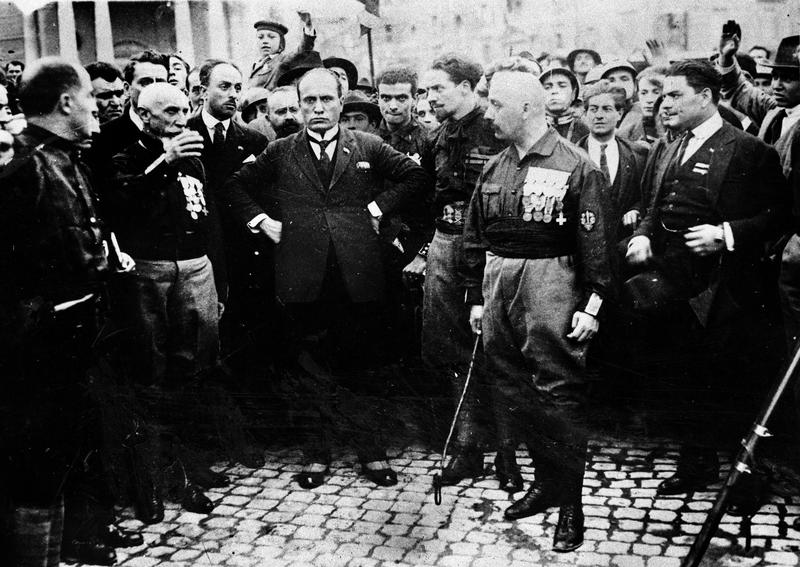
October 28, 1922: The March On Rome

October 28, 1922: The March on Rome takes place. It was an organized mass demonstration by 25,000 right-wing Blackshirt paramilitary men, representing the National Fascist Party, led by Benito Mussolini, seeking to rescue Italy from the economic and social chaos of the post-World War I world.

Prime Minister Luigi Facta told King Victor Emmanuel III that he wanted to declare a state of siege, but the King, conservative like most European monarchs tended to be then, and sympathetic to the Fascists, overruled him. The next day, the King dismissed Facta, and gave the job to Mussolini.

For the next 21 years, Mussolini ruled Italy with an iron fist, having opponents killed, including Socialist Party leader Giacomo Matteotti in 1924; aiding the Fascist movement in Spain during that country's Civil War of 1936 to 1939; and expanding Italy's influence into Africa, taking over Libya and Ethiopia, in an attempt to establish a new Roman Empire with himself as Caesar.

Mussolini considered Fascism to be the direct opposite of liberalism’s opposite. In article in the 1932 edition of the Enciclopedia Italiana, he wrote, “Fascism should more appropriately be called Corporatism because it is a merger of state and corporate power.” As the 1930s proved, Fascism also includes militarism and nationalism, which, inevitably, includes bigotry -- if not at first, then, eventually, lurching toward it and eventually carrying it out on a governmental level.

The American journalist George Seldes, whom Mussolini had befriended on the way up in the hopes of gaining American patrons, turned on him after gaining power. Seldes then wrote a biography of Mussolini, titled Sawdust Caesar. 

And in aiding the Fascists in Spain, led by Generalissimo Francisco Franco, Mussolini sent troops, which became known as Franco's Italian Army. That name would later be adopted by a family that owned an Italian restaurant in Pittsburgh, to honor Pittsburgh Steelers running back Franco Harris, whose mother grew up in Italy under Mussolini -- but whose father was an African-American soldier who participated in the liberation of Italy from Fascism, and married her and took her to America.

While Harris always showed appreciation to the restaurateurs and the other Steeler fans, it is not known if it made him uncomfortable to know what Francisco Franco did in Spain and Benito Mussolini did in Ethiopia, before that country was liberated.

Mussolini was deposed in 1943, and executed in 1945. And that old saying, "At least he made the trains run on time"? It was a myth: On the average, the trains in Italy ran no better than they did before he took over.

At heart, Italy is a conservative country. But, since World War II, more of its governments have been left of center rather than right. When one government falls, it is usually replaced by another leftward one. An exception was Silvio Berlusconi, the broadcast executive whose Forza Italia party is economically and socially conservative. He served as Prime Minister in 1994 and '95, from 2001 to 2006, and 2008 to 2011.

But on September 25, 2022, a right-wing party named Fratelli d'Italia, meaning "Brothers of Italy," won the most seats, and built a coalition that made its Leader -- ironically, given the name of the party, a woman, Giorgia Meloni -- the new Prime Minister. She will be Italy's furthest-right head of government since Mussolini, noticeably further to the right than Berlusconi.

*

October 28, 1922 was a Saturday. The Major League Baseball season had ended earlier in the month, with the New York Giants winning the World Series over the New York Yankees. There was, as yet, no major professional basketball league. The National Hockey League's new season was still a few weeks away. The nascent National Football League did play games that weekend, but all the next day, Sunday.

But, being a Saturday, there were college football games. One was the 1st football game ever broadcast on live nationwide radio. The year before, the University of Chicago had become one of the first colleges to send its football team to play a team outside its home region, beating Princeton University 9-0 at Palmer Stadium. Now, they would have a rematch at Stagg Field on the South Side of Chicago.

The Princeton Tigers entered the game 4-0, the Chicago Maroons 3-0. After 3 quarters, thanks to 3 touchdowns by John Thomas, Chicago led 18-7. Then came the kind of collapse people would still be talking about nearly a century later if it had happened on TV and the footage preserved. The Maroons fumbled, the Tigers recovered, and took it in for a 40-yard touchdown. Harry Crum scored for Princeton in the closing minutes, and, since Princeton made their PATs and Chicago didn't, the Tigers emerged victorious, 21-18. 

Another battle of unbeatens took place at the new Rose Bowl stadium in the Los Angeles suburb of Pasadena. The University of California, from the system's main campus in Berkeley, outside San Francisco, was 4-0, and took on the 5-0 team from the University of Southern California, based in Los Angeles. A safety gave Cal a 2-0 lead at halftime, and the Golden Bears held on 2 goal-line stands, before adding a touchdown and a field goal to win 12-0. I have a separate entry for this event.

On the basis of the win over Chicago, Eastern and Midwestern sportswriters proclaimed Princeton to be the National Champions after the season. Western writers gave the title to Cal. No playoff in those days. Bowl games? Cal had won the Rose Bowl in 1920 and tied it in 1921, but in 1922 and 1923, they didn't go. From September 25, 1920 to October 3, 1925, under coach Andy Smith, the Golden Bears had a 50-game unbeaten streak, still the longest in college football history: Played 50, won 46, tied 4, lost exactly none.

Coaching took a severe toll on Smith, who went just 6-3 with Cal in 1925. On a visit to Philadelphia, where he had coached the University of Pennsylvania from 1909 to 1912, he was hospitalized with pneumonia, and died on January 8, 1926, only 49 years old. His career coaching record was 116-32-13, including 74-16-7 at Cal.

In New York City, New York University played Rhode Island State at Ohio Field in The Bronx, and won 23-7. Fordham University played Westminster College of Pennsylvania at Fordham Field, also in The Bronx, and won 12-0. Columbia University wasn't so lucky: They played Williams College of Massachusetts, at South Field, just south of their famed Low Library in the Morningside Heights section of Manhattan, and lost 13-10.

And, aside from Princeton the main team in New Jersey, Rutgers University went to Morgantown and lost to West Virginia University 28-0.

Also, Arsenal FC lost to Newcastle United, 2-1 at the Arsenal Stadium, a.k.a. Highbury, in North London. 

Sunday, October 16, 2022

October 16, 1943: The Raid of the Ghetto of Rome

October 16, 1943: Nazi Germany's Gestapo round up over 1,000 Jews in Rome, and deport them to the Auschwitz concentration camp in Poland. Only 16 of them survive World War II. The public silence of Pope Pius XII, the Bishop of Rome, on this raid casts a shadow over his legacy.

Born on March 2, 1876 in Rome, Eugenio Maria Giuseppe Giovanni Pacelli rose through the ranks of the Vatican before being elected Pope on March 2, 1939 (his 63rd birthday), taking the name Pius XII, as his much-admired immediate predecessor had been Pius XI. Adolf Hitler's Nazi Germany was already in Austria and Czechoslovakia, and before the year was out, he had invaded Poland and started World War II.
With Vatican City surrounded by the Metropolitan City of Rome, and thus by Italy, and thus by Benito Mussolini's Fascist government, allied with Hitler, there wasn't much that the Pope could do. The same was true of Communism: Joseph Stalin, the Premier of the Soviet Union, was told by British Prime Minister Winston Churchill, at the Tehran Conference, earlier in 1943, that the Pope might be able to help the Allied cause, and responded, "The Pope? How many divisions has he?" As in, army divisions.

Pius maintained the Vatican's neutrality, and refused to denounce the Nazis' persecution of the Jews, before the extent of the horrors of the concentration camps were known to the outside world. As Holocaust survivor, author and Nobel Peace Prize laureate Elie Wiesel put it, "We must always take sides. Neutrality helps the oppressor, never the victim. Silence encourages the tormentor, never the tormented." For that reason, some of have called Pius "Hitler's Pope."

This is grossly unfair. He organized relief efforts from Rome, and, through intermediaries in the Church, all over the world, helped get thousands of refugees, Jewish and otherwise, out of Nazi-controlled territories. He continued to lead the Church until his death on October 9, 1958.

The term "ghetto" originated in the limited area into which medieval Rome put Jews, and even in America, the word was used to describe poor Jewish neighborhoods before it was used for poor black ones -- many of which had once been poor Jewish ones. Ruby Goldstein, before becoming one of boxing's best referees, was a lightweight contender from the Lower East Side of Manhattan, nicknamed "The Jewel of the Ghetto."

*

October 16, 1943 was a Saturday. Scottish soccer star Tommy Gemmell, once of Celtic Football Club's 1967 "Lisbon Lions," was born on this day. So was Paul Rose, one of the Front de Libération du Québec (FLQ) terrorists who kidnapped Pierre Laporte, Minister of Labour for the Province of Quebec, as part of what became known as the October Crisis. Unlike his brother Jacques, Paul was not with the others when Laporte tried to escape, and the others killed him in the attempt.

Although England had suspended Football League and FA Cup play for the duration of The War, there was competition. The North London team I would one day support, Arsenal, played West London team Brentford to a 3-3 draw. The game was played at White Hart Lane, home of Arsenal's rivals Tottenham Hotspur, because the British government had appropriated the Arsenal Stadium, a.k.a. Highbury, for the war effort.

The baseball season had ended 5 days earlier, with the New York Yankees winning the World Series over the St. Louis Cardinals in 5 games. The NBA hadn't been founded yet. The NHL season started 2 weeks later.

There was football. But with the manpower drain of World War II, many military bases had football teams, and were scheduled against college teams. This also enabled the teams at the service academies to be better than usual. Indeed, Army won the National Championship in 1944 and 1945, almost did so in 1943 and 1946; and Navy finished the season ranked Number 4 in 1943 and '44, and Number 3 in '45.

On October 16, 1943, Army were ranked Number 2, and beat Columbia, 52-0 at Baker Field in Upper Manhattan; while Navy were ranked Number 3, and beat Penn State, 14-6 at Thompson Stadium in Annapolis, Maryland. Among the other games:

* Number 1 Notre Dame beat Wisconsin, 50-0 at Camp Randall Stadium, which had been built on an Army base in Madison, Wisconsin.

* Number 4 University of Pennsylvania beat Lakehurst Naval Air Station, the site of the Hindenburg disaster, 74-6 at Franklin Field in Philadelphia.

* Number 5 Purdue beat Ohio State, 30-7 at Ohio Stadium in Columbus, Ohio.

* Number 6 Duke beat their arch-rivals, North Carolina, 14-7 at Duke Stadium, later renamed Wallace Wade Stadium, in Durham, North Carolina.

* During the war, the University of Iowa was represented by a U.S. Navy Pre-Flight School, and "Iowa Pre-Flight" were ranked Number 7 on this day. They beat Missouri, 21-6 at Memorial Stadium (later Faurot Field) in Columbia, Missouri.

* Number 8 University of Southern California beat the University of San Francisco, 34-0 at Kezar Stadium in San Francisco.

* In New York City, in addition to Columbia's loss, City College of New York (CCNY) beat Brooklyn College, 22-6 at Kingsmen Field in Brooklyn; New York University (NYU) suspended their program for the 1942 and '43 seasons; and Fordham suspended their program for the 1943, '44 and '45 seasons.

And among New Jersey's teams, Rutgers had trouble scheduling opponents, and did not play their 1st game until October 30; while Princeton lost to Brown, 28-20 at Palmer Stadium in Princeton.

December 31, 1999 & January 1, 2000: The Millennium

December 31, 1999:  The Millennium arrives. The people of planet Earth survived. At a terrible cost. But we hadn't destroyed ourselves. ...