Showing posts with label turkey. Show all posts

Saturday, November 5, 2022

November 5, 1956: The Swans That Nearly Started World War III

A Soviet MiG-15

Note: I added this entry in 2024, having heard the story for the first time on an episode of NCIS.

November 5, 1956: With the Suez Crisis and the crushing of the Hungarian Revolution underway, and America electing a President the next day, there is a close call that nearly starts World War III.

The North American Aerospace Defense Command (NORAD) received a number of simultaneous reports, including unidentified aircraft over Turkey, Soviet MiG-15 fighters over Syria, a downed British Canberra medium bomber, and unexpected maneuvers by the Soviet Black Sea Fleet through the Dardanelles (also in Turkey) that appeared to signal a Soviet offensive.

Considering previous Soviet threats to use conventional missiles against Britain and France if they intervened in the Suez Crisis, U.S. forces believed these events could trigger a NATO nuclear strike against the Soviet Union, and went on high alert.

As it turned out, all reports of Soviet action turned out to be erroneous, misinterpreted, or exaggerated. The perceived threat was due to a coincidental combination of harmless events:

* The "unidentified aircraft over Turkey" was a flock of swans.
* The MiGs were a fighter escort for President Shukri al-Quawatli of Syria, returning from a meeting with Premier Nikita Khrushchev in Moscow. A check with the Turkish government proved the flight to have been previously cleared with them.
* The British reported that their bomber had been brought down by mechanical issues.
* And a check of records showed that the Black Sea Fleet's exercises had been previously scheduled.

Had any one of these things, alone, happened, it probably wouldn't have concerned too many people. The fact that they all seemed to be happening at once was nerve-rattling. Over the next few days, things calmed down. The Egyptians won in the Suez, the Soviets won in Hungary, President Dwight D. Eisenhower was re-elected, no new wars -- conventional or otherwise -- got started, and the status quo was restored.

It was the closest call since the Chinese invasion during the Korean War, 6 years earlier. The next close call would be in another 6 years, over missiles in Cuba.

*

November 5, 1956 was a Monday. Baseball season was over. Football was in midweek: There would be no Monday Night Football for another 14 years. And while both leagues' new seasons had gotten underway, there were no games were scheduled in either the NBA or the NHL. So there were no scores on this historic day.

Tuesday, November 1, 2022

November 1, 1922: The Fall of the Ottoman Empire

Kemal Atatürk

November 1, 1922: The Grand National Assembly of Turkey votes to declare that the monarchy of the Ottoman Empire is abolished, and moves the national capital from Constantinople to Ankara.

The monarch, Sultan Mehmed VI, left the country on November 17, living in exile in Malta, and then in Sanremo on the Italian Riviera. He died in 1926, and was buried in Damascus, Syria.

The government changed the name of Constantinople -- which the Roman Emperor Constantine the Great had given to the city of Byzantium in AD 330 -- to Istanbul, meaning "to the city," in 1930.

The Empire had been founded in 1299, by Osman I, its name an anglicization of his. The term "Turk" was used to refer to the Anatolian peasant and tribal population, and was seen as disparaging when applied to urban, educated individuals. In Western Europe, the names Ottoman Empire, Turkish Empire and Turkey were often used interchangeably, with Turkey being increasingly favoured both in formal and informal situations.

Mustafa Kemal, the Ottomans' hero of the Battle of Gallipoli in 1915, and leader of the Turkish National Movement, was elected President of Turkey in 1923. He initiated a rigorous program of political, economic, and cultural reforms with the ultimate aim of building a modern, progressive and secular nation-state.

He made primary education free and compulsory, opening thousands of new schools all over the country. He gave women the right to vote in 1934. That same year, the Parliament gave him the honorific name Atatürk, meaning "Father of the Turks." He died in office in 1938, having turned a nation that straddled the divide between Europe and Asia, but was so backward it was known as "the Sick Man of Europe," into a modern state that could stand on its own.

*

November 1, 1922 was a Wednesday. Baseball was out of season. Football was in midweek. The NBA hadn't been founded yet. And the NHL season wouldn't start until December 16.

But there was a notable sporting event that day: Edward "Mickey" Walker, a boxer from Elizabeth, Union County, New Jersey, known as "the Toy Bulldog," defeated Jack Britton in a unanimous decision at the 2nd Madison Square Garden, to win the Welterweight Championship of the World.

Sunday, October 30, 2022

October 30, 1973: The Bosphorus Bridge Opens

October 30, 1973: The Bosphorus Bridge opens in Istanbul, Turkey, connecting the city's European and Asian sections by road, where, previously, the connections had only been by ferry.

It was the 1st bridge to ever connect one continent with another. It is now 1 of 3 bridges over the Bosphorus Strait, followed by the Fatih Sultan Mehmet Bridge in 1988 (named for Sultan Mehmed II, a.k.a. Mehmed the Conqueror, who conquered the city, then named Constantinople, in 1453) and the Yavuz Sultan Selim Bridge in 2016.

Every year, on its anniversary, its operating authority hosts a "fun run." It also happens to have opened on the anniversary of Galatasaray Spor Kulübü (Sport Klub), founded on October 30, 1905. 

Part of the nasty rivalry between Turkey's 2 biggest sports clubs, especially its soccer teams, comes from the fact that they are on opposite sides of these 3 bridges: Fenerbahçe (FEN-er-BAH-chah, or "Fener") is in the Kadıköy district on the Asian side, while Galatasaray is in the Galata Palace area on the European side.


In the 2022-23 season, there are 6 Istanbul clubs in the Turkish Süper Lig, but Fener is the only one on the Asian side. Joining Gala on the European side are Beşiktaş, İstanbul Başakşehir, Kasımpaşa and Fatih Karagümrük.

*

October 30, 1973 was a Tuesday. Baseball season was over. Football was in midweek. There were 4 games played in the NBA:

* The Atlanta Hawks beat the Phoenix Suns, 122-101 at The Omni in Atlanta.

* The Buffalo Braves beat the Seattle SuperSonics, 105-103 at the Buffalo Memorial Auditorium.

* The Milwaukee Bucks beat the Kansas City-Omaha Kings, 112-78 at the Kansas City Municipal Auditorium.

* And the Portland Trail Blazers beat the Los Angeles Lakers, 114-112 at the Portland Memorial Coliseum.

There were 2 games played in the American Basketball Association. The New York Nets lost to the San Antonio Spurs, 104-92 at the HemisFair Arena in San Antonio. And the Memphis Tams beat the Carolina Cougars, 110-99 at the Mid-South Coliseum in Memphis.

There were 3 games played in the NHL:

* The New York Rangers and the Vancouver Canucks played to a tie, 3-3 at the Pacific Coliseum in Vancouver.

* The Toronto Maple Leafs beat the Detroit Red Wings, 7-0 at Maple Leaf Gardens in Toronto.

* And the Los Angeles Kings beat the St. Louis Blues, 3-2 at the St. Louis Arena.

And there were 3 games played in the World Hockey Association:

* The Chicago Cougars beat the Winnipeg Jets, 4-1 at the International Amphitheatre in Chicago.

* The Houston Aeros beat the Minnesota Fighting Saints, 6-1 at the Sam Houston Coliseum.

* And the Quebec Nordiques beat the Los Angeles Sharks, 6-4 at the Los Angeles Memorial Sports Arena.

Sunday, October 2, 2022

October 2, 2018: The Saudi Hit On Jamal Khashoggi

October 2, 2018: There are certain things that the President of the United States has to avoid, first if he wants to be re-elected; then, if successful in that, if he wants to be remembered well by history.
As Ulysses S. Grant, Grover Cleveland, Herbert Hoover, Gerald Ford, Jimmy Carter and both George Bushes found out, you can't have a major economic downturn on your watch.
As Lyndon Johnson and George W. Bush found out, you can't have a war go badly on your watch -- or, as Carter also found out, you can't have a hostage crisis that drags out until it feels like a war.
As Grant, Warren Harding, Richard Nixon and George W. Bush found out, you can't have a major scandal. (The one that the Republican Party tried to put on Bill Clinton didn't work: Having avoided the other things, he was more popular after a full 8 years than any President.)
And, as George W. Bush also found out, you can't be seen as screwing up the response to a devastating hurricane.
Except for a war, all of those things happened during the Presidency of Donald Trump. But what no one foresaw until Trump got into the White House was the possibility of a President being compromised by a foreign power. 
Trump is compromised by, among other nations, Russia and Saudi Arabia. Without the backing of both of these nations, his financial empire wouldn't be worth the paper it's printed on. (It still might not be.) And without their campaign contributions -- and hacking from at least the Russians and possibly also the Saudis -- he could not have become President.
On June 3, 2009, President Barack Obama met with King Abdullah of Saudi Arabia, and appeared to bow before him. Trump had a public fit over this. But on January 23, 2015, Abdullah died, succeeded by his half-brother, King Salman; and on May 2017, Trump met with Salman in the Saudi national capital of Riyadh, received a gaudy medal from him, and appeared to curtsy right afterward.
Salman's health was already beginning to fail. On June 21, 2017, he appointed his son, Crown Prince Mohammed bin Salman, to run the country on his behalf. On that day, Trump called him to "congratulate him on his recent elevation." Trump and "MBS" pledged "close cooperation" on security and economic issues.
The month before, MBS publicly warned: "I confirm to you, no one will survive in a corruption case—whoever he is, even if he's a prince or a minister." He wasn't kidding: On November 4, the Saudi media announced the house arrest of some 200 wealthy businessmen and princes at the Ritz Carlton hotel in Riyadh, on various "corruption" charges. They became the subject of "The Night of Beating," with Saudi agents torturing them.
He became his country's absolute ruler at age 32.
This is why "foreign policy by obituary," waiting for
a tyrant to die so policy can change, usually doesn't work.
This included Prince Al-Waleed bin Talal, an English-language news commentator and a major shareholder in Citigroup, Twitter, and Rupert Murdoch's News Corp; Prince Mutaib bin Abdullah, head of the Saudi Arabian National Guard; Adel Fakeih, Minister of Economy and Planning; and Admiral Abdullah bin Sultan bin Mohammed Al-Sultan, commander of the Royal Saudi Navy. As of October 2, 2022, Fakeih was still in custody; the others were quickly released, but have not been returned to any role in the Saudi government. 
Jamal Khashoggi was born on October 13, 1958 in Medina, Saudi Arabia. He was an exiled journalist who had written damning exposes of his homeland's government. This was complicated by the fact that his grandfather, Mohammed Khashoggi, was the personal physician of King Ibn Saud, the founder of the Saudi state. His uncle, Adnan Khashoggi, was a billionaire arms dealer. He was also a first cousin of Dodi Fayed, the Egyptian film producer who was Princess Diana's boyfriend and was killed with her in the 1997 Paris car crash.
In a column printed in the April 3, 2018 edition of The Washington Post, Jamal Khashoggi wrote that Saudi Arabia "should return to its pre-1979 climate, when the government restricted hard-line Wahhabi traditions. Women today should have the same rights as men. And all citizens should have the right to speak their minds without fear of imprisonment." In that same column, he said that Saudis "must find a way where we can accommodate secularism and Islam, something like what they have in Turkey," the country where he was then living. He also opposed the Saudi's intervention in neighboring Yemen.
He was no angel: He had just gotten married for the 3rd time, but was already planning to divorce his new wife and marry another woman. He was critical of Israel. He had even been friends with Osama bin Laden during the latter's opposition to the Soviet invasion of Afghanistan, but renounced bin Laden when he turned to violence against America. When bin Laden was killed in 2011, Khashoggi wrote, "You were beautiful and brave in those beautiful days in Afghanistan, before you surrendered to hatred and passion."

On October 2, 2018, Khashoggi walked into the Saudi consulate in Istanbul, Turkey, where he was living, to obtain documents needed for his planned marriage. (He was already married, but planning to divorce his wife so he could marry someone else.) He never left alive, and word reached the outside world that he was murdered and dismembered inside the consulate. He was just short of turning 60, and left behind his wife, 2 sons and 2 daughters (with all 4 children from his 2nd marriage).
On November 16, the CIA determined that MBS has personally ordered the murder. This was not just an assassination: This was more like a Mob hit.
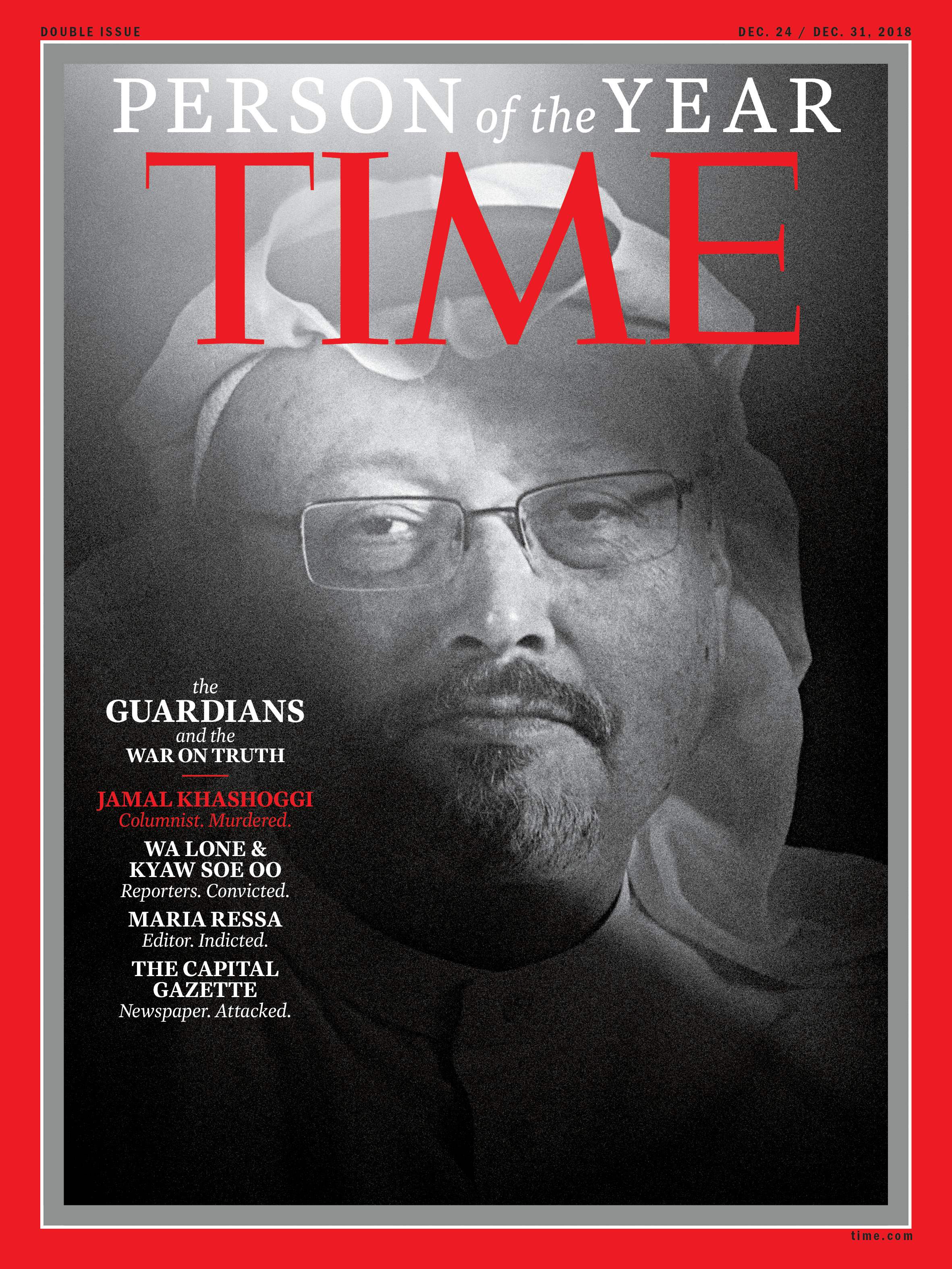
On December 11, 2018, Time magazine collectively named journalists they called "Guardians of the Truth" as their "Persons of the Year." They put Khashoggi on the cover as their stand-in. This made him, technically, the 1st person already dead to receive their Man/Person of the Year designation since the distinction was established in 1927. Time also cited journalists in the U.S., Mexico, Venezuela, Russia, Turkey, Sudan, Bangladesh, Myanmar (formerly Burma), Vietnam and the Philippines.
(No, John F. Kennedy didn't receive it in 1963, although he got it while alive in 1961. The 1963 recipient was Martin Luther King Jr.)
In 2021, the former Saudi intelligence official Saad al-Jabri said in an interview with CBS that bin Salman is "a psychopath, killer... with infinite resources, who poses threat to his people, to the Americans and to the planet."
*
October 2, 2018 was a Tuesday. Football was in midweek. The NHL season started 2 days later; the NBA season, 15 days later. And only 1 baseball game was played. It was the National League Wild Card Game, at Wrigley Field in Chicago, and the Colorado Rockies beat the Chicago Cubs, 2-1. With 2 outs in the top of the 13th inning, the Rockies got consecutive singled from Trevor Story, Gerardo Parra and Tony Wolters to take the lead. The Rockies were subsequently swept by the Milwaukee Brewers in the NL Division Series.

Saturday, September 17, 2022

September 17, 1967: The Kayseri Atatürk Stadium Disaster

September 17, 1967: The Kayseri Atatürk Stadium Disaster occurs, killing 43 people and injuring at least 300 others.

The stadium opened in the city of Kayseri, in central Turkey in 1964, and seated 26,500. Two teams shared it: Kayserispor and Kayseri Erciyesspor. On September 17, 1967, Erciyesspor led Sivasspor, 1-0 at halftime.

During the halftime intermission, supporters of the two teams began to throw rocks at each other. Some fans attempted to get out of the way, causing a stampede in front of the stand exits, leading to a crush similar to what has happened in many other stadium disasters, including Hillsborough in England in 1989. The action spilled into the streets, and there was extensive vandalism.

The stadium was demolished in 2009. Kayserispor then moved into the new, 32,000-seat Kadir Has Stadium, while Erciyesspor moved into a much smaller satadium, and went out of business in 2018.

*

September 17, 1967 was a Sunday. This was also the day that The Doors appeared on The Ed Sullivan Show, and The Who appeared on The Smothers Brothers Comedy Hour, each creating a different kind of controversy. I have a separate entry for that dual event.

A full slate of Major League Baseball games was played:

* The New York Yankees lost to the Cleveland Indians, 4-2 at the old Yankee Stadium. Luis Tiant outpitched Mel Stottlemyre. Mickey Mantle went 0-for-2 with 2 walks.

* The Philadelphia Phillies beat the Los Angeles Dodgers, 6-1 at Connie Mack Stadium in Philadelphia.

* The Baltimore Orioles beat the Boston Red Sox, 5-2 at Fenway Park in Boston. This was a bit of a blow in the Sox' 4-way dogfight for the American League Pennant with Chicago, Detroit and Minnesota. The Birds got home runs from Boog Powell (not surprising), Paul Blair (a little surprising) and Andy Etchebarren (very surprising).

Both pitchers of record would pitch for the Seattle Pilots in 1969, and feature in fellow pitcher Jim Bouton's published diary Ball Four: The winning pitcher for the O's was Gene Brabender, and the losing pitcher for the Sox was Gary Bell.

* The Pittsburgh Pirates beat the San Francisco Giants, 5-4 at Forbes Field, in Pittsburgh. For the Pirates, Roberto Clemente went 3-for-5 with a solo home run. For the Giants, Jim Ray Hart hit a home run, but Willie Mays only appeared as a pinch-hitter, and didn't get a hit.

* The St. Louis Cardinals beat the Cincinnati Reds, 3-2 at Crosley Field in Cincinnati.

* The Washington Senators beat the Detroit Tigers, 5-0 at Tiger Stadium in Detroit.

* The Chicago White Sox beat the Minnesota Twins, 4-0 at Comiskey Park in Chicago. Gary Peters pitched a 4-hit shutout.

* The Chicago Cubs beat the Atlanta Braves, 5-3 at Atlanta Stadium. (It would be renamed Atlanta-Fulton County Stadium in 1974.) For the Cubs, Billy Williams hit a home run, and Ernie Banks went 2-for-4. For the Braves, the only home run was hit by Charlie Lau, the light-hitting catcher who would go on to become one of the sport's most admired hitting instructors; Hank Aaron went 1-for-4 with a double; and Joe Torre went 0-for-4.

* The New York Mets lost to the Houston Astros, 4-3 at the Astrodome in Houston.

* The California Angels beat the Kansas City Athletics, 3-2 at Anaheim Stadium in the Los Angeles suburb of Anaheim, California. (The ballpark is now named Angel Stadium of Anaheim.) This would be the last month for the A's as a Kansas City team: They moved to Oakland the next season.

And, being a Sunday, there was pro football, both the NFL and the AFL. For the senior league, it was the opening game of the season:

* The New York Giants beat the football version of the St. Louis Cardinals, 37-20 at Busch Memorial Stadium in St. Louis.

* The Philadelphia Eagles beat the Washington Redskins, 35-24 at Franklin Field in Philadelphia.

* The Baltimore Colts beat the Atlanta Falcons, 38-31 at Memorial Stadium in Baltimore.

* The Pittsburgh Steelers beat the Chicago Bears, 41-13 at Pitt Stadium in Pittsburgh.

* The Dallas Cowboys beat the Cleveland Browns, 21-14 at Cleveland Municipal Stadium.

* The Green Bay Packers and the Detroit Lions played to a tie, 17-17 at Lambeau Field in Green Bay.

* The San Francisco 49ers beat the Minnesota Vikings, 27-21 at Metropolitan Stadium in the Minneapolis suburb of Bloomington, Minnesota.

* The Los Angeles Rams beat the New Orleans Saints, 27-13 at Tulane Stadium in New Orleans. The Saints were an expansion team, and this was the 1st regular-season game they ever played. They lost their 1st 7 games before finally beating the Eagles on November 5 at Tulane.

And in the AFL:

* The Houston Oilers beat the Buffalo Bills, 20-3 at War Memorial Stadium in Buffalo.

* The Miami Dolphins beat the Denver Broncos, 35-21 at the Orange Bowl in Miami.

* The Oakland Raiders beat the Boston Patriots, 35-7 at the Oakland Coliseum.

* And the New York Jets, the Kansas City Chiefs and the San Diego Chargers all had a bye week. In 1966, the Dolphins were an AFL expansion team. Another, the Cincinnati Bengals, was added in 1968. So in 1966 and 1967, the AFL had 9 teams, and there was a bye every week to at least one team.  

Monday, April 25, 2022

April 25, 1915: The Battle of Gallipoli

April 25, 1915: At 4:00 AM local time, troops from the British Empire attempt an amphibious landing at Gallipoli (pronounced "Gah-LIH-poh-lee"), a peninsula that acts as a land guardian to the Sea of Marmara and the city of Constantinople, the capital of the Ottoman Empire, which was allied with the Germany Empire, Britain's main enemy in "The Great War," or World War I as it's now known.

Most of the troops come from the recently-independent (well, mostly independent) nations of Australia and New Zealand. They are known as ANZACs: Australian and New Zealand Army Corps.

The fighting is brutal. The Ottoman troops call out the Arabic/Turkish name for God: "Allah! Allah!" And the Aussies yell back, "Come on, you bastards! We'll give you Allah!" A story, which I hope is true, tells of a captured Ottoman prisoner, having heard the word "bastard" so many times, asked the ANZACs if "Bastard" was the English name for the Christian God.

The Gallipoli campaign had begun on February 17, 1915, and the amphibious landing was meant to end what had been a stalemate. It didn't. The fighting continued until January 9, 1916, when the British government admitted that no progress was being made, and withdrew the troops. The Ottomans lost 255,000 men, but because they had protected their capital, it was a victory for them.

The British Empire lost over 31,000 men. Of these, Australia lost 7,594, and New Zealand lost 3,431. And over half of the ANZAC losses came on that one day, April 25. In both countries, it is commemorated as ANZAC Day, and is viewed as the day each country came of age. (Australia became a Federation within the Empire in 1901, and New Zealand a Dominion within it in 1907.)
On November 11, 1918, after 4 years and 4 months of war, the addition of American troops to the British Empire and the French Third Republic won the war for the Allies. The German, Austrian and Ottoman Empires were dissolved, and replaced with republics.

The Ottoman Empire was replaced by the Republic of Turkey, which moved the capital from Constantinople to Ankara in 1923, and renamed Constantinople "Istanbul" in 1930.

Alec Campbell was the last Australian survivor of the Gallipoli campaign, living until 2002. The actress Ruby Rose is his great-granddaughter. Alfred Dibley was the last New Zealand ANZAC, living until 1997. And the last surviving Ottoman soldier from the campaign was Adil Şahin, living until 1998.

*

April 25, 1915 was a Sunday. In some countries, sports were already canceled for the duration of the war. England's Football Association ran its Football League and its FA Cup for the 1914-15 season, then suspended both, resuming for the 1919-20 season. But America, which did not enter the war until April 6, 1917, played baseball throughout. These were the major league scores for the day. First, for the American League:

* The New York Yankees lost to the Boston Red Sox, 9-5 at Fenway Park in Boston. The losing pitcher was Ray Caldwell. The winning pitcher for the Red Sox helped his cause with a home run. He was a 20-year-old lefthander from Baltimore named George Herman Ruth, already known as "Babe."

* The Washington Senators beat the Philadelphia Athletics, 4-1 at National Park in Washington. (It was renamed Griffith Stadium in 1922.)

* The Cleveland Indians beat the Detroit Tigers, 3-1 at League Park in Cleveland. "Shoeless" Joe Jackson went 2-for-4 for Cleveland, and Ty Cobb went 1-for-3 and drove in Detroit's only run.

* And the Chicago White Sox beat the St. Louis Browns, 1-0 at Comiskey Park in Chicago. Ewell "Reb" Russell pitched a 4-hit shutout for the South Siders.

In the National League:

* The New York Giants beat the Boston Braves, 5-0 at the Polo Grounds. William "Pol" Perritt pitched a 4-hit shutout. Dave Robertson (no, not the Yankee reliever of a century later) hit a home run, and George Burns (no, not the comedian) went 3-for-4 with an RBI.

* The Brooklyn Robins beat the Philadelphia Phillies, 4-2 at Baker Bowl in Philadelphia. From 1914 to 1931, the once-and-future Dodgers were named for their manager, Wilbert Robinson.

* The Cincinnati Reds and the Chicago Cubs were tied 4-4, after 15 innings at West Side Park in Chicago, when the game was called due to darkness.

* And the Pittsburgh Pirates and the St. Louis Cardinals were tied, at Forbes Field in Pittsburgh, when the game was called due to darkness.

And in the Federal League:

* The Brooklyn Tip-Tops beat the Chicago Whales,, 12 -4 at Washington Park in Brooklyn.

* The Newark Peppers beat the Kansas City Packers, 6-1 at Harrison Park, outside Newark in Harrison, New Jersey.

* The St. Louis Terriers beat the Baltimore Terrapins, 11-2 at Terrapin Park in Baltimore.

* And the Pittsburgh Rebels beat the Buffalo Blues, 6-5 at Federal League Park in Buffalo. 

Sunday, April 24, 2022

April 24, 1915: The Armenian Genocide Begins

April 24, 1915: This is the date usually given as the start of the Armenian genocide, carried out by the Ottoman Empire, in an effort to wipe out Armenian identity.

Before World War I, Armenians occupied a somewhat protected, but subordinate, place in Ottoman society. Large-scale massacres of Armenians had occurred in the 1890s and in 1909. The Empire suffered a series of military defeats and territorial losses, especially in the Balkan Wars of 1912 and 1913, against Greece, Bulgaria, Serbia and Montenegro. This led to fear among the Empire's Committee of Union and Progress (CUP) that the Armenians would seek independence.

During their invasion of Russian and Persian territory in 1914, Ottoman paramilitaries massacred local Armenians. Ottoman leaders took isolated instances of Armenian resistance as evidence of a widespread rebellion, which did not actually exist. Mass deportation was intended to permanently forestall the possibility of Armenian autonomy or independence.

On April 24, 1915, the Ottoman authorities began the arrest and deportation of hundreds of Armenian intellectuals and leaders from the national capital, Constantinople. At the orders of Mehmet Talaat, a.k.a. Talaat Pasha, Minister of Finance but essentially the man who ran the Ottoman government, an estimated 800,000 to 1.2 million Armenians were sent on death marches to the Syrian Desert in 1915 and 1916.

Driven forward by paramilitary escorts, the deportees were deprived of food and water and subjected to robbery, rape and massacres. In the Syrian Desert, the survivors were dispersed into concentration camps -- not an early use of such facilities, but one of the earliest uses of the term. In 1916, another wave of massacres was ordered, leaving about 200,000 deportees alive by the end of the year.

In an additional method of wiping out Armenian identity, around 100,000 to 200,000 Armenian women and children, previously Eastern Orthodox Catholics, were forcibly converted to Islam and integrated into Muslim households. Massacres and ethnic cleansing of Armenian survivors continued through the Turkish War of Independence after World War I, carried out by Turkish nationalists.

Despite their victory at Gallipoli, the day after the genocide began, the Ottoman Empire was devastated by World War I. It was broken up, and Anatolia, its centerpiece, became the officially secular Republic of Turkey (in their language, "Türkiye") in 1922, and abolished the Ottoman Empire, its Sultanate, and its Caliphate.

The new nation in an old civilization -- one of many places in the world that can be described as such, including Israel, India, and the People's Republic of China -- moved the capital from Constantinople to Ankara, and changed the name of Constantinople to Istanbul in 1930.

The Turkish government maintains that the deportation of Armenians was a legitimate action that cannot be described as genocide. As of 2022, 34 countries have recognized it as such. One that has not is the United States of America, due to Turkey's strategic importance, first during the Cold War, and now in the War On Terror. Having the dictatorial Recep Tayyip Erdoğan, a hyper-nationalist, as President of Turkey since 2014 doesn't help.

The Republic of Armenia separated from the Ottoman Empire, declaring its independence on May 28, 1918. The Soviet Union conquered it on November 29, 1920. As the Soviet Union collapsed, the Republic of Armenia declared independence again on September 23, 1991. Today, it is a free country of about 3 million people.

About half that many people, 1.5 million, are believed to be of Armenian descent and living in America, mostly in California and Nevada. Their numbers have included singer-actress Cher (Cherilyn Sarkisian), novelist William Saroyan, songwriter David Seville (real name Ross Bagdasarian, the creator of cartoon characters The Chipmunks), music producer Michael Omartian, tennis star Andre Agassi, former Notre Dame football coach Ara Parseghian, former Nevada-Las Vegas basketball coach Jerry Tarkanian, sportswriter Tim Kurkjian, the real estate-developing Hovnanian family, and the Kardashian family.

In a story that may be apocryphal, when told that history might condemn him for the Jewish Holocaust he was planning, Adolf Hitler said, "Nobody remembers what happened to the Armenians."

*

April 24, 1915 was a Saturday. It was the 2nd and last season of baseball's Federal League, so there were 3 major leagues at the time. These games were played in the American League:

* The New York Yankees beat the Washington Senators, 4-0 at the Polo Grounds. Ray Caldwell pitched a 2-hit shutout, to beat Walter Johnson. Roy Hartzell went 3-for-4.

* The Philadelphia Athletics beat the Boston Red Sox, 6-3 at Fenway Park in Boston. Nap Lajoie went 1-for-4 for the A's. Tris Speaker did the same for the Sox. Babe Ruth came in to pitch in relief of Dutch Leonard, going 3 1/3rd innings, allowing 1 run on a walk, but no hits.

* The Detroit Tigers beat the Cleveland Indians, 6-0 at League Park in Cleveland. Bernie Boland pitched a 5-hit shutout for the Tigers. Shoeless Joe Jackson had 2 of those hits. Bobby Veach went 4-for-4. Ty Cobb went 0-for-4, but had an RBI on a sacrifice fly.

* And the Chicago White Sox beat the St. Louis Browns, 4-1 at Comiskey Park in Chicago. Eddie Collins went 0-for-2 with a walk.

In the National League:

* The Brooklyn Robins -- as the Dodgers were known when Wilbert Robinson managed them from 1914 to 1931 -- beat their arch-rivals, the New York Giants, 7-5 at Ebbets Field. George Cutshaw went 3-for-4 with 2 RBIs.

* The Boston Braves beat the Philadelphia Phillies, 10-2 at Baker Bowl in Philadelphia.

* The Cincinnati Reds and the Pittsburgh Pirates were tied 1-1 after 8 innings at Forbes Field in Pittsburgh, when the game was called due to rain. Honus Wagner went 1-for-2 with a walk and an RBI.

* And the St. Louis Cardinals beat the Chicago Cubs, 3-0 at Robison Field in St. Louis. Slim Sallee pitched a 2-hit shutout.

And in the Federal League:

* The Newark Peppers beat, I suppose, their regional rivals, the Brooklyn Tip-Tops, 7-2 at Harrison Park in Harrison, Hudson County, New Jersey. It was across the Passaic River from Newark, Essex County; and on the opposite corner from where Red Bull Arena, home of Major League Soccer's New York Red Bulls, was built in 2010. After the Federal League folded, the 21,000-seat Harrison Park continued to host minor-league baseball, professional soccer, and prizefights until it burned down in 1923.

* The Baltimore Terrapins beat the Buffalo Blues, 10-4 at Federal League Park in Buffalo.

* The Pittsburgh Rebels beat the St. Louis Terriers, 2-0 at Handlan's Park in St. Louis. Frank Allen pitched a no-hitter for the Rebels. It was 1 of 5 no-hitters pitched in the FL. The others: Ed Lafitte of Brooklyn vs. Kansas City, September 19, 1914; Claude Hendrix of Chicago vs. Pittsburgh, May 15, 1915; Alex Main of Kansas City vs. Buffalo, August 16, 1915; and Dave Davenport of St. Louis vs. Chicago, September 7, 1915.

* And the Chicago Whales and the Kansas City Packers were rained out at Gordon and Koppel Field in Kansas City. It was made up as part of a doubleheader the next day. The Whales won the opener, 10-3. The Packers won the nightcap, 4-2.

And at the Arsenal Stadium, later known as Highbury for its neighborhood in North London, Arsenal Football Club defeated Nottingham Forest Football Club, 7-0. It was the last game of the season.

England's Football Association then suspended Football League games for the duration of World War I. Since the Armistice happened on November 11, 1918, it was too late to organize and start the 1918-19 season. Therefore, Arsenal did not play another League game after this until August 30, 1919, a 1-0 home loss to Newcastle United.

And since Arsenal were promoted from the Football League's Division Two to its Division One for the 1919-20 season, and they have not been relegated since, this game, on April 24, 1915, remains the last League game they have played outside the top division, the longest such run in British soccer.

It is somewhat appropriate that it was against Forest, for it was a former Forest player, goalkeeper Peter Beardsley, who, as the club that would become Arsenal was founded in 1886, wrote to his former club and asked them to send any leftover uniforms they might have. And that's why Arsenal wear red to this day, because Forest also did (and still do).

Saturday, March 12, 2022

March 12, 1947: The Truman Doctrine

March 12, 1947: President Harry S Truman speaks before a Joint Session of the U.S. Congress, announcing a joint aid package to Greece and Turkey, both then threatened by the specter of the extension of Communist ideology by the Soviet Union.

He said, "It must be the policy of the United States to support free peoples who are resisting attempted subjugation by armed minorities or by outside pressures." It was his belief that, because totalitarian regimes coerced free peoples, they automatically represented a threat to international peace and to America's national security. This became known as the Truman Doctrine.

This policy cannot be underestimated. As a student of history, Truman knew that the places now named Greece and Turkey had been trying to kill each other for over 3,000 years, since the Mediterranean coast of present-day Turkey was the front line of the Trojan War. (While it probably didn't happen the way the ancient Greeks said it did, archaeologists have discovered a considerable amount of evidence of a besieged city on the site where Troy is said to have stood.)

If both Greece and Turkey fell to Red influence, it would be a huge loss for the Western democracies. If one fell and the other didn't, it might well be even worse, especially due to religion: Turkey, though constitutionally having a secular government, has a population that is almost entirely Muslim; while Greece is 90 percent Greek Orthodox Catholic. Throw the hatreds of religious conflict into a political one, and a war would have been certain. With one country allied with the U.S. and the other with the Soviets, that's where World War III would have started. And the world was still weary from the effects of World War II.

So Truman had to support both countries this way, even though Greece was in the middle of a civil war in which the Communist troops had been making gains, and Turkey was not in one. Turkey was, however, across the Black Sea from the Soviet Union, and susceptible to naval attacks. To make matters worse, Greece's closest ally in the West, Great Britain, was nearly bankrupt after World War II, and couldn't keep its support going.

Two things came out of the Truman Doctrine: An expansion of the idea for Western Europe, which was named the Marshall Plan after its originator, Secretary of State George C. Marshall; and a military alliance of Western Europe, where "An attack on one of us is an attack on all of us." Founded in 1949, this was the North Atlantic Treaty Organization (NATO). Having been so named for his Army directions in 1943, Marshall was named Time magazine's Man of the Year again in 1947.

The founding members of NATO, established on August 24, 1949, were America, Canada, Britain, France, Italy, Belgium, the Netherlands, Luxembourg, Norway, Denmark, Iceland and Portugal. On February 18, 1952, with the Truman Doctrine having proven successful, and with both nations having participated in the United Nations' effort to protect South Korea during the Korean War, Greece and Turkey were admitted to NATO.

The word "Doctrine" had only been officially applied to the foreign policy of one previous President of the United States: James Monroe. The Monroe Doctrine, issued in 1823 by his Secretary of State -- and, as it turned out, his successor as President -- John Quincy Adams, forbade European powers from involving themselves in the affairs of any independent nation in the Western Hemisphere, though it did not affect those places that were still their colonies.

Theodore Roosevelt didn't have a Doctrine, but, in his State of the Union Message to Congress, delivered (by mail, not a live speech) on December 6, 1904, he added what became known as the Roosevelt Corollary to the Monroe Doctrine: He would not let one Latin American nation oppress another. Woodrow Wilson didn't have a Doctrine, but in his address (live) to Congress on April 2, 1917, he asked for a Declaration of War against the German Empire, coining the phrase, "The world must be made safe for democracy." In another address to Congress, on January 8, 1918, he outlined his "Fourteen Points" for the settlement of World War I.

The three Republican Presidents who followed the Democratic Wilson issued no Doctrines. Warren Harding, Calvin Coolidge and Herbert Hoover were so isolationist, each of them barely had a foreign policy at all. The next President, Franklin D. Roosevelt, a Democrat, didn't call his foreign policy guide a "Doctrine," but rather "Four Freedoms": He said the United States should seek the right of people to have freedom of speech and expression, freedom of religion, freedom from want and freedom from fear, everywhere and anywhere in the world.

Some later Presidents have had their own Doctrines:

* Eisenhower Doctrine: On January 5, 1957, in response to the Suez Crisis in October 1956, President Dwight D. Eisenhower told Congress that a Middle Eastern country could request American economic assistance, or American military aid, if it was being threatened by "overt armed aggression from any nation controlled by international Communism."

* President John F. Kennedy never proclaimed one, but in his commencement address at American University in Washington on June 10, 1963, he spoke words that could, in hindsight, be called the Kennedy Doctrine: "What kind of peace do we seek? Not a Pax Americana, enforced on the world by American weapons of war. Not the peace of the grave, or the security of the slave. I am talking about genuine peace, the kind of peace that makes life on earth worth living, the kind that enables men and nations to grow and to hope, and to build a better life for their children. Not merely peace for Americans, but peace for all men and women. Not merely peace in our time, but peace for all time."

President Lyndon B. Johnson made many big speeches, but none that can be said to have outlined a "Johnson Doctrine."

* Nixon Doctrine: On July 25, 1969, in a press conference in Guam, President Richard Nixon stated that each nation that was an ally of America was in charge of its own security in general, but America would act as a "nuclear umbrella" when requested. This was a hint of the "Vietnamization" policy that would change the running of the Vietnam War.

President Gerald R. Ford had no doctrine.

* Carter Doctrine: In his State of the Union Address on January 23, 1980, President Jimmy Carter told Congress that America would use military force, if necessary, to defend its national interests in the Persian Gulf. This was in response to the Soviet invasion of Afghanistan the previous month.

In a sentence written by his National Security Adviser, Zbigniew Brzezinski, Carter said, "An attempt by any outside force to gain control of the Persian Gulf region will be regarded as an assault on the vital interests of the United States of America, and such an assault will be repelled by any means necessary, including military force."

Carter ended up not using his Doctrine, but both George Bushes, father and son, did.

* Reagan Doctrine: Another policy issued in a State of the Union Address before a Joint Session of Congress. On February 6, 1985 (which happened to be his 74th birthday, and Congress sang "Happy Birthday" to him as he came in), President Ronald Reagan said, "We must not break faith with those who are risking their lives -- on every continent, from Afghanistan to Nicaragua -- to defy Soviet-supported aggression, and secure rights which have been ours from birth."

Unfortunately, his implementation of that doctrine involved, in Afghanistan, selling weapons to groups who later formed al-Qaeda and the Taliban; and, in Nicaragua, giving the anti-Communist, and fascist, Contra rebels money from the sale of military weapons to Iran, which was done in exchange for the release of some hostages. This became the Iran-Contra Scandal, and it could have led to an impeachment inquiry for Reagan.

* Clinton Doctrine: President Bill Clinton never used the phrase himself. But, in The Nation on April 1, 1999 -- and not as an April Fool's joke -- Michael T. Klare used the phrase to describe Clinton's handling of the Serbian invasion of Kosovo, which was similar to his intervention against Serbia for its war crimes during the Bosnian Civil War, something Clinton felt he had to do in light of his failure to do anything to stop the genocide in the civil war in Rwanda in 1994.

Clinton did make a statement in early 1999 that could accurately describe what Klare called his doctrine: "Genocide is, in and of itself, a national interest where we should act," and, "We can say to the people of the world, whether you live in Africa, or Central Europe, or any other place, if somebody comes after innocent civilians, and tries to kill them en masse because of their race, their ethnic background or their religion, and it's within our power to stop it, we will stop it."

* Bush Doctrine: Unlike his father, President George H.W. Bush, President George W. Bush had a docrtine. On September 17, 2002, a little over a year after the 9/11 attacks, this phrase was used by his Vice President Dick Cheney, in a document titled The National Security Strategy of the United States, to describe the Administration's policy, that America had the right to secure itself against countries that harbor or give aid to terrorist groups.

* Obama Doctrine: After hearing the phrase used very loosely for the 1st 6 years of his Presidency, President Barack Obama said in an interview with New York Times foreign policy columnist Thomas L. Friedman on April 5, 2015, "You asked about an Obama Doctrine, the doctrine is: We will engage, but we preserve all our capabilities."

Donald Trump never issued a "Doctrine," nor had one issued on his behalf. This was odd, because it was the kind of thing one would expect from such an ignorant blowhard: A big, bold statement with his name attached to it.

He did tell the audience at a rally, "I'm a nationalist," and he and his supporters frequently used the phrase, "America First" -- a phrase he proved to be a lie in the way he caved in to Vladimir Putin of Russia, Mohammed bin Salman of Saudi Arabia, Benjamin Netanyahu of Israel, Recep Tayyip Erdoğan of Turkey, and Kim Jong Un of North Korea, all dictators (or, in Netanyahu's case, nearly so) that he admired as "strong men," wishing that he had their kind of power.

In his 1st year in office, January 20, 2021 to March 12, 2022, President Joe Biden has not officially announced a Doctrine, either.

*

March 12, 1947 was a Wednesday. Mitt Romney was born on this day. He was the Republican Party's nominee for President in 2012. Before that, he served as Governor of Massachusetts; after it, he was elected U.S. Senator from Utah. He had also organized the 2002 Winter Olympics in Salt Lake City.

Baseball was in Spring Training. Football was in the off-season. This was the 1st season of the Basketball Association of America, which became the National Basketball Association in 1949. Two BAA games were played that night. The Boston Celtics beat the Toronto Huskies, 69-57 at the Boston Garden. And the Cleveland Rebels beat the Detroit Falcons, 89-81 at the Olympia Stadium in Detroit. Of these, only the Celtics would still be playing the next season.

Two games were played in the NHL. The New York Rangers lost to the Detroit Red Wings, 4-2 at the old Madison Square Garden. And the Boston Bruins beat the Chicago Black Hawks, 8-3 at the Chicago Stadium. Clare Martin had 2 goals. Bill Cowley had a goal and 4 assists. Bill Gadsby had 2 goals for the Hawks. The Montreal Canadiens and the Toronto Maple Leafs were not scheduled.

December 31, 1999 & January 1, 2000: The Millennium

December 31, 1999:  The Millennium arrives. The people of planet Earth survived. At a terrible cost. But we hadn't destroyed ourselves. ...