Showing posts with label spectrum. Show all posts

Thursday, December 8, 2022

December 8, 1987: The 1st NHL Goalie to Score a Goal

December 8, 1987: The Philadelphia Flyers beat the Boston Bruins, 5-2 at The Spectrum in Philadelphia. Scoring for the Flyers are Brian Propp, on a power play at 6:58 of the 1st period; Peter Zezel, on a power play at 5:38 of the 3rd period; Zezel again, on another power play, at 14:40 of the 3rd; Propp again, at even strength, at 17:33 of the 3rd; and Ron Hextall, at even strength, at 18:48 of the 3rd.

Hextall was the Flyers' goaltender. It was the 1st time an NHL goaltender had ever shot the puck and scored.

Born in 1964 in Brandon, Manitoba, he was the son of New York Rangers Hall-of-Famer Bryan Hextall, the son of former Pittsburgh Penguins star Bryan Hextall Jr., and the nephew of former Minnesota North Stars player Dennis Hextall. Ron made his debut for the Flyers in the 1986-87, following the death of All-Star goalie Pelle Lindbergh in a drunken car crash the preceding season.

He immediately became one of the best goalies in the game, helping the Flyers reach the Stanley Cup Finals. Although they fell in 7 games to the Edmonton Oilers, Hextall made some amazing stops, especially in Game 6. He won the Conn Smythe Trophy as the Most Valuable Player of the Stanley Cup Playoffs. Of the 5 players from losing teams to receive it, 4 have been goalies, including Hextall. He was also awarded the Vezina Trophy as the top goalie. Oddly, he did not receive the Calder Memorial Trophy as Rookie of the Year: That went to Luc Robitaille of the Los Angeles Kings.

Through that season, only one NHL goaltender had ever been credited with a goal. On November 28, 1979, Billy Smith of the New York Islanders was credited with a goal when Rob Ramage of the Colorado Rockies (the team that became the New Jersey Devils 3 years later) tried to pass the puck back, forgetting that his head coach, the infamous Don Cherry, had pulled goalie Bill McKenzie for an extra attacker, and the puck went into his own net.

Under the rules of soccer, the goal would have been "credited" to Ramage as an "own goal"; under the rules of ice hockey, the goal was credited to the last player on the other team to have touched the puck, and that was Smith. Under these same circumstances -- and, barring a true goalkeeping "howler," it can only happen when the goalie is pulled for an extra attacker -- these goalies have been credited with goals that were really own goals:

* Damian Rhodes of the Ottawa Senators, January 2, 1999, when the Devils pulled Martin Brodeur, and Lyle Odelein scored an own goal.

* Martin Brodeur himself, February 15, 2000, when the Flyers pulled Brian Boucher, and Daymond Langkow scored an own goal.

* Mika Noronen of the Buffalo Sabres, February 14, 2004, when the Toronto Maple Leafs pulled Trevor Kidd, and Robert Reichel scored an own goal.

* Chris Mason of the Nashville Predators, April 15, 2006, when the Phoenix Coyotes pulled David LeNeveu, and Geoff Sanderson scored an own goal.

* Cam Ward of the Carolina Hurricanes, December 26, 2011, when the Devils pulled Johan Hedberg, who was filling in for Brodeur, and Ilya Kovalchuk scored an own goal.

* And Brodeur again, March 21, 2013, when the Hurricanes pulled Dan Ellis, and Jordan Staal scored an own goal.

But on December 8, 1987, with the Flyers leading the Bruins late, and Bruins coach (and former player) Terry O'Reilly having pulled Reggie Lemelin (himself a former player in the Flyers' organization, although he didn't reach the NHL with them), despite already being down by 2 goals, Hextall made a save, and flung the puck the length of the ice. It didn't go in, but one of the Flyer broadcasters said, "He could score a goal." A few seconds later, he got another chance to do so, and converted it, becoming the 1st NHL goalie to do so legitimately.

He also became the 2nd, the 1st to do it twice, and the 1st to do it in the Playoffs. It was April 11, 1989, in the 1st round, against the Washington Capitals. Bryan Murray pulled Pete Peeters (the goalie when the Flyers reached the Stanley Cup Finals in 1980), and, again, Hextall flung the puck the length of the ice, and it went in. The Flyers won the series, and advanced to the Prince of Wales Conference Finals, where they lost to the Montreal Canadiens.

Other goalies to do it:

* Chris Osgood of the Detroit Red Wings, March 6, 1996, when the Hartford Whalers pulled Sean Burke.

* Martin Brodeur, April 17, 1997, when the Montreal Canadiens, his hometown team, pulled Jocelyn Thibault at the end of a Playoff game in Montreal. The Devils won the series, before losing to their arch-rivals, the New York Rangers, in the next round. So Brodeur is the all-time leader in goals by a goalie, with 3, 1 of them as close to legit as a goalie can get. Hextall is the only other man with 2.

* Jose Theodore of the Montreal Canadiens, January 2, 2001, when the New York Islanders pulled John Vanbiesbrouck.

* Evgeni Nabokov of the San Jose Sharks, March 10, 2002, when the Vancouver Canucks pulled Peter Skudra.

* Mike Smith of the Phoenix Coyotes, October 19, 2013, when the Red Wings pulled Jimmy Howard. And...

* Pekka Rinne of the Nashville Predators, January 9, 2020, when the Chicago Blackhawks pulled Corey Crawford.

Total: 12 goalies, 7 actually doing it themselves.

Philadelphia is the home of fictional boxer Rocky Balboa, but Hextall's hockey story has been really rocky. In spite of his achievements, his relationship with the Flyers has been back-and-forth. In 1992, he was traded to the Quebec Nordiques, along with prospect Peter Forsberg, as part of the deal to get the rights to superstar-in-waiting Eric Lindros. Forsberg ended up having the kind of career that Lindros should have had.

The Flyers brought Hextall back, and he and Lindros combined to lead the Flyers to the Eastern Conference Finals in 1995. But at the end of Game 5, with the series tied, Claude Lemieux made a wobbly 65-foot shot that most goalies should have stopped, but Hextall never saw, and the Devils went on to win their 1st Stanley Cup.

In 1997, Hextall and Garth Snow became a goaltending tandem, and they reached the Stanley Cup Finals. But the Red Wings won the 1st 2 games in Philadelphia, with Snow started it Game 2 instead of Hextall, and the Wings completed the sweep in Detroit, with Hextall back in the net. A Wings fan held up a sign: "HEY HEXTALL YOU AND SNOW GET PULLED MORE THAN A U-HAUL!"

Hextall retired after the 1998-99 season, and became a scout for the Flyers. In 2006, he joined the Kings as assistant general manager, and in 2012, in that role, finally received his 1st Stanley Cup ring. Since 2014, he has been the Flyers' GM.

Another grandchild of Bryan Hextall Sr., a niece of Bryan Jr. and Dennis, and a 1st cousin of Ron, Leah Hextall has been a hockey broadcaster for several networks. And Ron's son, Brett Hextall, played a few years of minor-league hockey, but didn't make the majors.

There have been a few 3-generation NHL families, but, as yet, no 4-generation NHL families. Almost qualifying is the Morenz-Geffrion family: Howie Morenz's daughter married Bernie Geoffrion, and their son and grandson played in the NHL. But "Boom-Boom" was the son-in-law, not the son, of "The Statford Sreak," so that doesn't count.

*

December 8, 1987 was a Tuesday. These other NHL games were played that day:

* The New York Islanders lost to the Montreal Canadiens, 3-2 at the Nassau Coliseum.

* The Hartford Whalers beat the Quebec Nordiques, 5-4 at the Colisée de Québec.

* The Calgary Flames beat the Washington Capitals, 5-4 at the Capital Centre in the Washington suburb of Landover, Maryland.

* And the Minnesota North Stars beat the Vancouver Canucks, 3-2 at the Pacific Coliseum in Vancouver.

Baseball was out of season. Football was in midweek. These NBA games were played that day:

* The New York Knicks beat the Washington Bullets, 116-92 at Madison Square Garden.

* The New Jersey Nets lost to the Los Angeles Lakers, 98-81 at the Brendan Byrne Arena at the Meadowlands.

* The Detroit Pistons beat the Portland Trail Blazers, 127-117 at the Silverdome in the Detroit suburb of Pontiac, Michigan.

* The Indiana Pacers beat the Milwaukee Bucks, 103-101 at the Market Square Arena in Indianapolis.

* The Philadelphia 76ers beat the Chicago Bulls, 109-96 at the Chicago Stadium. In spite of the defeat, Michael Jordan led all scorers on the night with 33 points.

* The Houston Rockets beat the Sacramento Kings, 106-97 at The Summit in Houston. (The arena has since been converted into the Central Campus of the Lakewood Church, Dr. Joel Osteen's "megachurch.")

* The San Antonio Spurs beat the Utah Jazz, 105-100 at the HemisFair Arena in San Antonio.

* The Atlanta Hawks beat the Los Angeles Clippers, 90-79 at the Los Angeles Memorial Sports Arena.

* And the Seattle SuperSonics beat the Cleveland Cavaliers, 107-96 at the Seattle Center Coliseum.

Sunday, November 20, 2022

November 20, 1976: "Rocky" Premieres

Sylvester Stallone and Talia Shire

November 20, 1976: The film Rocky premieres -- and the fact that it hit movie screens at all is as much of an underdog story as the story it tells.

Sylvester Stallone, a struggling actor, wrote the screenplay in 3 days in March 1975. It entered a complicated production process after Stallone refused to allow the film to be made without him in the lead role. United Artists eventually agreed to cast Stallone after he rejected a six-figure ($100,000 or more) deal for the film rights.

Principal photography began in January 1976, with filming primarily held in Philadelphia. Several locations featured in the film are now considered cultural landmarks. When Stallone ran up the 72 steps of the Philadelphia Museum of Art, they became known as the Rocky Steps. With an estimated production budget of under $1 million, Rocky popularized the "rags to riches" and "American Dream" themes of sports dramas which preceded it.

The film begins in November 1975, and Apollo Creed (played by former NFL player Carl Weathers), the Heavyweight Champion of this fictional world, is preparing to begin 1976, America's Bicentennial year, with a fight in the country's founding city, Philadelphia, on New Year's Day. (In real life, that year, Philly hosted the MLB, NBA and NHL All-Star Games, and the NCAA Final Four, but not a Heavyweight Championship Fight.)

The intended opponent has to back out due to an injury. Every other major contender is unavailable. Apollo decides to hire a local challenger, just so the investment in setting up the fight can pay off. The choice is Robert "Rocky" Balboa, of Italian descent, lefthanded, and with a pedestrian record, mostly in small gyms. Offered $150,000 -- $816,000 in 2022 money -- he accepts.

He begins training with Mickey Goldmill (Burgess Meredith), a Jewish boxer in the 1920s who became a trainer. Rocky's unusual training methods include punching sides of beef in a meat locker, drinking raw eggs, and running round the city, including up the 72 steps of the Philadelphia Museum of Art -- which, at the end of Rocky V, he admits to his son Rocky Jr. (then played by Sly's real-life son, Sage Stallone), he'd never been inside.

Rocky's best friend is Paulie Pennino (Burt Young), and he begins to date Paulie's sister, Adrian (Talia Shire -- making Rocky lucky that he wasn't dating the character Shire was previously best known for, because her brother was Michael Corleone, The Godfather). Rocky and Mickey take Paulie on as a cornerman for the fight. Rocky tells Adrian he doesn't think he can win, but that his real goal is to go the full 15 rounds with Apollo, something no fighter has yet done.

New Year's Day arrives, and the fight is held at The Spectrum. (Although most of the movie was filmed in Philadelphia, the Los Angeles Memorial Sports Arena stood in for the home of the NBA's 76ers and the NHL's Flyers.) Before the fight, Joe Frazier, former Heavyweight Champion (1968-73), who lived his adult life in Philadelphia and opened a renowned boxing gym there, is introduced, playing himself. This indicates that he existed in the film’s universe, possibly as the champion immediately before Apollo, whose braggadocio and style were meant to evoke Muhammad Ali, if an overtly patriotic one who would never have dodged the draft. Which begs the question: Did Ali exist in those films? If so, did he never get the title back?

To everyone's shock, a left hook from Rocky knocks Apollo down, the 1st knockdown of his career. More stunned than hurt, he realizes that this apparent "tomato can" is serious, and he starts pounding him, winning the round anyway. Afterward, his trainer, Duke Evers (Tony Burton) tells Apollo what he already knows: "He doesn't know it's a damn show! He thinks it's a damn fight!"

The fight is hard. After the 14th round, Rocky's eye is swollen, and he can't see out of it. In a scene I've always found hard to watch, he says, "Cut me, Mick, cut me," and Mickey cuts his eyelid open with a razor, a wound that will have to be surgically repaired.

At the same time, in a moment reminiscent of Frazier and Eddie Futch at this point in the Thrilla in Manila, 3 months before this in real life, Duke (whom we learn in Rocky IV essentially raised him) tells Apollo, "Champ, you're bleedin' inside. I'm gonna stop the fight." Apollo says, "You ain't stoppin' nothin'!" Rocky is equally determined to finish, telling Mickey, "You stop this fight, and I'll kill you!"

Somehow, both survive the 15th round, and they are practically holding each other up at the final bell. Apollo says, "There ain't gonna be no rematch!" Rocky says, "Don't want one!"

Paulie distracts security, so that Adrian can get into the ring. Just as impressionists do Marlon Brando yelling, "Stella!" in A Streetcar Named Desire, impressionists always copy Stallone by yelling, "Adrian!" (Sure enough, film critic Roger Ebert, giving the film 4 stars, said that Stallone reminded him of the young Brando.) They embrace in the ring.

Rocky got what he wanted: The girl, and the respect, including the self-respect, that came from going the distance with the greatest boxer in the world. The audience can be excused for missing the announcement of a split decision in Apollo's favor, as the music composed by Bill Conti reaches its crescendo and the film ends.

The film was a smash, becoming beloved, especially by Italian-Americans, and has become regarded as the ultimate "sports underdog movie." It was nominated for 9 Academy Awards, including acting nominations for Stallone, Shire, Meredith and Young. None won. The film won 3: Best Picture, Best Director for John G. Avildsen, and Best Film Editing (although boxing experts have called the staging of the fights in the Rocky films unrealistic). Conti and lyricists Carol Connors and Ayn Robbins were nominated for Best Original Song for the film's theme, "Gonna Fly Now," which hit Number 1 early in 1977.

Tourists in Philadelphia began running up the Art Museum steps, and posing with their arms raised like Rocky when they got to the top. They sought out other locations from the movie, including the Italian Market, centered on South 9th Street. (The rowhouse containing Rocky's apartment is not, however, in South Philadelphia: It's at 1898 East Tusculum Street, in the Kensington Section of Northeast Philly.)

But some fans couldn't handle the fact that Rocky lost in the end. So there had to be a sequel. Rocky II was released in 1979, and showed Rocky and Adrian's wedding, and Adrian nearly dying giving birth to Rocky Jr. The rematch, on Thanksgiving 1976, also went 15 harsh rounds, and they knocked each other down. Rocky got up at the count of 9, Apollo didn't. Rocky was the Champion.

Rocky III, in 1982, featured a twist: Both boxers from the 1st 2 films needed redemption. In the opening credits, Rocky is shown successfully defending his title 10 times. But none of them are as good as James "Clubber" Lang, played by Mr. T, a Chicago brawler who has become the Number 1 contender. Mickey doesn't want Rocky fighting Clubber. Rocky says it will be his last fight. Clubber knocks him out in the 2nd round, and Mickey dies of a heart attack.

At his lowest ebb, Rocky is approached by Apollo, who claims that Rocky has lost "the eye of the tiger." (A song by the band Survivor, "Eye of the Tiger," serves as the film's theme song, and hit Number 1 in 1983.) Apollo takes Rocky and Paulie to his old stomping grounds, the Watts ghetto of Los Angeles, and trains him Creed-style, until Rocky is more than ready for the rematch at Madison Square Garden on New Year's Day 1982.

Wearing Apollo's famed star-spangled boxing trunks, he fights like Apollo: He dodges punches instead of his usual tactics of simply taking them and showing how tough he is, dances around the ring, and taunts his opponent. Clubber's anger gets the better of him, and Rocky knocks him out in the 3rd round.

For this film, a statue of Rocky was commissioned, and places on the Art Museum steps. It was later moved to The Spectrum, but after that arena closed in 2010, instead of being moved across the street to its replacement, the Wells Fargo Center, it was moved back to the Art Museum, where it remains.

Rocky IV was released in 1985, at a rather chilly moment in the Cold War. Ivan Drago (Dolph Lundgren) is the 1st Soviet professional boxer. He wants to fight Rocky, but Rocky is done. Apollo, great patriotic American that he is, steps in, and they fight in Las Vegas. But the steroided-up Drago literally kills Apollo in the 2nd round.

Rocky agrees to avenge his friend, and a fight with Drago is set for Christmas Day in Moscow. (The Pacific Coliseum in Vancouver stood in as the arena.) Rocky, Paulie and Duke (and, eventually, Adrian) train in Siberia, old-school, while Drago has the best training that 1980s Soviet technology can offer. And the Moscow crowd is totally behind Drago, with a Mikhail Gorbachev lookalike and various Red Army generals in the stands. And Drago is in his prime, while Rocky is nearly 40 years old. He has had no advantages whatsoever: The king of the underdogs has never been this much of an underdog before.

It looks like the fight will be no contest, but in the 2nd round, Rocky launches a punch that cuts Apollo. Duke tells him, "You see? He's not a machine! He's a man!" The implication is, a man can be beaten. As the fight goes on, Drago is way ahead on points, but Rocky has bloodied him a bit. The Soviet crowd, seeing Rocky's courage, begins to chant his name. Finally, in the 15th round, his face a pulp, and his vision again affected -- he tells Paulie, "I see three of him," and Paulie, as if addressing a drunk, says, "Hit the one in the middle" -- Rocky knocks Drago out.

After the fight, he addresses the crowd. He says that two men trying to kill each other is better than 20 million trying to do it. The crowd saw the humanity in him, and he saw it in them. He tells them, "If I can change... and you can change... everybody can change!" As the translation to Russian hits the crowd, they cheer one more time.

That should have been the end of the story. (Indeed, the original plan was for Rocky to win, then die, and close with Adrian giving a speech at the funeral.) But Stallone couldn't resist the desire for another story, or the money that would come with it. Rocky V, released in 1990, is a film that not all "Ring Cycle" fans agree should be considered canon, and it's regarded as the worst film in the series.

It begins right after the Drago fight, and Rocky can't stop his hands from shaking. When he gets back, its shown that Drago's punches didn't kill him, but did inflict brain damage. And a crooked account zapped Rocky's finances, so he has to move out of his Main Line mansion back to the old neighborhood. Rocky and Adrian are used to this, but Rocky Jr. has only known being rich, and he's not prepared to face city kids. His father teaches him some pointers, and he wins a fight, and is okay from there.

Rocky starts running Mickey's old gym, where he trains Tommy "The Machine" Gunn (played by real-life boxer Tommy Morrison). Union Cane (Michael Anthony Williams) wins the title vacated by Rocky's retirement. He is guided by promoter George Washington Duke. (He should not be confused with Apollo's trainer Duke Evers. He is played by Richard Gant, as an obvious parody of real-life promoter Don King).

Gunn rises through the ranks, and Duke signs him to a contract. Rocky is depressed, telling Adrian that training Gunn gave him new purpose, but Adrian tells him that Gunn never had his heart, and that's something that can't be taught. Sure enough, when Gunn beats Cane for the title, he walks right past Rocky, and gives all the credit to Duke at the press conference.

The public turns on Gunn, saying that he's not a "real champion," because Cane wasn't, because he didn't beat the champ (Rocky). Gunn and Duke know they have to have a fight with Rocky, so they go to the bar with a TV crew, and challenge Rocky on the spot. Rocky refuses. They keep taunting him, Paulie tells them to get lost, and Gunn sucker-punches Paulie, knocking him out.

Seeing this, Rocky challenges Gunn to a fight -- not with sanctioning and rules and promotions, but right outside, in the street. That's not what Duke wants, as he can't make any money off of it, but Gunn is fine with it: He knows the cameras will record it, and people will see him beat Rocky, and know who the real Champion is.

Unusually, Rocky has the upper hand at first. Gunn steps up his game, and knocks Rocky down. The force of the punches, and the brain damage he's suffered, making him think he's being hit by Lang and Drago. But it also causes him to hallucinate seeing Mickey, which spurs him to get up. With the crowd, including his wife, son and brother-in-law watching, Rocky knocks Gunn out. He then comes face-to-face with Duke, and looks like he wants to punch him. Duke says, "Come on, pug: Touch me, and I'll sue." Rocky punches him, and says, "Sue me for what?"

That should have been the end. He'd fought a champion. He'd fought a scarier one. He'd fought a scarier one still. He'd defeated the greatest opponent a man could ever face: His own self-doubt -- many times over. The story should have ended there. When I heard that a Rocky VI was in the works, I asked, "Who's he fighting next, Godzilla?" As it turns out, the opponent was one that eventually beats us all: Father Time.

Rocky Balboa -- no Roman numeral -- was released in 2006. Rocky seems to be fully recovered, at least physically, from the trauma he suffered against Drago. He runs a restaurant, named Adrian's. Unfortunately, the reason he named it after his wife is that Adrian had died. (Shire didn't want to do another Rocky movie.) Rocky Jr. (now played by Milo Ventimiglia), now going by his given name Robert, is a lawyer, and he and his father don't see eye-to-eye. He and Paulie both accuse Rocky of living in the past.

The current Heavyweight Champion of the World is Mason "The Line" Dixon (Antonio Tarver, then the real-life Light Heavyweight Champion). He's undefeated, but hardly undisputed: He's been accused of never having fought a true contender. To bruise his ego further, ESPN broadcasts a computer simulation of a fight between Dixon and prime Rocky (something to which neither fighter agreed), and Rocky wins by knockout.

Rocky sees this, and, despite being 60 years old, renews his boxing license, and starts training again. Hearing this, Dixon's promoters suggest a charity exhibition fight in Las Vegas. Concerned for his father's well-being, Robert seeks him out, and they reconcile over Adrian's grave. Duke Evers returns to train Rocky, making him stronger than ever despite being more than middle-aged.

In the fight, Dixon dominates at first, but injures his left hand in the 2nd round. Rocky knocks him down. The fight continues, intended for 10 rounds, and going that far. A microphone picks up Rocky calling Dixon "a great champion." Rocky's last fight ends the way his first fight for the title did: With his belief in himself renewed, and a standing ovation from the crowd, but with his opponent winning a split decision. Unlike Apollo, however, Dixon's reputation grows.

Okay, so that was the end of it, right? I mean, who's left for Rocky to face? Godzilla? Aliens? Does he travel to our world, and face Muhammad Ali? Does he fight Superman, like Ali once did in a comic book?

Creed premiered in 2015. Michael B. Jordan played Adonis "Donnie" Creed, son of Apollo. Rocky trains him, along with Tony Evers Jr., Duke's son, a.k.a. "Little Duke" (Wood Harris). The elder Duke and Paulie have since died (though Tony Burton and Burt Young had not yet), and Robert does not appear in the film. And Rocky fights the deadliest, most heartless opponent of all: Cancer.

Donnie fights the Light Heavyweight Champion, a British boxer named "Pretty" Ricky Conlan (Tony Bellew), in Conlan's hometown of Liverpool, at Goodison Park, home of soccer team Everton F.C. As with Balboa-Creed I, the title character loses a split decision to the Champion, but gains the respect of the world. At the end, his treatment working, a weakened Rocky is led up the Art Museum steps by Donnie.

Creed II was released in 2018. Still trained by Rocky and Little Duke, Donnie wins the Heavyweight Championship, and marries his girlfriend, singer Bianca Taylor (Tessa Thompson, who was in the previous film).

Drago returns. I had always wondered what happened to him after losing: Did the country, both its people and his government, turn on him? His wife, Ludmilla, a former Olympic swimmer (Brigitte Nielson -- Stallone's real-life girlfriend at the time of Rocky IV), sure did: She divorced him, and Drago has been raising their son Viktor alone, in the Ukraine, holding modest jobs while training Viktor (Florian Munteanu) to become a boxer.

Donnie can't resist the challenge from the son of the man who killed his father. Viktor badly injures him, inflicting kidney damage, but is disqualified for punching Adonis while he is already down. As in the previous generation, the rematch is held in Moscow, and, never having gone beyond 4 rounds before, the younger Drago can't handle it. In the 10th round, behind on points, Donnie knocks Viktor down twice, and looks like he might really hurt him. Ivan throws in the towel, hugs his son, and tells him he's proud of him.

Father and son both get their redemption moment. Inspired by this, Rocky, again estranged from Robert, again makes peace with him, and meets his grandson, Logan. The film closes with Adonis, Bianca, and their infant daughter Amara at Apollo's grave.

So, that's it, right? No: Creed III is scheduled to be released in early 2023. And Stallone has talked about a Rocky prequel, showing his rise, which makes no sense, since Rocky didn't have a rise: He went straight from street-level boxer to a title shot. Pretty much the only loose thread left is Clubber Lang: Does he, like Ivan Drago, train a son as part of a redemption arc? Does Donnie have to fight Clubber Jr.? So far, Mr. T has refused to appear in any more Rocky films. If they recast the part of Clubber, as Mr. T (both in character and out) would say, I pity the fool who has to take up the iconic role.

Burgess Meredith died in 1997, Tommy Morrison (from AIDS) in 2013, Tony Burton in 2016, and the 1st film's director, John G. Avildsen, in 2017. As of November 20, 2022, pretty much everybody else of consequence in the Rocky films is still alive, including Talia Shire, Burt Young and Carl Weathers, whose characters are said to have died.

UPDATE: Young died in 2023, Weathers in 2024. Creed III was released on schedule, with Michael B. Jordan not only starring, but directing. It was the 1st film in the Rocky series in which Stallone did not appear. Donnie has avenged his defeat to Conlan, and retired, running his father's old L.A. gym with Little Duke. He is training the new Champion, Felix Chavez, nicknamed "El Guerrero," "The Warrior" (former Welterweight Champion José Luis Benavidez Jr.) for a fight against Viktor Drago.

Damian Anderson (Jonathan Majors), an old friend of Donnie's, and a former Golden Gloves Champion, has just gotten out of prison. He hires a former fellow inmate to attack Viktor, sidelining him for the fight (something Donnie learns too late), and manipulates Donnie into giving him a title shot against Felix. "Dame" gets away with using dirty tactics, and wins the fight, and then publicly smears Donnie.

Bianca convinces Donnie to come out of retirement, and teach Dame a lesson. "The Battle of Los Angeles" is fought at Dodger Stadium, and Donnie is knocked down in the last round, barely getting up in time, before he knocks Dame out. They reconcile after the fight.

Creed III was a box-office success, and a Creed IV was announced. Come on, Mr. T: One more time. Have some fun in your old age.

*

November 20, 1976 was a Saturday. Olympic Gold Medal-winning gymnast Dominique Dawes was born. This was also the day that Rupert Murdoch bought the New York Post, and baseball pitcher Wayne Garland received a contract he couldn't live up to. I have separate entries for those events.

Baseball was out of season. It was a college football day. Among the games played that day were these:

* Number 1 University of Pittsburgh and Number 16 Penn State had the week off, to prepare for each other as arch-rivals the next week. Pitt won, 24-7 at Three Rivers Stadium in Pittsburgh.

* Rivalry: Number 2 UCLA lost to Number 3 USC, 24-14 at the Los Angeles Memorial Coliseum. USC thus clinched the Pacific-Eight Conference title. They ended up beating Michigan in the Rose Bowl, then waited to see if Pitt lost the Sugar Bowl, which would have given USC the National Championship.

* Rivalry: Number 4 Michigan beat Number 8 Ohio State, 22-0 at Ohio Stadium in Columbus, to clinch the Big Ten Conference title.

* Number 5 Texas Tech were upset by Number 9 University of Houston, 27-19 at Jones Stadium in Lubbock, Texas. This gave UH the Southwest Conference title.

* Rivalry: Number 6 Maryland beat Virginia, 28-0 at Scott Stadium in Charlottesville, Virginia. This clinched the Atlantic Coast Conference title. Maryland received a bid to the Cotton Bowl, where Houston beat them.

* Number 7 Georgia had the week off, to prepare for arch-rival Georgia Tech the next week. They won, 13-10 at Sanford Stadium in Athens, Georgia. Having already won the Southeastern Conference title, they advanced to the Sugar Bowl, but lost to Pitt, who clinched an undefeated season and the National Championship.

* Number 11 Texas A&M beat Texas Christian University (TCU), 59-10 at Kyle Field in College Station.

* Number 13 Notre Dame beat the University of Miami, 40-27 at Notre Dame Stadium in South Bend, Indiana. This was not one of the more memorable games between those schools.

* Number 15 Colorado beat Kansas State, 35-28 at KSU Stadium (now Bill Snyder Family Stadium) in Manhattan, Kansas. This clinched the Big Eight Conference title, and a berth in the Orange Bowl. This was the 1st season in which the Big 10 allowed any of its schools to go to a bowl game other than the Rose, and Ohio State beat Colorado.

* Number 16 Oklahoma State beat Number 14 Iowa State, 42-21 at Lewis Field (now Boone Pickens Stadium) in Stillwater, Oklahoma.

* Rivalry: Kansas upset Number 19 Missouri, 41-14 at Faurot Field in Columbia, Missouri.

* Army and Navy had the week off, preparing for each other as arch-rivals the next week (Navy won, 38-10 at John F. Kennedy Stadium in Philadelphia); while Air Force beat Wyoming 41-21 at Falcon Stadium in Colorado Springs, Colorado.

* Rutgers also had the week off. Five days later, on Thanksgiving, they beat Colgate, 17-9 at the new Giants Stadium in the Meadowlands, and completed an undefeated season, 11-0.

* Rivalry: Villanova beat Temple, 24-7 at Veterans Stadium in Philadelphia.

* Rivalry: The University of Richmond beat William & Mary, 21-10 at City Stadium in Richmond, Virginia.

* Rivalry: North Carolina beat Duke, 39-38 at Kenan Stadium in Chapel Hill, North Carolina.

* Rivalry: Clemson beat South Carolina, 28-9 at Memorial Stadium in Clemson, South Carolina.

* Rivalry: Kentucky beat Tennessee, 7-0 at Neyland Stadium in Knoxville, Tennessee.

* Rivalry: Mississippi State beat Mississippi (Ole Miss), 28-11 at Mississippi Memorial Stadium in Jackson.

* Rivalry: Louisiana State University (LSU) beat Tulane, 17-7 at Tiger Stadium in Baton Rouge, Louisiana.

* Rivalry: Indiana beat Purdue, 20-14 at Ross-Ade Stadium in West Lafayette, Indiana, to win the Old Oaken Bucket.

* Rivalry: Illinois beat Northwestern, 48-6 at Memorial Stadium in Champaign, Illinois.

* Rivalry: Wisconsin beat Minnesota, 26-17 at Camp Randall Stadium in Madison, Wisconsin.

* Rivalry: Brigham Young University (BYU) beat Utah, 34-12 at Rice Stadium (later Rice-Eccles Stadium) in Salt Lake City, to win the Beehive Boot.

* Rivalry: Stanford beat the University of California, 27-24 at California Memorial Stadium in Berkeley.

* Rivalry: Oregon beat Oregon State, 23-14 at Parker Stadium (now Reser Stadium) in Corvallis, Arkansas.

* Rivalry: Washington beat Washington State, 51-32 at Martin Stadium in Pullman, Washington.

There were 6 games played in the NBA:

* The New York Knicks beat the Denver Nuggets, 120-115 at Madison Square Garden. David Thompson scored 35 points in defeat.

* The Washington Bullets beat the San Antonio Spurs, 109-103 at the Capital Centre in the Washington suburb of Landover, Maryland.

* The Philadelphia 76ers beat the Atlanta Hawks, 123-106 at The Omni in Atlanta.

* The Detroit Pistons beat the Boston Celtics, 116-110 at Cobo Hall (now Huntington Place) in Detroit. Bob Lanier scored 40 points.

* The Houston Rockets beat the Kansas City Kings, 127-126 in overtime at The Summit in Houston. (It's now the Central Campus of the Lakewood Church, Joel Osteen's "megachurch.") Ron Boone scored 37 points in defeat.

* And the Golden State Warriors beat the Buffalo Braves, 130-93 at the Oakland Coliseum Arena.

There were 4 games played in the NHL:

* The New York Rangers lost to the St. Louis Blues, 3-1 at the St. Louis Arena.

* The Toronto Maple Leafs beat the Minnesota North Stars, 8-3 at Maple Leaf Gardens in Toronto. Darryl Sittler, Dave "Tiger" Williams and Jack Valiquette each scored 2 goals.

* The Colorado Rockies beat the Pittsburgh Penguins, 5-2 at the Civic Arena in Pittsburgh.

* And the Buffalo Sabres beat the Los Angeles Kings, 4-3 at The Forum outside Los Angeles in Inglewood, California.

And there were 3 games played in the World Hockey Association:

* The New England Whalers and the Minnesota Fighting Saints played to a tie, 3-3 at the Hartford Civic Center (now the PeoplesBank Arena).

* The Indianapolis Racers beat the Winnipeg Jets, 8-4 at the Market Square Arena in Indianapolis.

* And the Houston Aeros beat the Phoenix Roadrunners, 5-2 at the Arizona Veterans Memorial Coliseum in Phoenix.

And in English soccer, Arsenal and Liverpool played to a 1-1 draw at the Arsenal Stadium, a.k.a. Highbury, in North London.

Monday, October 31, 2022

October 31, 2009: The Spectrum Closes

October 31, 2009: The "grunge rock" band Pearl Jam sell out The Spectrum, in the South Philadelphia Sports Complex. It is the last event at the 42-year-old arena.

The Spectrum, a new sports arena, opened in South Philadelphia on September 30, 1967, with the Quaker City Jazz Festival. It was home to the NBA's Philadelphia 76ers and the NHL's Philadelphia Flyers until 1996; hosted the NBA All-Star Game in 1970 and 1976; the NHL All-Star Game in 1976 and 1992; the NCAA Final Four in 1976 and 1981; the Stanley Cup Finals in 1974, 1975, 1976, 1980, 1985 and 1987; the NBA Finals in 1977, 1980, 1982 and 1983; and concerts by Elvis Presley in 1971, 1974, 1976 and 1977.

Unlike most arenas, The Spectrum was not replaced due to it being technologically outdated, or in poor condition, or being in a bad neighborhood (it was an island in a sea of parking, therefore it was in no neighborhood). It was because Spectator, the company owned by the Snider family to operate the arena and the Flyers, was booking more events than it could handle.

So in 1992, JFK Stadium was torn down, and what was originally named Spectrum II was built on the site. The idea was that the new arena would host the headline events -- the 76ers, the Flyers, and the major concerts -- while the original Spectrum would host smaller events.

The 76ers' last game at The Spectrum was on April 19, 1996. They lost to the Orlando Magic, 112-92. The Flyers' last game there was in the Stanley Cup Playoffs, on May 12. They were eliminated from the Eastern Conference Semifinals by the Florida Panthers, 2-1. Mike Hough scored the winning, and last, goal at 8:05 of the 2nd overtime.

The Spectrum continued to hold public events until a series of Pearl Jam concerts from October 27 to 31, 2009. The building was torn down the following year. Xfinity Live! Philadelphia, a dining and entertainment complex, opened on the site in 2012.

*

October 31, 2009 was a Saturday. It was also Halloween. At the same time as the concert, Game 3 of the World Series was also held at the South Philadelphia Sports Complex. The New York Yankees beat the Philadelphia Phillies, 8-5 at Citizens Bank Park. Andy Pettitte outpitched Cole Hamels. Home runs were hit by Yankees Alex Rodriguez, Nick Swisher and Hideki Matsui; while Jayson Werth hit 2 for the Phillies, and Carlos Ruiz added one.

It figured that A-Rod's 1st World Series home run would be controversial. But it was only a slight controversy: At first, his drive appeared to be a double off the wall. Even he thought so, and he stopped at 2nd base. But, for the 1st time, instant replay was used in a World Series game, and it showed that the ball deflected off a TV camera above the wall. According to the ground rules, that made it a home run.

The Yankees took a 2-games-to-1 lead in the Series, retaking home-field advantage after the Phillies won Game 1. The Yankees went on to win the Series in 6 games.

These notable college football games were played:

* Rivalry: Number 1 Florida beat Georgia, 41-17 at Jacksonville Municipal Stadium (now EverBank Stadium).

* Number 3 Texas beat Number 13 Oklahoma State, 41-14 at Boone Pickens Stadium in Stillwater, Oklahoma.

* Number 4 University of Southern California (USC) were upset by Number 10 Oregon, 47-20 at Autzen Stadium in Eugene, Oregon.

* Number 5 University of Cincinnati beat Syracuse, 28-7 at the Carrier Dome (now the JMA Wireless Dome) in Syracuse, New York.

* Number 6 Boise State beat San Jose State, 45-7 at Bronco Stadium in Boise, Idaho. As an undefeated team and Champions of the Western Athletic Conference, the Broncos got invited to the Fiesta Bowl.

* Number 7 Iowa beat Indiana, 42-24 at Kinnick Stadium in Iowa City, Iowa.

* Number 8 Texas Christian University (TCU) beat the University of Nevada at Las Vegas (UNLV), 41-0 at Amon G. Carter Stadium in Fort Worth, Texas. As an undefeated team and Champions of the Mountain West Conference, the Horned Frogs got invited to the Fiesta Bowl. They came in at Number 6, while Boise State were Number 8. Since neither the WAC nor the MWC, which grew out of the WAC, is a "Power Five" conference, this was a consolation prize: Whoever won was still going to be undefeated, but wouldn't get to be called National Champions. It was, essentially, college football's version of the NIT. Boise State won, 17-10. Despite remaining undefeated, they only rose to Number 4 in the polls.

* Rivalry: Number 9 Louisiana State University (LSU) beat Tulane, 42-0 at Tiger Stadium in Baton Rouge, Louisiana.

* Number 21 South Carolina were upset by Tennessee, 31-13 at Neyland Stadium in Knoxville, Tennessee.

* Number 24 Mississippi lost to  Auburn, 33-20 at Jordan-Hare Stadium in Auburn, Alabama.

* Number 25 Notre Dame beat Washington State, 40-14 at the Alamodome in San Antonio. I don't know why the game was played there, but it was part of "the Shamrock Series," where Notre Dame plays "home away from home games."

* Illinois beat Michigan, 38-13 at Memorial Stadium in Champaign, Illinois.

* Among the service academies, Army had the week off; Navy lost to Temple, 27-24 at Navy-Marine Corps Memorial Stadium in Annapolis, Maryland; and Air Force beat Colorado State, 34-16 at Hughes Stadium in Fort Collins, Colorado.

* And Rutgers beat Connecticut (a.k.a. UConn), 28-24 at Rentschler Field in East Hartford, Connecticut.

There were 7 games played in the NBA. Appropriately, 1 was a win by the 76ers, beating the New York Knicks, 141-127 at Madison Square Garden in New York. Othella Harrington scored 42 points for the Knicks, while Andre Iguodala led the Sixers with 32. The other games:

* The New Jersey Nets lost to the Washington Wizards, 123-104 at the Verizon Center (now the Capital One Arena) in Washington.

* The Cleveland Cavaliers beat the Charlotte Hornets, 90-79 at the Quicken Loans Arena (now the Rocket Arena) in Cleveland.

* The Milwaukee Bucks beat the Detroit Pistons, 96-85 at the Bradley Center in Milwaukee.

* The Houston Rockets beat the Portland Trail Blazers, 111-107 at the Toyota Center in Houston. Brandon Roy scored 42 for the Blazers, while Trevor Ariza led the Rockets with 43.

* The San Antonio Spurs beat the Sacramento Kings, 113-94 at the AT&T Center (now the Frost Bank Arena) in San Antonio.

* And the Dallas Mavericks beat the Los Angeles Clippers, 93-84 at the Staples Center (now the Crypto.com Arena) in Los Angeles.

There were 11 games played in the NHL:

* The New York Islanders beat the Buffalo Sabres, 5-0 at the Nassau Coliseum.

* The New Jersey Devils beat the Tampa Bay Lightning, 2-1 at the St. Pete Times Forum (now the Benchmark International Arena) in Tampa.

* In the opener of Hockey Night In Canada's Saturday night doubleheader, there was an Original Six matchup: The Montreal Canadiens beat the Toronto Maple Leafs, 5-4 in a shootout at the Bell Centre.

* The Boston Bruins beat the Edmonton Oilers, 2-0 at the TD Garden Boston.

* The Philadelphia Flyers beat the Carolina Hurricanes, 6-1 at the Wachovia Center (now the Xfinity Mobile Arena) in Philadelphia.

* The Atlanta Thrashers beat the Ottawa Senators, 3-1 at Scotiabank Place in Ottawa.

* The Minnesota Wild beat the Pittsburgh Penguins, 2-1 at the Mellon Arena (as the Civic Arena was then known) in Pittsburgh.

* The Nashville Predators beat the Dallas Stars, 4-2 at the Sommet Center (now the Bridgestone Arena) in Nashville.

* The Florida Panthers beat the St. Louis Blues, 4-0 at the Scottrade Center (now the Enterprise Center) in St. Louis.

* The Phoenix Coyotes beat the Anaheim Ducks, 3-2 in a shootout at the Jobing.com Arena (now the Desert Diamond Arena) in the Phoenix suburb of Glendale, Arizona.

* The Detroit Red Wings beat the Calgary Flames, 3-1 at the Saddledome in Calgary.

* And the New York Rangers, the Chicago Blackhawks, the Los Angeles Kings, the Vancouver Canucks, the Washington Capitals, the Colorado Avalanche, the San Jose Sharks and the Columbus Blue Jackets were not scheduled.

And in English soccer, a North London Derby was held at the Emirates Stadium. Arsenal beat Tottenham Hotspur, 3-1.

Friday, September 30, 2022

September 30, 1967: The Spectrum Opens

September 30, 1967: The Spectrum, a new sports arena, opens in South Philadelphia, just to the north of John F. Kennedy Stadium. The new baseball and football facility, Veterans Stadium, had recently begun construction, just to the north. The first event at the arena was the Quaker City Jazz Festival.

Lou Scheinfeld, former President of the Spectrum, explained that the name "Spectrum" was selected to evoke the broad range of events to be held there:

* SP: "SPorts" and "South Philadelphia"
* E: "Entertainment"
* C: "Circuses"
* T: "Theatricals"
* R: "Recreation"
* UM: "Um, what a nice building!"

That last one was a bit of a stretch. Scheinfeld also said that a seat in the city's first superbox initially cost $1,000 a year: "For every Flyers game, Sixers game, circus, you name it, you got 250 events for $1,000."

The first sporting event at the arena was a fight card on October 17, headlined by hometown hero Joe Frazier defeating Tony Doyle. The next day, the defending NBA Champion 76ers, previously playing at the Convention Hall of the Philadelphia Civic Center, made their Spectrum debut, beating the Los Angeles Lakers, 103-87. Elgin Baylor of the Lakers led all scorers with 24 points. Wilt Chamberlain scored only 11, but had 30 rebounds. The day after that, the Flyers made their home debut, beating their fellow Pennsylvania expansion team, the Pittsburgh Penguins, 1-0. Bill Sutherland scored the 1st goal.

On March 1, 1968, wind blew part of the covering off The Spectrum's roof during a performance of the Ice Capades, forcing the building to close for a month while Mayor James Tate fought with Philadelphia County District Attorney Arlen Specter (later a U.S. Senator) over responsibility for the construction of the roof, and the damage was repaired.

The 76ers moved their home games to Convention Hall and to the Palestra, but neither of those arenas had ice rinks at the time, and there were no other NHL-quality sites in the Philadelphia area. Thus the Flyers hurriedly moved their next home game, against the Oakland Seals, to Madison Square Garden in New York, followed by a meeting with the Boston Gardens at Maple Leaf Gardens in Toronto, before establishing a base at Le Colisée de Québec in Quebec City, home of their top farm team, the Quebec Aces. The roof was repaired in time for them to play their home Playoff games there.

In 1976, the nation's Bicentennial led to several events being held in Philadelphia, where the Declaration of Independence was written, debated and signed. Veterans Stadium hosted MLB's All-Star Game, while The Spectrum hosted the NBA and NHL All-Star Games, and the NCAA Final Four, won by Indiana University.

In fiction, each of the fights between Rocky Balboa and Apollo Creed were held at The Spectrum in 1976: The 1st, in the original Rocky, on New Year's Day, January 1; the 2nd, in Rocky II, on Thanksgiving Day, November 25.

The Spectrum also hosted the All-Star Game for the NBA in 1970, and for the NHL in 1992. A 2nd Final Four was held there in 1981, again won by Indiana. The Spectrum hosted the NBA Finals in 1977, 1980, 1982 and 1983, with the Sixers winning only the last of these; and the Stanley Cup Finals in 1974, 1975, 1976, 1980, 1985 and 1987, with the Flyers winning the 1st 2 of these.

The arena became home to statues of 76ers star Julius "Dr. J" Erving, a prominent goal scored by the Flyers' Gary Dornhoefer, the fictional Rocky Balboa (later moved to its site in the movies, the Philadelphia Museum of Art), and Kate Smith, the Flyers' "good luck charm" during their 1974 Stanley Cup run.

Elvis Presley sang there 4 times: November 8, 1971; June 23, 1974; June 28, 1976; and May 28, 1977. The Beatles did not perform there together, but all of them except John Lennon would give solo concerts there. The Grateful Dead played there more than any other act, 53 times. Other notable Spectrum concerts included Jimi Hendrix and Led Zeppelin in 1969, The Doors in 1970, The Who in 1973, Bob Marley in 1975 and 1978, Queen in 1980, Bruce Springsteen paying tribute to John Lennon the day after his murder in 1980, Guns N'Roses opening for Aerosmith in 1988, N.W.A. and Metallica in 1989 (not on the same bill), and Philadelphia-area natives Pink and Taylor Swift in 2009 (not on the same bill).

Unlike most arenas, The Spectrum was not replaced due to it being technologically outdated, or in poor condition, or being in a bad neighborhood (it was an island in a sea of parking, therefore it was in no neighborhood). It was because Spectator, the company owned by the Snider family to operate the arena and the Flyers, was booking more events than it could handle.

So in 1992, JFK Stadium was torn down, and what was originally named Spectrum II was built on the site. The idea was that the new arena would host the headline events -- the 76ers, the Flyers, and the major concerts -- while the original Spectrum would host smaller events.

The 76ers' last game at The Spectrum was on April 19, 1996. They lost to the Orlando Magic, 112-92. The Flyers' last game there was in the Stanley Cup Playoffs, on May 12. They were eliminated from the Eastern Conference Semifinals by the Florida Panthers, 2-1. Mike Hough scored the winning, and last, goal at 8:05 of the 2nd overtime.

The Spectrum continued to hold public events until a series of Pearl Jam concerts from October 27 to 31, 2009. The building was torn down the following year. Xfinity Live! Philadelphia, a dining and entertainment complex, opened on the site in 2012.

In 2005, the NBA's Charlotte Bobcats opened a new arena, named the Charlotte Bobcats Arena. Neither the team nor the arena kept their original names. In 2008, the arena became the Time Warner Cable Arena. In 2014, the Bobcats were permitted to take the name of the city's previous NBA team, the Charlotte Hornets. In 2016, following Time Warner's breakup, its cable-TV operations were bought out by Charter Communications, and the arena became the Spectrum Center. Charter Communications and their Spectrum division have no connection to Spectacor or the Snider family, which sold Spectacor in 2011.

*

September 30, 1967 was a Saturday. Actress Andrea Roth was born. And, in college football, Nate Northington of the University of Kentucky became the Southeastern Conference's 1st black football player. I have a separate entry for this event. Kentucky lost to the University of Mississippi, 26-13 at McLean Stadium in Lexington, Kentucky.

Among the other college football games played that day were these:

* Number 1 Notre Dame were upset by Number 10 Purdue, 28-21 at Ross-Ade Stadium in West Lafayette, Indiana.

* Number 2 Southern California (USC) beat Michigan State, 21-17 at Spartan Stadium in East Lansing, Michigan.

* The night before, Number 3 University of Houston beat Wake Forest, 50-6 at the Astrodome in Houston.

* Number 4 UCLA beat Washington State, 51-23 at the Los Angeles Memorial Coliseum.

* Number 5 Georgia beat Clemson, 24-17 at Memorial Stadium in Clemson, South Carolina.

* Number 7 Nebraska beat Minnesota, 7-0 at Memorial Stadium in Lincoln, Nebraska.

* Number 8 Texas lost to Texas Tech, 19-13 at Memorial Stadium in Austin, Texas.

* Number 9 Alabama beat Southern Mississippi, 25-3 at Ladd Stadium in Mobile, Alabama.

* Among the service academies, Army beat Boston College, 21-10 at Alumni Stadium, just outside Boston in Chestnut Hill, Massachusetts; Navy lost to Rice, 21-7 at Rice Stadium in Houston; and Air Force lost to the University of Washington, 30-7 at Falcon Stadium in Colorado Springs, Colorado.

* In New Jersey, Princeton beat Rutgers, 22-21 at Palmer Stadium in Princeton.

And in New Jersey high school football, East Brunswick, the school that would one day be my Alma Mater, beat Woodbridge, 14-0 at home, at the stadium that would one day be named Jay Doyle Field.

And these games were played in Major League Baseball:

* The Boston Red Sox beat the Minnesota Twins, 6-4 at Fenway Park in Boston. This was the next-to-last day of the regular season, and the Red Sox and Twins were battling the Detroit Tigers and the Chicago White Sox for the American League Pennant. Carl Yastrzemski of the Red Sox and Harmon Killebrew of the Twins each hit his 44th home run of the season. Neither of them homered the next day, so they finished in a tie for the AL home run lead.

With Yaz also leading the AL in batting average and runs batted in, that means that, despite only being tied for the home run lead, he was awarded the Triple Crown. There would not be another Triple Crown winner for 45 years.

At the time, the Red Sox' games were broadcast on WHDH-Channel 5. With the Sox involved in a Pennant race for the 1st time in a generation, the station went against protocol, which was to save money on videotape by taping over old games, and saved several games from that season. These clips were edited down into a highlight reel, except for the last 2 games, this one and the next day's. As a result, this Boston victory over Minnesota is, as far as is publicly known, the oldest surviving full color video broadcast of an MLB game.

* A doubleheader was split at Tiger Stadium in Detroit. The Detroit Tigers won the opener, 5-0. Mickey Lolich pitched a 3-hit shutout. The California Angels won the nightcap, 8-6. Over the 2 games, Al Kaline went 1-for-8 with a walk.

With this doubleheader, the AL standings now featured the Red Sox and the Twins tied for 1st place, with the Tigers only half a game back. The Red Sox and Twins played each other again the next day, with the winner assured of no worse than a Playoff for the Pennant the next day. The Tigers had another doubleheader, and if they swept it, they would have a Playoff with the Red Sox-Twins winner. As it turned out, the Red Sox beat the Twins, and the Tigers only split their doubleheader, so the Sox won the Pennant.

* The Washington Senators beat the Chicago White Sox, 4-0 at Comiskey Park in Chicago. The White Sox had been eliminated from the race when the Senators beat them the night before, so this game was meaningless -- except, perhaps, to Senators pitcher Frank Bertaina, who pitched a 5-hit shutout.

* The New York Yankees beat the Kansas City Athletics, 5-4 at Yankee Stadium. Mickey Mantle drove in the Yankees' 1st run with a groundout, and then left the game due to injury. Rookie Reggie Jackson did not play for the A's in this game. The next day, the Yankees won, 4-3. This was the last game for the A's representing Kansas City. The next season, they moved to Oakland.

* The New York Mets beat the Los Angeles Dodgers, 5-0 at Dodger Stadium in Los Angeles. Les Rohr pitched 8 shutout innings, and Ron Taylor completed a 7-hit shutout, to outpitch Don Drysdale. Ken Boswell hit a home run.

* The St. Louis Cardinals beat the Atlanta Braves, 3-1 at Atlanta Stadium (later Atlanta-Fulton County Stadium). In contrast to the AL, the Cardinals had the National League Pennant wrapped up several days earlier. Lou Brock went 3-for-4. Roger Maris went 1-for-4 with an RBI. Joe Torre went 1-for-3 with an RBI. Hank Aaron only appeared as a pinch-hitter, and struck out.

* The Houston Astros beat the Pittsburgh Pirates, 4-3 at Forbes Field in Pittsburgh. Roberto Clemente went 1-for-3 with a walk. Willie Stargell went 1-for-4 with an RBI.

* The Baltimore Orioles beat the Cleveland Indians, 5-2 at Cleveland Municipal Stadium. Frank Robinson went 0-for-4, and Brooks Robinson did not play.

* The Chicago Cubs beat the Cincinnati Reds, 9-4 at Crosley Field in Cincinnati. Ernie Banks went 4-for-5 with an RBI. Pete Rose went 1-for-5 with 2 RBIs. Rookie Johnny Bench did not play for the Reds in this game.

* And the San Francisco Giants swept a doubleheader with the Philadelphia Phillies, 3-2 and 1-0 at Candlestick Park in San Francisco. Willie McCovey hit a home run in the 1st game. Willie Mays went 0-for-4, and then did not play in the 2nd game. Three Giant pitchers -- Bill Henry (3 innings), Nestor Chavez (4, winning pitcher) and Lindy McDaniel (2, save) combined on a 4-hit shutout. 

Tuesday, May 31, 2022

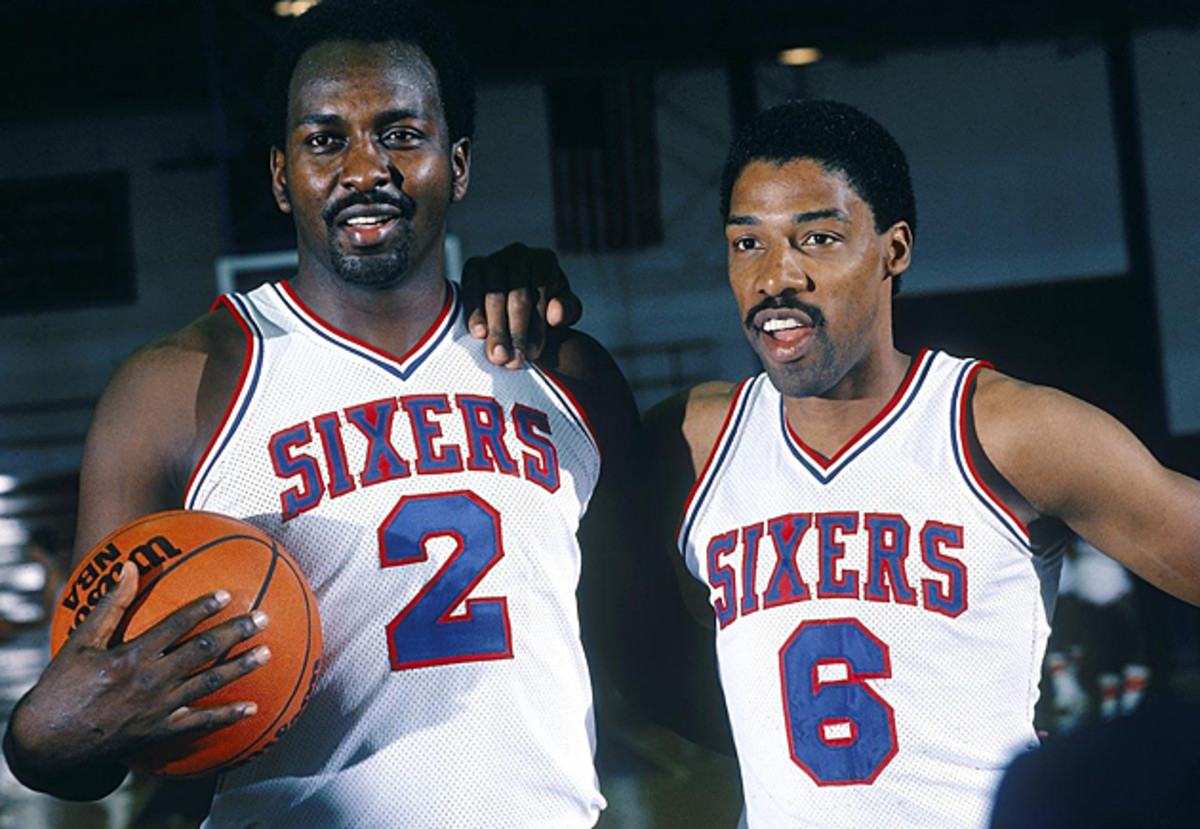
May 31, 1983: Moses Malone Gets Julius Erving a Ring

Moses Malone (left) and Julius Erving. Big Mo and Dr. J.

May 31, 1983: The Philadelphia 76ers, and Julius Erving, finally win an NBA Championship, on the massive shoulders of the man who, for most of the early 1980s, was the best basketball player in the world.

Not Erving. Not Kareem Abdul-Jabbar or Magic Johnson of the Los Angeles Lakers, whom the Sixers beat in these Finals. Not Larry Bird of the Boston Celtics, whom the Sixers beat to get into the Finals.

His name was Moses Malone.

It was a story of 2 men, who couldn't have been more different in style, but who combined to get a precious result for one of basketball's greatest cities.

Both players started out in the American Basketball Association. Erving began with the Virginia Squires in 1971, and went to the New York Nets in 1973. Known as "Doctor J," his stunning moves led the Long Island team to the ABA Championship in 1974 and 1976. But when the Nets were invited into the NBA for the 1976-77 season, the territorial indemnification fee they had to pay to the New York Knicks forced them to dump Erving's salary. They traded him to the 76ers.

The 76ers, previously the Syracuse Nationals until 1963, and NBA Champions in 1967, reached the NBA Finals in 1977, but lost it to the Portland Trail Blazers. For 1978, the team adopted the slogan of "We owe you one," but they lost the Eastern Conference Finals to the Washington Bullets.

By 1980, Erving had cut back some on the superhuman moves (but not entirely: There was a basket in that year's NBA Finals against the Lakers that got the tag "The Move"), and became a better defensive player in the process. But the 76ers again lost the Finals. They blew a 3-games-to-1 lead in the Conference Finals in 1981, to the Celtics. They beat the Celtics to get into the NBA Finals in 1982, but, again, lost to the Lakers.

It was said at the time that Dr. J had 2 "red, white and blue rings," but, still, no "real ring." And even fans in New England, Celtic fans who'd hated Philadelphia basketball teams going back to Warriors, who debuted in 1946 and moved to San Francisco in 1962, began to feel bad for him.

Enter Moses Malone. In 1974, he became the 1st player to jump from high school directly to the pros, signing with the ABA's Utah Stars. In 1976, after brief stopovers with the ABA's Spirits of St. Louis and the NBA's Buffalo Braves, he was traded to the Houston Rockets, and was named NBA Most Valuable Player in 1979 and 1982. He got the Rockets to their 1st NBA Finals berth in 1981, where they lost to the Celtics.

After the 1981-82 season, he was a free agent. The Sixers knew that enough was enough: They had to go for it, and adopt a "The future is now" attitude, and so they opened the vault for Malone. Head coach Billy Cunningham and assistant coach Matt Guokas, both rookie forwards on the 76ers' 1967 title team, now had Malone at center, Erving and Bobby Jones as forwards, and Maurice Cheeks and Andrew Toney as guards. There was good scoring, and truly rugged defense. Toney was particularly good against the Celtics, and became known as the Boston Strangler.

The Sixers went 65-17, by 7 games over the Lakers the best record in the NBA. Malone, a native of the Norfolk, Virginia area, was asked how he thought the Playoffs would go. He said, "Fo', fo', fo'." In other words, he thought the Sixers would sweep all three series in four straight games. It had never been done.

In the Conference Semifinals, the Sixers did, indeed, sweep the New York Knicks in 4 straight. Malone led the team in scoring in all 4 games: 38 points, 30, 28 and 29. Knicks coach Hubie Brown, making a point about talent, if not one about proper pronunciation, said, "Moses Malone is a real man. They cannot pay him a-nough."

The Sixers won the 1st 3 games of the Eastern Conference Finals against the Milwaukee Bucks, although none of those 3 was easy. They were 7-0 in the Playoffs. The Bucks won Game 4, 100-94, ending the sweep dream. But the Sixers closed it out in Game 5, 115-103.

The Sixers went into the NBA Finals like a steamroller. The Lakers did not: Rookie sensation James Worthy broke his leg late in the regular season, and missed the entire Playoffs. Bob McAdoo -- like Worthy, Abdul-Jabbar and Johnson, on his way to the Basketball Hall of Fame -- was also hurt, though he was playing through it.

Indeed, in a 1996 ESPN discussion as to what was the greatest team in NBA history, the '83 76ers got nominated by Roy S. Johnson, then with Sports Illustrated. But Bob Ryan of The Boston Globe, who chose the '86 Celtics, said of the '83 76ers, "There's a team out there that could have beaten them," citing the injuries to Worthy and McAdoo.

How much difference could those 2 have made? Perhaps enough to deny those Sixers entry into the "greatest team ever" conversation, but not enough to deny them the NBA title. The Sixers won Game 1 at The Spectrum, 113-107, with Malone scoring 27. They won Game 2, 103-93, with Malone scoring 24. With all the focus on Malone, Erving could relax a little, and played some of the best basketball of his career.

The series moved out to Inglewood, California. Basketball pundits like to say that a series is never over until a home team loses at least once. But the Sixers mopped up the Forum floor with the Lakers in Game 3, 111-94. Malone had 28 points and 19 rebounds. A sweep was now a fait accompli, and Malone accomplished it with 24 points and 23 rebounds in Game 4. He had controlled the entire postseason, which ended with a 115-108 76ers victory. The joke was easy: Moses had led them to the Promised Land.

Moses Malone had carved his name into the marble of NBA history, winning the MVP of both the regular season and the Finals. And Julius Erving finally had an NBA Championship. Pretty much anybody who wasn't a hardcore Laker fan was happy for him.

This closed a very productive period for Philadelphia sports. Over the past 9 years, Philly teams had reached 11 Finals, winning 4 titles. After this, though, it would take 25 years for another Philly major league team to win a World Championship, going 0-for-7 in Finals. (The Phillies lost in 1983 and 1993; the Flyers lost in 1985, 1987 and 1997; the Sixers lost in 2001; and the Eagles lost in 2005.)

The 76ers remained a strong team for 3 more years. But on June 15, 1986, team owner Harold Katz traded Malone, and they traded the top pick the Draft. They've never been the same since, making only 1 NBA Finals, in 2001 with Allen Iverson. Otherwise, with Charles Barkley, Iverson, and Joel Embiid, and under 3 different ownership regimes, the Philadelphia 76ers have been one of the most underachieving teams in North American sports.

From the NBA Finals of 1984 to that of 2021, the count of NBA Championships is as follows: Los Angeles Lakers 9, Chicago Bulls 6, San Antonio Spurs 5, Detroit Pistons 3, Boston Celtics 3, Miami Heat 3, Golden State Warriors 3, Houston Rockets 2, Dallas Mavericks 1, Cleveland Cavaliers 1, Toronto Raptors 1, Milwaukee Bucks 1. The other 18 teams, including the Philadelphia 76ers, none. And of the teams that have won since the last Sixer title, the Mavs, the Heat and the Raps didn't even exist in 1983.

"Trust the process"? The 76ers acquired James Harden in 2022, but Harden is no Moses Malone. And Embiid is no Julius Erving.

The 76ers retired Malone's Number 2, Erving's Number 6, Cheeks' Number 10, Jones' Number 24, and Cunningham's Number 32. Those men, along with Tony, executive Sonny Hill, statistician Harvey Pollack and public address announcer Dave Zinkoff, have been elected to the Philadelphia Sports Hall of Fame. So has Doug Collins, who had played on the 76ers' 1977 and 1980 NBA Finalists, but not on this team. Malone and Erving were named to the NBA's 50th and 75th Anniversary Teams. So was Cunningham, but as a player, not a coach.

It says a lot about how the 76ers have been run since that their only retired numbers since have been the 34 of Charles Barkley and the 3 of Allen Iverson; and that only those 2 and Pat Williams, the general manager of their 2001 NBA Finalists that included Iverson, have been elected to the Philadelphia Sports Hall of Fame.

*

May 31, 1983 was a Tuesday. Ordinarily, football would have been out of season. But this was the 1st year of the United States Football League. However, being a Tuesday, no games were played.

The hockey season had ended 2 weeks earlier, when the New York Islanders completed a 4-game Finals sweep over the Edmonton Oilers, to win their 4th straight Cup, making them the only team besides the Montreal Canadiens to achieve it. (The Canadiens won 5 straight, 1956-60; and 4 straight, 1976-79.) The Oiler dynasty began the next season, ending the Islander dynasty in the Finals.

These Major League Baseball games were played that day:

* The New York Yankees beat the California Angels, 5-3 at Yankee Stadium. The Yankees got 4 runs in the bottom of the 8th to win it, capped by a 2-run single by Ken Griffey Sr. Uncharacteristically, Rod Carew went 0-for-3 for the Angels, although he did draw a walk. Reggie Jackson went 1-for-3 with a walk -- for the Angels, not the Yankees.

* The New York Mets lost to the San Francisco Giants, 2-1 at Candlestick Park in San Francisco.

* The Boston Red Sox beat the Chicago White Sox, 2-1 at Fenway Park in Boston. Carl Yastrzemski, in his final season, did not play in this game.

* The Atlanta Braves beat the Pittsburgh Pirates, 10-2 at Three Rivers Stadium in Pittsburgh.

* The Cleveland Indians beat the Seattle Mariners, 5-2 at Cleveland Municipal Stadium.

* The Houston Astros beat the Chicago Cubs, 12-10 at Wrigley Field in Chicago. The wind must have been blowing out, because the Astros got home runs from Alan Ashby, Phil Garner and Tim Tolman, none of them known as sluggers. The Cubs got one from Ryne Sandberg, not yet a star.

* The Milwaukee Brewers beat the Oakland Athletics, 5-2 at Milwaukee County Stadium. Robin Yount went 1-for-2 with 2 RBIs. Paul Molitor went 1-for-4. Rickey Henderson went 1-for-4, with no stolen bases.

* The Minnesota Twins beat the Baltimore Orioles, 10-3 at the Metrodome in Minneapolis. Eddie Murray hit a home run, but Cal Ripken Jr. went 0-for-4.

* The Cincinnati Reds beat the St. Louis Cardinals, 2-1 at Busch Memorial Stadium in St. Louis.

* The Kansas City Royals beat the Texas Rangers, 6-5 at Arlington Stadium in the Dallas suburb of Arlington, Texas. George Brett went 1-for-3 with 2 walks.

* The San Diego Padres beat the Montreal Expos, 5-3 at Jack Murphy Stadium in San Diego.

* And the Los Angeles Dodgers beat the Philadelphia Phillies, 4-1 at Dodger Stadium in Los Angeles. Mike Schmidt went 0-for-3 with a walk. Joe Morgan went 0-for-4. Pete Rose only appeared as a pinch-hitter, unsuccessfully.

December 31, 1999 & January 1, 2000: The Millennium

December 31, 1999:  The Millennium arrives. The people of planet Earth survived. At a terrible cost. But we hadn't destroyed ourselves. ...