Showing posts with label lincoln memorial. Show all posts

Sunday, August 28, 2022

August 28, 1963: The March On Washington

August 28, 1963: The March On Washington for Jobs and Freedom is held at the Lincoln Memorial. A crowd usually listed as 250,000 or 300,000 attends.

It is organized by A. Philip Randolph, the leading figure of the black wing of America's labor movement, who had canceled a similar march in 1941, after getting concessions from President Franklin D. Roosevelt; and Bayard Rustin, who had organized the anti-segregation Freedom Rides in 1961.

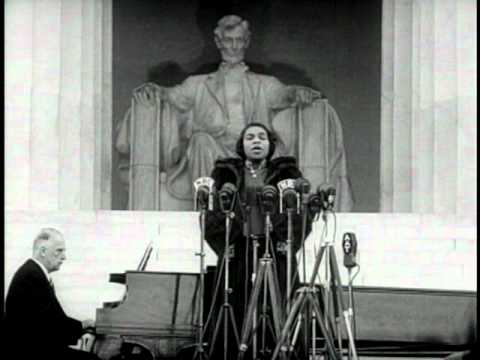
Mahalia Jackson, then America's greatest living singer of gospel music, sang "How I Got Over." Marian Anderson, who had sung at the Lincoln Memorial in an Easter concert before 75,000 in 1939, sang "He's Got the Whole World in His Hands."

Joan Baez sang "We Shall Overcome," Bob Dylan sang, "Only a Pawn in Their Game," and, then a couple, together they sang Bob's song "When the Ship Comes In." Peter, Paul and Mary sang "If I Had a Hammer" and Bob's song "Blowin' in the Wind." Odetta sang "I'm On My Way."

Other celebrities on hand: Singers Josephine Baker, Harry Belafonte, Sammy Davis Jr., Diahann Carroll, Lena Horne, Judy Garland and Bobby Darin; actors Sidney Poitier, Marlon Brando, Burt Lancaster, James Garner, Robert Ryan, Rita Moreno, married couple Ossie Davis and Ruby Dee, married couple Paul Newman and Joanne Woodward, and, surprising many people only old enough to remember him as a conservative and a gun-rights advocate, Charlton Heston; novelist James Baldwin; and baseball trailblazer Jackie Robinson.

The speakers were, in order: Randolph; Walter Reuther, the President of the United Auto Workers (UAW), who'd been bringing black leaders into the labor movement since the 1930s; Roy Wilkins, the Executive Director of the National Association for the Advancement of Colored People (NAACP); John Lewis, the Chairman of the Student Nonviolent Coordinating Committee (SNCC); Daisy Bates, a journalist in Little Rock, Arkansas, who had aided the Little Rock Nine in 1957; Dr. Eugene Carson Blake, of the United Presbyterian Church and the National Council of Churches; Floyd McKissick, the National Director of the Congress of Racial Equality (CORE); Whitney Young, President of the National Urban League; and the Rev. Dr. Martin Luther King Jr., Chairman of the Southern Christian Leadership Conference (SCLC).

Dr. King's speech lasted 17 minutes, and turned out to be the highlight of the demonstration. Already famous since his role in the Montgomery Bus Boycott in Alabama in 1955 and '56, he had written Letter from Birmingham Jail earlier in the year, so his speech was highly anticipated.

Early in his speech, he said some things that many white Americans did not want to hear -- and probably still don't, because they are largely still true:

In a sense, we have come to our Nation’s Capital to cash a check. When the architects of our great republic wrote the magnificent words of the Constitution and the Declaration of Independence, they were signing a promissory note to which every American was to fall heir.
This note was a promise that all men, yes, black men as well as white men, would be guaranteed the inalienable rights of life, liberty, and the pursuit of happiness.
It is obvious today that America has defaulted on this promissory note insofar as her citizens of color are concerned. Instead of honoring this sacred obligation, America has given its colored people a bad check, a check that has come back marked "insufficient funds."
But we refuse to believe that the bank of justice is bankrupt. We refuse to believe that there are insufficient funds in the great vaults of opportunity of this nation. So we have come to cash this check, a check that will give us upon demand the riches of freedom and security of justice.
A little later, he said, confronting the differing challenges of South and North:
We cannot be satisfied as long as a colored person in Mississippi cannot vote, and a colored person in New York believes he has nothing for which to vote.
No, no, we are not satisfied, and we will not be satisfied until justice rolls down like waters and righteousness like a mighty stream.
It sounded pretty radical then. In some places in this country, it would be radical now.
When he seemed to be wrapping up, Mahalia Jackson remembered a speech he had given a few weeks earlier, at Cobo Hall in Detroit, in which he spoke of a dream he had. She said, "Martin, tell them about the dream." He did:
I still have a dream. It is a dream deeply rooted in the American dream. I have a dream that, one day, this nation will rise up and live out the true meaning of its creed: "We hold these truths to be self-evident that all men are created equal."
I have a dream that, one day, out in the red hills of Georgia, the sons of former slaves and the sons of former slaveowners will be able to sit down together at the table of brotherhood.

I have a dream that, one day, even the state of Mississippi, a State sweltering with the heat of oppression, will be transformed into an oasis of freedom and justice.


I have a dream that my four little children will, one day, live in a nation where they will not be judged by the color of their skin but by the content of their character. I have a dream today.

He went on a little longer with this point. And his closing was unforgettable: 

And if America is to be a great nation, this must become true. So let freedom ring from the hilltops of New Hampshire. Let freedom ring from the mighty mountains of New York. Let freedom ring from the heightening Alleghenies of Pennsylvania. Let freedom ring from the snow-capped Rockies of Colorado. Let freedom ring from the curvaceous slopes of California.

But, not only that, let freedom ring from Stone Mountain of Georgia. Let freedom ring from Lookout Mountain of Tennessee. Let freedom ring from every hill and molehill of Mississippi.

"My country, 'tis of thee, sweet land of liberty, of thee I sing. Land where my fathers died. Land of thy pilgrims' pride. From every mountainside, let freedom ring."

When we let freedom ring, when we let it ring from every tenement and every hamlet, from every State and every city, we will be able to speed up that day when all of God’s children, black men and white men, Jews and Gentiles, Protestants and Catholics, will be able to join hands and sing in the words of the old spiritual, "Free at last, free at last. Thank God Almighty, we are free at last."

Watching the speech on television, President John F. Kennedy told the others in the room, "He's damn good." Afterward, Dr. King was among the figures from the demonstration invited to meet him at the White House. Despite everything revolving around JFK, from his civil rights work to his Cold War ups and downs to his assassination, it would be MLK who was named Time magazine's Man of the Year, making him the 1st black person, of any nationality, so designated.

Martin Luther King was assassinated in 1968. Walter Reuther was killed in a plane crash in 1970, which may have been the result of sabotage, and thus also an assassination. Whitney Young lived until 1971, A. Philip Randolph until 1979, Roy Wilkins until 1981, Eugene Carson Blake until 1985, Floyd McKissick until 1991, and Daisy Bates until 1999.

The last survivor among the speakers was John Lewis. Among the victims of the police attack on civil rights demonstrators in Selma, Alabama in 1965, he was elected to Congress from an Atlanta-based district in 1986, and led anniversary celebrations at the Lincoln Memorial and at Selma's Edmund Pettus Bridge for as long as he could, until he made his march to Heaven in 2020.

In another speech, Dr. King said, "The arc of the moral universe is long, but it bends toward justice." Some of his dream has come true. This nation is the better for it. But hardly all of it. And, in many ways, the nation still suffers for that.

The comedy team of Key & Peele starred in a 2013 episode of the YouTube series Epic Rap Battles of History, with Keegan-Michael Key playing Gandhi, and Jordan Peele playing Gandhi's most famous follower, Martin Luther King Jr. One would think they wouldn't have been rivals, but, as Gandhi, Key started with, "You want to battle wits? So who's the better pacifist? I fought the caste system, but you still cannot touch this!" And, as King, Peele said, "I admire the way you broke the British power, but I have a dream that, one day, you'll take a shower!"

*

I don't know why this demonstration was scheduled for a Wednesday afternoon, instead of a weekend. There were baseball games scheduled for this day, and these were the results:

* The New York Yankees beat the Boston Red Sox, 4-1 at Yankee Stadium. The Yankees hit no home runs. The only Boston run came on a homer by Dick Stuart, the slugging 1st baseman whose fielding was so bad, he was known as "Dr. Strangeglove."

Whitey Ford pitched a complete game, outpitching Earl Wilson. In spite of the Red Sox' poor record on race relations, a year earlier, pitching for them, Wilson became the 1st black pitcher to throw a no-hitter in the American League. (The 1st in the National League was Sam Jones of the Chicago Cubs, in 1959. Like an earlier white Yankee pitcher named Sam Jones, he was known as Sad Sam.)

* The New York Mets lost to the Pittsburgh Pirates, 7-2 at Forbes Field in Pittsburgh.

* The Baltimore Orioles beat the Kansas City Athletics, 3-1 at Memorial Stadium in Baltimore.

* The Chicago White Sox swept a doubleheader from the Cleveland Indians at Cleveland Municipal Stadium, winning the 1st game 8-3, and the 2nd game 3-1.

* The Detroit Tigers beat the Los Angeles Angels, 2-1 at Tiger Stadium in Detroit.

* The Philadelphia Phillies beat the Chicago Cubs, 8-7 at Wrigley Field in Chicago.

* The Milwaukee Braves beat the Houston Colt .45s (who became the Astros in 1965), 9-1 at Colt Stadium in Houston.

* The Cincinnati Reds beat the Los Angeles Dodgers, 9-5 at Dodger Stadium.

* And the San Francisco Giants beat the St. Louis Cardinals, 5-3 at Candlestick Park in San Francisco. 

Monday, May 30, 2022

May 30, 1922: The Lincoln Memorial Is Dedicated

May 30, 1922: The Lincoln Memorial is dedicated in Washington, D.C. The monument to the 16th President of the United States, who defeated the Confederate States of America, ended slavery, and restored the Union was designed by Henry Bacon. His seated statue inside was sculpted by Daniel Chester French.

Inside the south wall of the statue's chamber is an inscription of his Gettysburg Address of November 19, 1863; inside the north wall, one from his Second Inaugural Address of March 4, 1865. Above the statue is an inscription written by American historian Royal Cortissoz: "In this temple, as in the hearts of the people for whom he saved the Union, the memory of Abraham Lincoln is enshrined forever."
There are a total of 87 steps: 29 from the Reflecting Pool to the Plaza, and 58 steps from the Plaza to the chamber. The Memorial It has 36 columns, representing each of the 36 States in the Union in 1865, including the ones in rebellion. There are 48 festoons above the columns, representing the 48 States in the Union in 1922.

President Warren G. Harding speaks at the dedication ceremony. So does the Chief Justice of the United States, former President William Howard Taft, who had been head of the commission to build it. The other living former President, Woodrow Wilson was ill, and did not attend.

Black people were permitted to attend, in a segregated section guarded by U.S. Marines.

Robert Todd Lincoln, the sole surviving child of Abraham Lincoln, did not want to attend. He had been nearby when his father was assassinated in 1865. He had been in the room when President James Garfield was assassinated in 1881. He had been nearby when President William McKinley was assassinated in 1901. He did not want to jinx another President. Harding and Taft talked him into coming.

On August 2, 1923, Harding died -- not from an assassination, but a heart attack. Robert Todd Lincoln swore he would never meet another President, and died in 1926 without doing so.

In 1929, the $5 bill was redesigned, with Lincoln's portrait on the front, and his Memorial on the back. In 1909, the 100th Anniversary of his birth, the Lincoln Penny replaced the Indian Head Penny. In 1959, the 150th Anniversary of his birth, the back side of the Lincoln Penny, which had stalks of wheat since its introduction in 1909, was replaced with the Memorial.

The Memorial has been the site of many demonstrations, including:

* April 9, 1939: Marian Anderson's nationally-broadcast Easter Concert, after she was denied the right to sing at nearby Constitution Hall.
* August 28, 1963: The March On Washington for Jobs and Freedom, highlighted by the "I Have a Dream" speech by Dr. Martin Luther King, with an inscription now on the spot where he delivered it. Marian Anderson also sang there in that ceremony.
* October 21, 1967: A demonstration against the Vietnam War, a fictionalized version of which was depicted in the film Forrest Gump.
* July 4, 1970: A "counter-counterculture" demonstration, a "celebrate America" event headlined by President Richard Nixon, and clergymen like the Rev. Billy Graham and Bishop Fulton Sheen.

Other notable memorials to Lincoln a statue of him outside the Essex County Courthouse in Newark, New Jersey, sculpted by Gutzon Borghlum, who later had Lincoln's face carved on Mount Rushmore outside Rapid City, South Dakota, along with those of George Washington, Thomas Jefferson and Theodore Roosevelt.
A commemorative issue of Time magazine, 1960,
for the 100th Anniversary of Lincoln's election

The capital of the State of Nebraska is named for Lincoln. Countless other towns are named for him. Schools in black neighborhoods were named for him, as is the high school in Brooklyn that represents the neighborhoods of Brighton Beach and Coney Island. There was a Lincoln Highway, stretching from Times Square in New York to Lincoln Park in San Francisco. The Lincoln Tunnel goes under the Hudson River, connecting Manhattan to Weehawken, New Jersey.

Ford Motor Company issued a line of luxury cars named Lincoln. When he became Vice President in 1973, Gerald Ford -- not related to that Ford family -- told the nation, "I'm a Ford, not a Lincoln." When the laughter inside the Capitol subsided, he added, "My addresses will never be as eloquent as Mr. Lincoln's. But I will do my very best to equal his brevity and his plain speaking."

Ford became President the following year, and, in 1976, running for a term of his own, campaigned aboard a customized Amtrak car named the Honest Abe. Since 1909, the 100th Anniversary of his birth, Lincoln has appeared on the penny, America's one-cent coin. Since 1914, he has appeared on the $5 bill. On October 14, 2004, 139 years after his death, the Abraham Lincoln Presidential Library and Museum opened in his adopted hometown of Springfield, Illinois.

There have been 2 ships named the USS Abraham Lincoln: A submarine in service from 1961 to 1981, and a nuclear-powered aircraft carrier, CVN-72, a.k.a. the Abe, in service since 1988. There was a troop transport named USS President Lincoln, sunk by German torpedoes in World War I in 1918.

Just as more books have been written about Lincoln than any other American, so have more films been made about him. Among the actors who have played him: Francis Ford in 9 silent films from 1909 to 1915, Walter Huston (father of John, grandfather of Anjelica) in Abraham Lincoln in 1930, Frank McGlynn in 5 films in 1936 and '37, John Carradine in Of Human Hearts in 1938, Henry Fonda in Young Mr. Lincoln in 1939, Raymond Massey in Abe Lincoln in Illinois in 1940 and How the West Was Won in 1962, Hal Holbrook in Carl Sandburg's Lincoln in 1974 and North and South in 1985, Gregory Peck in The Blue and the Gray in 1982, Sam Waterston in Gore Vidal's Lincoln in 1988, Lance Henriksen in The Day Lincoln Was Shot in 1998, Brendan Fraser in Bedazzled in 2000, Glenn Beck in National Treasure: Book of Secrets in 2007, and Daniel Day-Lewis in Lincoln in 2012.

Even science fiction, fantasy and time travel stories have gotten in on the act: Austin Green on The Twilight Zone in 1961, Robert Marsden on Doctor Who in 1965, Lee Bergere on Star Trek in 1969, Robert V. Barron in Bill & Ted's Excellent Adventure in 1989, David Selby on Touched By an Angel in 1998, David Livingstone on Supernatural in 2009, Benjamin Walker in Abraham Lincoln: Vampire Hunter, both in 2012, and Michael Krebs on Timeless in 2016.

Though born in Kentucky, Lincoln was the 1st President to represent Illinois. He is usually listed as 1 of the 3 greatest Presidents, along with George Washington and Franklin Delano Roosevelt, so he is still the greatest politician from Illinois.

Hugh McCulloch was the last survivor of Lincoln's Cabinet. He served as Secretary of the Treasury for the length of what was meant to be Lincoln's 2nd term, including under the next President, Andrew Johnson, 1865-69. He briefly returned to the office, 1884-85, under President Chester Arthur. He lived until 1895.

In a 2010 episode of the YouTube series Epic Rap Battles of History, "Nice" Peter Shukoff played Lincoln, against "Epic" Lloyd Ahlquist as actor and martial arts master Chuck Norris.

*

May 30, 1922 was a Tuesday. It was also Memorial Day: Until 1970, Memorial Day was celebrated on May 30, regardless of the day of the week. Since 1971, it has been on the last Monday in May, regardless of the date: It can be anywhere from May 25 to May 31.

Football, basketball and hockey were out of season. These baseball games were played that day, many of them doubleheaders, as was once traditional for baseball on Memorial Day:

* The New York Yankees split a doubleheader with the Philadelphia Athletics at the Polo Grounds. The Yankees won the opener, 3-2, behind Hall of Fame pitcher Waite Hoyt. The A's won the nightcap, 4-3, with Fred Heimach outpitching Bob Shawkey. Babe Ruth went 3-for-8 in the doubleheader, including a home run in a losing cause in the nightcap.

* The New York Giants split a doubleheader with the Philadelphia Phillies at Baker Bowl in Philadelphia. The Phils won the 1st game, 9-8 in 10 innings. The Jints won the 2nd game, 16-7.

* The Brooklyn Robins (as the Dodgers were known during Wilbert Robinson's tenure as manager, 1914-31) swept a doubleheader from the Boston Braves at Ebbets Field, 9-3 and 8-4.

* The Washington Senators swept a doubleheader from the Boston Red Sox at Fenway Park, 7-4 and 5-3. Amazingly, they did it without Walter Johnson pitching in either game.

* A doubleheader was split at Forbes Field in Pittsburgh. The Cincinnati Reds won the 1st game, 9-3. The Pittsburgh Pirates won the 2nd game, 7-3.

* The Chicago White Sox swept a doubleheader from the Cleveland Indians at League Park in Cleveland, 4-0 and 7-6. Gorham "Dixie" Leverett pitched a 6-hit shutout in the opener. Tris Speaker was 1-for-6 with 2 walks over the 2 games.

* The Chicago Cubs swept the St. Louis Cardinals, 4-1 and 3-1 at Cubs Park in Chicago. (It was renamed Wrigley Field in 1926.)

* And a doubleheader was split at Sportsman's Park in St. Louis. The Detroit Tigers won the 1st game, 6-5. The St. Louis Browns won the 2nd game, 2-1 in 16 innings. Over the 2 games, George Sisler went 6-for-10 for the Browns, while Ty Cobb, also the Tigers' manager at the time, was injured and didn't put himself in either game.

Saturday, April 9, 2022

April 9, 1939: Marian Anderson at the Lincoln Memorial

April 9, 1939: For the 1st time, the Lincoln Memorial in Washington, D.C. is used as the setting for a statement in favor of civil rights in America. It will not be the last.

Marian Anderson was born on February 27, 1897 in Philadelphia. By 1923, she had begun her professional singing career; by 1930, she had become the 1st great black American female opera singer. She began touring Europe in 1933. In 1935, after hearing her sing in Salzburg, Austria, hometown of Wolfgang Amadeus Mozart, the Italian conductor Arturo Toscanini, notoriously perfectionist with the musicians he led, told her, "You have a voice heard once in a hundred years."

But she was still turned away from many performance venues and hotels because of her race. In 1937, this happened in Princeton, New Jersey. A professor at Princeton's Institute for Advanced Study heard about this, and invited her to his own home. His name was Albert Einstein, and they remained friends for the rest of Einstein's life.

Anderson's manager, Sol Hurok, tried to book her for a concert at Constitution Hall in Washington, D.C. on Easter Sunday, April 9, 1939. But the Hall was operated by the Daughters of the American Revolution. Not the of the Confederacy, but of the American Revolution. The DAR denied her the right to sing there.

Calls were made. First Lady Eleanor Roosevelt resigned from the DAR in protest. And the Richmond Times-Dispatch -- the paper of the city that had been the capital of the Confederacy -- editorialized, "In these days of racial intolerance so crudely expressed in the Third Reich, an action such as the D.A.R.'s ban... seems all the more deplorable." Deplorable. Sound familiar?

Mrs. Roosevelt told her husband. President Franklin D. Roosevelt the Secretary of the Interior, Harold Ickes, who had authority over federally-owned land, to authorize an open-air free concert for Anderson at the Lincoln Memorial. He did.

Accompanied as usual by Kosti Vehanen, a pianist from Finland, Anderson faced a crowd of 75,000, and a national radio audience of millions, and began her performance with "My Country, 'Tis of Thee." (Also known as "America," this song uses the same melody as Britain's National Anthem, "God Save the (King or Queen).")

She also sang Franz Schubert's arrangement of "Ave Maria," Gaetano Donizetti's "Oh mio Fernando," "The Gospel Train," "My Soul Is Anchored in the Lord," and "Tramping."

In 1943, with World War II raging, the DAR relented, and let Anderson sing before an integrated audience at Constitution Hall, as part of a benefit for the American Red Cross. On June 15, 1953, in New York, she was one of the performers on a 50th Anniversary show for the Ford Motor Company, and 60 million viewers saw her sing "He's Got the Whole World In His Hands" and "The Battle Hymn of the Republic." On January 7, 1955, she became the 1st black person to sing with the Metropolitan Opera in New York.

She sang at the Inaugurations of Presidents Dwight D. Eisenhower in 1957 and John F. Kennedy in 1961, and Kennedy invited her to sing in the East Room of the White House in 1962. On August 28, 1963, the March On Washington for Jobs and Freedom set a new record for largest crowd at the Lincoln Memorial: About 300,000 people heard, among other things, Martin Luther King's "I have a dream" speech and songs by Marian Anderson. She died on April 8, 1993, at the age of 76.

*

April 9, 1939 was a Sunday. Actress Michael Learned was born on this day.

Major League Baseball opened its season 11 days later. Football was out of season. The NBA hadn't been founded yet. The only game was Game 2 of the Stanley Cup Finals: The Toronto Maple Leafs beat the Boston Bruins, on Doc Romnes' goal at 9:22 left in the 1st overtime.

December 31, 1999 & January 1, 2000: The Millennium

December 31, 1999:  The Millennium arrives. The people of planet Earth survived. At a terrible cost. But we hadn't destroyed ourselves. ...