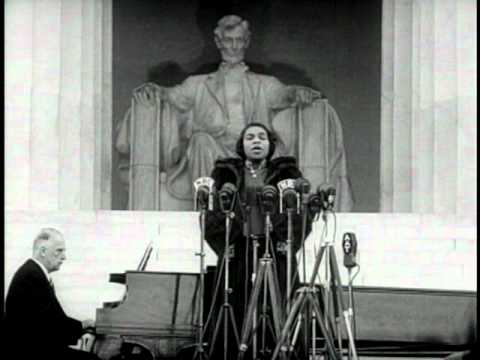
April 9, 1939: For the 1st time, the Lincoln Memorial in Washington, D.C. is used as the setting for a statement in favor of civil rights in America. It will not be the last.
Marian Anderson was born on February 27, 1897 in Philadelphia. By 1923, she had begun her professional singing career; by 1930, she had become the 1st great black American female opera singer. She began touring Europe in 1933. In 1935, after hearing her sing in Salzburg, Austria, hometown of Wolfgang Amadeus Mozart, the Italian conductor Arturo Toscanini, notoriously perfectionist with the musicians he led, told her, "You have a voice heard once in a hundred years."
But she was still turned away from many performance venues and hotels because of her race. In 1937, this happened in Princeton, New Jersey. A professor at Princeton's Institute for Advanced Study heard about this, and invited her to his own home. His name was Albert Einstein, and they remained friends for the rest of Einstein's life.
Anderson's manager, Sol Hurok, tried to book her for a concert at Constitution Hall in Washington, D.C. on Easter Sunday, April 9, 1939. But the Hall was operated by the Daughters of the American Revolution. Not the of the Confederacy, but of the American Revolution. The DAR denied her the right to sing there.
Calls were made. First Lady Eleanor Roosevelt resigned from the DAR in protest. And the Richmond Times-Dispatch -- the paper of the city that had been the capital of the Confederacy -- editorialized, "In these days of racial intolerance so crudely expressed in the Third Reich, an action such as the D.A.R.'s ban... seems all the more deplorable." Deplorable. Sound familiar?
Mrs. Roosevelt told her husband. President Franklin D. Roosevelt the Secretary of the Interior, Harold Ickes, who had authority over federally-owned land, to authorize an open-air free concert for Anderson at the Lincoln Memorial. He did.
Accompanied as usual by Kosti Vehanen, a pianist from Finland, Anderson faced a crowd of 75,000, and a national radio audience of millions, and began her performance with "My Country, 'Tis of Thee." (Also known as "America," this song uses the same melody as Britain's National Anthem, "God Save the (King or Queen).")
She also sang Franz Schubert's arrangement of "Ave Maria," Gaetano Donizetti's "Oh mio Fernando," "The Gospel Train," "My Soul Is Anchored in the Lord," and "Tramping."
In 1943, with World War II raging, the DAR relented, and let Anderson sing before an integrated audience at Constitution Hall, as part of a benefit for the American Red Cross. On June 15, 1953, in New York, she was one of the performers on a 50th Anniversary show for the Ford Motor Company, and 60 million viewers saw her sing "He's Got the Whole World In His Hands" and "The Battle Hymn of the Republic." On January 7, 1955, she became the 1st black person to sing with the Metropolitan Opera in New York.
She sang at the Inaugurations of Presidents Dwight D. Eisenhower in 1957 and John F. Kennedy in 1961, and Kennedy invited her to sing in the East Room of the White House in 1962. On August 28, 1963, the March On Washington for Jobs and Freedom set a new record for largest crowd at the Lincoln Memorial: About 300,000 people heard, among other things, Martin Luther King's "I have a dream" speech and songs by Marian Anderson. She died on April 8, 1993, at the age of 76.
*
April 9, 1939 was a Sunday. Actress Michael Learned was born on this day.
Major League Baseball opened its season 11 days later. Football was out of season. The NBA hadn't been founded yet. The only game was Game 2 of the Stanley Cup Finals: The Toronto Maple Leafs beat the Boston Bruins, on Doc Romnes' goal at 9:22 left in the 1st overtime.


No comments:
Post a Comment