Showing posts with label tris speaker. Show all posts

Thursday, October 27, 2022

October 28, 1913: Christy Mathewson vs. Walter Johnson

Walter Johnson (left) and Christy Mathewson

October 28, 1913: In the only time the 2 greatest pitchers of their time face each other -- baseball would have no All-Star Game until 1933, and no Interleague Play until 1997, and they never faced each other in a World Series -- Walter Johnson and Christy Mathewson square off, at South Main Park in Tulsa‚ Oklahoma.

Normally, Johnson pitched for the Washington Senators. This time, he is backed by the Chicago White Sox‚ with the addition of another superstar, Boston Red Sox center fielder Tris Speaker. Johnson wins the battle‚ as the White Sox beat the New York Giants, 6-0. Johnson went the distance, striking out 8, while Matty exited after 4 innings.

Speaker and White Sox regular Buck Weaver did the hitting for the Pale Hose‚ while Oklahoma native, Sac and Fox Indian, and fan favorite Jim Thorpe got 2 hits for the Giants off Johnson. 

The game had been delayed for nearly 2 hours when the stands collapsed‚ injuring 52 people and killing a soldier. Governor R.L. Williams of Oklahoma narrowly escaped injury in the tragedy.

This was part of a world tour undertaken by the Giants and White Sox from late October 1913, after the Giants lost the World Series to the Philadelphia Athletics, until February 1914, through the Western United States, then to Asia, Australia, Egypt and Europe, although some of their intended games were rained out.

Mathewson won more games in the 1900s (1900 through 1909) than any other pitcher: 236. Johnson was the winningest pitcher of the 1910s: 265. Each would be among the 1st 5 inductees into the Baseball Hall of Fame in 1936, along with Ty Cobb, Babe Ruth and Honus Wagner. Unfortunately, both men would die too soon: Mathewson from tuberculosis in 1925, at the age of 45; Johnson from a brain tumor in 1946, at 59.

*

October 28, 1913 was a Tuesday. Football was in midweek. Professional basketball barely existed. And it was too early for hockey season. So this was the only score on this historic day.

Monday, October 10, 2022

October 10, 1920: The Bill Wambsganss Game

Bill Wambganss, wearing the special uniform
that the Cleveland Indians wore in 1921

October 10, 1920: Perhaps the most eventful game in World Series history unfolds at League Park in Cleveland, and we barely even have photographs of it. No film. Radio broadcasting was in the process of being invented. Television was still just an idea. The Internet wasn't yet an idea.

The American League Champions, the Cleveland Indians, were hosting the National League Champions, the Brooklyn Robins. The name "Dodgers" had already been used, but, since 1914, their manager had been Wilbert Robinson, a former star catcher, and so they were the "Robins," just as the Indians had been the "Naps" from 1903 to 1914, in honor of 2nd baseman and manager Napoleon "Nap" Lajoie.
In the 1950s, it would be a joke that the Dodgers had everything but a left fielder, but in their Robins days, their best hitter was their left fielder. Zack Wheat would finish his career with a .317 batting average and 2,884 hits, 2,804 of them with Brooklyn. After 100 years, this remains a Dodger franchise record. To put this Hall-of-Famer into perspective: According to Baseball-Reference.com, a website which is your friend whether you know it or not, his 2 most statistically similar players are Tony Gwynn and Roberto Clemente.
They had 2 Hall of Fame pitchers: Richard "Rube" Marquard, a former star with their arch-rivals, the New York Giants; and Burleigh Grimes, a pitcher with a nasty spitball and a personality to match. On May 1, at Braves Field in Boston, they played the longest game in Major League Baseball history. Leon Cadore started for the Robins, and Joe Oeschger started for the Braves. The game went 26 innings before it was called due to darkness, tied 1-1. Both starters went the distance.
Burleigh Grimes

Cadore, who had also pitched for the Robins on their 1916 Pennant winners, was held out of his next start, and pitched less than 5 innings in his next one. But he pitched a complete-game shutout in his next, and ended the season at 15-14 with a 2.26 ERA. Oeschger, who had pitched for the Philadelphia Phillies' Pennant winners of 1915, was held out of his next 2 starts, and lost his next 2, but was fine, going 15-13 for a 62-90 team, with a 3.46 ERA.

The Indians were managed by Tris Speaker, still their center fielder, and one of the greatest players in the history of the game. A .345 career hitter, he would collect 3,514 hits, 792 of them doubles, which is still an all-time record. And, until Joe DiMaggio came along, he was regarded as the greatest defensive outfielder ever. He had already helped the Boston Red Sox win the World Series in 1912 and 1915.
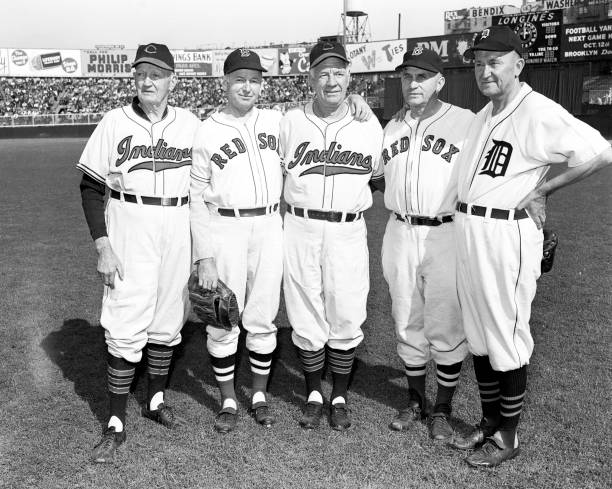
Speaker at an old-timers game in 1947

They also had a Hall of Fame pitcher, Stan Coveleski. Like Grimes, he threw a spitball. A son of Polish immigrants, he had escaped the Pennsylvania coal mines, and, when interviewed by Lawrence Ritter for his book The Glory of Their Times in the 1960s, he would say, "Lord, baseball is a worrying thing."
On August 16, the Indians went to the Polo Grounds in New York to play the Yankees, who were in their 1st season with Babe Ruth. Yankee pitcher Carl Mays hit Indian shortstop Ray Chapman in the head with a pitch. The impact was so hard that the ball came right back to Mays, and he threw it to 1st base, because he thought Chapman had hit it.

Chapman got up, and told catcher Wally Schang, "I'm all right. Tell Mays not to worry." He started toward 1st, and collapsed. He was taken to a hospital, and died the next day. He remains baseball's only player to die as the result of an in-game injury. Mays lived until 1971, insisting that he hadn't hit Chapman intentionally. Others backed that up, including Chapman's teammates, who admitted that he crowded the plate at times.
The Indians wore black armbands on their sleeves for the rest of the season, and would dedicate a monument to Chapman, which now stands in the Heritage Park section behind center field at Progressive Field.
Baseball would respond to Chapman's death by supplying umpires with far more balls, and ordering them to throw balls out if they looked too dirty, and thus insufficiently visible. They also outlawed the various altered -- or "doctored" -- pitches that fell under the umbrella category of "spitball." But they allowed 17 pitchers, including Cleveland's Coveleski and Brooklyn's Grimes, to continue throwing the spitball because it was their "bread-and-butter," or what we would call today their "out pitch."

Chapman's replacement was rookie Joe Sewell, and he ended up being a big reason why the Indians edged the Yankees and the Chicago White Sox for the Pennant. The suspension of 7 White Sox players for throwing the previous year's World Series -- an 8th, Chick Gandil, had already retired -- helped the Indians. 
Joe Sewell

It was the 1st Pennant ever won by a Cleveland team. The Robins/Dodgers had won their 1st Pennant in 20 years.

*

Game 1 was played on October 5 at Ebbets Field. In a game that lasted just 1 hour and 41 minutes, Stan Coveleski outpitched Rube Marquard, and a pair of RBI doubles by Steve O'Neill gave the Indians a 3-1 win. Burleigh Grimes pitched a shutout in Game 2, and the Robins won 3-1. The Dodgers took the lead in the Series in Game 3, when Sherry Smith outpitched Ray Caldwell, and Brooklyn won 2-1.

The Robins/Dodgers would not take a games lead in a World Series again for 33 years. The series moved to Cleveland, and the Indians knocked Leon Cadore out in the 1st inning. In spite of that, their win turned out to be just 5-1, but the Series was tied. Game 5 would be the one for the ages.
League Park, built 1910, torn down 1951.
A previous ballpark had stood there from 1891 to 1909.

In the bottom of the 1st inning, Grimes gives up hits to Charlie Jamieson, Bill Wambsganss, and center fielder/manager/legend Tris Speaker. Tribe outfielder Elmer Smith then hits the 1st grand slam in Series history.
Elmer Smith

In the 3rd‚ Jim Bagby comes up with 2 on, and crashes another Grimes delivery for a 3-run blast‚ the 1st home run ever by a pitcher in Series play.
Jim Bagby

In the 5th, with Pete Kilduff on 2nd and Otto Miller on 1st with nobody out, Robins reliever Clarence Mitchell bats for himself, and hits a line drive, right at 2nd baseman Wambsganss. One out. "Wamby" takes a couple of steps, and tags Kilduff before he can get back to 2nd base. Two out. Then Wambsganss tags the off-and-running Miller, before he can see what's happening and get back to 1st base. Three out.

An unassisted triple play. And, 102 years later, this remains the only triple play of any kind in World Series history.
The only known photo of the play

The Indians win the game, 8-1, and their 1st appearance in the World Series will soon be a successful one. Duster Mails outpitched Sherry Smith for a 1-0 Cleveland win in Game 6. in Game 1. The Series went back to Brooklyn for Game 7 and a potential Games 8 and 9, but on October 12, 1920, Game 7 was won 3-0, as Coveleski pitched a shutout to beat Grimes, whose error allowed the deciding run.

Wambsganss, suddenly nationally famous, later lamented that he had a pretty good career (and a case can be made that he was right), but that, for most people, he might as well have been born the day before this game and died the day after.

As it turned out, Wamby died on December 8, 1985, in a suburb of Cleveland, where he'd lived all his life, making him 89 years old.

The last living player from this game was Joe Sewell, the man who had been called up after Ray Chapman had been killed. Sewell went on to a Hall of Fame career, including helping the Yankees win the 1932 World Series, and lived until 1990.

The Indians began to split their home games in 1932, with their bigger-attendance games, and eventually their night games, at Cleveland Municipal Stadium. They last played at League Park in 1946, and it was demolished in 1951. The only surviving part is the ticket booth, outside the right field corner.

Today, a baseball field is on the site, and the City of Cleveland has named the facility "League Park." 
Cleveland was World Champions. Brooklyn would have to wait.

On the other hand, in the 102 years since, the Indians have won just 1 more World Series, while the Dodgers have 7.

UPDATE: Through the 2025 season, the Dodgers have 10 World Series wins since 1920; the Guardians, still just 1, in 1948.

The Guardians have a team Hall of Fame. From the 1920 World Champions, they have honored Tris Speaker, Stan Coveleski, Steve O'Neill, Jim Bagby Sr., Charlie Jamieson, Joe Sewell, and, it should be said, Ray Chapman.

From their start in 1901 until 1919, but not including 1920, they have honored Cy Young, Nap Lajoie, Addie Joss, Bill Bradley (not the Knicks star turned Senator), Elmer Flick, Jack Graney and "Shoeless" Joe Jackson.

From the period between the 1920 and 1948 titles, they have honored Wes Ferrell, Mel Harder, Earl Averill and Hal Trosky.

Bradley, Flick, Speaker, Wambsganss, O'Neill and Harder have also been elected to the Greater Cleveland Sports Hall of Fame. That Hall has also honored a few Indians who were from Cleveland or nearby: Bradley, Wambsganss, Hegan, 1910s catcher Paddy Livingston, 1910s shortstop Roger Peckinpaugh, 1930s 2nd baseman Ray Mack, and 1930s left fielder Joe Vosmik.

*

October 10, 1920 was a Sunday. Frank Sinkwich was born on this day. He won the Heisman Trophy as a University of Georgia running back in 1942, and later played for the Detroit Lions.

It was the 2nd week of competition for the newly-founded American Professional Football Association, which was renamed the National Football League the next season. On this day:

* The Decatur Staleys beat the Kewanee Walworths, 25-7 at Staley Field in Decatur, Illinois. The next season, the Staleys became the Chicago Bears. The Walworths, from western Illinois, soon folded.

* The Chicago Cardinals played the Chicago Tigers to a 0-0 tie, at Cubs Park, which was renamed Wrigley Field in 1926. The Tigers soon went out of business. The Cardinals moved to St. Louis in 1960 and Arizona in 1988.

* The Green Bay Packers were founded in 1919, but did not join the NFL until 1921. All teams mentioned after this ended up folding before the 1920s were out.

* The Canton Bulldogs beat the Toledo Maroons, 42-0 at Lakeside Park in Canton.

* The Akron Pros beat the Columbus Panhandles, 37-0 at League Park in Akron. The Pros would go on to win the league's 1st Championship.

* The Buffalo All-Americans beat a team called "All-Buffalo" at Canisius Field, on the campus of Canisius University in Buffalo.

* The Cleveland Tigers and the Dayton Triangles played to a 0-0 tie, at Triangle Park in Dayton.

* The Detroit Heralds beat the Cleveland Panthers, 40-14 at Navin Field in Detroit. It was renamed Briggs Stadium in 1938, and Tiger Stadium in 1961. In the 1950s and '60s, Detroit and Cleveland would be a great NFL rivalry, but that would be the Lions and the Browns, respectively, not the Heralds and the Panthers.

* The Rock Island Independents beat the Hammond Pros, 26-0 at Douglas Park in Rock Island, Illinois, one of the "Quad Cities." The week before, the Independents played what is generally regarded as the 1st NFL game, beating the Muncie Flyers, 45-0 at Douglas Park. Both the Pros and the Flyers were based in Indiana.

* And the Rochester Jeffersons beat Fort Porter, 66-0 at the Bay Street Baseball Grounds.

Wednesday, September 28, 2022

September 28, 1947: The 1st Yankee Old-Timer's Day

Left to right: The Georgia Peach, the Sultan of Swat, 
and the Grey Eagle. Between them, 10,579 hits.

September 28, 1947: While the New York Yankees officially count Lou Gehrig Day, July 4, 1939, as the 1st Old-Timers' Day, the first of the annual event at Yankee Stadium is held on this day.

Among the guests are Babe Ruth, then age 52, wearing a suit and his camel-hair coat, and appearing in spite of the cancer that will take his life within a year; Ty Cobb, 61, wearing a Detroit Tigers uniform, Number 25; Tris Speaker, 59 and a coach for the Cleveland Indians, wearing his uniform, Number 43; and Cy Young, 80, who pitched for both the Indians and the old National League team, the Cleveland Spiders, wearing an Indians uniform, Number 29. Cobb, Speaker and Young all retired as players before numbers were regularly worn.

Also on hand were Duffy Lewis and Harry Hooper, who, with Speaker, formed the great Boston Red Sox outfield that won the 1912 and 1915 World Series, before Speaker was traded to the Indians. With Ruth as a young pitcher, Lewis and Hooper won the Series again in 1916 and 1918. Had Walter Johnson, who died of cancer the year before, still been alive, he likely would have been invited as well, as he had pitched to Ruth in a war bond drive game at Yankee Stadium in 1942.
Left to right: Cy Young, Duffy Lewis, Tris Speaker,
Harry Hooper and Ty Cobb.

There's also a regular game, the last of the regular season. The Yankees beat the Philadelphia Athletics, 5-3. Johnny Lindell hits a home run off Lou Brissie, the war hero who has to wear a metal plate on his shin to protect his surgically-repaired leg. The winning pitcher is Bill Wight -- not to be confused with Bill White, later a fine 1st baseman, a longtime Yankee broadcaster, and a President of the National League.

*

September 28, 1947 was a Sunday. In other baseball games:

* The Chicago White Sox beat the St. Louis Browns, 5-2 at Sportsman's Park in St. Louis. The Browns started Dizzy Dean, one of the greatest pitchers in baseball for the St. Louis Cardinals before his 1937 injury, and by this point a broadcaster for both St. Louis teams.

A few days earlier, frustrated with their pitching, he said, on the air, "Doggone it, I can pitch better than 9 out of the 10 guys on this staff." The Brown pitchers' wives complained to management, and they decided to put their money where Dean's mouth was. Since Dean was still only 37, they chose the last day of the season, when the spectator-poor Browns would have even more trouble than usual filling Sportsman's Park, to have Dean pitch for the Browns. It didn't work: Attendance is only 15,910, about half the ballpark's capacity.

He went 4 innings, and got a hit off future Yankee All-Star Eddie Lopat, but pulled a muscle rounding 1st base, and had to leave the game. The Browns' bullpen proved Ol Diz' point as much as he did, losing the game for him.

* The Brooklyn Dodgers, having already clinched the National League Pennant, lose their meaningless regular-season finale, 3-2 to the Boston Braves at Braves Field. Johnny Sain pitches 5 innings in relief to pick up his 21st win of the season.

The game ends on a run scored due to an error by the Dodgers' 1st baseman. It's not Jackie Robinson, who got the day off. With poetic justice, it is Ed Stevens, one of the Southerners who'd signed the petition to keep Robinson off the Dodgers in Spring Training. He never appears for the Dodgers again: In the off-season, he's traded to Pittsburgh.

* The New York Giants split a doubleheader with the Philadelphia Phillies at Shibe Park in Philadelphia. The Jints win the opener, 4-1. The Phils win the nightcap, 3-1. Despite having hit a major league record 221 home runs this season, led by the 51 of Johnny Mize, the Giants hit no homers in this doubleheader, and only finished 4th in the NL, 13 games behind the Pennant-winning Dodgers.

* The Washington Senators beat the Boston Red Sox, 5-1 at Griffith Stadium in Washington. Ted Williams of the Red Sox goes 2-for-4. With the regular season over, Williams has won the Triple Crown for the 2nd time: He batted .343, hit 32 home runs, and had 114 RBIs. But Joe DiMaggio had led the Yankees to the Pennant, and ended up leading them to the World Championship. Again, DiMaggio, not Williams, is named the American League's Most Valuable Player.

* The Pittsburgh Pirates beat the Cincinnati Reds, 7-0 at Forbes Field in Pittsburgh. Former Yankee Ernest "Tiny" Bonham pitches a 2-hit shutout. Ralph Kiner finishes 1-for-4 with a RBI. He does not hit a home run, finishing with 51 on the season, tying Mize for the NL and major league lead. Not entering the game for the Pirates is Hank Greenberg, who is retiring, and played his last game 10 days earlier.

* The Detroit Tigers beat the Cleveland Indians, 1-0 at Cleveland Municipal Stadium. Fred Hutchinson, later to manage the Reds to a Pennant, pitches a 6-hit shutout, to beat Bob Feller.

* And the Chicago Cubs beat their arch-rivals, the St. Louis Cardinals, 3-0 at Wrigley Field in Chicago. Bill Nicholson, known as "Swish" because he struck out a lot by the standards of the era, was kind of a precursor to Dave Kingman: All or nothing. This time, he got all of one, hitting the game's only homer. Johnny Schmitz pitched a 5-hit shutout. Stan Musial did not enter the game for the Cards.

Since it was a Sunday, there were also NFL games played, but only 3 of them:

* The Philadelphia Eagles beat the Washington Redskins, 45-42. Wikipedia and Pro-Football-Reference.com agree that the game was played at Shibe Park. Except it couldn't have been, unless it was played at night, after the Phillies finished their doubleheader with the Giants. It's much more likely that the game was moved to Municipal Stadium (later renamed John F. Kennedy Stadium) or Franklin Field.

* The Chicago Cardinals beat the Detroit Lions, 45-21 at Comiskey Park in Chicago. This one is possible, since the White Sox were in St. Louis -- oddly, the city the football Cardinals would move to in 1960.

* And The Green Bay Packers beat their arch-rivals, the Chicago Bears, 29-20 at Green Bay City Stadium.

And there were 2 games in the All-America Football Conference. The football version of the New York Yankees beat the Baltimore Colts, 21-7 at Municipal Stadium in Baltimore. And the San Francisco 49ers beat the Buffalo Bills, 41-24 at Civic Stadium (later War Memorial Stadium) in Buffalo.

Wednesday, September 21, 2022

September 21, 1970: Willie Mays Breaks the Record for Games Played In Center Field

Willie Mays at Wrigley Field in Chicago,
another ballpark known for troublesome winds.

September 21, 1970: The San Francisco Giants beat their arch-rivals, the Los Angeles Dodgers, 7-0 at Dodger Stadium in Los Angeles. Juan Marichal pitched a 6-hit shutout. Willie Mays went 3-for-4 with a home run and 4 RBIs. It was his 2,692nd game played in center field, setting a new major league record.

He surpassed Tris Speaker, who starred from 1907 to 1928. In his time, Speaker was not just one of the greatest hitters, but was considered the greatest fielder, at any position, in baseball history. Playing for the Boston Red Sox at Fenway Park from 1912 to 1915, he had to play in a center field which stretched to 505 feet away from home plate, which may be an all-time major league record.

From 1916 to 1926, with the Cleveland Indians, he had to play in League Park, which, jammed into a much smaller plot of land, had a considerably smaller field, especially in right-center. He often played shallow enough to catch a ball in center field, then quickly throw out runners trying to get back to their bases. On 6 occasions, he made a catch an then ran to 2nd base to complete an unassisted double play -- as an outfielder. He is the all-time leader in that category, as he is in doubles, with 792.

Mays never turned an unassisted double play. But, with center field at the Polo Grounds in New York stretching to 483 feet from the plate, he had to go a long way to prevent extra-base hits, including inside-the-park home runs, most famously his catch against Vic Wertz of the Indians in Game 1 of the 1954 World Series.

After the Giants' move to San Francisco, he had to master the winds that plagued Candlestick Park -- both as a fielder and as a hitter. Like Speaker, he managed to join the 3,000 Hit Club. Unlike Speaker, he didn't hit 792 doubles, but he did hit 525 of them, plus 141 triples, and 660 home runs, 3rd all-time when he retired.

From 1951 to 1973, Mays played 2,829 games in center field. The closest anyone has come to his record since then is Steve Finley, whose 2,314 trail both Mays and Speaker. Finley was never considered on Mays' level, either as a hitter or a fielder.

Speaker, Joe DiMaggio, Mickey Mantle and Ken Griffey Jr. are Mays' main contenders for the title of the greatest center fielder ever, with defense also considered. (Mantle might have been a better hitter, but wasn't quite as good as a fielder.) Jim Edmonds and Andruw Jones have also been considered contenders for all-time fielding honors at the position.


*

September 21, 1970 was a Monday. The premiere of ABC Monday Night Football was broadcast, and it was probably selected because it featured not just one of the New York teams, but the biggest name in the NFL at the time: New York Jets quarterback Joe Namath. But the Jets were beaten by the Cleveland Browns, 31-21 at Cleveland Municipal Stadium. I have a separate entry for this event.

These other Major League Baseball games were played:

* The New York Yankees beat the Washington Senators, 5-2 at Yankee Stadium. Jim Lyttle hit a home run in support of Fritz Peterson.

* The Boston Red Sox beat the Cleveland Indians, 2-1 at Fenway Park in Boston. The Sox runs scored on solo homers by Carl Yastrzemski and Rico Petrocelli.

* The Baltimore Orioles beat the Detroit Tigers, 4-3 at Memorial Stadium in Baltimore. Mark Belanger, one of the best-fielding shortstops ever, but also one of the worst hitters in the game, went against type, and singled home the winning run in the bottom of the 12th inning. Boog Powell hit a home run off Joe Niekro. Brooks Robinson and Frank Robinson each went 1-for-4.

For the Tigers, Al Kaline went 2-for-6 with an RBI. Kaline was a Baltimore native, and, in 1974, playing in his hometown, collected his 3,000th career hit.

* The Cincinnati Reds beat the Houston Astros, 2-0 at Riverfront Stadium in Cincinnati. Don Gullett (5 innings), Clay Carroll (2) and Wayne Granger (2) combined on a 4-hit shutout. This willingness to pull pitchers quickly and make full use of his bullpen gave Sparky Anderson, a rookie manager for the Reds at age 36 but already with white hair, the nickname "Captain Hook." But it also helped him become a Pennant-winning manager in his rookie year, as the Reds reached the World Series, losing it to the Orioles.

* A doubleheader was split at Comiskey Park in Chicago. The Chicago White Sox won the opener, 8-4. The Kansas City Royals won the nightcap, 8-2.

* The California Angels beat the Milwaukee Brewers, 7-6 at Milwaukee County Stadium.

* And the Oakland Athletics beat the Minnesota Twins, 6-0 at the Oakland Coliseum. Vida Blue pitched a no-hitter, missing a perfect game only through a 4th-inning walk of Harmon Killebrew, and outpitching Jim Perry. Bert Campaneris hit a home run, and Reggie Jackson went 0-for-3 with a walk.

Blue was just getting warmed up: From September 11, 1970 to August 15, 1971, he was as good as any pitcher in the post-1920 Lively Ball Era, going 24-4 with an ERA of 1.66. For the 1971 season, he went 24-8, and was named the American League Most Valuable Player. But he held out at the start of the 1972 season, and for a man playing for a team owned by Charlie Finley, that was a huge mistake. He was often good after that, but was never great again. 

Thursday, September 8, 2022

September 9, 1928: The Death of Urban Shocker

September 9, 1928: Urban Shocker dies of heart failure. He was only 37 years old and, technically, still an active pitcher in baseball.

Today, a man with a name like "Urban Shocker" would be welcomed with open arms in New York sports. And every rapper would ask himself why he didn't think of that for a stage name. (New Orleans-based rapper Vyshonn King Miller named himself "Silkk the Shocker" -- instead of going with, oh, I don't know, "King Miller.")

He was of French-Canadian descent, born Urbain Jacques Shockcor in Cleveland, on September 22, 1890. He threw a breaking ball and a spitball with great success, and ended up as 1 of the 17 active pitchers who was allowed to continue throwing the spitball after the 1920 season.

In 1914, pitching for the Ottawa Senators of the Canadian League, he went 20-8; in 1915, 19-10. That led the New York Yankees to sign him, but he appeared in only 12 games, going 4-3, before going back to Canada, loaned to the Toronto Maple Leafs of the International League. (Both the Senators and the Maple Leafs would have their names borrowed by hockey teams that survived them.) There, he went 15-3 with a 1.31 ERA.

He went 8-5 for the Yankees in 1917, but the new manager, Miller Huggins, had little faith in him. On January 22, 1918, the Yankees traded Shocker, Fritz Maisel, Les Nunamaker, Nick Cullop, Joe Gedeon and $15,000 to the St. Louis Browns for Eddie Plank and Del Pratt.

From 1918 to 1924, Shocker went 126-80 for the Browns -- an average of 18-11. He won 27 games in 1921, leading the major leagues, and 24 in 1922, with 149 strikeouts, which doesn't sound like much today, but it was good enough to lead both Leagues that season.

Shocker's absence nearly cost the Yankees the Pennant in '22, may have cost them the Pennant in '20 (20-10) and '24 (16-13), and may have been a reason why they lost the World Series in '21 and '22. Never mind the other players the Yankees gave up: Getting rid of Shocker was a mistake.

What about what they got in return? Plank was a genuine Hall-of-Fame pitcher, with a career record of 326-194 before the trade. But he was 42, and never threw another professional pitch, retiring because the stress of the game had given him stomach problems. (The stress must have gotten worse: He died of a stroke in 1926, just 8 years after the trade.)

Pratt was a good 2nd baseman, and led the AL in RBIs in 1916. In 1920, he attained career highs while with the Yankees in batting .314 with 108 RBIs. But the Yankees traded him, anyway -- to the Red Sox for pitcher Waite Hoyt and catcher Wally Schang. That was a great trade.

In his 1979 book This Date In New York Yankees History, Nathan Salant called trading Shocker away the worst trade in Yankee history to that point. But there are 2 reasons why it isn't that bad: The fact that it was, essentially, Shocker for Hoyt (a Hall-of-Famer) and Schang (an All-Star-caliber player, had there been an All-Star Game back then); and the fact that the Yankees did get Shocker back from the Browns, on December 17, 1924, sending them another star pitcher, Bullet Joe Bush, and 2 other guys.

He was only 12-12 in 1925, as the Yankees were in transition: The hitting stars of their Pennant streak of 1921-23 had stopped hitting. They were replaced with new stars, like Lou Gehrig, Earle Combs and Tony Lazzeri, joining Babe Ruth. In 1926, Shocker went 19-11, and the Yankees won the Pennant. In 1927, the year the Yankees became known as "Murderers' Row" and "The Greatest Team Ever," Shocker went 18-6.

But he had a swollen heart, causing him constant pain. Supposedly, his condition was so severe, he had to sleep either sitting or standing up. He was too ill to appear in the 1927 World Series, and appeared in only 1 game in 1928, on May 30, pitching 2 innings in a mop-up role, as the Yankees lost to the Washington Senators, 5-0.

Like many people before him with either a bad heart or bad lungs, he went to Denver, Colorado, thinking that the thin mountain air would be good for him. He asked the Yankees for his release, and they gave it to him. On August 6, 1928, Shocker appeared in an exhibition tournament in Denver, and pitched in a game against a team from Cheyenne, Wyoming, but fared poorly. Shortly thereafter, he contracted pneumonia, and was hospitalized shortly thereafter.

The Yankees began September 9, 1928 half a game behind the Philadelphia Athletics. The Yankees had 19 games left in the regular season; The A's, 18. And they were about to face each other in a 4-game series at Yankee Stadium, starting with a Sunday doubleheader that brought 85,265 fans to the big ballyard in The Bronx. With the Stadium's triple-decked stands not curled around the right-field foul pole until 1936, newspaper accounts estimated that another 5,000 people were able to watch the games from rooftops on River Avenue.

The Yankees won the opener, 5-0. George Pipgras allowed 9 hits, but kept a shutout. Then the Yankees won the nightcap, 7-3, coming back from 3-0 down at the 7th inning stretch to score 2 runs in the 7th, and a grand slam by Bob Meusel meant 4 in the 8th. Hoyt beat Eddie Rommel, a knuckleballer about to turn 41.

Over the 2 games, Babe Ruth went 1-for-6 with 2 walks, and Lou Gehrig went 3-for-6 with a walk and an RBI. For the A's, Jimmie Foxx went 1-for-8, and Mickey Cochrane went 1-for-7 with a walk. With the A's at the end of long and glorious careers, Eddie Collins got a hit as a pinch-hitter in the 1st game, while Ty Cobb and Tris Speaker, both available, did not get into either game. Cobb played in the last game of the series, on September 11, a 5-3 Yankee win, popping up to shortstop as a pinch-hitter for Max Bishop. It was his last major-league appearance. Speaker had made his last on August 30. Collins played 16 more games over the 1928, '29 and '30 seasons, and retired.

The Yankees ended the day a game and a half ahead of the A's. They roared into their clubhouse, and were ready to celebrate, when they saw Mark Roth, the team's traveling secretary, standing by a telephone, and looking sad. He told them he had just heard that Shocker was dead. The players knew Shocker was sick, but they had no idea how sick. They ended the season 2 1/2 games ahead of the A's, and won the World Series again.

Urban Shocker compiled a record of 187-117 with an ERA of 3.17, and an ERA+ of 124. He's not in the Hall of Fame, but he should be.

*

September 9, 1928 was a Sunday. These other baseball games were played that day:

* The Brooklyn Dodgers beat the New York Giants, 3-2 at Ebbets Field. The Dodgers were actually called the Brooklyn Robins from 1914 to 1931, while Wilbert Robinson was their manager. In this game, Jake Flowers singled Babe Herman home with the winning run in the bottom of the 9th. Dazzy Vance, the best pitcher the Dodger franchise ever had until Sandy Koufax found his control, went the distance for the win.

* A doubleheader was split at Griffith Stadium in Washington. The Boston Red Sox won the 1st game, 3-2. The Washington Senators won the 2nd game, 5-3.

* The Chicago White Sox beat the Cleveland Indians, 10-1 at League Park in Cleveland.

* The St. Louis Browns beat the Detroit Tigers, 8-6 at Navin Field (later renamed Briggs Stadium and Tiger Stadium).

* The Chicago Cubs beat the Cincinnati Reds, 2-0 at Wrigley Field in Chicago. Guy Bush, later to become famous as the pitcher who gave up Babe Ruth's 714th and last career home run, pitched a 2-hit shutout.

* The Pittsburgh Pirates beat the St. Louis Cardinals, 8-7 at Sportsman's Park in St. Louis. The Cards scored 5 runs in the bottom of the 7th, but the Bucs scored 5 in the top of the 8th.

* And the Boston Braves and the Philadelphia Phillies took the day off. They didn't have a choice: The 2 previous days, they'd played at Baker Bowl in Philadelphia, but, until 1933, playing a professional sporting event on a Sunday was illegal in Pennsylvania. Come to think of it, 1928 was also the year Sunday ball was legalized in Massachusetts, so they couldn't move a game they wanted to play on this day to Braves Field in Boston, either.

Tuesday, July 5, 2022

July 5, 1947: Larry Doby Becomes the 1st Black American Leaguer

July 5, 1947: The Chicago White Sox beat the Cleveland Indians, 6-5 at Comiskey Park in Chicago. In the bottom of the 7th inning, Larry Doby pinch-hits for Cleveland pitcher Bryan Stephens, against pitcher Earl Harrist. He strikes out. Nevertheless, it makes him the 2nd black player in the modern era of Major League Baseball, and the 1st black player in the American League.

Born on December 13, 1923 in Cmaden, South Carolina, and raised in Paterson, Passaic County, New Jersey, Doby played in the Negro Leagues, with the Newark Eagles, from 1942 to 1947, helping them win a Pennant in 1946. In 1948, he would become the 1st black player to hit a home run in a World Series game, helping the Indians win the World Series. He helped them win another Pennant in 1954, remained in the major leagues until 1959, and last played in Japan in 1962.

He made 7 All-Star Games, led the AL in home runs in 1952, and led it in both homers and RBIs in 1954. His lifetime batting average was .287, and he hit 273 home runs, a pretty good total for a player with his length of service while playing most of his home games at Cleveland Municipal Stadium.

In 1978, the White Sox would hire Doby as the 2nd black manager in MLB. The Indians (now the Cleveland Guardians) would go on to retire Doby's Number 14, and he was elected to the Baseball Hall of Fame. He lived until 2003.

*

July 5, 1947 was a Saturday. These other baseball games were played that day:

* The New York Yankees beat the Philadelphia Athletics, 5-1 at Yankee Stadium. Rookie Frank "Spec" Shea went the distance, Joe DiMaggio went 2-for-4, and rookie Yogi Berra went 1-for-4 with an RBI.

* The New York Giants beat the Philadelphia Phillies, 4-0 at Shibe Park in Philadelphia. Johnny Mize hits 2 home runs, to support a 6-hit shutout by Clint Hartung.

* The Brooklyn Dodgers lost to the Boston Braves, 4-1 at Ebbets Field. Jackie Robinson went 2-for-4.

* The Boston Red Sox beat the Washington Senators, 7-6 at Fenway Park in Boston. Ted Williams went 2-for-3 with 2 walks.

* The Chicago Cubs beat the Pittsburgh Pirates, 4-3 at Forbes Field in Pittsburgh. Hank Greenberg went 1-for-3 with a walk. So did Ralph Kiner, but his hit was a 2-run home run.

* The Cincinnati Reds beat the St. Louis Cardinals, 7-5 at Crosley Field in Cincinnati. Stan Musial went 0-for-3, although he did draw a walk.

* And the Detroit Tigers were supposed to play the St. Louis Browns at Sportsman's Park, but were rained out. It was rescheduled as part of a doubleheader on August 31. The Tigers swept, 11-2 and 10-1.

Wednesday, April 20, 2022

April 20, 1912: Fenway Park Opens

April 20, 1912: Two of baseball's legendary ballparks open: Fenway Park in Boston, and Tiger Stadium in Detroit. Given their respective historical natures, I've decided to do separate entries for each.

The Boston Red Sox were charter members of the American League in 1901, under the name of the Boston Americans. They played their 1st 11 seasons at the Huntington Avenue Grounds. It seated only 11,500 people, so they needed a new place to play.

Team owner John I. Taylor bought a plot of land in Boston's Back Bay neighborhood, bordered by Brookline Avenue, Jersey Street, Van Ness Street and Lansdowne Street. It was near "The Fens," a marshy area, and Taylor also owned the Fenway Realty Company. So the new 35,000-seat stadium was named Fenway Park.

For the first game, the Mayor of Boston threw out the ceremonial first ball. He was John F. Fitzgerald, known as Honey Fitz. He also served in Congress, and would later become the grandfather of 3 U.S. Senators: John Fitzgerald, Robert Francis and Edward Moore Kennedy. JFK, of course, became the 35th President of the United States.

The opponent for the 1st game was the New York Highlanders. By this point, they were already being called the Yankees, and they officially took that name the next season. Despite having finished 2nd 3 times, including taking the Red Sox (then named the Boston Americans) to the final day of the season in 1904, the team was now terrible, and would go on to lose 102 games.

This would be one of them. Thomas "Buck" O'Brien started for the Red Sox, Ray Caldwell for the Highlanders, and neither one made it to the 5th inning. New York scored 3 runs in the top of the 1st inning, and Boston scored 1 in the bottom half. The Highlanders scored 2 more in the top of the 3rd, leading 5-1. The Red Sox scored 3 in the bottom of the 4th and 1 in the bottom of the 6th, making it 5-5. Both teams scored in the 8th, and it went to extra innings. Tris Speaker singled home the winning run in the bottom of the 11th: Boston 7, New York 6.

The winning pitcher was Charley Hall, and the losing pitcher was Jim "Hippo" Vaughn. No home runs were hit during the game: This was, after all the Dead Ball Era.

The Red Sox won the World Series that 1st season. This inspired the city's National League team, the Boston Braves, to build their own new ballpark, leaving the small South End Grounds behind. It wasn't ready for the 1914 World Series, which the Braves made, so they played home games at Fenway.

When the 40,000-seat Braves Field opened in 1915, it was then the largest ballpark in the country. So they returned the favor to the Red Sox, who played their home games for the 1915, 1916 and 1918 World Series at Braves Field. Fenway didn't host another World Series until 1946.

Tom Yawkey bought the Red Sox in 1933. Prior to the next season, he substantially altered Fenway Park, including the construction of a 37-foot-high left field wall to protect businesses on the other side of Lansdowne Street. He couldn't build seats behind it, because there wasn't any room, so he expanded the center field bleachers. In 1947, he had the advertising signs taken off the left field wall, making it look big and green and foreboding. The nickname "The Green Monster" was applied, and it has stuck.

The Red Sox won Pennants in 1946, 1967, 1975 and 1986, but lost the World Series in 7 games every time. Finally, in 2004, through means that should have been officially rendered unacceptable, and the achievements thereof stripped from the record, they ended an 86-year drought, and won the World Series. They did it again in 2007. They did it again 2013, their 1st Series clincher at Fenway since 1918. And they won another in 2018.

Fenway would also host the All-Star Game in 1946, 1961 and 1999. The New England Patriots, then known as the Boston Patriots, played there from 1963 to 1968. It's also hosted college football, hockey, boxing, concerts, and political rallies, including what turned out to be the last ever held by President Franklin D. Roosevelt, on November 4, 1944, with singer Frank Sinatra and actor Orson Welles also giving speeches.

In 1999, the Red Sox organization released a plan for a new Fenway Park, across Jersey Street from the old one. But in 2002, John W. Henry bought the team from the Yawkey Trust, and, instead of building the new Fenway, decided to make as many modernizations as he could to the old one.
On April 20, 2012, Fenway Park became the 1st Major League Baseball ground to celebrate a 100th Anniversary. Again, the Yankees were the opponent. This time, the Yankees beat the Red Sox, 6-2.

As of April 20, 2022, there are no plans to build a new stadium for the Red Sox.

*

April 20, 1912 was a Saturday. A full slate of games was played in what we would now call Major League Baseball. This included the 1st game at what would become Tiger Stadium in Detroit. The Detroit Tigers defeated the Cleveland Naps, forerunners of the Indians and the Guardians, 6-5.

In addition to the preceding:

* The New York Giants beat the Brooklyn Dodgers, 4-3 at the Polo Grounds.

* The Boston Braves beat the Philadelphia Phillies, 5-1 at Baker Bowl in Philadelphia.

* The Philadelphia Athletics beat the Washington Senators, 6-3 at National Park in Washington. (It was renamed Griffith Stadium in 1922.)

* The Pittsburgh Pirates beat the St. Louis Cardinals, 7-0 at Forbes Field in Pittsburgh. Honus Wagner went 1-for-5.

* The Chicago Cubs beat the Cincinnati Reds, 5-4 in 10 innings at West Side Park in Chicago.

* And the Chicago White Sox and the St. Louis Browns played 15 scoreless innings at Sportsman's Park in St. Louis, before the game was called due to darkness.

Although it was a Saturday, Arsenal, then still known as Woolwich Arsenal, did not play. They may have had a game that was pushed back by very cold weather or unplayable grounds. Two days later, on the Monday, they beat Blackburn Rovers, 5-1 at the Manor Ground in Plumstead, Southeast London.

This was the day of the FA Cup Final, at the Crystal Palace stadium in South London. Barnsley F.C., of Yorkshire, played West Bromwich Albion, of the Birmingham area, to a 0-0 tie. A replay was held 4 days later, at Bramall Lane in Sheffield, and that nearly went a full 120 minutes without scoring, before Barnsley won it, 1-0. 

Saturday, April 9, 2022

April 9, 1916: The Boston Red Sox Trade Tris Speaker

April 9, 1916: The Boston Red Sox trade center fielder Tris Speaker to the Cleveland Indians for pitcher "Sad" Sam Jones, 3rd baseman Fred Thomas, and $55,000.

Thomas was a throw-in: He hadn't yet reached the major leagues, and would play only 247 games, batting .225. Jones had just had a rough rookie year for the Indians, going 4-9. Although he would win 229 games in the major leagues, no one knew that at the time. Basically, this deal was meant to get rid of Speaker, get what would then have been considered a lot of money for him, and get 2 players back, with Red Sox manager Joseph Lannin not especially caring who those players were, just so it looked like it wasn't only about the money.

It was about the money, on both sides. In 1915, as in 1912, the Red Sox had won the World Series, and Speaker was a key part of it. Along with Ty Cobb, he was 1 of the 2 best hitters in baseball. Like Cobb, he was also an expert base stealer. And, unlike Cobb, he was a great fielder, regarded as the best defensive outfielder in baseball at the time. That line in the movie Field of Dreams, where Kevin Costner quotes Cobb as calling Shoeless Joe Jackson's glove "the place where triples go to die"? Jackson was an exceptional left fielder, but Cobb actually said it about Speaker's glove.

Nevertheless, from 1914 to 1915, Speaker's batting average dropped. Not much, from .338 to .322. His RBIs dropped, from 90 to 69. His home runs, not yet considered a big deal, dropped, from 4 to 0. So Lannin decided to cut Speaker's salary from $15,000 to $9,000. Enraged, "the Grey Eagle" refused to accept this, and told Lannin he would except no lower than $12,000.

Lannin made the trade, as the Indians had just been bought from the bankrupt Charles Somers by James Dunn, who could afford it. With the season beginning in 3 days, Speaker demanded $10,000 as part of the purchase price. Dunn agreed, and Speaker played on Opening Day, as the Indians lost to the St. Louis Browns, 6-1 at League Park in Cleveland.

As a lefthanded hitter, hitting no longer in a home park with a close left-field fence, but in one with a close right-field fence, Speaker had a rebound year in 1916, leading the American League in batting average (.386), on-base percentage (.470), slugging percentage (.502), hits (211) and doubles (41). He also had 2 home runs and 79 RBIs.

Can't blame this one on Harry Frazee, Sox fans: He didn't buy the team from Joseph Lannin until the following November 2.

At first, it didn't look like that bad of a trade for the Red Sox, as Jones blossomed into a good pitcher, and Babe Ruth, one of the best pitchers in baseball, turned into a great hitter. The Sox won the World Series in 1916 and 1918. In 1919, Ruth hit a record 29 home runs. They didn't miss Speaker, even as he was named Indians manager in 1919, and, as both manager and center fielder, he led them to win the 1920 World Series, their 1st title.

But in 1919, Frazee began to break up the Red Sox' sort-of dynasty, by trading pitcher Carl Mays to the Yankees. He would end up trading Jones, Waite Hoyt, "Bullet" Joe Bush and Herb Pennock to the Yankees, too. That would have been enough to wreck the Red Sox for a generation, had he not also sold them Ruth. There would be no new Pennant in Boston until 1946.

Meanwhile, Speaker went on to bat .345 lifetime, collecting 3,514 hits, a record 792 of them doubles, 222 triples, 117 home runs (hardly a low total for his time), 1,531 RBIs and 436 stolen bases. He would remain the defensive standard for center fielders until first Joe DiMaggio, and then Willie Mays, came along.

A native of Texas, Speaker belonged to the Ku Klux Klan. Nevertheless, when Bill Veeck bought the Indians in 1947, he made Larry Doby the 1st black player in the AL, and asked Speaker to coach him in playing center field, a position Doby had not played before. Speaker did so, putting on a uniform for the 1st time since retiring after the 1928 season. With Speaker's help, Doby was able to spark the Indians to win the 1948 World Series.

On that uniform, Speaker wore a number for the 1st time, 43. The Indians, now known as the Cleveland Guardians, have never retired that number. But Speaker was part of the 2nd class of inductees into the Baseball Hall of Fame in 1937, and attended the Hall's opening ceremony in 1939, along with fellow former Cleveland baseball greats Cy Young and Nap Lajoie -- and fellow former Boston baseball greats Young and Ruth. (Cobb, famously, was the one living member of the Hall who did not attend the ceremony, for reasons that are still debated.)

The Cleveland franchise of the American League won the World Series in 1920, with Speaker managing and playing center field; and in 1948, with Speaker coaching. In their 1st 121 seasons of existence, they have never won a World Championship without Tris Speaker in uniform. And Speaker has been dead since 1958, so you do the math.

In 1949, Ogden Nash, my grandmother's favorite poet, wrote "Line-Up for Yesterday" for Sport magazine, an alphabetical list of star players. For the letter S, he wrote: 

S is for Speaker,
Swift center-field tender,
When the ball saw him coming,
It yelled, "I surrender."

*

April 9, 1916 was a Sunday. The baseball started 3 days later. Football was out of season. Professional basketball barely existed. And the hockey season ended 10 days earlier, when the Montreal Canadiens beat the Portland Rosebuds for the Stanley Cup. The Rosebuds, Champions of the Pacific Coast Hockey Association, were the 1st American-based team to play for the Cup. The following season, the PCHA Champion Seattle Metropolitans beat the Canadiens, and became the 1st U.S.-based team to win it. 

Thursday, January 27, 2022

January 27, 1927: Cobb and Speaker Are Cleared

Ty Cobb (left) and Tris Speaker, 1927

January 27, 1927: Two of baseball's greatest players ever are cleared of wrongdoing, in what could have become the greatest scandal in the game's history -- worse than the Black Sox Scandal of a few years earlier, and worse than the Pete Rose gambling scandal of 1989.

Let's take a step back: On November 3, 1926, two of the top baseball players of the last decade -- in the case of one, of the last 2 decades -- resign as player-managers. George Sisler, arguably the greatest 1st baseman who has ever lived to this point, resigns as manager of the St. Louis Browns, but will remain a player. Dan Howley is named his replacement.

On the same day, Ty Cobb resigns as manager of the Detroit Tigers, and announces his retirement from playing baseball. Soon after, a 3rd legend retires as a player-manager, Tris Speaker of the Cleveland Indians.

Cobb still holds the all-time record for highest lifetime batting average, at .366. He had 4,189 hits, which was a record until 1985. A re-check of the records in 1981 forced corrections, as one of his games had previously been counted twice, giving a .367 average and 4,191 hits. However, Pete Rose was still celebrated as breaking the hits record with his 4,192, not his 4,190th. Cobb also stole 892 bases, which was considered a record until broken by Lou Brock in 1977.

Cobb was not, however, celebrated for his defense. He wasn't a liability in center field, but he wasn't great out there, either. Tris Speaker was, considered the best at playing the position until Joe DiMaggio came along. And he was also a great hitter, batting .344 lifetime, collecting 3,514 hits, including 792 doubles, which is still the all-time record. (Before the 1981 revision, he was listed at .345, 3,515 and 793.)

Sisler, known as "Gorgeous George" and "the Sizzler," batted .340 for his career, but just 2,812 hits, albeit 257 of them in the 1920 season, a record until Ichiro Suzuki got 262 in 2004. For his leaving of his managerial post, whom everything seems to have been above-board.
George Sisler

But with Cobb, "the Georgia Peach," and Speaker, "the Grey Eagle," it soon came out that they were coerced into retirement, because of allegations of game-fixing brought about by Hubert "Dutch" Leonard, a former pitcher managed by Cobb.

Not to be confused with the later pitcher Emil Leonard, also nicknamed "Dutch," Hubert, also nicknamed "Hub" (but pronounced "Hyoob"), was a lefthander who, with the Boston Red Sox in 1914, had an earned run average of 0.96. This was long listed in major league records as 1.01, but later revised and corrected. But even at 1.01, it was the lowest ERA for a single full season in major league history, and remains so. The closest anyone has come since is Bob Gibson, with 1.12 for the 1968 St. Louis Cardinals.
Dutch Leonard

Leonard helped the Red Sox win the 1915 and 1916 World Series, and pitched 2 no-hitters. However, he was hurt midway through the 1918 season, and did not pitch in that year's World Series. The Sox traded him to the Yankees, who soon traded him to the Tigers, with whom he played, alongside Cobb and, from 1921 onward, under him.

They already didn't like each other: In 1914, Leonard had hit Cobb in the ribs with a pitch. In his next-at-bat, Cobb dragged a bunt, and Leonard raced him to 1st base, where Cobb spiked him. They openly feuded, with Leonard once calling Cobb a "horse's ass" in front of the other players. Finally, on September 14, 1925, with permission from team owner Frank Navin, Cobb put Leonard on waivers. No team picked him up. He was only 33 years old, with a decent career record of 139-113, but his career was over.

Leonard claimed proof of Cobb and Speaker attempting to fix a game in 1919, so that the Tigers would finish 3rd and qualify for additional postseason money, existed in letters written to him by Cobb and Smoky Joe Wood, the former ace pitcher and hero of the 1912 season before injury wrecked his career, who'd been Speaker's teammate on the Boston Red Sox and again with the Indians.

Commissioner Kenesaw Mountain Landis held a secret hearing with Cobb, Speaker and Wood. A second secret meeting among the American League directors led to the unpublicized resignations of their managerial posts by Cobb and Speaker. Rumors of the scandal led Judge Landis to hold additional hearings, in which Leonard, interestingly, refused to participate.

Was he bought off? Or intimidated into silence? Maybe he had been lying all along, and he realized that Landis, a former federal judge, would see through him. It's also worth noting that Leonard waited an entire year to make his accusation.

Cobb and Wood admitted to writing the letters, but claimed that a horse-racing bet was involved, nothing to do with baseball, and that Leonard's accusations were in retaliation for Cobb's having released him. Speaker denied any wrongdoing.

And so, on January 27, 1927, Judge Landis cleared Cobb and Speaker of any wrongdoing, because of Leonard's refusal to appear at the hearings. Landis allowed both Cobb and Speaker to return to their original teams, but each team let them know that they were free agents, and could sign with any club they wanted.

Speaker signed with the Washington Senators for 1927, and Cobb with the Philadelphia Athletics. Speaker then joined Cobb in Philadelphia for the 1928 season, the last in the majors for each of them. (Sisler played on until 1930.) Cobb said he had come back only to seek vindication, and to say that he left baseball on his own terms.

Cobb's replacement as Tiger manager was George Moriarty, a former Tiger infielder who was, until then, an American League umpire. He remains the only man to hold the positions of player, umpire, scout and manager in Major League Baseball. He will also become the grandfather of Michael Moriarty, who becomes an actor, best known for playing a baseball player in the film Bang the Drum Slowly. Speaker's successor in Cleveland is Jack McCallister, and having succeeded Speaker is about the only noteworthy thing about him.

Leonard became a successful fruit farmer and winemaker in California, living until 1952. Speaker died in 1958, Cobb in 1961, and Sisler (remember, he was never accused) in 1973. Smoky Joe Wood, the other man involved in the alleged conspiracy, lived all the way until 1985.

*

January 27, 1927 was a Thursday. Baseball and football were out of season. Professional basketball was still very minor-league. But there were 4 games in the NHL:

* The New York Rangers beat the Montreal Canadiens, 3-2 at the Montreal Forum.

* The Ottawa Senators beat the Detroit Cougars, 3-1 at the Ottawa Auditorium. The Cougars became the Detroit Falcons in 1930, and the Detroit Red Wings in 1932.

* The Montreal Maroons beat the Toronto Maple Leafs, 5-3 at Maple Leaf Gardens in Toronto.

* And the Pittsburgh Pirates beat the Chicago Black Hawks, 4-2 at the Duquesne Gardens in Pittsburgh. The Pirates were done in by the Depression, first moving in 1930, becoming the Philadelphia Quakers, and then going out of business after one season.

December 31, 1999 & January 1, 2000: The Millennium

December 31, 1999:  The Millennium arrives. The people of planet Earth survived. At a terrible cost. But we hadn't destroyed ourselves. ...