Showing posts with label roaring twenties. Show all posts

Tuesday, December 6, 2022

December 6, 1925: Red Grange Saves the NFL

December 6, 1925: The New York Giants football team, in its 1st season of play, is in deep financial trouble, in spite of a 10-3 record to this point -- 8-2 against NFL teams. Too few fans have come out to the Polo Grounds that team owners Tim and Jack Mara are afraid that their team will financially fail. And if the NFL's New York team fails, so will the League.

Red Grange to the rescue. Harold Edward Grange, "the Galloping Ghost" out of the University of Illinois, the most famous (or, at least, the most-hyped) player in the history of college football, comes in with his new teammates, the Chicago Bears.

A crowd of 68,000 people pays to get into the Polo Grounds, more than the Giants' last 3 home games combined. It's believed that another 8,000 crashed the gate, making the 74,000 crowd the biggest in the NFL's 6-season history to that point.

The Ghost lives up to the hype: He scores a touchdown on a 35-yard interception return, runs for 53 yards on 11 carries, catches a 23-yard pass, and completes 2 of 3 passes for 32 yards. And he is part of a defense that recorded a shutout. He could do everything except kick.

The Bears win, 19-0, but that's beside the point: The gate receipts from all the people coming out to see Grange mean that the Giants will be able to play the 1926 season. In 1927, they finish 1st, taking the 1st of what is now 8 NFL Championships, including 4 Super Bowls.

The Bears? They were a good team throughout the 1st decade of NFL play, winning the title in 1921, but won't win another title until 1932. By that point, Grange will be joined by Bronislau "Bronko" Nagurski, and they will win the title in 1933 as well.

Grange was the template for every speedy scatback who followed him: Steve Van Buren, Doak Walker, Frank Gifford, Lenny Moore, Paul Hornung, Gale Sayers, O.J. Simpson, Tony Dorsett, Marcus Allen, Walter Payton, Terrell Davis, Marshall Faulk, Chris Johnson, Joe Mixon.

Nagurski is the model for every big bruising fullback to come: Clarke Hinkle, Marion Motley, Tank Younger, Jim Taylor, Jim Brown, Larry Csonka, Franco Harris, John Riggins, Roger Craig, Emmitt Smith, Terrell Davis, Jerome Bettis, Adrian Peterson.

This -- not the 1958 NFL Championship Game that the Giants lost to the Baltimore Colts at Yankee Stadium -- is not only the biggest football game ever played in New York City; it is the most important game in the history of American professional football. If Grange had, for whatever reason, been unable to play in it, the Giants would have folded, and the NFL would probably have gone down the tubes during the Great Depression.

This might have opened the door for soccer, with its working-class roots and its ethnic appeal (most U.S. soccer teams at that point were ethnically based), to become America's Fall and Winter sport, possibly also hurting basketball and hockey. If you want to know why "football" made it in America, and "futbol" didn't until the 1970s, this, as much as America's natural distrust for "foreign" things, is the moment.

Even at the time, the 1920s, "The Roaring Twenties," was called "The Golden Age of Sports." It was Babe Ruth in baseball, Howie Morenz in hockey, Jack Dempsey in boxing, Paavo Nurmi in track, Bill Tilden in tennis, Bobby Jones in golf, and Man o' War in horse racing. In football, it was the Galloping Ghost, Red Grange.

Grange played until 1934, and became a broadcaster. He lived until 1991.

*

December 6, 1925 was a Sunday. These other NFL games were played that day:

* The Pottsville Maroons beat the Chicago Cardinals, 21-7 at Comiskey Park in Chicago. This led to the most controversial awarding of the NFL Championship in the League's history

* The Green Bay Packers beat the Providence Steam Rollers, 13-10 at the Cycledrome in Providence. The Steam Rollers debuted in 1916, joined the NFL for the 1925 season, won its Championship in 1928, and folded due to the Depression in 1933.

* The Cleveland Bulldogs beat the Canton Bulldogs, 6-0 at Dunn Field in Cleveland. (League Park used that name from 1921 to 1927.) Despite being just 60 miles apart, the cities' respective Bulldogs were separate teams.

* While baseball was in the off-season, and the NBA wasn't founded yet, there was also 1 NHL game played on this day. The Pittsburgh Pirates beat the Toronto St. Patricks, 6-3 at the Duquesne Gardens in Pittsburgh.

While the St. Patricks became the Toronto Maple Leafs in 1927, the Pirates -- as the NFL's Steelers were from their 1933 debut through 1939, named after the baseball team in town -- are not the forerunners of the Pittsburgh Penguins. In 1930, they moved across Pennsylvania, and became the Philadelphia Quakers. After one of the worst seasons in NHL history, both on the ice and at the Depression-addled box office, they folded.

Sunday, December 4, 2022

December 4, 1928: “Makin' Whoopee!” On Broadway

December 4, 1928: Whoopee! premieres on Broadway, a musical based on the play The Nervous Wreck by Owen Davis. The story was written by William Anthony McGuire, with music by Walter Donaldson and lyrics by Gus Kahn. The producer is the man then in the process of taking over from George M. Cohan as the King of Broadway, Florenz Ziegfeld.

The show itself is forgettable, but 2 of its songs are remembered: "Makin' Whoopee," sung by the show's male lead, Eddie Cantor, for whom it would become his biggest hit song; and "Love Me Or Leave Me," by the show's female lead, Ruth Etting, and brought back as a hit in 1955 by Doris Day, who starred as Etting in a film of the same title. The show also features a pair of up-and-comers in its chorus: Buddy Ebsen and Paulette Goddard.

The venue is the New Amsterdam Theatre at 214 West 42nd Street. After many years as a derelict, it was bought and renovated by the Walt Disney Company, and reopened in 1997. Currently, it is showing a live-action version of Disney’s "Aladdin."

The show was filmed in 1930, as a musical with mostly different songs, but still starring Cantor.

In the years to come, "making whoopee" became code for "having sex," and in the 1970s would be used as a euphemism on TV games shows like Match Game and The Newlywed Game.

*

December 4, 1928 was a Tuesday. Baseball was out of season. Football was in midweek. The NBA hadn't been founded yet.

There were 2 games in the NHL. The Boston Bruins beat the New York Rangers, 2-0 at the brand-new Boston Garden. And the Toronto Maple Leafs beat the Montreal Canadiens, 3-1 at the Montreal Forum.

Wednesday, November 23, 2022

November 23, 1946: The Disgrace of Bill Tilden

November 23, 1946: Two Beverly Hills police officers pull over a car that had been moving erratically. The driver appeared to be a teenage boy. An older man had his arm around him. When the officers pulled the car over, the man hurriedly changed places with the boy. The boy's fly was open. The police arrested the older man.

His name was Bill Tilden. At the time, he was 53 years old, and considered the greatest tennis player who ever lived.

William Tatem Tilden Jr. was born on February 10, 1893, to a wealthy family in the Germantown section of Philadelphia. By the time he was 22, both of his parents and 3 older siblings had all died. For the rest of his life, as one of his biographers, Sports Illustrated writer Frank Deford, explained, he spent his adult life trying to create father-son relationships with tennis students and ball boys.

He had taken up tennis at the age of 6, after seeming to already be depressed over the loss of one of the siblings.

He never competed in the Australian Open -- given the distance, many of the best American and European players didn't make the trip -- and was 0-2 in French Open Finals. But, from 1920 to 1930, he won the U.S. Open 7 times and Wimbledon 3 times. From 1920 to 1926, he helped the U.S. team win 7 straight Davis Cups.

As the "Roaring Twenties" were considered "the Golden Age of Sports," sportswriters put him on a pedestal with baseball's Babe Ruth, boxing's Jack Dempsey, football's Red Grange, hockey's Howie Morenz, track's Paavo Nurmi, golf's Bobby Jones, and racehorse Man o' War. (Basketball, as yet, was not considered big enough for its best player, whoever that would have been deemed to be, to be an equivalent to those men.)

In 1930, he won his last major, Wimbledon. He was 37 years old. But those tournaments, until 1968, were all-amateur. And he had blown through his family fortune. So he turned professional, and was rated the Number 1 professional player in the world in each of the next 3 years, making money through the depth of the Great Depression.

But age caught up with him, and by the late 1930s, he was living in Los Angeles, making money by giving tennis lessons to film actors, including Charlie Chaplin, who became a close friend, and other wealthy people.

Then came his arrest in 1946. He was numb from shock, and, not having his glasses with him, signed a confession without even looking at it. When he recovered, he asked for a lawyer. He wanted Jerry Giesler, who had achieved fame by defending Chaplin and Errol Flynn in suits resulting from their sexual escapades. Giesler wanted no part of him, since he defended only heterosexual predators.

Tilden finally engaged Richard Maddox, a young former prosecutor. Maddox had a hard time convincing Tilden that he was in serious trouble. Maddox pointed out that the scandal sheets and rumor-mongers would have a field day, imagining tennis parties at the Chaplin estate, thinking there were orgies with Chaplin, a known Communist, and "In Like" Flynn seducing the little girls, while Queer Bill seduced the little boys.

The state's case was weak, the lawyer said. If Tilden repudiated his statement, the only evidence would be the boy's statement. The boy, a precociously dissolute 14-year-old, had been expelled from several schools because of his sexual activities and general delinquency. If Tilden pleaded not guilty, Maddox said, the boy's parents would not want him to testify. And they had said they didn't want Tilden to go to jail.

But Tilden refused to plead not guilty. He said he must accept responsibility. "He was hung up on the sportsman thing," Maddox said later.

Tilden was still convinced that, with his celebrity and his famous friends, he would get no more than a tongue-lashing and a fine. Dr. J. Paul De River, a psychiatrist who examined Tilden, told the court he was "impulsively weak... passive autistic with egocentric traits... in need of special psychiatric care." He said, "Any jail sentence would of necessity be limited and would not tend to work as a curative measure, and would probably bring... more harm." He concluded, "He is... in some ways quite juvenile... This man should be regarded as someone who is mentally ill."

De River believed Tilden suffered from "an endocrine dysfunction so often seen during the evolutionary stage of life when the sex curve is on the decline." Even the prosecutor, Deputy District Attorney William Ritzi, said, years later, "The poor man was a sick individual. We realized it then, and we realize it now. It's just that society treats it differently today than in those days."

At the sentencing hearing, Tilden compounded his trouble by lying to the judge, A.A. Scott. He said he had never been involved in a situation like this before. Scott, like almost everybody in Beverly Hills, knew better. He sentenced Tilden to one year in jail. Tilden was so stunned at this, Maddox had to lift him to his feet.

De River was right: Jail was no cure. Tilden was released after serving 7 1/2 months. Both the tennis world and Hollywood wanted nothing to do with him. It was one thing if a person being gay, or a woman being a "homewrecker" or having a child out of wedlock, or if a person being a Communist was "a well-kept secret" -- that is, if everybody in Hollywood knew, but the general public did not. But once said secret was exposed, they wanted nothing to do with the person. Tilden had embarrassed them, and that was the greatest sin of all.

And so, invitation to play at a pro tournament at the Beverly Wilshire Hotel was withdrawn at the last moment. He was unable to give lessons at most clubs. Even on public courts, he had fewer clients. At first, Chaplin stood by him, allowing him to use his private court for lessons.

But he couldn't help himself, and he was arrested again in January 1949, for groping a 16-year-old hitchhiker. He was sentenced to another year, but he got out after about 10 months. Shortly before he was released, the Associated Press' poll of American sportswriters voted him the greatest men's tennis player of the 1st half of the 20th Century.

The AP's other honorees: Babe Ruth for baseball, George Mikan for basketball, Howie Morenz for hockey, Jack Dempsey for boxing, Suzanne Lenglen for women's tennis, Man o' War as the greatest racehorse; and Jim Thorpe for football and track and field, and as greatest athlete overall.

Few others honored him. Chaplin may have wanted to, but he couldn't: He had gone home to England, and, with the Red Scare having significantly ramped up in 1950, he was barred from returning to America. Almost all of Tilden's other acquaintances avoided him. Mentally, he was rapidly disintegrating. He stopped bathing and changing his clothes. When he visited Maddox, the lawyer's secretary complained that his odor was unbearable.

According to George Lott, a player and later tennis coach at DePaul University, who spoke to Deford, Tilden never made advances to players, whether other adults or his pupils. Art Anderson of Burbank, who took lessons from Tilden from the age of 11, and remained a lifelong loyal friend, reported that Tilden never made advances toward him.

Tilden would not concede that he was finished. In 1953, at the age of 60, sick and out of shape, he persuaded a former pupil to give him money for the trip to Cleveland for the U.S. Professional Tennis Championships. On June 5, 1953, preparing to leave for the tournament, he dropped dead of a heart attack at his apartment in Hollywood Dell.

The International Tennis Hall of Fame was established in Newport, Rhode Island, America's 1st great tennis center, and inducted its 1st class in 1955. It was still too soon: People remembered Tilden's fall too easily. He was inducted in 1959.

*

November 23, 1946 was a Saturday. Bobby Rush, a Black Panther who was later elected to Congress as a Democrat from Illinois, was born on this day.

Baseball was out of season. No games were played in either the NFL or the insurgent All-America Football Conference. But it was a big day in college football, including some major rivalries:

* The night before, Number 9 Louisiana State (LSU) beat Fordham, 40-0 at Tiger Stadium in Baton Rouge, Louisiana.

* Number 1 Army had the week off. They were preparing to play Navy the next week, at Municipal Stadium (later John F. Kennedy Stadium) in Philadelphia. In a near-upset, Army hung on to win, 21-18.

* Number 2 Notre Dame beat Tulane, 41-0 at Tulane Stadium in New Orleans.

* Number 3 Georgia beat the University of Chattanooga (now the University of Tennessee at Chattanooga), 48-27 at Chamberlain Field in Chattanooga, Tennessee. Georgia won the Southeastern Conference title.

* Rivalry: Number 4 UCLA (University of California at Los Angeles) beat Number 10 USC (University of Southern California), 13-6 at the Los Angeles Memorial Coliseum. UCLA won the title in the Pacific Coast Conference, a forerunner of the league now known as the Pac-12.

* Rivalry: Number 5 Illinois beat Northwestern, 20-0 at Dyche Stadium (now Ryan Field) outside Chicago in Evanston, Illinois. Illinois won the title of the Big Nine Conference (as the Big Ten was known between the University of Chicago canceling its program in 1940 and the admission of Michigan State in 1953). They went to the Rose Bowl, and beat UCLA.

* Number 6 Georgia Tech beat Furman, 41-7 at Grant Field in Atlanta.

* Rivalry: Number 7 Tennessee beat Kentucky, 7-0 at Shields-Watkins Field (now Neyland Stadium) in Knoxville, Tennessee.

* Rivalry: Number 8 Michigan beat Ohio State, 58-6 at Ohio Stadium in Columbus.

* Number 11 Arkansas were not scheduled. They played LSU to a tie in the Cotton Bowl.

* Number 13 Rice beat Texas A&M, 27-10 at Kyle Field in College Station, Texas. Rice won the Southwest Conference title, then beat Tennessee in the Orange Bowl.

* Rivalry: Number 14 North Carolina beat Duke, 22-7 at Kenan Stadium in Chapel Hill, North Carolina. Carolina won the Southern Conference title (not to be confused with the SEC or the SWC), and went to the Sugar Bowl. There, they lost to Georgia, who were then awarded a share of the National Championship.

* Rivalry: Number 15 Yale beat Harvard, 27-14 at Harvard Stadium in Boston.

* Rivalry: Number 18 Oklahoma beat Nebraska, 27-6 at Owen Field in Norman, Oklahoma.

* Rivalry: Lafayette beat Lehigh, 13-0 at Fisher Field in Easton, Pennsylvania.

* Rivalry: The University of Pittsburgh beat Penn State, 14-7 at Pitt Stadium.

* Rivalry: Virginia beat West Virginia, 21-0 at Scott Stadium in Charlottesville.

* Rivalry: Indiana beat Purdue, 34-20 at Ross-Ade Stadium in West Lafayette, Indiana.

* Rivalry: Minnesota beat Wisconsin, 6-0 at Camp Randall Stadium in Madison, Wisconsin.

* Rivalry: Mississippi State beat Mississippi (Ole Miss), 20-0 at Hemingway Stadium (now Vaught-Hemingway Stadium) in Oxford, Mississippi.

* Rivalry: Stanford beat the University of California, 25-6 at California Memorial Stadium in Berkeley.

* Rivalry: Oregon State beat Oregon, 13-0 at Bell Field in Corvallis, Oregon.

* In New York City, Columbia beat Syracuse, 59-21 at Baker Field in Manhattan. The next day, New York University (NYU) lost to Georgetown, 19-12 at Yankee Stadium in The Bronx.

* And in New Jersey, Rutgers beat Bucknell, 25-0 at Rutgers Stadium in Piscataway; and Princeton lost to Dartmouth, 20-13 at Palmer Stadium in Princeton.

There were 4 games played in the Basketball Association of America, which was in its 1st season. It became the NBA in 1949.

* The New York Knicks beat the Cleveland Rebels, 82-76 at the old Madison Square Garden.

* The St. Louis Bombers beat the Providence Steam Rollers, 65-59 at the Rhode Island Arena in Providence.

* The Washington Capitols beat the Toronto Huskies, 74-50 at the Uline Arena (now the Washington Coliseum) in Washington.

* And the Detroit Falcons beat the Boston Celtics, 54-46 at the Olympia Stadium in Detroit.

Although Cleveland, Washington, Toronto and Detroit currently have teams in the NBA, and St. Louis would get a new one before losing it to Atlanta, of those 8 teams, only 2 still exist: The Knicks and the Celtics.

And there were 2 games in the NHL. The New York Rangers beat the Montreal Canadiens, 3-2 at the Montreal Forum. And the Detroit Red Wings beat the Toronto Maple Leafs, 4-2 at Maple Leaf Gardens in Toronto. The Boston Bruins and the Chicago Black Hawks were not scheduled.

Sunday, November 6, 2022

November 6, 1928: Herbert Hoover Is Elected President

November 6, 1928: Secretary of Commerce Herbert Hoover is elected President. The Republican Party's nominee gets a whopping 58 percent of the vote, and 444 Electoral Votes.

The Democratic Party had nominated Governor Alfred E. Smith of New York, the 1st Catholic ever nominated by a major party. He won just 40.8 percent, a figure exceeded by all but 2 Democratic nominees since (George McGovern in 1972 and Walter Mondale in 1984), and took just 8 States, worth 87 Electoral Votes: South Carolina, Georgia, Alabama, Mississippi, Louisiana and Arkansas in the South; and the 2 most Catholic States in the nation, Massachusetts and Rhode Island. In total votes, Hoover won, 21.5 million to 15.0 million.

After a career that had seen him get rich in mining, lead a massive hunger relief program for Europe during and after World War I, and serve as Secretary of Commerce under Presidents Warren G. Harding and Calvin Coolidge, Hoover had even broken through in what was then known as "the Solid South": He won Virginia, North Carolina, Kentucky, Tennessee, Florida, Oklahoma and Texas.

That's how much anti-Catholic bias there was: Southerners, who normally would never have voted for the nominee of the party of Abraham Lincoln, did so. After all, the Ku Klux Klan hated Catholics nearly as much as they hated black people.

It was a massive landslide: Even if Smith had won every State in which he got between 45.0 and 49.9 percent of the vote -- Texas, New York, Tennessee, Virginia, Utah, Connecticut and North Carolina -- he still would have lost the Electoral Vote, 349-189.
Alfred E. Smith

In his nationally-syndicated newspaper column, humorist Will Rogers wrote that Smith's supporters "are going to be shocked at how much of the country lives west of the Hudson River." He was right, as Smith was too New Yorky for the rest of the country, including most of New York State. The term "the Big Apple" had already come into use, and Smith called the State north of The Bronx "Apple-knockers."

In the end, thought, it was never even about Smith. Had Smith been a Protestant, from a small town rather than the biggest city, with a pleasant voice instead of a N'Yawk accent, in favor of keeping Prohibition rather than repealing it, and not connected (however loosely) to the corrupt Tammany Hall political machine that dominated New York State and especially New York City, he still would have lost, as Hoover rode the Republican prosperity of the Roaring Twenties.

Hoover's running mate was Senator Charles Curtis of Kansas, a member of the Kaw Nation. His inauguration as Vice President made him, to this day, the highest-ranking Native American in the history of American politics.

Despite the Hoover landslide, Franklin D. Roosevelt, former Assistant Secretary of the Navy, 1920 Democratic nominee for Vice President, and cousin of the late former President Theodore Roosevelt, is narrowly elected to succeed Smith as Governor. Someone asked Smith if FDR, one of his biggest backers, was going to be a rival that would prevent him from getting the Democratic nomination again in 1932. Smith, noting that Roosevelt had been dealing with the effects of polio since 1921, said, "No, he will be dead within a year."

Within a year of the 1928 election, the stock market had crashed, and, barring a major scandal, the Democratic nominee was going to win in 1932. Smith tried for that nomination. He lost it. To FDR. FDR became President. Smith became one of his fiercest critics. And, in the end, in spite of FDR's health difficulties, Smith died 6 months before he did.

Hoover, on the other hand, was pretty much forgiven by Republican regulars, and was invited to speak at every Republican Convention from 1936 to 1964. Only in the last of these did he decline, due to the illness that brought his life to an end at 90 years shortly before the general election. As for his enemies, he said, "I outlived the bastards."

He also outlived every one of his fellow members of both Warren Harding's Cabinet and Calvin Coolidge's, and even his own: His last surviving Cabinet member was Patrick J. Hurley, his Secretary of War, who died in 1963. Hurley remains the highest-ranking native of Oklahoma in American political history.

Hoover also outlived his Vice President: Charles Curtis died in 1936, 13 months before what would have been the 2nd Hoover-Curtis term would have ended. However, Curtis was 74, making him 12 years old than Hoover.

And yet, at the time of his death, Herbert Hoover was less famous than the Director of the FBI, J. Edgar Hoover, who was not related to him. Nor was he related to Irwin "Ike" Hoover, the White House Chief Usher from 1904 to 1933, who died in that post a few months after Herbert Hoover was succeeded by FDR.

In 1931, a bill was passed by Congress to build a dam on the Colorado River, forming the Nevada-Arizona State Line. It was named the Hoover Dam. In 1935, a year before it opened, President Franklin D. Roosevelt renamed it for the closest town, Boulder City, Nevada: Boulder Dam. In 1947, a Republican Congress renamed it Hoover Dam. As Hoover was U.S. Secretary of Commerce, the U.S. Department of Commerce Building in Washington is named for him. His Presidential Library opened adjacent to his birthplace in West Branch, Iowa, outside Iowa City, on August 10, 1962.
Statue, West Branch, Iowa

Hoover remains the only President born in Iowa, and the only one to live in Oregon. He was the 1st one to represent California.

Hoover was played by Larry Gates in Backstairs at the White House in 1979. On the campus of his alma mater, Stanford University, the Hoover Institution is a conservative economic think tank. Yes, they named an economic think tank after the Depression President.

*

November 6, 1928 was a Tuesday. This was also the day the news-flashing "Zipper" sign was introduced in Times Square. I have a separate entry for this event.

Baseball season was over. Football was in midweek. The NBA hadn't been founded yet. And the NHL season didn't start until November 15. So there were no scores on this historic day.

Saturday, October 29, 2022

October 29, 1929: Crash and Depression

October 29, 1929: Black Tuesday. The stock market completes the crash that began the preceding Thursday. The Roaring Twenties are over. The Dirty Thirties, and the Great Depression, have begun.

The incumbent Republican President, Herbert Hoover, gets blamed for it, when it was his Republican predecessors, Warren Harding and Calvin Coolidge, who set the table for it. Hoover shouldn't be blamed for the Depression. And he shouldn't be blamed for doing nothing: He tried a few things.
What he should be blamed for is giving up. Some of the things he tried worked a little, but not enough, and he abandoned his efforts. And in 1932, he lost in a landslide, to the Democratic Governor of New York, Franklin Delano Roosevelt.

Emptied pockets, to show that you had no money, became known as Hoover flags. Newspapers used as cover by homeless people became known as Hoover blankets. Shanty towns became Hoovervilles. And hitching a horse up to your car, because you couldn't afford gasoline but you didn't dare sell your car, earned the vehicles the nickname Hoover wagons. In Canada, where Richard Bennett rode the Depression to become Prime Minister in 1930, but was turned out in 1935 because he governed more like Hoover than Roosevelt, they were known as Bennett buggies.
Did you think I was making it up?

The happy, peppy songs of the Roaring Twenties -- including a song recorded just before, but released just after, the crash, which was saved by FDR making it his campaign theme song, "Happy Days Are Here Again" -- were gone. Songs of the Depression either spoke of hardship, like "Brother, Can You Spare a Dime?" (evoking both now-fallen industry and World War I), "Boulevard of Broken Dreams" (not the Green Day song of 2005), "Gloomy Sunday," and "Remember My Forgotten Man"; or tried to defy it, like "We're In the Money" and "Life Is Just a Bowl of Cherries."

Movies also reflected this. Monster movies abounded, with Dracula and Frankenstein both released in 1931, and King Kong and The Invisible Man in 1933, each inspiring many imitators. Gangster movies peaked then, with James Cagney's The Public Enemy, Edward G. Robinson's Little Caesar, and the original version of Scarface, starring Paul Muni, all made in 1931, the latter not released until 1932.

At the height of the stock boom in early September 1929, America's unemployment rate was 3.2 percent. By the end of 1930, it was 8.7. 1931, 15.9. At the 1932 election, 23.6. At the depth, on March 4, 1933, when FDR was inaugurated and the banking crisis was critical, the rate was 24.9 percent. Fully 1 out of 4 Americans who wanted to work couldn't get work. Some people have suggested the rate was considerably higher than that, as much as 31 percent, or nearly 1 in 3.

FDR ended up building on some of what worked under Hoover, and in New York State under his leadership there, and put it in overdrive. Banking reforms stopped the financial bleeding, securities reforms prevented much of the abuses that had been done (stopped it, that is, until deregulation in the 1980s), and his public works and other construction programs created millions of jobs.

His New Deal had worked very well, but the problems remained vast. When he was sworn in for a 2nd term on January 20, 1937, having gotten the unemployment rate down to 14 percent (either cut by a third or a half, depending on whose figures you believe), FDR said the work was far from done: "I see one-third of a nation ill-housed, ill-clad, ill-nourished." And it may have been more like two-fifths, or 40 percent, because that included what we would now call "the working poor."

That year, FDR did what conservatives have always suggested for economic hardship: Cut spending. It backfired, and unemployment went from a Depression-low of 14.3 percent to 19.0 percent by the time of the 1938 elections, resulting in the Republicans' best performance between 1928 and 1946, although not enough to gain control of either house.

But 1937 was the year Social Security began handing out checks, and 1938 was the year the 1st federal minimum wage took effect. By 1941, unemployment was back under 10 percent. It still didn't get back to tolerable levels until the U.S. entered World War II, and a lot of unemployed men went into the armed forces, and a lot of employed men did as well, their stateside jobs becoming available to unemployed men -- and women.

From the dawn of the American Civil War in 1860 to 1928, the Republican Party had gone 14-4 in Presidential elections. (Okay, they may have stolen those of 1876, 1880 and 1888.) And in the 4 that the Democratic Party won -- 1884, 1892, 1912 and 1916 -- they still didn't get a majority of the popular vote in any of them, not even with the 1912 split in the Republicans that led to an Electoral Vote landslide for Woodrow Wilson. The GOP also held both houses of Congress for most of a 70-year stretch from 1860 to 1930.

But when the Great Depression began, and turned out to be worse than previous depressions -- 1837-43, 1857-59, 1873-78, 1893-98, 1920-22 -- people took their anger out on the Republicans. Herbert Hoover went from winning 21.4 million votes in 1928 to 15.7 million in 1932. He went from a popular vote percentage of 58.2 percent in 1928 to 39.6 in 1932. He went from winning 40 States to 6, and only in Maine and Vermont did he get more than 51 percent. In the Electoral Vote, he went from 444 to 59. This was not so much an embrace of FDR and his as-yet vague New Deal as it was a firing of Hoover and the Republicans.

The Democrats won 7 of the next 9 elections. The 2 the Republicans won, 1952 and 1956, were by Dwight D. Eisenhower, and "Ike" basically won them because he was the commanding General of World War II. America was embracing him, not Republican principles. Even when Richard Nixon won in 1968, it was a 3-way race, in which he got 48 percent of the vote. Aside from Ike, no Republican got at least 50 percent between Hoover in 1928 and Nixon himself in 1972. 

Furthermore, in Congressional elections, the Republicans lost the House of Representatives in 1930, and held it only in 1947-48 and 1953-54, until 1994. They lost the Senate in 1932, and held it only in 1947-48, 1953-54, and 1981-86, until 1994.

Among the effects the Depression had on sports: Connie Mack lost everything he had aside from his stock in the Philadelphia Athletics, forcing him, by the end of the 1932 season, to break up his dynasty. The American Basketball League lost several teams, thus delaying pro basketball's rise to major league status until after World War II. And several NFL teams went under, putting the League's future in jeopardy.

In addition, when cartoonist Willard Mullin went to Ebbets Field , and heard a fan call his beloved Brooklyn Dodgers "you bums," he drew a bum, with a five o'clock shadow, just one tooth, and patches all over his clothes, and everyone in New York could identify with it, because they had all been seriously affected by poverty, or knew someone who had been.
The Dodgers were "Dem Bums" from then on, even including Mullin's drawing on the covers of their yearbooks, until Walter O'Malley moved them to Los Angeles after the 1957 season. As late as 1975, the Houston Astros had cartoon representations of the other National League teams on the cover of their yearbook, and the Dodgers, in their 18th season in Los Angeles, were still represented by a bum.

But the Great Depression of which the Crash of 1929 was the chief cause (but not the only cause, as is commonly believed) also led Americans to search for heroes wherever they could find them. As they so often do, they turned to sports. Babe Ruth, still a star up to his 1935 retirement, became even more popular. So did Lou Gehrig. Dizzy Dean, Hank Greenberg, Joe DiMaggio and Bob Feller would debut within the next 7 years, and would become legends. So would football stars Bronko Nagurski, Don Hutson and Slingin' Sammy Baugh, and the Heisman Trophy would be established.

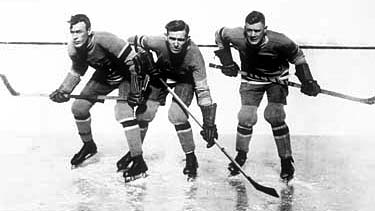
The New York Rangers' forward line of Frank Boucher and the brothers Bill and Frederick "Bun" Cook, previously known as the A Line for the Subway line that went to Madison Square Garden (the 50th Street stop used for the old Garden is now used by the C and the E, and is bypassed by the A), became known as the Bread Line. 
Left to right: Bill Cook, Frank Boucher, Bun Cook

Desperate for any paying customers, sports promoters would try anything, from the college basketball doubleheaders that began at the old Garden in 1934 to night games for outdoor events, which began in baseball's minor leagues and Negro Leagues in 1930, and in the majors in 1935.

The Depression also led, in 1933, to the repeal of Prohibition, which led to the booze industry being able to create jobs, as well as people once again legally being able to enjoy its products; and the repeal of Pennsylvania's "blue laws" prohibiting certain activities on Sunday, including sports.

That allowed for crowds that couldn't be gotten on any other day of the week, except Saturday, since there were no lighted stadiums in the big cities, which would also change soon. That may have kept the Athletics and the Philadelphia Phillies in business, and made the NFL's Philadelphia Eagles and Pittsburgh Pirates (changing their name to the Steelers in 1940), both founded in 1933, economically viable.

The Great Depression left scars on people that never went away. My grandmother grew up in Queens in that era, and knew how important it was to save money. She grew up in the Depression, so, due to her pinching pennies as an adult, my mother also "grew up in the Depression." And because of that, I "grew up in the Depression." Am I saying that I'm cheap? Yes, I am cheap, but not by choice.

In 1992, during another bad recession, I stayed with my grandmother over Thanksgiving Weekend. On the Saturday, I helped her with grocery shopping. We walked out of the car, and, crossing the parking lot, I saw a penny on the ground. I knew she was superstitious, and that a penny, heads-up, was good luck, but tails-up was not. This penny was tails-up, so I left it alone.

She saw it, stopped, pointed, and said, "Aren't you going to pick that up?"

I said, "It's tails-up, it's not good luck." I figured she would accept this answer.

I was wrong. After nearly 40 years of living in New Jersey, her N'Yawk accent kicked back in, and she said, "Whaaaat? It's money!"

I picked it up.


She died in 2006. Now, every time I see a coin on the ground, I presume that she left it there for me, pick it up, and say, "Thanks, Grandma."

But, as Mom pointed out, Grandma and her contemporaries never had a "Depression survivors group," the way war veterans have social clubs, and survivors of other forms of trauma have support groups. And t
here is no memorial specifically for them on the National Mall in Washington, although the FDR Memorial includes a tribute to them. They had their songs, and their movies, rather than tangible tributes.

We dare not forget them now. We have had hard recessions in 1973-76, 1980-83, 1990-93, 2001-03, 2007-10 and 2020-21. But not another Depression, because of the safeguards we put into place in the 1930s. If we fail to support these safeguards, then everything those people suffered through, and everything those who worked to help them did to do so, will have been in vain.

*

October 29, 1929 was, as stated, a Tuesday. Baseball season was over. The NBA hadn't yet been founded. And the NHL season didn't start until November 14. So there were no scores on this historic day.

But there was one score on this historic day, and it was in the NFL: The Boston Bulldogs beat the Orange Tornadoes, 6-0. Instead of at either team's home field, this game was played at Minersville Park in Minersville, Pennsylvania, home of the Pottsville Maroons, the perhaps unfairly-denied Champions of 1925.

The Depression doomed the Bulldogs, and they did not play the 1930 season. The Tornadoes, originally the Orange Athletic Club of Orange, Essex County, New Jersey, played home games at Knights of Columbus Stadium in East Orange. In 1930, they moved to nearby Newark City Schools Stadium, becoming the Newark Tornadoes. But they had to drop out of the NFL. They continued as a minor-league team until 1965, then, like aging New Yorkers and New Jerseyans tend to do, moved to Florida, and played as the Orlando Panthers from 1966 to 1970, before finally going out of business.

Friday, October 28, 2022

October 29, 1923: The Birth of the Charleston

October 29, 1923: The musical Runnin' Wild premieres at the Colonial Theatre in New York, with a tune by James P. Johnson: "Charleston." It inspires the dance of the same name, which becomes every bit as synonymous with "The Roaring Twenties" as the jazz music that inspired it.

Runnin’ Wild was a two-act musical comedy taking place in Jimtown and St. Paul, Minnesota, about the adventures of two likable scamps played by F.E. Miller and Aubrey Lyles. The feature tune of the show was "Old Fashioned Love." But what would now be called the "breakout" song was "Charleston," along with its accompanying dance. The show ran through June 28, 1924, but the dance outlived it.

The kicks, and the crossing of the hands on the knees, became an absolute craze. Josephine Baker, the black American entertainer who was even bigger in Europe than at home, became identified with it.
Josephine Baker

The dance caught on with white American audiences when Bessie Love did it in the 1925 film The King on Main Street, and got another boost in 1926 in when she did it in The Song and Dance Man. The 1946 film It's a Wonderful Life, with a scene set in 1929, featured a Charleston contest. In the 1980s, when impersonating the film's star, James Stewart, on Saturday Night Live, Dana Carvey would do the Charleston.

The 1952 musical Singin' in the Rain, set in 1927, includes a demonstration of the dance. So does the 1974 adaptation of F. Scott Fitzgerald's The Great Gatsby, set in the Summer of 1922 -- an anachronism, because that was over a year before the dance's Broadway debut. But that film, and It's a Wonderful Life and Singin' in the Rain, helped to cement the Charleston in the public memory as the dance of the Jazz Age.

The Colonial Theatre was on Broadway at 62nd Street. It hosted black-produced, black-starring entertainment from 1905 to 1925. It was bought, renamed Hampden's Theatre, and became a whites-only theater. In 1932, it became the RKO Colonial Theatre, and a movie house only. In 1951, NBC bought it, and used it as a TV studio until 1971. It became the Harkness Theatre in 1974, showing live entertainment again, but closed in 1977, and was then torn down. A new movie theatre, Lincoln Plaza, opened on the site.

*

October 29, 1923 was a Monday. The baseball season had ended 13 days earlier, when the New York Yankees beat the New York Giants in the World Series. Football was in midweek. Professional basketball barely existed. And the NHL season was several weeks away. So there were no scores on this historic day.

Saturday, October 22, 2022

October 23, 1920: Sinclair Lewis Publishes "Main Street"

October 23, 1920: Sinclair Lewis publishes Main Street. It is his 7th novel, but his 1st to really gain the attention of the American public.

Lewis was born on February 7, 1885, in Sauk Centre, Minnesota, a small town about 100 miles northwest of Minneapolis, nearly halfway between there and Fargo, North Dakota. He graduated from Yale University, sold short stories to magazines, and published his 1st novel in 1914: Our Mr. Wrenn: The Romantic Adventures of a Gentle Man. He was already 32 years old when America entered World War I in 1917, and was not drafted, and did not serve.

He spent most of 1916, 1917, 1918 and 1919, and early 1920, working as an editor and writing Main Street. At the start of the novel, Carol Milford is in college, and dreams of becoming a town planner. But this is 1910, and women aren't allowed to do that. She becomes a librarian in St. Paul, the capital of Minnesota, where she meets a doctor, Will Kennicott. He takes her back to his hometown, Gopher Prairie, Minnesota, a thinly-disguised version of Lewis' Sauk Centre, whose population has never exceeded 5,000.

Carol finds the town small and ugly, and the people small-minded. She tries to change things, but is thwarted at every turn. When America enters World War I, she leaves Will, moves to Washington, and becomes a clerk in a wartime government agency. Within 2 years, the war is over, and she has to go back to Gopher Prairie.

Her last words to the reader: "I do not admit that Main Street is as beautiful as it should be! I do not admit that Gopher Prairie is greater or more generous than Europe! I do not admit that dish-washing is enough to satisfy all women! I may not have fought the good fight, but I have kept the faith."

In its 1st 6 months, through April 1921, a person of Red Scare, and the transition of the Presidency from the paralyzed activist Woodrow Wilson to Warren Harding and his "Return to Normalcy," Main Street sold over 180,000 copies. (For comparison's sake, Our Mr. Wrenn sold only 9,000.) It turned out to be the best-selling work of fiction in America in 1921. By the time the decade ended, and Lewis had written other classics, it had sold over 2 million copies.

Main Street would be followed in 1922 by Babbitt, decrying conformity in American life; in 1925 by Arrowsmith, about the culture of science; in 1927 by Elmer Gantry, poking organized religion and the frauds who give it a bad name; in 1929 by Dodsworth, comparing the mores of America and Europe; and in 1935 by It Can't Happen Here, a warning against fascism. In 1930, he became the 1st American to receive the Nobel Prize in Literature.

Journalist H.L. Mencken wrote of Lewis, "If there was ever a novelist among us with an authentic call to the trade... it is this red-haired tornado from the Minnesota wilds." I have been unable to establish whether Mencken wrote this before or after Lewis dedicated Elmer Gantry to him.

Oddly, while films have been made of Lewis' works, most are not up to the same level. But in 1960, Elmer Gantry was made into a film, and it was nominated for the Academy Award for Best Picture. Burt Lancaster won Best Actor for the title role.

He married twice. He was married to Grace Livingston Hegger, an editor at Vogue magazine, from 1914 to 1925. In 1917, they had a son, Wells Lewis, named for Lewis' friend, author H.G. Wells. He was married to journalist Dorothy Thompson from 1928 to 1942.

In 1930, when he was 45 and she was 43, they had a son, Michael Lewis. She had written a book denouncing Communism, The New Russia in 1928; and another denouncing Fascism, I Saw Hitler! in 1932, 3 years before her husband's novel on the subject. In 1939, Time magazine put Thompson on its cover, saying, "She and Eleanor Roosevelt are undoubtedly the most influential women in the U.S."

Lewis died on January 10, 1951, in Rome, from the effects of alcoholism. He was a little short of his 66th birthday. He was predeceased by his son Wells Lewis, who was killed in action in World War II, on October 29, 1944. Dorothy Thompson died in 1961, at 67. Michael Lewis became an actor, but died in 1975, only 44 years old. Michael had 3 children, so Sinclair Lewis' bloodline continues. Grace Hegger lived until 1981, at 94.

In spite of being lampooned as Gopher Prairie in Main Street, Sauk Centre embraces its best-known native son. His boyhood home is maintained as a historic site, and a sign on the actual street with the name reads, "ORIGINAL MAIN STREET."

*

October 23, 1920 was a Saturday. Vern Stephens, a shortstop who hit 247 career home runs (a huge number for that position in that era) and played in 8 All-Star Games, was born on this day.

Baseball season was over. The NBA hadn't been founded yet. The NHL season didn't begin for another 2 months. It was the 1st season of the American Professional Football Association, the league that became the NFL in 1922, but all of its games were played on Sunday, the next day.

There were, however, college football games, including these:

* Ohio State beat Wisconsin, 13-7 at Ohio Field in Columbus. Ohio State went on to win the Big Ten Conference title.

* Oklahoma beat Washington University of St. Louis, 24-14 at Boyd Field in Norman, Oklahoma. Oklahoma went on to win the title of the Missouri Valley Conference, a forerunner of the Big Eight/Big Twelve.

* The University of California beat the University of Utah, 63-0 at California Field in Berkeley. Under head coach Andy Smith, Cal's "Wonder Team" won the title of the Pacific Coast Conference, a forerunner of the Pacific-Twelves, won the 1921 Rose Bowl over previously unbeaten Ohio State, and started a 50-game unbeaten streak: Won 46, tied 4, lost exactly none. They were retroactively named National Champions for 1920, 1921, 1922 and 1923.

* Virginia Military Institute (VMI) beat the University of Pennsylvania (Penn), 27-7 at Franklin Field in Philadelphia. Both teams came into this game undefeated, but only VMI stayed that way, and remained so throughout the season. This may have been the 1st big win by a Southern college football team away to a Northern one.

* At the other end of Pennsylvania, the University of Pittsburgh defended the honor of the North, beating Georgia Tech, 10-3 at Forbes Field.

* In between, Penn State beat Lebanon Valley College, 109-7 at Beaver Field in State College.

* Georgia beat Oglethorpe University, 27-3 at Ponce de Leon Park in Atlanta. Georgia finished the season 8-0-1, and won the title in the Southern Intercollegiate Athletic Association, a precursor of the Southeastern and Atlantic Coast Conferences (the SEC and the ACC).

* Notre Dame beat Valparaiso, 28-3 at Carter Field in South Bend, Indiana. Knute Rockne's team was led by George Gipp, and some sources recognize Notre Dame, not Cal, as the 1920 National Champions.

* Harvard beat Centre College, 31-14 at Harvard Stadium in Boston. A year later, though, Centre would beat Harvard in one of the greatest upsets in college football history. Harvard finished the season undefeated, although there was a tie against Princeton. Another Boston-area team, Boston College, finished the season undefeated and untied, but did not play on this day.

* Yale beat West Virginia, 24-0 at the Yale Bowl in New Haven, Connecticut.

* Army beat Tufts, 28-6 on The Plain at West Point, New York.

* Among New York City teams, NYU lost to Hamilton College, 14-13 in Clinton, Oneida County, New York. Fordham lost to Georgetown, 40-16 at Fordham Field in The Bronx.

* In New Jersey, Princeton beat Navy, 14-0 at Palmer Stadium in Princeton. And Rutgers lost to Virginia, 7-0 at Neilson Field in New Brunswick.

Also, in England's Football League, Arsenal and Derby County played to a 1-1 draw at The Baseball Ground in Derby. Unlike New York's Polo Grounds, where polo had only been played at the original stadium of that name, baseball had been played at The Baseball Ground, as Derbyshire was one of the few areas of England where the sport caught on. But it didn't last, and, by 1920, to look at the Ground, you'd never know that any sport other than soccer had ever been played there.

October 22, 1926: "The Sun Also Rises" Is Published

October 22, 1926: The Sun Also Rises, written by Ernest Hemingway, is published by Charles Scribner's Sons. Although Hemingway had previously been a journalist, and had published short stories, this was his 1st novel, and it set the tone for a writing style that would change literature.

The novel is a roman à clefThe characters are based on real people in Hemingway's social circle, and the action is based on real events, particularly Hemingway's life in Paris in the 1920s, and a trip to Spain in 1925 for the "running of the bulls" festival in Pamplona and fishing in the Pyrenees.

Hemingway, then 27 years old, presented his notion that what was already being called the "Lost Generation," considered to have been decadent, dissolute, and irretrievably damaged by their experiences in World War I, which had ended just 8 years earlier, was, instead, resilient and strong. Hemingway investigated the themes of love and death, the revivifying power of nature, and the concept of masculinity.

However, in his treatment of women, art imitated life: The character of Lady Brett Ashley is promiscuous and untrustworthy. Hemingway married 4 times, and it's been suggested that he mistreated all 4 wives, but got a great novel out of each: The Sun Also Rises, A Farewell to Arms (a version of his experience in World War I, published in 1929), For Whom the Bell Tolls (a version of his experience in the Spanish Civil War, published in 1940), and The Old Man and the Sea (based on stories he heard from fishermen in Cuba, published in 1952).

Along with The Great Gatsby, by his friend F. Scott Fitzgerald, and Main Street by Sinclair Lewis, The Sun Also Rises is 1 of 3 definitive novels of the "Roaring Twenties" and the "Lost Generation." But it has not really stood the test of time: Not only does Lady Brett look bad in an era of feminism, but the character of Robert Cohn is treated badly, leading to the charge the Hemingway was anti-Semitic; and bullfighting, which Hemingway celebrated in this book and in several short stories, has come to be seen by the wider world as barbaric.

Hemingway himself, though an incredibly talented writer, was a barbaric man, who never met a human being, man or woman, that he didn't want to hit; never met a woman that he didn't want to have sex with; and never met an animal he didn't want to shoot. On July 2, 1961, he shot and killed the most dangerous animal he ever faced: Himself. He was his own worst enemy, and he was just short of turning 63.

*

October 22, 1926 was a Friday. This was also the day that Harry Greb, a former Light Heavyweight Champion of the World, died. I have a separate entry for that event.

The baseball season had just ended, with the St. Louis Cardinals beating the Yankees in the World Series. Football was in midweek. The NBA hadn't yet been founded. And the NHL season wouldn't begin until November 16. So there were no scores on this historic day.

Monday, October 17, 2022

October 18, 1924: Red Grange & the Four Horsemen

This photo of Red Grange is colorized, but is otherwise real.

October 18, 1924: Two of the most iconic games in the history of college football are played.

Harold Edward Grange was born on June 13, 1903, in Forksville, in the mining country of Northeastern Pennsylvania -- 6 days before Lou Gehrig was born 200 miles to the southeast in East Harlem, Manhattan. He was born 15 days after entertainer Bob Hope, 5 days before early film singer Jeannette MacDonald, 9 days before Baseball Hall of Fame pitcher Carl Hubbell and bank robber John Dillinger, and 12 days before British writer George Orwell.

His father was the foreman on a lumber camp, and eventually moved the family to Wheaton, Illinois, about 30 miles west of Chicago, where 4 of his brothers lived, and he became that small city's Chief of Police. His son Harold, nicknamed Red because of his hair, got a job delivering ice, a hard job because ice is heavy. (A gallon of water weighs over 8 pounds. Now imagine it hard as a rock.) It made him strong, and he was fast, too. He was nicknamed "The Wheaton Iceman" well before "The Galloping Ghost." He made $37.50 a week -- about $548 in today's money.

Red lettered in football, baseball, basketball and track at Wheaton High School, all 4 years, 16 varsity letters. He was a State Champion in the high jump, the long jump and the 100-yard dash.

The school is now known as Wheaton Warrenville South High School, and also counts astronomer Edwin Hubble, journalist Bob Woodward, and the comedian brothers John and Jim Belushi among its alumni. The colors are orange and black -- not quite the same colors as Red would wear for the Illini and the Bears, but close. The school's stadium is named Red Grange Field.

In his 1st game at the University of Illinois, in Champaign in the east-central part of the State, on October 6, 1923, Grange scored 3 touchdowns against Nebraska, a very strong team at the time. Coached by Bob Zuppke, Illinois went 8-0, beating teams by an average score of 17-3. After a 9-6 win away to Iowa, they didn't allow a point for the rest of the season.

The Helms Athletic Foundation awarded Illinois the National Championship. This notoriety allowed Illinois to raise the money to build a new stadium, as a memorial to the school's alumni who had fallen in World War I a few years earlier.

On October 18, 1924, Red Grange led the Illini onto the field at Memorial Stadium in Champaign for its dedication game against the University of Michigan. A player now largely forgotten outside Michigan, Bennie Oosterbaan, led the Wolverines, who were favored to win the National Championship. (Michigan and Notre Dame did not play each other that season. They have not always played, occasionally feuding, and this was during one of the feuds.)

Grange returned the opening kickoff 95 yards for a touchdown. He ran 67 yards for a touchdown. He ran 56 yards for a touchdown. He ran 44 yards for a touchdown.

All this was accomplished in the 1st 12 minutes of the ballgame.

He later passed for another touchdown, and returned a kick for another. He accounted for 6 touchdowns in Illinois' 39-14 victory.

Keep in mind: Michigan was already the most honored college football program west of the Ivy League. In spite of the achievements of Knute Rockne and George Gipp, Notre Dame was not yet Notre Dame. But Michigan, under the guidance of legendary coach Fielding Yost (and, this season only, George Little), was already Michigan, which, despite their recent struggles to beat arch-rival Ohio State, remains the defining football school of that league.

*

Grange's performance is often called the best one-man game in college football history. But it wasn't even the most talked-about game played that day. There was another game that made this day, as far as college football was concerned, the peak of the "Roaring Twenties." Did I mention Notre Dame? Yes, yes, I did:

At the Polo Grounds in New York, the South Bend, Indiana-based University of Notre Dame beats Army -- the U.S. Military Academy at West Point, New York -- 13-7. The Fighting Irish were led by their 4-man backfield: Quarterback Harry Stuhldreher, left halfback Jim Crowley, right halfback Don Miller and fullback Elmer Layden. Layden scored a touchdown in the 2nd quarter, Crowley in the 3rd.

Army were favored to win, but there was precedent: Notre Dame had shocked them in 1913, with quarterback Gus Dorais and end Knute Rockne, for all intents and purposes, introducing the passing game to a wide audience, and making Notre Dame more than just what we would now call a "mid-major" Catholic school in the Midwest like DePaul or Marquette. Now, with Rockne as head coach, the Fighting Irish -- although Miller was of English descent, and Stuhldreher, German -- pulled off a much less surprising upset.

George Strickler, a Notre Dame student, was what we would now call a publicity director. At halftime, he mentioned Rudolph Valentino's 1921 silent film epic The Four Horsemen of the Apocalypse (although that term comes from the Bible's Book of Revelation), in the press box. The great syndicated sports columnist Grantland Rice, based out of the New York Herald Tribune, ran with it, and wrote this opening paragraph, the most famous piece of sportswriting ever:

Outlined against a blue-gray October sky, the Four Horsemen rode again. In dramatic lore their names are Death, Destruction, Pestilence, and Famine. But those are aliases. Their real names are: Stuhldreher, Crowley, Miller and Layden. They formed the crest of the South Bend cyclone before which another fighting Army team was swept over the precipice at the Polo Grounds this afternoon as 55,000 spectators peered down upon the bewildering panorama spread out upon the green plain below.

They don't write 'em like that anymore: Not only was the 1920s, as Rice himself later billed it, the Golden Age of Sports, it was the golden age of sportswriting, with Rice joined by such men as Ring Lardner, Paul Gallico, Jimmy Cannon and Damon Runyon.

To further plant the idea of the Four Horsemen in people's minds, the 4 of them were posed on horseback, wearing full uniforms and holding footballs. From left to right: Miller, Layden, Crowley, Stuhldreher. A set of statues representing that photo is now at Notre Dame's Guglielmo Athletic Complex.
(As far as I know, nobody ever asked Red Grange to pose as a ghost, or with a man dressed as a ghost, or on a galloping horse.) 

Over the Horsemen's 3 seasons -- freshmen were not eligible to play varsity football at the time -- Notre Dame won 27 games and lost only 2, both away to Nebraska, plus a tie in an earlier game with Army. They won the 1924 National Championship, defeating Ernie Nevers' Stanford squad in the 1925 Rose Bowl, with Layden returning 2 interceptions for touchdowns. (Notre Dame would then refuse all bowl invitations until the 1969 season.)

None of the Four Horsemen was over 6 feet tall, and none was listed as weighing more than 162 pounds. But this was typical of football players of the Roaring Twenties. And no one today can question their toughness: In their 30 games together, they played in primitive protective equipment, played offense and defense, excelling on both sides, and played all 60 minutes, with no substitutions. The offensive line that protected them was nicknamed the "Seven Mules," to emphasize their crucial but less glamorous function.

(The Mules didn't become famous in their own right, with one exception: The center, Adam Walsh, would go on to coach the Cleveland Rams to the 1945 NFL Championship, and then become their 1st head coach in Los Angeles the following season.)

It was the Four Horsemen, and Rockne's subsequent publicity campaigns through the beginnings of mass media in the 1920s, that made Notre Dame iconic. Even George Gipp wasn't as famous in life as the 1928 Notre Dame-Army game, in which Rockne made up the "Win one for the Gipper" story, and the later film Knute Rockne, All-American, with Pat O'Brien as Rockne and young Ronald Reagan as Gipp, would make him in death.

*

Having made legends out of the Four Horsemen, Grantland Rice took pen in hand (or, more likely, tapped out on his typewriter), and wrote this about Grange:

A streak of fire, a breath of flame
Eluding all who reach and clutch;
A gray ghost thrown into the game
That rival hands may never touch;
A rubber bounding, blasting soul
Whose destination is the goal

Red Grange of Illinois!

Although Rice had called Grange "a gray ghost" (and he certainly appears as such in the few surviving film clips of him playing, all black and white, of course), Warren Brown, writing for the Chicago American, gave him the nickname "the Galloping Ghost."

A year later, on Halloween, October 31, 1925, Illinois traveled to Philadelphia to play the University of Pennsylvania at Franklin Field. The playing surface was a muddy mess, and few expected Grange to move well on it. He did, scoring 3 touchdowns and setting up the Illini's other touchdown, in a 24-2 win. Rice covered this game as well, and wrote:

There are two shapes now moving
Two ghosts that drift and glide
And which of them to tackle
Each rival must decide.
They shift with spectral swiftness
Across the swarded range
And one of them's a shadow
And one of them is Grange.

Runyon added, "This man Red Grange of Illinois is three or four men and a horse rolled into one for football purposes. He is Jack Dempsey, Babe Ruth, Al Jolson, Paavo Nurmi and Man o' War. Put them all together, they spell Grange."

Zuppke would later say, "An All-American consists of a fast back, weak opposition, and a poet in the press box." But he also said, "I will never have another Grange, but neither will anyone else. They can argue all they like about the greatest football player who ever lived, but I was satisfied I had him when I had Red Grange." A statue of Grange now stands outside Memorial Stadium -- essentially, the house than Zuppke and Grange built.

Grange's 77 became the 1st celebrated uniform number in American sports -- especially since Major League Baseball wouldn't have uniform numbers until 1929. When asked how he got the famous double-digit, he said, "The guy in front of me got 76, and the guy behind me got 78." It wasn't a choice, and it's not like Wheaton had uniform numbers at the time. (In case you're wondering about the Four Horsemen, I looked it up: Layden wore 5, Miller 16, Crowley 18 and Stuhldreher 32. And George Gipp wore 66.)

*

How did the Four Horsemen do in the pros? Not especially well. Pro football was then still frowned upon, as a backwater game at best, and as outright dishonorable at worst. Zuppke himself was of two minds about it: George Halas, who had helped Illinois gain a share of the 1918 Big Ten title (before going into the U.S. Navy and helping the Chicago-based Great Lakes Naval Training Center team win the 1919 Rose Bowl), remembered him lamenting that players graduated just as they were really learning how to play. But Zuppke also stopped speaking to Halas and Grange for many years after they turned pro, eventually reconciling with both of them.

The Horsemen only played 1 professional game together, at the end of the 1925 season, for the Waterbury Blues against a team from Adams, Massachusetts, at Hartford, Connecticut (about halfway between), and won 34-0. (Imagine Patrick Mahomes passing to Stefon Diggs, with Derrick Henry and Dalvin Cook in his backfield, and the other 7 players on his own team and the 11 on the other side being college players, and you'll get the idea of what it was like.) The Horsemen were paid $5,000 apiece -- about $78,000 in today's money, for a little over 2 hours' performance. Then as now, nice work if you can get it.

Stuhldreher, from the football-crazy town of Massillon, Ohio (also hometown of Yankee Legend Tommy Henrich), and Layden, from Davenport, Iowa (part of the "Quad Cities" that were then represented in the NFL by Illinois' Rock Island Independents), had a team built around them and named for them, the Brooklyn Horsemen. They played in the original American Football League in 1926. When that league folded, the Brooklyn Horsemen were absorbed into the NFL, which still needed the publicity, and played 3 games in that league's '26 season.

Stuhldreher ended his playing career after that season, and was named head coach at Villanova, and later at the University of Wisconsin, managing a decent record but no conference titles in 24 years. He then worked for U.S. Steel, and wrote a couple of books about football. He died in 1965, only 63 years old.

Layden went on to be the head coach at Pittsburgh's Duquesne University, getting them into the 1934
Festival of Palms Bowl, the forerunner of Miami's Orange Bowl. He then became head coach at Notre Dame, and in 1941 was offered the post of Commissioner of the NFL, serving 5 seasons and guiding them through the difficulties caused by the manpower shortage from the World War II draft. He then went into business in Chicago, and died in 1973, age 70.

Miller, from Defiance, Ohio, about halfway between Toledo and Fort Wayne (and the only 1 of the 4 from anywhere near South Bend), coached at Georgia Tech, and then practiced law. He was appointed a U.S. Attorney for the Cleveland area by President Franklin D. Roosevelt, and died in 1979, age 77.

Crowley, from the football-crazy town of Green Bay, Wisconsin -- Packer co-founder Earl "Curly" Lambeau had played for Rockne at Notre Dame -- became an assistant coach at Georgia, and head coach at Michigan State and Fordham.

At Fordham, in The Bronx, he coached a team that challenged for the National Championship in 1937 and '38, with a line known as the Seven Blocks of Granite, including 2 future Pro Football Hall-of-Famers. Alex Wojciechowicz starred for the Philadelphia Eagles and the Detroit Lions. The other never played a down of pro ball, and is in the Hall as a coach: Vince Lombardi. (Longtime Giants owner Wellington Mara didn't play, but was also a student at Fordham at this time.)

Crowley enlisted in the Navy in World War II, and coached the Navy's renowned North Carolina Pre-Flight School team at Chapel Hill, with Paul "Bear" Bryant and Johnny Vaught, later to become coaching legends at Alabama and Mississippi, respectively, as assistant coaches.

Crowley then coached the Chicago Rockets of the All-America Football Conference, including receiving legend Elroy "Crazy Legs" Hirsch. He later became chairman of the Pennsylvania State Athletic Commission, and was the last survivor of the Four Horsemen, living until 1986, at the age of 83.

Grange played his last college game on November 21, 1925, a 14-9 Illinois win away to Ohio State. His collegiate obligation complete, he signed with Halas' Chicago Bears. At the time, this was legal: There was no NFL Draft, nor any rule preventing the signing. Five days after his college finale, he suited up for the Bears against the Chicago Cardinals at Wrigley Field (in its last season under the name Cubs Park) on Thanksgiving Day, resulting in a 0-0 tie.

The Bears went to New York to play the Giants on December 6, and the gate receipts from that full house at the Polo Grounds -- New Yorkers coming to see Grange, not the home team -- may have saved the Giant franchise, and possibly even the League. He would play in the NFL until 1934, helping the Bears win the NFL Championship in 1932 and 1933, teaming with Bronislau "Bronko" Nagurski.

Grange became the template for the speedy halfback, Nagurski that for the big bruising fullback. Think of Grange's "descendants" as being Steve Van Buren, Doak Walker, Lenny Moore, Paul Hornung, Gale Sayers, Walter Payton, Barry Sanders and Christian McCaffrey; and Nagurski's as being Marion Motley, Tank Younger, Jim Brown, Jim Taylor, Larry Csonka, Franco Harris, John Riggins, Emmitt Smith, Terrell Davis, Jerome Bettis, Adrian Peterson and Derrick Henry.

Grange went on to become a broadcaster. In 1963, he was a charter inductee into the Pro Football Hall of Fame. He died on January 28, 1991, at the age of 87.

*

October 18, 1924 was a Saturday. The baseball season had ended 8 days earlier, with the Washington Senators beating the New York Giants in the World Series, the only World Championship that a Washington baseball team would win until 2019. There was no NBA yet. The NHL season didn't start until November 29.

Despite it being a Saturday, there was NFL action on the day. The Frankford Yellow Jackets beat the Columbus Tigers, 23-7 at Frankford Stadium in Northeast Philadelphia. The Jackets had to play on Saturdays because, until 1933, playing professional sports on Sundays was illegal in Pennsylvania.

The Tigers had been known as the Columbus Panhandles, and went out of business after the 1926 season. That year, the Yellow Jackets won the NFL Championship. But the Great Depression did them in, and they folded in 1931. Philadelphia returned to the NFL in 1933, with the Eagles, but there is no connection between them and the Jackets.

Among the other college games played that day:

* The University of Chicago beat Indiana, 23-0 at Stagg Field in Chicago.

* Purdue beat Northwestern, 7-3 at Northwestern Field in Evanston, Illinois.

* Ohio State beat Ohio Wesleyan, 10-0 at Ohio Stadium in Columbus.

* Iowa beat Lawrence University of Appleton, Wisconsin, 13-5 at Iowa Field in Iowa City.

* Minnesota and Wisconsin played to a 7-7 tie at Camp Randall Stadium in Madison, Wisconsin.

* Nebraska beat Colgate, 35-7 at Memorial Stadium in Lincoln, Nebraska.

* USC beat Oregon Agricultural, 17-3 at Multnomah Stadium in Portland, Oregon. Oregon Agricultural would become Oregon State, and what's now Providence Park would be built on the site of Multnomah Stadium.

* Alabama beat Sewanee, of Sewanee, Tennessee, 14-0 at Rickwood Field in Birmingham, Alabama.

* Georgia Tech beat Penn State, 15-13 at Grant Field in Atlanta.

* Southern Methodist University beat Texas, 10-6 at Armstrong Field, SMU's home, in Dallas.

* Harvard beat Holy Cross, 12-6 at Harvard Stadium in Boston.

* Yale and Dartmouth played to a tie, 14-14 at the Yale Bowl in New Haven, Connecticut.

* Among New York City teams, New York University beat their arch-rivals, City College of New York. NYU beat CCNY, 7-0 , at NYU's home field, Ohio Field in The Bronx.

* Columbia lost to Penn, 10-7 at Franklin Field in Philadelphia.

* Fordham beat St. Stephen's College, 26-0 at Fordham Field in The Bronx. St. Stephen's, of Annandale-on-Hudson, New York, later became Bard College, and now compete in NCAA Division III.

* In New Jersey, Princeton beat Navy, 17-14 at Palmer Stadium.

* And Rutgers beat Cornell, 10-0 at Schoellkopf Field in Ithaca, New York.

Also, Arsenal drew with Aston Villa, 1-1 at the Arsenal Stadium, a.k.a. Highbury, in North London.

December 31, 1999 & January 1, 2000: The Millennium

December 31, 1999:  The Millennium arrives. The people of planet Earth survived. At a terrible cost. But we hadn't destroyed ourselves. ...