Showing posts with label wall street. Show all posts

Saturday, October 29, 2022

October 29, 1929: Crash and Depression

October 29, 1929: Black Tuesday. The stock market completes the crash that began the preceding Thursday. The Roaring Twenties are over. The Dirty Thirties, and the Great Depression, have begun.

The incumbent Republican President, Herbert Hoover, gets blamed for it, when it was his Republican predecessors, Warren Harding and Calvin Coolidge, who set the table for it. Hoover shouldn't be blamed for the Depression. And he shouldn't be blamed for doing nothing: He tried a few things.
What he should be blamed for is giving up. Some of the things he tried worked a little, but not enough, and he abandoned his efforts. And in 1932, he lost in a landslide, to the Democratic Governor of New York, Franklin Delano Roosevelt.

Emptied pockets, to show that you had no money, became known as Hoover flags. Newspapers used as cover by homeless people became known as Hoover blankets. Shanty towns became Hoovervilles. And hitching a horse up to your car, because you couldn't afford gasoline but you didn't dare sell your car, earned the vehicles the nickname Hoover wagons. In Canada, where Richard Bennett rode the Depression to become Prime Minister in 1930, but was turned out in 1935 because he governed more like Hoover than Roosevelt, they were known as Bennett buggies.
Did you think I was making it up?

The happy, peppy songs of the Roaring Twenties -- including a song recorded just before, but released just after, the crash, which was saved by FDR making it his campaign theme song, "Happy Days Are Here Again" -- were gone. Songs of the Depression either spoke of hardship, like "Brother, Can You Spare a Dime?" (evoking both now-fallen industry and World War I), "Boulevard of Broken Dreams" (not the Green Day song of 2005), "Gloomy Sunday," and "Remember My Forgotten Man"; or tried to defy it, like "We're In the Money" and "Life Is Just a Bowl of Cherries."

Movies also reflected this. Monster movies abounded, with Dracula and Frankenstein both released in 1931, and King Kong and The Invisible Man in 1933, each inspiring many imitators. Gangster movies peaked then, with James Cagney's The Public Enemy, Edward G. Robinson's Little Caesar, and the original version of Scarface, starring Paul Muni, all made in 1931, the latter not released until 1932.

At the height of the stock boom in early September 1929, America's unemployment rate was 3.2 percent. By the end of 1930, it was 8.7. 1931, 15.9. At the 1932 election, 23.6. At the depth, on March 4, 1933, when FDR was inaugurated and the banking crisis was critical, the rate was 24.9 percent. Fully 1 out of 4 Americans who wanted to work couldn't get work. Some people have suggested the rate was considerably higher than that, as much as 31 percent, or nearly 1 in 3.

FDR ended up building on some of what worked under Hoover, and in New York State under his leadership there, and put it in overdrive. Banking reforms stopped the financial bleeding, securities reforms prevented much of the abuses that had been done (stopped it, that is, until deregulation in the 1980s), and his public works and other construction programs created millions of jobs.

His New Deal had worked very well, but the problems remained vast. When he was sworn in for a 2nd term on January 20, 1937, having gotten the unemployment rate down to 14 percent (either cut by a third or a half, depending on whose figures you believe), FDR said the work was far from done: "I see one-third of a nation ill-housed, ill-clad, ill-nourished." And it may have been more like two-fifths, or 40 percent, because that included what we would now call "the working poor."

That year, FDR did what conservatives have always suggested for economic hardship: Cut spending. It backfired, and unemployment went from a Depression-low of 14.3 percent to 19.0 percent by the time of the 1938 elections, resulting in the Republicans' best performance between 1928 and 1946, although not enough to gain control of either house.

But 1937 was the year Social Security began handing out checks, and 1938 was the year the 1st federal minimum wage took effect. By 1941, unemployment was back under 10 percent. It still didn't get back to tolerable levels until the U.S. entered World War II, and a lot of unemployed men went into the armed forces, and a lot of employed men did as well, their stateside jobs becoming available to unemployed men -- and women.

From the dawn of the American Civil War in 1860 to 1928, the Republican Party had gone 14-4 in Presidential elections. (Okay, they may have stolen those of 1876, 1880 and 1888.) And in the 4 that the Democratic Party won -- 1884, 1892, 1912 and 1916 -- they still didn't get a majority of the popular vote in any of them, not even with the 1912 split in the Republicans that led to an Electoral Vote landslide for Woodrow Wilson. The GOP also held both houses of Congress for most of a 70-year stretch from 1860 to 1930.

But when the Great Depression began, and turned out to be worse than previous depressions -- 1837-43, 1857-59, 1873-78, 1893-98, 1920-22 -- people took their anger out on the Republicans. Herbert Hoover went from winning 21.4 million votes in 1928 to 15.7 million in 1932. He went from a popular vote percentage of 58.2 percent in 1928 to 39.6 in 1932. He went from winning 40 States to 6, and only in Maine and Vermont did he get more than 51 percent. In the Electoral Vote, he went from 444 to 59. This was not so much an embrace of FDR and his as-yet vague New Deal as it was a firing of Hoover and the Republicans.

The Democrats won 7 of the next 9 elections. The 2 the Republicans won, 1952 and 1956, were by Dwight D. Eisenhower, and "Ike" basically won them because he was the commanding General of World War II. America was embracing him, not Republican principles. Even when Richard Nixon won in 1968, it was a 3-way race, in which he got 48 percent of the vote. Aside from Ike, no Republican got at least 50 percent between Hoover in 1928 and Nixon himself in 1972. 

Furthermore, in Congressional elections, the Republicans lost the House of Representatives in 1930, and held it only in 1947-48 and 1953-54, until 1994. They lost the Senate in 1932, and held it only in 1947-48, 1953-54, and 1981-86, until 1994.

Among the effects the Depression had on sports: Connie Mack lost everything he had aside from his stock in the Philadelphia Athletics, forcing him, by the end of the 1932 season, to break up his dynasty. The American Basketball League lost several teams, thus delaying pro basketball's rise to major league status until after World War II. And several NFL teams went under, putting the League's future in jeopardy.

In addition, when cartoonist Willard Mullin went to Ebbets Field , and heard a fan call his beloved Brooklyn Dodgers "you bums," he drew a bum, with a five o'clock shadow, just one tooth, and patches all over his clothes, and everyone in New York could identify with it, because they had all been seriously affected by poverty, or knew someone who had been.
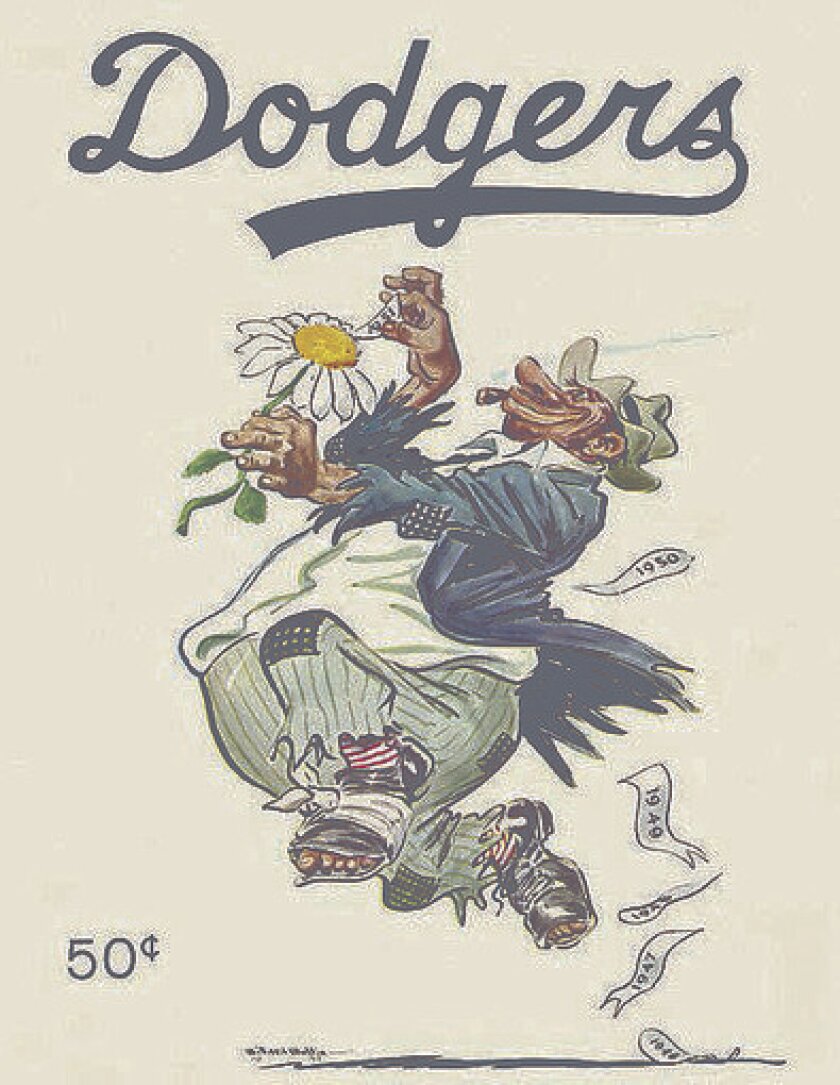
The Dodgers were "Dem Bums" from then on, even including Mullin's drawing on the covers of their yearbooks, until Walter O'Malley moved them to Los Angeles after the 1957 season. As late as 1975, the Houston Astros had cartoon representations of the other National League teams on the cover of their yearbook, and the Dodgers, in their 18th season in Los Angeles, were still represented by a bum.

But the Great Depression of which the Crash of 1929 was the chief cause (but not the only cause, as is commonly believed) also led Americans to search for heroes wherever they could find them. As they so often do, they turned to sports. Babe Ruth, still a star up to his 1935 retirement, became even more popular. So did Lou Gehrig. Dizzy Dean, Hank Greenberg, Joe DiMaggio and Bob Feller would debut within the next 7 years, and would become legends. So would football stars Bronko Nagurski, Don Hutson and Slingin' Sammy Baugh, and the Heisman Trophy would be established.

The New York Rangers' forward line of Frank Boucher and the brothers Bill and Frederick "Bun" Cook, previously known as the A Line for the Subway line that went to Madison Square Garden (the 50th Street stop used for the old Garden is now used by the C and the E, and is bypassed by the A), became known as the Bread Line. 
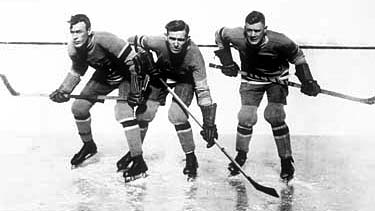
Left to right: Bill Cook, Frank Boucher, Bun Cook

Desperate for any paying customers, sports promoters would try anything, from the college basketball doubleheaders that began at the old Garden in 1934 to night games for outdoor events, which began in baseball's minor leagues and Negro Leagues in 1930, and in the majors in 1935.

The Depression also led, in 1933, to the repeal of Prohibition, which led to the booze industry being able to create jobs, as well as people once again legally being able to enjoy its products; and the repeal of Pennsylvania's "blue laws" prohibiting certain activities on Sunday, including sports.

That allowed for crowds that couldn't be gotten on any other day of the week, except Saturday, since there were no lighted stadiums in the big cities, which would also change soon. That may have kept the Athletics and the Philadelphia Phillies in business, and made the NFL's Philadelphia Eagles and Pittsburgh Pirates (changing their name to the Steelers in 1940), both founded in 1933, economically viable.

The Great Depression left scars on people that never went away. My grandmother grew up in Queens in that era, and knew how important it was to save money. She grew up in the Depression, so, due to her pinching pennies as an adult, my mother also "grew up in the Depression." And because of that, I "grew up in the Depression." Am I saying that I'm cheap? Yes, I am cheap, but not by choice.

In 1992, during another bad recession, I stayed with my grandmother over Thanksgiving Weekend. On the Saturday, I helped her with grocery shopping. We walked out of the car, and, crossing the parking lot, I saw a penny on the ground. I knew she was superstitious, and that a penny, heads-up, was good luck, but tails-up was not. This penny was tails-up, so I left it alone.

She saw it, stopped, pointed, and said, "Aren't you going to pick that up?"

I said, "It's tails-up, it's not good luck." I figured she would accept this answer.

I was wrong. After nearly 40 years of living in New Jersey, her N'Yawk accent kicked back in, and she said, "Whaaaat? It's money!"

I picked it up.


She died in 2006. Now, every time I see a coin on the ground, I presume that she left it there for me, pick it up, and say, "Thanks, Grandma."

But, as Mom pointed out, Grandma and her contemporaries never had a "Depression survivors group," the way war veterans have social clubs, and survivors of other forms of trauma have support groups. And t
here is no memorial specifically for them on the National Mall in Washington, although the FDR Memorial includes a tribute to them. They had their songs, and their movies, rather than tangible tributes.

We dare not forget them now. We have had hard recessions in 1973-76, 1980-83, 1990-93, 2001-03, 2007-10 and 2020-21. But not another Depression, because of the safeguards we put into place in the 1930s. If we fail to support these safeguards, then everything those people suffered through, and everything those who worked to help them did to do so, will have been in vain.

*

October 29, 1929 was, as stated, a Tuesday. Baseball season was over. The NBA hadn't yet been founded. And the NHL season didn't start until November 14. So there were no scores on this historic day.

But there was one score on this historic day, and it was in the NFL: The Boston Bulldogs beat the Orange Tornadoes, 6-0. Instead of at either team's home field, this game was played at Minersville Park in Minersville, Pennsylvania, home of the Pottsville Maroons, the perhaps unfairly-denied Champions of 1925.

The Depression doomed the Bulldogs, and they did not play the 1930 season. The Tornadoes, originally the Orange Athletic Club of Orange, Essex County, New Jersey, played home games at Knights of Columbus Stadium in East Orange. In 1930, they moved to nearby Newark City Schools Stadium, becoming the Newark Tornadoes. But they had to drop out of the NFL. They continued as a minor-league team until 1965, then, like aging New Yorkers and New Jerseyans tend to do, moved to Florida, and played as the Orlando Panthers from 1966 to 1970, before finally going out of business.

Monday, October 24, 2022

October 24, 1907: The Panic of 1907

J.P. Morgan

October 24, 1907: The Panic of 1907 hits the New York Stock Exchange, sending stock prices tumbling, and triggering fears of a depression.

The panic was triggered by the failed attempt to corner the market on the stock of the United Copper Company. When the bid failed, banks that had lent money to the cornering scheme suffered runs that later spread to affiliated banks and trusts, leading a week later to the downfall of the Knickerbocker Trust Company, New York City's 3rd-largest trust.

The collapse of the Knickerbocker spread fear throughout the city's trusts as regional banks withdrew reserves from New York City banks. The panic then extended across the nation, as vast numbers of people withdrew deposits from their regional banks, causing the 8th-largest decline in U.S. stock market history.

The panic might have deepened if not for the intervention of financier John Pierpont Morgan, one of the richest men in America, who pledged large sums of his own money, and convinced other New York bankers to do the same, to shore up the banking system. The idea was, if J.P. Morgan was willing to put his fortune and his reputation on the line, they should be willing to do the same. They were.

That highlighted the limitations of the U.S. Independent Treasury system, which managed the nation's money supply, but was unable to inject sufficient liquidity back into the market. By November, the financial contagion had largely ended, only to be replaced by a further crisis due to the heavy borrowing of a large brokerage firm using the stock of Tennessee Coal, Iron and Railroad Company (TC&I) as collateral.

Collapse of TC&I's stock price was averted by an emergency takeover by U.S. Steel Corporation, owned by Morgan since he paid Andrew Carnegie $492 million for it in 1901. (About $17.1 billion in 2022 money.) This move was approved by President Theodore Roosevelt, who, despite having previously picked a policy fight with Morgan and won, knew that letting Morgan have what he wanted was the right move this time. Morgan was pleased to have won one over "the Trust-Buster."

Morgan died in 1913. That same year, United Copper went out of business, and the Federal Reserve Board was established, to help steady the American economy, so that no future panics would cause an economic downturn. It usually works. In 1929, it did not: That crash was so bad, even the Fed couldn't do much about it. Nor could J.P. Morgan Jr., who tried to repeat his father's attempt to prop up the market, and ended up losing 40 percent of his personal fortune as a result. (He lived until 1943.)

*

October 24, 1907 was a Thursday. The only sport currently in season in North America was football, and only one game was played: Mississippi A&M beat Mercer, 75-0 at the Columbus Fairgrounds in Columbus, Mississippi.

A&M would be renamed Mississippi State College in 1932, and Mississippi State University in 1958. Mercer University, based in Macon, Georgia, dropped football after the 1941 season due to World War II, and didn't start playing again until 2013, in the Football Championship Subdivision (FCS, formerly known as Division I-AA).

Wednesday, October 19, 2022

October 19, 1987: Black Monday

Note that the "Bernie" in this sub-headline is Bernhard Goetz,
the 1984 "Subway Vigilante," not Senator Bernie Sanders,
future New York Police Commissioner Bernard Kerik,
or fraud financier Bernie Madoff.

October 19, 1987: Black Monday. After the Dow Jones Industrial Average had the biggest drop, points-wise, in its history the preceding Friday, 108 points, and investors had all weekend long to worry, the Dow now has its biggest drop ever in terms of points, 508 (a record long since broken), 2,246.74 to 1,734; and its biggest drop ever in terms of percentage of total value, 22.6 percent (a record that still stands).

People began to wonder if this stock market crash would do what the one in 1929 did, and start a new depression. A cartoonist, remembering President Ronald Reagan's previous career as an actor, drew him "in his last and greatest role: The Herbert Hoover Story."

Ironically, the great conservative was saved by the heavy hand of the federal government: The Federal Reserve Board, chaired by Paul Volcker, appointed by Reagan's much-maligned predecessor, Jimmy Carter, stepped in, supplying banks with liquidity, and convincing them to lend to securities firms. As a result, the next day, the Dow had its largest one-day point gain ever, 102 points. Two days after that, the record was broken again, with the Dow rising 186 points. When 1987 ended, the Dow was still up 0.6 percent for the year. 

*

Being a Monday, there was not a full slate of NFL games on this day, but there was a Monday Night Football game. The Washington Redskins beat the Dallas Cowboys, 13-7 at Texas Stadium in the Dallas suburb of Irving.

Baseball was on a travel day between Games 2 and 3 of the World Series, which the Minnesota Twins would win in 7 games over the St. Louis Cardinals. And the NBA season wouldn't start for another few days.

There were 2 NHL games played that day, 1 involving a local team. The New York Rangers lost to the Washington Capitals, 4-2 at Madison Square Garden. And the Montreal Canadiens beat the Minnesota North Stars, 5-1 at the Montreal Forum. 

Friday, September 23, 2022

September 24, 1869: The Panic of 1869

September 24, 1869: The Panic of 1869 occurs. It does not immediately lead to an economic depression, although it was a factor which, along with the later Panic of 1873, contributed to a depression in the years to come.
Jay Gould

New York stock market investors Jay Gould and James Fisk had approached Abel Corbin, brother-in-law of President Ulysses S. Grant, in order to get inside information on the American economy. It worked, and Gould and Fisk began buying gold, raising its price. So, on this day, Grant, learning he had been betrayed and that the American economy could be ruined, orders the release of $4 million worth of gold -- about $86 million in 2022 money.
Jim Fisk

The result is a stock market crash that becomes known as Black Friday. But while the short-term effects were bad, the long-term effect was the stabilization of the American economy. There would be no depression – in Grant's 1st term. In his 2nd term, that would be another story.

But his reputation was already damaged: The biggest hero of the Civil War was now viewed as a man who had been fooled into an emergency measure. It was the 1st scandal of his Administration, but it would not be the last.

Fisk was murdered in 1872. Gould was able to rebuild his fortune through railroad speculation, and, in 1882, a cartoonist drew him with a bowling ball, depicting Wall Street as "Jay Gould's Private Bowling Alley." He died in 1892, at age 56, from tuberculosis. He was said to be worth $72 million -- about $2.3 billion in today's money. So, by today's standards, filthy rich, but not the richest of the rich.

*

September 24, 1869 was, as stated, a Friday. This was the dawn of professional sports. It was a day off for the Cincinnati Red Stockings, baseball's 1st openly professional team. So there were no scores on this historic day.

Saturday, September 17, 2022

September 17, 2011: Occupy Wall Street

September 17, 2011: The "Occupy Wall Street" demonstration began.

On February 2, Adbusters, a Canadian anti-consumerist publication, called for "A Million Man March on Wall Street," intending it as a peaceful occupation of Wall Street, the street in Lower Manhattan that is home to the New York Stock Exchange, making the Street itself a metaphor for American capitalism. The idea was to protest corporate influence on democracy, an increasing disparity in wealth, and a lack of legal consequences for the perpetrators of corporate malfeasance.

The original location planned was One Chase Manhattan Plaza, home of the world's largest bank, JPMorgan Chase, formed by the 2000 merger of J.P. Morgan & Co. and Chase Manhattan. That's at 28 Liberty Street, across the street from the New York branch of the Federal Reserve Bank, and 2 blocks north of Wall Street. The backup location was the "Charging Bull" statue in Bowling Green, about a 5-minute walk from the Stock Exchange. The police found out about this, and fenced both off. So they went with Plan C: Zuccotti Park, in front of One Liberty Plaza, at Broadway and Liberty Street, 3 blocks north of Wall Street.

In response to the charge that the Republican Party's tax cuts were designed for the top 1 percent of richest Americans, the demonstrators came up with the slogan, "We are the 99 percent." The conservative response to the protests was to use some of the lines they used on the 1960s' Hippies. They were Communists, or Socialists. They were dirty. They should get a haircut, take a shower, and get a job. The liberal response was practically nonexistent.

That seemed to fit with what the Occupy movement thought about the liberals. The "populist left" in America seems to hate the Democratic Party as much as the "populist right" does. It's because they view the Democrats as their oppressors.

They view them this way because the evidence shows it to them. Think of the defining moments in America's populist left:

* The populist left identified with the Civil Rights Movement, even though their contributions to it, and especially those of a then-young Bernie Sanders, have been seriously overblown, and even lied about. In 1963, the civil rights demonstrators in Birmingham, Alabama had police dogs and firehoses trained on them. At the time, the President was John F. Kennedy, a Democrat. And the Police Commissioner in Birmingham was Eugene "Bull" Connor, a Democrat.

* In 1968, the populist left protested at the Democratic National Convention, over the Vietnam War, and the Chicago Police beat them. At the time, the President was Lyndon Johnson, a Democrat. And the Mayor of Chicago was Richard J. Daley, a Democrat.

* It took a long time for there to be another defining moment for the populist left in America, but it came in 1999, in the protest of the World Trade Organization conference at Seattle. At the time, the President was a Democrat, Bill Clinton. 

* And the most recent major formative event for them, in 2011, was the Occupy Wall Street movement, where the police moved in and beat them. At the time, the President was a Democrat, Barack Obama.

It doesn't seem to have occurred the populist left that, in some of these cases, in some of these cases, it was a Republican Mayor or a Republican Governor sending the big boys in to beat them.

Nor does it seem to have occurred to them that, when it was a Democratic Mayor or Governor, it was a more conservative one than the liberal Democrat who was President at the time period.

Another thing that does not seem to have occurred to them is that, in each of these cases, the President of the United States didn't have a damn thing to do with the harm that was caused to them and their movement. 

But these people are so thick, all they saw was the top of the org chart: President, Democrat, liberal, not progressive, not one of us.

They either saw the President as ordering this (which he didn't), or approving of it, or standing by and letting it happen to them and doing nothing about it. 

That's why they see the Democrats as the greater enemy than the Republicans, even though it's not even close to being true. These people are just that thick.

The editors of Time magazine had named "The Protestor," as a generic representative of various causes, as their Person of the Year for 2011. Occupy Wall Street was a part of that. By the end of 2016, with Donald Trump in the White House, in large part because of many Occupiers helping Bernie Sanders undermine Hillary Clinton's campaign, a self-inflicted wound, the hope was over.

*

Over the next few days, shouting matches between demonstrators and uniformed police officers led to several arrests. On September 30, over 1,000 demonstrators marched on NYPD headquarters at One Police Plaza, half a mile away. The next day, they marched across the Brooklyn Bridge, and over 700 people were arrested.

Eventually, they were met with counter-protestors, sort of. One guy in a suit held up a sign that said "GET A JOB." That was the whole point: Those people destroyed their jobs. Maybe the Occupy people were doing their cause more harm than good with the way they were demonstrating, but one thing nobody could seriously call them was "lazy."

On October 10, Mayor Michael Bloomberg said that as long as the protesters operated under the law, they would not be arrested. Three days later, he contradicted this, saying that Zuccotti Park had to be cleared so it could be cleaned. The protestors refused to leave.

The park cleaning was continually delayed, until November 14. At 1:00 AM on November 15, the police cleared the park. On that occasion, they would return, but the momentum was lost.

Result? Within a year, President Barack Obama won an overwhelming victory against his Republican opponent, Mitt Romney, a former Governor of Massachusetts, a predatory businessman who called himself "severely conservative." Four years after that, an even more corrupt businessman, Donald Trump, took the Presidency, in part due to the resentment of rich people against the demonstrators, and of "Heartland" America against "coastal elites." Four years after that, Trump got his ass kicked by Joe Biden, who won in large part because, like the Occupy movement, he made a big deal of showing empathy.

And on the 10th Anniversary of the initial demonstration, income inequality has gotten worse. Obama wasn't able to do much about it. Trump refused to. Biden? We shall see.

*

September 17, 2011 was a Saturday. College football? Number 1 Oklahoma beat Number 5 Florida State, at Doak Campbell Stadium in Tallahassee, no less, 23-13. Alabama, then Number 2 but ending up as the National Champions, beat North Texas, 41-0 at Bryant-Denny Stadium in Tuscaloosa.

Notre Dame, unranked, beat Number 15 Michigan State, 31-13 at Notre Dame Stadium in South Bend, Indiana. Here in New Jersey, Rutgers had the week off.

And a full slate of Major League Baseball games was played:

* The New York Yankees beat the Toronto Bluey Jays, 7-6 at the Rogers Centre in Toronto. Alex Rodriguez and Curtis Granderson hit home runs. Bartolo Colon allowed 6 runs in the 1st 4 innings, but the bullpen allowed just 1 baserunner thereafter, and reliever Aaron Laffey got the win.

* The New York Mets beat the Atlanta Braves, 1-0 at Turner Field in Atlanta. Tim Hudson allowed 4 hits over 8 innings, with Craig Kimbrel completing the shutout.

* The Philadelphia Phillies beat the St. Louis Cardinals, 9-2 at Citizens Bank Park in Philadelphia.

* The Baltimore Orioles beat the Los Angeles Angels, 6-2 at Camden Yards in Baltimore.

* The Florida Marlins beat the Washington Nationals, 4-1 at Nationals Park in Washington. Donnie Murphy hit a home run in the top of the 13th inning.

* The Tampa Bay Rays beat the Boston Red Sox, 4-3 at Fenway Park in Boston. This was in the middle of a massive collapse that saw the Sox go from 1st place on Labor day to out of the Playoffs completed, with the Yankees winning the Division and the Rays the AL Wild Card.

* The Milwaukee Brewers beat the Cincinnati Reds, 10-1 at Great American Ball Park in Cincinnati.

* The Chicago Cubs beat the Houston Astros, 2-1 at Wrigley Field in Chicago.

* The Cleveland Indians beat the Minnesota Twins, 10-4 at Target Field in Minneapolis.

* The Kansas City Royals beat the Chicago White Sox, 10-3 at Kauffman Stadium in Kansas City.

* The San Francisco Giants beat the Colorado Rockies, 6-5 at Coors Field in Denver.

* The San Diego Padres beat the Arizona Diamondbacks, 3-1 at Petco Park in San Diego.

* The Los Angeles Dodgers beat the Pittsburgh Pirates, 6-1 at Dodger Stadium in Los Angeles.

* The Oakland Athletics beat the Detroit Tigers, 5-3 at the Oakland Coliseum (then named the O.co Coliseum).

* And the Texas Rangers beat the Seattle Mariners, 7-6 in 10 innings at Safeco Field (now T-Mobile Park) in Seattle.

Also, Arsenal lost to Blackburn Rovers, 4-3 at Ewood Park in Blackburn, Lancashire.

Friday, September 16, 2022

September 16, 1920: Terrorism On Wall Street

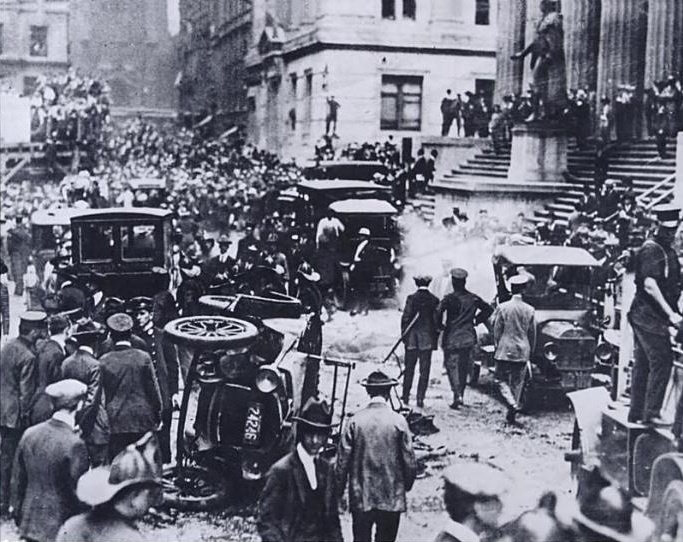
September 16, 1920: Wall Street is bombed. The explosion kills 38 people, and injures over 400.


Although Mario Buda, an Italian anarchist, and an associate of the recently-arrested Nicola Sacco and Bartolomeo Vanzetti, is now believed to have been the man who dropped off the bomb, this was not figured out until he had escaped back to his native Italy.


Buda continued his anarchist activities until the 1930s, switching sides to help the Fascist government of Benito Mussolini find his former friends. After World War II, he switched back to anarchism, though it's not clear why any side would have trusted him at that point, since any side he was on ended up betrayed and defeated. He died in 1963.


It's not clear when the new decade began to be called "The Roaring Twenties," but this was the kind of roar that no one needed.


To this day, there are still gouges from the shrapnel in the outer wall on the Wall Street side of the House of Morgan, then the headquarters of the company founded by J.P. Morgan, at 23 Wall, across Broad Street from the New York Stock Exchange. The building is mainly empty now, and is basically a monument to the victims of the bombing. However, despite the New York Stock Exchange being literally right across Broad Street, 23 Wall stood in for the Gotham Stock Exchange in the 2012 Batman film The Dark Knight Rises.


*


September 16, 1920 was a Thursday. Johanna "Hannie" Schaft, a leading figure in the Dutch Resistance to Nazi Germany in World War II, was born on this day.


And these games were played in what would eventually be called Major League Baseball:


* The New York Yankees lost to the Chicago White Sox, 8-3 at Comiskey Park in Chicago. Babe Ruth went 2-for-5, and Shoeless Joe Jackson went 3-for-5. When the season was over, Ruth had a new record of 54 home runs, while Jackson would never play in "organized ball" again.


* A doubleheader was played at the Polo Grounds in New York. The New York Giants lost the 1st game to the Pittsburgh Pirates, 3-1. The Giants won the 2nd game, 4-0.


* The Brooklyn Robins beat the Cincinnati Reds, 5-3 at Ebbets Field in Brooklyn. (The Brooklyn team was known as the Robins in honor of their manager, Wilbert Robinson. He was fired after the 1931 season, and one of their former names was restored: The Brooklyn Dodgers.


* The Chicago Cubs beat the Philadelphia Phillies, 9-5 at Baker Bowl in Philadelphia.


* A doubleheader was played at Braves Field in Boston. The St. Louis Cardinals won the 1st game, 4-3. The Boston Braves won the 2nd game, also 4-3. Rogers Hornsby went 2-for-6 with an RBI over the 2 games.


* The Cleveland Indians beat the Washington Senators, 1-0 at League Park in Cleveland. Tris Speaker went 0-for-2 with a walk.


* The Detroit Tigers beat the Boston Red Sox, 7-6 in 10 innings, at Navin Field in Detroit. (It would be renamed Briggs Stadium in 1938 and Tiger Stadium in 1961.) Ty Cobb went 2-for-5.


* And the Philadelphia Athletics beat the St. Louis Browns, 8-5 in 11 innings, at Sportsman's Park in St. Louis. George Sisler went 1-for-5 with 2 RBIs.

Thursday, September 15, 2022

September 15, 2008: The Crash Begins

"Oh no, now I'm going to have to get a real job --
and there won't be any real jobs!"

September 15, 2008: The stock market crashes following a triple whammy in the financing industry: Lehman Brothers files for bankruptcy, Merrill Lynch is acquired by Bank of America, and American International Group (AIG) asks for short-term financing from the Federal Reserve.

AIG was a major finance and insurance company. Merrill Lynch was then the 3rd-largest investment bank in America, behind Goldman Sachs and Morgan Stanley. Lehman Brothers was 4th, and owned the brokerage firms E.F. Hutton, Smith Barney and Shearson Hammill.

Some of you may remember the commercials from the 1970s and '80s: "When E.F. Hutton talks, people listen." And the commercials with John Houseman: "Smith Barney. They make money the old-fashioned way: They earn it."

Lehman Brothers also owned American Express, the credit card and travelers' cheque company, the only one of these Lehman-owned companies to end up surviving the recession that was already underway by mid-2007. AIG also survived, and Bank of America managed to keep the Merrill name and division alive.

The preceding Friday, September 12, the Dow Jones Industrial Average closed at 11,421.99. When it closed on Monday, September 15, it was 10,917.51, down over 504 points. And it kept getting worse: By Friday, October 10, it was 8,451.19. It bottomed out on Monday, March 9, 2009, at 6,457.05. The market had lost 56 percent of its worth. Not since April 14, 1997 had it been so low: The Autumn of 2008 wiped out 11 years' worth of growth.

As it usually does -- since 1952, the only exceptions have been 1968, 2000 and 2016, and all of those may have been stolen -- the economy tells the story of the Presidential election. At this point, Senators John McCain of Arizona, the Republican nominee, and Barack Obama of Illinois, the Democratic nominee, were neck-and-neck in the polls. After this, McCain never had a chance: Obama won 53 percent of the popular vote, and won 28 States, including 9 that had voted Republican in 2004.

Margaret Thatcher, Prime Minister of Britain from 1979 to 1990, once said, "The problem with socialism is that you eventually run out of other people's money." The Crash of 2008 proved that Thatcher lied: That's what happens with under-regulated capitalism, not socialism. Or even "socialism." Capitalism is the problem when it is under-regulated; when it is properly regulated, it can be a solution.

The Crash of 2008 also proved that, when liberalism wins, everybody wins, including conservatives; but when conservatives win, everybody loses, including eventually, conservatives. It was only because the conservatives got scared that the Bush Administration acted. It was because the economy still needed saving on January 20, 2009 that the Obama Administration acted.

The Federal Reserve Board, led by Chairman Ben Bernanke, helped keep the downturn from becoming a full-fledged depression. For this, Time magazine named Bernanke its Person of the Year for 2009, as it had named Obama for 2008, and would again in 2012.

*

Major League Baseball games played on this "Black Monday":

* The New York Yankees beat the Chicago White Sox, 4-2 at the soon-to-close old Yankee Stadium. Xavier Nady hit a home run, Bobby Abreu went 3-for-4, and Phil Coke was the winning pitcher, in relief of Alfredo Aceves.

* The New York Mets lost to the Washington Nationals, 7-2 at Nationals Park in Washington.

* The Boston Red Sox beat the Tampa Bay Rays, 13-5 at Tropicana Field in St. Petersburg. Tropicana is owned by Pepsi, and survived the recession.

* The Los Angeles Dodgers beat the Pittsburgh Pirates, 8-2 at PNC Park in Pittsburgh. PNC Bank survived the recession.

* The Cleveland Indians beat the Minnesota Twins, 3-1 at Progressive Field in Cleveland. Progressive Insurance survived the recession.

* The Kansas City Royals beat the Seattle Mariners, 3-0 at Kauffman Stadium in Kansas City.

* The Chicago Cubs beat the Houston Astros, 6-1 at Minute Maid Park in Houston. Minute Maid is owned by Coca-Cola, which survived the recession. The ballpark opened in 2000 as Enron Field, but Enron not only didn't survive the previous recession, it helped cause that recession. (UPDATE: In 2025, it was renamed Daikin Park.)

* The Texas Rangers beat the Detroit Tigers, 11-8 at Rangers Ballpark in the Dallas suburb of Arlington, Texas. That stadium has gone through a few names, but did not then have a corporate name. It is now named Choctaw Stadium.

* The San Diego Padres beat the Colorado Rockies, 11-5 at Coors Field in Denver. Coors survived the recession.

* The Arizona Diamondbacks beat the San Francisco Giants, 3-1 at Chase Field in Phoenix. JP Morgan Chase was hit hard by the crash, but survived the recession. A grandson of the original John Pierpont Morgan founded what became the aforementioned Morgan Stanley.

Since this was a Monday in September, there was also a Monday Night Football game that night. The Dallas Cowboys beat the Philadelphia Eagles, 41-37 at Texas Stadium in the Dallas suburb of Irving, Texas.

Wednesday, May 25, 2022

May 26, 1896: The Dow Jones Industrial Average Goes Into Effect

The New York Stock Exchange.
I don't know why there's a Brazilian flag out front.

May 26, 1896: The Dow Jones Industrial Average goes into effect. Its value: 33.43.

"The Dow" was created by Charles Dow (1851-1902), the editor of The Wall Street Journal and, with his business associate, statistician Edward Jones (1856-1920), the co-founder of Dow Jones & Company.

Having the word "Industrial" in the name initially emphasized the fact that most of the companies involved were in the sector of heavy industry. But that has not always been the case: Some companies have been removed from it, others have been added, and some that were formerly connected with heavy industry have diversified and moved away from it.

At the start, there were 12 companies. The only ones of these that are likely to be familiar to a 2022 audience are General Electric and the United States Rubber Company, now known as Uniroyal.

But even GE, as big as it still is, didn't stay part of the Dow forever, being dropped in 2018. As of August 30, 2020, these are the 30 companies on the Dow: 3M (Minnesota Mining and Manufacturing), American Express, Amgen, Apple, Boeing, Caterpillar (makers of construction equipment), Chevron, Cisco Systems, Coca-Cola, Dow Inc. (the chemical company, with no other connection to Dow Jones & Company besides name), Goldman Sachs, Home Depot, Honeywell, Intel, IBM (International Business Machines), Johnson & Johnson, JPMorgan Chase, McDonald's, Merck, Microsoft, Nike, Procter & Gamble, Salesforce, The Travelers, UnitedHealth, Verizon, Visa, Walgreens Boots Alliance (Boots is a British pharmacy chain, similar to America's Walgreens), and The Walt Disney Company.

On September 3, 1929, the Dow hit 381.17, then a record high. Then it started to drop. From October 24 to 29 of that year, it crashed to 230.07. On July 8, 1932, at the depth of the Great Depression, it was 41.22, the lowest it has been since its earliest days. On November 23, 1954, 25 years after the Crash, it finally got above its 1929 high in constant dollars. And it took until July 6, 1959, almost 30 years after, to surpass it in inflation-adjusted dollars.

On November 14, 1972, the Dow closed above 1,000 for the 1st time. After a brief period up there, it would not reach 1,000 again until 1980, as the 1973-81 period was a time of high inflation. On October 19, 1987, the Dow had its biggest value drop ever, over 22 percent, and 508 total points. That total has been topped (or bottomed) many times, but not the value.

The Dow first topped 10,000 on March 29, 1999; and reached 14,198.10 on October 11, 2007. Then it started going back down, for a period that included the Crash of 2008, bottoming out at 6,547.05 on March 9, 2009, its lowest straight-dollar close in 22 years. It topped the 2007 high on March 5, 2013; topped 20,000 on October 2, 2017; topped 25,000 on January 4, 2018; topped 30,000 on November 24, 2020.

On October 1, 1999, Washington Post columnist James K. Glassman and economist Kevin A. Hassett published a book titled Dow 36,000: The New Strategy for Profiting From the Coming Rise in the Stock Market. They predicted that the Dow would reach 36,000 by 2004. The "bursting of the dot-com bubble" and the 9/11 attacks, both in 2001, prevented this, and the Crash of 2008 prevented it from happening soon after that. The Dow finally closed over 36,000 on November 2, 2021.

Glassman and Hassett shouldn't feel too bad: They're not alone. In 1976, Paul Erdman, who had previously served time in prison for bank fraud, published The Crash of '79, which predicted a depression following an Islamic revolution in Iran jacking up oil prices. He almost got it right, as there was such a revolution there in 1979. But while there was a "bear market" from 1979 to 1982, there wasn't a crash; while there was a recession, there wasn't a depression.

He followed this in 1986 with The Panic of '89. There was a big downturn in October that year, but it wasn't as bad as the one in 1987, and the recession that began in 1990 and lasted until 1993 had little to do with either real-life drops, '87 or '89.

And in 1991, ABC aired the drama My Life and Times, in which an old man looks back on his life from the year 2035. The 5th episode was about the Crash of '87. The 6th was titled "The Collapse of '98," and showed the Miller family dealing with the depression that resulted. As it turned out, not only was this the last episode of the series, but 1998 was a "bull market" year, and neither the recession that followed the Crash of 2008 nor the one that followed the COVID lockdown of 2020 was as bad as what was shown in "The Collapse of '98," which seemed to be as bad as the Great Depression of the 1930s.

*

May 26, 1896 was a Tuesday. Professional basketball and hockey did not exist. Professional football barely did. And there was only 1 major league in baseball, the National League. These games were played that day:

* The New York Giants beat the Cleveland Spiders, 5-4 at the 1890-1911 version of the Polo Grounds.

* The Brooklyn Bridegrooms -- often called the Dodgers, but still officially using the name they'd used since 1887, when several of their players got married in the off-season -- beat the Louisville Colonels, 4-3 at Eastern Park in Brooklyn.

* The Philadelphia Phillies beat the Chicago Colts, 8-1 at National League Park in Philadelphia. The ballpark would later be renamed Baker Bowl, and the Colts would be renamed the Cubs.

* The Baltimore Orioles beat the St. Louis Browns, 13-3 at Oriole Park in Baltimore. The Browns would become the Cardinals in 1900. In 1902, a new Browns team would begin in the American League, but moved for the 1954 season, becoming the new version of the Baltimore Orioles.

* The Cincinnati Reds beat the Washington Senators, 18-5 at Boundary Field in Washington.

* The Boston Beaneaters were supposed to host the Pittsburgh Pirates at the South End Grounds in Boston, but the game was rained out. It was made up as part of a doubleheader on August 22. The Pirates won both games, 8-4 and 6-3. The Beaneaters would go through additional odd names before becoming the Braves in 1912.

The Spiders, the Colonels, the Orioles and the Senators would be contracted out of existence after the 1899 season. This, and the subsequent availability of players, made it possible for the American League to declare itself a major league in 1901.

Wednesday, May 4, 2022

May 5, 1893: The Panic of 1893

May 5, 1893: The American stock markets crash, an occurrence known as the Panic of 1893. It causes a nasty depression.

The causes can be traced back to 1890, to a wheat crop failure in Argentina. This led to an unsuccessful coup in that country, which led to European investors pulling their money out of the country. Speculations in South Africa and Australia also collapsed, affecting the British Empire, which in turn affected the European continent. 

This led to a run on gold in the U.S. Treasury. This shook the American economy, and led to Grover Cleveland, who had lost the 1888 Presidential election to Benjamin Harrison, defeating Harrison in 1892, and becoming the only President to regain the office.

On February 20, 1893, 12 days before Cleveland's Inauguration, the Philadelphia and Reading Railroad was forced into receivership. Shortly after taking office, Cleveland, a big believer in the gold standard, convinced Congress to repeal the Sherman Silver Purchase Act of 1890, which he thought was the chief cause of the crisis.

It might have been the right thing to do, but it might also have been too late: The European markets were a mess, and European investors sold their stock in American companies, causing the Panic on May 5. The economy fell into a depression, and over the course of the calendar year, 3 more major railroads went bankrupt: The Union Pacific, the Northern Pacific, and the Atchison, Topeka & Santa Fe. (Each of these would reorganize, and survive until Amtrak took over passenger service in 1971, and all still run freight under different corporations today.)

To make matters worse, Cleveland discovered he had oral cancer. Like a previous President, Ulysses S. Grant, he loved cigars, and it caught up with him. Unlike Grant, the tumor was in his palette, not his throat, and was operable.
But, concerned that publicizing his illness would cause people to lose confidence in their President, and thus lose whatever remaining confidence they had in the economy, he had to keep his surgery a secret. On June 30, he took a train to New York, announced as a fishing vacation. On July 1, on a yacht in the East River, away from prying eyes, he was operated on.

The tumor was removed, but when he woke up, he found he couldn't speak. A 2nd surgery had to be performed, to provide him with a rubber substitute for the upper jaw area that was removed. After that, he was fine, and the details of the surgery were not revealed until years after his death.

He was able to return to work quickly, but the economy fell further. The unemployment rate hit 25 percent in Pennsylvania, 35 percent in New York State, and 43 percent in Michigan. U.S. gold reserves fell dangerously low. Cleveland ended up borrowing gold from investment banker J.P. Morgan and the Rothschild banking family, about $65 million worth. (In 2022 money, about $2.1 billion.)

It provided a floor for the economy, but getting off the floor just wasn't happening. Jobs continued to be lost, and wages for jobs that still existed got cut. Farm prices dropped. Shipping was hit hard. Railroads continued to suffer. Labor strife abounded, leading to the Pullman Strike in the Summer of 1894. Cleveland sent the U.S. Army to break it up, since it was interfering with the mail. Constitutionally, it was legal. Morally, it was reprehensible.

People starved. Soup kitchens sprouted up, presaging the later Great Depression of the 1930s. And, as Herbert Hoover did then, Cleveland didn't think the Constitution allowed him to do any more to improve things than he was already doing.

An urban legend, probably not true but meant to allege Cleveland's disinterest in people's suffering, told of him walking out of the White House, and seeing someone eating the grass on the lawn. The man told Cleveland that he was starving. Cleveland told him, "If you're going to eat the grass, you might as well do some good. Go over there, where the grass is longer."

The 1894 election saw the greatest wipeout in American Congressional history. Although the process had begun under Harrison and the Republicans, people had short memories, and blamed Cleveland and the Democrats for it. The Republicans gained 110 seats in the House of Representatives, an all-time record, and took control. They already had control of the Senate, and so they gained just 2 seats there.

By the time the choice had to be made on whether to run again in 1896, the economy's recovery was still slow, and Cleveland believed the Democratic nominee would lose, no matter who it was, and so he stepped aside. Ironically, the winning Republican was William McKinley, then Governor of Ohio, who, as a member of the House in 1890, had written a tariff bill that, along with the Silver Purchase Act written by his home-State colleague, Senator John Sherman (brother of General William T. Sherman), had been one of the major causes of the Panic. So not only did Harrison pretty much get absolved of blame, but so did McKinley.

The Spanish-American War of 1898 swept aside the last vestiges of the 1890s depression. For a country, war is good for business -- but only if you win.

Cleveland died in 1908, from heart trouble, not from any form of cancer. By that point, his reputation had pretty much been restored, and he was fondly remembered again.

UPDATE: This was the decade known as the Gay Nineties, in this case "gay" meaning "joyful." (Despite the excesses of Oscar Wilde, "gay" was not in-subculture slang for "homosexual" until the 1930s, and wasn't widely used as such until the 1960s.) But, for the most part, it was not joyful.

And the era from the end of the Civil War in 1865 to the rise of Theodore Roosevelt in 1901 became known as the Gilded Age. In a White House press conference on April 19, 2025, Donald Trump said:

You know, our country was the strongest, believe it or not, from 1870 to 1913. You know why? It was all tariff-based. We had no income tax. Then in 1913, some genius came up with the idea of let's charge the people of our country, not foreign countries that are ripping off our country. And the country was never relatively, was never that kind of wealth.

In response, historian Lauren Thompson, author of some books on the period, wrote this on Facebook, citing the Panics of 1873 and 1893:

Do you know what happened between 1870 and 1913? There were two economic panics. Huge ones. Deep, scarring panics where many working people went hungry and jobless. Do you know who was "rich" in that period? The Carnegies. The Vanderbilts. J.P. Morgan, who almost singlehandedly controlled the nation money's supply. Wild swings occurred in the stock market.

Working people were paid pennies. Middle-class people made money, bought homes, and lost them with regularity. There was no economic stability. There was no regulation. Between 1880 and 1905 there were well over 36,000 strikes involving 6 million workers. Do you know what they were striking for? The biggest ask was an 8-hour workday.

Do you know what Congress focused on instead? Passing obscenity law, obsessing about sex and white women's purity. Creating instability in the Philippines, the Carribbean and Latin America via colonialist, eugenic-based projects. Enriching themselves on kickbacks from industries like the railroads. Rejecting appeals for women's suffrage and anti-lynching laws. State governments doubled-down on segregation law and passed laws to try to control what was taught in classrooms.

Sound familiar?

Yes, it does. For 21st Century Republicans, as it was for 1865-1901 Republicans, it's "the usual."

*

May 5, 1893 was a Friday. The only major professional sports league in America at the time was baseball's National League, and these games were played in it:

* The New York Giants lost to the Washington Senators, 11-3 at Boundary Field in Washington.

* The Brooklyn Bridegrooms beat the Philadelphia Phillies, 3-1 at Eastern Park in Brooklyn.

* The Baltimore Orioles beat the Boston Beaneaters, 8-2 at Union Park in Baltimore. From 1891 to 1898, one of these teams would win the NL Pennant in each season: The Beaneaters in '91, '92, '93, '97 and '98; and the Orioles in '94, '95 and '96.

* The Cleveland Spiders beat the Chicago Colts, 9-6 at League Park in Cleveland.

* The Cincinnati Reds beat the St. Louis Browns, 3-2 at League Park in Cincinnati.

* And the Pittsburgh Pirates and the Louisville Colonels were rained out at Exposition Park in Pittsburgh. The game was made up as part of a doubleheader on August 10. The Colonels won the opener, 11-6. The Pirates won the nightcap, 14-3.

After the 1899 season, the Senators, the Orioles, the Spiders and the Colonels were contracted out of the NL. The Bridgegrooms -- so named because several of their players had gotten married in a single off-season -- had already bought most of the Orioles' stars, including manager Ned Hanlon, and, for a circus troupe named Hanlon's Superbas, renamed themselves the Brooklyn Superbas. They won Pennants in 1899 and 1900. In 1911, they became the Dodgers.

After 1899, the Pirates bought the Colonels' contracts, including that of Honus Wanger, and won 3 straight Pennants, 1901-03. In 1900, the Browns became the Cardinals. In 1903, the Colts became the Cubs. The American League was founded in 1901, and would have their own teams named the St. Louis Browns, the Baltimore Orioles (the same team, moving to Baltimore in 1954), and the Washington Senators.

December 31, 1999 & January 1, 2000: The Millennium

December 31, 1999:  The Millennium arrives. The people of planet Earth survived. At a terrible cost. But we hadn't destroyed ourselves. ...