Showing posts with label oregon. Show all posts

Thursday, November 24, 2022

November 24, 1971: The D.B. Cooper Hijacking

November 24, 1971: The legend of D.B. Cooper begins. He had some things in common with Jack the Ripper: He was a mysterious figure; he committed a shocking crime, although, in his case, he didn't kill anybody; he was never caught; and he may not even have come up with the name by which he became known on his own.

It was the day before Thanksgiving, traditionally the busiest travel day of the year. At Portland International Airport in Oregon, a flight counter attendant for Northwest Orient Airlines reported that a man identifying himself as "Dan Cooper" walked up and used cash to buy a one-way ticket on Flight 305 to Seattle, a flight intended as being only 30 minutes. "Mr. Cooper" boarded the plane, which was a Boeing 727-100, took his seat, and ordered a bourbon and soda.

The flight attendant, Florence Schaffner, backed up the counter attendant's description of Cooper: Wearing a business suit with a black tie and a white shirt, appearing to be in his mid-40s, and looking like the composite sketch above.

The plane took off at 2:50 PM Pacific Standard Time (5:50 Eastern), on time. Shortly thereafter, Cooper handed a note to Schaffner. Flight attendants -- they were usually still called "stewardesses" at this point, or "stews" for short -- often got handed notes, usually from men who were lonely from their travels. This one dropped it in her purse without reading it. Cooper spoke up: "Miss, you'd better look at that note. I have a bomb."

She read it. It asked her to sit next to him. She asked to see the bomb. He opened his briefcase, and convinced her that what was inside really was a bomb. The he gave her his demands: $200,000 (about $1.44 million in today's money), 4 parachutes, and a fuel truck standing by in Seattle, to refuel the plane after it landed.

Schaffner went to the cockpit, and told the pilots. When she got back, Cooper was wearing sunglasses. The flight's captain, William A. Scott, contacted Seattle-Tacoma International Airport (a.k.a. "Sea-Tac"). The authorities there contacted local and federal authorities. The other 35 passengers were told only that their arrival would be delayed because of "a minor mechanical difficulty."

Donald Nyrop, president of the airline, was reached. He ordered that the ransom be paid, and that all employees should cooperate completely with Cooper. The plane circled Puget Sound for 2 hours, to give the police and the FBI time to get the money and the parachutes.

Flight attendant Tina Mucklow recalled that Cooper appeared familiar with the local terrain; at one point he remarked, "Looks like Tacoma down there," as the aircraft flew above it. He also correctly mentioned that McChord Air Force Base was only a 20-minute drive (at that time) from Sea-Tac. He didn't match the profile of men engaged in air piracy at the time: Enraged, hardened criminals or "Take this plane to Cuba!" political dissidents.

"He wasn't nervous," she told investigators. "He seemed rather nice. He was never cruel or nasty. He was thoughtful and calm all the time." He even ordered a refill of his drink, paid his tab, and offered to request meals for the flight crew during the stop in Seattle. He was very much the stereotype not of the "air pirate," but that of the "gentleman bandit."

His motive? It wasn't clear. Mucklow asked Cooper if he had a grudge with Northwest Airlines. He said, "I don't have a grudge against your airline, Miss. I just have a grudge."

The FBI got 10,000 $20 bills from the Federal Reserve Bank of San Francisco, thus making the serial numbers easier to track.

At 5:39 PM, the plane landed at Sea-Tac. A backpack with the money and the parachutes was delivered to Mucklow. Cooper then released the passengers, Schaffner, and another flight attendant, Alice Hancock -- but not Mucklow. He then told the cockpit crew to take off again, toward Mexico City.

At 7:40, the plane took off again. The only people on board were Cooper, Scott, Mucklow, first officer William Rataczak, and flight engineer Harold E. Anderson. Two F-106 fighter jets from McChord and a Lockheed T-33 training jet followed. At 8:00 PM, having been shown how while on the ground, Cooper opened the plane's rear staircase. At 8:13, there was a sudden, unexpected change in altitude. It has been presumed that this was when he jumped. At 10:15, the plane landed at Reno, Nevada, and it was determined that Cooper was no longer on board.

The FBI found fingerprints and Cooper's tie, but the prints were not in their system, and the tie gave them no hints as to his identity. They looked for men in the region with a criminal record, and an Oregon man named D.B. Cooper stood out. The Portland police quickly ruled him out as a suspect, but the wire service picked up the story, and "D.B. Cooper" has been the name attached to the hijacker ever since.

As far as can be determined, "Dan Cooper" was never seen again. An extensive search was made of Washington State and Oregon. It enabled the FBI to solve one crime: A skeleton was found, but of a teenage girl, determined to be one murdered weeks earlier. In 1980, Brian Ingram, a boy on a camping trip, found some weather-damaged bills with serial numbers matching the ransom money, $5,880 worth. This was near the Columbia River, which separates Washington from Oregon.

This has led to the leading theory: Cooper died in his attempt to escape, either through being unable to open his parachute in time, or landing too hard anyway, on impact with either the ground or a tree, or drowned in the river, possibly before he could get the heavy parachute off of himself.

In 1986, the FBI gave a cash award worth half the money to Ingram, by then in high school; and half to Northwest Orient Airlines' insurer. Like Cooper himself, none of the other money has ever been found.

As with Jack the Ripper, multiple guesses as to the perpetrator's identity have been made. As with the Ripper, most are easily dismissible. One of the more fascinating ones was that Cooper was John List, who had murdered his family in a religious-fanatic rage in Westfield, New Jersey just 15 days before the hijacking, and hadn't been seen since. He did bear a facial resemblance to the sketch, and, at 46, was age-consistent. List was captured in 1989, and confessed to slaying his family, but denied any connection to the Cooper case, and maintained that denial until his death in prison in 2008. The FBI have dropped him from their list of Cooper suspects.

Also as with the Ripper, the fact that the Cooper case was unsolved has led to an unending public fascination with it. In 1975, James M. Cain, author of the crime novels turned film noirs The Postman Always Rings Twice, Mildred Pierce and Double Indemnity, published the novel Rainbow's End, an imagination of what happened to Cooper after he jumped.

In 1980, J.D. Reed published a novel titled Free Fall. The following year, it was made into a film, The Pursuit of D.B. Cooper, starring Treat Williams. The story takes a lot of liberties, including the fact that Cooper jumped in daylight, when he actually jumped at night.

In 1991, Scott Adams published an issue of his Dilbert comic strip suggesting that Cooper died due to sabotage: "He learned that you should never get your parachutes from the same people you're robbing."

The TV series In Search of... (in 1979) and Unsolved Mysteries (1988) examined the Cooper case. TV shows suggesting in-universe solutions to the case have included NewsRadio in 1998, Prison Break in 2006, Numbers in 2009, Leverage in 2012, and Loki in 2021 (The Marvel Cinematic Universe makes the suggestion that Loki, played by Tom Hiddleston, was Cooper).

And the series Twin Peaks, set in Washington State, has a lead character, an FBI Agent, named Dale Bartholomew Cooper. (The name is only a tribute: Agent Cooper was too young to have been the hijacker -- his portrayer, Kyle MacLachlan, was 12 at the time -- but he could have been his son, and thus became an FBI agent as an act of rebellion.)

*

November 24, 1971 was a Wednesday. Baseball was out of season, and football was in midweek. There were 5 games each in the NBA and the ABA:

* The New York Knicks beat the Baltimore Bullets, 111-94 at the Baltimore Civic Center. (It still stands, known as the CFG Bank Arena.)

* The Boston Celtics beat the Buffalo Braves, 108-100 at the Boston Garden.

* The Cincinnati Royals beat the Portland Trail Blazers, 114-112 at the Cincinnati Gardens.

* The Milwaukee Bucks beat the Atlanta Hawks, 141-107 at the Milwaukee Arena. In 1974, it was renamed the Milwaukee Exposition, Convention Center and Arena, or "The MECCA." Since 2014, it has been named the UW-Panther Arena. I don't know what Kareem Abdul-Jabbar, who had recently changed his name from Lew Alcindor in accordance with his conversion to Islam, thinks of that name now, or thought then, but he scored 33 points in this game.

* The Houston Rockets beat the Philadelphia 76ers, 109-108 at the Hofheinz Pavilion in Houston.

* The New York Nets lost to the Indiana Pacers, 112-101 at the Indiana State Fairgrounds Coliseum in Indianapolis. (It still stands, named the Corteva Coliseum.)

* The Utah Stars beat the Virginia Squires, 120-113 at the Scope in Norfolk, Virginia. Despite losing the game, Charlie Scott of the Squires led all pro basketball scorers on the night, with 42 points.

* The Carolina Cougars beat the Dallas Chaparrals, 120-106 at the Greensboro Coliseum.

* The Miami Floridians beat the Denver Rockets, 133-129 at the Miami Beach Convention Center. (The Rockets became the Denver Nuggets in 1974.)

* And the Memphis Pros beat the Pittsburgh Condors, 126-110 at the Mid-South Coliseum in Memphis.

There were 6 games played in the NHL:

* The New York Rangers beat the St. Louis Blues, 8-3 at the new Madison Square Garden. Bobby Rousseau, Walt Tkaczuk and Brad Park -- a defenseman, mind you -- each scored 2 goals for the Broadway Blueshirts. Vic Hadfield and Jim Neilson also scored.

* The Boston Bruins beat the Philadelphia Flyers, 2-1 at The Spectrum in Philadelphia.

* The Toronto Maple Leafs beat the Pittsburgh Penguins, 2-1 at the Civic Arena in Pittsburgh.

* The Montreal Canadiens and the Chicago Black Hawks played to a tie, 3-3 at the Chicago Stadium.

* The Los Angeles Kings beat the Buffalo Sabres, 5-3 at The Forum in Inglewood, California, outside Los Angeles.

* The California Golden Seals beat the Detroit Red Wings, 6-1 at the Oakland Coliseum Arena.

* And the Minnesota North Stars and the Vancouver Canucks were not scheduled.

Saturday, November 19, 2022

November 19, 1975: "One Flew Over the Cuckoo's Nest" Premieres

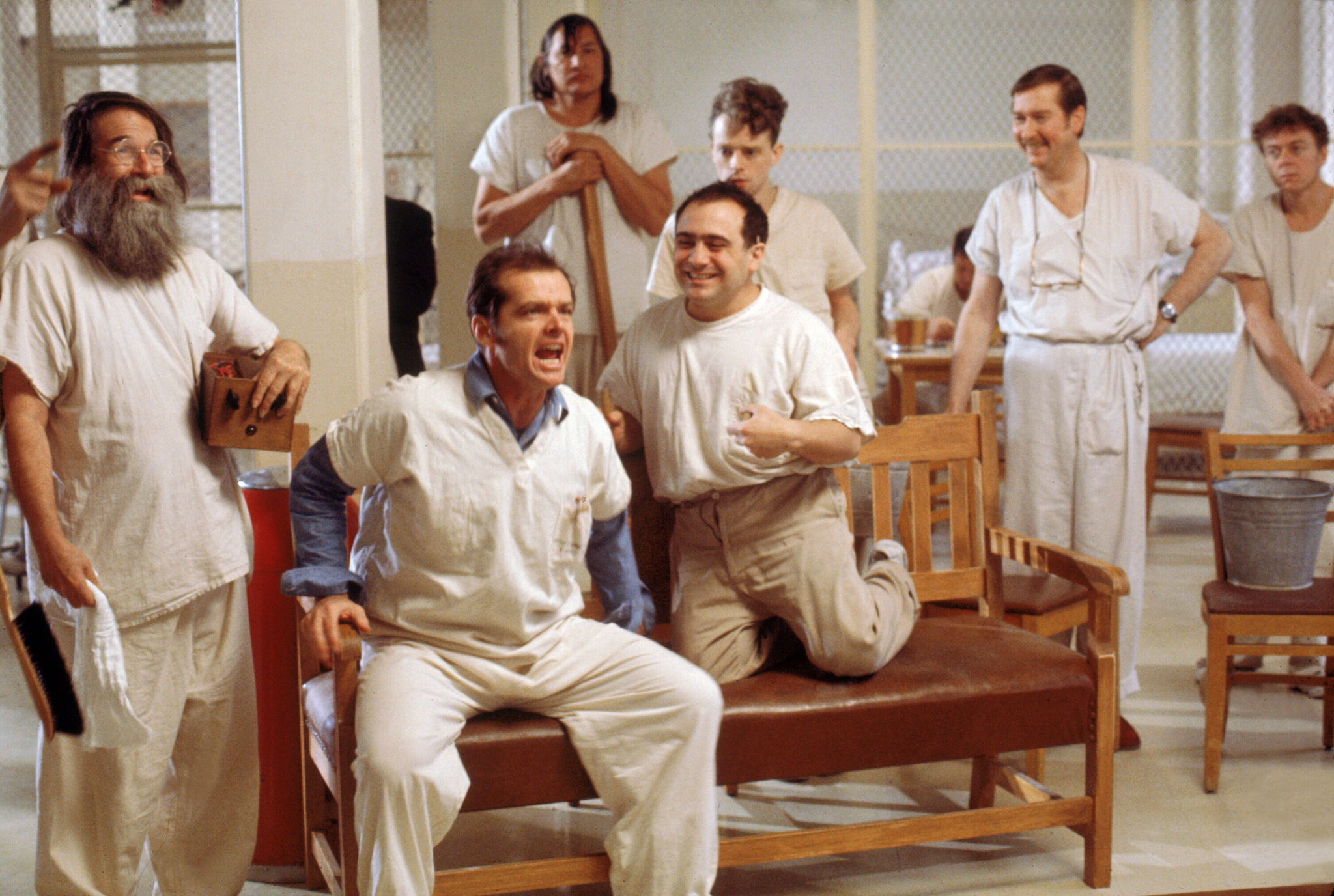
November 19, 1975: One Flew Over the Cuckoo's Nest premieres, directed by Miloš Forman, and based on the 1962 novel by Ken Kesey. Kesey himself hated the film.

Maybe the film's star, Jack Nicholson, had something to do with it. After all, in 1980, Stanley Kubrick directed a film version of Stephen King's The Shining, and cast Nicholson as the lead, and King hated it.

Shortly after its publication, the novel had been produced on Broadway, starring Kirk Douglas. Gene Wilder, not yet a star, played Billy Bibbitt. Ed Ames, already a star, 6-foot-3, and, despite being Jewish, dark-skinned enough to have played Native Americans before and after, played Chief Bromden.

Douglas held the film rights to it, but it remained stuck in "development hell." He allowed his son, actor Michael Douglas, to produce the film. Michael hired Hal Ashby to direct, but Ashby decided that Kirk was now too old to play the lead, and Michael backed him up on this. When Forman, Kirk's first choice to direct but stuck in Communist Czechoslovakia, escaped to America, Ashby gracefully stepped aside, but Forman also maintained that Kirk was too old. (He was just short of turning 59 when the film was released.)

Oddly, Michael Douglas would have been about the right age (31 when the film was released), but things were already strained between him and his father, so he stepped aside, and served as producer only. Gene Hackman (45) and Marlon Brando (51) were also too old for the role, but were offered it, anyway. So were James Caan and Burt Reynolds, who were age-appropriate (35 and 39, respectively). All 4 turned it down. Nicholson (38) accepted.

The title comes from a nursery rhyme read to Chief Bromden as a child by his grandmother, mentioned in the book:

Vintery, mintery, cutery corn,
Apple seed and apple thorn,
Wire, briar, limber lock,
Three geese in a flock.
One flew East, one flew West,
And one flew over the cuckoo's nest.

It was filmed in the exact same place that the book takes place, the Oregon State Hospital, in the State capital of Salem, although the building where most of the action takes place has since been torn down. (Kesey lived most of his life in Oregon, and had worked as an orderly in that hospital.) Since it's a psychiatric hospital, the patients are "cuckoo," hence, "cuckoo's nest."

The film takes place in 1963, a year after the novel was published. We know it's 1963 because, when Randle Patrick McMurphy, played by Nicholson, asks the other inmates to imagine they're watching the World Series on television, he says that Sandy Koufax of the Los Angeles Dodgers is pitching against the New York Yankees.

McMurphy is 38, and has been arrested for assault many times. This time, he is convicted of the statutory rape of a 15-year-old girl. The film makes no effort to suggest that he was innocent. Let me make that clear: McMurphy is not the hero of the film, or any kind of hero.

He is sentenced to a State work farm, but wants to avoid hard labor. He pretends to be insane -- which, of course, is what Nicholson spent much of the 1970s and 1980s doing for a living, pretending to be insane -- so that he can be transferred to a psychiatric institution, and avoid hard labor. He would have been better off leaving well enough alone, and serving his sentence and doing the labor. Let me make this clear, as well: McMurphy was not as smart as he thought he was.

Louise Fletcher plays Mildred Ratched, the "Big Nurse" (big in power, not in physical size -- she's not especially tall, and not fat) who runs the ward. Like the character of Major Margaret "Hot Lips" Houlihan on the TV show M*A*S*H, she was an Army nurse. Unlike Margaret, she let her wartime experience turn her into a cold, passive-aggressive tyrant. She maintains her World War II-era hairstyle, as Kesey pointed out in the book that "life had stopped for her a long time ago." (In real life, years later, he ran into the woman on whom he modeled the character, recalling, "She was much smaller than I remembered, and a whole lot more human.")

She holds near-absolute power over the patients' access to medications, privileges, and basic necessities such as food and toiletries. She capriciously revokes these privileges whenever a patient displeases her. She maintains order, keeping the patients from acting out, either through antipsychotic and anticonvulsant drugs, or her own brand of psychotherapy, which consists mostly of humiliating patients into doing her bidding. They are terrified of her, and, since the doctors and the hospital administrators value order, they let her get away with it all. Let's make one more thing clear: The 1960s were not a golden age for the treatment of mental health.

Among the actors playing patients are Danny DeVito and Christopher Lloyd, not yet stars, and later reunited in the cast of the TV sitcom Taxi. Will Sampson, a 6-foot-7 member of the Muscogee Nation, plays Chief Bromden, a very tall Native American who acts as though he is deaf and mute. Brad Dourif, later to be the voice of Chucky in the Child's Play franchise, plays Billy Bibbitt.

McMurphy quickly realizes that some of the patients don't really belong there, and wouldn't be if people had just taken more care with them, especially Billy. McMurphy and Ratched begin a war of wills, which leads to her decision to have him given electroconvulsive therapy. It doesn't work, and only makes him more defiant. That inspires the other inmates.

But they're still too scared to stand up to Ratched. Murphy says he'll pick up the hydrotherapy console and throw it out the window, breaking it, and allowing the inmates to escape. He can't, as it's too heavy. He tells them, "At least I tried!"

Bromden reveals to McMurphy that he can hear and speak. They plan to escape. But first, McMurphy gets a hold of the ward's phone, and makes arrangements for what he calls "a Christmas party." He brings a pair of prostitutes over, with bottles of booze.

The next morning, Ratched sees the ward is a mess, and sees Billy and a prostitute named Candy sleeping naked together. She verbally abuses Billy, as always. This time, he stands up to her, and even loses his stutter. But she has one more "fear card to play": She threatens to tell his mother. He goes back to fear and stuttering, and is taken to the office. Billy breaks some glass, and slits his throat with it, killing himself. Upon learning this, McMurphy blames Ratched, and lunges at her, and tries to strangle her to death, before the orderlies can pull him off her.

Time passes without McMurphy being seen, and rumor spreads that he has escaped -- leaving Bromden behind, breaking his promise that they would do it together. But McMurphy is brought back to his bed. He has been lobotomized, and is now "a vegetable." Ratched appears to have won the war.

But Ratched has suffered the consequences of the attack: She is wearing a neck brace, and her voice is only a whisper. And McMurphy has kept his promise to Bromden, although not in the way he had hoped. Bromden carries out a "mercy killing," smothering McMurphy with a pillow, and ending his suffering. Bromden is strong enough to lift the hydrotherapy machine, and to throw it through the window. He escapes. Ratched and the orderlies can't stop him. The other inmates cheer -- but don't follow him. 

Bromden is the hero of the film. But, since neither the book nor the film have ever had an authorized sequel, we have no idea of what will happen to him afterward: Maybe he'll truly escape, maybe he'll get caught; maybe he can now "make it" in the outside world, maybe he can't. Given this, and given what happened to every inmate but Bromden, it's arguable that Ratched is still "the winner." The "bad guy" wins -- barely.

Bromden narrates the book, which, unlike the film, details his background: He became a paranoid schizophrenic due to his World War II experiences, and his white mother committed him to embarrass his Native father.

Another big difference from the book: McMurphy is considerably less violent in the film, which treats him as more of a con man than a serious threat. And the fishing trip isn't McMurphy hijacking a hospital bus on a whim, taking the patients with him, doing the fishing, and then taking them back rather than making it a permanent escape. In the book, it's planned by the doctors, but Ratched attempts to sabotage it.

The film was nominated for 8 Academy Awards, and swept the 5 major "Oscars": Best Picture for producer Michael Douglas, Best Director for Forman, Best Actor for Nicholson, Best Actress for Fletcher, and Best Adapted Screenplay for Laurence Hauben and Bo Goldman. The only other films to do that have been It Happened One Night in 1934 and The Silence of the Lambs in 1991.

Michael Douglas would later win Best Actor in 1988, for Wall Street. His 2nd wife, Catherine Zeta-Jones, would win Best Supporting Actress in 2003, for Chicago. Kirk Douglas was nominated for Best Actor 3 times, but never won an Oscar, in any capacity. Jack Nicholson has 12 acting nominations (only Meryl Streep, who's won 3 times out of 21 nominations, has more), and 3 wins: Along with One Flew Over the Cuckoo's Nest, he won Best Supporting Actor in 1983, for Terms of Endearment; and a 2nd Best Actor in 1997, for As Good As It Gets.

Laurence Hauben died in 1985, Will Sampson in 1987, Kirk Douglas in 2016 (at the age of 103), Miloš Forman in 2018, and Louise Fletcher earlier in 2022. As of November 19, 2022, Jack Nicholson, Danny DeVito, Christopher Lloyd, Brad Dourif, Bo Goldman and Michael Douglas are still alive. (UPDATE: Goldman died in 2023.)

*

November 19, 1975 was a Wednesday. Baseball was out of season. Football was in midweek. There were 6 games in the NBA:

* The Philadelphia 76ers beat the Kansas City Kings, 113-103 at The Spectrum in Philadelphia.

* The Atlanta Hawks beat the Golden State Warriors, 104-98 in overtime at The Omni in Atlanta.

* The Detroit Pistons beat the Portland Trail Blazers, 120-114 at Cobo Hall (now Huntington Place) in Detroit.

* The Los Angeles Lakers beat the Houston Rockets, 118-110 at The Summit in Houston. (The arena has been converted into the "Central Campus" of televangelist Joel Osteen's Lakewood Church.)

* The Milwaukee Bucks beat the Phoenix Suns, 96-94 at the Arizona Veterans Memorial Coliseum in Phoenix.

* And the Seattle SuperSonics beat the Chicago Bulls, 97-87 at the Seattle Center Coliseum.

There were 4 games played in the American Basketball Association:

* The New York Nets lost to the Virginia Squires, 110-100 at The Scope in Norfolk, Virginia.

* The Denver Nuggets beat the Spirts of St. Louis, 119-106 at the St. Louis Arena.

* The San Antonio Spurs beat the Kentucky Colonels, 113-106 at the HemisFair Arena in San Antonio.

* And the Indiana Pacers beat the Utah Stars, 130-110 at the Salt Palace in Salt Lake City.

There were 5 games in the NHL:

* The New York Rangers lost to the Kansas City Scouts, 6-4 at Madison Square Garden. The Scouts played 2 seasons before moving, and won exactly 7 away games. This was the 6th. The Rangers had indeed fallen on hard times.

* The Vancouver Canucks beat the Washington Capitals, 5-2 at the Capital Centre in the Washington suburb of Landover, Maryland.

* In an "Original Six" matchup, the Boston Bruins and the Detroit Red Wings played to a tie, 3-3 at the Olympia Stadium in Detroit.

* The Montreal Canadiens beat the Minnesota North Stars, 6-0 at the Metropolitan Sports Center in the Minneapolis suburb of Bloomington, Minnesota.

* And the Chicago Black Hawks beat the Los Angeles Kings, 4-2 at The Forum outside Los Angeles in Inglewood, California.

And there were 2 games in the World Hockey Association. The Cleveland Crusaders beat the Minnesota Fighting Saints, 4-3 in overtime at The Coliseum in the Cleveland suburb of Richfield, Ohio. And the Indianapolis Racers beat the New England Whalers, 3-1 at the Market Square Arena in Indianapolis.

Sunday, October 2, 2022

October 3, 1873: Chief Kintpuash Is Executed

October 3, 1873: Kintpuash, the Chief of the Modoc tribe of Native Americans, is executed at Fort Klamath, Oregon. He is believed to have been about 36 years old, and is the only Native Chief to be executed for war crimes.

He is believed to have been born in 1837, around Tule Lake, California, near the Oregon State Line. In the Modoc language, "Kintpuash" means "Strikes the water brashly." In 1864, the U.S. government, wanting the fertile land in the area, forcefully removed the Modocs to the Klamath Reservation in southwest Oregon. The act itself was bad enough, but Klamath was already home to the Klamath tribe, their arch-rivals. There was a lot of fighting between them.

In 1865, Kintpuash, by then informally called "Captain Jack" by American colonizers, led a band of Modoc from the reservation back to their home in California. In 1869, the band were rounded up by the U.S. Army, and returned to the Klamath Reservation. Finding conditions had not improved, in April 1870, Kintpuash led the Modoc back to the Tule Lake area.

(He was not the first person in a leadership position in the Americas to be known as "Captain Jack," nor the last. At least one later Native Chief had the nickname. The Billy Joel song of the same title was about drugs, as Billy knew of a heroin dealer with the nickname.)

In 1872, U.S. troops were sent to capture Kintpuash's band, and force them back to the reservation. On November 29, while their surrender was being negotiated at the Lost River in Oregon, fighting broke out between a soldier and one of the Modoc warriors. The brief Battle of Lost River ensued, and Kintpuash was forced to retreat.

They found what is now the Lava Beds National Monument, a natural fortress. His warriors made use of its many caves and trenches in the lava beds for defensive fighting, and women and children could be sheltered. The Army launched an attack on January 17, 1873, but it backfired: They lost 35 men, while the Modoc suffered no casualties.

Kintpuash's advisers, not understanding differences between Modoc and Euro-American culture, suggested that the Army would leave if their warriors killed its leader, Major General Edward Canby. Kintpuash hoped for a peaceful solution that would allow his people to stay in their territory. He was challenged for leadership, and agreed to their plan.

On April 11, 1873, in what was supposed to be a peace conference at Tule Lake, he shot Canby. Another tribesman killed a minister, the Reverend Eleazar Thomas. Two other negotiators were wounded. This -- and the fact that George Armstrong Custer's General status during the Civil War was a brevet rank, and he was a Lieutenant Colonel when he was killed at the Little Bighorn -- made Canby the only U.S. General killed during the Indian Wars. The Kentucky native was 55 years old.

The Modoc fled to the lava beds. The Army brought in over 1,000 reinforcements, and attacked on April 14. The Modoc scattered, thinking they had a better chance of continued resistance if they were separated. But as time passed, Kintpuash's own men realized that it was just a matter of time, and turned him in. He surrendered on June 1, ceremonially laying down his rifle.

He and 3 others -- known as Black Jim, John Schonchin and boston Charley -- were tried by a military court, for the murders of General Canby and Reverend Thomas. They were all convicted, and were hanged on October 3, 1873.

*

October 3, 1873 was a Friday. The only professional team sport in North America at this point was baseball, and, while the National Association season was not over yet, there were no games scheduled for this day. The Boston Red Stockings, the team that would eventually become the Atlanta Braves, would go on to win the Pennant.

Monday, June 13, 2022

June 14, 1903: The Heppner Flood

June 14, 1903: Willow Creek overflows, flooding the town of Heppner, Oregon. It kills 247 people, making it the 2nd-deadliest flood in American history, behind only the Johnstown Flood in Pennsylvania in 1889.

After the flood inundated Heppner, two of its residents, Les Matlock and Bruce Kelly, rode on horseback to warn the cities of Lexington and Ione, 9 and 18 miles downstream, respectively. The facts that they made these warnings on horseback, and that one of the towns was named Lexington, is reminiscent of the midnight rides of Paul Revere and his cohorts.

Unfortunately, they were not as successful as Revere. The flood just beat them to Lexington, and several buildings were destroyed. They went on to Ione, and beat the flood. The floodwaters washed raw sewage from Heppner into the wells of both towns. So while nobody in the towns they warned died from the effects of the flood, over the next few months, 18 people died from typhoid fever.

There have been no fatal floods from Willow Creek since. To reduce the possibility further, the Willow Creek Dam was build in 1983.

*


June 14, 1903 was a Sunday. Because the States of New York, Pennsylvania and Massachusetts -- home to half the teams then in the major leagues, 8 out of 16 -- still had "blue laws" that prevented various activities on Sundays, including professional sports, there were only 3 baseball games played:

* The New York Giants lost to the Cincinnati Reds, 7-6 at The Palace of the Fans in Cincinnati.

* The Chicago Cubs beat the Philadelphia Phillies, 4-2 at the West Side Grounds in Chicago.

* And the Boston Beaneaters beat the St. Louis Cardinals, 5-1 at Robison Field in St. Louis. (You've read that right: "Robison" was the name of the brothers who owned the team, not "Robinson.") The Boston team of the National League went through several name changes before settling on "Braves" in 1912.

Sunday, June 5, 2022

June 5, 1977: The Triumph of the Portland Trail Blazers

June 5, 1977: The Portland Trail Blazers and the Philadelphia 76ers take the court for Game 6 of the NBA Finals. One team can win their 1st title, a very improbable one. The other can force a Game 7, and build on an established legacy of greatness for their city.

The 76ers had been the Syracuse Nationals, arriving in 1963, a year after the Philadelphia Warriors moved to San Francisco. They won the NBA Championship in 1967, and remained a Playoff team through 1971. Then they crashed and burned, and their 1972-73 team had the worst record in NBA history, 9-73.

They rebuilt, and were back in the Playoffs in 1976. Then they acquired the best player in the newly-folded American Basketball Association, Julius Erving. They also acquired possibly the 2nd-best ABA player, George McGinnis. Erving, a.k.a. "Dr. J," with his smooth moves, spectacular dunks and strong defense, led them to 50 wins, the Atlantic Division title, and Playoff series wins over the defending NBA Champion Boston Celtics (always the arch-rival of any NBA team from Philadelphia) and the Houston Rockets, returning to the NBA Finals after 10 years.

The Blazers were an expansion team in 1970, the 1st major league sports team in the City of Portland, or even in the State of Oregon. This was a great growth period for the Pacific Northwest: The NBA had already added the Seattle SuperSonics in 1967, Major League Baseball tried the Seattle Pilots in 1969 before moving them to become the Milwaukee Brewers the next year, and the NHL established the Vancouver Canucks for the 1970-71 season.

The Blazers' star player was a Princeton graduate named Geoff Petrie. Their 1st season wasn't that bad, 29-53. For comparison's sake, look at the other 2 teams brought into the league that season: The Cleveland Cavaliers not only lost to the Blazers' in both teams' debut, but lost their 1st 15 regular-season games, en route to a 15-67 finish; while the Buffalo Braves finished 22-60.

Under an ownership group led by Larry Weinberg, general manager Harry Glickman slowly built a better team. In 1971, he drafted guard Larry Steele from Kentucky. In 1972, he drafted center Lloyd Neal from Tennessee State. And in 1974, with the 1st pick in the NBA Draft, he chose a 6-foot-11 center from San Diego: Bill Walton.

Walton had played at UCLA under legendary coach John Wooden, who kept a tight leash on his players. When Wooden showed up for the first preseason practice with long hair and a beard, against rules, and told Wooden he wasn't going to a barber, Wooden told Walton he respected him for standing up for his principles. And then he said, "I'm sorry to see you go." In other words, Walton had the right to have long hair and a beard, or the right to play for Wooden, but not both.

Walton got the haircut and the shave, and led UCLA to the National Championship in 1972 and 1973, but they lost in the Semifinal of the NCAA Tournament in 1974. The Blazers drafted him, and he made up for lost time, growing his hair long even by rock star standards, growing the beard, and wearing a headband. Between his hair, beard, the red Blazers road uniform and his naturally pale skin, he looked like the reddest human being on the planet.

He may also have been the most injured athlete on the planet. In high school, he broken bones in his feet, his ankle, and his leg, and had knee surgery, essentially missing his sophomore year. In the 1973 NCAA Tournament Final, in which he had gone 21-for-22 on shots, he injured his knee and his ankle on the same play, forcing him to leave the game with 3 minutes to play. In 1974, he hurt his back, and he said it contributed to the end of UCLA's record 88-game winning streak and its loss to North Carolina State in the NCAA Tournament Semifinal.

And his first two seasons included twice breaking his wrist, dislocated two fingers, sprained an ankle, broke one toe and dislocated two others, and injured his leg in a jeep accident. He played in only 35 games in 1974-75, and 51 in 1975-76. If only he could stay healthy for most of a season, and then the Playoffs...

Glickman kept building the Blazers. In 1975, he drafted guard Lionel Hollins from Arizona State, and tough forward Bob Gross from Long Beach State. He also signed forward Robin Jones. After the 1975-76 season, despite his popularity, Glickman traded Petrie to the Atlanta Hawks for the 2nd pick in the ABA Disperal Draft, which he used to select forward Maurice Lucas. He also traded for guards Johnny Davis and Herm Gilliam and forward David "Corky" Calhoun. He drafted forward Wally Walker from Virginia. That's the University of Virginia, not the Virginia Squires. Guard Dave Twardzik, who got around the court so much, his nickname was "Pinball," played for the Squires, and Glickman signed him as a free agent.

Now, with Lucas and Gross, the Blazers had sledgehammers to go with stylists Hollins, Davis and Twardzik. And, of course, they had Walton, who was both. It was a deep team, allowing it to be a well-rested team, and there were no major weaknesses -- presuming, that is, Walton could stay healthy.

Lucas was the key. Walton would recall Lucas walking up to him in the locker room before games, and saying, "Who do you want me to kill tonight?" More often than not, the player Walton named would get shut down by Lucas.

More importantly, for that season, Glickman hired Jack Ramsay as head coach. He had been the head coach at St. Joseph's University in Philadelphia, then the general manager of the '67 76ers, then the Sixers' coach, and then the Braves' coach. Having received a doctorate of education from the University of Pennsylvania -- in Philadelphia, even the Ivy League school is tough -- and was known as "Dr. Jack." He was seen as the right man to take the Blazers to the next level.

Walton played 65 of a possible 82 games in 1976-77. The Blazers thrilled their fans, who plowed into the Portland Veterans Memorial Coliseum, 12,880 fans every night, and the team never played to an unsold seat until moving into their larger arena, now known as the Moda Center, in 1995. Riding "Blazermania," the team finished 49-33, to be seeded 3rd in the Western Conference Playoffs.

They beat the Chicago Bulls, 2 games to 1; then beat the Denver Nuggets, the strongest team to emerge from the ABA-NBA merger, 4 games to 2; and then swept the Los Angeles Lakers in 4 straight, a series punctuated by Kareem Abdul-Jabbar suffering a rare "in-your-face disgrace" dunk from Walton. After 6 seasons of not having reached the Playoffs at all, the Blazers had reached the NBA Finals in Year 7, and would face the 76ers.

The 1st 2 games were played at The Spectrum in Philadelphia. Erving scored 33 in Game 1, and the Sixers won, 107-101. They also won Game 2, 107-89. This was the 31st season of NBA play, and only once so far had a team dropped the 1st 2 games of the Finals and gone on to win: The 1969 Celtics.

The action shifted across the continent to Portland. The Blazers took over the series, winning Game 3, 129-107; and Game 4, 130-98. They carried that momentum back to Philadelphia in Game 5, winning, 110-104.
The Portland Memorial Coliseum

Game 6 was played before a raucous crowd at the Coliseum. At first, it looked easy, as the Blazers led by 15 at the half. But Erving went on a tear, scoring 40 points, and the 76ers took the lead in the dying minutes. It went back and forth, but Walton ended up making the difference, with 20 points, 23 rebounds, 7 assists, and especially with 8 blocked shots. With 5 seconds left, the Blazers led, 109-107.

Lloyd Free, who would later take his nickname, "All-World," and use it as the basis to legally change his name to World B. Free, inbounded the ball. He got the ball to McGinnis, who put up a jumper. He missed, and every other player, including Lloyd, rushed to get the rebound. Walton got to it, and slapped it away, allowing the clock to run out.

The Portland Trail Blazers were World Champions, and the crowd rushed the court. Walton threw his jersey into the crowd. Lucas said, "If I had caught the shirt, I would have eaten it. Bill's my hero." Erving called Walton "an inspiration." The NBA called him the Most Valuable Player of the Finals.

It was only the 7th season of play for the Blazers, and it remains the only World Championship ever won by an Oregon team. The Blazers have since won the Western Conference title in 1990 and 1992, and reached the Conference Finals as recently as 2000. The Portland Timbers won the MLS Cup in 2015. The Portland Thorns won the National Women's Soccer League title in 2013 and 2017. (UPDATE: They won again in 2022.)

The Walter Brown Trophy, named for the late owner of the Boston Celtics, was given to the NBA Champions for the last time. That trophy, like the Stanley Cup, was meant to be held by the winning team only for one year. The new World Championship Trophy was also given to the Blazers, meant to be kept forever. In 1984, when NBA Commissioner Larry O'Brien, who awarded it, retired from his office, giving way to David Stern, the trophy was renamed the Larry O'Brien Championship Trophy.

In the locker room, Ramsay -- who had previously coached Wilt Chamberlain, mind you -- said, "I've never coached a better player, I've never coached a better competitor, and I've never coached a better person than Bill Walton."
Ramsay (blue shirt), Walton (towel), and Larry O'Brien (gray suit)

The Blazers kept going in the 1977-78 season, winning 50 of their 1st 60 games. Walton was named the NBA's Most Valuable Player. He, Lucas and Hollins were named to the All-Defensive First Team, while Gross was named to the All-Defensive Second Team. From March 29, 1977 to February 28, 1978, counting the 1977 Playoffs, the Portland Trail Blazers went 70-15, a winning percentage of .823. It was as good a performance as any NBA team has ever had.

But 13 minutes into their February 28 game, a 113-92 win over the Sixers at the Coliseum, Walton suffered a broken bone in his foot. He did not play again until the 1st Round of the Playoffs, and only in the 1st 2 games of the Round, as his foot injury caused a broken bone in his ankle. The Blazers ended up losing to their geographic rivals, the Seattle SuperSonics, in 6 games.

Like the Chicago Bears, and the New York Mets, who would both win titles in calendar year 1986, the 1977 and '78 Portland Trail Blazers were a team that looked like it would dominate for years to come, turned into "a dynasty of one." The breakup was on: During the off-season, Walton demanded to be traded, citing unethical and incompetent treatment of his and other players' injuries by the Blazers' front office. He did not get his wish, and sat out the entire 1978-79 season, seeing his contract out.

Gilliam had already retired after the 1977 title. Jones was immediately traded to the Houston Rockets, Walker to the Sonics. After the 1977-78 season, Davis and Calhoun were traded to the Indiana Pacers. Neal retired in 1979. In 1980, Twardzik (due to injury, only 29 years old), Steele and Calhoun retired, and Lucas was traded to the New Jersey Nets, and Hollins was traded to the 76ers. Gross was traded in until 1982. It would be 1983 before the Blazers won another Playoff round, and 1990 before they returned to the NBA Finals. As of the 2021-22 season, the 1977 title remains their only one.

Jones retired in 1982, Gross in 1983, Hollins in 1985, Davis in 1986, and Lucas in 1988, having returned to the Blazers for 1 last season. Davis went into coaching, and served as head coach of the 76ers, the Orlando Magic, and the Memphis Grizzlies. Hollins also went into coaching, and was an assistant to Paul Westphal on the 1993 Western Conference Champion Phoenix Suns. In 2009, he succeeded Davis has head coach of the Grizzlies, and later was head coach of the Brooklyn Nets, and won another ring as an assistant on the 2020 Lakers.

Twardzik was hired by the Blazers' front office, was an assistant coach for the Pacers, and served as general manager of the Golden State Warriors. As director of player personnel for the Orlando Magic, he helped build a team that won the 2009 Eastern Conference Championship. He went back to his Alma Mater, Old Dominion University in Norfolk, Virginia, and became their basketball team's broadcaster.

And Walton, the marquee player? signed with the Braves, who had moved to his hometown, and become the San Diego Clippers. Due to injuries, he played 14 games for them in 1979-80, missed 1980-81 completely, and missed 1981-82 completely. Between the ages of 26 and 30, what should have been his peak years, he played a total of 14 games.

He played 33 games in 1982-83, with Blazer teammate Gross joining him; and 55 games in 1983-84. That would be the Clips' last season in San Diego: They moved to Los Angeles, and Walton played a career-high 67 games in 1984-85.

He was traded to the Boston Celtics for Cedric Maxwell and a draft pick. With Kevin McHale wearing Number 32, Walton added 3+2 and began wearing Number 5. Being used by head coach K.C. Jones as a backup to Hall-of-Famer Robert Parish, giving him an average of 19.3 minutes per game, an early version of what would later become known as "load management," Walton was able to be available for all 80 regular-season games.

The Celtics won the title, and, given that Walton played only 10 games in 1986-87, missed 1987-88 completely, and then retired, that 1985-86 season probably made the difference between Walton being considered the great lost opportunity in basketball history, and being elected to the Basketball Hall of Fame. He went on to be named to the NBA's 50th Anniversary 50 Greatest Players, and its 75th Anniversary 75 Greatest Players.

Bill Walton was under contract to one NBA team or another for 14 seasons, from 1974 to 1988. Out of a possible 1,148 regular-season games, he played in 468 -- about 5.7 seasons' worth, or 40.7 percent of the possible games. To put that in perspective, with the players in their respective sports most often identified with injuries: In baseball, Mickey Mantle played in 84.6 percent; in football, Joe Namath played in 76.9 percent; and, in hockey, Bobby Orr played in 70.3. In other words, Walton made the Mick, Broadway Joe and Orr look healthy. He would say, "Minor surgery is what they do to somebody else."

On a 1996 ESPN special about the greatest teams in NBA history, Bob Ryan of The Boston Globe said that Walton was "the most influential player ever to lace up a pair of sneakers." That was ridiculous, and partly colored by the fact that Walton stayed healthy long enough to be a key reserve on Ryan's favorite team of all time, the 1985-86 Celtics.

But, with considerably more credibility, Ryan also said that the 1977 Trail Blazers were "the greatest what-if story in the history of basketball." He said that if they'd stayed healthy, and stayed together, they could have won 3 out of 4 titles, and even 4 out of 6.

It could have been even better than that: Given the fact that the Seattle SuperSonics, winners of the Western Conference in 1978 and the NBA title of 1979, had no players chosen for the NBA's 50th and 75th Anniversary Teams, and that the Houston Rockets only went 40-42 when they won the West in 1981, there was a good chance that, at the very least, they would have won the West 4 out of 5 seasons before the Los Angeles Lakers of Kareem Abdul-Jabbar and Magic Johnson all but locked the Conference down.

Walton, who lived his first 28 years with a stutter so bad that he hated giving interviews, went into broadcasting. CBS hired him for its college basketball coverage. In 1991, and again in 2001, he won an Emmy Award for it. He would announce for several networks, often showing up wearing not a suit, but a tie-dyed T-shirt, in connection with his fandom for rock band The Grateful Dead. (They nicknamed him "Grateful Red.")
Julius Erving and Bill Walton, 2021

He named his son Luke after Maurice Lucas. Luke played for the Lakers, winning NBA Championships in 2009 and 2010. He won another in 2015, as an assistant coach for the Warriors, and later was head coach of the Lakers and the Sacramento Kings.

Herm Gilliam died in 2005, Maurice Lucas in 2010, Dr. Jack Ramsay in 2014, Robin Jones in 2018, Larry Weinberg in 2019, Harry Glickman in 2020 (not from COVID). As of June 5, 2022, the rest of the '77 Blazers are still alive.

UPDATE: Bill Schonely died in 2023. Bill Walton died in 2024.

As of the 2025-26 season, the Portland Trail Blazers do not have a team Hall of Fame. They have, however, retired a large number of uniform numbers, 10, for 11 individuals:

* From their founding era, 1970-76: 45, for guard Geoff Petrie.

* From their 1977 NBA Champions: 13, for guard Dave Twardzik; 14, for guard Lionel Hollins; 15, for guard Larry Steele; 20, for forward Maurice Lucas; 30, for forward Bob Gross; 32, for center Bill Walton; 36, for forward Lloyd Neal; and 77, representing the year of the title, for head coach Jack Ramsay.

* From their 1990 and 1992 NBA Western Conference Championships: 22, for guard Clyde Drexler; and 30 again, for guard Terry Porter.

* In addition, they have raised a banner with a microphone on it, for 1970-1998 broadcaster Bill Schonely; and for founding owner Larry Weinberg. It has the Number 1 on it, but 1 remains in circulation, available to be worn by a Blazers player.

Although his Number 11 has not been retired, Lithuanian center Arvydas Sabonis, who became world famous for playing on the Soviet Union's national team in the 1980s, played for the Blazers from 1995 to 2003, and is a member of the Basketball Hall of Fame, along with Walton, Drexler, Ramsay, and Rick Adelman, who coached them to their 1990 and '92 Finals appearances.

Petrie, Twardzik, Lucas, Walton, Drexler, Porter, 1980s guard Jim Paxson, 1980s and '90s forward Jerome Kersey, and 2000s guard Damon Stoudamire have been elected to the Oregon Sports Hall of Fame.

*

June 5, 1977 was a Sunday. Football was out of season. The Stanley Cup had been decided on May 14, when the Montreal Canadiens swept the Boston Bruins in the Finals. And these Major League Baseball games were played:

* The New York Yankees beat the Chicago White Sox, 8-6 at Comiskey Park in Chicago. Yankee starter Gil Patterson didn't get out of the 2nd inning. This was only the 8th major league appearance of his career, and he made just 2 more.

But the Yankees got home runs from Reggie Jackson, Graig Nettles, Thurman Munson, Carlos May, Bucky Dent and George Zeber, a highly-touted prospect who never panned out. This made a winning pitcher out of Dick Tidrow.

* The New York Mets swept a doubleheader from the Philadelphia Phillies, 6-5 and 3-2 at Shea Stadium. In the opener, Bob Apodaca gave up a tying home run to Tim McCarver in the 9th inning. But he ended up as the winning pitcher, anyway, because, in the bottom of the 10th, with John Stearns at bat, Tom Underwood threw a wild pitch that scored John Milner.

In the nightcap, Craig Swan outpitched Jim Kaat. Dave Kingman drove in all of the Mets' runs with a home run in the 4th inning. Over the 2 games, Mike Schmidt went 0-for-8 with a walk.

* The Montreal Expos beat the St. Louis Cardinals, 7-5 at the Olympic Stadium in Montreal.

* The San Francisco Giants beat the Atlanta Braves, 10-9 at Atlanta-Fulton County Stadium. Willie McCovey did not play.

* The Pittsburgh Pirates beat the Chicago Cubs, 5-4 at Three Rivers Stadium in Pittsburgh. Willie Stargell went 2-for-4 with 2 RBIs.

* The Cincinnati Reds beat the Houston Astros, 10-4 at Riverfront Stadium in Cincinnati. Gary Nolan outpitched J.R. Richard. Johnny Bench hit 2 home runs and had 5 RBIs, and Joe Morgan hit 1 and had 3 RBIs. Pete Rose went 3-for-4.

* The Boston Red Sox beat the Minnesota Twins, 5-1 at Metropolitan Stadium in the Minneapolis suburb of Bloomington, Minnesota. Carl Yastrzemski hit a home run. Rod Carew went 1-for-3 with an RBI.

* The Kansas City Royals beat the Baltimore Orioles, 4-3 at Royals Stadium (now Kauffman Stadium) in Kansas City. George Brett went 2-for-4 with an RBI. Brooks Robinson, in his final season, went 0-for-2 with a walk before being removed for a pinch-hitter. Eddie Murray, in his Rookie of the Year season, went 1-for-4.

* The Texas Rangers beat the Milwaukee Brewers, 7-6 at Arlington Stadium in the Dallas suburb of Arlington, Texas. Gaylord Perry outpitched Jim Slaton. Tom Grieve hit a home run. Sal Bando, Cecil Cooper, Charlie Moore hit them for the Brewers. Robin Yount went 1-for-4.

* The Toronto Blue Jays beat the Oakland Athletics, 7-3 at the Oakland Coliseum.

* The California Angels beat the Detroit Tigers, 5-1 at Anaheim Stadium (now Angel Stadium of Anaheim).

* The Los Angeles Dodgers beat the San Diego Padres, 4-2 at Dodger Stadium in Los Angeles. Dave Winfield went 0-for-2 with 3 walks.

* And the Seattle Mariners beat the Cleveland Indians, 6-1 at the Kingdome in Seattle.

Thursday, May 5, 2022

May 5, 1945: The Only Enemy Attack On the U.S. Mainland In WWII

A Fu-Go "balloon bomb"

May 5, 1945: For all that Nazi Germany and Imperial Japan did to their various enemies in World War II, they could only hurt America from afar. Their respective saboteurs in America had a rather pathetic record. But there was one attack on the U.S. mainland that had, by any definition, some success.

"Balloon bombs" had been postulated as early as 1792 in France, but had never been considered practical until 1849, when the Austrian Empire used them on Venice, with some success, in the First War of Italian Independence.

Britain had used them on Nazi Germany in World War II. Japan had also tried them, as the only thing they could launch that could reach the U.S. mainland without getting shot down. On May 5, 1945, 6  civilians were killed near Bly, Oregon, when they discovered one of the balloon bombs (in Japanese, "Fu-Go") in Fremont National Forest, becoming the only fatalities from Axis action in the continental U.S. during the war.

Reverend Archie Mitchell (then age 27) and his pregnant wife Elsie (age 26) drove up Gearhart Mountain that day with 5 of their Sunday school students for a picnic. While Archie was parking the car, Elsie and the children discovered a balloon and carriage, loaded with an anti-personnel bomb, on the ground. A large explosion occurred, and the 4 boys -- Edward Engen (13), Jay Gifford (13), Dick Patzke (14) and Sherman Shoemaker (11) were killed instantly; while Elsie and Joan Patzke (13) died from their wounds shortly afterwards.

An Army investigation concluded that the bomb had likely been kicked or dropped, and that it had lain undisturbed for about 1 month before the incident. The U.S. press blackout was lifted on May 22 so the public could be warned of the balloon threat.

This would not be Rev. Mitchell's last experience in war. He served as a missionary to South Vietnam, and, along with 2 others, was taken captive by the Vietcong on May 30, 1962. None of them have been seen since.

A memorial, the Mitchell Monument, was built in 1950 at the site of the explosion. In 1987, a group of Japanese women involved in Fu-Go production as schoolgirls delivered 1,000 paper cranes to the victims' families as a symbol of peace and healing, and 6 cherry trees were planted at the site on the incident's 50th anniversary in 1995.

*

May 5, 1945 was a Saturday. Music critic and historian Kurt Loder was born.

These baseball games were played:

* The New York Yankees beat the Boston Red Sox, 7-3 at Fenway Park. The Yankees scored 5 runs in the top of the 1st inning, including a home run by Oscar Grimes.

* The New York Giants swept a doubleheader from the Boston Braves, 15-5 and 6-4 at the Polo Grounds.

* The Brooklyn Dodgers swept a doubleheader from the Philadelphia Phillies, 10-1 and 12-8 at Shibe Park in Philadelphia.

* The Washington Senators beat the Philadelphia Athletics, 7-3 at Griffith Stadium in Washington.

* The St. Louis Browns beat the Detroit Tigers, 5-0 at Briggs Stadium (later renamed Tiger Stadium) in Detroit. Jack Kramer pitched a 4-hit shutout.

* The Chicago White Sox beat the Cleveland Indians, 7-3 at Comiskey Park in Chicago.

* The Chicago Cubs beat their arch-rivals, the St. Louis Cardinals, 5-1 at Sportsman's Park in St. Louis.

* And the Pittsburgh Pirates and the Cincinnati Reds were rained out at Crosley Field in Cincinnati. The game was made up as part of a doubleheader on June 5. The Reds won the opener, 4-0. Ed Heusser pitched a 7-hit shutout. The Pirates won the nightcap, 9-1.

And while England's Football Association had shut Football League and FA Cup competition down for the duration of the war, there was Football League South play. 

Arsenal and West Ham United played to a 1-1 draw at White Hart Lane in Middlesex.

Yes, The Arsenal used the ground of their arch-rivals, Tottenham Hotspur, because their home, Arsenal Stadium, a.k.a. Highbury, in North London was appropriated by the government for defense purposes. The London Government Act 1963 redrew the boundaries of the city of London (not to be confused with "The City of London") so that White Hart Lane was inside the city for the first time.

Monday, February 7, 2022

February 8, 1896: What Became the Big Ten Conference Is Founded

February 8, 1896: The Intercollegiate Conference of Faculty Representatives is founded in Chicago. It eventually became known as the Big Ten Conference, or the Big 10. It is the oldest college sports league in America.

To deal with mounting criticism of college football, James Henry Smart, then the President of Purdue University in West Lafayette, Indiana invited the presidents of some other Midwestern schools to a meeting in Chicago. The original 7 members were Purdue; the University of Chicago; the University of Illinois, in Champaign, Illinois; the University of Michigan, in Ann Arbor; the University of Minnesota, in Minneapolis; Northwestern University, in Evanston, Illinois; and the University of Wisconsin, in Madison.

"The Intercollegiate Conference of Faculty Representatives" was an unwieldy name. So they called themselves "The Western Conference." This would appear to make little sense, but the western part of the U.S., in spite of the transcontinental railroad having been in place since 1869, still didn't really feel like part of the country to the east. And so, what is now called "the Midwest" was still "the West" for a lot of people.

Indicative of this is the fact that a school just north of Chicago is called "Northwestern University"; and also the fact that, in 1899, the University of Michigan published a fight song, "Hail to the Victors," that calls themselves "Michigan, the Champions of the West." Schools that would later oppose them in the Rose Bowl would sometimes get a laugh at that.

In 1899, Indiana University, in Bloomington, and the University of Iowa, in Iowa City, joined. This led to the league being nicknamed the Big Nine. In 1900, the University of Nebraska, in Lincoln, petitioned to join, but were turned down. They were turned down again in 1911.

In 1907, Michigan were voted out of the league. In 1912, the Ohio State University, in Columbus, were voted in. In 1916, Michigan were voted back in, and the league began to be called the Big Ten for the first time. In 1939, the University of Chicago de-emphasized their sports program, and dropped out, making the league a Big Nine again. In 1949, Michigan State University, in East Lansing, were admitted, and it was a Big Ten Conference again, although that name wasn't made official until 1987.
Logo, 1949-1990

From 1947 until 2001, the Rose Bowl in the Los Angeles suburb of Pasadena, California usually invited the Big 10 football champion to play against the champion of the league that would eventually be known as the Pac-8, the Pac-10 and the Pac-12.

Of those 55 appearances: Michigan made 16, Ohio State 12, Wisconsin 6, Iowa 5, Illinois 4, Michigan State 4, Minnesota 2, Northwestern 2, Purdue 2, Indiana 1... and Penn State 1. More on that in a moment. It should be noted that, until 1975, the Big 10 had a rule: No school could represent them in the Rose Bowl 2 years in a row. So, if a team won back-to-back titles, in the 2nd season, the 2nd-place team would go to the Rose Bowl instead.

In 1990, Pennsylvania State University, or "Penn State" for short, based in State College and an independent until then, were admitted as the league's 11th member, to begin play in the 1993-94 schoolyear. A vote was taken to keep the Big Ten name, but a new logo was designed, with the number 11 worked in. Leaving the Big 12, Nebraska were finally admitted, effective 2011, and the current "B1G" logo was unveiled.
Logo, 1990-2011

But at least a school in Nebraska was Midwestern, and it was odd, but not outrageous, to give a school in Central Pennsylvania the "Midwestern" label. But in 2013, effective the next year, the Big 10 admitted Rutgers University, in New Brunswick, New Jersey, from the Big East; and the University of Maryland, in the Washington suburb of College Park, from the Atlantic Coast Conference.

All geographical sense was blown out of the water in 2022, when the 2 major schools in Los Angeles -- UCLA, the University of California at Los Angeles, and USC, the University of Southern California -- were admitted, effective with the 2024-25 schoolyear. The Pac-12 was disintegrating. The following year, the University of Oregon, in Eugene, and the University of Washington, in Seattle, joined the Big 10, also effective in 2024. That made the Big 10 an 18-team league.

The University of Notre Dame, in South Bend, Indiana, had long had rivalries with Michigan, Michigan State, Purdue and Northwestern, and had occasionally had big games with Ohio State. But, being an independent, they didn't want to split bowl game and other-sports tournament revenue. Finally, other expenses prevailed: They joined the Big 10, but only for hockey purposes, in 2016, and the ACC for other sports.

A person knowing only geography, and not the history of college football, would think that Michigan and Michigan State would be a big rivalry. And it is. Certainly, Michigan State fans think of Michigan as their biggest rivals. But Michigan fans see MSU as merely "the little brother." To them, the true arch-enemy is Ohio State. The schools were so dominant in football for so long, and are again, that the league was often referred to as "The Big Two, Little Eight." UM-MSU is, however, a big rivalry in basketball and hockey.

In football, Michigan and Michigan State play each other for the Paul Bunyan Trophy. Michigan and Minnesota play for the Little Brown Jug. Minnesota and Wisconsin play for the Paul Bunyan Axe. And Minnesota and Iowa play for a bronze statue of a pig, named Floyd of Rosedale, after a live pig that was a trophy designed to actually calm down the rivalry during a nasty stage in 1935.

Minnesota vs. Wisconsin is easily the biggest college hockey rivalry in the country, the way many people (ignoring Alabama vs. Auburn and Texas vs. Texas A&M) think of Michigan vs. Ohio State. The biggest basketball rivalry is the intrastate one between Indiana and Purdue. In football, Indiana and Purdue play for the Old Oaken Bucket. Illinois vs. Northwestern is also a big rivalry.

Ohio State vs. Penn State would seem to be a big rivalry, but PSU's recency in the league keeps a damper on it. Penn State's main rivals are the University of Pittsburgh, now in the ACC. Same with Iowa vs. Nebraska: Both schools have a bigger rivalry with Iowa State, Iowa because it's intrastate, Nebraska because they were in the Big 8 and then the Big 12 with Iowa State. Neither Rutgers nor Maryland have a rivalry with any of the other Big 10 schools, although it wouldn't be surprising to see them develop one with each other.

*

February 8, 1896 was a Saturday. Baseball and football were out of season. Hockey was all-amateur. And basketball barely existed. The only scores on this day were in English soccer, and some of the teams involved no longer exist. And most of the teams that do don't even use the same names anymore.

Tuesday, February 1, 2022

February 1, 1964: The "Louie Louie" Controversy

The Kingsmen

February 1, 1964: Governor Matthew E. Welsh, Democrat of Indiana, declares the song "Louie Louie" by the Kingsmen "pornographic." He requests that the Indiana Broadcasters Association ban the record. Governor Welsh claimed that hearing the song made his "ears tingle."

Max Firetag, owner of Limax Records, the publisher of the song, offered $1,000 -- $9,182 in 2022 money -- to anyone that can find anything "suggestive" in the song's lyrics. He never had to pay up.

This controversy was the 2nd-biggest thing happening in American music in early 1964, behind the arrival of The Beatles and the subsequent "British Invasion" of music acts from "the Mother Country."

"Louie Louie" was written by Los Angeles-based singer Richard Berry -- no relation to Chuck Berry -- and released by him in 1957. The tune was based on "El Loco Cha Cha" by Cuban bandleader René Touzet. Berry called it a "lovesick sailor's lament to a bartender about wanting to get back home to his girl." It wasn't even meant to be the A-side of his Flip Records release: That was a cover of the country song "You Are My Sunshine."

Here are the lyrics. The chorus:

Louie Louie
oh no
you take me to where ya gotta go.
Yeah, yeah, yeah, yeah, yeah, baby.
Louie Louie
oh baby
take me to where ya gotta go

The first verse:

A fine little girl, she waits for me
Me catch a ship across the seaMe sailed that ship all aloneMe never think I'll make it home
A repeat of the chorus. The second verse:
Three nights and days I sailed the seaMe think of girl constantlyOn that ship, I dream she thereI smell the rose in her hair
A repeat of the chorus. Then a third verse:
Me see Jamaica, the moon aboveIt won't be long me see me loveMe take her in my arms and thenI tell her I'll never leave again
And one final chorus.

That's it. If they were included, and perfectly enunciated, in a movie in 1968, when the movie rating system debuted, they would be rated "G."

In 1963, The Kingsmen, a rock band from Portland, Oregon, recorded "Louie Louie" for Jerden Records. The lead singer was rhythm guitarist Jack Ely. The drummer was Lynn Easton. The lead guitarist was Mike Mitchell. The bass guitarist was Bob Nordby. The keyboard player was Don Gallucci.

Gallucci played the opening riff. At the 58-second mark, having thrown one of his drumsticks in the air and dropped it, Easton yelled, "Fuck!" Somehow, the mental acrobats calling the lyrics "obscene" missed an actual profanity that wasn't actually in the lyrics.

After the chorus between the 2nd and 3rd verses, Ely yelled, "Okay, let's give it to 'em, right now!" (Which could have been interpreted as a sex reference.) Mitchell then began one of the most beloved guitar riffs in rock and roll history. As Gallucci repeated the opening riff, to begin the 3rd verse, Ely missed his cue, and said, "May" -- "Me," with the bad attempt at a Caribbean accent he was using -- and had to stop, and start again. At the end of the song, he yelled, "Let's get on out of here... let's go!"

Things happened fast. Jerden Records was bought by Wand Records, and the "hit version" of "Louie Louie" by The Kingsmen was on Wand, making the Jerden release a rarity, and thus a collector's item. Because every member of the band was underage, Easton's mother owned the rights to the name "The Kingsmen." She pulled rank, and insisted that her son be the lead singer from that point onward.

Ely was fired, Easton became the new lead singer, and Dick Peterson became the new drummer. Norby was out on bass, and Norm Sundholm was brought in. And Gallucci, only 15 years old, was too young to tour, so he was unceremoniously replaced by Barry Curtis.

And so, every time The Kingsmen played the song live, Lynn Easton sang it, and sounded different from the voice on the record, that of Jack Ely; while, every time it was sung on TV, Easton had to lip-synch to Ely's vocal. 

Welsh was, under the State Constitution of the time, prevented from running for a 2nd consecutive term in 1964, but probably would have lost anyway -- due not to his prudishness, but his tax hikes. He ran again in 1972, thinking people were ready to let it go... but in the Nixon landslide, he never had a chance.

The 1978 film Animal House, which took place in 1962, before The Kingsmen's version, used a performance by Otis Day & The Knights in the toga party scene, making "Louie Louie" forever identified with the subgenre known as "frat rock."

The Kingsmen had a few more hits, and helped start a mini-movement of rock music in the Pacific Northwest. Most of the bands would be considered "frat rock." The biggest group to get out of the region at the time was Paul Revere & The Raiders, who started in Boise, Idaho, and hit it big in the clubs of Seattle and Portland. Then, in 1967, came Seattle native Jimi Hendrix.

Ely and Gallucci formed a new band, Don and the Goodtimes. In 1967, Ely left the Goodtimes, and formed the Courtmen. That didn't last long, as he was drafted, and fought in Vietnam. When he got back, there was no demand for him as a performer. He fell victim to drugs, got clean, and founded an advocacy group called Rockers Against Drugs.

He returned to Oregon, bought a farm, raised and trained horses, and, with his former bandmates' struggles in mind, fought for performers' royalties. After all, since he hadn't written his one hit -- all other Kingsmen hits had Easton on lead -- he got nothing, not even the pittance that songwriter Berry had gotten. He said, "It's not just about me. There are a lot of one-hit wonders out there just like me, who deserve compensation when their recorded performances are played and stations get ad revenue from it."

Governor Matthew Welsh died in 1995, Richard Berry in 1997, René Touzet in 2003, Jack Ely in 2015, Lynn Easton in 2020. Mike Mitchell in 2021. As of February 1, 2022, Dick Peterson, Bob Nordby, Don Gallucci, Norm Sundholm and Barry Curtis are still alive. Other than the challenge he issued back in 1964, I can find no information on Max Firetag; but, given the length of time since it happened, and the likelihood that he was already a successful businessman, it is likely that he has died.

*

February 1, 1964 was a Saturday. Baseball and football were out of season. There were 4 games in the NBA:

* The New York Knicks lost to the San Francisco Warriors, 125-106 at the old Madison Square Garden. It was just another day at the office for Wilt Chamberlain: 40 points and 16 rebounds.

* The Boston Celtics beat the Philadelphia 76ers, 119-111 at the Philadelphia Civic Center.

* The Detroit Pistons beat the Baltimore Bullets, 112-111 at the Baltimore Civic Center (now the CFG Bank Arena).

* And the St. Louis Hawks beat the Los Angeles Lakers, 113-96 at the Kiel Auditorium in St. Louis.

The NHL's entire "Original Six" were in action:

* The New York Rangers and the Chicago Black Hawks played to a tie, 2-2 at the old Madison Square Garden. Even in 1964, it was not unusual for both the Knicks and the Rangers, or any other pair of pro basketball and hockey teams, to both play in the same arena on the same day.

* The Montreal Canadiens beat the Detroit Red Wings, 9-3 at the Montreal Forum. Bobby Rousseau scored 5 goals.

* And the Toronto Maple Leafs beat the Boston Bruins, 5-1 at Maple Leaf Gardens in Toronto.

And in English soccer, Manchester United beat North London team Arsenal, 3-1 at Old Trafford in Salford.

December 31, 1999 & January 1, 2000: The Millennium

December 31, 1999:  The Millennium arrives. The people of planet Earth survived. At a terrible cost. But we hadn't destroyed ourselves. ...