Showing posts with label wisconsin. Show all posts

Saturday, December 31, 2022

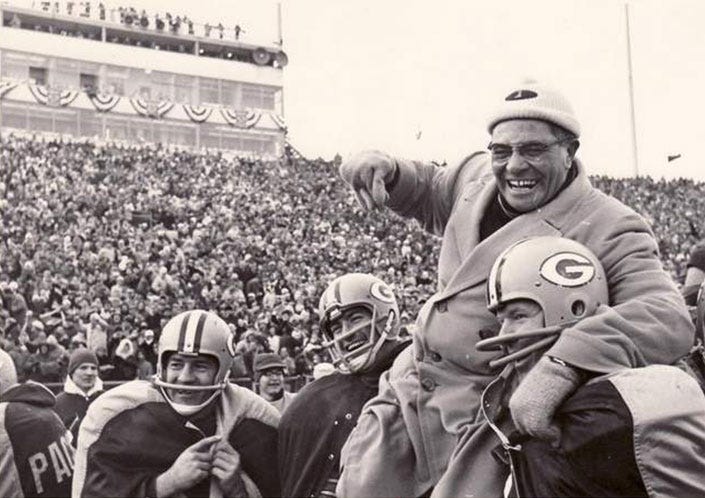
December 31, 1961: Those Who Stayed Were Champions

December 31, 1961: The NFL Championship Game is played at the 2nd City Stadium in Green Bay, Wisconsin. In 1965, it will be renamed Lambeau Field.

In spite of the previous success of the Green Bay Packers, this is the 1st time the game is played in Green Bay. The previous City Stadium had never hosted it. The Packers had finished 1st in the NFL in 1929, 1930 and 1931; and 2nd behind a team that would have been in the Eastern Division in 1927. But there was no NFL Championship Game for them to host, or for which to be the visiting team, until 1933.

Once that was established, the way the old system worked out, the Championship Game was hosted by the Eastern Division winners in even-numbered years, and the Western Division winners in odd-numbered years. The Packers won the West in 1936, 1938, 1944 and 1960, and played the Championship Game on the road. Their only previous time hosting was in 1939, and with a seating capacity of just 25,000, City Stadium was considered too small, so they moved it to Wisconsin State Fair Park in the Milwaukee suburb of West Allis. They won, beating the New York Giants, 27-0.

In 1956, the NFL gave the Packers an ultimatum: Build a bigger stadium, or move. They built what became Lambeau Field in 1957, and seating capacity was 32,500. By 1961, it was 38,669. (By the time of the 1967 title game, the Ice Bowl, it was 50,861. It reached 56,263 in 1970, 60,890 in 1990, 72,515 in 2003, and 81,441 by 2013.) Now, all they had to do was qualify for the title game, by winning the Western Division.

The 1961 season was also the one in which the teams involved adopted their familiar helmet logos: The Packers, football-shaped "G" monogram, for Green Bay (they've never used a "GB," although Lombardi had practice caps made with such a logo); the Giants, the lower-case "ny," for "New York."

The Giants won the NFL Championship in 1956, with head coach Jim Lee Howell. What we would now call his offensive coordinator was Vince Lombardi, and his defensive coordinator was Tom Landry. Lombardi left to become the head coach of the Packers in 1959. Landry left to become the head coach of the expansion Dallas Cowboys in 1960. It would take them a few years to get their act together.

Meanwhile, the Giants again reached the Championship Game in 1958 and 1959, losing to the Baltimore Colts both times. In 1961, Allie Sherman replaced Howell as Giants head coach, and Y.A. Tittle replaced Charley Conerly as quarterback. But running back Frank Gifford came out of retirement, and Sam Huff still led the best defense in the NFL.

The Giants lost their opener, home to the St. Louis Cardinals, then won 5 straight -- the 1st 4 on the road, as the New York Yankees kept using Yankee Stadium all the way to the World Series -- then lost at home to the Dallas Cowboys, won 4 straight, lost to the Packers in Green Bay, beat the defending Champion Philadelphia Eagles away, and finished with a home tie with the Cleveland Browns. At 10-3-1, they won the Eastern Division.

Back to Lombardi: When he arrived, the Packers were coming off a 1-10-1 season. He told his players, "We may not win, but we won't be losing with the same people." With that in mind, he cut the man then regarded as the team's best player, end Billy Howton, because he didn't think Howton was serious enough.

But he kept the actual best player, Paul Hornung: While Hornung was the life of the party off the field, he was completely dedicated on it. And that summed up what Lombardi meant when he gave the Packers their slogan: "Those who stay will be champions."

Sure enough, in just 1 season, having gotten rid of the unserious, and having promoted the dedicated, he took the Packers to to 7-5. In 1960, they went 8-4, and won the Western Division, but lost the NFL Championship Game to the Philadelphia Eagles. It would be the only postseason game Lombardi ever lost.

In 1961, they lost their opener to the Detroit Lions in Milwaukee, then won 6 straight, lost to away to the Baltimore Colts, won their next 4, lost away to the San Francisco 49ers, and closed with a win away to the Los Angeles Rams, finishing 11-3.

With Bart Starr quarterbacking an offense with Hornung and Jim Taylor running, Boyd Dowler receiving, and one of the great offensive lines of all time, including Hall-of-Famers Jim Ringo at center, Jerry Kramer at guard and Forrest Gregg at tackle -- Lombardi called Gregg "the finest player I ever coached," and he later coached the Cincinnati Bengals into their 1st Super Bowl -- the Pack dropped 49 points on the Browns, 45 on the Colts, and 35 on the Rams.

The defense was fearsome, with end Willie Davis, tackle Henry Jordan, linebacker Ray Nitschke, cornerback Herb Adderley, and safeties Willie Wood, and former Giant Emlen Tunnell all going to the Hall of Fame. They shut out the Chicago Bears, held the Colts and the Minnesota Vikings to just 7 points each, held the Lions to 9 in their rematch, and held the 49ers in their earlier win and the Vikings in their other game to 10.

This was the 1st title game played in Green Bay, which would become famous for its cold weather, especially after the 1967 NFL Championship Game, which became known as the Ice Bowl. Green Bay wasn't the furthest-north city in the NFL anymore -- the expansion Vikings now were -- but they were further north than 2 of the Canadian Football League's 9 teams, the Toronto Argonauts and the Hamilton Tiger-Cats.

For the 3rd time, the Giants faced a frozen field for an NFL Championship Game. For the 3rd time, they decided to try sneakers rather than cleats, to get better traction. (This would eventually be outlawed.) In 1934 and 1956, both times against the Bears, it worked. This time, it didn't.

The game kicked off at 1:00 PM Central Time (2:00 Eastern). The 1st quarter ended with the game scoreless, and that would be the highlight of the day for the Giants. It was all Packers: Hornung scored on a 6-yard run, Starr threw a 13-yard pass to Dowler, Starr threw a 14-yard pass to Ron Kramer, and Hornung kicked a 17-yard field goal -- all in the 2nd quarter. Green Bay led, 24-0.

In the 3rd quarter, Hornung kicked a 22-yard field goal, and Starr threw a 13-yard touchdown pass to Kramer. Hornung added a 19-yard field goal. Meanwhile, the Packer defense completely shut Big Blue down. Packers 37, Giants 0. It was only the 5th shutout in an NFL Championship Game -- and, after 4 more NFL Championship Games and 56 Super Bowls, it remains the last. (The 1939 game was also a Packer shutout of the Giants, 27-0.

The Packers beat the Giants again in the 1962 NFL Championship Game, 16-7 at Yankee Stadium. The Giants made one more Championship Game in 1963, losing to the Chicago Bears, then collapsed, not reaching the Playoffs again until 1981.

The Packers fell short in 1963 and 1964, then became the only team ever to win 3 straight NFL Championship Games: 1965, 1966 and 1967. This included the 1st 2 Super Bowls, before Lombardi retired. After coaching the Washington Redskins to a big improvement in 1969, Lombardi developed colon cancer, and died the next year.

Nevertheless, he was right about his Packers: In 7 seasons, 5 times, those who stayed were champions.

UPDATE: The Packers have the largest team Hall of Fame in North American sports. Through the 2025 NFL season, the inductees from the Lombardi Era, 1959 to 1968, are:

* Offense: Quarterbacks Bart Starr and Zeke Bratkowski; running backs Paul Hornung, Jim Taylor, Elijah Pitts, Donny Anderson and Travis Williams; wide receivers Gary Knafelc, Ron Kramer, Max McGee and Boyd Dowler; tight ends Marv Fleming and Carroll Dale; centeres Jim Ringo and Ken Bowman; guards Jerry Kramer, Fred "Fuzzy" Thurston and Gale Gillingham; tackles Forrest Gregg, and Bob Skoronski; and kicker-punter Don Chandler.

* Defense: Ends Willie Davis, Dave Hanner and Lionel Aldridge; tackles Henry Jordan and Ron Kostelnik; linebackers Ray Nitschke, Bill Forester, Dan Currie, Dave Robinson and Lee Roy Caffey; cornerbacks Herb Adderley and Jesse Whittenton; and safeties Willie Wood and Bob Jeter.

* Management: Head coach and general manager Vince Lombardi, assistant coaches Red Cochran and Phil Bengtson; scout Jack Vainisi; longtime executives Fred Leicht, Frederick Trowbridge, Jerry Atkinson, Dominic Olejniczak and Tom Miller; trainer Bud Jorgensen and team physician E.S. Brusky; team historian Lee Remmel; team photographer Vernon Biever; band director Wilner Burke; video director Al Treml; broadcaster Ray Scott; journalist Art Daley; the Hall of Fame's founder, William Brault; and longtime Packer fan Al Schneider.

Lombardi, Starr, Hornung, Taylor, Kramer, Thurston, Davis and Nitschke have also been inducted into the Wisconsin Athletic Hall of Fame.

After Lombardi left, it would be a long time before there was another title. Elected to the Packers Hall of Fame from the 1970s: Linebacker Fred Carr, cornerbacks Ken Ellis and Willie Buchanon, running back John Brockington, and placekicker Chester Marcol.

Elected from the 1980s: Quarterbacks Lynn Dickey and Don Majkowski; running back Gerry Ellis; receivers James Lofton and Sterling Sharpe; tight end Paul Coffman; center Larry McCarren; tackle Greg Koch; defensive end Ezra Johnson; linebackers Mike Douglass, John Anderson, Tim Harris and Johnny Holland; cornerback Mark Lee; safeties Johnny Gray and Mark Murphy (not to be confused with the Mark Murphy who was Packer team president from 2007 to 2025); placekicker Jan Stenerud; and executive Robert Parins.

*

December 31, 1961 was a Sunday. The AFL Championship had been played a week earlier, with the Houston Oilers beating the San Diego Chargers, 10-3 at Balboa Stadium in San Diego. There had been 2 college bowl games the day before the NFL Championship Game, and the 4 major bowls were played the next day, New Year's Day. This included the Sugar Bowl, at Tulane Stadium in New Orleans, in which Number 1-ranked Alabama clinched the National Championship, beating Arkansas, 10-3.

Baseball was out of season. The NBA scheduled no games for the day. The NHL scheduled 2. The New York Rangers lost to the Boston Bruins, 7-4 at the old Madison Square Garden. And the Detroit Red Wings beat the Toronto Maple Leafs, 4-2 at the Olympia Stadium in Detroit. The Montreal Canadiens and the Chicago Black Hawks were not scheduled.

Tuesday, November 29, 2022

November 29, 1931: The Packers' 1st "Threepeat"

Johnny "Blood" McNally

November 29, 1931: The Championship of the National Football League is clinched... at Ebbets Field. The Green Bay Packers beat the football team named the Brooklyn Dodgers, 7-0, to advance to 12-1 on the season.

Coached by Earl "Curly" Lambeau, the Packers' star player was John Victor McNally Jr., from New Richmond, Wisconsin, across the State, close to Minneapolis rather than to Green Bay or Milwaukee. He starred at St. John's University in Minnesota, and then at Lambeau's Alma Mater, Notre Dame.

In 1922, while at St. John's, he and a teammate, Ralph Hanson, were passing a Minneapolis movie theater, showing the movie Blood and Sand, starring Rudolph Valentino as a Spanish bullfighter. McNally turned to the teammate, and, knowing that they could secretly make money playing professional or semipro ball on Sundays, the day after playing for Notre Dame, if they used fake names, and said, "I'll be Blood, and you be Sand." Hanson, as Ralph Sand, never played in the NFL, but John McNally was "Johnny Blood" from then on.

He played in the NFL for the Milwaukee Badgers, the Duluth Eskimos and the Pottsville Maroons, before joining the Packers in 1929, eventually helping them win 4 NFL Championships. In this 1931 season, the two-way halfback scored 2 touchdowns rushing, a then-record 10 receiving, and another on an interception return. He later served as a player-coach with the football version of the Pittsburgh Pirates, before they changed their name to the Steelers; and returned to St. John's to coach. (St. John's is now an NCAA Division III school, and has no connection besides name to the one in New York City.)

The Packers benefited from having their 1st 7 games all at home, probably because most NFL teams then used the biggest stadium in their city, which tended to be not a college football stadium, including one of the many "Memorial Stadiums" built to honor the dead of World War I in the preceding decade, but a baseball park, and most of those parks were occupied in September.
City Stadium

The Packers beat the football version of the Cleveland Indians, 26-0; the Dodgers, 32-6; the team that would become their arch-rivals, the Bears, 7-0; the football version of the New York Giants, 27-7; the Chicago Cardinals, 26-7; the Frankford Yellow Jackets, 15-0; and the Providence Steam Roller (no "S" on the end), 48-20.

The Packers went to Wrigley Field to play the Bears again, and won, 6-2. They hosted the Staten Island Stapletons, and won, 26-0. They were finally beaten by Ernie Nevers and the Cardinals, 21-13 at Wrigley, where they played their home games that season, rather than at Comiskey Park, the usual home of the Cardinals and baseball's Chicago White Sox.

The Packers rebounded, beating the Giants, 14-10 at the Polo Grounds; beating the Steam Roller, 38-7 at the Providence Cycledrome on Thanksgiving; and clinching against the Dodgers at Ebbets Field. The following week, they lost to the Bears, 7-6 at Wrigley Field. But it didn't matter, because the Portsmouth Spartans finished at 11-3, and could not catch the Packers.

The Packers thus won their 3rd straight NFL Championship. It had never happened before. Through the 2021 season, it has happened only once since: The Packers again, in 1965, 1966 and 1967, including Super Bowls I and II.

This remains the last time the NFL Championship has been decided without some form of postseason play.

Lambeau and McNally were both charter inductees into the Pro Football Hall of Fame in 1963. Lambeau died in 1965, and Green Bay's new City Stadium was renamed Lambeau Field in his memory. McNally was one of a few 1920s players interviewed by NFL Films for their 1976 documentary Old Leather, and lived until 1985.

UPDATE: The Green Bay Packers have the largest team Hall of Fame of any team in the "Big Four" North American sports: The NFL, MLB, the NBA and the NHL. From the team's founding era, 1919 to 1928, but not on the 1929, '30 or '31 title teams, they have inducted tackle Howard "Cub" Buck, back Charlie Mathys, and team executive Andrew Turnbull.

From the 1929-30-31 title teams, they have inducted co-founder, owner, general manager, head coach and back Earl "Curly" Lambeau; co-founder George Whitney Calhoun; executives Frank Jonet, Gerald F. Clifford, Fred Leicht, Emil Fischer and Lee Joannes; backs Johnny "Blood" McNally, Verne Lewellen, Arnie Herber, Hank Bruder and Joseph "Red" Dunn; ends Lavern "Lavvie" Dilweg and Milt Gantenbein; tackle Cal Hubbard; guards Mike Michalske and Howard "Whitey" Woodin; centers Francis "Jug" Earp, Bernard "Boob" Darling and Nate Barragar; trainer Carl "Bud" Jorgensen and team doctor W. Webber Kelly; and the team's 1st broadcaster, Russ Winnie.

Lambeau, Buck, Dilweg, Dunn, Goldenberg, Lewellen, McNally and Michalske have also been inducted into the Wisconsin Athletic Hall of Fame.

*

November 29, 1931 was a Sunday. Only 2 other games were played that day. The Giants and the Steam Roller played to a 0-0 tie at the Polo Grounds. This turned out to be the last game the Steam Roller ever played. They had won the NFL Championship in 1928, but the Great Depression did them in.

And the Spartans beat the Bears, 3-0 at Universal Stadium in Portsmouth, Ohio. It still stands, as Spartan Memorial Stadium.

The day before, the Cardinals beat the Indians, 21-0 at Wrigley Field. And, 2 days before that, on Thanksgiving Day, these games were played:

* The Giants lost to the Stapletons, 9-6 at Thompson Stadium on Staten Island.

* The Bears beat the Cardinals, 18-7 at Wrigley Field.

* And, as I said, the Packers beat the Steam Roller, 38-7 at the Cycledrome.

Baseball was out of season. The NBA hadn't been founded yet. There were 2 games played in the NHL. The New York Rangers beat the Chicago Black Hawks, 5-0 at the Chicago Stadium. And the Detroit Falcons beat the Montreal Canadiens, 3-2 at the Olympia Stadium in Detroit. Ebenezer "Ebbie" Goodfellow scored the winning goal, 3:33 into overtime. The next season, the Falcons became the Detroit Red Wings.

Wednesday, October 12, 2022

October 13, 1872: The Sinking of the Lac La Belle

October 13, 1872: The SS Lac La Belle sinks in Lake Michigan, off the coast of Racine, Wisconsin. There are 8 deaths.

The Lac La Belle was a luxury passenger steamer, built in Cleveland in 1864, along with an identical sister ship, SS Ironsides. She was involved in several accidents, including one in Algonac, Michigan in 1866, in which 2 crewmen died.

At 9:00 PM on October 13, 1872, under the command of Captain W.H. Thompson, she left Milwaukee, to cross Lake Michigan to Grand Haven, Michigan. She had 53 passengers and crew, with a cargo of about 19,000 bushels of barley, 1,200 barrels of flour, 50 barrels of pork, 25 barrels of whiskey, 20 tons of animal feed, and various sundries.

The boat began leaking about 25 miles off the coast of Racine, Wisconsin. At around 12:00 Midnight, rising water in the engine room extinguished the fire in the boilers. She sank about 20 miles off the coast. One of the lifeboats capsized, resulting in the deaths of 8 people, while the rest of the lifeboats drifted ashore, or were picked up by passing vessels.

SS Ironsides remained in service for almost another year, until it sank on the same Milwaukee-to-Grand Haven route, taking 28 lives with it.

UPDATE: In 2026, a research crew announced they had found Lac La Belle's wreck in October 2022, about the time of the 150th Anniversary of the sinking.

*

October 13, 1872 was a Sunday. The only professional sport in North America at the time was baseball, and Sunday baseball was then prohibited by both the National Association and most State laws. So there were no scores on this historic day.

Friday, October 7, 2022

October 8, 1871: The Great Chicago & Peshtigo Fires

October 8, 1871: The Great Chicago Fire breaks out at 10:00 in the evening, and burns down about 2/3rds of the city, including the Union Base-Ball Grounds, home of the Chicago White Stockings of the National Association. It is estimated that 300 people died.

The White Stockings are forced to play the rest of the season on the road, in borrowed uniforms and equipment. This likely costs them the 1st Pennant of a baseball league that could be (but, in retrospect, is not always) called "major league."

Up Lake Michigan, 260 miles to the north, a forest fire breaks out in Peshtigo, Wisconsin. It becomes the deadliest wildfire in American history, killing 2,500 people. It burns so many trees that it's been credited with forcing Wisconsans to leave the timber industry and start dairy farms, making Wisconsin the Dairy State.

That day, there were also fires in Port Huron, Holland and Manistee, all in Michigan. There is a theory that, rather than Mrs. O'Leary's cow kicking over a lantern -- or, much more likely, Mr. O'Leary or one of his poker-playing buddies dropping cigar ash -- onto straw in the family barn, the fires all over the Great Lakes were caused by the breakup of a meteorite.

Most likely of all, though, the forest fires in Wisconsin and Michigan were the result of a very dry Summer, and it was simply a coincidence that they all happened on the same day.

Baseball historian Richard Hershberger, who specializes in the early professional era, has argued that the fire set baseball not just in Chicago, but in the Western U.S. in general, back several years. Baseball had been played in St. Louis since before the American Civil War, but with a weakened Chicago team, the rivalry that should have developed between the 2 big cities at opposite ends of Illinois -- St. Louis across the Mississippi River in Missouri -- took a bit longer to do so.

St. Louis didn't get its 1st true professional baseball team until the 1875 Brown Stockings. Another team with that name was founded in the American Association in 1882, played the Chicago White Stockings in postseason series in 1885 and 1886, and began the rivalry that has kept going to the present day, under the names of the Chicago Cubs and the St. Louis Cardinals.

There are 4 6-pointed stars on Chicago's city flag, and 1 represents the Great Fire. The others represent the founding of Fort Dearborn in 1803, the World's Columbian Exposition of 1893, and the Century of Progress Fair of 1933-34.
The top blue bar represents Lake Michigan and the North Branch of the Chicago River, and the bottom blue bar represents the South Branch of the River and the Chicago Sanitary and Ship Canal. The 3 white background areas represent the North, South and West Sides.

*

October 8, 1871 was a Sunday. As a result, there were no scores on that historic day, because the National Association wouldn't play games on Sunday. Indeed, professional sports was still illegal in a lot of places on Sunday. The NA's successor, the National League, also prohibited it until 1892.

Thursday, October 6, 2022

October 6, 1928: Wisconsin's Victory In the Tall Grass

October 6, 1928: The football team at the University of Wisconsin hosted the University of Notre Dame at Camp Randall Stadium in Madison, Wisconsin. It becomes known as "The Tall Grass Game."

The host Badgers, coached by Glenn Thistlethwaite, were opening their season. The visiting Fighting Irish, coached by Knute Rockne, had opened theirs a week earlier, defeating Loyola University of New Orleans.

Notre Dame arrived in Madison, only to find that the grass on the football field at Camp Randall had not been mowed in a week. Rumor was that Thistlethwaite wanted to slow down the speedy Notre Dame players. Rockne demanded the field be trimmed, and Thistlethwaite refused. Rockne may have been all-powerful in South Bend, Indiana, but he had no power over the Badger State.

A raucous sellout crowd of 40,000 saw Wisconsin pull the upset, 22-6. Wisconsin fans still refer to the game as "The Victory In The Tall Grass." Notre Dame hadn't lost to a Big Ten Conference team in 7 years.

*

October 6, 1928 was a Saturday. Among the other college football games played that day were these:

* Michigan State were not yet members of the Big 10 -- eventually, they would replace the University of Chicago as such -- and, on this day, they were beaten by Albion College, 2-0 at College Field in East Lansing. It wasn't an upset, though: Albion, based in the Michigan city of the same name, went 8-0 that season, although Michigan State were the only team they played that would now be recognized as a major team. Albion now compete in NCAA Division III.

* The University of Michigan were members of the Big 10, but fared no better, losing to Ohio Wesleyan, 17-7 at Michigan Stadium in Ann Arbor.

* The service academies: Army beat Southern Methodist University (SMU), 14-13 at Michie Stadium in West Point, New York; and Navy lost to Boston College, 6-0 at Thompson Stadium in Annapolis, Maryland.

* Among New York City teams: Columbia beat Union College, 27-0 at Baker Field in Upper Manhattan; New York University (NYU) beat West Virginia Wesleyan, 26-7 at Ohio Field in The Bronx; City College of New York (CCNY) played Lebanon Valley College to a tie, 6-6 at Annville, Pennsylvania; and Fordham beat George Washington University, 20-0 at Fordham Field in The Bronx.

GWU dropped their football program after the 1966 season. West Virginia Wesleyan now compete in NCAA Division II. Union, based in Schenectady, New York, outside Albany, and Lebanon Valley both now compete in Division III.

* And in New Jersey: Princeton beat Vermont, 50-0 at Palmer Stadium in Princeton; while Rutgers beat Albright, 19-0 at Nielson Field in New Brunswick. Albright, in Reading, Pennsylvania, now compete in Division III. Vermont dropped football after the 1974 season.

This was a travel day for the World Series. The New York Yankees went on to sweep the St. Louis Cardinals in 4 straight games.

And in English soccer, the team I would eventually support, Arsenal, traveled from North London to Stanley Park in Liverpool, and lost to Everton, 4-2 at Goodison Park.
 

Wednesday, September 14, 2022

September 14, 1919: The Debut of the Green Bay Packers

Curly Lambeau

September 14, 1919: The football team of the Indian Packing Company of Green Bay, Wisconsin, coached and captained by local hero and former University of Notre Dame quarterback Earl "Curly" Lambeau, a Green Bay native, defeats the Menominee North End Athletic Club, 53-0 at Hagemeister Park.
Thus debuted the team that would come to be known as the Green Bay Packers, the most successful team in the history of professional football, with 13 NFL Championships.

Because they were made up of co-workers, the Packers were a "company team," or what the British would call a "works side." This would also be true of the team that would become their arch-rivals, the Chicago Bears, who began the following season as the Decatur Staleys, representing the A.E. Staley Starch Company of Decatur, Illinois.

The Staleys/Bears, run by George Halas, were a founding team of the NFL in 1920. The Packers were not, but joined in 1921. The Packers won the NFL Championship in the single-division, no-playoff era, 3 straight times: 1929, 1930 and 1931. They won the NFL Championship Game in 1936, 1939, 1944, 1961, 1962, 1965, 1966 and 1967, meaning they won 3 straight NFL Championships for a 2nd time. No other franchise has done this. Vince Lombardi coached them to those last 5 titles. They also lost NFL Championship Games in 1938 and 1960.

Those last 2 titles, 1966 and 1967, were won by defeating the Dallas Cowboys, the former on New Year's Day 1967 at the Cotton Bowl in Dallas, the latter on New Year's Eve 1967, in frigid conditions that got the game nicknamed "The Ice Bowl."

That game was played at their new stadium, built in 1957, which, like its predecessor, was named Green Bay City Stadium. Curly Lambeau, who played for them from 1919 to 1929, coached them from 1920 to 1949, and later coached the Chicago Cardinals and the Washington Redskins, died before the 1965 season. In his memory, the 2nd City Stadium was then renamed Lambeau Field.
Statue of Lambeau outside the stadium

Those last 2 NFL titles sent the Packers to the games that would retroactively be named the 1st 2 Super Bowls, and they won both. After a long down period, they won Super Bowl XXXI in 1997, and lost Super Bowl XXXII in 1998, both under head coach Mike Holmgren. They have usually been at least competitive since. In 2011, they won Super Bowl XLV, under head coach Mike McCarthy.

Because Green Bay is a small city -- population 62,888, according to a sign shown in a 1967 NFL Films documentary, and 107,395 according to the 2020 Census -- the Packers often played regular-season games in Milwaukee, including the 1939 NFL Championship Game at the State Fair stadium in suburban West Allis, now a racetrack known as the Milwaukee Mile; and at Milwaukee County Stadium, home of baseball's Braves and later the Brewers.

They stopped doing this in 1994, as Lambeau Field had been expanded to be bigger than County Stadium, and it had become more costly to move everything from one "home field" to another and back than it did to stage the games in the much bigger city.

Green Bay is the only one of the NFL's early small cities to survive -- R.I.P. Providence, Rhode Island; Hartford, Connecticut; Rochester, New York; Pottsville, Pennsylvania; Canton, Massillon and Dayton, Ohio; Muncie and Hammond, Indiana; Decatur and Rock Island, Illinois; Racine, Wisconsin; and Duluth, Minnesota.

How? Halas, despite his rivalry with Lambeau, stepped in to use his influence to keep the Packers in the League. And the NFL's TV revenue-sharing agreement means that the Packers can compete on an even level with big cities like New York, Chicago and Los Angeles. Without that, most likely, the Packers would have begun "groundsharing" with the Brewers at the Milwaukee domed stadium now named American Family Field.

Since the team now known as the Arizona Cardinals, despite claiming an official connection to a Chicago athletic club that began playing professional football in 1898, hasn't played continuously since then, the Packers are officially the NFL's oldest franchise, older than the NFL itself. And their rivalry with the Bears is the NFL's oldest, and probably its best, helping to give first the NFC Central Division (1970-2001), then the NFC North Division, the nickname "The Black and Blue Division."

Interestingly, while the Packers named their stadium for Lambeau, and dedicated a statue of him outside (along with one of Lombardi), they have never retired his Number 20.

*

September 14, 1919 was a Sunday. Because the Commonwealths of Massachusetts and Pennsylvania still prohibited professional sports on Sunday, it was difficult for pro football leagues to gain traction, prior to the NFL's founding the next season. And some baseball teams were forced to take the day off. But these baseball games were played that day:

* The New York Yankees beat the St. Louis Browns, 8-1 at the Polo Grounds. The newly-acquired Carl Mays went the distance for the win. Wally Pipp hit a home run. George Sisler went 0-for-4 for the Browns.

* The New York Giants lost to the St. Louis Cardinals, 3-1 at Robison Field in St. Louis. Rogers Hornsby went 1-for-4. The Giants got only 4 hits, 2 by Art Fletcher.

* The Detroit Tigers beat the Washington Senators, 9-4 at National Park (later renamed Griffith Stadium) in Washington. Ty Cobb went 2-for-3 with 2 walks, a stolen base, and 2 RBIs. Harry Heilmann went 4-for-5 with 2 RBIs.

* The Cincinnati Reds beat the Boston Braves, 1-0 at Redland Field (later renamed Crosley Field) in Cincinnati. Ray Fisher pitched a 6-hit shutout. Edd Roush, the Hall of Fame center fielder about to lead the Reds to a World Series win over the Chicago White Sox -- and he insisted until his death that the Reds would have won even if the White Sox had played on the level -- went 4-for-4.

* And the Chicago Cubs beat the Philadelphia Phillies, 4-0 at Weeghman Park -- later renamed Cubs Park and Wrigley Field -- in Chicago. Elwood "Speed" Martin allowed the Phils 10 hits, but kept the shutout.

Monday, September 5, 2022

September 5, 1906: College Football's 1st Legal Forward Pass

Brad Robinson

September 5, 1906: For the 1st time, the newly legalized forward pass is used in a college football game.

The coach who called the play was Eddie Cochems. Born in 1877 in Sturgeon Bay, Wisconsin, not far from Green Bay where football would be raised to the level of an art form, more than once, he had played at the University of Wisconsin. Newly hired as head coach at Saint Louis University -- the first word in the university's name is always spelled out as "Saint," never the abbreviation "St." -- he had his players practice the newly-legal play prior to the season.

The passer was Bradbury Norton Robinson Jr. Born in 1884 in Bellevue, Ohio, "Brad" moved to St. Louis with his family as a toddler. He went to SLU, where he joined the football team, excelling at running, passing, and kicking.

The receiver was William John Schneider. Born in 1883 in Wisconsin, "Jack" was 1 of 4 UW players who had followed Cochems to SLU.

On September 5, Saint Louis played Carroll College, in Waukesha, Wisconsin. The 1st pass attempt was incomplete. Under the rule of the time, that meant a turnover. But the 2nd attempt was not only successful, it went for a touchdown. Schneider recalled:

We were in the 2nd half, and the game was tied when Robinson called the pass. Actually, Robinson was an end, and I was a fullback. But Brad could throw the ball a long way, so we switched positions for that one play.

We were told to run after the snap and just keep going until we heard the passer yell "hike' or our name. So, I ran and ran. I was about to give up when I heard Robinson call. I turned and caught the ball a yard or so short of the goal, and went over with it.

SLU won, 22-0. That season, they went 11-0, outscoring their opponents 407-31, for an average of 37-3; including beating such modern "big schools" as Iowa, 39-0; and Kansas, 34-2.

In spite of this success, Cochems was only a head coach for 3 more seasons: The next 2 at SLU, and in 1914 at the University of Maine. He moved into politics, becoming a campaign aide to the Presidential campaigns of Theodore Roosevelt in 1912, Charles Evans Hughes in 1916, Calvin Coolidge in 1924 and Herbert Hoover in 1928. He died in 1953.

Robinson became a doctor, and performed surgery at the Mayo Clinic in Rochester, Minnesota. In World War I, he was a Captain in the U.S. Army -- not as a doctor, but as an instructor in the operation of a new vehicle, the tank.

He later served on the staff of U.S. Surgeon General Hugh Cumming, and moved to St. Louis -- not the better-known city of the name, in Missouri, but to one in Michigan. There, he practiced medicine, and was elected Mayor in 1931 and 1937, as a Republican. In the 1940s, Robinson was among the first to warn against the dangers of DDT use in agriculture. He died in 1949, and was buried at Arlington National Cemetery. 

Schneider went on to coach at Creighton University in Omaha, Nebraska, before also becoming a doctor. He died in 1958, at 74.

Saint Louis University stopped playing football after the 1949 season. Carroll College became a "small college," and were placed in NCAA Division III upon its creation in 1973. The school became Carroll University in 2008.

*

September 5, 1906 was a Wednesday. There were no other college football games that day. These baseball games were played:

* The New York Highlanders beat the Boston Americans, 6-1 at the Huntington Avenue Grounds in Boston. The Americans became the Boston Red Sox in 1908. The Highlanders became the New York Yankees in 1913.

* The New York Giants swept their arch-rivals, the Brooklyn Superbas, 4-3 in 10 innings and 2-1 at the Polo Grounds. The Superbas became the Brooklyn Dodgers in 1911.

* The Philadelphia Phillies beat the Boston Beaneaters, 8-5 at National League Park (later renamed Baker Bowl) in Philadelphia. The Beaneaters became the Boston Braves in 1912.

* The Philadelphia Athletics beat the Washington Senators, 3-1 at American League Park in Washington.

* The St. Louis Cardinals beat the Pittsburgh Pirates, 9-4 at Exposition Park in Pittsburgh. Honus Wagner did not play.

* The Cleveland Naps beat the St. Louis Browns, 1-0 at League Park in Cleveland. Addie Joss pitched a 6-hit shutout. Named for manager-2nd baseman-slugger Napoleon "Nap" Lajoie, who went 1-for-4 in this game, they became the Cleveland Indians in 1915 and the Cleveland Guardians in 2022.

* The Chicago White Sox beat the Detroit Tigers, 2-0 at Bennett Park in Detroit. Doc White pitched a 2-hit shutout. Ty Cobb, 19 years old, got 1 of those hits.

* And the Chicago Cubs and the Cincinnati Reds were not scheduled.

Thursday, April 7, 2022

April 7, 1970: A Baseball Restoration In Milwaukee

April 7, 1970: Major League Baseball returns to Milwaukee on a regular basis. Though there would be times the local fans would wonder why.

After the Braves left for Atlanta at the end of the 1965 season, and the Chicago White Sox came up, and the Minnesota Twins came down, Interstate 94 to play a 1967 exhibition game at Milwaukee County Stadium. It attracted 51,000 fans, inspiring the White Sox to play 9 "home games" at County Stadium in 1968. Those games accounted for nearly one-third of the total attendance at White Sox games. This would also be true the next season, for the 11 home games the White Sox played there. (In each case, one home game against every other American League team, with 1969 being an expansion year.)

Talk that the White Sox might move would continue until former owner Bill Veeck bought them in 1975. But any talk that they would move to Milwaukee ended toward the end of Spring Training in the 1970 season, when one of the 1969 expansion team, the Seattle Pilots, went bankrupt, and were awarded to a former part-owner of the Braves, a used car salesman, Allan H. "Bud" Selig. The team was named for the city's former minor-league team: The Milwaukee Brewers.

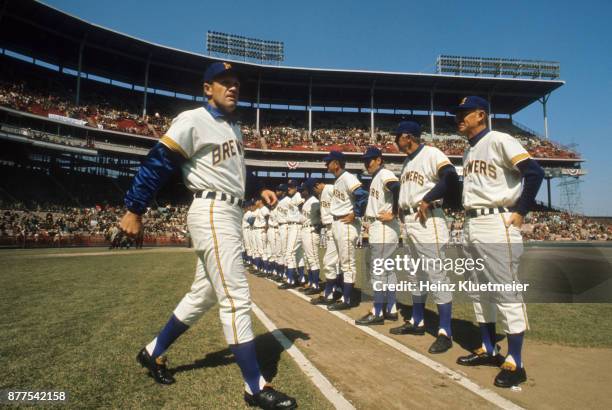
The move was announced on April 1 -- the Pilots "dying" on April Fool's Day -- and there was just enough time to make caps with M's for Milwaukee on them, and stitch "BREWERS" over the old Pilots jerseys, with the nautical-themed sleeves staying on for that one season. The team debuted on April 7, at County Stadium, and it didn't go so well for the home fans: The Brewers lost to the team then known as the California Angels, 12-0.

Starting pitcher Lew Krausse Jr. lasted only 3 innings, trailing 4-0, and replacing him with John Gelnar didn't help, as he didn't retire a batter in the 4th inning: Center fielder Russ Snyder dropped a fly ball for an error, followed by 2 doubles and a single, for 4 more. Angel starter Andy Messersmith pitched a 4-hit shutout, striking out 11 batters.

The awful Pilots team from the season before, described in sometimes-hilarious, sometimes-depressing detail in former pitcher Jim Bouton's upcoming book Ball Four was, for all intents and purposes, still together. The Brewers went 65-97, an improvement of just 1 game over the Seattle season.

(Bouton had been traded to the Houston Astros the preceding August, and was about to face both controversy and a loss of control, and retired in July -- for the 1st time.)

It would take until 1978 for the Brewers to get into a Pennant race and finish better than .500, until 1981 for them to make the Playoffs, and 1982 for them to win a Pennant. Although they remained a good team through the 1988 season, largely thanks to shortstop Robin Yount and infielder Paul Molitor, and plenty of good pitchers, they didn't make the Playoffs again until 2008, by which time they had left County Stadium and moved into Miller Park. That retractable-roof stadium had opened in 2001, and was renamed American Family Field in 2021.

It was hoped that moving the Brewers from the AL to the National League in the 1998 season might help attendance, given the tendency for fans of the nearby Chicago Cubs to travel. But while Brewers-Cubs became a good rivalry, the rivalries with the White Sox (reflecting the NFL's Packers vs. Bears and the NBA's Bucks vs. Bulls) and the Twins (reflecting the NFL's Packers vs. Vikings and the NHL's Blackhawks vs. North Stars, as Milwaukee has never had an NHL team) fell by the wayside.

Killing 2 good rivalries to make 1 big rivalry was a total Selig move. By this point, he was the Commissioner of Major League Baseball, having placed control of the team with his daughter, who has since sold it. Selig was a bad team owner, and an even worse Commissioner.

The Braves, it should be said, mostly struggled in Atlanta from 1966 to 1990. But from 1991 onward, not only were they better off in Atlanta than they had been in Milwaukee, but they were better off than the Brewers were.

Fred Stanley was the last active former Seattle Pilot, playing in the major leagues until 1982.

UPDATE: American Family Field has a Walk of Fame, honoring both of Milwaukee's Major League Baseball teams. For the Braves: Hank Aaron, Warren Spahn, Eddie Mathews, Johnny Logan, Lew Burdette and general manager John Quinn.

For the Brewers: For the Brewers: Aaron, Robin Yount, Paul Molitor, Rollie Fingers, Don Money, Gorman Thomas, Jim Gantner, Cecil Cooper, Teddy Higuera, Geoff Jenkins, Ben Sheets, Prince Fielder, Ryan Braun, manager Harvey Kuenn, general manager Harry Dalton, team owner Bud Selig, and broadcaster Bob Uecker, who had also played for the Braves in both Milwaukee and Atlanta.

Aaron, Spahn, Mathews, Yount, Molitor, Thomas, Gantner, Cooper, Fielder, Kuenn, Selig, Uecker, and Braves broadcaster Earl Gillespie have also been elected to the Wisconsin Athletic Hall of Fame.

*

April 7, 1970 was a Tuesday. I had been born in the off-season, so, in addition to Brewers vs. Angels, these were the 1st MLB games of my lifetime.

* The New York Yankees, the team I would go on to root for, lost to their-arch-rivals, the Boston Red Sox, 4-3 at Yankee Stadium. Gary Peters outpitched Mel Stottlemyre. Carl Yastrzemski went 2-for-5. Horace Clarke and Bobby Murcer each got 2 hits for the Yankees.

* The New York Mets opened their defense of their World Championship by beating the Pittsburgh Pirates, 5-3 at Forbes Field in Pittsburgh. Donn Clendenon singled home 2 unearned runs against his former team in the top of the 11th inning, making Ron Taylor a winning pitcher in relief of Tom Seaver. Tommie Agee went 3-for-6. Roberto Clemente went 3-for-4 with a walk and 2 RBIs. Willie Stargell went 0-for-5.

* The Philadelphia Phillies beat the Chicago Cubs, 2-0 at Connie Mack Stadium in Philadelphia. Chris Short pitched a 5-hit shutout to beat former Phillie Ferguson Jenkins. Ernie Banks went 1-for-3 with a walk. Denny Doyle had an RBI triple, and Don Money had an RBI double. Both would become better known on other teams: Doyle on the Red Sox, Money on the Brewers.

* The Washington Senators beat the Detroit Tigers, 14-4 at Robert F. Kennedy Stadium in Washington. Mike Epstein and Lee Maye hit home runs for the Senators. Al Kaline went 2-for-4 for the Tigers.

* The Baltimore Orioles beat the Cleveland Indians, 8-2 at Cleveland Municipal Stadium. Frank Robinson hit the 451st home run of his career. Brooks Robinson went 1-for-4 with a walk. Dave McNally struck out 13 to outpitch Sam McDowell, who struck out 11.

* The Chicago White Sox, briefly Milwaukee's "home team," also lost their 1970 opener by a 12-0 score, to the Minnesota Twins, at Comiskey Park in Chicago. Jim Perry pitched a 6-hit shutout. (Unlike his brother Gaylord, Jim never admitted to throwing a spitball, nor was he ever seriously suspected of having done so.) For the ChiSox, Bill Melton got 3 of those hits. Their starter, Tommy John, didn't get out of the 5th inning.

Brant Alyea hit 2 home runs for the Twins. Harmon Killebrew went 1-for-2 with 2 walks before leaving for a pinch-runner. Rod Carew went 2-for-5 with an RBI.

* The Oakland Athletics beat the Kansas City Royals, 6-4 at Kansas City Municipal Stadium. Sal Bando and Don Mincher hit home runs. Reggie Jackson went 1-for-4 with a walk and an RBI.

* The San Diego Padres beat the Atlanta Braves, 8-3 at San Diego Stadium (later Jack Murphy Stadium and Qualcomm Stadium). Pat Dobson outpitched Phil Niekro. Nate Colbert hit a home run for the Padres, and Orlando Cepeda hit one for the Braves. Hank Aaron did not hit a home run, but went 1-for-3 with a walk and an RBI.

* The Cincinnati Reds beat the Los Angeles Dodgers, 4-0 at Dodger Stadium in Los Angeles. Gary Nolan allowed only 2 hits, both of them singles to Willie Crawford, in the 4th and 9th innings. Pete Rose went 2-for-4 with a walk. Johnny Bench went 1-for-4 with an RBI.

* The Houston Astros beat the San Francisco Giants, 8-5 at Candlestick Park in San Francisco. Larry Dierker beat Gaylord Perry. For the Astros, Jim Bouton got the last out in the 7th inning, and the 1st out in the 8th. Norm Miller hit a home run, while pinch-hitting for Dierker in the 7th. For the Giants, Willie Mays went 2-for-4 with an RBI.

* And the Montreal Expos and the St. Louis Cardinals were not scheduled. The Expos had opened the day before, the traditional National League opener in Cincinnati, losing to the Reds, 5-1 at Crosley Field. The Cardinals would open the day after this, beating the Expos, 7-2 at Jarry Park in Montreal.

This would be the last season for 3 classic National League ballparks: Crosley Field would close on June 24, Forbes Field would close on June 29, and Connie Mack Stadium, formerly known as Shibe Park, would close on October 1. They would be replaced, respectively, by Riverfront Stadium on June 30, Three Rivers Stadium on July 16, and Veterans Stadium on April 10, 1971.

Or, to put it another way: In 1970, the average age of a National League ballpark was 23 seasons; in 1971, 9. At the close of the 1957 season, the average opening date of a major league ballpark was 1919, and thus 38 years; by Opening Day 1973, it was 1952, and thus 19 years. (In 2022, it's 1991, and thus 31 years -- but if you don't count Fenway Park and Wrigley Field, then it's 1997, and 25 years.)

Football was out of season. The NHL was between the end of the regular season and the start of the Stanley Cup Playoffs. There was 1 game in the NBA Playoffs: The Los Angeles Lakers beat the Phoenix Suns, 104-93 at the Arizona Veterans Memorial Coliseum in Phoenix. Jerry West scored 35 points. Wilt Chamberlain had 11 points, 12 assists, and 26 rebounds.

And there were 3 games in the American Basketball Association, which was closing out its regular season:

* There was a doubleheader at the Washington Coliseum in D.C. In the opener, the Los Angeles Stars beat the Miami Floridians, 129-114. In the nightcap, the Washington Capitols beat the New Orleans Buccaneers, 115-111. Rick Barry scored 44 for the Caps.

* The Kentucky Colonels beat the Dallas Chaparrals, 118-112 at the Moody Coliseum in Dallas. Darrel Carrier scored 38 for the Colonels.

Friday, March 18, 2022

March 18, 1953: Baseball On the Move

Milwaukee County Stadium, as it appeared during the Braves' tenure

March 18, 1953: For the 1st time in 50 years, a major league baseball team moves from one city to another. And it does so right on the heels of a new season.

For years, several cities in "the high minors" had tried to get the major leagues to put a team there. Milwaukee, where the Boston Braves had their top farm team, was the first to break through. Moving there meant that they already owned the rights to have a major league team there, and wouldn't have to pay someone else a territorial indemnification fee.

The case for the Braves staying in Boston was actually stronger than you might think. They had won the National League Pennant as recently as 1948. They still had Warren Spahn, a Hall of Fame pitcher. They had Eddie Mathews, who turned out to be a Hall of Fame 3rd baseman, coming off a good rookie season. They had Hank Aaron, who turned out to be a Hall of Fame right fielder, in their farm system. Many of the other players who would win Pennants in Milwaukee in 1957 and '58 were also in their farm system.

In contrast, the American League's Boston Red Sox had one bankable star: Ted Williams. At the end of the 1952 season, Williams was in the U.S. Marine Corps, flying a jet in the Korean War. He wouldn't be back until late 1953 -- and no one knew that would be the case in the preceding Winter. For all they knew, he could have ended up missing all of '53, '54, and so on... maybe even retire.

The Red Sox had Fenway Park. But Fenway wasn't considered special in the early Fifties. Its Fenway's age (40 years old) didn't make it special: 8 of the other 13 major league ballparks (2 of them having 2 teams sharing) opened in April 1912 or earlier. Nor did the other things that are now considered to make Fenway "special": Other parks had big, close walls, and most had a hand-operated scoreboard. The CITGO sign? Didn't go up until 1965. The bleachers on top of the Green Monster? 2002.

No, the Red Sox weren't special because of their players, or their ballpark, or their history. They hadn't won the World Series since 1918, and as for their 1946 Pennant, well, the Braves had won one more recently. Neither team was a glamour team, but the Braves were, at the least, not far behind the Sox by that measure.

If the Braves had just hung on in Boston one more season, they would have had Mathews' 47 home runs (or thereabouts; Braves Field was roughly as hitter-pitcher balanced as Milwaukee County Stadium), and the attendance would have gone up. One more, and Aaron would have arrived. The team was getting better.

Despite the manpower shortage of World War II, and having a really inadequate ballpark in Borchert Field (it was older than any major league park, and its dimensions were similar to those of the Polo Grounds), the minor-league version of the Milwaukee Brewers drew rather well.

This was mainly because they were winning. They won the American Association Pennant in 1943, '44 and '45. They also had success because their owner was Bill Veeck, and this was where he became the king of the baseball promotion. This included starting games at 8:00 in the morning so people working the overnight shift at Milwaukee-area defense plants could come to a ballgame right from work.

But Veeck and his Brewers proved that Milwaukee could support a major league team. So the County of Milwaukee began building a stadium, confident that they could get a team. By then, Veeck had owned the Cleveland Indians, and was owning the St. Louis Browns, and intended to move them to Milwaukee. There was also a group trying to buy the St. Louis Cardinals from Fred Saigh, who had to go to prison and sell the team due to tax fraud, and move them to Milwaukee.

So if the Braves hadn't exercised their option before the 1953 season, some major league team would surely have been playing home games at Milwaukee County Stadium in April 1954. But the Braves, literally and figuratively, made their move. Gussie Busch bought the Cardinals, keeping them in St. Louis. Veeck tried to move the Browns to Baltimore, but MLB voted that the move could only go forward with another owner, so he sold them, and they became the Baltimore Orioles.

Milwaukee was a good market. The Braves ended up bringing in more fans in their 1st 13 home games in Milwaukee in 1953, 312,936, than they did in all 77 games in Boston in 1952, 281,281. In 1954, they set an NL record for highest attendance, and did it again in 1957. O'Malley got jealous of the attendance and the parking spaces, and the rest is history.
Downtown Milwaukee, circa 1957

Oddly, the Braves made their move during Spring Training, with 45 days before the regular season opened. On April 14, 1953, they played, interestingly enough, the Cardinals, and beat them, 3-2 in 10 innings. Spahn went the distance, and Billy Bruton hit a home run off Gerry Staley to win it.

The Braves broke the ice:

* 1953-54: The St. Louis Browns moved, becoming the Baltimore Orioles.
* 1954-55: The Philadelphia Athletics moved, becoming the Kansas City Athletics.
* 1957-58: The Brooklyn Dodgers moved, becoming the Los Angeles Dodgers. Horace Stoneham, owner of the New York Giants, was preparing to move his team to Minneapolis, where they had their top farm team. But, needing a reasonably close team to cut down on travel costs, Dodger owner Walter O'Malley talked him into San Francisco instead.
* 1960-61: The Washington Senators moved to Minneapolis, becoming the Minnesota Twins. The AL expanded, creating a new Washington Senators, and the Los Angeles Angels.
* 1961-62: The New York Mets and the Houston Colt .45s began play. In 1965, the Colt .45s changed their name to the Houston Astros.
* 1965-66: The bloom had come off the rose for the Braves, who moved to Atlanta.
* 1967-68: After threatening to move to Dallas and Louisville, Charlie Finley moves the Kansas City Athletics to Oakland.
* 1969: Another expansion creates the Kansas City Royals, the Seattle Pilots, the Montreal Expos and the San Diego Padres.
* 1969-70: After a disastrous first season in Seattle, the Pilots move, becoming the Milwaukee Brewers. The Chicago White Sox had been threatening to move to Milwaukee.
* 1971-72: The "new" Washington Senators move to the Dallas area, where they became the Texas Rangers. The White Sox threaten to move to Denver.
* 1973-74: The Padres nearly move to Washington, before they are sold.
* 1975-76: The White Sox again threaten to move, this time to Seattle, before being sold and kept in Chicago.
* 1976-77: The San Francisco Giants nearly move to Toronto, leading to the creation of 2 new expansion teams, the Toronto Blue Jays and the Seattle Mariners.
* 1977-78: Finley nearly moves the A's to Denver.
* 1978-79: Finley nearly moves the A's to New Orleans. He sells them in 1980.

The Tampa Bay nearly got the White Sox for 1989 and the Giants for 1993, before last-minute moves kept those teams where they were. Denver and Miami finally got teams in 1993, the Colorado Rockies and the Florida Marlins (later the Miami Marlins). In 1998, the Tampa Bay Rays and the Arizona Diamondbacks were created. In 2004-05, the Expos moved, becoming the Washington Nationals.

Mathews played until 1968, making him the last active former Boston Braves. Catcher Del Crandall was the last living former Boston Brave, living until May 5, 2021.

UPDATE: The Atlanta Braves have a team Hall of Fame. The Boston Braves they've inducted into it are Harry Wright, Kid Nichols, Herman Long, Hugh Duffy, Fred Tenney, Rabbit Maranville, Wally Berger, Johnny Sain, Tommy Holmes and Warren Spahn. The Milwaukee Braves they've inducted are Spahn, Hank Aaron, Eddie Mathews, Del Crandall, Joe Adcock and Joe Torre.

Aaron, Spahn, Mathews and Braves broadcaster Earl Gillespie have been elected to the Wisconsin Athletic Hall of Fame.

*

March 18, 1953 was a Wednesday. As I said, baseball was in Spring Training. Football was out of season. One game was played in the NBA: The Indianapolis Olympians beat the Milwaukee Hawks, 74-69 at the Milwaukee Arena. In 1974, it was renamed the Milwaukee Exposition, Convention Center and Arena, or "The MECCA." Since 2014, it has been named the UW-Panther Arena.

Ironically, just 2 years after getting the Braves, and only 4 years after getting the Hawks, Milwaukee would lose the Hawks: They moved to St. Louis in 1955, and then to Atlanta in 1968, the year Milwaukee got a new NBA team, the Bucks.

There were 2 games in the NHL. The Boston Bruins beat the New York Rangers, 2-1 at the old Madison Square Garden. And the Toronto Maple Leafs beat the Chicago Black Hawks, 4-3 at Maple Leaf Gardens in Toronto. The Montreal Canadiens and the Detroit Red Wings were not scheduled.

Monday, February 7, 2022

February 8, 1896: What Became the Big Ten Conference Is Founded

February 8, 1896: The Intercollegiate Conference of Faculty Representatives is founded in Chicago. It eventually became known as the Big Ten Conference, or the Big 10. It is the oldest college sports league in America.

To deal with mounting criticism of college football, James Henry Smart, then the President of Purdue University in West Lafayette, Indiana invited the presidents of some other Midwestern schools to a meeting in Chicago. The original 7 members were Purdue; the University of Chicago; the University of Illinois, in Champaign, Illinois; the University of Michigan, in Ann Arbor; the University of Minnesota, in Minneapolis; Northwestern University, in Evanston, Illinois; and the University of Wisconsin, in Madison.

"The Intercollegiate Conference of Faculty Representatives" was an unwieldy name. So they called themselves "The Western Conference." This would appear to make little sense, but the western part of the U.S., in spite of the transcontinental railroad having been in place since 1869, still didn't really feel like part of the country to the east. And so, what is now called "the Midwest" was still "the West" for a lot of people.

Indicative of this is the fact that a school just north of Chicago is called "Northwestern University"; and also the fact that, in 1899, the University of Michigan published a fight song, "Hail to the Victors," that calls themselves "Michigan, the Champions of the West." Schools that would later oppose them in the Rose Bowl would sometimes get a laugh at that.

In 1899, Indiana University, in Bloomington, and the University of Iowa, in Iowa City, joined. This led to the league being nicknamed the Big Nine. In 1900, the University of Nebraska, in Lincoln, petitioned to join, but were turned down. They were turned down again in 1911.

In 1907, Michigan were voted out of the league. In 1912, the Ohio State University, in Columbus, were voted in. In 1916, Michigan were voted back in, and the league began to be called the Big Ten for the first time. In 1939, the University of Chicago de-emphasized their sports program, and dropped out, making the league a Big Nine again. In 1949, Michigan State University, in East Lansing, were admitted, and it was a Big Ten Conference again, although that name wasn't made official until 1987.
Logo, 1949-1990

From 1947 until 2001, the Rose Bowl in the Los Angeles suburb of Pasadena, California usually invited the Big 10 football champion to play against the champion of the league that would eventually be known as the Pac-8, the Pac-10 and the Pac-12.

Of those 55 appearances: Michigan made 16, Ohio State 12, Wisconsin 6, Iowa 5, Illinois 4, Michigan State 4, Minnesota 2, Northwestern 2, Purdue 2, Indiana 1... and Penn State 1. More on that in a moment. It should be noted that, until 1975, the Big 10 had a rule: No school could represent them in the Rose Bowl 2 years in a row. So, if a team won back-to-back titles, in the 2nd season, the 2nd-place team would go to the Rose Bowl instead.

In 1990, Pennsylvania State University, or "Penn State" for short, based in State College and an independent until then, were admitted as the league's 11th member, to begin play in the 1993-94 schoolyear. A vote was taken to keep the Big Ten name, but a new logo was designed, with the number 11 worked in. Leaving the Big 12, Nebraska were finally admitted, effective 2011, and the current "B1G" logo was unveiled.
Logo, 1990-2011

But at least a school in Nebraska was Midwestern, and it was odd, but not outrageous, to give a school in Central Pennsylvania the "Midwestern" label. But in 2013, effective the next year, the Big 10 admitted Rutgers University, in New Brunswick, New Jersey, from the Big East; and the University of Maryland, in the Washington suburb of College Park, from the Atlantic Coast Conference.

All geographical sense was blown out of the water in 2022, when the 2 major schools in Los Angeles -- UCLA, the University of California at Los Angeles, and USC, the University of Southern California -- were admitted, effective with the 2024-25 schoolyear. The Pac-12 was disintegrating. The following year, the University of Oregon, in Eugene, and the University of Washington, in Seattle, joined the Big 10, also effective in 2024. That made the Big 10 an 18-team league.

The University of Notre Dame, in South Bend, Indiana, had long had rivalries with Michigan, Michigan State, Purdue and Northwestern, and had occasionally had big games with Ohio State. But, being an independent, they didn't want to split bowl game and other-sports tournament revenue. Finally, other expenses prevailed: They joined the Big 10, but only for hockey purposes, in 2016, and the ACC for other sports.

A person knowing only geography, and not the history of college football, would think that Michigan and Michigan State would be a big rivalry. And it is. Certainly, Michigan State fans think of Michigan as their biggest rivals. But Michigan fans see MSU as merely "the little brother." To them, the true arch-enemy is Ohio State. The schools were so dominant in football for so long, and are again, that the league was often referred to as "The Big Two, Little Eight." UM-MSU is, however, a big rivalry in basketball and hockey.

In football, Michigan and Michigan State play each other for the Paul Bunyan Trophy. Michigan and Minnesota play for the Little Brown Jug. Minnesota and Wisconsin play for the Paul Bunyan Axe. And Minnesota and Iowa play for a bronze statue of a pig, named Floyd of Rosedale, after a live pig that was a trophy designed to actually calm down the rivalry during a nasty stage in 1935.

Minnesota vs. Wisconsin is easily the biggest college hockey rivalry in the country, the way many people (ignoring Alabama vs. Auburn and Texas vs. Texas A&M) think of Michigan vs. Ohio State. The biggest basketball rivalry is the intrastate one between Indiana and Purdue. In football, Indiana and Purdue play for the Old Oaken Bucket. Illinois vs. Northwestern is also a big rivalry.

Ohio State vs. Penn State would seem to be a big rivalry, but PSU's recency in the league keeps a damper on it. Penn State's main rivals are the University of Pittsburgh, now in the ACC. Same with Iowa vs. Nebraska: Both schools have a bigger rivalry with Iowa State, Iowa because it's intrastate, Nebraska because they were in the Big 8 and then the Big 12 with Iowa State. Neither Rutgers nor Maryland have a rivalry with any of the other Big 10 schools, although it wouldn't be surprising to see them develop one with each other.

*

February 8, 1896 was a Saturday. Baseball and football were out of season. Hockey was all-amateur. And basketball barely existed. The only scores on this day were in English soccer, and some of the teams involved no longer exist. And most of the teams that do don't even use the same names anymore.

Wednesday, January 26, 2022

January 26, 1974: "Dungeons & Dragons" Premieres

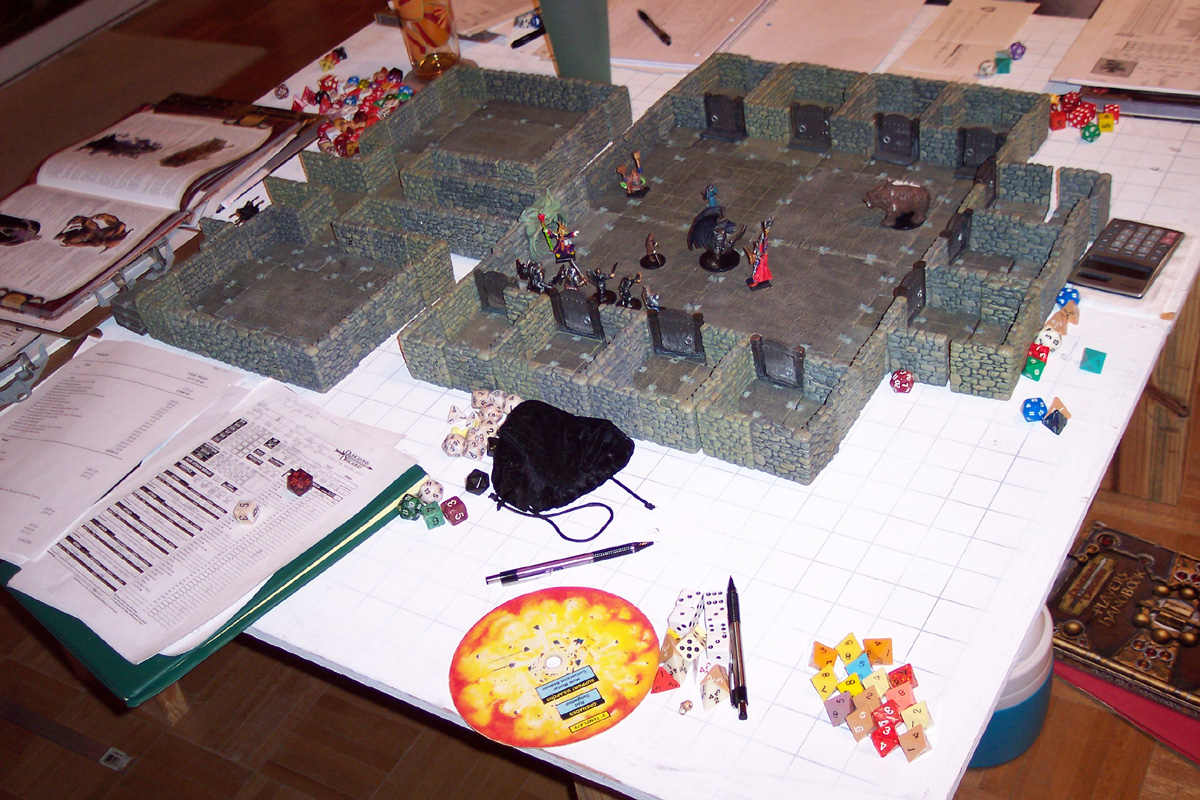
January 26, 1974: The 1st edition of the tabletop role-playing game Dungeons & Dragons is released. It becomes a favorite pastime of fantasy fans and other "nerds."

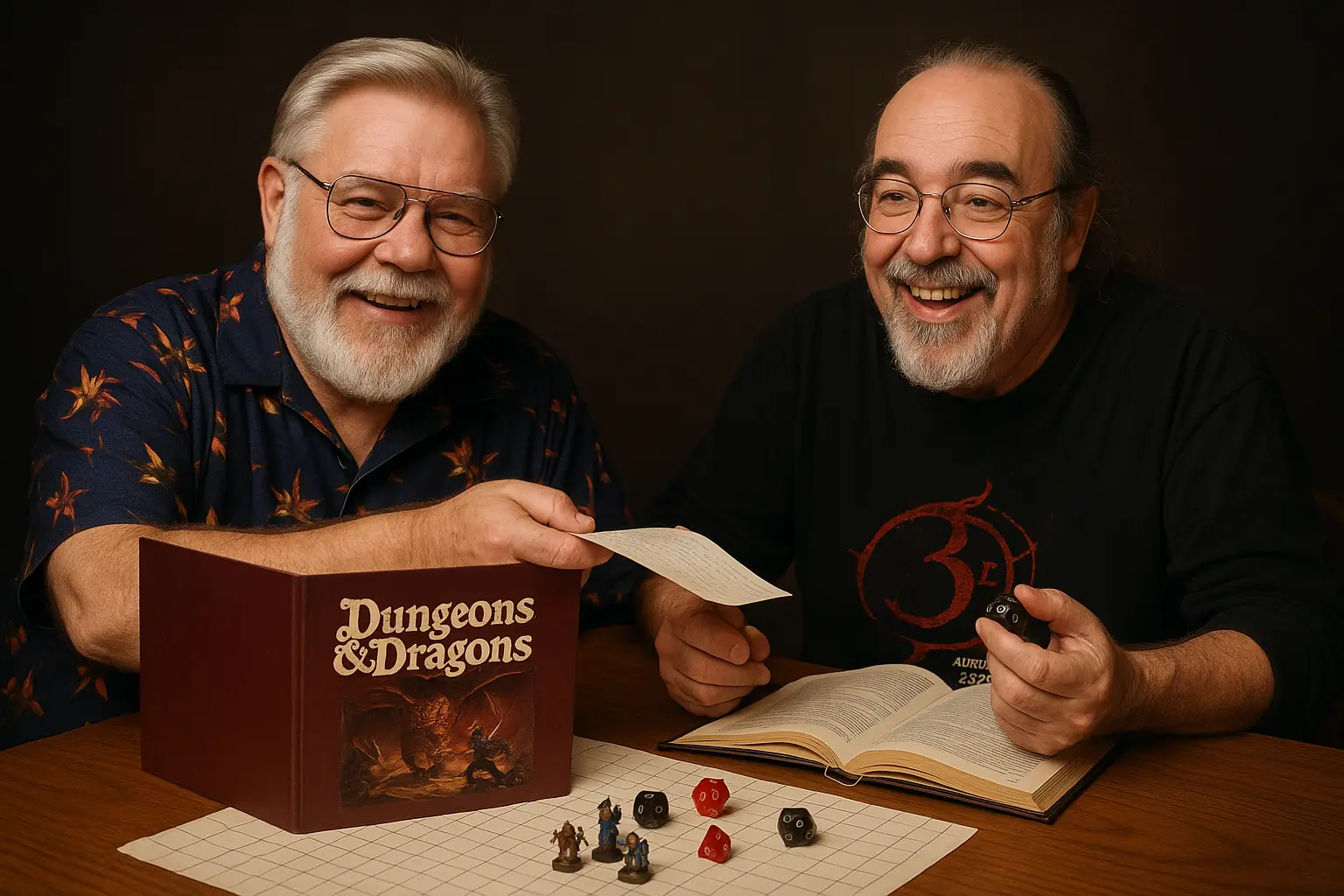
It was created by Gary Gygax, a 35-year-old Chicagoan; and Dave Arnesen, 26, from Minneapolis. They had met at "Gen Con," a gaming convention founded by Gygax in Lake Geneva, Wisconsin, where he was living at the time. They founded Tactical Studies, Inc. (TSR), to publish their ideas. "D&D" became the 1st one to hit it big.
Dave Arnesen (left) and Gary Gygax

D&D's publication is commonly recognized as the beginning of modern role-playing games and the role-playing game industry, which also deeply influenced video games, especially the role-playing video game genre.

D&D departs from traditional wargaming by allowing each player to create their own character to play instead of a military formation. These characters embark upon adventures within a fantasy setting.

A Dungeon Master (DM) serves as referee and storyteller for the game, while maintaining the setting in which the adventures occur, and playing the role of the inhabitants of the game world, known as non-player characters (NPCs).

The characters form a party, and they interact with the setting's inhabitants and each other. Together they solve problems, engage in battles, explore, and gather treasure and knowledge. In the process, player characters earn experience points (XP) to level up, and become increasingly powerful over a series of separate gaming sessions. Players choose a class when they create their character, which gives them special perks and abilities every few levels.

Later editions defined "alignments":

* Lawful Good: A character who typically acts with compassion and always with honor and a sense of duty. However, lawful good characters will often regret taking any action they fear would violate their code, even if they recognize such action as being good.

* Neutral Good: A character who typically acts altruistically, without regard for or against lawful precepts such as rules or tradition. A neutral good character has no problems with cooperating with lawful officials, but does not feel beholden to them. In the event that doing the right thing requires the bending or breaking of rules, they do not suffer the same inner conflict that a lawful good character would.

* Chaotic Good: A character who does whatever is necessary to bring about change for the better, disdains bureaucratic organizations that get in the way of social improvement, and places a high value on personal freedom, not only for oneself but for others as well. Chaotic good characters usually intend to do the right thing, but their methods are generally disorganized and often out of sync with the rest of society.

* Lawful Neutral: A character who typically believes strongly in lawful concepts such as honor, order, rules, and tradition, but often follows a personal code in addition to, or even in preference to, one set down by a benevolent authority. Examples of this alignment include a soldier who always follows orders, a judge or enforcer who adheres mercilessly to the letter of the law, a disciplined monk, and some wizards.

* True Neutral: A character who is neutral on both axes, and tends not to feel strongly towards any alignment, or actively seeks their balance.

* Chaotic Neutral: An an individualist who follows their own heart and generally shirks rules and traditions. Although chaotic neutral characters promote the ideals of freedom, it is their own freedom that comes first; good and evil come second to their need to be free.

* Lawful Evil: A character who sees a well-ordered system as being necessary to fulfill their own personal wants and needs, using these systems to further their power and influence.

* Neutral Evil: A character who is typically selfish, and has no qualms about turning on allies-of-the-moment, and usually makes allies primarily to further their own goals. A neutral evil character has no compunctions about harming others to get what they want, but neither will they go out of their way to cause carnage or mayhem when they see no direct benefit for themselves.

* Chaotic Evil: A character who tends to have no respect for rules, other people's lives, or anything but their own desires, which are typically selfish and cruel. They set a high value on personal freedom, but do not have much regard for the lives or freedom of other people. Chaotic evil characters do not work well in groups, because they resent being given orders and usually do not behave themselves unless there is no alternative.

By 2004, there were an estimated 20 million people having played D&D, with more than $1 billion in book and equipment sales worldwide. The game inspired a CBS Saturday morning cartoon that ran in the 1983-84 and 1984-85 seasons. It has been shown in the film E.T.: The Extra-Terrestrial; and on the TV shows The Simpsons, NewsRadio, Buffy the Vampire Slayer, Freaks and Geeks, Futurama, Community, The Big Bang Theory and Stranger Things.


TSR moved Gen Con around Wisconsin until taking on Milwaukee as a fixed annual site in 1985, before the company was bought by Hasbro, which moved Gen Con to Indianapolis in 2003. By that point, it was big enough of an event to be held at the domed stadium of the Indianapolis Colts, the RCA Dome until 2008, and since 2009 at Lucas Oil Stadium.

Gygax died in 2008, of a heart condition, at age 69; and Arnesen the following year, from cancer, at 61. According to Arnesen's daughter, Malia Weinhagen, "The biggest thing about my dad's world is he wanted people to have fun in life."

*

January 26, 1974 was a Saturday. Baseball and football were out of season. There were 4 games in the NBA:

* The New York Knicks beat the Philadelphia 76ers, 122-98 at Madison Square Garden.

* The Atlanta Hawks beat the Buffalo Braves, 132-122 at The Omni in Atlanta. "Pistol" Pete Maravich scored 33 points.

* The Detroit Pistons beat the Seattle SuperSonics, 94-85 at Cobo Hall (now Huntington Place) in Detroit.

* And the Golden State Warriors beat the Cleveland Cavaliers, 106-93 at the Oakland Coliseum Arena.

There were 3 games in the ABA:

* The Carolina Cougars beat the Memphis Tams, 137-104 at the Charlotte Coliseum.

* The San Antonio Spurs beat the Indiana Pacers, 90-89 at the Indiana State Fair Coliseum (now the Corteva Coliseum) in Indianapolis.

* And the Utah Stars beat their arch-rivals, the Denver Rockets, 119-117 at the Denver Auditorium Arena.

There were 4 games in the NHL:

* The New York Islanders lost to the Boston Bruins, 4-0 at the Nassau Coliseum.

* The Montreal Canadiens beat the Chicago Black Hawks, 4-1 at the Montreal Forum.

* The Los Angeles Kings beat the Pittsburgh Penguins, 2-0 at the Civic Arena in Pittsburgh.

* And the Toronto Maple Leafs and the St. Louis Blues played to a tie, 3-3 at the St. Louis Arena.

There were 2 games in the WHA. The New England Whalers beat the Cleveland Crusaders, 4-0 at the Boston Garden. And the Houston Aeros beat the Vancouver Blazers, 4-2 at the Pacific Coliseum in Vancouver.

And in English soccer, Arsenal played Aston Villa to a 1-1 draw at the Arsenal Stadium, nicknamed Highbury for its North London neighborhood. This was a 4th Round tie in the FA Cup. Four days later, they played again at Villa Park in Birmingham, and Villa won, 2-0.

December 31, 1999 & January 1, 2000: The Millennium

December 31, 1999:  The Millennium arrives. The people of planet Earth survived. At a terrible cost. But we hadn't destroyed ourselves. ...