After the Braves left for Atlanta at the end of the 1965 season, and the Chicago White Sox came up, and the Minnesota Twins came down, Interstate 94 to play a 1967 exhibition game at Milwaukee County Stadium. It attracted 51,000 fans, inspiring the White Sox to play 9 "home games" at County Stadium in 1968. Those games accounted for nearly one-third of the total attendance at White Sox games. This would also be true the next season, for the 11 home games the White Sox played there. (In each case, one home game against every other American League team, with 1969 being an expansion year.)
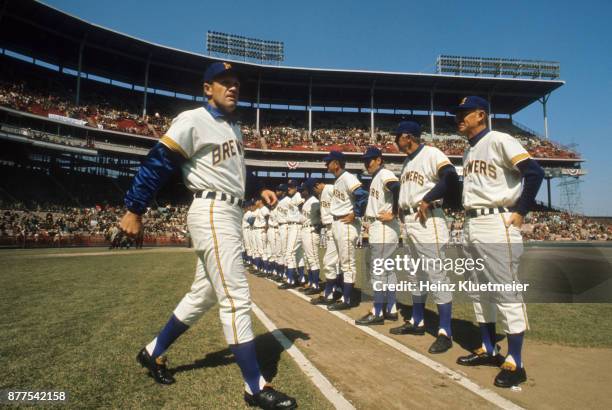
Talk that the White Sox might move would continue until former owner Bill Veeck bought them in 1975. But any talk that they would move to Milwaukee ended toward the end of Spring Training in the 1970 season, when one of the 1969 expansion team, the Seattle Pilots, went bankrupt, and were awarded to a former part-owner of the Braves, a used car salesman, Allan H. "Bud" Selig. The team was named for the city's former minor-league team: The Milwaukee Brewers.
The move was announced on April 1 -- the Pilots "dying" on April Fool's Day -- and there was just enough time to make caps with M's for Milwaukee on them, and stitch "BREWERS" over the old Pilots jerseys, with the nautical-themed sleeves staying on for that one season. The team debuted on April 7, at County Stadium, and it didn't go so well for the home fans: The Brewers lost to the team then known as the California Angels, 12-0.
Starting pitcher Lew Krausse Jr. lasted only 3 innings, trailing 4-0, and replacing him with John Gelnar didn't help, as he didn't retire a batter in the 4th inning: Center fielder Russ Snyder dropped a fly ball for an error, followed by 2 doubles and a single, for 4 more. Angel starter Andy Messersmith pitched a 4-hit shutout, striking out 11 batters.
The awful Pilots team from the season before, described in sometimes-hilarious, sometimes-depressing detail in former pitcher Jim Bouton's upcoming book Ball Four was, for all intents and purposes, still together. The Brewers went 65-97, an improvement of just 1 game over the Seattle season.
(Bouton had been traded to the Houston Astros the preceding August, and was about to face both controversy and a loss of control, and retired in July -- for the 1st time.)
It would take until 1978 for the Brewers to get into a Pennant race and finish better than .500, until 1981 for them to make the Playoffs, and 1982 for them to win a Pennant. Although they remained a good team through the 1988 season, largely thanks to shortstop Robin Yount and infielder Paul Molitor, and plenty of good pitchers, they didn't make the Playoffs again until 2008, by which time they had left County Stadium and moved into Miller Park. That retractable-roof stadium had opened in 2001, and was renamed American Family Field in 2021.
It was hoped that moving the Brewers from the AL to the National League in the 1998 season might help attendance, given the tendency for fans of the nearby Chicago Cubs to travel. But while Brewers-Cubs became a good rivalry, the rivalries with the White Sox (reflecting the NFL's Packers vs. Bears and the NBA's Bucks vs. Bulls) and the Twins (reflecting the NFL's Packers vs. Vikings and the NHL's Blackhawks vs. North Stars, as Milwaukee has never had an NHL team) fell by the wayside.
Killing 2 good rivalries to make 1 big rivalry was a total Selig move. By this point, he was the Commissioner of Major League Baseball, having placed control of the team with his daughter, who has since sold it. Selig was a bad team owner, and an even worse Commissioner.
The Braves, it should be said, mostly struggled in Atlanta from 1966 to 1990. But from 1991 onward, not only were they better off in Atlanta than they had been in Milwaukee, but they were better off than the Brewers were.
Fred Stanley was the last active former Seattle Pilot, playing in the major leagues until 1982.
UPDATE: American Family Field has a Walk of Fame, honoring both of Milwaukee's Major League Baseball teams. For the Braves: Hank Aaron, Warren Spahn, Eddie Mathews, Johnny Logan, Lew Burdette and general manager John Quinn.
For the Brewers: For the Brewers: Aaron, Robin Yount, Paul Molitor, Rollie Fingers, Don Money, Gorman Thomas, Jim Gantner, Cecil Cooper, Teddy Higuera, Geoff Jenkins, Ben Sheets, Prince Fielder, Ryan Braun, manager Harvey Kuenn, general manager Harry Dalton, team owner Bud Selig, and broadcaster Bob Uecker, who had also played for the Braves in both Milwaukee and Atlanta.
Aaron, Spahn, Mathews, Yount, Molitor, Thomas, Gantner, Cooper, Fielder, Kuenn, Selig, Uecker, and Braves broadcaster Earl Gillespie have also been elected to the Wisconsin Athletic Hall of Fame.
*
April 7, 1970 was a Tuesday. I had been born in the off-season, so, in addition to Brewers vs. Angels, these were the 1st MLB games of my lifetime.
* The New York Yankees, the team I would go on to root for, lost to their-arch-rivals, the Boston Red Sox, 4-3 at Yankee Stadium. Gary Peters outpitched Mel Stottlemyre. Carl Yastrzemski went 2-for-5. Horace Clarke and Bobby Murcer each got 2 hits for the Yankees.
* The New York Mets opened their defense of their World Championship by beating the Pittsburgh Pirates, 5-3 at Forbes Field in Pittsburgh. Donn Clendenon singled home 2 unearned runs against his former team in the top of the 11th inning, making Ron Taylor a winning pitcher in relief of Tom Seaver. Tommie Agee went 3-for-6. Roberto Clemente went 3-for-4 with a walk and 2 RBIs. Willie Stargell went 0-for-5.
* The Philadelphia Phillies beat the Chicago Cubs, 2-0 at Connie Mack Stadium in Philadelphia. Chris Short pitched a 5-hit shutout to beat former Phillie Ferguson Jenkins. Ernie Banks went 1-for-3 with a walk. Denny Doyle had an RBI triple, and Don Money had an RBI double. Both would become better known on other teams: Doyle on the Red Sox, Money on the Brewers.
* The Washington Senators beat the Detroit Tigers, 14-4 at Robert F. Kennedy Stadium in Washington. Mike Epstein and Lee Maye hit home runs for the Senators. Al Kaline went 2-for-4 for the Tigers.
* The Baltimore Orioles beat the Cleveland Indians, 8-2 at Cleveland Municipal Stadium. Frank Robinson hit the 451st home run of his career. Brooks Robinson went 1-for-4 with a walk. Dave McNally struck out 13 to outpitch Sam McDowell, who struck out 11.
* The Chicago White Sox, briefly Milwaukee's "home team," also lost their 1970 opener by a 12-0 score, to the Minnesota Twins, at Comiskey Park in Chicago. Jim Perry pitched a 6-hit shutout. (Unlike his brother Gaylord, Jim never admitted to throwing a spitball, nor was he ever seriously suspected of having done so.) For the ChiSox, Bill Melton got 3 of those hits. Their starter, Tommy John, didn't get out of the 5th inning.
Brant Alyea hit 2 home runs for the Twins. Harmon Killebrew went 1-for-2 with 2 walks before leaving for a pinch-runner. Rod Carew went 2-for-5 with an RBI.
* The Oakland Athletics beat the Kansas City Royals, 6-4 at Kansas City Municipal Stadium. Sal Bando and Don Mincher hit home runs. Reggie Jackson went 1-for-4 with a walk and an RBI.
* The San Diego Padres beat the Atlanta Braves, 8-3 at San Diego Stadium (later Jack Murphy Stadium and Qualcomm Stadium). Pat Dobson outpitched Phil Niekro. Nate Colbert hit a home run for the Padres, and Orlando Cepeda hit one for the Braves. Hank Aaron did not hit a home run, but went 1-for-3 with a walk and an RBI.
* The Cincinnati Reds beat the Los Angeles Dodgers, 4-0 at Dodger Stadium in Los Angeles. Gary Nolan allowed only 2 hits, both of them singles to Willie Crawford, in the 4th and 9th innings. Pete Rose went 2-for-4 with a walk. Johnny Bench went 1-for-4 with an RBI.
* The Houston Astros beat the San Francisco Giants, 8-5 at Candlestick Park in San Francisco. Larry Dierker beat Gaylord Perry. For the Astros, Jim Bouton got the last out in the 7th inning, and the 1st out in the 8th. Norm Miller hit a home run, while pinch-hitting for Dierker in the 7th. For the Giants, Willie Mays went 2-for-4 with an RBI.
* And the Montreal Expos and the St. Louis Cardinals were not scheduled. The Expos had opened the day before, the traditional National League opener in Cincinnati, losing to the Reds, 5-1 at Crosley Field. The Cardinals would open the day after this, beating the Expos, 7-2 at Jarry Park in Montreal.
This would be the last season for 3 classic National League ballparks: Crosley Field would close on June 24, Forbes Field would close on June 29, and Connie Mack Stadium, formerly known as Shibe Park, would close on October 1. They would be replaced, respectively, by Riverfront Stadium on June 30, Three Rivers Stadium on July 16, and Veterans Stadium on April 10, 1971.
Or, to put it another way: In 1970, the average age of a National League ballpark was 23 seasons; in 1971, 9. At the close of the 1957 season, the average opening date of a major league ballpark was 1919, and thus 38 years; by Opening Day 1973, it was 1952, and thus 19 years. (In 2022, it's 1991, and thus 31 years -- but if you don't count Fenway Park and Wrigley Field, then it's 1997, and 25 years.)
Football was out of season. The NHL was between the end of the regular season and the start of the Stanley Cup Playoffs. There was 1 game in the NBA Playoffs: The Los Angeles Lakers beat the Phoenix Suns, 104-93 at the Arizona Veterans Memorial Coliseum in Phoenix. Jerry West scored 35 points. Wilt Chamberlain had 11 points, 12 assists, and 26 rebounds.
And there were 3 games in the American Basketball Association, which was closing out its regular season:
* There was a doubleheader at the Washington Coliseum in D.C. In the opener, the Los Angeles Stars beat the Miami Floridians, 129-114. In the nightcap, the Washington Capitols beat the New Orleans Buccaneers, 115-111. Rick Barry scored 44 for the Caps.
* The Kentucky Colonels beat the Dallas Chaparrals, 118-112 at the Moody Coliseum in Dallas. Darrel Carrier scored 38 for the Colonels.


No comments:
Post a Comment