Showing posts with label 1870. Show all posts

Tuesday, October 25, 2022

October 26, 1870: The Atlantics Beat the Red Stockings Again

October 26, 1870: In a rematch of the game that finally ended their unbeaten streak at the Capitoline Grounds in Brooklyn the previous June, the Cincinnati Red Stockings take on the Atlantics of Brooklyn‚ on neutral ground, at the Jefferson Street Grounds in Philadelphia. Led by 1st baseman Joe Start (pictured), the Atlantics score 5 runs in the bottom of the 9th to beat the mighty Reds‚ 11-7.

This was, effectively, the end of the 1st era of organized baseball, the all-amateur era. The next season, the National Association, the 1st professional league, began play. The Boston Red Stockings were formed, taking about half of the Cincinnati players, and they continued to dominate baseball in the 1870s. The National League came along in 1876.

The Boston club won NA Pennants in 1872, '73, '74 and '75, and NL Pennants in 1877 and '78, before poachings from other teams finally forced them off their perch. They won just 1 Pennant between 1878 and 1891, before starting a new dynasty.

The Atlantics weren't so lucky, as they refused to join the NA, and lost most of their good players to that league. They continued to play an independent schedule until folding in 1882, baseball's first great team (founded in 1855) going out not with a bang, but with a whimper.

October 26, 1870 was a Wednesday. There were no other scores on this historic day, as baseball was America's only organized team sport at the time. 

Monday, September 19, 2022

September 20, 1870: The Unification of Italy

Giuseppe Garibaldi

September 20, 1870: Pope Pius IX ends the Siege of Rome by surrendering the Papal States, ending his temporal control over the city. This is the final step of the Unification of Italy, like many countries an old civilization, but a young nation.

In 1859, Emperor Napoleon III of France met with Emperor Franz Joseph of Austria, and negotiated an end to the war between them. In exchange for peace -- Napoleon III was not nearly as good at war as his great-uncle and namesake, Napoleon I Bonaparte -- the French monarch was willing to transfer control of the province of Lombardy, including Milan, to the Kingdom of Sardinia.

Later in the year, Tuscany (including Florence), Parma and Modena asked to join Sardinia. In 1860, Sardinia made a deal with France for those provinces, giving up Nice and Savoy. King Victor Emmanuel II of Sardinia, of the House of Savoy-Carignano -- Vittorio Emanuele Maria Alberto Eugenio Ferdinando Tommaso di Savoia -- then proclaimed himself the King of Italy (Re d'Italia).
King Victor Emmanuel II

In May, Giuseppe Garibaldi sailed from Genoa, and conquered Sicily, bringing the island into the Kingdom of Italy. In September, he brought Naples into the Kingdom. The Kingdom of Italy was officially proclaimed on March 17, 1861. That left only Austrian-controlled Veneto, including Venice and Verona, and the Papal States, including Rome, among traditionally Italian-speaking lands not under Italian control.

Getting Rome, the Eternal City, seat of the greatest empire the ancient world, and the largest city on the Italian peninsula, in proved more difficult. In 1862, Garibaldi was captured at Aspromonte, and was only released when he gave an order to disband his army. In 1864, Victor Emmanuel II convinced Napoleon III to withdraw French troops from the Papal States within 2 years.

In June 1866, Italy entered the Austro-Prussian War on Prussia's side, with King Wilhelm I (later Kaiser Wilhelm I of a united Germany) promising them control of Veneto if he won. But the war didn't go well for Italy. Nevertheless, in August, Austria and Prussia signed an armistice, and in October, Franz Joseph ceded Veneto to France, as a reward for not entering the war. Napoleon III immediately ceded Veneto to Italy. That left only the Papal States.

Italy's chance came in 1870, with the Franco-Prussian War. Again losing, Napoleon III needed troops, and, in July, he called back the ones he had in Rome. That gave General Raffaele Cadorna, in command of the Italian Army, a chance. On September 11, he began his advance toward Rome. After a siege, the Pope surrendered, and Cardona entered Rome, which was annexed by the Kingdom of Italy. The following June, the capital of Italy was moved from Florence to Rome.
Raffaele Cadorna

This period of Italian history became known as Il Risorgimento, The Resurgence.

For the 1st time since the fall of the Western Roman Empire, 1,400 or so years earlier, Italy was united. Except for 1943 to 1945 during World War II, it has remained so -- at least, as a nation. That nation has often been internally divided, but it remains one nation.

Napoleon III was dethroned after losing the Franco-Prussian War, and died in exile in 1873. Victor Emmanuel II remained King of Italy until his death in 1878. Garibaldi served in the Chamber of Deputies until his death in 1882. Cadorna lived until 1897.

A red shirt, or camicia rossa, became a powerful symbol of Italian nationalism, freedom, and revolutionary spirit. In particular, it became a popular women's fashion item in Europe and the U.S. In 1865, a soccer team in Nottingham, England, was founded: Nottingham Forest Football Club. It wore red shirts, which their fans still call "The Garibaldi that we wear with pride." Former Forest players would later donate red shirts to newly-founded teams that would resound through the history of not just English, but European soccer: The club founded in London in 1886 that would become Arsenal F.C., and Liverpool F.C. in 1892.

And yet, the national team of Italy wear blue shirts, the color of the House of Savoy, and are known as the Azzurri, much like their arch-rivals, France (Les Bleus).

*

September 20, 1870 was a Tuesday. This was the end of the amateur era of baseball. The 1st openly professional team, the Cincinnati Red Stockings, traveled to nearby Hamilton, Ohio, and beat the Resolute club, 36-4.

Thursday, September 1, 2022

September 2, 1870: The Battle of Sedan

Wilhelm Camphausen's painting of Napoleon III (left) and Bismarck after the battle

September 2, 1870: The Battle of Sedan is fought, in the Ardennes Forest, near France's border with Belgium. It is an utter disaster for the French Second Empire. It is the beginning of the German Second Reich.

Since the final fall of Napoleon Bonaparte in 1815, France went through the monarchies of Louis XVIII, Charles X and Louis Philippe. Louis-Napoléon Bonaparte, son of Napoleon's brother Louis, was elected President following the Revolution of 1848, then seized full power in 1851, proclaiming himself Emperor Napoleon III. (Napoleon's son died in 1832, at age 21, without ever having reigned as Napoleon II.)

Napoleon III was popular among his people for several years. He modernized the French economy, focusing on railways. He reconstructed Paris with new boulevards and parks, and the architectural style that became known as "Second Empire Style," which would also become popular in America.

In foreign policy, he led the building of the Suez Canal in Egypt, assisted the unification of Italy to win their alliance, and negotiated a free trade agreement with Britain, bringing the old enemy nations closer together than ever before. So, unlike Le Petit Corporal, one of the greatest enemies Britain has ever had, Napoleon III is well-regarded by British people today.
Emperor Napoleon III

But he made 2 great mistakes in foreign policy: The attempted annexation of Mexico ended in disaster in 1867, and the Franco-Prussian War. Nervous about Chancellor Otto von Bismarck's maneuvering to unify the various small German states into a single country, Napoleon III attacked on July 19, 1870.
Chancellor Otto von Bismarck

A story which may be apocryphal tells of a German-owned firm in New York receiving a large order for arms from France. They wired Bismarck, and asked them how they should handle it. He replied that they should sell the French all the weapons they could afford, because his army would have them soon enough. 

The French were no match for the German troops. Finally, at Sedan, on September 2, with Napoleon III himself on hand, a German force commanded by Helmuth von Moltke, with King Wilhelm I of Prussia on hand, encircled the French troops, capturing 104,000 men, including the Emperor. Napoleon III personally surrendered to Wilhelm I, and sent word of his abdication as Emperor to Paris.

A Government of National Defense was formed on September 4. They considered having Henri, Comte de Chambord and Duke of Bordeaux, the grandson of the last legitimate King, Charles X, as a parliamentary monarch, Henri V, but he wanted to get rid of all symbols of the French Revolution of 1789-94, including the Tricolor Flag. The French people had grown too attached to the flag, and so he refused to take the throne. France has never had a monarchy again, no matter how powerless.

The Government of National Defense turned out to be useless. On September 19, Bismarck entered Paris. On January 18, 1871, at the Palace of Versailles, built by the most legendary of all French Kings, Louis XIV, the German Second Reich was proclaimed, with Wilhelm I as Emperor, or Kaiser. (Like the Russian title "Czar," the German title "Kaiser" comes from the Roman title "Caesar.")
Kaiser Wilhelm I

Taken into the German Empire were the eastern French territories of Alsace and Lorraine. France would take them back in World War I, then Germany would take the entirety of France in World War II, before Allied troops liberated the country. Unlike his grandson Wilhelm II, the great villain of World War I, and Adolf Hitler, that of World War II, Wilhelm I is still admired in Germany, as is Bismarck, the father of the nation, their George Washington.

Later in 1871, the Government of National Defense fell to the Paris Commune, but that didn't last long, either. A series of weak governments under the Third Republic led to France suffering terribly in both World Wars.

Napoleon III died in exile in London in 1873, after years of ill health, at the age of 64. His son, Prince Imperial Louis-Napoléon, never reigned as Emperor Napoleon IV, enlisted in the British Army, and died a hero's death in the Anglo-Zulu War in 1879, just 23. With him died the last serious hope for a return to monarchy in France.

In 2022, there are 3 pretenders to the French throne, none of whom has made much effort to reclaim it. The Legitimist claimant is Louis Alphonse de Bourbon, Duc d'Anjou, age 48, the would-be Louis XX, a direct descendant of Louis XV (but not XVI, XVII, XVIII or XIX), and also descended from Queen Victoria of Britain, Kings of Spain, and (through his mother) Spanish dictator Francisco Franco.
The Orléanist claimant is Jean, Comte de Paris, 57, the would-be Jean IV, a direct descendant of Louis-Phillippe.
And the Bonapartist claimant is Jean-Christophe, Prince Napoléon, 36, the would-be Napoleon VIII, a direct descendant of the original Napoleon's brother, Jérôme-Napoléon Bonaparte.
Like George Washington, Charles de Gaulle probably could have had himself proclaimed King if he'd wanted it. Certainly, there were times when he acted more like a king than Washington ever did. His son, Philippe, served in the French Senate from 1986 to 2004. As of September 2, 2022, he is still alive, age 98.

UPDATE: Philippe de Gaulle died in 2024, at 102. His eldest son and heir, named Charles de Gaulle, turned 77 on September 25, 2025. From 1994 to 2004, he served in the European Parliament. In 1999, he switched to the National Front, a since-dissolved far-right party that often seemed to resemble Germany's Nazis, which would have horrified his grandfather and namesake, not to mention Napoleon III. "It was like hearing the Pope had converted to Islam," a family member said.

*

September 2, 1870 was a Friday. This was the dawn of professional baseball, but before the 1st professional league. The biggest rivalry in the sport at the time was between the top team in what was then considered the West, the Cincinnati Red Stockings; and the top team in the East, the Brooklyn Atlantics.

On this day, the Red Stockings beat the Atlantics, 14-3. The Red Stockings finished the season 67-6, with 2 of their losses -- June 14, the 1st game they'd ever lost since their founding the preceding hear, and October 26 -- being dealt by the Atlantics.

Thursday, July 14, 2022

July 15, 1870: The Manitoba Act Ends the Red River Rebellion

Louis Riel

July 15, 1870: The Manitoba Act passes the Parliament of Canada, ending the Red River Rebellion, and establishing the Province of Manitoba.

Louis Riel led a group of rebels of mixed French and indigenous Canadians, known as Métis. The Spanish/native equivalents in Mexico are called Mestizos. Much of central Canada was Rupert's Land, owned by the Hudson's Bay Company. It was named for Prince Rupert of the Rhine, a nephew of the Company's 1st Governor, King Charles I of England.

Following Canada gaining independence through "Confederation" on July 1, 1867, though still under some control by Britain, the British Parliament authorized the sale of the Land to Canada, as the Red River Colony. But the national government at Ottawa appointed an English-speaking Governor, William McDougall, for the Colony.

That angered the French, the First Nations (indigenous peoples), and the Métis, most of whom spoke French as their first language. The Métis, led by Riel, prevented McDougall from entering the territory on October 11, 1869, beginning the Rebellion. They created a provisional government to which they invited an equal number of Anglophone representatives. Riel negotiated directly with the Canadian government to establish Manitoba, a Native name, as a Canadian Province. At Confederation, there were 5 Provinces: Ontario, Quebec, Nova Scotia and New Brunswick.

Riel's men arrested members of a pro-Canadian faction who resisted the provisional government. This included Thomas Scott, whom they tried for insubordination, convicted, and executed on March 4, 1870.

To prevent further bloodshed, Canada and the Assiniboia provisional government soon negotiated an agreement. On July 15, 1870, Parliament passed the Manitoba Act, allowing the Red River Colony to enter Confederation as the Province of Manitoba. The act also incorporated some of Riel's demands, such as the provision of separate French schools for Métis children and the protection of Catholicism.

In August 1870, Riel peacefully withdrew from Fort Garry, a former HBC trading post around which the Provincial capital of Winnipeg was built, starting in 1873. He fled to America, and the Rebellion was over. In 1885, Riel returned, and led another rebellion, the North-West Rebellion. That one ended with his capture and execution.

British Columbia became a Province on July 20, 1871; Prince Edward Island on July 1, 1873; Saskatchewan and Albert on September 1, 1905; and Newfoundland and Labrador on March 31, 1949, making for 10 Provinces.

*

July 15, 1870 was a Friday. By a strange coincidence, this was also the day the last of the States that had seceded from the United States of America to form the Confederate States of America, Georgia, was readmitted to the Union. I have a separate entry for this event.

The only organized team sport in America at this point was baseball, and it was just starting the professional era. The difference between those teams that had turned pro and those that hadn't became stark. The only score I can find for this historic day involves the 1st team to openly turn pro, the Cincinnati Red Stockings, who beat the Eagle Base Ball Club of Louisville, Kentucky, 39-8. That season, against pro teams, the Red Stockings went 27-6; against amateur teams, they went 40-0.

July 15, 1870: The Reunion of the Union Is Completed

The Flag of the United States, with 37 Stars,
in use from July 4, 1867 to July 4, 1877,
including when most of the former Confederate States
were readmitted to the Union.

July 15, 1870: The last of the States that had seceded from the United States of America to form the Confederate States of America is readmitted, completing the reunion of the Union.

Those States seceded over what they called "States' Rights," but each one's Ordinance of Secession mentioned slavery as one of those "rights." The secessions began after the election of Abraham Lincoln, who opposed the future expansion of slavery, as the President of the United States on November 6, 1860.

This was the order of secession:

1. December 20, 1860: South Carolina.
2. January 9, 1861: Mississippi.
3. January 10, 1861: Florida.
4. January 11, 1861: Alabama.
5. January 19, 1861: Georgia.
6. January 26, 1861: Louisiana.
7. February 23, 1861: Texas.

Lincoln was Inaugurated on March 4. On April 12, Confederate ships fired on Fort Sumter in Charleston, South Carolina, starting the American Civil War. This was followed by more secessions:

8. May 6, 1861: Arkansas.
9. May 20, 1861: North Carolina.
10. May 23, 1861: Virginia.
11. June 1, 1861: Tennessee.

On January 3, 1861, Delaware voted not to secede. On January 29, Kansas was admitted as the 34th State in the Union. On March 19, Missouri overwhelmingly vote to remain in the Union. On April 29, Maryland voted not to secede.

This was key: The District of Columbia, the seat of the Union's government, was between Maryland and Virginia, and Virginia was already considering secession. If both had seceded, the federal government would be trapped. As it was, when Virginia seceded, the U.S.A. literally had its capital on the border with an enemy nation. Fortunately, the C.S.A. didn't have engineers capable of building a bridge across the Potomac River to invade. Nor did they have cannons capable of reaching the U.S. Capitol or the White House.

On May 20, Kentucky declared its neutrality. But on November 18, delegates from 68 of Kentucky’s 110 Counties met, passed an ordinance of secession, adopted a new state seal, and elected a secessionist as Governor. Kentucky was admitted to the Confederacy on December 10. However, the elected State government did not secede, and Kentucky remained in the Union.

Still, the Confederate Flag -- and its variation that is more familiar today, the Confederate Battle Flag -- had 13 stars, one for each State that had seceded, and one each for Kentucky and Missouri, which had not. So the States of Delaware, Maryland, Kentucky and Missouri remained in the Union, despite still keeping slavery legal within their borders.

Several Western Counties in Virginia voted to secede from the rest of the State, and on June 20, 1863, those Counties, collectively, were admitted to the Union as West Virginia, the 35th State. This included Harpers Ferry, home to the federal arsenal that abolitionist John Brown tried and failed to capture in 1859.

The idea that Virginia went to the Confederacy and West Virginia stayed loyal to the Union will seem strange to people whose experience watching those States only goes back far enough to know Virginia as a State regularly voting Democratic and West Virginia as one regularly voting Republican.

Nevada was admitted as the 36th State on October 31, 1864. Because it was admitted during the Civil War, and immediately sent troops to the Union Army, the State’s motto is "Battle Born."

The Confederate States of America surrendered, piece by piece, in the Spring of 1865. This was the order of readmission to the Union, based on acceptance of the Constitution of the United States, including the Reconstruction Amendments: The 13th, prohibiting slavery; the 14th, guaranteeing citizenship and equal protection of the laws to all people born in the United States; and the 15th, guaranteeing the right to vote to all male American citizens age 21 and up:

1. July 24, 1866: Tennessee.
2. June 22, 1868: Arkansas.
3. June 25, 1868: Florida.
4. July 4, 1868: North Carolina.
5. July 9, 1868: Louisiana.
6. July 9, 1868: South Carolina (same day as Louisiana).
7. July 13, 1868: Alabama.
8. January 26, 1870: Virginia.
9. February 23, 1870: Mississippi.
10. March 30, 1870: Texas.
11. July 15, 1870: Georgia.

During this process, another State was admitted to the Union: Nebraska, the 37th State, on March 1, 1867. The 38th wouldn’t come until 1876, Colorado.

Of the 33 States in the Union when South Carolina became the 1st to secede, slavery had been banned in 18. Of the 37 States in the Union when Georgia became the last to rejoin, it had been banned in all 37.

So 1870 marked the final reunion of the Union. On October 12, Robert E. Lee, the leading General of the CSA, died from the effects of a stroke, in Lexington, Virginia. He was 63 years old. Jefferson Davis, the one and only President of the C.S.A., previously a U.S. Senator from Mississippi and Secretary of War under President Franklin Pierce, lived on until 1889.

*

July 15, 1870 was a Friday. By an odd coincidence, this was also the day that Manitoba became a Province of Canada, ending the Red River Rebellion. I have a separate entry for this event.

The only organized team sport in America at this point was baseball, and it was just starting the professional era. The difference between those teams that had turned pro and those that hadn't became stark. The only score I can find for this historic day involves the 1st team to openly turn pro, the Cincinnati Red Stockings, who beat the Eagle Base Ball Club of Louisville, Kentucky, 39-8. That season, against pro teams, the Red Stockings went 27-6; against amateur teams, they went 40-0.

Monday, June 27, 2022

June 28, 1870: Gloves Come to Baseball

Doug Allison

June 28, 1870: Baseball gloves become respectable. In the amateur era, using anything to protect yourself from a moving baseball was considered "unmanly." But when the 1st openly professional baseball team did it, that meant that it was okay.

And it was Doug Allison, the catcher for the Cincinnati Red Stockings, who did it. As a local newspaper, the Cincinnati Commercial, reported, "Allison caught today in a pair of buckskin mittens, to protect his hands." Cincinnati won, 30-10, beating the Washington Nationals at the National Grounds in Washington. (Today, there are teams named the Cincinnati Reds and the Washington Nationals, but they are not the same teams.)

The Red Stockings had gone through the 1869 season undefeated. They were finally beaten 2 weeks before this, by the Brooklyn Atlantics. But they were still, at the least, 1 of the 2 best teams in the world. So other teams were willing to follow them in doing something. 

A report appeared in the Detroit Free Press on August 14, 1867, of a catcher named Ben Delaverage playing for the Victory Club of Troy, across the Hudson River from Albany, New York, using a catcher's glove. In the late 1870s, gloves came into common use. At first, players had to sneak them onto the field.

But star pitcher-turned-1st baseman Al Spalding made it a manly thing in 1877, boldly donning a black glove that was fingerless but padded. Ever the entrepreneur, Spalding envisioned big sales for his mail-order sporting-goods business. Catchers were among his best customers. The 1877 season also saw the debut of the catcher's mask.

By 1885, a padded glove began to be used in baseball. The "pillow style" catcher's mitt made its debut in 1899, and the current design arrived in 1920. In the late 1960s, Randy Hundley of the Chicago Cubs developed a "hinged" mitt that snapped closed on contact with the ball, enabling one-handed catching.

Chest protectors were first worn in 1883, by a star player, Jim "Deacon" White. Shin guards were first used in 1907, again by a star, Roger Bresnahan. Since stars were willing to do it, and no one questioned their toughness, everybody began to use them.

June 28, 1870 was a Tuesday. I have no record of any other baseball games played that day. This was also the day that Congress passed a bill creating the first federal holidays. I have a separate entry for that event.

June 28, 1870: The Holiday Act of 1870

June 28, 1870: Congress passes the Holiday Act of 1870, creating the 1st federal holidays. It reads as follows, and I have not changed the spelling or punctuation from the original bill:

Be it enacted by the Senate and the House of Representatives of the United States in Congress assembled, That the following days to wit: The first day of January, commonly called New Year's Day, the fourth day of July, the twenty-fifth day of December, commonly called Christmas Day, and any day appointed or recommended by the President of the United States as a day of public fast or thanksgiving shall be holidays within the District of Columbia, and shall for all purposes of presenting for payment or acceptance for the maturity and protest, and of giving notice of the dishonor of bills of exchange, bank checks and promisory notes or other negotiable or commercial paper, be treated and considered as is the first day of the week, commonly called Sunday, and all notes, drafts, checks, or other commercial or negotiable paper falling due, or maturing on either of said holidays shall be deemed as having matured on the day previous.

Although at first applicable only to federal employees in Washington, D.C., Congress extended coverage in 1885 to all federal employees. In other words: For federal government workers, New Year's Day, Independence Day, Thanksgiving Day and Christmas Day were to be federal holidays, on which all federal offices, including post offices, would be closed.

This also applied to public schools. At first, most banks and stock markets closed as a courtesy. But with the establishment of the Federal Reserve System, it became mandatory.

George Washington's Birthday became a federal holiday in 1879. In 1888 and 1894, respectively, Decoration Day (later Memorial Day, May 30) and Labor Day (the 1st Monday in September) were created. Armistice Day was established in 1938 to honor the end of World War I, on November 11, 1918. In 1954, the scope of the holiday was expanded to honor all veterans, renamed Veterans Day.

In 1968, the Uniform Monday Holiday Act gave several holidays "floating" dates, so that they always fall on a Monday, establishing three-day weekends -- or, if the holiday falls on a Sunday, making the next day, Monday, the holiday. It also established Columbus Day, and combined the mandated Washington's Birthday and the optional Lincoln's Birthday into a single Presidents Day. In 1983, Martin Luther King Jr. Day was established. And in 2021, Juneteenth National Independence Day was established.

Therefore, federal holidays in the United States are as follows:

* January 1, fixed date: New Year's Day.

* The 3rd Monday in January, 15 to 21: Martin Luther King Jr. Day. Dr. King's birthday was January 15.

* The 3rd Monday in February, 15 to 21: Presidents Day. This is followed on the calendar by March 17, St. Patrick's Day, on which federal offices, banks and schools remain open, unless it falls on a Saturday or a Sunday; Easter, which falls between March 22 to April 25, but always on a Sunday; and Mother's Day, the 2nd Sunday in May, 8 to 14. So, on Easter and Mother's Day, all of those places would be closed, anyway.

* The last Monday in May, 25 to 31: Memorial Day. This is followed on the calendar by June 14, Flag Day, on which federal offices, banks and schools remain open, unless it falls on a Saturday or a Sunday; and Father's Day, the 3rd Sunday in June, 15 to 21, so everything that would be closed on a federal holiday would be closed, anyway.

* June 19, fixed date: Juneteenth National Independence Day.

* July 4, fixed date: Independence Day.

* The 1st Monday in September, 1 to 7: Labor Day.

* The 2nd Monday in October, 8 to 14: Columbus Day. Given Christopher Columbus' role in the harm done to Native Americans, some places in America celebrate it, instead, as Indigenous Peoples' Day. Either way, this holiday is followed on the calendar by October 31, Halloween Day; and the 1st Tuesday after the 1st Monday in November, 2 to 8, Election Day, neither of which is a holiday on which on which federal offices, banks and schools remain open, unless, in the case of Halloween, it falls on a Saturday or a Sunday.

* November 11, fixed date: Veterans Day.

* The 4th Thursday in November 22 to 28: Thanksgiving Day. The next day, "Black Friday," is not a federal holiday, and banks and stock markets are open. But most public schools remain closed, resulting in the Thanksgiving holiday becoming a four-day weekend.

* December 25, fixed date: Christmas Day. December 24, Christmas Eve, is not a holiday. Nor is December 31, New Year's Eve. However, in each case, in anticipation of the next day's holiday, many public places close early, usually at 6:00 PM. And schools are usually closed for a Winter break.

*

June 28, 1870 was a Tuesday. This was also the day that Doug Allison, the catcher for the Cincinnati Red Stockings, wore "buckskin mittens," to aid in catching the pitches of his teammate, Asa Brainard. who did it. This made him the 1st professional baseball player to wear any kind of glove. I have a separate entry for this event. It appears to have been the only professional baseball game played that day, and Cincinnati won, beating the Washington Nationals, 30-10, at the National Grounds in Washington. (Today, there are teams named the Cincinnati Reds and the Washington Nationals, but they are not the same teams.)

Monday, June 13, 2022

June 14, 1870: The 1st "Greatest Game Ever Played"

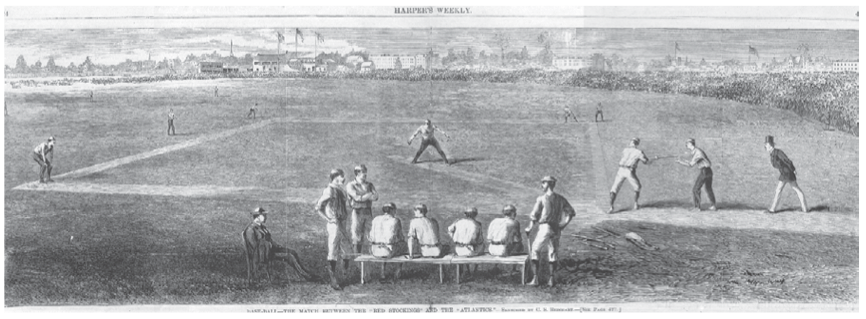
A July 2, 1870 Harpers Weekly illustration of the game. 
June 14, 1870: After 84 consecutive wins since assembling the 1st openly professional baseball team in 1869, the Cincinnati Red Stockings come to the Capitoline Grounds in Brooklyn -- which, until 1898, was a separate city from New York, then consisting only of Manhattan.

They were to face the top team in the New York area, the Brooklyn Atlantics. The biggest crowd in baseball history to that point, an estimated 20,000, came in to see it.

It was a different world. There really wasn't professional sports at this point. The 1st college football game had been played the previous November in New Jersey, and it was basically a 25-a-side soccer game. Soccer had barely been standardized, with England's Football Association establishing rules in 1863. Hockey was in its infancy. Basketball hadn't been invented yet. Boxing was an "underground" sport. Horse racing was big, as sports went. The Olympic Games weren't even an idea.

Connie Mack, later known as "The Grand Old Man of Baseball," was 7 years old. Jacob Ruppert, who would build Yankee Stadium and the 1st Yankee dynasty, was 2. John McGraw wouldn't be born for another 3 years.

It was June 14, 1870, when the Cincinnati Red Stockings and the Brooklyn Atlantics played the 1st baseball game that could legitimately have been called "The Greatest Game Ever Played."

*

Here were the lineups for this epic game:

Cincinnati
SS George Wright (Hall of Fame)
1B Charlie Gould
3B Fred Waterman
C Doug Allison
CF Harry Wright (Hall of Fame, brother of George, also Captain and manager)
LF Andy Leonard
P Asa Brainard
2B Charlie Sweasy
RF Cal McVey

Brooklyn
SS Dickey Pearce
3B Charlie Smith
1B Joe Start
LF Jack Chapman
C Bob Ferguson (Also Captain, and effectively manager)
P George Zettlein
CF George Hall
2B Lipman Pike
RF Dan McDonald

Leonard was the 1st native of Ireland, and thus the 1st Irish-American, to play professional baseball. "Lip" Pike is believed to be the 1st Jewish player of any renown.

A couple of notes on nicknames. In this era when all pitching truly was "pitching," underhanded, rather than "throwing," overhanded, Brainard was so good at pitching, other teams began to call their best pitcher "our Asa," and thus, the term "ace" to mean a top pitcher was born.

And Ferguson, who could play any position, was so good defensively that he became known as "Death to Flying Things." (This would later be reflected in "Shoeless" Joe Jackson, when his contemporary Ty Cobb called him the best left fielder he ever saw, and Jackson's glove "the place where triples go to die.")

The Red Stockings scored 2 runs in the 1st inning and 1 more in the 3rd, and held that 3-0 lead going to the bottom of the 4th. But the Atlantics scored 2 runs in the 4th, and 2 more in the 6th, taking a 4-3 lead. The Red Stockings scored 2 in the top of the 7th, to retake the lead, 5-4. The Atlantics tied it up in the bottom of the 8th.

At the end of the 9th inning, it was still 5-5. The Atlantics were willing to accept the tie. The Red Stockings demanded that the game be played until somebody won. This would prove to be their undoing.

Neither team scored in the 10th inning. In the top of the 11th, the Red Stockings scored 2 runs, and with the 7-5 lead, it looked like they would emerge victorious.

But Brainard tired in the bottom of the 11th. He allowed a leadoff hit to Smith. Then Start hit a shot to right field that McVey couldn't reach. He chased it, and it rolled into the crowd. Newspaper accounts suggest that a fan, clearly a native and rooting for Brooklyn, jumped on McVey's back. McVey got rid of him, but by the time he threw the ball back to the infield, Smith had scored, and Start was on 3rd base with the tying run and nobody out.

(Don't blame the antique conditions: With a real fence, he might have been able to hold Smith to 3rd and McVey to 2nd, but that doesn't mean those runs wouldn't have eventually scored anyway.)

Brainard got Chapman out. But Ferguson singled Start home to make it 7-7. Zettlein got a hit, making it 1st and 2nd with just 1 out. A double play had saved Cincinnati in the previous inning and kept the score level, so maybe that could happen again.

And it looked like it would, as Hall grounded to short. George Wright had redefined the position, setting a standard for playing shortstop that would stand until Honus Wagner came along 30 years later. This time, however, he rushed his throw to 2nd, and Sweasy couldn't reach it. Ferguson heard the crowd roar as he approached 3rd, and ran home with the winning run. Atlantics 8, Red Stockings 7.

Covering the game for the New York Sun, an unidentified correspondent wrote, "The yells of the crowd could be heard for blocks around and a majority of the people acted like escaped lunatics."

Aaron Champion, president of the Red Stockings organization, sent a telegram back to Cincinnati:

Brooklyn 8, Red Stockings 7. The finest game ever played. Our boys did nobly, but fortune was against us. Eleven innings played. Though beaten, not disgraced.

It was the Game of the Century -- the 19th Century.

*

With their aura of invincibility shattered, fans stopped coming to see the Red Stockings. They folded at the end of the season.

In 1871, Harry Wright took some of the players, including his brother George, to Boston, where he formed a new team, the Boston Red Stockings, in a new league, the 1st professional baseball league, the National Association.

The Red Stockings won the Pennant in 1872, 1873, 1874 and 1875. While their earlier success in Cincinnati helped to make the sport popular from coast to coast, their new domination was one of the factors that caused interest in the NA to drop.

In 1876, the National League was formed, with standardized scheduling, meaning that any team that chose not to play out its schedule would be kicked out of the league. This has led some to consider the NL "the first major league," and dismiss inclusion of the NA as such. With the NL's founding, some of the Boston players, including their ace pitcher, future sporting goods magnate Al Spalding, went west to Chicago, and joined the Chicago White Stockings.

By 1912, the Boston Red Stockings were known as the Boston Braves. They have moved twice, becoming the Milwaukee Braves in 1953 and the Atlanta Braves in 1966. The Chicago White Stockings became known as the Chicago Cubs in 1903. And each of these teams had their name taken by founding members of the American League: The Boston Red Sox and the Chicago White Sox.

As for the Atlantics: They joined the NA, but were not very successful playing against other professional teams, and folded with the NA after the 1875 season. In 1883, a new team was formed, the Brooklyn Grays. They would also be nicknamed the Bridegrooms, the Superbas and the Robins. By 1911, the notion of Brooklynites as "trolley dodgers" earned the team a name that stuck, the Brooklyn Dodgers. They moved after the 1957 season, becoming the Los Angeles Dodgers. There are some people who consider the L.A. team the direct descendant of the Brooklyn Atlantics, but that is a bit of a stretch.

George Wright was the last survivor of the 1869-70 Red Stockings, living until 1937. The last survivor of the 1870 Atlantics was Joe Start, who lived until 1927.

The Capitoline Grounds didn’t last beyond the 1880 season. Today, the site is residential, mostly brownstones along Hancock Street and Marcy Avenue, in the Bedford-Stuyvesant section of Brooklyn. It should be safe to visit in daylight.

June 14, 1870 was a Tuesday. I can find no record of any other scores on this historic day.

Wednesday, June 8, 2022

June 9, 1870: Charles Dickens Dies

June 9, 1870: Charles Dickens dies from the effects of a stroke at his home in Higham, Kent, England. He was 58 years old.

He was born on February 7, 1812, in Portsmouth, Hampshire, on the South Coast of England. His father was put into a debtors' prison, and Charles left school and went to work at age 12, getting a harsh education in poverty in a world without a welfare state or, as America would one day put it, a New Deal.

But he began writing as soon as he could. In 1836, his novel The Pickwick Papers was serialized, and became a publishing phenomenon. Over the next few years, and throughout his life, Dickens became known for his satire against the ruling classes and his characters' triumphs over poverty. His lecture tours, including of America in 1842 and 1867, helped spread his fame.

He wasn't always easy to read. He got paid by the word, and thus often bulked up his novels with unnecessary passages. And including what came to be known as "cliffhanger" endings worked well for serialization, as the movies would find out in the next century, but not so well for a modern reader.

Among his most familiar stories: The Adventures of Oliver Twist was published from 1837 to 1839; The Old Curiosity Shop in 1840 and 1841; The Personal History, Adventures, Experience and Observation of David Copperfield the Younger of Blunderstone Rookery (Which He Never Meant to Publish on Any Account) in 1849 and 1850; A Tale of Two Cities in 1859; Great Expectations in 1860 and 1861; and Our Mutual Friend in 1864 and 1865.

He has been best remembered for his 1843 novella A Christmas Carol in Prose: Being a Ghost-story of Christmas, in which a miserly London moneylender named Ebenezer Scrooge hates the poor, and has no sympathy for anyone. He especially hates Christmas, and "Scrooge" came to mean anyone who was mean and/or stingy at Christmastime. His expression, "Bah! Humbug!" entered the lexicon for anyone not feeling the Christmas spirit.

Scrooge is visited by ghosts, who show him his past, the present of those with whom he reluctantly associates, and a future in which he dies unmourned and his money does him no more good. He is scared into deciding to stop being evil, and becomes generous. People ate up this story of a rich man scared into becoming good, and A Christmas Carol  was turned into a play still staged all over the world, and several hit movies.

Sadly, Dickens was often Scrooge-like toward his own family. His wife, the former Catherine Hogarth, gave him 10 children, but he treated her poorly, and left her in 1858, taking up with Ellen Ternan, an actress 24 years younger than Kate (and thus 27 years younger than Charles). 

At the time of his death, his novel The Mystery of Edwin Drood was being serialized, but he had only written 6 of the planned 12 installments. Various adaptations have attempted to solve the mystery, including a 1985 Broadway musical titled Drood, written by Rupert Holmes, he of "Escape (The Piña Colada Song)." Holmes came up with the idea that the audience decides by vote which of the characters is the murderer. In other words, it could be a different killer every night.

Kate Dickens died in 1879. Ellen Ternan eventually married, had children, and died in 1914. Of his children: Charles Dickens Jr. became the editor of a magazine his father founded, and wrote histories of the city of London (not to be confused with "The City of London") and its River Thames. Mary Dickens wrote a biography of her father. Kate Perugini became a painter and married another.

Dora died in infancy in 1851. Walter Dickens died of an aneurysm while serving in India with the British Army in 1863. He was only 23 years old. Another son, Sydney Dickens, also died of illness while serving in the British Army, on a ship returning from India, in 1872, just 25. 

Francis Dickens moved to Canada and served with what became known as the Royal Canadian Mounted Police. Alfred Dickens moved to Australia and managed a train station. Edward Dickens also moved to Australia, and served in the New South Wales legislature. Henry Fielding Dickens became a prominent lawyer, and was the last survivor of the 10 Dickens children, living until 1933. There are many descendants of Charles Dickens alive today.

Dickens has never been portrayed in the YouTube series Epic Rap Battles of History. But in an episode for Christmas 2013, Ebenezer Scrooge was played by Zach Sherwin. The "three spirits" were played by "Epic" Lloyd Ahlquist as J.P. Morgan, as "Christmas Past" (even though he would still have been in Scrooge's future); DeStorm Power as Kanye West, as "Christmas Present"; and "Nice" Peter Shukoff, who played both a pre-President Donald Trump in the Jacob Marley role and the Grim Reaper, as "Christmas Yet to Come."

*

June 9, 1870 was a Thursday. Believe it or not, there was a score on this historic day. Baseball's 1st openly professional team, the Cincinnati Red Stockings, went to Boston, and beat the Tri-Mountain Base Ball Club, 22-0. The next day, they beat Fairmount in Worcester, Massachusetts. Three days after that, they beat the Mutual of New York Base Ball Club in Brooklyn, running their all-time record to 81-0. But the day after that, they were finally beaten by the Brooklyn Atlantics.

Monday, May 9, 2022

May 10, 1870: The 1st Heavyweight Title Fight

May 10, 1870: James Mace, a 39-year-old prizefighter from Beeston, Norfolk, England, known as "Jem" and (with no ethnic basis) "The Gypsy," returns to competitive boxing and fights Tom Allen, nominally for the English Heavyweight Championship at Kennerville, Louisiana. He had previously held the English Middleweight and Welterweight titles.

Why Kennerville? Because it was near New Orleans, then considered the center of American boxing, but also a place where professional boxing (as opposed to amateur) is illegal, so a secret location must be chosen, and kept secret, but, for the sake of fans, not that secret.

Mace wins with a 10th round knockout which confirms that he is still the best English fighter. Since this happened on American soil, claims are made on behalf of Mace that he is also the holder of the American Championship and this fight was the 1st true bout for the Heavyweight Championship of the World.

Given that he has not yet fought either Jimmy Elliott or Mike McCoole, the top 2 American contenders, and the strong anti-British sentiment within the American boxing community of the time, mostly men of Irish descent, these claims are still debated.

Like so many boxers after him, Jem Mace threw his money away on frivolous pursuits and fast women, and struggled in retirement. He lived until 1910, long enough to see the Heavyweight Championship of the World properly established and sanctioned, and to be held by a black American, Jack Johnson.

*

May 10, 1870 was a Tuesday. There is no record of any other professional sporting event being held on this day. I looked up the first openly professional baseball team, the Cincinnati Red Stockings: They played games on the 7th and the 12th of May 1870, but not the 10th.

Tuesday, April 12, 2022

April 13, 1870: The Metropolitan Museum of Art Is Founded In New York

April 13, 1870: The Metropolitan Museum of Art is founded in New York. It opens a physical location on February 20, 1872, at 681 5th Avenue, at 54th Street -- right around the corner from where its eventual rival, the Museum of Modern Art, would be built.

Its permanent location opened on March 30, 1880, at 1000 5th Avenue, just inside Central Park from 80th to 84th Streets, with its main entrance at 82nd. The Museum is directly across Central Park, 1 mile away, from the American Museum of Natural History. Both would be hallmarks of the Gilded Age.
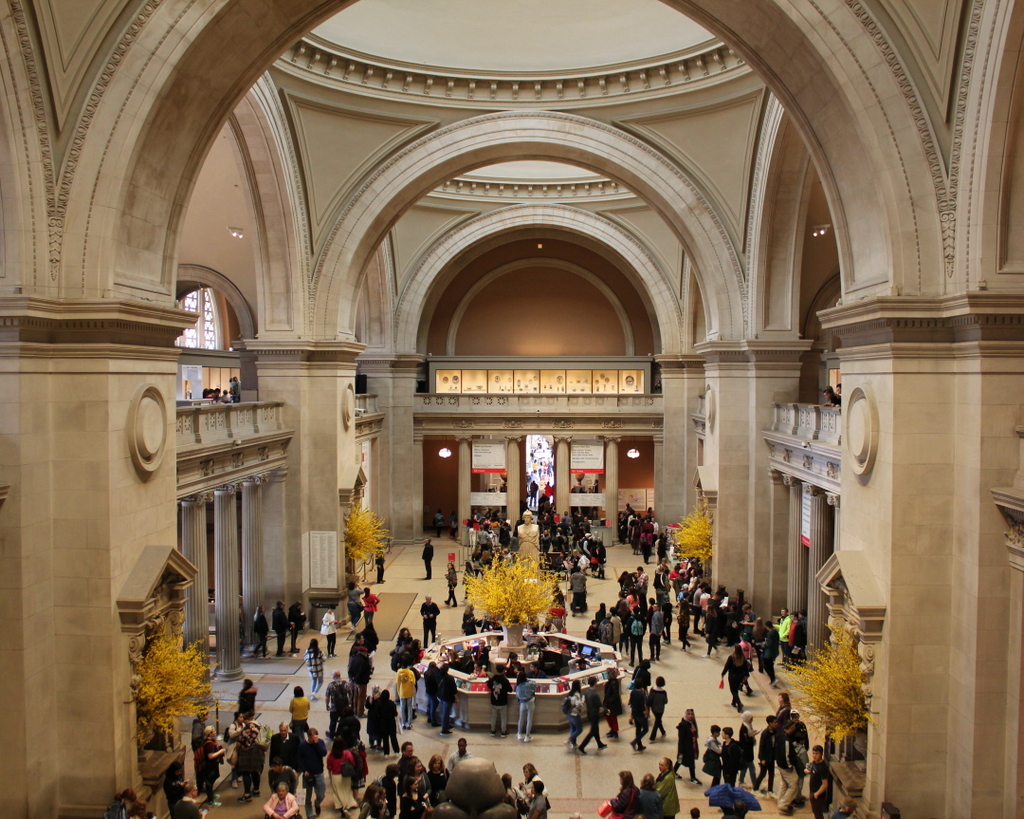
The Great Hall at the 82nd Street entrance

The stretch of 5th Avenue alongside the Park is known as Museum Mile, and also includes the Frick Collection at 70th Street, the Ukrainian Institute of America at 79th, Neue Galerie New York at 86th, the Solomon R. Guggenheim Museum at 88th, the Cooper Hewitt Museum at 91st, the Jewish Museum at 92nd, and the Museum of the City of New York and the Hispanic-themed Museo del Barrio, on opposite sides of 104th.

The permanent collection of "The Met" -- not to be confused with the Metropolitan Opera, or its House at Lincoln Center, or Citi Field, home of baseball's New York Mets -- has works of art from all over the world: Ancient Egypt, Greece, Byzantine, Islamic art, Asia and the Pacific Rim. It has encyclopedic collections of musical instruments, costumes, decorative arts, textiles, interior designs, jewelry, weapons and armor.

Among the well-known paintings are Manuel Osorio Manrique de Zúñiga (a.k.a. The Red Boy) by Francisco Goya, Portrait of Madame X by John Singer Sargent, Self-portrait with Straw Hat by Vincent van Gogh, The Card Players by Paul Cézanne, The Gulf Stream by Winslow Homer, and I Saw the Figure 5 in Gold by Charles Demuth.

The Museum also contains works by Michelangelo Caravaggio (usually referred to by his surname, so he's not confused with Michelangelo Buonarotti), Rembrandt van Rijn (usually referred to by his first name), Johannes Vermeer, Eugene Delacroix, Pablo Picasso, and, confusing some, Édouard Manet and Claude Monet.

There are also some noteworthy statues, including a copy of Augustus Saint-Gaudens' nude of the archer goddess Diana. But this is not the version that topped the 1891-1925 version of Madison Square Garden, 56 blocks down 5th Avenue. That one is at the Philadelphia Museum of Art. (You know, the one whose steps Rocky Balboa ran up.) Ironically, it was a Philadelphia art critic who wrote a savage review of the statue.

The Met established the world's first museum shop in 1908, and it's worth a visit all by itself. In 1954, it opened the Grace Rainey Rogers Concert Hall, and the classical concerts staged there proved so successful, they started an art lecture series there in 1956.

Today, The Met is the largest art museum in America, in terms of exhibition space, and the 4th-largest in the world, behind the Louvre in Paris, the State Hermitage Museum in St. Petersburg, and the British Museum in London. It ranks 3rd, behind the British Museum and the Hermitage, in number of objects available to display. It is the 3rd-most-visited museum in the U.S., behind the National Museum of Natural History and the National Gallery of Art, both of them part of the Smithsonian Institution in Washington.

*

April 13, 1870 was a Wednesday. Baseball was the only team sport in North America at the time, and the season hadn't started yet. So there were no scores on this historic day. 

Friday, February 25, 2022

February 26, 1870: New York's 1st Subway

February 26, 1870: New York City gets its 1st Subway system – and most people didn’t know it. Most people still don't know it.

London had developed the world's first urban underground railway in 1863, to relieve crowded street traffic. Clearly, New York already needed it. In 1869, a man named Alfred Ely Beach -- a 43-year-old member of the Yale family and the son of the publisher of the New York Sun newspaper -- was willing to spend his own money to build a subway system.
Imagine that: A rich man offering his own money for the public good, without asking the taxpayers to fund a vanity project for him.

William Tweed, the "Boss" of the City's Democratic political organization, Tammany Hall, who held more power than Mayor Abraham Oakey Hall, decided the project should not go forward. Why? Because it would take passengers off the elevated railways and horse-drawn carriages owned by the City, and thus controlled by Tweed, and thus costing Tweed money.

Beach built his subway in secret, anyway, with a tunneling shield, in just 58 days. The tunnel was 300 feet long, 8 feet in diameter, and run under Broadway from Warren Street to Murray Street. That's one whole block, with City Hall adjacent to the east.

City Hall is bordered by Broadway on the west, Chambers Street on the north, Centre Street on the east, and Park Row on the southeast. Just to the north, on the same grounds, with an address of 52 Chambers Street, is the "Tweed Courthouse," which Tweed had been building since 1861, and it still wasn't finished. The idea was, if construction was ever finished, Tweed couldn't keep skimming money off the costs. (Interestingly, the construction supervisor was Smith Ely Jr., a cousin of Alfred Ely Beach.)

Beach's line was built as a demonstration of a pneumatic transit system, open to the public with a 25-cent fare per person. (About $5.59 in 2022 money, or about twice what the Subway costs now.) Proceeds for the admission went to the Union Home and School for Soldiers' and Sailors' Orphans.

For the public, the project was used as an attraction. It ran only a single car on its one-block-long track to a dead-end at its terminus, and passengers would simply ride out and back, to see what the proposed subway might be like. During its first two weeks of operation, the Beach Pneumatic Transit sold over 11,000 rides, and over 400,000 total rides.

Tweed was arrested for his municipal excesses in 1871, and that halted construction. It was renewed in 1876, and finally finished in 1881. Tweed died in prison in 1878. In 1927, City court proceedings were moved to a new building. The Tweed Courthouse still stands, hosting municipal offices, but no court proceedings.

Beach planned his subway to run about 5 miles, to Central Park. But the Panic of 1873 and the ensuing depression made funding for further construction impossible. Both entrances were sealed. The City, free of Tweed's interference, did adopt a pneumatic mail system based on Beach's ideas, running it until 1953.

Beach continued investing in new technology, helping the innovations of Thomas Edison and Alexander Graham Bell, and inventing he also invented a typewriter for the blind and a system for heating water with solar power. He, his son Frederick Converse Beach, and his son, Stanley Yale Beach, all served as the editor of Scientific American magazine. He died in 1896.

Beach did not live to see the 1st real New York Subway system, which opened in 1904. In 1912, the Beach system was discovered by tunnelers extending a line, with the car and the station's elaborate decorations intact. These items were donated to Cornell University in Ithaca, New York. Sadly, Cornell later reported that they had lost track of the items.

The Beach station was converted into the City Hall station on the R and W Trains. City Hall is also served by the Chambers Street stations on the J and Z Trains, and the Brooklyn Bridge-City Hall station on the 6 Train.
A remainder of the Beach line

Much is made of the original 1904 City Hall station that is intact, but used only on special occasions. But the Beach line is all but forgotten.

*

February 26, 1870 was a Saturday. Baseball was in the off-season. What have become the other major North American sports either didn't exist or barely did. So there were no scores on this historic day.

December 31, 1999 & January 1, 2000: The Millennium

December 31, 1999:  The Millennium arrives. The people of planet Earth survived. At a terrible cost. But we hadn't destroyed ourselves. ...