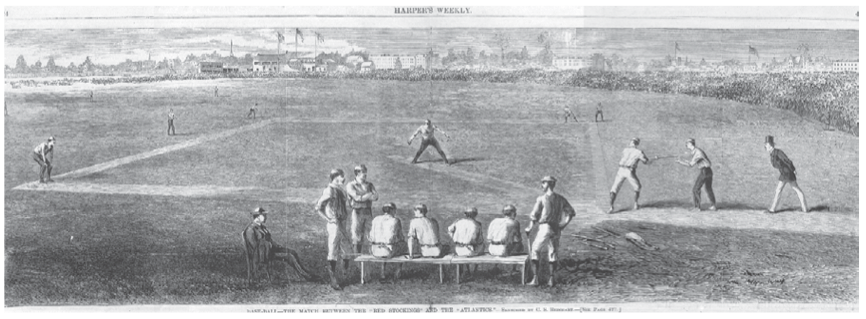
They were to face the top team in the New York area, the Brooklyn Atlantics. The biggest crowd in baseball history to that point, an estimated 20,000, came in to see it.
It was a different world. There really wasn't professional sports at this point. The 1st college football game had been played the previous November in New Jersey, and it was basically a 25-a-side soccer game. Soccer had barely been standardized, with England's Football Association establishing rules in 1863. Hockey was in its infancy. Basketball hadn't been invented yet. Boxing was an "underground" sport. Horse racing was big, as sports went. The Olympic Games weren't even an idea.
Connie Mack, later known as "The Grand Old Man of Baseball," was 7 years old. Jacob Ruppert, who would build Yankee Stadium and the 1st Yankee dynasty, was 2. John McGraw wouldn't be born for another 3 years.
It was June 14, 1870, when the Cincinnati Red Stockings and the Brooklyn Atlantics played the 1st baseball game that could legitimately have been called "The Greatest Game Ever Played."
*
Here were the lineups for this epic game:
Cincinnati
SS George Wright (Hall of Fame)
1B Charlie Gould
3B Fred Waterman
C Doug Allison
CF Harry Wright (Hall of Fame, brother of George, also Captain and manager)
LF Andy Leonard
P Asa Brainard
2B Charlie Sweasy
RF Cal McVey
Brooklyn
SS Dickey Pearce
3B Charlie Smith
1B Joe Start
LF Jack Chapman
C Bob Ferguson (Also Captain, and effectively manager)
P George Zettlein
CF George Hall
2B Lipman Pike
RF Dan McDonald
Leonard was the 1st native of Ireland, and thus the 1st Irish-American, to play professional baseball. "Lip" Pike is believed to be the 1st Jewish player of any renown.
A couple of notes on nicknames. In this era when all pitching truly was "pitching," underhanded, rather than "throwing," overhanded, Brainard was so good at pitching, other teams began to call their best pitcher "our Asa," and thus, the term "ace" to mean a top pitcher was born.
And Ferguson, who could play any position, was so good defensively that he became known as "Death to Flying Things." (This would later be reflected in "Shoeless" Joe Jackson, when his contemporary Ty Cobb called him the best left fielder he ever saw, and Jackson's glove "the place where triples go to die.")
The Red Stockings scored 2 runs in the 1st inning and 1 more in the 3rd, and held that 3-0 lead going to the bottom of the 4th. But the Atlantics scored 2 runs in the 4th, and 2 more in the 6th, taking a 4-3 lead. The Red Stockings scored 2 in the top of the 7th, to retake the lead, 5-4. The Atlantics tied it up in the bottom of the 8th.
At the end of the 9th inning, it was still 5-5. The Atlantics were willing to accept the tie. The Red Stockings demanded that the game be played until somebody won. This would prove to be their undoing.
Neither team scored in the 10th inning. In the top of the 11th, the Red Stockings scored 2 runs, and with the 7-5 lead, it looked like they would emerge victorious.
But Brainard tired in the bottom of the 11th. He allowed a leadoff hit to Smith. Then Start hit a shot to right field that McVey couldn't reach. He chased it, and it rolled into the crowd. Newspaper accounts suggest that a fan, clearly a native and rooting for Brooklyn, jumped on McVey's back. McVey got rid of him, but by the time he threw the ball back to the infield, Smith had scored, and Start was on 3rd base with the tying run and nobody out.
(Don't blame the antique conditions: With a real fence, he might have been able to hold Smith to 3rd and McVey to 2nd, but that doesn't mean those runs wouldn't have eventually scored anyway.)
Brainard got Chapman out. But Ferguson singled Start home to make it 7-7. Zettlein got a hit, making it 1st and 2nd with just 1 out. A double play had saved Cincinnati in the previous inning and kept the score level, so maybe that could happen again.
And it looked like it would, as Hall grounded to short. George Wright had redefined the position, setting a standard for playing shortstop that would stand until Honus Wagner came along 30 years later. This time, however, he rushed his throw to 2nd, and Sweasy couldn't reach it. Ferguson heard the crowd roar as he approached 3rd, and ran home with the winning run. Atlantics 8, Red Stockings 7.
Covering the game for the New York Sun, an unidentified correspondent wrote, "The yells of the crowd could be heard for blocks around and a majority of the people acted like escaped lunatics."
Aaron Champion, president of the Red Stockings organization, sent a telegram back to Cincinnati:
Brooklyn 8, Red Stockings 7. The finest game ever played. Our boys did nobly, but fortune was against us. Eleven innings played. Though beaten, not disgraced.
It was the Game of the Century -- the 19th Century.
*
With their aura of invincibility shattered, fans stopped coming to see the Red Stockings. They folded at the end of the season.
With their aura of invincibility shattered, fans stopped coming to see the Red Stockings. They folded at the end of the season.
In 1871, Harry Wright took some of the players, including his brother George, to Boston, where he formed a new team, the Boston Red Stockings, in a new league, the 1st professional baseball league, the National Association.
The Red Stockings won the Pennant in 1872, 1873, 1874 and 1875. While their earlier success in Cincinnati helped to make the sport popular from coast to coast, their new domination was one of the factors that caused interest in the NA to drop.
In 1876, the National League was formed, with standardized scheduling, meaning that any team that chose not to play out its schedule would be kicked out of the league. This has led some to consider the NL "the first major league," and dismiss inclusion of the NA as such. With the NL's founding, some of the Boston players, including their ace pitcher, future sporting goods magnate Al Spalding, went west to Chicago, and joined the Chicago White Stockings.
The Red Stockings won the Pennant in 1872, 1873, 1874 and 1875. While their earlier success in Cincinnati helped to make the sport popular from coast to coast, their new domination was one of the factors that caused interest in the NA to drop.
In 1876, the National League was formed, with standardized scheduling, meaning that any team that chose not to play out its schedule would be kicked out of the league. This has led some to consider the NL "the first major league," and dismiss inclusion of the NA as such. With the NL's founding, some of the Boston players, including their ace pitcher, future sporting goods magnate Al Spalding, went west to Chicago, and joined the Chicago White Stockings.
By 1912, the Boston Red Stockings were known as the Boston Braves. They have moved twice, becoming the Milwaukee Braves in 1953 and the Atlanta Braves in 1966. The Chicago White Stockings became known as the Chicago Cubs in 1903. And each of these teams had their name taken by founding members of the American League: The Boston Red Sox and the Chicago White Sox.
As for the Atlantics: They joined the NA, but were not very successful playing against other professional teams, and folded with the NA after the 1875 season. In 1883, a new team was formed, the Brooklyn Grays. They would also be nicknamed the Bridegrooms, the Superbas and the Robins. By 1911, the notion of Brooklynites as "trolley dodgers" earned the team a name that stuck, the Brooklyn Dodgers. They moved after the 1957 season, becoming the Los Angeles Dodgers. There are some people who consider the L.A. team the direct descendant of the Brooklyn Atlantics, but that is a bit of a stretch.
George Wright was the last survivor of the 1869-70 Red Stockings, living until 1937. The last survivor of the 1870 Atlantics was Joe Start, who lived until 1927.
The Capitoline Grounds didn’t last beyond the 1880 season. Today, the site is residential, mostly brownstones along Hancock Street and Marcy Avenue, in the Bedford-Stuyvesant section of Brooklyn. It should be safe to visit in daylight.
As for the Atlantics: They joined the NA, but were not very successful playing against other professional teams, and folded with the NA after the 1875 season. In 1883, a new team was formed, the Brooklyn Grays. They would also be nicknamed the Bridegrooms, the Superbas and the Robins. By 1911, the notion of Brooklynites as "trolley dodgers" earned the team a name that stuck, the Brooklyn Dodgers. They moved after the 1957 season, becoming the Los Angeles Dodgers. There are some people who consider the L.A. team the direct descendant of the Brooklyn Atlantics, but that is a bit of a stretch.
George Wright was the last survivor of the 1869-70 Red Stockings, living until 1937. The last survivor of the 1870 Atlantics was Joe Start, who lived until 1927.
The Capitoline Grounds didn’t last beyond the 1880 season. Today, the site is residential, mostly brownstones along Hancock Street and Marcy Avenue, in the Bedford-Stuyvesant section of Brooklyn. It should be safe to visit in daylight.
June 14, 1870 was a Tuesday. I can find no record of any other scores on this historic day.


No comments:
Post a Comment