Showing posts with label celtic fc. Show all posts

Friday, November 4, 2022

November 4, 1977: Rod Stewart & The Ramones

November 4, 1977: Rod Stewart releases Foot Loose and Fancy Free. It includes "You're In My Heart," which hits Number 3 in his native Britain, Number 4 in America, and Number 1 in Canada and Australia. Steve "the Colonel" Cropper of Booker T. & The M.G.'s plays lead guitar on it.

Of this song, "Rod the Mod" said, "It's about 3 women, 2 football teams, and a country, Scotland."
Although born in London, his ancestry is entirely Scottish, and, as we would say today, he identifies as Scottish.

Of the 3 women, he has only publicly identified 1: Swedish actress Britt Ekland, with whom he'd recently broken up. The year before, he'd hit Number 1 in the U.S. with "Tonight's the Night (Gonna Be Alright)," on which Ekland can be heard speaking French at the end. Apparently, another of the women who inspired "You're in My Heart" was "a big-bosomed lady with a Dutch accent." (Theoretically, this could have been Mariska Veres, the Dutch singer who led the band The Shocking Blue, who hit Number 1 with "Venus" in 1970. But, as far as I know, she and Rod never met.)

The football (soccer) teams are definitely known: Celtic Football Club of Glasgow, and Manchester United, dominant teams in Scotland and England, respectively, as his music career was beginning in the 1960s. Celtic were the 1st British team to win the European Cup (the tournament now known as the UEFA Champions League), in 1967; Man United, the 1st English team to do so, in 1968.

I am of the firm belief that, while there have been better singers in rock and roll, nobody sings a rock and roll song better than Rod Stewart.

Foot Loose and Fancy Free is the best album released on this day. But it is not the most influential. On the same day, The Ramones released Rocket to Russia, which includes "Sheena is a Punk Rocker" and the closest thing the Queens-based band would ever have to a hit single, "Rockaway Beach," which hit Number 48 on Billboard magazine's Hot 100 chart.
UPDATE: It took me until 2024 to think of this, but the 1970s were Schrödinger's Decade. There was too much overwrought music, and, at the same time, not enough of it.

*

November 4, 1977 was a Friday. This was also the day that The Incredible Hulk premiered as a 2-hour "backdoor pilot" TV-movie on CBS. I have a separate entry for that event.

Baseball season was over. Football was in midweek. There were 9 games played in the NBA:

* The New York Knicks beat the Seattle SuperSonics, 95-92 at the Seattle Center Coliseum.

* The New Jersey Nets lost to the Philadelphia 76ers, 107-104 at the Rutgers Athletic Center (now the Jersey Mike's Arena) in Piscataway, New Jersey. Bernard King scored 41 points for the Nets, but the Sixers had a better team effort, getting 29 from Doug Collins, 21 from George McGinnis, 17 from Darryl Dawkins, 14 from Lloyd Free (later to rename himself World B. Free), and 11 from the man the 1974 and 1976 ABA Champion Nets had to let go just to be able to afford the NBA's entry fee, Julius "Dr. J" Erving.

* The Denver Nuggets beat the Boston Celtics, 109-107 at the Boston Garden.

* The Washington Bullets beat the Phoenix Suns, 113-96 at the Capital Centre in the Washington suburb of Landover, Maryland.

* The New Orleans Jazz beat the Golden State Warriors, 105-102 at the Superdome in New Orleans.

* The Buffalo Braves beat the Chicago Bulls, 100-92 at the Chicago Stadium.

* The Milwaukee Bucks beat the Houston Rockets, 110-108 at the Milwaukee Exposition, Convention Center and Arena, or "The MECCA." Since 2014, it has been named the UW-Panther Arena.

* The Atlanta Hawks beat the Kansas City Kings, 111-110 at the Kemper Arena (now the Hy-Vee Arena) in Kansas City.

* And the Los Angeles Lakers beat the Indiana Pacers, 111-99 at The Forum outside Los Angeles in Inglewood, California.

There were 2 NHL games played that night. The New York Rangers beat the Vancouver Canucks, 5-1 at the Pacific Coliseum in Vancouver. And the Atlanta Flames beat the Pittsburgh Penguins, 5-2 at The Omni in Atlanta.

And there were 4 games played in the World Hockey Association:

* The New England Whalers beat the Cincinnati Stingers, 4-3 at the Hartford Civic Center (now the PeoplesBank Arena).

* The Winnipeg Jets beat the Birmingham Bulls, 4-2 at the Birmingham-Jefferson Civic Center in Birmingham, Alabama.

* The Quebec Nordiques beat the Houston Aeros, 7-6 at The Summit in Houston. (The arena has since been converted into the Central Campus of the Lakewood Church, Dr. Joel Osteen's "megachurch.")

* And the Edmonton Oilers beat the Indianapolis Racers, 3-1 at the Northlands Coliseum in Edmonton.

Wednesday, October 19, 2022

October 19, 1963: "You'll Never Walk Alone" Is First Played at Anfield

October 19, 1963: The Gerry & the Pacemakers version of "You'll Never Walk Alone" is played at Anfield, home stadium of Liverpool Football Club, for the first time. It became a team tradition.

The song, with music by Richard Rodgers and lyrics by Oscar Hammerstein II, first appeared in 1945, in the Broadway musical Carousel, sung by Christine Johnson as Nettie Fowler, and later by John Raitt (father of rock music legend Bonnie Raitt) as Billy Bigelow, Jan Clayton as his wife Julie, and Bambi Linn as their daughter Louise.

The musical was made into a film in 1956. Gordon MacRae played Billy, Shirley Jones played Julie, Susan Luckey played Louise, Claramae Turner played Nettie, and Gene Lockhart played the Starkeeper and the doctor.

"You'll Never Walk Alone" became a standard. Jerry Lewis would use it to close his annual Labor Day telethon for research into muscular dystrophy and related conditions. Elvis Presley made it a mainstay of his live performances from his Las Vegas debut in 1969 until his death in 1977.

In 1963, Liverpool rock band Gerry & The Pacemakers recorded a version of it. In the 1960s, at Anfield, the home stadium of Liverpool F.C., games would be preceded by the public address system playing the Top 10 songs in the country. "You'll Never Walk Alone" debuted in the Top 10 on October 19, 1963, and so it was played at Anfield for the 1st time. Liverpool beat West Bromwich Albion, of the Birmingham area, 1-0 on a goal by Gordon Milne in the 32nd minute.
A recent photo of Anfield, seriously added-onto

Liverpool's other major team, Everton, who had won the League the previous season, traveled to the East End of London on this day, and lost to West Ham United, 4-2 at Upton Park. Everton fans would become sick of the song, and one of their fans' slogans is "I'd rather walk alone."

The Pacemakers were the 2nd-biggest band in Liverpool at the time, behind The Beatles, but their version of "YNWA" never became a hit in the song's country of origin, not even in the "British Invasion" year of 1964, when The Beatles caught fire in America and pretty much every other British band that was even remotely good followed them. The Pacemakers had a few songs reach the American charts, most notably "Don't Let the Sun Catch You Crying" and "How Do You Do It" in 1964, and "Ferry Cross the Mersey" (from the film of the same title) in 1965. But not "YNWA."

It did, however, hit Number 1 in Britain. But when it fell out of the Top 10, Liverpool fans demanded that it be played at Anfield, anyway, just before the team walked onto the pitch. This was done, and Liverpool, managed by Bill Shankly, won the Football League in 1964.

After that, in England, the song was considered a good-luck charm by fans of the Mersey Reds, and was irrevocably tied to the team. After the Hillsborough Disaster of 1989, the words of the song gave hope to a grieving city. The words "YOU'LL NEVER WALK ALONE" are now cast in iron atop the Shankly Gates leading into Anfield.

Most Liverpool fans don't even realize that the song debuted on Broadway, in New York, in America, during the waning days of World War II.

Fans of Celtic Football Club in Glasgow, Scotland also took it up. Like Liverpool fans, they sing it before every game, and after every win. In 2003, the teams faced each other in the UEFA Cup Quarterfinal, and Pacemakers singer Gerry Marsden was invited to sing it on the pitch before the game. He did so, wearing one of those "half scarves" produced before international matches with logos of both teams. Another British rocker, Rod Stewart, also attended, supporting Celtic.
Oscar Hammerstein died in 1960, having never learned of his song's connection with Liverpool. Richard Rodgers lived until 1979, and if he ever knew of the connection, he never made a public statement about it. Gerry Marsden died in 2021.

*

October 19, 1963 was a Saturday. North London team Arsenal traveled to Birmingham, and lost to Aston Villa, 2-1 at Villa Park.

In American football, among the college games played that day were these:

* Number 1 Texas beat Arkansas, 17-13 at War Memorial Stadium in Little Rock, Arkansas. Texas went on to win the Southwest Conference Championship.

* Number 2 Wisconsin beat Iowa, 10-7 at Iowa Stadium (now Kinnick Stadium) in Iowa City.

* Number 3 Pittsburgh beat West Virginia, 13-10 at the old Mountaineer Field in Morgantown, West Virginia. This is a rivalry known as "The Backyard Brawl."

* Number 4 Ohio State were upset by the University of Southern California (USC), 32-3 at the Los Angeles Memorial Coliseum. No, this was not the Rose Bowl game. And when that game was played, neither of these teams would be in it.

* Number 5 Mississippi beat Tulane, 21-0 at Tulane Stadium in New Orleans. "Ole Miss" went on to win the Southeastern Conference title.

* Number 6 Oklahoma beat Kansas, 21-18 at Owen Field in Norman, Oklahoma.

* Number 7 Illinois beat Minnesota, 16-6 at Memorial Stadium in Champaign, Illinois. With running back Jim Grabowski, and center and linebacker Dick Butkus, Illinois won the Big Ten Conference title.

* Number 8 Georgia Tech were upset by Auburn, 29-21 at Grant Field in Atlanta.

* Number 9 Alabama beat Tennessee, 35-0 at Legion Field in Birmingham, Alabama. Alabama didn't win the SEC title, but they didn't play Ole Miss. So those teams were matched up in the Sugar Bowl, the traditional home for the season's SEC Champion, and Alabama won. In fiction, that would have been the last game for 'Bama for running back Forrest Gump.

* Number 10 Navy beat the Virginia Military Institute (VMI), 21-12 at Foreman Field in Norfolk, Virginia. This was the annual Oyster Bowl game, which has featured Navy 10 times and VMI 16 times. These days, though, it's a game for FCS (formerly Division I-AA) teams, like the school for which Foreman Field, now named S.B. Ballard Stadium, is the home field, Old Dominion University. Although it was in VMI's home State, Norfolk, is home to America's largest naval base, so it felt more like a home field for Navy.

Navy were quarterbacked by Roger Staubach, who went on to win the Heisman Trophy, and rose to Number 2 in the country. Through the 2021 season, no service academy team has finished in the Top 10 since. They played Number 1 Texas for the National Championship in the Cotton Bowl, but Texas won.

* The University of Washington, then unranked, beat Stanford, 19-11 at Husky Stadium in Seattle. Washington went on to win the title in the American Association of Western Universities (AAWU, a forerunner of what's now the Pac-12), and beat Illinois in the Rose Bowl.

* Army beat Wake Forest, 47-0 at Michie Stadium in West Point, New York.

* Notre Dame beat UCLA, 27-12 at Notre Dame Stadium in South Bend, Indiana.

* In a rivalry game, North Carolina beat North Carolina State, 31-10 at Kenan Stadium in Chapel Hill, North Carolina.

* And among New Jersey teams, Rutgers beat Lehigh, 30-6 at Rutgers Stadium in Piscataway; while Princeton beat Colgate, 42-0 at Palmer Stadium in Princeton.

Neither the NFL nor the AFL played any games that day. But in Middlesex County, New Jersey, East Brunswick High School, which would one day be my Alma Mater, beat Bridgewater-Raritan, 27-21 at home, on a field that had no name, roughly where the school's practice field now is. Its stadium, later named Jay Doyle Field, wouldn't be built until 1965.

Baseball season had ended 13 days earlier, when the Los Angeles Dodgers completed a sweep of the New York Yankees in the World Series. There were 4 games played in the NBA:

* The New York Knicks lost to the Cincinnati Royals, 121-97 at the Cincinnati Gardens.

* The Detroit Pistons beat the Philadelphia 76ers, 124-121 at the Philadelphia Civic Center. This was only the 2nd regular-season game for the Sixers, and the 1st at home, after moving from being the Syracuse Nationals. I have a separate entry for that event. 

* The San Francisco Warriors beat the Baltimore Bullets, 103-102 at the Baltimore Civic Center (now the CFG Bank Arena). Walt Bellamy scored 36 points and grabbed 17 rebounds for the Bullets, who were played just their 3rd regular-season since moving from being the Chicago Zephyrs, and only their 2nd home game. They would last just 10 years before moving down Interstate 95, becoming the Washington Bullets, and eventually the Washington Wizards.

* And the St. Louis Hawks beat the Los Angeles Lakers, 117-108 at the Kiel Auditorium in St. Louis.

There were 2 games played in the NHL. The Montreal Canadiens beat the Boston Bruins, 2-0 at the Montreal Forum. And the Toronto Maple Leafs beat the Detroit Red Wings, 2-1 at Maple Leaf Gardens in Toronto. The New York Rangers and the Chicago Black Hawks were not scheduled.

Monday, October 17, 2022

October 17, 1987: The Old Firm's "Shame Game"

October 17, 1987: What might be the nastiest match in the history of what might be the world's nastiest sports rivalry takes place. It became known as "The Shame Game."

Rangers Football Club was founded in 1872, as a soccer team for the Protestant citizens of Glasgow, Scotland. Their arch-rivals are Celtic Football Club, a team founded in 1888, by and for Irish Catholics living in Glasgow. The former's Ibrox Stadium, on the west side of Glasgow, and the latter's Celtic Park, on the east side, are separated by just 5 miles -- but, Cliché Alert: They might as well be on opposite sides of the world.

These 2 teams -- Rangers, in blue shirts, like their counterparts in New York hockey and Texas baseball; and Celtic, in green and white stripes, giving them the nickname "The Hoops" -- have dominated Scottish soccer, and, together, are known as "The Old Firm."

But perhaps no 2 teams in all of sport hate each other as much, because religion is thrown into the mix. It has made both teams much bigger than they ordinarily would have been. Celtic, not the University of Notre Dame, are the most famous Catholic-themed sports team in the world. They, not Notre Dame and not the Boston Celtics, are the most famous Irish-themed sports team in the world. They can call upon that heritage in ways that Rangers have tried to do with the world's Protestants, but just can't.

This game, at Ibrox, followed a 1-0 Celtic win at Celtic Park on August 29, and was truly nasty. An altercation after 17 minutes between Celtic's Frank McAvennie and Rangers goalkeeper Chris Woods resulted in both being shown red cards, thus getting sent off. Rangers defenders Terry Butcher and Graham Roberts were also involved, with Butcher receiving a yellow card for dissent. This was a time when teams were limited to naming 2 possible substitutes, and didn't use one of them on a goalkeeper, resulting in position players having to occasionally take the goalie's place, as Roberts did in this case.

Andy Walker scored in the 33rd minute, and an own goal by Butcher 2 minutes later made it 2-0 Celtic. Things got worse for Rangers early in the 2nd half, when Butcher received a 2nd yellow card, resulting in a sendoff, and Rangers were down to 9 men. But in the 65th minute, Ally McCoist, perhaps Rangers' greatest player ever, scored to pull them to within 2-1. And in the 90th minute, Richard Gough tied it up.

After the final whistle, Roberts walked over to the fans, and waved his fans, who took this to mean he was "conducting" their singing; songs which included anti-Catholic chants, infuriating the Celtic fans.

Three days later, the Procurator Fiscal ordered a Police enquiry into the events of the match. The Rangers trio of Woods, Butcher and Roberts, and Celtic's McAvennie, were later charged with breach of the peace, and appeared at Court. After a trial lasting several days, Butcher and Woods were convicted and fined, Roberts was found "not proven" (a verdict that exists in courts in Scotland, but not in "England and Wales" or in the United States), and McAvennie was found not guilty.

The teams usually play on or close to New Year's Day, and on January 2, 1988, Celtic won 2-0 at Celtic Park. On March 20, they played at Ibrox again, and Celtic won, 2-1. Celtic won the title with 72 points, 10 ahead of Edinburgh-based Heart of Midlothian (a.k.a. "Hearts"), and 12 ahead of Rangers. Celtic also won the Scottish Cup, beating Dundee United in the Final. Rangers fans had to be content with the Scottish League Cup, including a Final win over Aberdeen.

*

October 17, 1987 was a Saturday. Game 1 of the World Series was played, the 1st Series game ever played indoors. Dan Gladden and Steve Lombardozzi backed Frank Viola with home runs, and the Minnesota Twins beat the St. Louis Cardinals, 10-1 at the Metrodome in Minneapolis.

By a weird turn of events, the song "U Got The Look" peaked at Number 2 n Billboard magazine's Hot 100 singles chart on this date. The song was written and performed by Prince, a Minneapolis native, and contains the line, "Boy versus girl in the World Series of love."

Among the college football games played on the day were these:

* Number 1 Oklahoma beat Kansas State, 59-10 at KSU Stadium (now Bill Snyder Family Stadium) in Manhattan, Kansas. Oklahoma had an undefeated regular season, and won the Big 8 Conference title.

* Number 2 Nebraska beat Number 12 Oklahoma State, 35-0 at Lewis Field (now Boone Pickens Stadium) in Stillwater, Oklahoma. Nebraska were undefeated and ranked Number 1, until November 21, when they lost to Number 2 Oklahoma, costing them the Big 8 title and a shot at the National Championship. They were invited to the Fiesta Bowl, anyway.

* Number 3 University of Miami had the week off. They were then an independent, and thus ineligible for any Conference Championship. The season before, they had gone into the Fiesta Bowl at Number 1, but lost the National Championship to Number 2 Penn State. This time, they again went undefeated in the regular season, were ranked Number 2, played in the Orange Bowl, at their home venue, the Orange Bowl stadium, and beat Number 1 Oklahoma to win the National Championship.

* Number 4 Florida State beat the University of Louisville, 32-9 at Doak Campbell Stadium in Tallahassee, Florida. Florida State were then an independent, and thus ineligible for any Conference Championship. Two weeks earlier, they had lost to the University of Miami, costing them a shot at the National Championship. They were invited to the Fiesta Bowl, where they beat Nebraska.

* Number 5 Auburn beat Georgia Tech, 20-10 at Grant Field in Atlanta. Auburn had been tied by Tennessee 3 weeks earlier, and would lose a non-conference game to Florida State 3 weeks later. But they still went undefeated in Southeastern Conference play, and thus won the league title.

* Number 6 Louisiana State University beat Kentucky, 34-9 at Tiger Stadium in Baton Rouge, Louisiana. A loss to Alabama 3 weeks later cost them the SEC title and a shot at the National Championship.

* Number 7 Clemson beat Duke, 17-10 at Memorial Stadium in Clemson, South Carolina. Clemson won the Atlantic Coast Conference title.

* Rivalry: Number 8 Tennessee were upset by Alabama, 41-22 at Legion Field in Birmingham, Alabama. This loss in their annual 3rd Saturday in October contest with 'Bama cost Tennessee a shot at the SEC title, and they ended up going to the Peach Bowl, where they beat Indiana.

* Number 9 UCLA beat Number 16 Oregon, 41-10 at the Rose Bowl in the Los Angeles suburb of Pasadena, California.

* Number 10 Penn State were upset by Number 13 Syracuse, 48-21 at the Carrier Dome (now the JMA Wireless Dome) in Syracuse, New York. Syracuse were an independent, so there was no Conference Championship for them to win. But they were undefeated in the regular season, and were invited to the Sugar Bowl, where they played Auburn to a tie. Nevertheless, they went into that game at Number 4, and would not have had a chance at the National Championship. Penn State were invited to the Florida Citrus Bowl, and lost to Clemson.

* Rivalry: Number 15 Arkansas were upset by Texas, 16-14 at War Memorial Stadium in Little Rock, Arkansas.

* Number 19 Michigan State beat Northwestern, 38-0 at Ryan Field in the Chicago suburb of Evanston, Illinois. (Due to force of habit, I originally typed that as "the Chicago cuburb.")

* The University of Southern California beat the University of Washington, 37-23 at Husky Stadium in Seattle. Neither team was ranked at the time. USC won the Pacific-10 Conference title. Michigan State pulled off a rare feat in college football, even rarer in those pre-Playoff, pre-BCS days: They beat a team twice in one season, opening the year by beating USC, and ending it by beating them again in the Rose Bowl.

* Rivalry: North Carolina beat North Carolina State, 17-14 at Carter-Finley Stadium in Raleigh, North Carolina.

* Texas A&M, then unranked, beat Baylor, 34-10 at Baylor Stadium (later Floyd Casey Stadium) in Waco, Texas. A&M went on to win the Southwest Conference, and beat Notre Dame in the Cotton Bowl.

* Among the service academies, Army lost to Colgate, 22-20 at Michie Stadium in West Point, New York; Navy beat the University of Pennsylvania, 38-28 at Franklin Field in Philadelphia; and Air Force lost to Number 11 Notre Dame, 35-14 at Falcon Stadium in Colorado Springs, Colorado.

* And Rutgers beat Boston College, 38-24 at the old Rutgers Stadium in Piscataway, New Jersey.

The NBA season hadn't started yet. There were 9 games in the NHL:

* The New York Rangers lost to the Washington Capitals, 4-3 at the Capital Centre in the Washington suburb of Landover, Maryland.

* The New York Islanders lost to the Philadelphia Flyers, 4-3 at the Nassau Coliseum.

* The New Jersey Devils lost to the Hartford Whalers, 4-3 at the Hartford Civic Center (now the PeoplesBank Arena). Sylvain Turgeon, who would play the 1989-90 season with the Devils, scored the winning goal for the Whalers, with 1:01 left in overtime.

* The Buffalo Sabres beat the Quebec Nordiques, 6-3 at the Colisée de Québec.

* The Montreal Canadiens beat the Pittsburgh Penguins, 3-2 at the Montreal Forum.

* In an "Original Six" matchup, the Toronto Maple Leafs beat the Detroit Red Wings, 7-4 at Maple Leaf Gardens in Toronto.

* The Winnipeg Jets beat the Minnesota North Stars, 5-2 at the Metropolitan Sports Center in the Minneapolis suburb of Bloomington, Minnesota.

* The Chicago Blackhawks beat the St. Louis Blues, 3-2 at the St. Louis Arena.

* And the Edmonton Oilers beat the Boston Bruins, 4-3 at the Northlands Coliseum in Edmonton. This turned out to be a preview of the Stanley Cup Finals, where the Oilers swept the Bruins.

Saturday, September 10, 2022

September 10, 1985: The Death of Jock Stein

September 10, 1985: The Scotland soccer national team gets a late equalizer to tie Wales, in a World Cup qualifying match at Ninian Park in Cardiff. But at the end of the game, Scotland manager John "Jock" Stein suffers a heart attack and dies. He was 62 years old.

Stein -- pronounced "Steen," not "Stine" -- was born on October 5, 1922 in Burnbank, Lanarkshire, Scotland. Like many Scots, especially those named John, he was nicknamed "Jock." After years of playing centre half with Coatbridge side Albion Rovers, and an ill-fated season with Llanelli Town in Wales, in 1951 he signed with Celtic of Glasgow, and helped them win the Scottish Football League title in 1954.

He managed Dunfermline Athletic to the 1961 Scottish Cup, and spent some time at Hibernian of Edinburgh, before Celtic hired him as manager in 1965. He managed them to 9 consecutive Scottish Football League titles, 1966 to 1974, and a 10th in 1977. He led them to 8 Scottish Cups from 1965 to 1977. He managed them to 6 Scottish League Cups from 1966 to 1975.

In 1967, he became the 1st manager of a British team, and the 1st British manager, to win the European Cup, as Celtic beat Internazionale Milano in the Final, at Portugal's National Stadium in Lisbon, earning them the nickname the Lisbon Lions. As Celtic also won all 3 domestic trophies, they became the 1st, and remain the only, side in European history to win such a Quadruple.

Like Brian Clough, he was a successful manager who nonetheless managed very briefly at Leeds United -- each man managing the Yorkshire club for just 44 days. He managed Scotland briefly in 1965, and was hired to manage the national side again in 1978. He got them into the 1982 World Cup. In 1985, managing a Home Nations match against Wales at Ninian Park in Cardiff, which ended in a 1-1 draw, he suffered a heart attack, and died in the dressing room. He was only 62.

A stand at Celtic Park was named in his memory, and a statue of him holding the European Cup stands outside. He was posthumously elected to the Scottish Football Hall of Fame.

A stand at Celtic Park in Glasgow is named for him, and a statue of him stands outside. (And that's pronounced "Steen," not "Styne.")

*

September 10, 1985 was a Tuesday. These Major League Baseball games were played:

* The New York Yankees beat the Milwaukee Brewers, 13-10 at Milwaukee County Stadium. The Yankees got home runs from Dan Pasqua, Ron Hassey and Ken Griffey Sr. Dave Winfield went 1-for-4. Don Mattingly went 1-for-5 with 3 RBIs. Rickey Henderson went 1-for-4 with a walk and 3 RBIs. For the Brewers, Robin Yount did not play, but Paul Molitor went 2-for-5 with an RBI.

Ed Whitson was the winning pitcher, but, due to manager Billy Martin being a psychopath, didn't win another game that season.

* The New York Mets beat the St. Louis Cardinals, 5-4 at Busch Memorial Stadium in St. Louis. Ron Darling outpitched Danny Cox, and Howard Johnson hit a home run.

* A doubleheader was split at Fenway Park in Boston. The Baltimore Orioles won the opener, 7-5. Mike Young hit 2 home runs for the O's. The Boston Red Sox won the nightcap, 5-3. Over the 2 games, Eddie Murray went 2-for-8 with a home run, a walk and 2 RBIs; Cal Ripken went 3-for-7 with 2 walks; and Wade Boggs went 6-for-8 with a walk.

* The Philadelphia Phillies beat the Montreal Expos, 5-2 at Veterans Stadium in Philadelphia. Mike Schmidt won the game with a home run in the bottom of the 11th inning.

* The Los Angeles Dodgers swept the Atlanta Braves, 10-1 and 10-4 at Atlanta-Fulton County Stadium.

* The Pittsburgh Pirates beat the Chicago Cubs, 2-1 at Three Rivers Stadium in Pittsburgh.

* The Toronto Blue Jays beat the Detroit Tigers, 2-1 at Exhibition Stadium in Toronto.

* The San Diego Padres beat the Cincinnati Reds, 3-2 at Riverfront Stadium in Cincinnati. Tony Gwynn went 2-for-4. Reds player-manager Pete Rose went 0-for-4, letting down a crowd of 51,045. The next day, he got his 4,192nd career hit, breaking what had officially been the all-time hits record.

* The Chicago White Sox beat the Minnesota Twins, 7-2 at Comiskey Park in Chicago.

* The Houston Astros beat the San Francisco Giants, 4-1 at the Astrodome in Houston.

* The Kansas City Royals beat the California Angels, 6-0 at Anaheim Stadium (now Angel Stadium of Anaheim). Charlie Liebrandt pitched a 3-hit shutout. George Brett went 2-for-4. Neither Reggie Jackson nor Rod Carew, in his last full month as an active player, got into the game.

* The Oakland Athletics beat the Texas Rangers, 10-3 at the Oakland Coliseum.

* And the Cleveland Indians beat the Seattle Mariners, 8-5 at the Kingdome in Seattle.

Friday, August 19, 2022

August 20, 1892: Celtic Park Opens

August 20, 1892: Celtic Park opens in the Parkhead neighborhood, on the East Side of Glasgow. It is the most honored stadium in Scotland.

It was actually the 2nd stadium with the name. The Celtic Football Club was founded in 1888, as an advocacy group for poor people of Irish descent in Glasgow. As the team's success grew, winning 52 League Championships and 40 Scottish Cups through the 2021-22 season, and the 1967 European Cup (forerunner of the UEFA Champions League), Celtic became, far beyond America's Boston Celtics basketball team and the University of Notre Dame "Fighting Irish" football team, the most popular sports team among the world's Irish diaspora.

(UPDATE: As of the 2025-26 season, the count is 56 League titles and 43 Scottish Cups.)

And Celtic Park became known as "Paradise." It gained lights in 1957. The Taylor Report, written in the wake of the 1989 Hillsborough Disaster, mandated that all British stadiums be converted to all-seaters, and Scotland was not permitted to allow exceptions. This led to a redevelopment, so crowds like the record of 83,500 to see their New Year's Day 1938 win over Glasgow arch-rivals Rangers were no longer possible, limiting them to 34,000 seats -- had they simply put seats where there had previously been only terraces, without building new stands.

In the Summer of 1994, the North End "Jungle," East Terracing and West Terracing were demolished, with only the structure of the Main Stand left intact. Celtic played their home games at Hampden Park during the 1994-95 season. The North Stand, the Main Stand (south), and a temporary West Terrace were ready for the 1995-96 season. The East Stand was ready for 1996-97. And in 1998, the new Jock Stein Stand, named for their greatest manager (and also a very good player), opened on the west. Capacity is 60,411. What had been "Paradise Lost" had been regained.

*

August 20, 1892 was a Saturday. In America, professional sports was pretty much limited to baseball's National League, and these games were played:

* The New York Giants split a doubleheader with the Cleveland Spiders, at League Park in Cleveland. The Giants won the opener, 6-4. The Spiders won the nightcap, 3-2. The Spiders were 1 of the 4 teams the NL consolidated out of existence after the 1899 season, making the American League team known for most of its existence as the Cleveland Indians possible. This version of League Park would be their home from 1901 to 1909, before a replacement of the same name opened on the site in 1910, and was used until 1946.

* The Brooklyn Bridegrooms, so named because several players had gotten married in a single off-season a few years earlier, beat the Chicago Colts, 9-6 at South Side Park in Chicago. The Colts became the Cubs in 1903, and the Bridegrooms the Dodgers in 1911.

* The Pittsburgh Pirates beat the Boston Beaneaters, 5-1 at Exposition Park in Pittsburgh. The Beaneaters became the Braves in 1912.

* The Cincinnati Reds beat the Philadelphia Phillies, 3-0 at League Park in Cincinnati. Yes, both Ohio teams played at stadiums named League Park. This one would be replace with another park on the same site in 1902, and another in 1912, which would eventually be named Crosley Field.

* The Louisville Colonels beat the Washington Senators, 4-2 at Eclipse Park in Louisville, Kentucky. Both teams would be eliminated after 1899. While this made the AL's Washington Senators possible, Louisville has never had another major league team.

* And the St. Louis Browns beat the Baltimore Orioles, 8-4 at Sportsman's Park in St. Louis. The Orioles were also discarded after 1899. The Browns became the Cardinals the name year. Sportsman's Park would be replaced by new parks of the same name, on the same site, in 1898 and 1909. The AL would have a St. Louis Browns, but they moved for the 1954 season, becoming... the Baltimore Orioles.

Friday, June 10, 2022

June 10, 1938: The Empire Exhibition Trophy

Willie Lyon with the Trophy

June 10, 1938: The Final of the Empire Exhibition Trophy is held at Ibrox Park in Glasgow, Scotland. It was one of the earliest "international" competitions in which English football (soccer) teams competed.

Four teams from England were selected. Naturally, England's Football Association (The FA) wanted the recently-crowned Football League Division One Champions, Arsenal Football Club, to participate. But the North London team declined.

So did 2nd-place Wolverhampton Wanderers, of the Birmingham area. So did the FA Cup winners, Preston North End of Lancashire. So did the team that Preston beat in the FA Cup Final, Huddersfield Town of Yorkshire. So did the 1937 League Champions, Manchester City, who, in what remains a unique achievement in English football, went from winning the League to relegation to the 2nd division in just 1 season.

So the 4 teams selected ended up being North-East team Sunderland, 1936 League Champions and 1937 FA Cup winners; West London team Brentford, who had just finished 6th; West London team Chelsea, who had just finished 10th; and Liverpool team Everton, who had just finished 14th. It would have made sense to include them if they still had one of the top scorers in the game, William "Dixie" Dean, but he had left them in 1937.

The Scottish Football Association (SFA) was a bit luckier: It got their newly-crowned Champions, Glasgow team Celtic, managed by Willie Maley; the runners-up, Edinburgh team Heart of Midlothian, a.k.a. "Hearts"; the previous season's Champions and the current season's 3rd place team, Glasgow team Rangers F.C.; and the previous season's runners-up, this season's 6th place team, Aberdeen.

In the Quarterfinals, Aberdeen hosted Chelsea, and won, 4-1; Everton hosted Rangers, and won, 2-0; Hearts hosted Brentford, and won, 1-0; and Celtic hosted Sunderland, and the game was played to a 0-0 draw. A replay was ordered, and this one also went to extra time, before Celtic won, 3-1.

The rest of the tournament was held at Ibrox, home of Rangers. In the Semifinals, Celtic beat Hearts, 1-0; while Everton beat Aberdeen, 3-2. The Final would be held on June 10, and it's doubtful that anybody thought that a win for Everton would mean that the English played football better than the Scottish, or that a win for Celtic would mean it was the other way around. Especially since Everton had 2 Irish players, a Scotsman and a Welshman in their starting XI.

The Final was played before 82,000 people. It ended scoreless, and it went to extra time. In the 95th minute, Johnny Crum, Celtic's centre forward, scored what turned out to be the only goal of the game. Celtic won, 1-0.

Willie Lyon, Celtic's Captain, received the Trophy from Edward Bruce, 10th Earl of Elgin and 14th Earl of Kincardine, and a descendant of legendary Scottish King Robert I, a.k.a. Robert the Bruce.

Perhaps this contest between English and Scottish teams could have launched a European Cup tournament earlier. But World War II would get in the way. Willie Lyon would receive the Military Cross after being wounded while serving with the Scots Guards in 1944. He lived until 1962, Crum until 1969.

With some irony, the official mascot for the 1966 World Cup, held in England, was Willie the Lion -- named for William the Conqueror.

*

June 10, 1938 was a Friday. These baseball games were played that day:

* The New York Yankees beat the Cleveland Indians, 8-2 at Yankee Stadium. Lefty Gomez went the distance for the win. Bill Dickey hit 2 home runs, and Lou Gehrig hit 1. Joe DiMaggio went 0-for-5.

* The New York Giants beat the St. Louis Cardinals, 3-1 at Sportsman's Park in St. Louis. Mel Ott went 0-for-3 with a walk.

* The Chicago White Sox beat the Boston Red Sox, 15-2 at Fenway Park in Boston.

* The St. Louis Browns beat the Philadelphia Athletics, 8-4 at Shibe Park in Philadelphia.

* The Detroit Tigers beat the Washington Senators, 7-6 at Griffith Stadium in Washington. Chet Laabs drove in the winning run with a groundout in the top of the 10th inning. Hank Greenberg went 1-for-5.

* The Philadelphia Phillies beat the Pittsburgh Pirates, 3-2 at Forbes Field in Pittsburgh. Paul Waner went 2-for-4, and Lloyd Waner went 1-for-4.

* The Brooklyn Dodgers and the Chicago Cubs were rained out at Wrigley Field in Chicago. The game was made up as part of a doubleheader 2 days later. The Cubs won the opener, 9-3. The Dodgers won the nightcap, 6-0. Freddie Fitzsimmons pitched a 4-hit shutout.

* And the Boston Bees (as the Braves were known from 1936 to 1940) and the Cincinnati Reds were rained out at Crosley Field in Cincinnati. The game was made up as part of a doubleheader on July 19. The Reds swept, 3-1 and 7-2.

Wednesday, May 25, 2022

May 25, 1967: Celtic Win the European Cup

May 25, 1967: For the 1st time, a soccer team from Great Britain wins the highest trophy in Europe, the European Cup, the trophy given for the tournament of the same name from 1956 to 1992, and since then named the UEFA Champions League. But it's not a team in England.

The Celtic Football Club was founded on the East Side of Glasgow, Scotland in 1887 (though it says 1888 on their badge), to represent poor Irish Catholics in that city. Their rivalry with the West Side team Rangers F.C., a militantly Protestant team, is one of the most bitter in sports on planet Earth.

Rangers have won the top division of Scottish soccer, under its various names, more than any other team, a few times more than have Celtic. For winning more than 50 titles, they wear 5 stars above their crest. But Celtic have won the European Cup, and wear one star before their crest. Their fans say, "One star means more."

And in the 1966-67 season, they won more than just the Double, the League title and the Scottish Cup. They won more than just the Treble, those 2 and the Scottish League Cup. They won Europe's only Quadruple: Their country's national league, it's national cup, its league cup, and the European Cup.

Under the rules of the time, only a defending champion of a European national league, and the team that won the European Cup the season before (if they hadn't repeated as League Champions), qualified for the European Cup. Celtic qualified as 1965-66 Scottish league Champions.

In the 1st Round, consisting of 32 teams, they beat Swiss Champions FC Zurich, 2-0 at home, 2-0 and 3-0 away. In the 2nd Round, they beat French Champions FC Nantes, 3-1 away and then 3-1 at home. In the Quarterfinals, they played away to Yugoslav Champions FK Vojvodina, and lost 1-0; but came back to Celtic Park and beat them 2-0, to win 2-1 on aggregate. In the Semifinal, they faced Czech Champions Dukla Prague, beating them 3-1 at home, and gaining a 0-0 draw away.

For the Final, they would travel to the Estádio Nacional in Lisbon, Portugal, and face Internazionale Milano, the Italian Champions, winners of the European Cup in 1964 and 1965. Manager Helenio Herrera could call upon such talents as right back Tarcisio Burgnich, left back Giacinto Facchetti, and the great central midfielder Sandro Mazzola.

Vying with Gianni Rivera of intracity (even intrastadium) A.C. Milan for the honor of the best Italian player of his generation, Mazzola was the son of Valentino Mazzola, a star for Torino F.C. of Turin in the 1940s, killed when most of the Torino team was wiped out in the Superga Air Disaster of 1949. That team was known as La Grande Torino. Now, Sandro was playing for the first team with the "Great" nickname since then: La Grande Inter.

But Celtic manager John "Jock" Stein -- and that's pronounced like the Scandinavian "Steen," even though it's spelled like the German/Jewish "Stine" -- knew he had the better team, and convinced them they were ready. It was truly a local team, with all of them having grown up within 30 miles of Glasgow:

* 1 Goalkeeper, Ronnie Simpson.
* 2 Right Back, Jim Craig.
* 3 Left Back, Tommy Gemmell.
* 4 Central Midfield, Bobby Murdoch.
* 5 Centreback and Captain, Billy McNeill.
* 6 Centreback, John Clark.
* 7 Right Wing, Jimmy "Jinky" Johnstone.
* 8 Centre Forward, Willie Wallace.
* 9 Centre Forward, Steve Chalmers.
* 10 Central Midfield, Bertie Auld.
* 11 Left Wing, Bobby Lennox.

Celtic were known as the "Hoops" because of their shirts, green and white horizontal stripes. Inter were known as the "Nerazzurri" because of their shirts, black and blue vertical stripes. Each team wore its usual uniform. A full house of 45,000 filled the National Stadium, and referee Kurt Tschenscher blew his whistle to start play at 5:30 PM local time -- which is also what it was in Glasgow, and in the rest of the British Isles. It was 6:30 in Milan, the rest of Italy, and most of Europe. It was 12:30 PM on the U.S. East Coast.

Inter were sharp at the opening. Mazzola nearly scored off a cross from Renato Cappellini in the 1st minute, then converted a penalty in the 7th minute after Craig fouled Cappellini in the box. Inter then switched to defensive mode, a mode known as catenaccio (meaning "padlock"), which had served them so well in the last few years.

Auld hit the crossbar with a shot, and goalkeeper Giuliani Sarti tipped a header from Johnstone over it. Sarti subsequently saved a free kick from Gemmell, who then hit the crossbar on the next shot. Although Celtic were in control for most of the 1st half, Inter were ahead, and it looked like Sarti would be Man of the Match and a legend.

In the 63rd minute, Gemmell fired from 25 yards out, and Sarti couldn't stop it. The game was tied, and the Hoops could feel the winning goal coming. Inter kept the catenaccio going, perhaps hoping for a lucky break. Instead, in the 84th minute, Murdoch took a shot. Sarti was ready for it. But it was deflected by Chalmers. Captain McNeill insisted that this play had been practiced. Sarti was not prepared for it, and Celtic were up, 2-1. Their defense held for the next 10 minutes, and they were Champions of Europe.

Celtic fans invaded the pitch, making it impossible to present the trophy there. A section of the stadium's stand was set aside for the presentation of the trophy. For the 1st 11 tournaments, the trophy presented was similar to that for the European Championship for national teams. This was the 1st time for the trophy that has become known as "Ol' Big Ears," and McNeill lifted it. A statue of him doing so now stands outside Celtic Park.

Football fans around the world admired La Grande Inter, but didn't like them, because catenaccio was considered boring. Celtic's win, based on attacking football, was considered a victory for fans. The Portuguese newspaper Mundo Desportivo (Sports World) wrote, "It was inevitable. Sooner or later the Inter of Herrera, the Inter of catenaccio, of negative football, of marginal victories, had to pay for their refusal to play entertaining football." Even Herrera agreed: "We can have no complaints. Celtic deserved their victory. We were beaten by Celtic's force. Although we lost, the match was a victory for sport."

Because of the location of the match and their refusal to give up, the '67 Celtic team quickly became known as the Lisbon Lions. Bill Shankly, manager of Liverpool and a fellow Scot, told Stein, "John, you're immortal now." Shankly was wrong: In 1985, managing the Scotland national team in a "Home Nations" tournament game against Wales, Stein suffered a heart attack and died. But Shankly was also right: Stein is the most admired manager in the history of Scottish football.

The question of who is the greatest soccer team in English history is hotly debated. Is it Manchester United's 1956 "Busby Babes," their 1968 team that was the 1st from England to win the European Cup, their 1999 team that remains the only English team to win a European Treble? Is it Liverpool's 1977 European Cup winners, their 1986 Double team, the 2005 Champions League winners? Is it Arsenal's 2004 team that went through the entire Premier League season unbeaten, the "Invincibles"? Is it Chelsea's 2005 team that won the League with the fewest goals allowed in history? Is it Manchester City's 2019 team that became the 1st team to win a domestic Treble?

The greatest soccer team in Scottish history is unquestionable. It is the 1967 Quadruple winners, the Lisbon Lions of Celtic.

*

May 25, 1967 was a Thursday. Also on this day, the film A Guide for the Married Man premiered. Despite its appalling premise -- a man who would like to cheat on his wife gets advice from one who has -- my grandmother called this the funniest movie she'd ever seen. I didn't think it was all that funny.

Football, basketball and hockey were out of season. There were 5 games played in Major League Baseball:

* The St. Louis Cardinals beat the Atlanta Braves, 5-0 at Atlanta Stadium. (It was renamed Atlanta-Fulton County Stadium in 1975.) Lou Brock and Curt Flood hit home runs. Hank Aaron did not: He went 1-for-4.

* The Washington Senators beat the Cleveland Indians, 2-1 at Cleveland Municipal Stadium.

* The Detroit Tigers beat the Boston Red Sox, 9-3 at Tiger Stadium in Detroit. Al Kaline went 1-for-4 with 2 RBIs. Carl Yastrzemski went 0-for-3 with a walk.

* The Chicago Cubs beat the Cincinnati Reds, 5-4 at Wrigley Field in Chicago. Ernie Banks went 1-for-4. Pete Rose went 1-for-3 with 2 walks.

* And the Kansas City Athletics beat the Minnesota Twins, 3-2 at Kansas City Municipal Stadium. Rod Carew hit a home run off Catfish Hunter. Harmon Killebrew did not, but did go 1-for-4.

Friday, May 20, 2022

May 20, 1953: The Coronation Cup Final

May 20, 1953: The Final of the Coronation Cup, a soccer tournament celebrating the Coronation of Queen Elizabeth II, is held -- but not in England, as had been expected.

There were 8 teams invited, 4 from England and 4 from Scotland. This was an unusual chance for them to test themselves against a team from "another country," as the European Cup had yet to be instituted.

The Scottish teams were: Rangers Football Club of Glasgow, who had won Scotland's Division One and Scottish Cup, "The Double"; Hibernian Football Club of Edinburgh, who had finished 2nd to Rangers in the Scottish league, and had won it in each of the 2 preceding seasons; Aberdeen Football Club, who had lost the Scottish Cup Final to Rangers; and Celtic Football Club, Rangers' Glasgow arch-rivals, although the real reason they were invited is that they had won the Empire Exhibition Trophy in 1938, the closest thing this tournament had to a previous edition, making them, in a way, the "defending champions."

The English teams were: Arsenal Football Club of North London, who had just won England's Football League Division One; Manchester United Football Club, who had won it the season before; Tottenham Hotspur, Arsenal's North London arch-rivals, who had won the League in 1951 and were runners-up to United in 1952; and Newcastle United, who had won the Football Association Cup in 1951 and 1952.

Each Quarterfinal featured an English team against a Scottish team. Many had hoped for a Final between the 2 newly-crowned Champions, Arsenal and Rangers. But both went down in the Quarterfinals: Celtic beat Arsenal, 1-0; and Man United beat Rangers, 2-1. Newcastle beat Aberdeen, 4-0; and Hibernian and Tottenham played to a 1-1 draw, with a replay going 2-1 to "Hibs" over "Spurs."

That left 2 teams from each country, and so the Semifinals were also set up to both be England vs. Scotland. But the Final would not be that way: Celtic beat United, 2-1; and Hibs beat Newcastle, 4-0. So the Final would be played not at England's national stadium, Wembley Stadium in West London; but at Scotland's national stadium, Hampden Park on the South Side of Glasgow.

Each team represented the Irish people, and, by extension, the Catholic people in their respective cities: Celtic against all-Protestant Rangers in Glasgow, and Hibernian, or "Hibs" in a far less controversial rivalry in Edinburgh with mostly-Protestant Heart of Midlothian, or "Hearts." Thus, the 117,060 people who crammed into Hampden on May 20 may have been the most Irish crowd ever on the island of Great Britain.

In those days, most teams used a 2-3-5 formation, with 5 forwards. And Hibs had a line known as "The Famous Five": Outside right Gordon Smith, inside right Bobby Johnstone, centre forward Lawrie Reilly (also their Captain), inside left Eddie Turnbull, and outside left Willie Ormond. They often dazzled opponents into submission.

But Celtic had a stout defense, led by centre halfback and team Captain John "Jock" Stein. (And that's pronounced "Steen," like Bruce, not "Stine," like R.L. and most Jewish people with the name "Stein.") Jock would lead Celtic to the next season's League title, and then win 10 of them, and the 1967 European Cup, as their manager.

And the defense he led completely shut the Famous Five down. In the 20th minute, Neil Mochan scored for Celtic. They hung on until inside right Jimmy Walsh put the game away in the 87th. Celtic won, 2-0. Until the 1967 European triumph, this was arguably their greatest victory, partly because it was unexpected.

This tournament was a one-off. There were no Coronation Cups for the Coronations of King Edward VII in 1902, King George V in 1911, or King George VI in 1937. (UPDATE: Nor was there one for that of King Charles III in 2023.)

*

May 20, 1953 was a Wednesday. These baseball games were played:

* The New York Yankees beat the Detroit Tigers, 9-8 at Yankee Stadium. They trailed 8-7, but tied the game in the 8th. In the 9th, Gene Woodling singled Billy Martin home with the winning run. Joe Collins hit a home run. Mickey Mantle went 3-for-4 with a walk and an RBI. Yogi Berra appeared as a pinch-hitter, reached base on a force play, and scored. Allie Reynolds was the winning pitcher, in relief of Eddie Lopat.

* The New York Giants beat the Chicago Cubs, 16-6 at Wrigley Field in Chicago. The wind was blowing out: Home runs were hit by Monte Irvin, Alvin Dark and Davey Williams of the Giants; and Dee Fondy and Roy Smalley of the Cubs. (His nephew, also named Roy Smalley, would also become a major league shortstop.) Willie Mays was unavailable, due to serving in the Korean War.

* The Brooklyn Dodgers beat the Milwaukee Braves, 7-2 at Milwaukee County Stadium. Jackie Robinson went 2-for-5 with a home run and 2 RBIs. This was the Braves' 1st season in Milwaukee, and, with County Stadium inside, but on the edge of, the City of Milwaukee, they had already surpassed their entire previous season's worth of home attendance in Boston.

Dodger owner Walter O'Malley had seen the future, and it was surrounded with 12,000 parking spaces, away from poor people who didn't go to ballgames anyway. (Except, many of them did.)

* The Boston Red Sox beat the St. Louis Browns, 3-2 at Fenway Park in Boston. Del Wilber won it with a home run in the bottom of the 14th inning. Ted Williams was unavailable, due to serving in the Korean War.

* The Philadelphia Athletics beat the Chicago White Sox at Connie Mack Stadium in Philadelphia. The former Shibe Park had just been renamed.

* The Washington Senators beat the Cleveland Indians, 8-3 at Griffith Stadium in Washington. Former Yankee Frank "Spec" Shea outpitched Bob Feller.

* The Cincinnati Redlegs beat the Philadelphia Phillies, 14-5 at Crosley Field in Cincinnati. This was the 1st of 7 seasons in which the Reds officially used the Redlegs name, because they were cowed into submission by the "Red Scare."

* And the St. Louis Cardinals beat the Pittsburgh Pirates, 11-6 at the original Busch Stadium in St. Louis. The former Sportsman's Park had just been renamed. Stan Musial went 3-for-4 with a walk and 2 RBIs. Ralph Kiner did the same thing, but in defeat.

Sunday, January 2, 2022

January 2, 1971: The Ibrox Disaster

Stairway 13 after the disaster

January 2, 1971: The Ibrox Disaster occurs, at Ibrox Park in Glasgow, Scotland. (It was renamed Ibrox Stadium in 1997.) There were 66 deaths, over 200 injuries.

The stadium opened in 1899, as the home of Rangers Football Club, a soccer team for the Protestant citizens of Glasgow. Their arch-rivals were Celtic Football Club, a team founded by and for Irish Catholics living in Glasgow.

These 2 teams -- Rangers, in blue shirts, like their counterparts in New York hockey and Texas baseball; and Celtic, in green and white stripes, giving them the nickname "The Hoops" -- have dominated Scottish soccer, and, together, are known as "The Old Firm."

But perhaps no 2 teams in all of sport hate each other as much, because religion is thrown into the mix. It has made both teams much bigger than they ordinarily would have been. Celtic, not the University of Notre Dame, are the most famous Catholic-themed sports team in the world. They can call upon that heritage in ways that Rangers have tried to do with the world's Protestants, but just can't.

There had previously been a disaster at Ibrox on April 5, 1902, during a British Home Championship match between Scotland and England that ended 1-1. A section of the newly built West Tribune Stand collapsed, killing 25 people and injuring about 500 others. In 1961, 2 people were killed in a crush on the narrow Stairway 13, the exit closest to Copland Road subway station. In 1967, 8 fans were injured there. In 1969, there was an incident there, injuring 26 people.
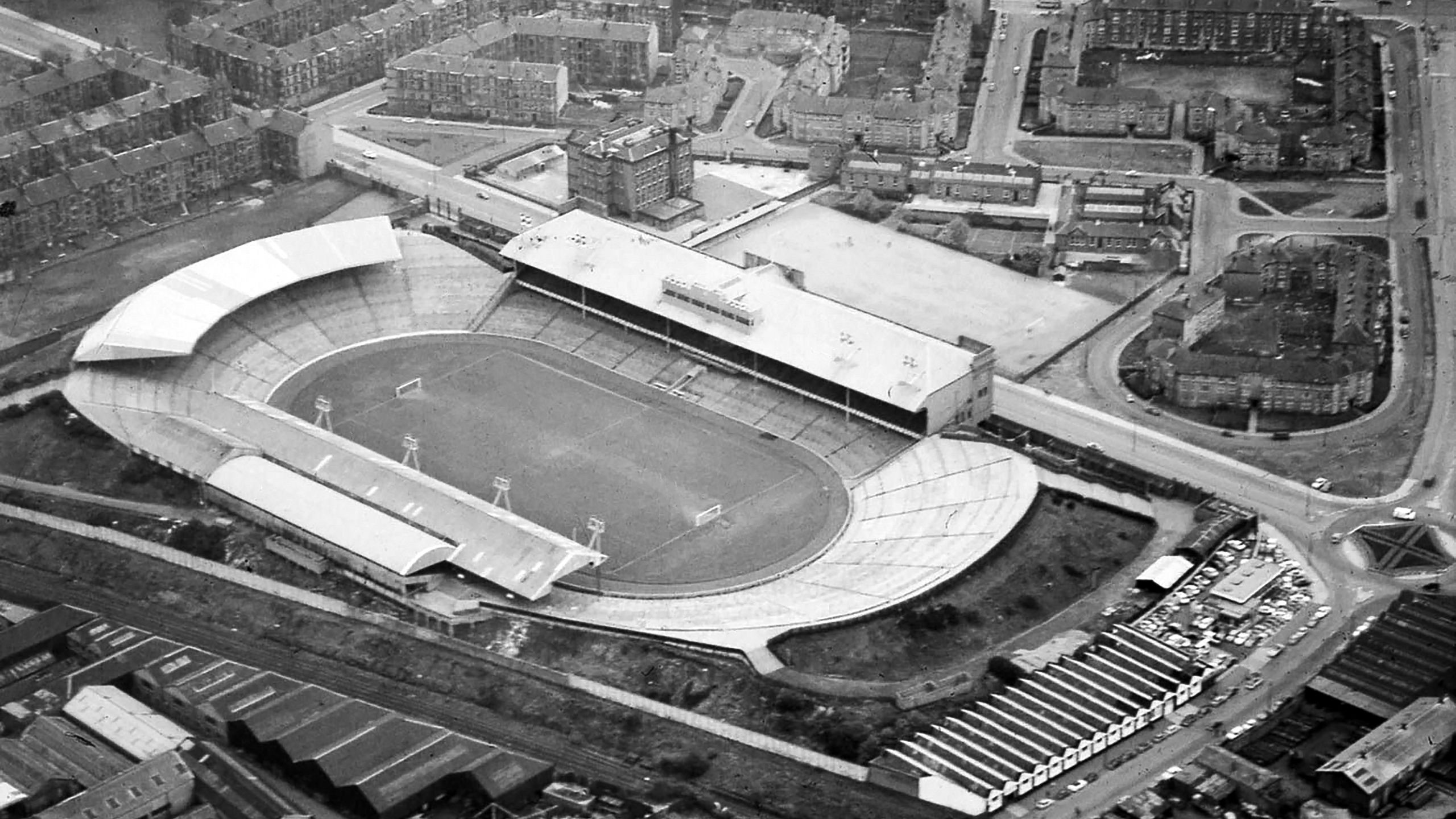
Ibrox Park, as it was named, and would have appeared, in 1971

On January 2, 1971, the teams took the pitch at Ibrox, and over 80,000 people attended. The game remained scoreless until the 90th minute, when Jimmy "Jinky" Johnstone, often regarded as Celtic's greatest player ever, scored. And so, thinking the game was sure to end in a 1-0 defeat, many of the Rangers fans got up to leave.

But in stoppage time, Colin Stein (like Celtic's manager, John "Jock" Stein, that's pronounced "STEEN," and isn't Jewish or German), scored an equalizer for Rangers. Hearing the roar of the fans who hadn't left, some of those who did turned around and tried to go back to see what had happened.

This proved fatal on Stairway 13. It is widely believed that someone tripped and fell, causing a domino effect. Bodies ended up being stacked up to 6 feet deep. Among the 66 deaths were 31 teenagers, and 5 children who were schoolmates from Fife.

The incident happened so late that the on-pitch people, including the players, and the fans still in the stands, didn't know what happened until after the game was over. The players for Celtic included 18-year-old forward Kenny Dalglish, who would become a star for the team, and later in England for Liverpool Football Club. He would be present for the Heysel Stadium Disaster of 1985, where 39 died; and the Hillsborough Stadium Disaster of 1989, which would surpass the Ibrox Disaster of 1971 as the deadliest sporting disaster in the history of the British Isles.

Rangers F.C. were sued, and, knowing the case was unwinnable, they settled. Ibrox soon underwent a renovation, including a new Stairway 13. While the Hillsborough Disaster was the catalyst for all English stadiums converting to all-seater, the Ibrox Disaster led to most Scottish stadiums doing so far sooner, and Ibrox was all-seater by 1981. Today, it seats 50,817.
A recent photo of Ibrox Stadium

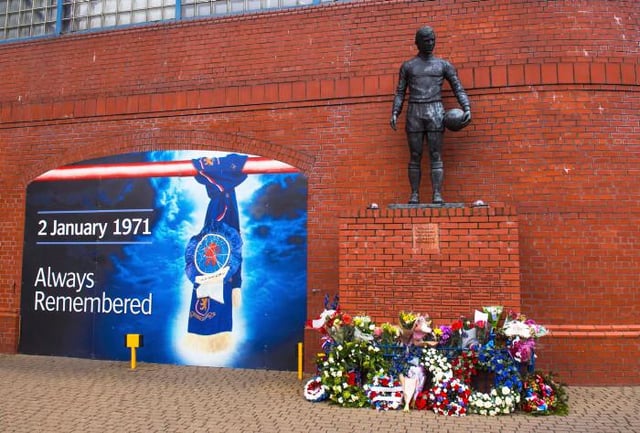
In 2001, on the 30th Anniversary of the tragedy, a monument with the names of the victims was dedicated. It includes a statue of John Grieg, their Captain in 1971, and often regarded as their greatest player ever.
In 2011, on the 40th Anniversary, Grieg and Billy McNeill, Celtic's Captain at the time (though he was injured and unavailable to play in the game in question), led the current versions of their respective teams out for a pregame ceremony.
Foreground: McNeill (left) and Grieg.
Background: 2011 Captains Scott Brown (left) and David Weir.
Celtic won the game, 2-0.

*

January 2, 1971, like most English and Scottish "football" matchdays in the pre-Premier League era, was a Saturday. Oddly, the team that ended up winning England's Football League Division One and its FA Cup, Arsenal F.C. of North London, did not play that day. Nor did they play the day before, New Year's Day, as they usually do. Indeed, no games were played in Division One that weekend.

In America, it was the off-season for Major League Baseball. No games were played in the NFL, although the Conference Championship Games were played the next day. The Baltimore Colts won the AFC Championship, beating the Oakland Raiders 27-17 at Memorial Stadium in Baltimore. And, in the last NFL game played at Kezar Stadium in San Francisco, the Dallas Cowboys won the NFC Championship by beating the San Francisco 49ers, 17-10. Two weeks later, the Colts beat the Cowboys in Super Bowl V, 16-13 at the Orange Bowl in Miami.

There were 8 games played in the NBA that day:

* The New York Knicks lost to the Atlanta Hawks, 112-108 at Madison Square Garden. Walt Frazier led all scorers with 28 points in defeat.

* The Boston Celtics beat the Philadelphia 76ers, 125-120 at The Spectrum in Philadelphia.

* The Cincinnati Royals beat the Buffalo Braves, 115-103 at the Buffalo Memorial Auditorium. The Royals moved in 1972 to become the Kansas City Kings, and moved again in 1985, to Sacramento. The Braves were a 1st-year expansion team, who became the San Diego Clippers in 1978 and the Los Angeles Clippers in 1984.

* The Baltimore Bullets beat the Detroit Pistons, 108-99 at Cobo Hall in Detroit. Dave Bing scored 33 points for the Pistons in defeat. The Bullets moved to Washington in 1973, and were renamed the Washington Wizards in 1997.

* The Milwaukee Bucks beat the Cleveland Cavaliers, 118-73 at the Milwaukee Arena. In 1974, it was renamed the Milwaukee Exposition, Convention Center and Arena, or "The MECCA." Since 2014, it has been named the UW-Panther Arena. Lew Alcindor, still a year and a half from changing his name to Kareem Abdul-Jabbar, led all scorers with 27 points.

If you don't know what happened in the NBA's 1970-71 season, reading the score will make it less of a surprise to learn that the Cavs were a 1st-year expansion team, and the Bucks went on to win the NBA Championship.

* The San Diego Rockets beat the Los Angeles Lakers, 109-108 in overtime at the San Diego Sports Arena. The Rockets moved to Houston before the next season.

* The Phoenix Suns beat the San Francisco Warriors, 122-116 in overtime at the Cow Palace in the San Francisco suburb of Daly City, California. The next season, the Warriors moved across San Francisco Bay, into the Oakland Coliseum Arena, and renamed themselves the Golden State Warriors.

* And the Chicago Bulls beat the Portland Trail Blazers, 136-113 at the Portland Memorial Coliseum. Bob Love of the Bulls led all NBA scorers on the day with 36 points.

There were 4 games played in the American Basketball Association:

* The New York Nets lost to the Carolina Cougars, 118-99 at the Greensboro Coliseum.

* The Virginia Squires beat the Pittsburgh Condors, 137-126 at the Hampton Coliseum.

* The Indiana Pacers beat the Kentucky Colonels, 134-132 at Freedom Hall in Louisville. In a losing cause, Dan Issel, who had starred at the University of Kentucky before playing for the Colonels (and later for the NBA's Denver Nuggets), scored 44, more than any other NBA or ABA player that day.

* And the Utah Stars beat the Texas Chaparrals, 134-109 at the Salt Palace in Salt Lake City. The Stars would win the ABA Championship that season, but would not be among the 4 ABA teams invited to join the NBA season. Those would be the Nets, the Pacers, the Nuggets, and the Chaparrals, who became the San Antonio Spurs in 1973.

There were 6 games played in the NHL that day:

* The New York Rangers beat the Pittsburgh Penguins, 3-1 at the Civic Arena in Pittsburgh. Jim Neilson, Arnie Brown and Pete Stemkowski scored for the Broadway Blueshirts.

* The Chicago Black Hawks beat the Philadelphia Flyers, 3-1 at The Spectrum in Philadelphia.

* The Montreal Canadiens beat the California Golden Seals, 5-3 at the Montreal Forum. Based in Oakland, the Golden Seals became the Cleveland Barons in 1976, and were merged with the Minnesota North Stars in 1978. They remain the last team in the North American "Big Four" sports leagues to close up operations.

* In the 1st game of the Saturday Hockey Night In Canada doubleheader on CBC, the Toronto Maple Leafs walloped the Detroit Red Wings, 13-0 at Maple Leaf Gardens in Toronto. Norm Ullman, Darryl Sittler, Billy MacMillan and Paul Henderson each scored 2 goals; and 1 each was scored by Mike Pelyk, Dave Keon, Garry Monahan, Brian Spencer and Jim Harrison.

* The Minnesota North Stars and the Los Angeles Kings played to a tie, 3-3 at The Forum in the Los Angeles suburb of Inglewood, California.

* And in the 2nd game of the Hockey Night In Canada doubleheader, the St. Louis Blues beat the Vancouver Canucks, 3-1 at the Pacific Coliseum in Vancouver. The 1970 expansion, including the Canucks, enabled the CBC to stage these prime-time doubleheaders: One in Eastern Canada, one in Western Canada, both starting at 7:00 PM local time.

Actors Taye Diggs and Renée Elise Goldsberry, both Broadway stars, were born on this day. 

December 31, 1999 & January 1, 2000: The Millennium

December 31, 1999:  The Millennium arrives. The people of planet Earth survived. At a terrible cost. But we hadn't destroyed ourselves. ...