
Stairway 13 after the disaster
The stadium opened in 1899, as the home of Rangers Football Club, a soccer team for the Protestant citizens of Glasgow. Their arch-rivals were Celtic Football Club, a team founded by and for Irish Catholics living in Glasgow.
These 2 teams -- Rangers, in blue shirts, like their counterparts in New York hockey and Texas baseball; and Celtic, in green and white stripes, giving them the nickname "The Hoops" -- have dominated Scottish soccer, and, together, are known as "The Old Firm."
But perhaps no 2 teams in all of sport hate each other as much, because religion is thrown into the mix. It has made both teams much bigger than they ordinarily would have been. Celtic, not the University of Notre Dame, are the most famous Catholic-themed sports team in the world. They can call upon that heritage in ways that Rangers have tried to do with the world's Protestants, but just can't.
There had previously been a disaster at Ibrox on April 5, 1902, during a British Home Championship match between Scotland and England that ended 1-1. A section of the newly built West Tribune Stand collapsed, killing 25 people and injuring about 500 others. In 1961, 2 people were killed in a crush on the narrow Stairway 13, the exit closest to Copland Road subway station. In 1967, 8 fans were injured there. In 1969, there was an incident there, injuring 26 people.
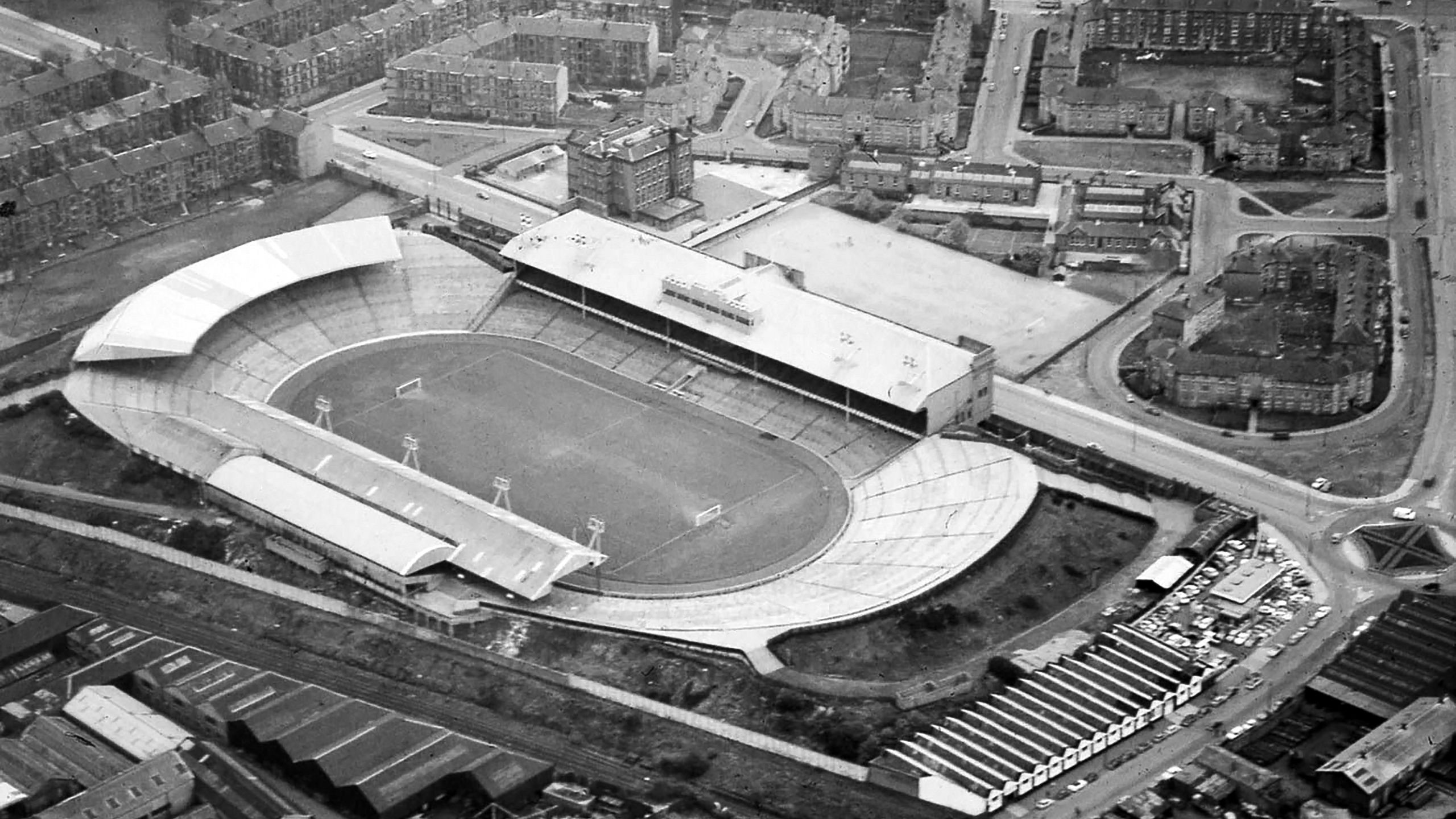
Ibrox Park, as it was named, and would have appeared, in 1971
On January 2, 1971, the teams took the pitch at Ibrox, and over 80,000 people attended. The game remained scoreless until the 90th minute, when Jimmy "Jinky" Johnstone, often regarded as Celtic's greatest player ever, scored. And so, thinking the game was sure to end in a 1-0 defeat, many of the Rangers fans got up to leave.
But in stoppage time, Colin Stein (like Celtic's manager, John "Jock" Stein, that's pronounced "STEEN," and isn't Jewish or German), scored an equalizer for Rangers. Hearing the roar of the fans who hadn't left, some of those who did turned around and tried to go back to see what had happened.
This proved fatal on Stairway 13. It is widely believed that someone tripped and fell, causing a domino effect. Bodies ended up being stacked up to 6 feet deep. Among the 66 deaths were 31 teenagers, and 5 children who were schoolmates from Fife.
The incident happened so late that the on-pitch people, including the players, and the fans still in the stands, didn't know what happened until after the game was over. The players for Celtic included 18-year-old forward Kenny Dalglish, who would become a star for the team, and later in England for Liverpool Football Club. He would be present for the Heysel Stadium Disaster of 1985, where 39 died; and the Hillsborough Stadium Disaster of 1989, which would surpass the Ibrox Disaster of 1971 as the deadliest sporting disaster in the history of the British Isles.
Rangers F.C. were sued, and, knowing the case was unwinnable, they settled. Ibrox soon underwent a renovation, including a new Stairway 13. While the Hillsborough Disaster was the catalyst for all English stadiums converting to all-seater, the Ibrox Disaster led to most Scottish stadiums doing so far sooner, and Ibrox was all-seater by 1981. Today, it seats 50,817.

A recent photo of Ibrox Stadium
In 2001, on the 30th Anniversary of the tragedy, a monument with the names of the victims was dedicated. It includes a statue of John Grieg, their Captain in 1971, and often regarded as their greatest player ever.
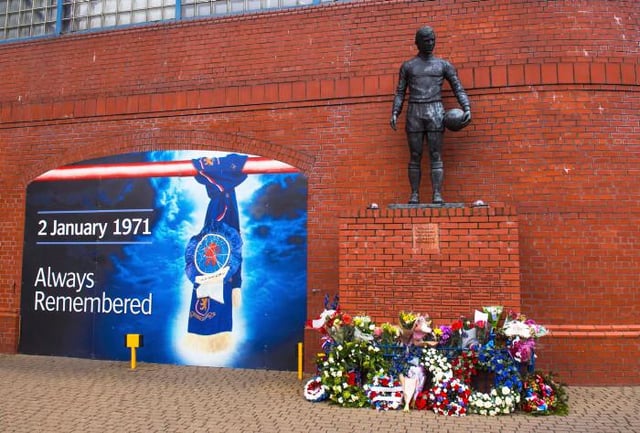
In 2011, on the 40th Anniversary, Grieg and Billy McNeill, Celtic's Captain at the time (though he was injured and unavailable to play in the game in question), led the current versions of their respective teams out for a pregame ceremony.

Foreground: McNeill (left) and Grieg.
Background: 2011 Captains Scott Brown (left) and David Weir.
Celtic won the game, 2-0.
*
January 2, 1971, like most English and Scottish "football" matchdays in the pre-Premier League era, was a Saturday. Oddly, the team that ended up winning England's Football League Division One and its FA Cup, Arsenal F.C. of North London, did not play that day. Nor did they play the day before, New Year's Day, as they usually do. Indeed, no games were played in Division One that weekend.
In America, it was the off-season for Major League Baseball. No games were played in the NFL, although the Conference Championship Games were played the next day. The Baltimore Colts won the AFC Championship, beating the Oakland Raiders 27-17 at Memorial Stadium in Baltimore. And, in the last NFL game played at Kezar Stadium in San Francisco, the Dallas Cowboys won the NFC Championship by beating the San Francisco 49ers, 17-10. Two weeks later, the Colts beat the Cowboys in Super Bowl V, 16-13 at the Orange Bowl in Miami.
There were 8 games played in the NBA that day:
* The New York Knicks lost to the Atlanta Hawks, 112-108 at Madison Square Garden. Walt Frazier led all scorers with 28 points in defeat.
* The Boston Celtics beat the Philadelphia 76ers, 125-120 at The Spectrum in Philadelphia.
* The Cincinnati Royals beat the Buffalo Braves, 115-103 at the Buffalo Memorial Auditorium. The Royals moved in 1972 to become the Kansas City Kings, and moved again in 1985, to Sacramento. The Braves were a 1st-year expansion team, who became the San Diego Clippers in 1978 and the Los Angeles Clippers in 1984.
* The Baltimore Bullets beat the Detroit Pistons, 108-99 at Cobo Hall in Detroit. Dave Bing scored 33 points for the Pistons in defeat. The Bullets moved to Washington in 1973, and were renamed the Washington Wizards in 1997.
* The Milwaukee Bucks beat the Cleveland Cavaliers, 118-73 at the Milwaukee Arena. In 1974, it was renamed the Milwaukee Exposition, Convention Center and Arena, or "The MECCA." Since 2014, it has been named the UW-Panther Arena. Lew Alcindor, still a year and a half from changing his name to Kareem Abdul-Jabbar, led all scorers with 27 points.
If you don't know what happened in the NBA's 1970-71 season, reading the score will make it less of a surprise to learn that the Cavs were a 1st-year expansion team, and the Bucks went on to win the NBA Championship.
* The San Diego Rockets beat the Los Angeles Lakers, 109-108 in overtime at the San Diego Sports Arena. The Rockets moved to Houston before the next season.
* The Phoenix Suns beat the San Francisco Warriors, 122-116 in overtime at the Cow Palace in the San Francisco suburb of Daly City, California. The next season, the Warriors moved across San Francisco Bay, into the Oakland Coliseum Arena, and renamed themselves the Golden State Warriors.
* And the Chicago Bulls beat the Portland Trail Blazers, 136-113 at the Veterans Memorial Coliseum in Portland, Oregon. Bob Love of the Bulls led all NBA scorers on the day with 36 points.
There were 4 games played in the American Basketball Association:
* The New York Nets lost to the Carolina Cougars, 118-99 at the Greensboro Coliseum.
* The Virginia Squires beat the Pittsburgh Condors, 137-126 at the Hampton Coliseum.
* The Indiana Pacers beat the Kentucky Colonels, 134-132 at Freedom Hall in Louisville. In a losing cause, Dan Issel, who had starred at the University of Kentucky before playing for the Colonels (and later for the NBA's Denver Nuggets), scored 44, more than any other NBA or ABA player that day.
* And the Utah Stars beat the Texas Chaparrals, 134-109 at the Salt Palace in Salt Lake City. The Stars would win the ABA Championship that season, but would not be among the 4 ABA teams invited to join the NBA season. Those would be the Nets, the Pacers, the Nuggets, and the Chaparrals, who became the San Antonio Spurs in 1973.
There were 6 games played in the NHL that day:
* The New York Rangers beat the Pittsburgh Penguins, 3-1 at the Civic Arena in Pittsburgh. Jim Neilson, Arnie Brown and Pete Stemkowski scored for the Broadway Blueshirts.
* The Chicago Black Hawks beat the Philadelphia Flyers, 3-1 at The Spectrum in Philadelphia.
* The Montreal Canadiens beat the California Golden Seals, 5-3 at the Montreal Forum. Based in Oakland, the Golden Seals became the Cleveland Barons in 1976, and were merged with the Minnesota North Stars in 1978. They remain the last team in the North American "Big Four" sports leagues to close up operations.
* In the 1st game of the Saturday Hockey Night In Canada doubleheader on CBC, the Toronto Maple Leafs walloped the Detroit Red Wings, 13-0 at Maple Leaf Gardens in Toronto. Norm Ullman, Darryl Sittler, Billy MacMillan and Paul Henderson each scored 2 goals; and 1 each was scored by Mike Pelyk, Dave Keon, Garry Monahan, Brian Spencer and Jim Harrison.
* The Minnesota North Stars and the Los Angeles Kings played to a tie, 3-3 at The Forum in the Los Angeles suburb of Inglewood, California.
* And in the 2nd game of the Hockey Night In Canada doubleheader, the St. Louis Blues beat the Vancouver Canucks, 3-1 at the Pacific Coliseum in Vancouver. The 1970 expansion, including the Canucks, enabled the CBC to stage these prime-time doubleheaders: One in Eastern Canada, one in Western Canada, both starting at 7:00 PM local time.
Actors Taye Diggs and Renée Elise Goldsberry, both Broadway stars, were born on this day.


No comments:
Post a Comment